Claude Code team standards: A framework for scale and security
Claude Code team standards: A practical framework for quality, security and scale
Individual productivity boosts can hide team issues like inconsistent code and expanding permissions, raising review workloads and lowering quality. Claude Code standards tackle this through shared instructions, clear access boundaries, and human governance across a 7-part framework. Rather than relying on prompts alone, this guide delivers a practical strategy for consistent engineering discipline.
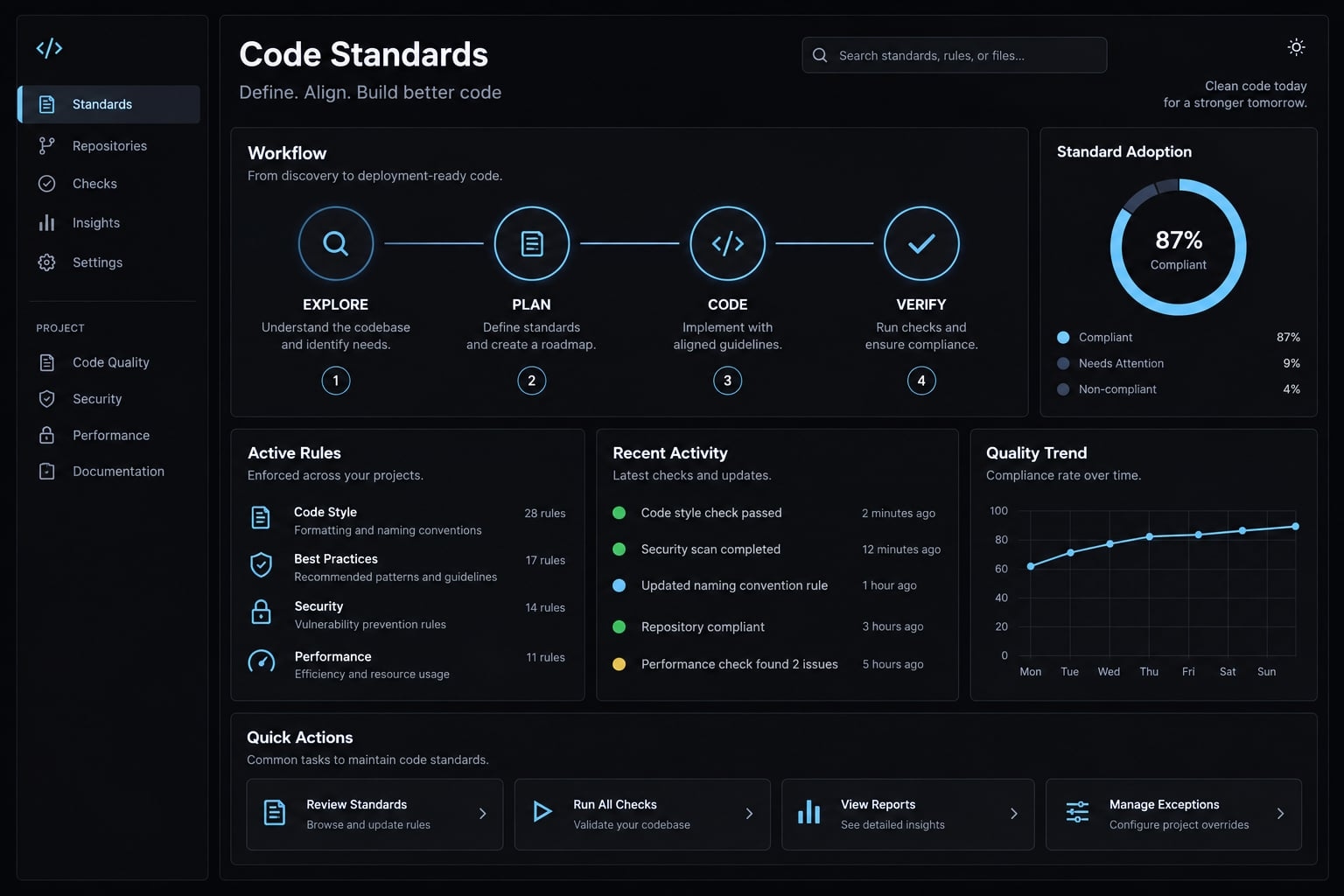
What Claude Code team standards need to accomplish
Standards ensure consistent implementations, verifiable results, controlled access, and maintainable configurations. They cover personal preferences, repository conventions, and organizational policies.
Personal preferences may shape presentation or local workflow. Shared conventions define repository expectations. Organizational controls determine permitted access and approval authority. Personal preferences must not weaken team policy; that is an organizational requirement, not a technical precedence guarantee.
Consider an illustrative team maintaining a multi-tenant SaaS application, shared packages, and infrastructure configuration. Its Claude Code development protocols need three complementary levels:
Level | Purpose | Example | Limitation |
|---|---|---|---|
Advisory | Communicate context and expectations | Document migration rollback requirements | Cannot block deployment |
Automated | Check defined conditions | Run migration compatibility tests | Cannot establish complete correctness |
Approval-gated | Authorize consequential risk | Require production migration approval | Depends on reviewer judgment and controlled bypasses |
Advisory standards
CLAUDE.md documents architecture, repository context, and expected behavior. Anthropic’s Claude Code documentation on memory describes instruction files as context, not guaranteed compliance. Guidance supports more consistent agent behavior but cannot substitute for security or release gates.
Automated standards
Formatters, type checks, tests, scans, and configured hooks evaluate explicit conditions. Deterministic checks provide repeatable evaluation under controlled inputs; they do not make model behavior deterministic. A passing migration test supports a specific compatibility claim, not universal safety.
Approval-gated standards
Migrations, production access, destructive operations, and sensitive authorization changes require additional scrutiny.
Place approval inside a controlled repository or deployment workflow. An instruction asking the agent to pause is insufficient. GitHub documentation on deployment environments explains how configured protection rules can gate deployment jobs. Effective team governance makes each level’s evidence visible.
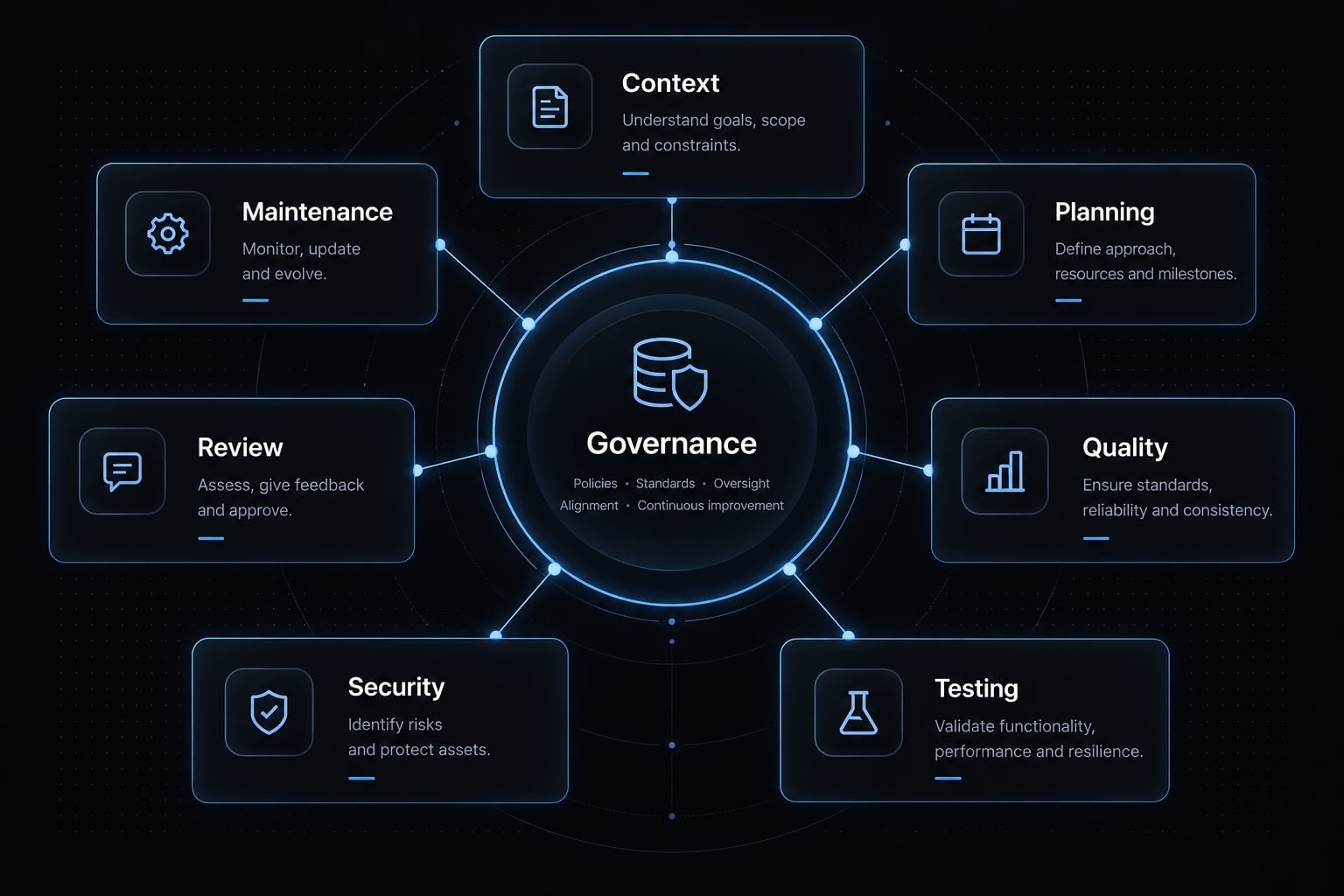
The seven-part Claude Code team standards framework
Define a minimum expectation, enforcement mechanism, and owner for each category. Increase rigor according to change risk-not merely diff size or developer seniority.
Standards category | Minimum team standard | Primary enforcement | Suggested owner |
|---|---|---|---|
Context | Document boundaries, constraints, and unusual commands | Reviewed repository instructions | Repository maintainer |
Planning | Review scope and risks for consequential changes | Approved plan and review gate | Tech lead |
Code quality | Follow coding conventions and dependency boundaries | Formatter, linter, architecture checks | Module owner |
Testing | Verify applicable behavior for the submitted revision | Required continuous integration checks | Change author and maintainer |
Security | Restrict credentials, tools, and sensitive resources | Identity controls, permissions, security checks | Security or platform owner |
Git and review | Submit scoped changes with accountable approval | Protected branches and review requirements | Repository administrator |
Maintenance | Version shared assets and reassess exceptions | Baseline inventory and scheduled review | Standards owner |
Context and instruction standards
High-signal instructions are actionable and repository-specific. They explain facts an agent cannot safely infer: Tenant boundaries, generated files, shared-package compatibility, and infrastructure ownership.
For the SaaS team, “follow existing patterns” is insufficient. “All tenant-scoped reads must use the approved authorization layer” identifies a meaningful architectural constraint.
Keep application and shared-package instructions aligned. Conflicting guidance should trigger clarification, not reliance on whichever instruction appears more prominent.
Planning and scope standards
Low-risk, localized changes may proceed directly. Cross-cutting changes, migrations, architectural decisions, and security-sensitive work need a written plan.
Record:
- Scope and excluded work.
- Dependencies and affected consumers.
- Risks and acceptance criteria.
- Applicable tests.
- Rollback considerations.
- Required approver.
The accountable tech lead approves architecture and scope; the designated security reviewer approves sensitive authorization decisions. Planning assistance does not itself establish approval.
Quality and verification standards
Match automated testing to the change. Documentation edits rarely need database integration tests. Tenant-access changes do. A one-line query modification can expose another tenant’s records. Require tests covering permitted access, rejected cross-tenant access, and relevant background processing.
Distinguish “tests were run” from “required checks passed for the submitted revision.” Later edits can invalidate earlier evidence. Continuous integration (CI) should evaluate the actual revision entering the protected workflow.
Security, Git and human accountability
Define restricted resources, protected branches, required reviewers, and escalation paths before increasing agent autonomy. GitHub documentation on protected branches and required status checks distinguishes available checks from configured merge requirements. Review those settings and their bypass permissions.
Language-model code review is supplementary. Developers remain accountable for submitted changes; maintainers remain accountable for approval. Neither a confident explanation nor an additional agent review transfers that responsibility.
How to structure CLAUDE.md for a development team
Keep shared instructions concise, reviewable, and tied to repository reality. A larger file is not necessarily a stronger standard.
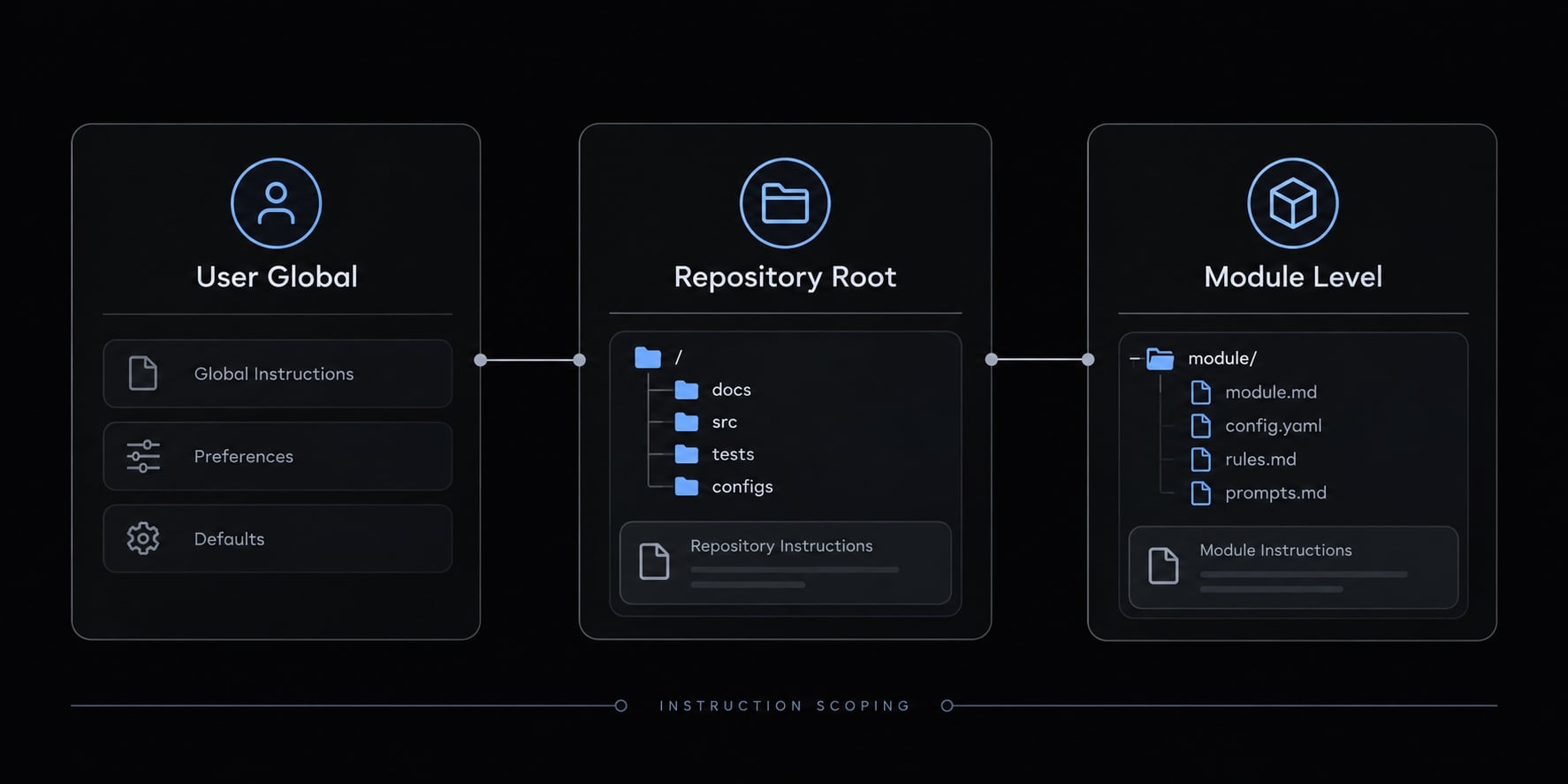
The three-tier instruction architecture
Use this simplified organizing model-not an exhaustive list of instruction sources or a complete precedence hierarchy.
Scope | Example location | Purpose |
|---|---|---|
User-global |
| Personal preferences across projects |
Project-root |
| Shared repository guidance |
Module-level |
| Scoped component guidance |
Anthropic’s memory documentation describes hierarchical discovery and scoped instruction loading. Nested guidance becomes relevant when Claude accesses that subtree. Working directory and supported instruction sources matter; do not assume a simple “last file wins” rule.
In the SaaS example, a billing instruction permitting direct database access conflicts with the root authorization boundary. Resolve the contradiction through review rather than undocumented personal configuration.
What belongs in team CLAUDE.md
Include these seven essentials:
- Project purpose and architecture.
- Non-obvious commands.
- Repository and module boundaries.
- Non-standard coding conventions.
- Required verification.
- Prohibited actions and escalation.
- Git and pull request expectations.
These describe project constraints, not a general programming curriculum. Assign a maintainer to update instructions when repository configuration changes.
What to exclude
Include | Exclude |
|---|---|
Verified commands and completion requirements | Duplicated formatter configuration |
Architecture exceptions | Generic language tutorials |
Canonical documentation references | Copied API manuals |
Stable repository expectations | Temporary sprint notes |
Credential-handling procedures | Secrets or access tokens |
Module boundaries | Exhaustive file-by-file descriptions |
Bloated files create a practical maintenance risk: outdated details can compete with current requirements. Avoid unsupported claims about a universal instruction-count limit.
Copyable CLAUDE.md starter structure
# Project Purpose[Describe the product and critical business invariants.]# Architecture[Identify services, shared packages, and ownership boundaries.]# Commands[Insert repository-verified setup, build, and test commands.]# Scope and Boundaries[Identify generated files and restricted modules.]# Coding Conventions[Document non-standard conventions and canonical references.]# Verification[Map change types to required checks and evidence.]# Security and Prohibited Actions[State restricted resources and approved escalation paths.]# Git and Pull Requests[Specify branch, review, and submission requirements.]# Ownership and Maintenance[Name the maintainer and review triggers.]
Replace every placeholder before adoption. Verify commands in the supported development environment and confirm escalation paths with their owners. Review the resulting file like any other operational configuration.
Match every rule to the correct enforcement mechanism
Map each requirement to a mechanism that can actually check or restrict it. Instructions provide context; local automation provides feedback; protected checks gate merges; access controls restrict resources. Critical requirements need protected enforcement points and controlled bypasses. Approval addresses consequential judgment that a script cannot reliably encode.
CLAUDE.md vs. Skills vs. Hooks vs. CI
Mechanism | Best use | Limitation | Example |
|---|---|---|---|
| Repository expectations | No compliance guarantee | Tenant-access boundaries |
Reusable procedures | Existence does not mandate execution | Migration preparation | |
Claude Code hooks | Configured script-based checks | Coverage depends on event, configuration, and execution path | Validate an eligible tool action |
CI/CD | Merge and release checks | Must be required with controlled bypasses | Required integration tests |
Restrict actions and resources | Boundaries depend on configuration and platform | Restricted filesystem and network access | |
Human approval | Risk judgment | Needs authority and evidence | Production migration authorization |
CI/CD means continuous integration and continuous delivery or deployment. Anthropic’s documentation distinguishes hook events, permissions, and supported sandbox behavior. Not all hook types are deterministic; Claude Code hooks cannot cover actions outside their configured execution path.
Reusable skills guide execution. Permission allowlists add restrictions, but shell-command matching alone is not a complete security boundary. Validate actual filesystem and network restrictions on supported platforms.
Rule-to-control matrix
Requirement | Documentation location | Enforcement mechanism | Approval condition |
|---|---|---|---|
Architecture boundaries | Root and module guidance | Dependency checks and code review | Boundary changes require module owner |
Code style | Contribution guide | Formatter/linter plus required CI check | Maintainer approves exceptions |
Required tests | Verification matrix | Required status for submitted revision | Controlled, documented exception only |
Security policy | Scanning and protected repository controls where available | Security review for flagged exceptions | |
Database migrations | Migration procedure | Compatibility tests and protected pipeline | Database owner approves consequential changes |
Destructive operations | Operations runbook | Restricted identities, resources, and controlled privileges | Authorized operator approves execution |
Production deployment | Release policy | Protected pipeline/environment | Authorized approval under this baseline |
Local checks provide earlier feedback. Required CI/CD checks establish protected evidence. Policy-as-code means expressing a requirement as executable configuration—for example, an architecture check rejecting forbidden package imports.
For the SaaS migration, documentation specifies compatibility and rollback requirements. Tests evaluate supported transitions. The protected deployment workflow requires authorized approval. Secret detection can detect and block identified secrets, not every possible credential. Passing checks likewise does not prove complete correctness or security.
Security and MCP governance
Model Context Protocol (MCP) connects AI applications to tools and data sources. MCP security requires reviewing the connected system, not just its configuration file.
Maintain:
- Approved server and tool inventory.
- Named owner and review date.
- Minimum required permissions.
- Read-only access where appropriate.
- Environment-separated credentials.
- Sensitive-data handling and retention review.
- Approval for production data and external writes.
- Review of untrusted output and prompt-injection exposure.
MCP security guidance treats external content as potentially untrusted. Tool output must not acquire authority to authorize unrelated actions. Use this matrix with the standards checklist before widening access.
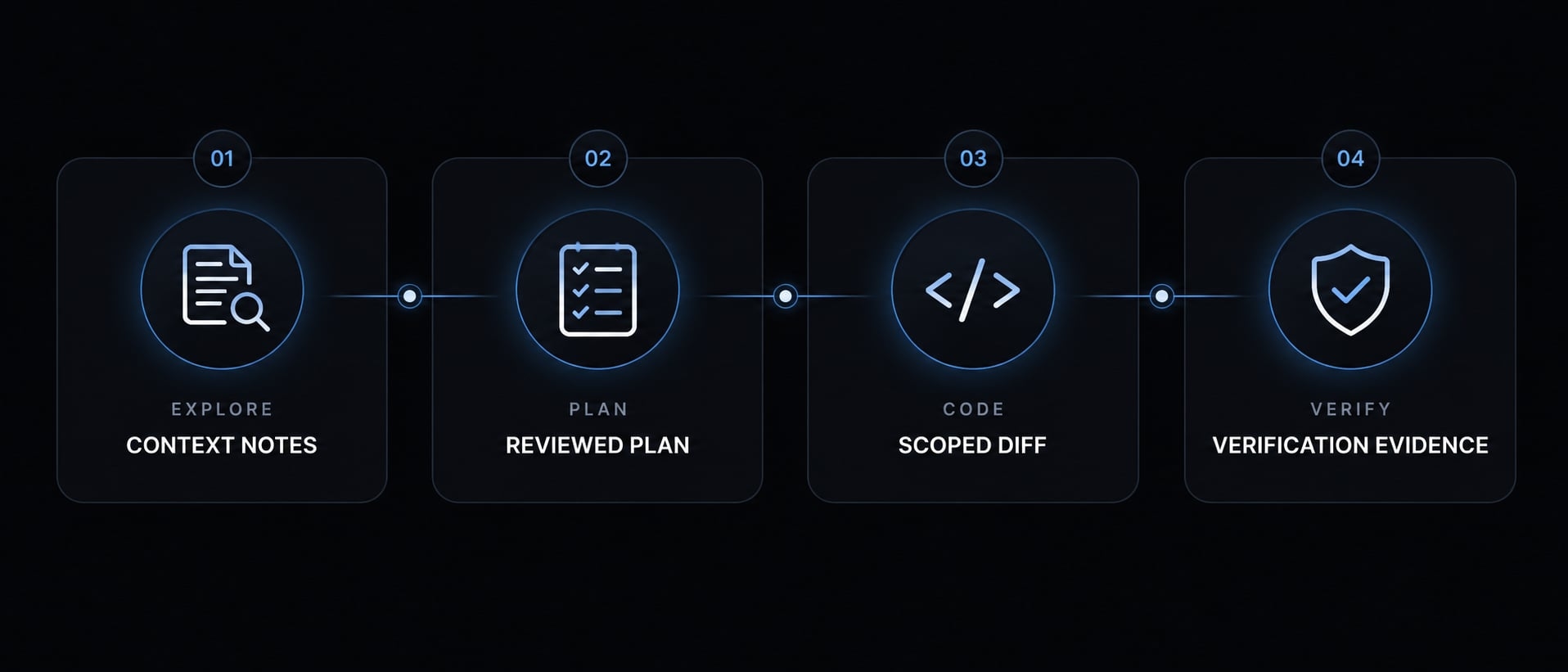
Standardize the Explore → Plan → Code → Verify workflow
- Explore: Identify relevant behavior, constraints, and existing implementation patterns.
- Plan: Define scope, risks, acceptance criteria, verification, and necessary approval.
- Code: Implement a bounded change in a coordinated working scope.
- Verify: Check the submitted revision and record evidence before requesting review.
Explore
Start with a bounded question: “Where does this endpoint establish tenant identity, and which tests cover rejected access?”. Read relevant code, tests, documentation, and recent changes. Identify established patterns before introducing abstractions. The output should explain the affected path and unresolved questions.
Plan
Record scope, dependencies, risks, acceptance criteria, tests, rollback, and approval. For the SaaS backend API change, include shared-package consumers and background jobs-not just the request handler. Optional plan mode supports investigation and planning; it is not an independently enforced approval gate. Resolve important unknowns before authorizing implementation.
Code in an isolated scope
Use dedicated branches or worktrees where appropriate. Separate branches alone do not create separate working directories. Worktree isolation separates working trees; it is not a security sandbox. Parallel tasks may still share credentials, databases, ports, caches, and other mutable resources.
Assign ownership for overlapping files and serialize incompatible changes. A scoped diff makes review easier but does not remove integration risk.
Verify before submission
Automated testing should cover the applicable acceptance criteria. Require this pull request checklist:
- Final diff reviewed.
- Applicable checks run against the submitted revision.
- Results recorded.
- Failed or skipped checks disclosed.
- Risks and rollback notes included where relevant.
- Required reviewer assigned.
A pull request stating “all tests passed” without a revision, command or job, and result is not reproducible evidence. Return it for completion.
An adversarial subagent review adds a differently focused pass, such as searching for tenant-boundary bypasses. Require findings to identify files, reasoning, and reproducible conditions. Another agent does not provide independent assurance merely by reviewing the first.
The accountable reviewer decides whether the evidence supports merging.
Roll out and maintain standards across repositories
Pilot the baseline before broad distribution. Cross-repository standards become maintainable through ownership, versioning, compatibility checks, and explicit exceptions—not copying files once.
Five-step implementation checklist
- Audit: Inventory instructions, skills, permissions, integrations, and bypass paths.
- Output: current-state inventory.
- Define: Select minimum requirements by repository risk.
- Output: approved baseline.
- Map: Assign controls, evidence, and owners.
- Output: rule-to-control matrix.
- Pilot: Test representative changes and failure cases.
- Output: findings and revisions.
- Distribute: Publish reviewed assets and migration guidance.
- Output: versioned rollout package with ownership.
Claude Code team standards checklist
Copy this audit artifact. Replace owner roles with names and select implemented, partial, missing, or not applicable for each status.
Standard or requirement | Current documentation | Enforcement mechanism | Evidence location | Named owner | Status | Exception and expiration | Next action |
|---|---|---|---|---|---|---|---|
Instructions and repository context | [Path] | Reviewed instructions | [Revision] | [Name] | [Select] | [Reason/date] | [Action] |
Planning and change scope | [Path] | Risk-based review gate | [Plan] | [Name] | [Select] | [Reason/date] | [Action] |
Quality and verification | [Path] | Required checks | [Run] | [Name] | [Select] | [Reason/date] | [Action] |
Permissions and sensitive data | [Path] | Access restrictions | [Configuration] | [Name] | [Select] | [Reason/date] | [Action] |
MCP integrations | [Inventory] | Approved access | [Review] | [Name] | [Select] | [Reason/date] | [Action] |
Git, review, and deployment | [Policy] | Protected workflows | [Settings] | [Name] | [Select] | [Reason/date] | [Action] |
Versioning, rollout, and ownership | [Baseline] | Inventory review | [Change log] | [Name] | [Select] | [Reason/date] | [Action] |
Claude Code standards maturity model
This editorial assessment framework is not an official Anthropic standard.
Level | Operating practice | Evidence | Next priority |
|---|---|---|---|
Documented | Shared expectations exist | Reviewed instructions | Protect critical checks |
Enforced | Critical requirements have gates | Required checks and approvals | Track distributed baselines |
Managed | Owners maintain versions and exceptions | Inventory and change log | Improve coverage and maintenance |
“Managed” describes operating discipline, not a product purchase.
Ownership and review cadence
Assign a standards owner. Reassess after significant tool, architecture, or policy changes. As a starting schedule, review sensitive integrations monthly and the broader baseline quarterly. Maintain a change log. Every exception needs an owner, reason, expiration, and remediation.
Ask:
- Which repositories use an outdated baseline?
- Which critical checks are optional or bypassable?
- Which MCP integrations or permissions lack a current owner?
Rollout coverage equals repositories on the approved baseline divided by all in-scope repositories. Stale configuration count counts repositories behind that baseline, excluding documented exceptions.
These measure configuration drift and adoption-not software correctness. CI pass rate alone is not code quality.
Memory harvest
A memory harvest is a team learning process, not a native enforcement feature:
- Collect recurring corrections.
- Group and validate the underlying issues.
- Technically review proposed shared rules or checks.
- Publish, version, and verify adoption.
Use skills versioning to prevent outdated migration procedures from persisting across repositories.
Common anti-patterns
Avoid unversioned copies, unrestricted access, unclear ownership, overlapping agent work, and usage-only measurement. Configuration drift is an AI governance problem when nobody owns its correction.
Operationalizing team standards with reusable Agent Kits
Manual templates are valid while maintenance remains manageable. Shared kits become useful when repeated updates, inconsistent procedures, or unclear configuration ownership create operational friction. The goal is to maintain reusable assets while retaining full ownership of your engineering decisions.
Manual standards vs. Managed AgentKits
Factor | Manual standards | Shared or managed kit |
|---|---|---|
Team coordination | Direct review can suffice | Shared procedures may reduce repeated setup |
Repository portfolio | Works for stable, distinct repositories | Useful where repositories share recurring needs |
Update frequency | Low-frequency changes remain manageable | Frequent changes can justify packaging |
Security-check maintenance | Team maintains scripts directly | Reusable checks still need review and ownership |
Drift visibility | Inventory requires deliberate upkeep | Visibility depends on actual tooling capabilities |
Customization | Maximum direct control | Local adaptations need compatibility testing |
Operating overhead | Lower setup; recurring manual updates | Added setup, learning, and upgrade work |
A small team with rapidly changing workflows may benefit sooner than a larger, stable team. Include subscription, model usage, integration review, training, and maintenance in the cost comparison.
AgentKit Engineer standards workflow
AgentKit Engineer is an optional implementation layer. Its product positioning includes specialized development subagents, reusable skills, workflows, integrations, a cross-platform CLI, and a desktop control center.
Treat the following as a recommended adoption workflow, not automatically enforced product behavior:
- Define the baseline: Approve requirements and protected controls.
- Package reusable procedures: Prepare reviewed skills and task workflows.
- Assign specialist subagents: Specify bounded responsibilities and expected evidence.
- Configure approved integrations: Limit resources and credentials.
- Pilot supported interfaces: Test the installed CLI and desktop operations your team needs.
- Review results: Approve outputs, compatibility, and ownership before rollout.
Workflow orchestration coordinates tasks; it does not establish merge authority. Local configuration management also does not prove organization-wide policy distribution.
Solution specifications
Evaluation area | Specification or decision |
|---|---|
Product and collaboration model | AgentKit Engineer; reusable assets supporting developers and coding agents |
Best fit | Teams repeatedly maintaining shared development procedures |
Relevant assets and interfaces | Skills, subagents, workflows, integrations, CLI, desktop controls; validate required operations |
Pilot approach | One representative repository and bounded change set |
Outputs requiring verification | Instructions, permissions, generated changes, check results, team-created baseline |
Evaluation metrics | Maintenance time, evidence completeness, upgrade effort, stale configurations |
Pricing verification | Check current pricing and included capabilities on agentkit.best |
Measure maintenance time consistently across comparable updates. For evidence completeness, divide sampled pull requests containing all applicable verification evidence by the sampled total. Record workload differences before drawing conclusions.
Appropriate proof of work
The following is an illustrative acceptance record, not a product screenshot, customer result, or verified implementation:
Artifact: shared tenant-access verification procedureVersion: [record tested version]Scope: application repository and shared authorization packageOwner: [named maintainer]Evidence: [reviewed instructions, test run, redacted pull request]Correction: [documented issue promoted into a maintained check]
Before adoption, request a reviewed instruction change, versioned workflow, redacted pull request, actual configuration capture, and documented correction. A dated screenshot proves only the visible configuration within its stated scope. It does not prove enforcement across repositories, successful deployment, or reduced defects.
Explore AgentKit Engineer when shared maintenance-not missing fundamentals-is the constraint.
Frequently asked questions
What are Claude Code team standards?
Using Claude Code team standards provides a framework of shared instructions, automated quality checks, access boundaries, and review requirements designed to ensure consistent agent behavior. They transform individual prompt workflows into repeatable, verifiable engineering processes that maintain code quality and system security.
How do we structure CLAUDE.md for our engineering team?
Structure your CLAUDE.md using a three-tier hierarchy: global settings, project-root team policies, and module-specific architectural constraints. Keep instructions concise, focus on high-signal project requirements, and avoid duplicating information that the model can already interpret from the codebase structure.
What enforcement mechanisms are most effective for team standards?
Effective enforcement uses a layered approach: CLAUDE.md for guidance, deterministic script-based hooks for local verification, CI/CD pipelines for mandatory merge gates, and restricted permissions for sensitive infrastructure access. Always pair agent instructions with concrete, automated checks that validate defined outcomes.
How should a team manage the "Explore, Plan, Code, Verify" workflow?
Standardize the workflow by requiring a clearly defined plan before execution, enforcing worktree isolation for parallel tasks, and mandating that every submission includes verifiable evidence (such as passing test logs) for the submitted diff. Accountable human review remains essential for all production-ready changes.
What is a "Memory Harvest" in the context of Claude Code?
Memory Harvest is a team-level process where developers export local auto-memory logs to identify recurring issues. Tech leads cluster these friction points to promote validated fixes into shared instructions or automated linter rules, effectively turning individual troubleshooting into permanent organizational knowledge.
Are reusable agent kits necessary for standardizing development?
Reusable agent kits are recommended when teams face high maintenance overhead, inconsistent configuration, or frequent workflow shifts. While manual templates work for small or stable projects, agent kits provide centralized configuration management and versioning when you need to distribute standards across multiple repositories at scale.
Read more:
- Claude Code toolkit: Scale your AI development workflow easily
- Mastering the Claude Code workflow for reliable AI development
- Claude Code plugin security: A guide to safe AI development
Conclusion
Claude Code team standards succeed when expectations connect to observable controls. Focus on a clear baseline, concise instructions, reusable workflows, and strict approval limits. Always rely on verifiable evidence rather than trusting AI outputs alone. Start with one high-risk repository, use the provided checklist to fix gaps, and keep human oversight central to maintain long-term code quality.