Vibe code SaaS: What AI-built apps change and what they still don’t replace
"Vibe coding" lets founders build apps in days, but fast software doesn't equal an easy SaaS business. The true test is prototype versus production. A vibe-coded app validates ideas, but real SaaS requires security, billing, and operational trust. Here’s what vibe coding actually means for SaaS economics, how to spot a production-ready product, and when to build, buy, or blend the two.
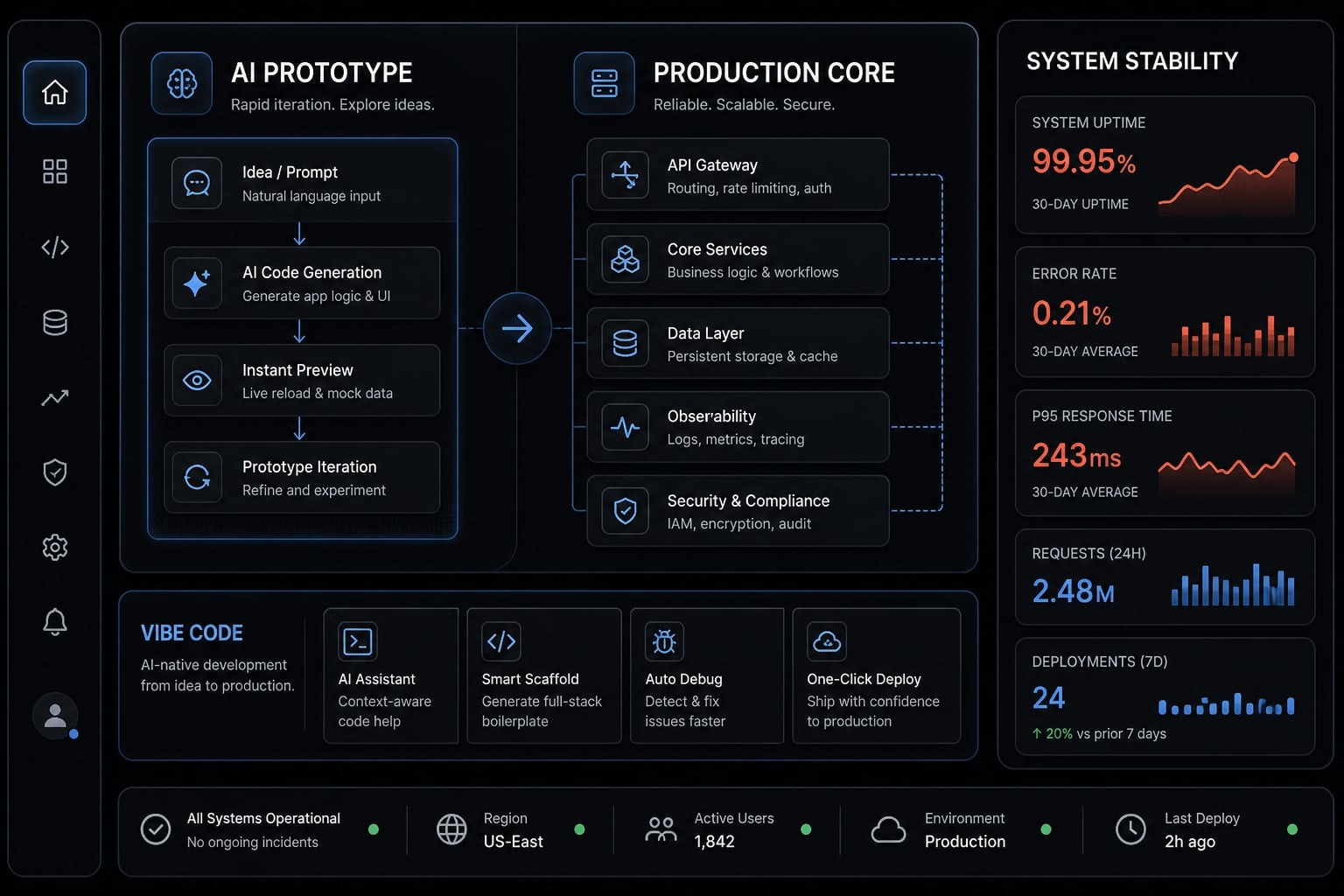
What “vibe code SaaS” actually means
Vibe code SaaS is a SaaS concept or product created through prompt-led, AI-assisted software building, where speed of output is prioritized early. The term often describes fast app generation, but it is frequently confused with running a real SaaS business, which requires reliability, billing, support, security, and maintainable workflows.
In simple terms, vibe code SaaS usually refers to founders or small teams using tools like Claude Code, Codex, or similar systems to describe what they want in plain English and get working software quickly. That can be useful. It can also be misleading if “working app” is treated as the same thing as a viable SaaS operation.
In practice, many founders discover that the first version feels impressive because the interface exists, core flows run, and deployment appears easy. What they usually discover after launch is that software generation and SaaS operation are different jobs.
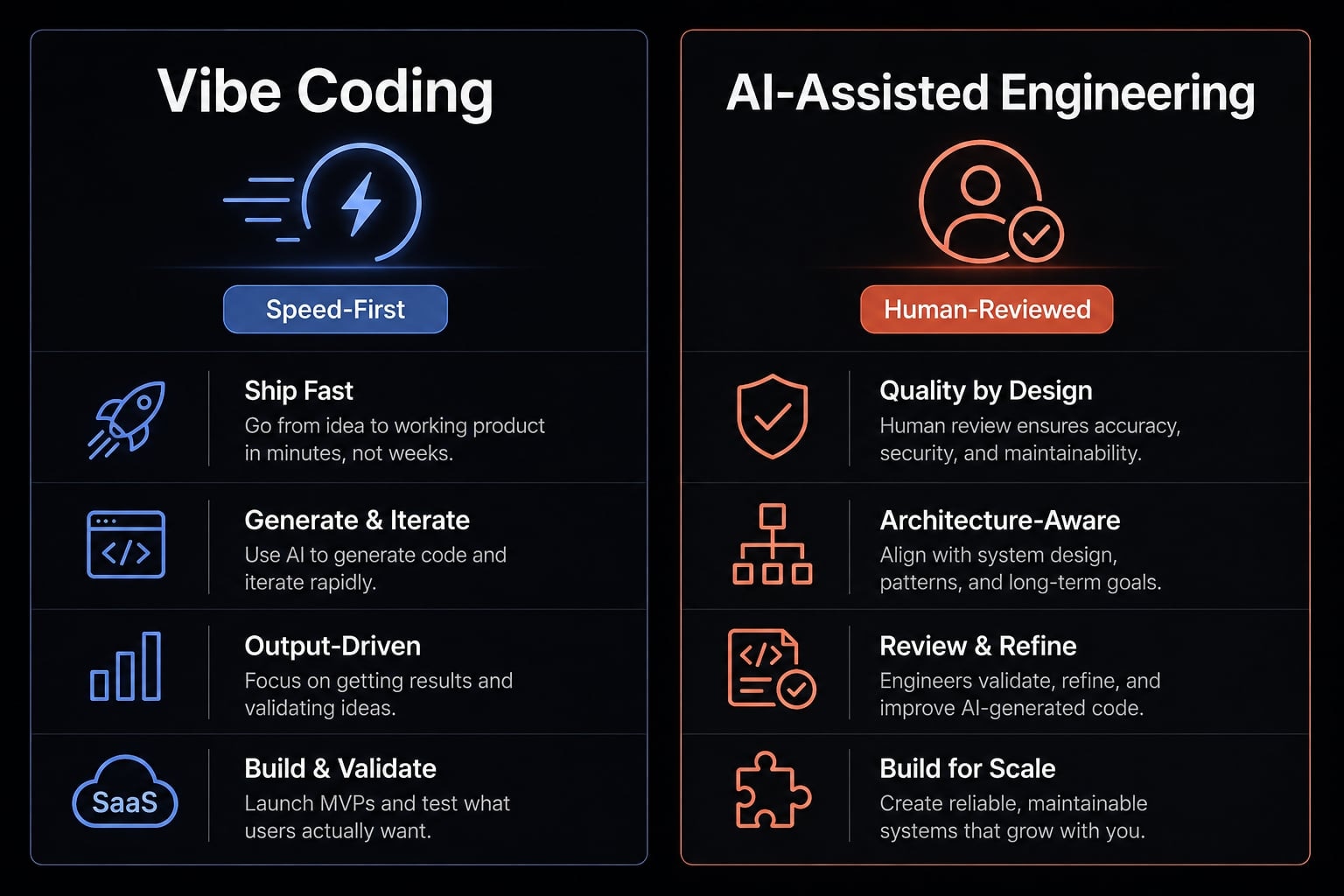
Vibe coding vs. AI-assisted engineering
Both approaches use AI. They simply optimize for different outcomes.
- Speed-first.
- Prompt-heavy.
- Output-driven.
- Useful for early momentum and rough validation.
- Often weak on maintainability and ownership.
AI-assisted software engineering:
- Human-reviewed.
- Architecture-aware.
- Maintainability-conscious.
- Better for production decisions.
- More suitable for long-term code and workflow ownership.
A useful way to think about this is the prompt-to-product workflow. If prompts are used mainly to get something visible on screen, that is usually vibe coding. If AI is used inside a reviewable system with version control, testing habits, documented decisions, and repeatable handoffs, that looks much closer to AI-assisted software engineering.
Why the definition matters in SaaS
The definition matters because SaaS is not just an app on a URL. A real SaaS business includes:
- Onboarding.
- Recurring billing.
- Account recovery.
- Workflow changes over time.
- Support operations.
- Retention mechanics.
- Product behavior under real customer usage.
A founder can generate an AI-built SaaS prototype quickly. A dependable operating model cannot be improvised carelessly. That is why the phrase “vibe-coded SaaS” is useful only if we keep the boundary clear between software output and business readiness.
Will vibe coding replace SaaS? The short answer is no but it will change SaaS economics
No. Vibe coding will not replace SaaS, and it is not a complete answer to the question “is vibe coding replacing traditional saas development models.” What it will do is reduce the cost and time required to build many types of software, especially early-stage products and narrow workflow tools. That changes competition. It does not remove the need for trust, retention, and operational quality.
The first thing AI changes is surface-level product creation. The deeper challenge is still turning software into something users rely on consistently. That is where SaaS scalability, business logic, and operating discipline still matter.
What gets commoditized first
AI lowers the barrier to creating functional software in categories where the logic is relatively standard:
- Simple CRUD apps.
- Basic dashboards.
- Internal tools.
- Thin wrappers around APIs.
- Narrow utility software.
This is where AI agents and coding tools create the most visible shift. If a product’s main value is just assembling standard components faster, the barrier to entry is weaker than it was two years ago.
What remains hard to replace
The hard part of SaaS has always lived beyond the first demo:
- Reliability under live usage.
- Complex workflow integrations.
- Governance, compliance, and trust.
- Evolving product logic.
- Support operations.
- Retention mechanics.
- Scalable operational discipline.
A common failure pattern is assuming that if AI can recreate the visible features, it can recreate the actual business. It usually cannot. The hidden problem is rarely code generation itself. It is handling the edge cases, permission rules, user exceptions, payment failures, support tickets, and product decisions that emerge only after real usage.
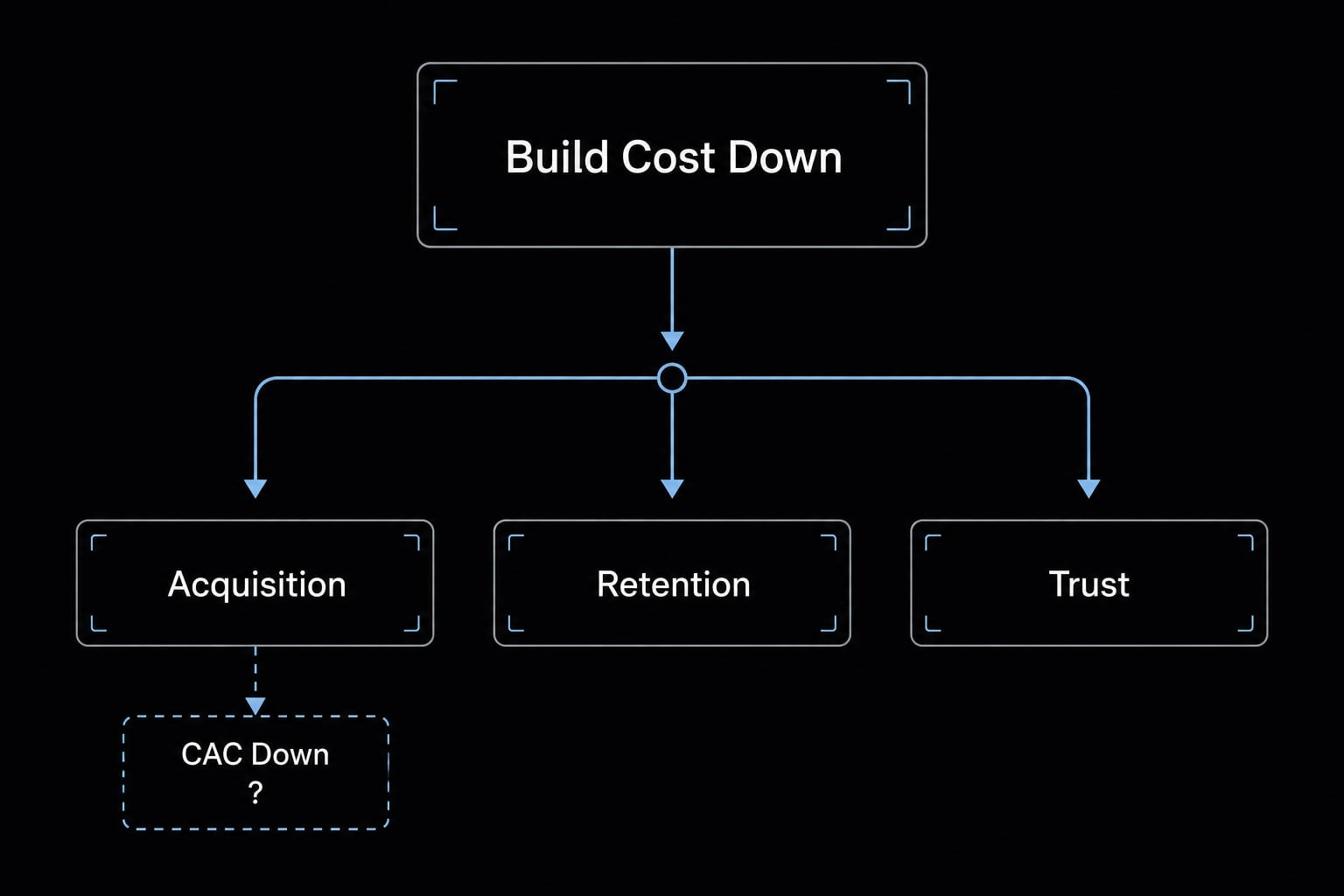
Lower build cost can reduce time-to-market, but it can also make it easier for competitors to produce similar products, which compresses differentiation.
That matters commercially. Customer Acquisition Cost (CAC) does not fall just because code becomes cheaper. You still need positioning, trust, distribution, onboarding, and retention. In some markets, cheaper building may actually increase noise, making it harder - not easier - to stand out.
The takeaway is simple: Code is getting cheaper; durable advantage is not. Sustainable SaaS still depends on product-market fit, service quality, trust, and the ability to keep improving the product under real customer pressure.
Prototype vs. real SaaS: The decision framework most founders need
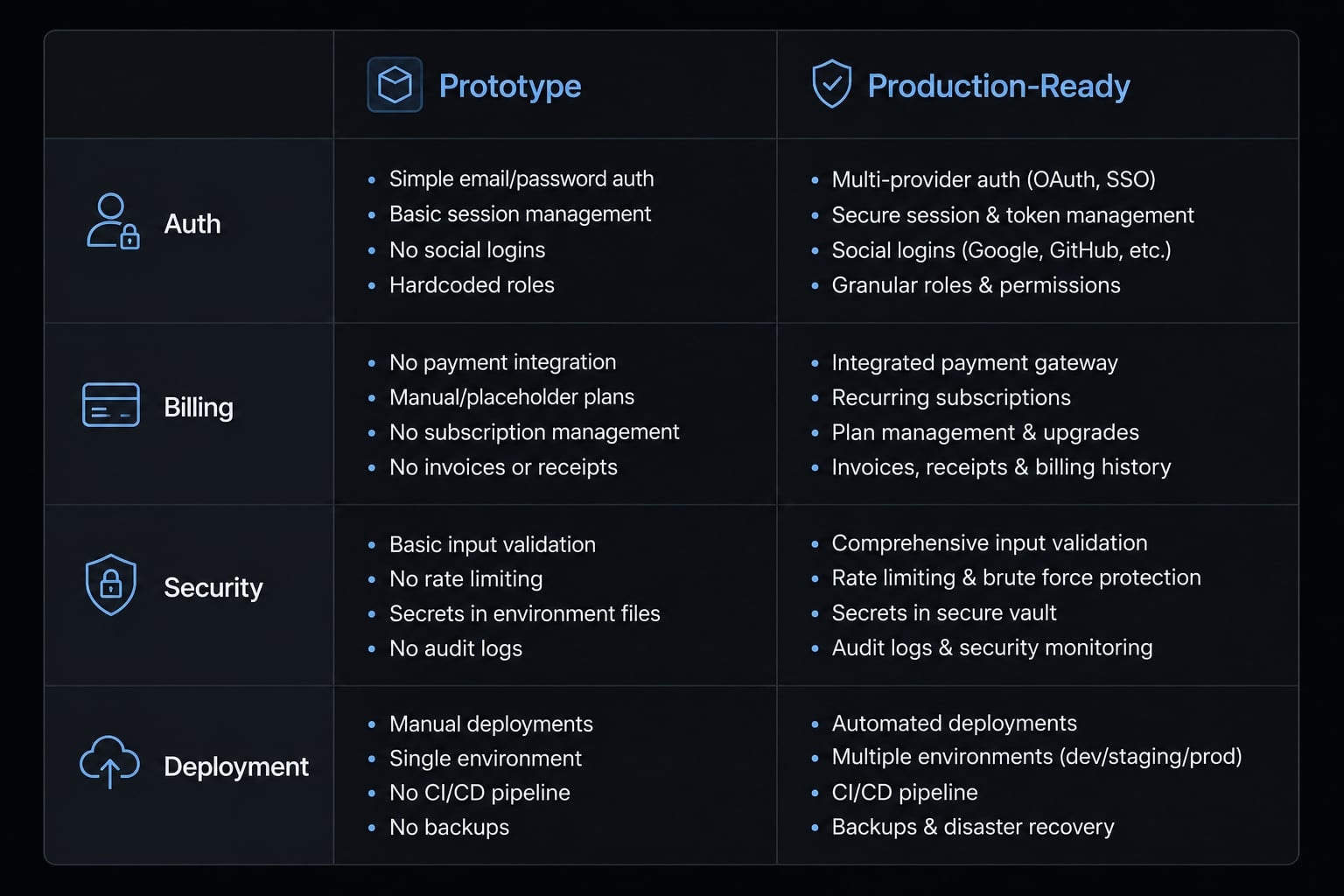
A prototype is not the same as a production-ready SaaS. The difference is not cosmetic. It sits in the layers users rarely praise directly but punish immediately when they fail: Access control, payment handling, error recovery, supportability, and release safety.
A simple way to assess your app is to ask: “Does it work independently?” or more importantly, “Can users rely on it without my constant intervention?
Category | Production-ready SaaS | |
|---|---|---|
Authentication | Basic or missing | Secure auth, role control, session handling |
Billing | Often absent | Recurring billing, failed-payment flows, invoicing |
Database | Functional but fragile | Rules, backups, migration discipline |
Error Handling | Manual testing only | Logging, alerts, reproducible debugging |
Deployment | One-click publish | Environment control, rollback path |
Analytics | Minimal | Product analytics, funnel tracking |
Support | Not considered | Onboarding, issue triage, help flows |
Maintainability | Prompt-dependent | Documented workflows, code ownership |
Security | Surface-level | Secrets management, permission boundaries |
This table is where many founder assumptions get corrected. An app may look complete and still be far from production-ready code. In practice, the trust burden shows up after launch, not before. Early users trigger forgotten states, edge behaviors, broken billing cases, and support questions the original prompts never accounted for.
The hidden cost is not code generation
AI dramatically accelerates the first 80% of a build. The final 20% is where most of the business risk lives:
- Edge cases.
- Recovery paths.
- Permissions.
- Billing logic.
- Supportability.
- Release safety.
- Technical debt management (the discipline of preventing fast decisions from becoming long-term maintenance pain).
This is why teams often feel falsely ahead. The interface exists. The flow mostly works. But the product is not yet supportable at scale. The hidden cost is not typing less code. It is preparing the app to survive repeated use, unexpected behavior, and future change.
This is also where production-ready AI-built apps separate themselves from demos. A dependable deployment pipeline (the process used to release updates safely) matters because every release creates risk once users depend on the product. Good authentication and security protocols matter because a product can lose trust faster than it gains users.
Common failure modes in vibe-coded apps
What teams usually discover after launch is surprisingly consistent.
- Contextual drift across sessions.
- Weak database permissions.
- Hard-to-debug logic chains.
- Missing rollback discipline.
- Undocumented architecture.
- Prompt history that cannot function as team documentation.
These failure modes are not theoretical. They are the normal outcome of fast building without operational controls. A prototype survives with founder memory. A real SaaS needs systems that survive team growth, user growth, and product change.
A practical audit question for any founder is this: If the original builder disappeared for two weeks, could the team still diagnose issues, release fixes, and support users confidently? If the answer is no, the product is still prototype-adjacent.
Contextual resource
If your team is evaluating whether an internal app or MVP is truly production-ready, use a simple readiness checklist before adding more features. That usually prevents more waste than another round of prompting.
The 7 building blocks of a real AI-built SaaS app
Most essential integrations for production-ready AI-built apps are not about polish. They are about trust, revenue protection, and maintainability. A real SaaS product needs operational layers around the generated code, not just a working interface. Below is the practical checklist most founders should use before treating an AI-built app as a real product.
1. Authentication and access control
Logging in is not enough. Users need secure account creation, recovery, session protection, and role boundaries. If users cannot trust who can access what, the product is not production-ready.
This matters most when different user types exist, when data is sensitive, or when teams share workspaces. Weak access control creates support issues and trust issues at the same time.
2. Billing and subscription logic
Subscription billing is more than connecting Stripe. It includes failed payments, upgrades, downgrades, cancellations, refunds, invoices, and plan enforcement. Billing is part of product trust, not just a payment feature.
A founder may get the first charge working quickly. The harder part is handling all the states around that charge without confusing users or leaking revenue.
3. Database structure and permissions
A clean interface can hide a weak data foundation. Supabase is a strong example platform, but the platform itself is not the issue. The issue is whether the data model and database permissions are designed safely.
A product that stores data poorly will eventually break trust, even if the interface feels polished. Weak permission rules are one of the most common post-launch risks in fast-built apps.
4. Email and lifecycle communication
SaaS apps need verification emails, password reset messages, onboarding sequences, receipts, and transactional alerts. When user communication breaks, support burden rises fast.
This layer often gets ignored in prototypes because the founder can manually explain things. That stops working immediately once real users arrive.
5. Analytics and observability
Use PostHog for product analytics if it fits your stack, and Sentry for error logging if you need structured debugging visibility. The exact tools can vary, but the capability cannot be skipped.
You cannot manage what you cannot observe. If the team cannot see behavior, drop-offs, or failures, it cannot improve the product responsibly.
6. Deployment and rollback discipline
Platforms like Vercel make shipping easier, which is valuable early. But once users depend on the app, the ability to release safely matters more than speed alone.
Release speed matters less than release control once trust is at stake. A good deployment pipeline should support environment control, staged releases, and rollback paths when updates fail.
7. Workflow repeatability and documentation
This is the building block many teams underestimate. Prompt-led development feels efficient until no one remembers why a workflow was implemented a certain way.
A system that only works when one person is present is not a dependable SaaS operation. Reusable workflows matter because they reduce dependence on memory, scattered prompt histories, and individual improvisation. This is where maintainability becomes a business issue, not just a technical one.
Contextual resource
If you are turning an MVP into a customer-facing product, map these seven layers before expanding features. Teams usually find that missing operational layers create more churn than missing feature depth.
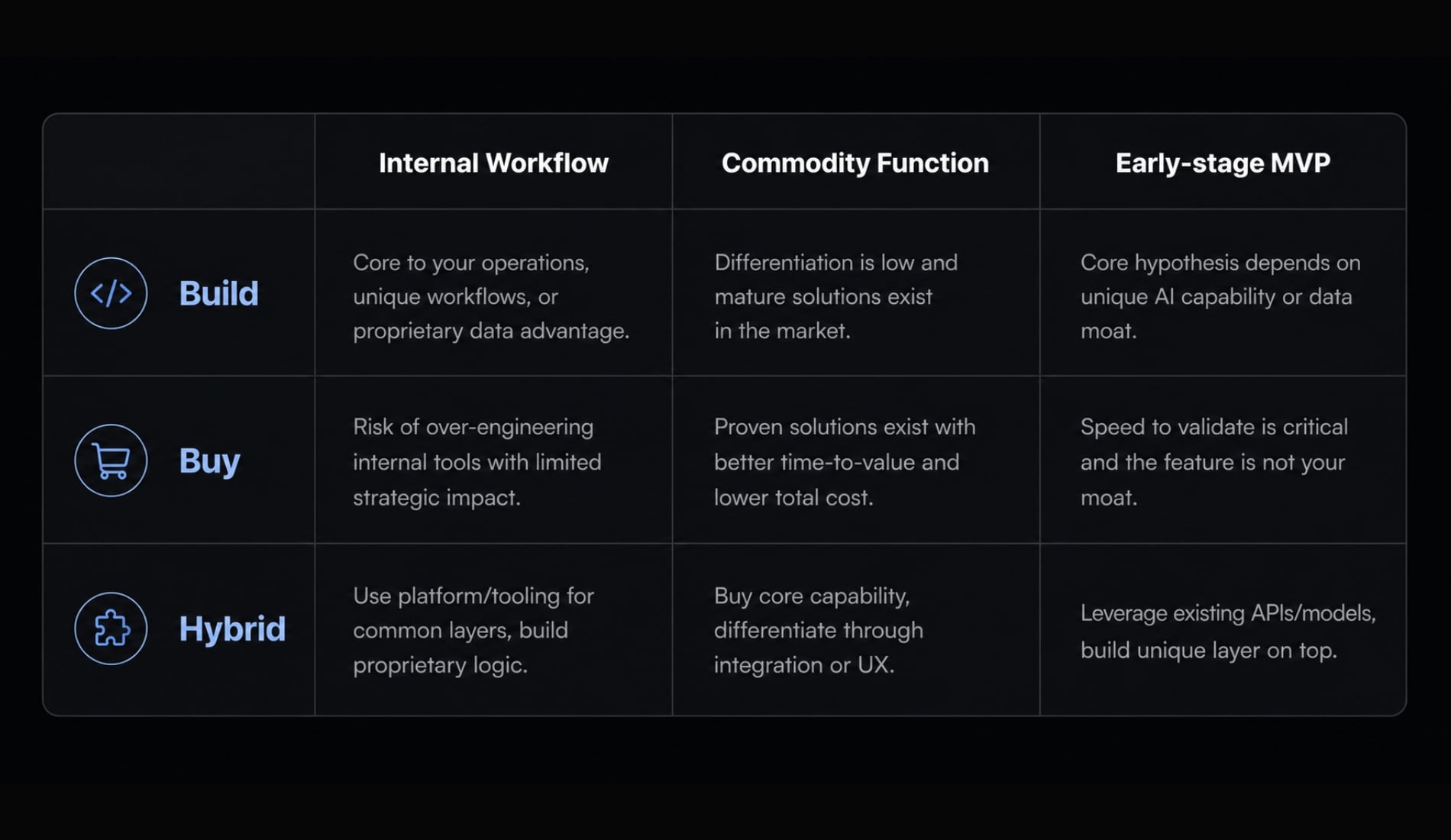
Build vs. Buy vs. Hybrid: How to decide in the age of vibe coding
The buy vs build dilemma in AI era is more important now because cheap software generation encourages overbuilding. The fact that something can be built quickly does not mean it should be built.
The right decision depends on strategic value, urgency, compliance burden, maintenance capacity, and how much oversight your team can provide. A sound cost-benefit analysis of AI-assisted vs. agency-led software development should include not just code cost, but focus cost.
Scenario | Best choice | Why |
|---|---|---|
Internal workflow with unique process logic | Build with AI assistance | Fast, low-cost, tailored to operations |
Commodity function like CRM/email/helpdesk | Buy SaaS | Reinventing adds little strategic value |
Early-stage MVP with low compliance risk | Hybrid | Launch fast, validate, harden later |
Customer-facing product with billing and sensitive data | Hybrid or disciplined build | Needs more control, testing, and rigor |
Team lacks technical oversight entirely | Buy or structured implementation support | Raw prompting raises operational risk |
When vibe coding is a strong fit
There are clear cases where iterative development with AI is a smart move:
- Rapid MVPs.
- Internal tools.
- Narrow workflow products.
- Founder-led experimentation.
- Low-compliance environments.
This is especially true when the goal is to learn quickly, remove manual work, or test demand before investing heavily in formal product engineering.
When buying existing SaaS is smarter
In many situations, buying is simply the better business decision:
- Mature categories.
- Commodity functions.
- High compliance burden.
- Limited maintenance capacity.
- Weak internal product oversight.
Building commodity software may reduce subscription spend, but it also consumes strategic attention that could be used to improve the core product.
That opportunity cost is often underestimated. Founders save license fees, then lose momentum maintaining tools that never created differentiation in the first place.
Why hybrid paths often win
A hybrid approach is often the most rational. Use AI to accelerate the differentiated layer. Buy proven infrastructure where trust and reliability already exist. Then apply AI-native product engineering only where ownership creates real strategic value.
This usually means building the unique workflow, while buying the commodity layer underneath it. It is a more disciplined response than either “build everything” or “buy everything.”
Where structured AI workflows create an advantage over Ad-Hoc prompting
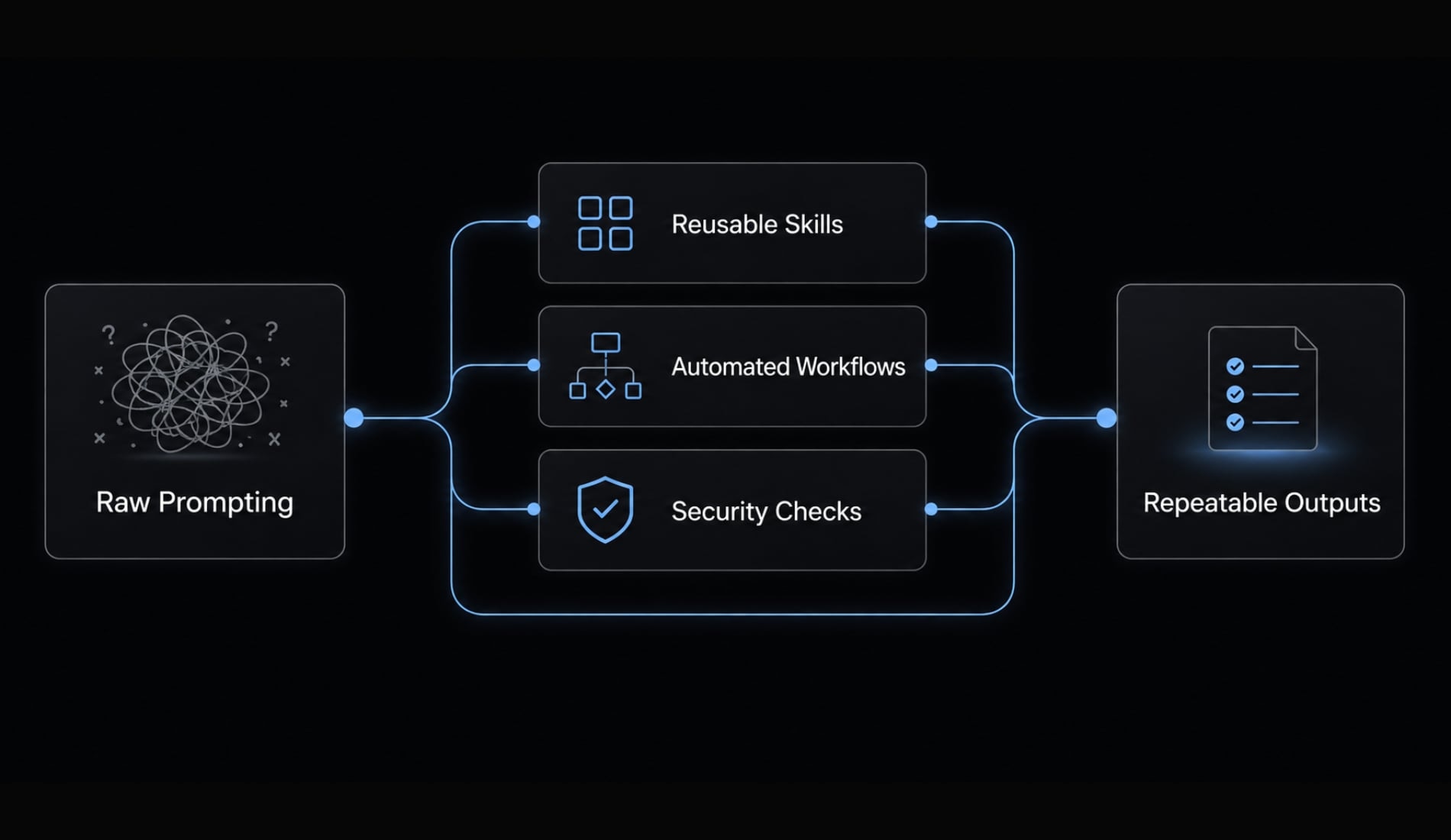
There is a missing middle between raw prompting and mature engineering. That middle is workflow discipline.
Ad-hoc prompting works for solo experimentation. It scales poorly across people, sessions, and tools. A common failure pattern is that one person knows how to get good output, but the team cannot reproduce it consistently. That creates handoff friction, quality variation, and governance risk.
What structured workflows solve
Structured workflows reduce the chaos that appears when AI use becomes operational.
- Less repetition.
- More consistent outputs.
- Cleaner handoffs.
- Lower prompt dependency.
- Better control over recurring tasks.
This matters for teams using Claude Code / Codex / GitHub Copilot because the issue eventually stops being “Can the AI generate this?” and becomes “Can the team reproduce this process safely and predictably?”
Why this matters operationally
Once AI-assisted building expands, teams need a layer of reusable skills, automated workflows, and security checks around repeated tasks. That structure improves review quality and reduces dependence on one person’s prompt memory.
This is where platforms like AgentKit become relevant-not as hype, but as a category of workflow tooling that helps teams turn isolated AI actions into repeatable operating systems. For teams already using coding agents, the real leverage often comes from consistency and control, not just more prompting.
Practical example: Turning a vibe-coded app into something users can trust
Consider a founder who builds a niche client-reporting app in a week using AI. The first version looks strong. Early users like the concept. Then production reality starts showing up.
A few users cannot recover accounts reliably. Team permissions are too loose. Subscription billing works for the initial checkout but breaks on plan changes. Bugs appear only in certain usage patterns, and there is no structured error logging to explain them. Updates go live fast, but the team has no safe deployment pipeline if something breaks.
The next phase is not a rebuild. It is productionization.
The founder adds stronger authentication rules, tighter access control, recurring billing logic, product analytics, error logging, and staged releases. The result is not perfect, but it is now more production-ready, easier to support, and better positioned for SaaS scalability.
That is what real progress usually looks like. Not a miracle transformation. A shift from “it works on demo day” to “users can depend on it with less founder rescue.”
Frequently asked questions
What is "vibe code SaaS"?
"Vibe code SaaS" refers to software-as-a-service applications built primarily through prompt-led, AI-assisted development. It prioritizes speed and momentum over traditional manual coding. While it effectively generates functional prototypes, it often requires additional operational rigor to become a reliable, production-ready business.
Will vibe coding replace traditional SaaS business models?
No. Vibe coding can accelerate the creation of simple apps, but it does not replace the core requirements of a SaaS business, such as retention, customer support, and complex workflow management. It changes the economics of building but does not lower the difficulty of running a sustainable business.
How do I know if my AI-built app is a prototype or production-ready?
A prototype focuses on basic functionality, while a production-ready SaaS includes essential layers: secure authentication, recurring billing, error logging, database permission management, and a controlled deployment pipeline. If your app lacks these operational guardrails, it is likely still in the prototype phase.
What are the core building blocks of a real SaaS app?
Every production-ready SaaS requires seven foundational elements: secure authentication, subscription billing logic, robust database permissions, email/lifecycle communication, product analytics, error observability, and a disciplined deployment pipeline. These components transform a "vibe-coded" demo into a dependable product that users can trust.
Is it better to build with AI or buy existing SaaS solutions?
It depends on your strategic goals. Build with AI-assisted workflows if you have a unique process, require speed, or are building internal tools. Buy existing SaaS solutions for commodity functions like CRM or helpdesk management, where reinventing the wheel provides little strategic advantage or differentiation.
How can teams scale AI-assisted development without "prompt chaos"?
Teams scale effectively by moving from ad-hoc prompting to structured AI workflows. This involves using reusable skills, standardized operational procedures, and integrated review steps (such as security checks). Structured workflows ensure that AI output remains consistent, maintainable, and aligned with team-wide production standards.
Read more:
- Vibe code marketplace: Defining AI-driven development & risks
- Vibe coding product spec: Build faster with AI clarity
- Is vibe coding bad? Pros, cons and responsible AI practices
Conclusion
Vibe code SaaS is real as a speed advantage. It is useful for experimentation, prototypes, internal tools, and early product validation. But a shipped app is not the same thing as a production-ready SaaS business.
The real work begins where user trust begins: Authentication, billing, permissions, observability, deployment control, and repeatable workflows. That is why the smartest teams treat AI-assisted building as an accelerator, not a substitute for operating discipline. In many cases, the best decision is not pure building. It is a deliberate mix of build, buy, and structured productionization.
If you want a practical next step, review your app against a production-readiness checklist or explore a structured AI workflow resource before adding more features. That usually reveals the real bottleneck faster than another prompt.