Vibe code marketplace: Defining AI-driven development & risks
Vibe Code marketplace: What it means, what it can build, and where the risks start
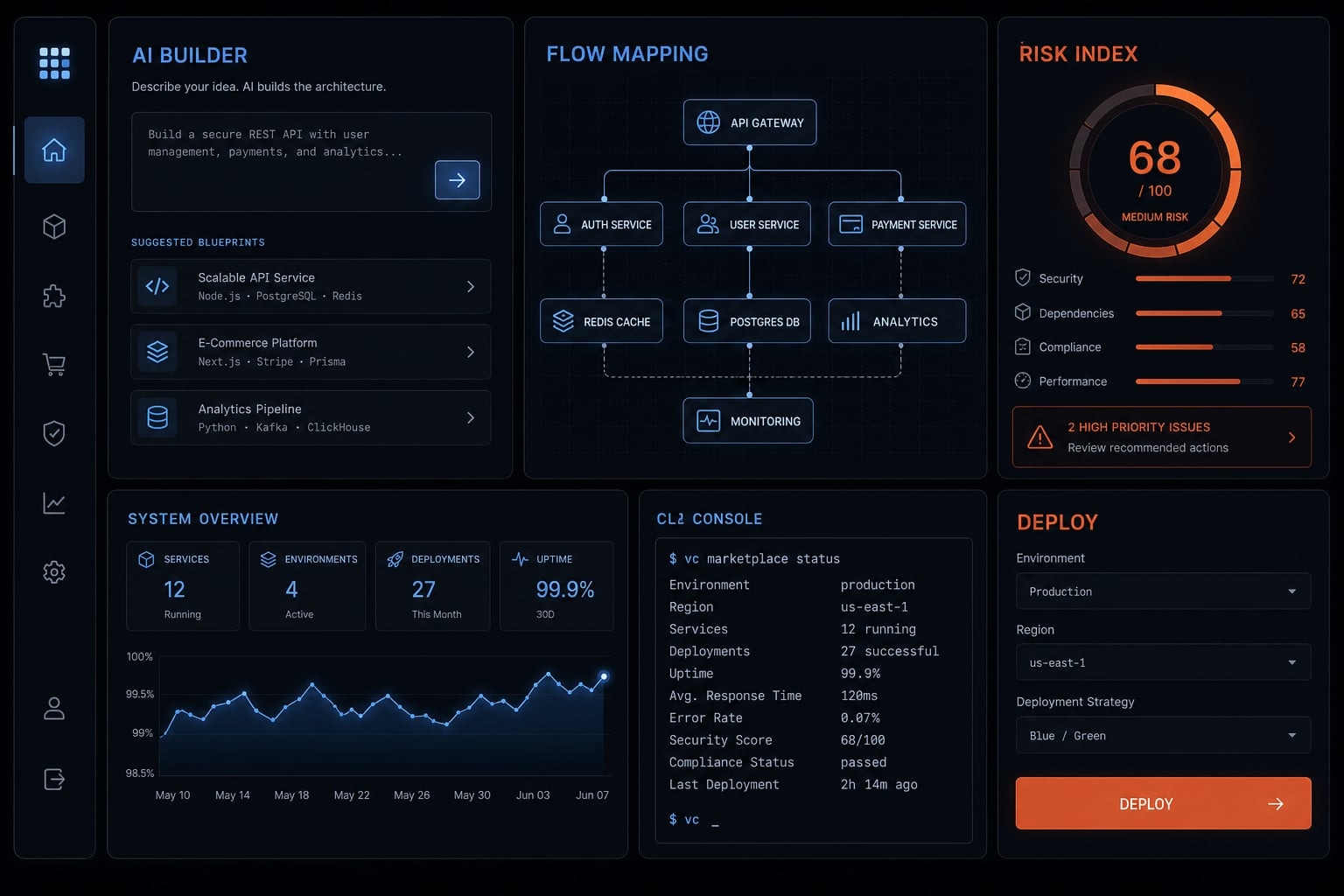
A "vibe code marketplace" usually means one of two things: building a marketplace using AI, or a platform to distribute AI apps. Whether your goal is product creation or exposure, the real test of vibe coding isn't speed - it's whether the code is actually safe for live operations. This guide separates prototype hype from production reality to help you choose the right path.
What does “vibe code marketplace” actually mean?
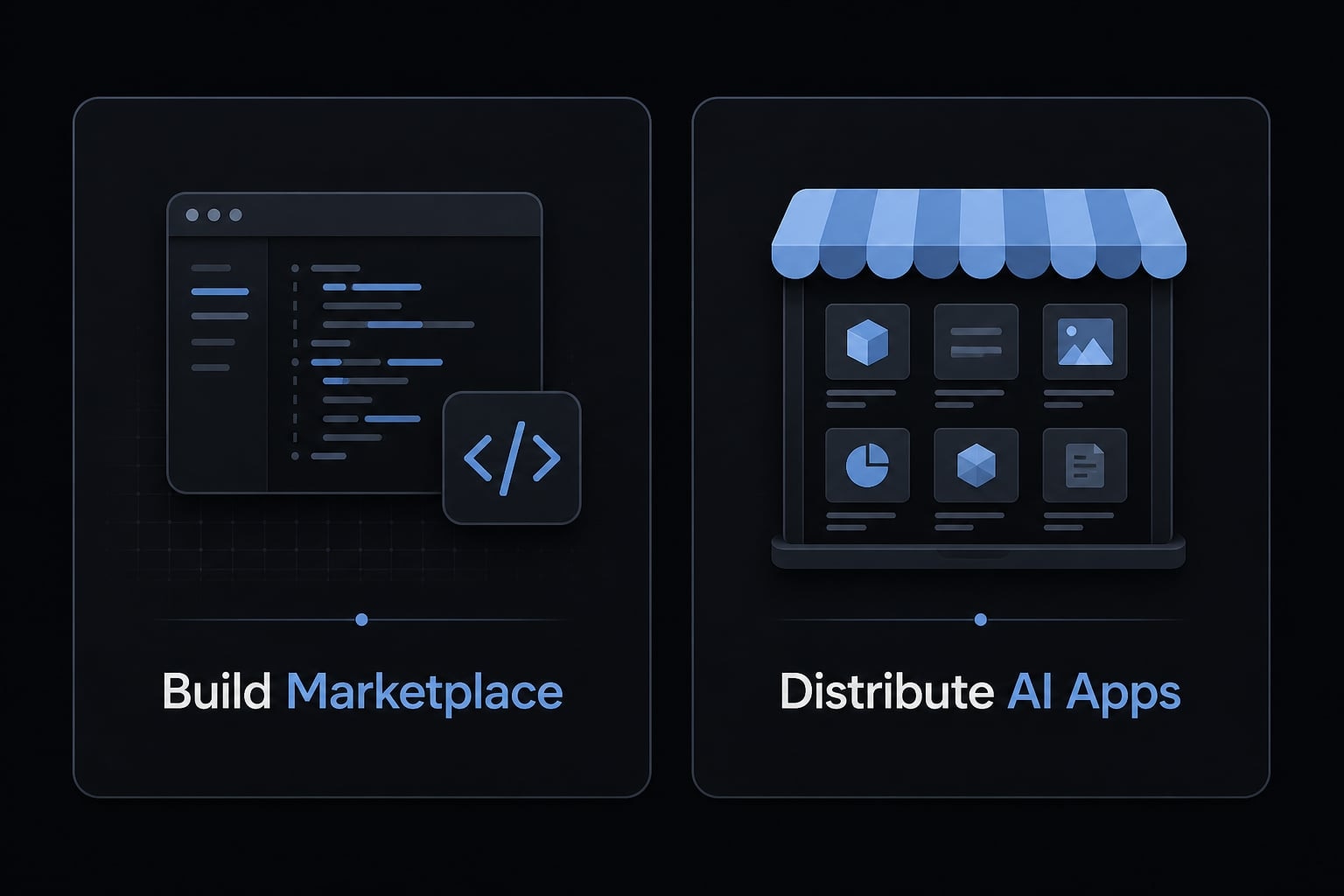
The term “vibe code marketplace” can be understood in two ways: using AI tools to build a marketplace platform, or using a platform to discover, share, and sell AI-built apps, templates, and agents. The distinction matters because one decision is about software creation, while the other is about distribution and discovery.
What “vibe coding” means in practical terms
In practical terms, vibe coding means using natural-language instructions to guide AI-assisted software development instead of writing every part manually. You describe screens, flows, features, or business logic, and a tool generates code or working interfaces in response.
This is often faster for prototypes than traditional development. The first version can look convincing because the interface appears before deeper operational weaknesses are exposed. But speed at the prototype stage does not remove architecture, testing, permissions, or production controls. In practice, issues tend to emerge only after the prototype is fully functional.
The two valid meanings behind the keyword
When people search for vibe code marketplace, they usually mean one of these two things:
Meaning A: Building a marketplace using vibe coding tools
- What the user is trying to do: Create a buyer-seller platform or marketplace app.
- Typical tools involved: Replit, Bolt.new, Lovable, other prompt-driven builders.
- Main decision criteria: Speed, flexibility, maintainability, launch risk.
Meaning B: Finding a marketplace or discovery ecosystem for AI-built assets
- What the user is trying to do: Discover, distribute, or evaluate AI-made apps, templates, agents, or demos.
- Typical platforms involved: Launch platforms, showcases, template stores, directories, an AI-generated application marketplace.
- Main decision criteria: Visibility, audience fit, credibility, distribution value.
The buyer journeys are different. One is about whether AI can help build a product. The other is about whether there is a viable ecosystem for discovery and exposure.
Why marketplaces are a hard test for vibe coding
Can you build a marketplace using vibe coding? For an early concept, often yes. For production-ready infrastructure, the answer becomes more conditional very quickly. Marketplaces are not hard because of one feature. They are hard because many dependent workflows must work together under live operating conditions.
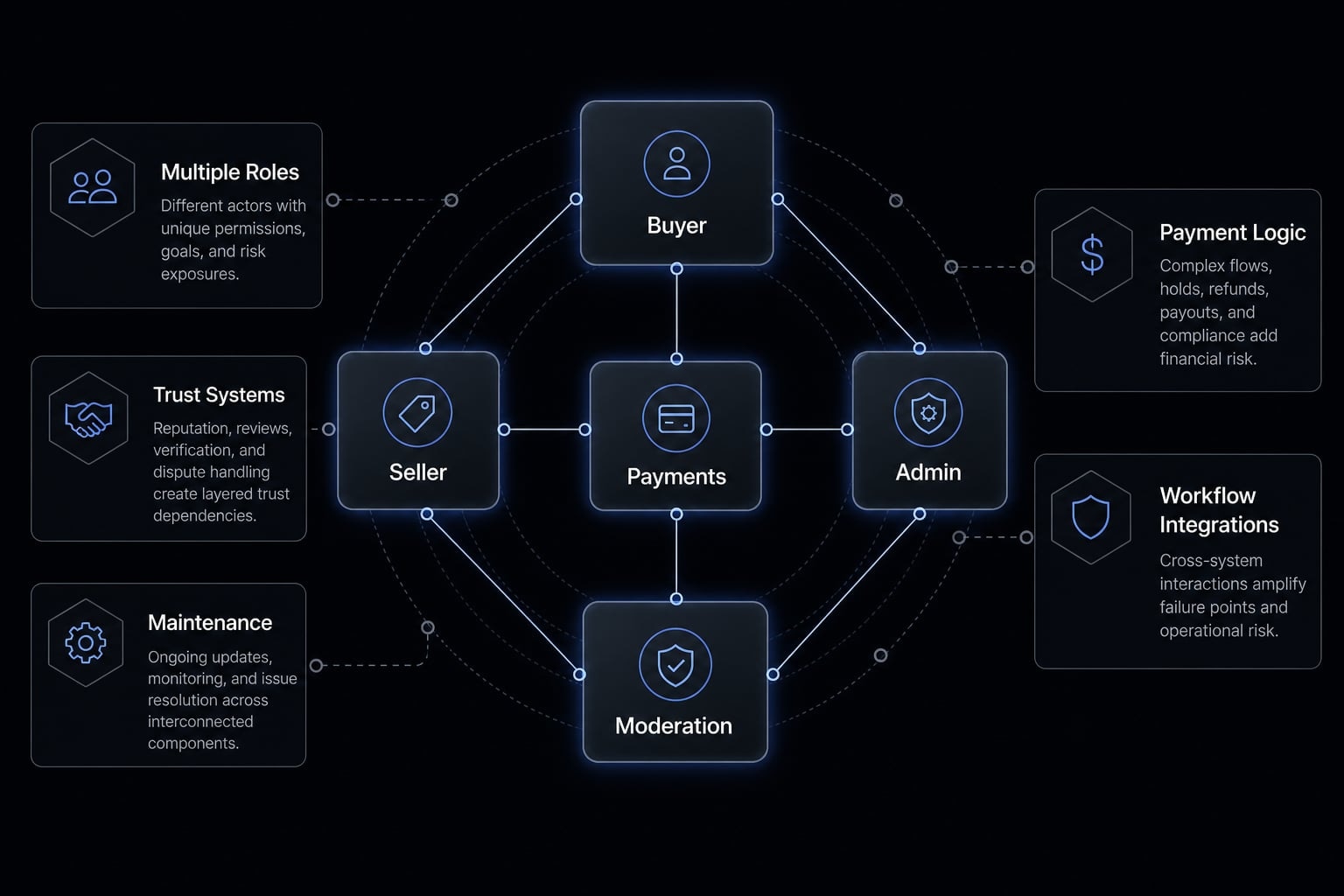
A marketplace is usually difficult for five practical reasons:
- Multiple roles and permissions
- Payment and refund logic
- Trust and moderation systems
- Workflow integrations
- Maintenance and debugging ownership
Multi-role products are structurally fragile
Marketplace products become fragile because they combine hidden branching logic across several user types:
- Buyer role with browsing, messaging, checkout, refunds
- Seller role with listings, inventory, pricing, fulfillment
- Admin role with approvals, moderation, dispute handling
- Role-based access that controls who can see, edit, approve, or reverse actions
- Listing states, approval rules, and workflow exceptions
The business impact is clear: broken permissions erode trust, increase support load, and create operational confusion. Marketplace logic becomes fragile once buyer, seller, and admin workflows start interacting.
Payments and trust flows are where risk becomes expensive
Payments are where a promising prototype often stops being a safe product. Once a marketplace handles money, the product must manage:
- Commissions and payout logic.
- Refunds and disputes.
- Pricing integrity.
- Transaction history.
- Abuse prevention.
- User trust.
Raw prompt output is rarely enough here. If payment logic fails, the result is not just a bug. It becomes a revenue risk, a dispute risk, and an infrastructure security issue. The distinction matters because a polished interface can still hide serious weaknesses underneath.
The maintenance problem appears after the demo
The first version often looks stronger than it really is because visible screens arrive before durable systems. After that, teams run into a different problem: Ownership.
Who debugs the generated code? Who verifies what changed? Who prevents one fix from breaking another flow?
This is where AI-generated software can accumulate technical debt fast. In business terms, technical debt means slower changes, fragile fixes, and rising maintenance burden. If nobody clearly owns testing, logs, and consistency, the product becomes harder to improve each week. A marketplace does not just need code that exists. It needs production-ready infrastructure that can be maintained with confidence.
Where vibe coding helps - and where it usually breaks
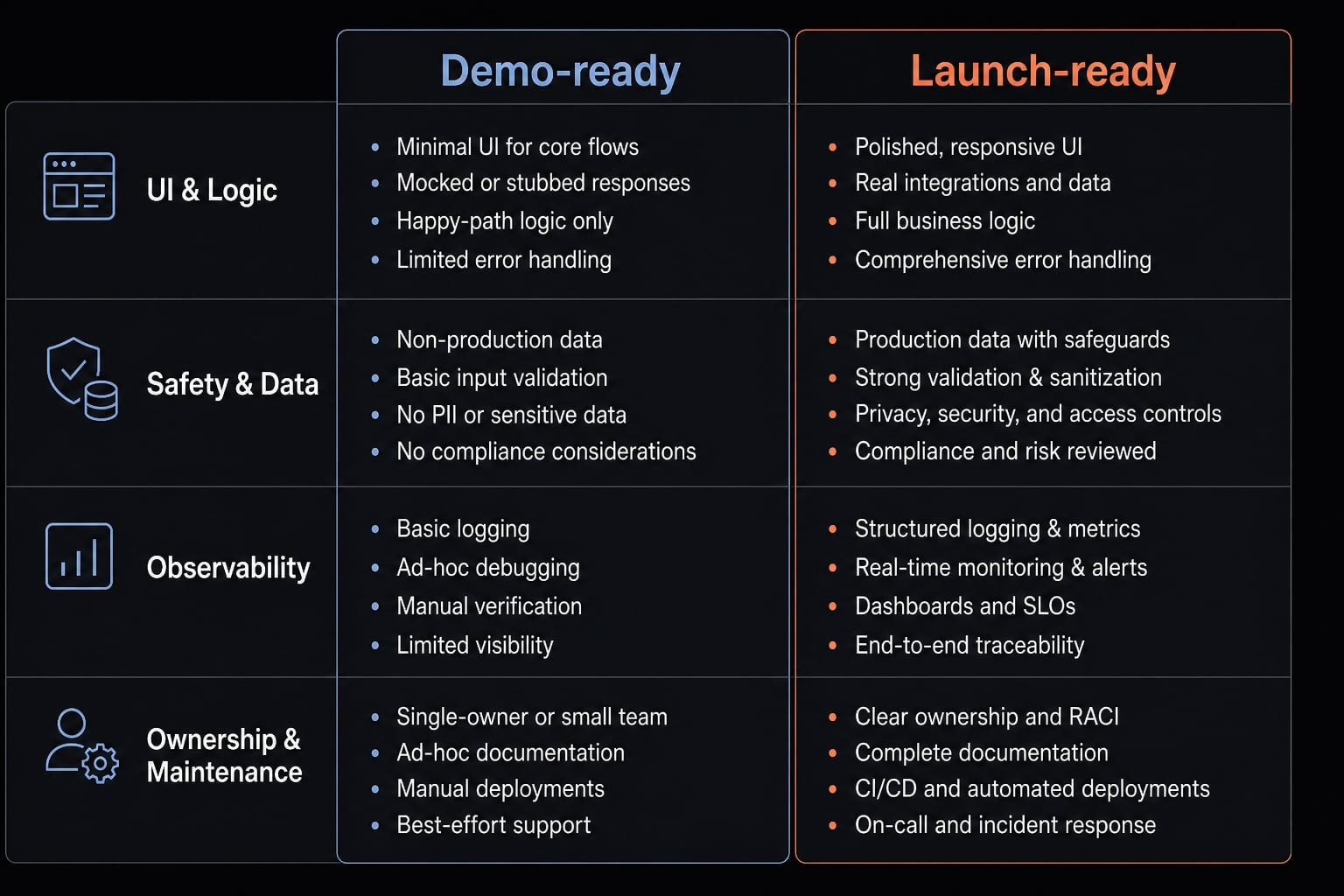
The most useful lens is simple: demo-ready is not the same as launch-ready. Demo-ready means the product can communicate an idea. Launch-ready means the product can carry responsibility.
That is why vibe coding deserves a balanced evaluation. It is highly effective for rapid prototyping, but the limitations of AI-generated code for production become more visible as operational risk rises.
Best-fit scenarios for vibe coding
Vibe coding is usually a strong fit when the goal is learning, validating, or communicating.
Best-fit use cases include:
- Validating whether the core marketplace concept makes sense.
- Building clickable prototypes for user interviews.
- Exploring UI direction and interaction flows.
- Creating internal demos for product alignment.
- Preparing an investor demo.
- Turning rough ideas into a clearer requirements artifact.
- Low-risk MVP development where live transactions are not yet critical.
- Accelerating rapid prototyping before a heavier build decision.
It also helps founders who need something concrete before spending on a full build. The trade-off is that fast output should be treated as evidence for learning, not proof of operational readiness.
Warning signs that the build has crossed into risky territory
A vibe-coded build is entering riskier territory when it starts carrying real business consequences.
Use this checklist:
- Real payments are involved.
- Live customer data is stored.
- Role-based permissions affect access or money.
- Multiple integrations must stay stable.
- There are no logs to explain failures.
- There are no tests to verify critical flows.
- There is no observability into what broke and why.
- Ownership of generated code is unclear.
- Compliance-sensitive workflows are in scope.
- The team expects iterative development without a structured change process.
These are common limitations of AI-generated code for production, especially in a prompt-to-code environment. In practice, teams often discover them after the demo succeeds. That is why a prompt-to-code project repository alone is not enough once the product becomes operational.
Use vibe coding to prove the idea. Do not treat that proof as launch clearance.
The current ecosystem: What counts as a “vibe code marketplace”?
The market remains fragmented. No single platform currently dominates this search category. Many products adjacent to this term are enablers rather than true marketplaces.
A more accurate way to understand the ecosystem is to split it into three layers: Build, discovery, and workflow.
Build layer: AI builders that generate early product versions
These tools help create early product output:
- Replit: Useful for prompt-assisted app creation and iteration
- Bolt.new: Focused on fast generation and prototyping flows
- Lovable: Often used for building polished front-end concepts quickly
These are builders, not necessarily a marketplace for vibe-coded projects. They help produce the asset. They do not automatically solve distribution, governance, or reliability.
Discovery layer: Directories, launch platforms, showcases
This layer includes showcases, directories, launch platforms, and template stores where AI-built projects can be seen, shared, or evaluated. In that sense, some users looking for a marketplace for vibe-coded projects are really looking for visibility channels rather than software infrastructure.
Exposure is useful because it helps validation. But discovery is not delivery. Audience attention does not equal transactional stability, governance, or maintainability. An AI-generated application marketplace may help a project get noticed, but it does not make the underlying build safer to operate.
Workflow layer: Systems that make AI output reusable
This is the layer many teams overlook. Once one-off prompting stops scaling, the issue is no longer generation alone. The issue becomes repeatability.
Workflow-layer systems focus on:
- reusable workflows.
- specialized subagents.
- reusable skills and execution patterns.
- quality checks.
- orchestration across tasks.
- more controlled handoffs between planning, building, testing, and shipping.
This is where an AI agent-built solution platform or structured workflow system becomes valuable. It helps teams move from isolated output to a process that can be repeated with more consistency. The safer interpretation is that the market has adjacent layers, not one mature, standardized category.
Vibe coding vs no-code marketplace tools vs professional development
The right path depends on stage, not ideology. Founders often compare these options as if one must always win. In practice, each path solves a different problem inside marketplace development.
Here is the practical comparison founders should use when evaluating marketplace development paths.
Path | Time to first prototype | Time to live launch | Upfront cost | Flexibility | Security control | Maintainability | Scalability | Best for | Founder fit |
|---|---|---|---|---|---|---|---|---|---|
Vibe coding | Very fast | Variable and often risky | Low to moderate | High at surface level | Limited without review | Fragile if unmanaged | Moderate at best without structure | Proof of concept, investor demo, early exploration | Non-technical or hybrid founders testing ideas quickly |
No-code marketplace tools | Fast | Faster than custom in many cases | Moderate | Moderate | Better than raw prompt output, but platform-bound | Usually better for standard use cases | Moderate, depends on platform limits | Operational MVP with standard workflows | Founders prioritizing speed and transactional stability |
Professional development | Slower | Slower upfront, stronger long-term | High | Very high | Strongest when well managed | Highest if engineered properly | Highest | Differentiated platforms and long-term infrastructure | Teams with budget, roadmap clarity, and product ambition |
Structured AI-assisted development | Fast to moderate | Moderate with better control | Moderate to high | High | Stronger than ad hoc prompting | Better through process discipline | High with the right system | Teams that want speed plus repeatability | Product teams, agencies, and operators needing controlled delivery |
When vibe coding is the right starting point
Use vibe coding when you need:
- A proof of concept.
- Internal validation.
- An investor demo.
- Fast exploration with limited capital.
- A low-friction way to learn before committing to full marketplace development.
When no-code or marketplace SaaS is the better operational choice
Use no-code marketplace tools when you need:
- A faster live launch.
- Transactional stability.
- Moderate customization.
- Operational speed over deep technical control.
- A more predictable early launch path than raw prompting.
When custom engineering or structured AI-assisted development is necessary
Use custom engineering or structured AI-assisted workflows when you need:
- Differentiated workflow logic.
- Scaling confidence.
- Deeper integrations.
- Stronger governance.
- Tighter security controls.
- Platform logic that is itself a competitive advantage.
- More durable production-ready infrastructure.
In practice, vibe coding vs professional development for SaaS is the wrong framing if used too broadly. The better framing is stage-based:
- For learning, vibe coding is strong.
- For standard transactional launch, no-code marketplace tools often make more sense.
- For strategic, scalable, or defensible marketplace development, custom or structured AI-assisted delivery is usually the safer path.
A simple decision framework for founders evaluating a vibe code marketplace
Most founders should decide based on stage, not excitement. Validation and launch readiness are different milestones, and AI-assisted software development needs more structure as risk increases.
Use it if:
- You are validating demand.
- You are clarifying UX and marketplace flow.
- You need a spec artifact for a builder or team.
- You want a proof piece for internal or investor discussion.
Do not rely on it alone if:
- You are handling real transactions.
- You are managing trust systems or moderation.
- You need critical tool integrations to stay stable.
- You operate in compliance-sensitive workflows.
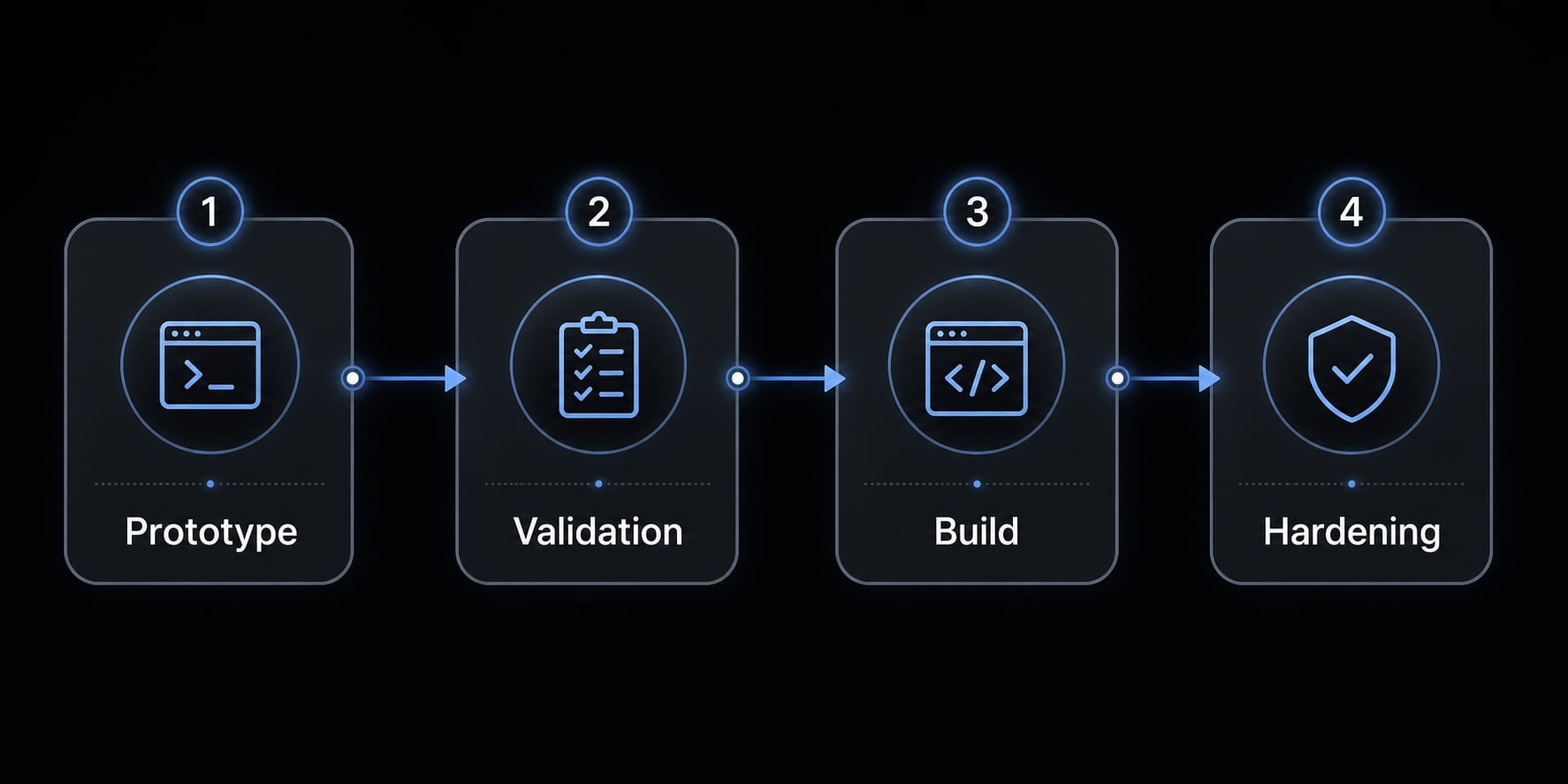
Use this founder decision framework:
- Prompt-driven prototype: Use prompts to test the concept quickly and create something visual.
- Workflow validation: Confirm the user journey, role logic, and value proposition before adding operational complexity.
- Structured build with testing and controls: Introduce ownership, logs, testing, and repeatable delivery rules.
- Production hardening: Validate payment safety, permissions, maintainability, and launch reliability.
This is the practical answer to how to validate marketplace ideas with vibe coding. The key is separating prototype vs production. One proves interest. The other proves operational readiness.
Where AgentKit fits: From prompt chaos to repeatable delivery
The problem is not only code generation. The larger operational failure usually comes from lack of structure, ownership, and repeatability. Teams can generate output, but still fail to ship reliably.
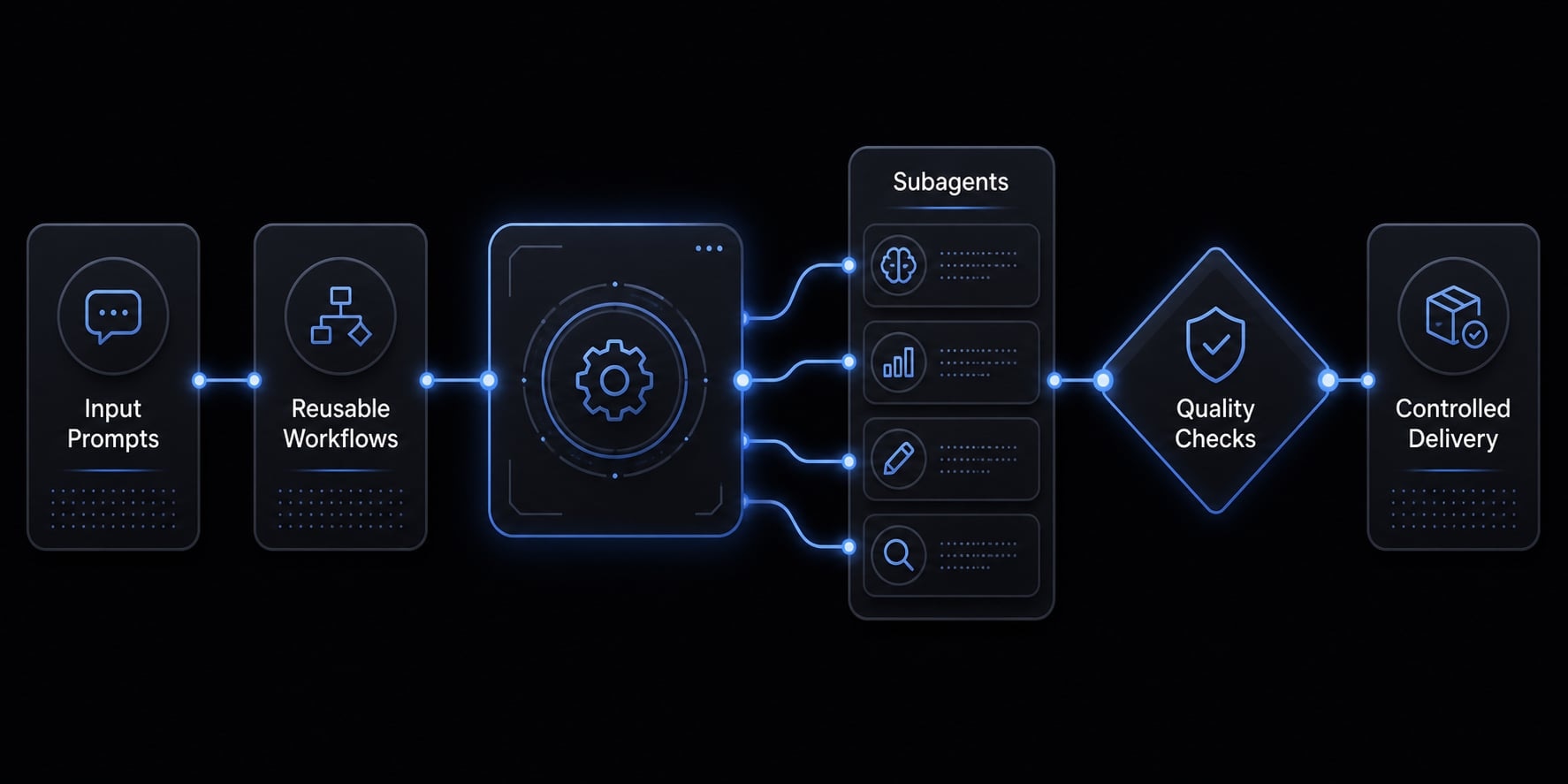
That is where AgentKit fits. It is best understood as a workflow standardization layer for AI-assisted product work. Instead of relying on one-off prompting, teams can use reusable workflows, specialized subagents, orchestrated steps, and quality checks to make delivery more controlled and repeatable.
AgentKit is particularly relevant for:
- Solo founders who need more control than ad hoc prompting.
- Indie makers moving from demo output to repeatable execution.
- Small product teams coordinating AI-assisted work.
- Agencies building multiple client workflows with consistency.
- Emerging AI development teams that need structure without unnecessary overhead.
Why this matters:
- One-off prompts rarely scale well.
- Reusable workflows reduce avoidable inconsistency.
- Subagents support specialization across planning, build, testing, and review.
- Quality checks improve control before output reaches users.
- An agent-based development environment supports repeatability, not just speed.
AgentKit does not remove engineering judgment, and it does not make marketplace production effortless. Its value is that it helps teams move from prompt chaos toward a more controlled shipping environment.
Frequently asked questions
What does the term “vibe code marketplace” mean?
The term "vibe code marketplace" is ambiguous, carrying two distinct meanings in the industry:
- Building: Using AI-assisted coding tools to develop a custom marketplace platform.
- Discovery: Referring to platforms, directories, or showcases that host or trade AI-generated projects, agents, and pre-built templates.
Can you build a marketplace using vibe coding?
Yes, vibe coding is highly effective for building a working marketplace prototype or an initial proof-of-concept. However, it is not currently a viable standalone solution for a launch-ready marketplace because it lacks the necessary security, transactional reliability, and maintenance infrastructure required for live user environments.
Is vibe coding suitable for production-ready infrastructure?
No. Vibe coding often creates "AI-created bugs" and architecture that is difficult to audit or secure. For production environments, you need robust testing, observability, and clear code ownership-features that raw AI prompting does not provide by default without structured developer oversight or professional infrastructure.
What are the main risks of vibe coding a marketplace?
The primary risks include fragile role-based permissions, lack of payment security, and technical debt that accumulates during maintenance. Because marketplaces require complex interactions between buyers, sellers, and admins, the AI’s lack of holistic architectural planning often leads to broken workflows when iterating on features.
When should founders choose vibe coding over professional development?
Founders should use vibe coding during the early validation phase, specifically for rapid prototyping, UI exploration, and internal demos. Professional development or structured AI-assisted workflows are necessary once the project crosses into launch-ready territory, where operational reliability, security controls, and long-term maintainability become top business priorities.
What is the difference between vibe coding and no-code tools?
Vibe coding uses natural language to generate custom, often proprietary, software code, offering high flexibility but higher maintenance risk. No-code marketplace tools are purpose-built SaaS platforms that prioritize operational stability and faster deployment at the cost of deep, custom architectural flexibility.
Read more:
- Vibe code mobile app: Build ideas faster with AI development
- Vibe coder meaning: How AI is changing software development
- Vibe coded websites: Build fast with AI prompt development
Conclusion
The phrase vibe code marketplace has two valid meanings: building a marketplace with AI tools, or exploring a discovery ecosystem for AI-built products and assets. In both cases, the same conclusion holds: vibe coding is highly useful for prototyping, validation, and early communication, but weak as a standalone path for live marketplace infrastructure.
The practical distinction is simple. Demo value is real. Launch responsibility is heavier. Once payments, permissions, moderation, and maintenance ownership matter, structured workflows become the missing layer between promising output and reliable delivery.