
Is vibe coding dead? What is replacing it in production software development
Vibe coding is not dead for low-risk prototypes and exploration, but its "prompt and pray" model fails in production because a working preview cannot guarantee security or reliability. To bridge this gap, structured AI-assisted engineering replaces blind acceptance with a disciplined workflow combining clear requirements, bounded tasks, rigorous verification, and human accountability.
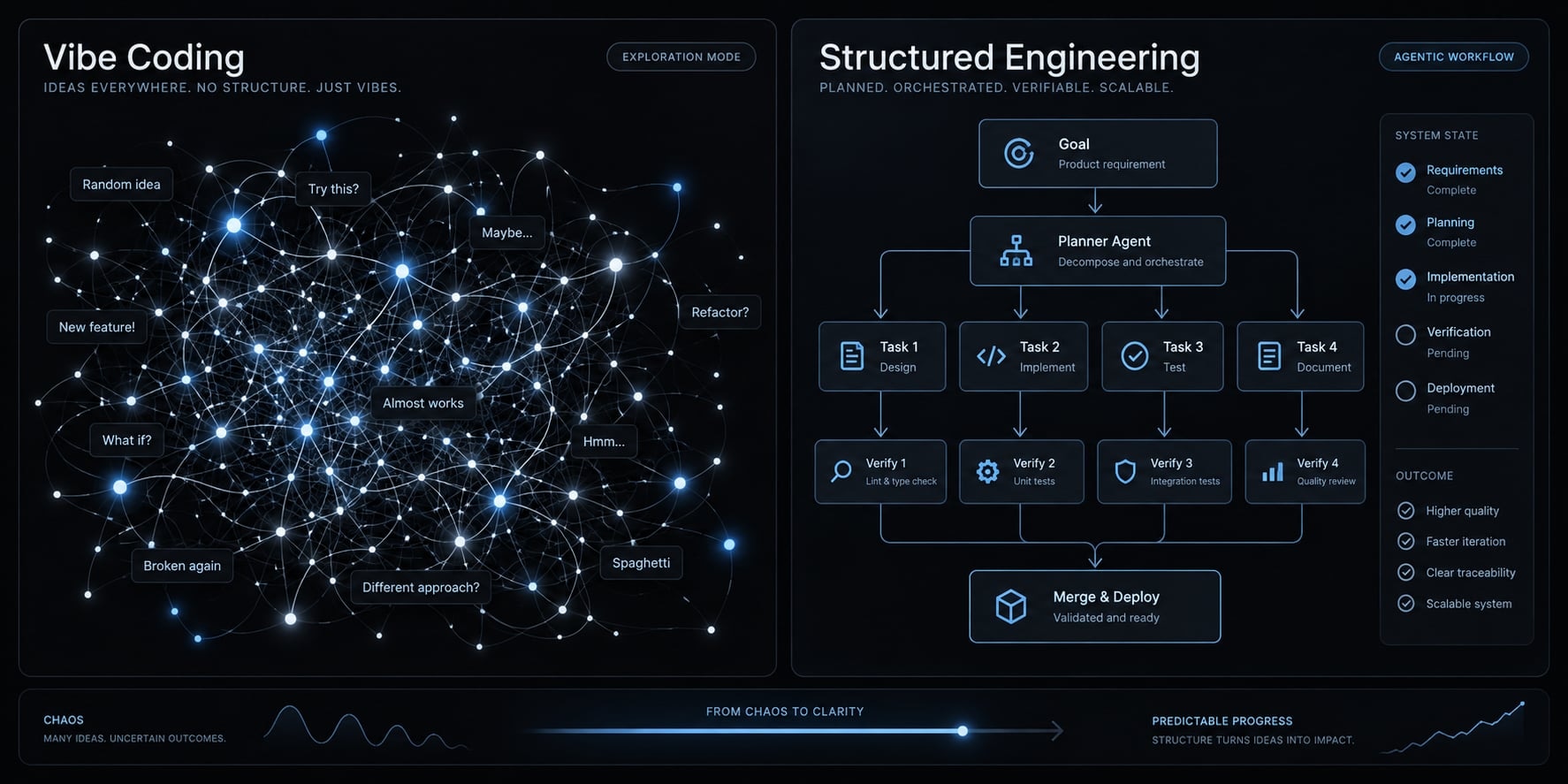
What does “Vibe coding is dead” actually mean?
The relevant distinction is conversational creation versus blind acceptance. A natural-language interface does not determine whether the underlying engineering process is rigorous.
In his February 2025 post introducing the term, Andrej Karpathy described an informal approach involving generated changes and little attention to the code itself. Later usage became broader, sometimes encompassing almost any programming assisted by AI.
That ambiguity matters. Calling all AI-assisted development “vibe coding” obscures the difference between exploring an idea and taking responsibility for an implementation. Likewise, “dead” is rhetorical criticism - not, by itself, evidence of declining adoption.
The useful part is not disappearing
Natural-language instructions can help explore interfaces, generate boilerplate, and draft tests. Developers can use those same instructions while inspecting changes and validating behavior.
AI-generated code can therefore participate in a disciplined workflow. The interface is not the problem; the release standard is.
The “Prompt and Pray” model is losing credibility
The substantive critique concerns approving unexplained changes, treating a successful preview as sufficient validation, and leaving maintenance without an owner. These behaviors create risk regardless of who - or what - writes the code.
Useful AI coding behaviors and their production limitations:
Behavior | Appropriate role | Limitation |
|---|---|---|
Natural-language instructions | Express intent and explore solutions | Do not establish correctness |
Bounded generation | Draft small, reviewable changes | Requires relevant context and checks |
Minimally inspected broad changes | Disposable experimentation | Difficult to assess and maintain |
Demo-only validation | Evaluate an interaction concept | Insufficient for production release decisions |
Why did the backlash against vibe coding begin?
Fast generation can expose weaknesses elsewhere in delivery. Producing a plausible implementation does not automatically resolve integration, authorization, review or maintenance work.
The backlash is best understood through these failure mechanisms, rather than treating individual incidents as proof that AI assistance universally reduces quality.
Local success can hide system-level failure
Consider an illustrative B2B software-as-a-service (SaaS) scenario: a customer-account administrator invites a teammate into a workspace.
The invitation button works. An email arrives. The recipient joins. Yet that visible success leaves important questions unanswered:
- Can an administrator invite someone into a different customer’s workspace?
- Can the request assign a role the administrator cannot grant?
- Can an expired or previously accepted invitation be reused?
- Could a failed deployment leave partially created memberships?
Authorization - deciding who may perform an action - must hold beyond the interface. A hidden button does not prevent an unauthorized request.
These failures can expose customer records, create support work, or require emergency recovery. A convincing demo establishes only that the demonstrated path worked.
The cost moves from writing code to reviewing code
Costs can shift, rather than invariably increase. A focused generated change may be straightforward to inspect. A quick implementation touching unrelated files can create a slow review.
Measure the whole delivery process:
- End-to-end change cycle time: Agreed starting point through release.
- Review duration: Elapsed review time, with active effort tracked separately where possible.
- Rework effort: Time spent correcting or restructuring the change.
- Post-release defects: Problems discovered after deployment.
Comparisons need comparable tasks, consistent definitions, and attention to developer experience and tool versions. Otherwise, a generation-speed improvement can conceal increased downstream effort.
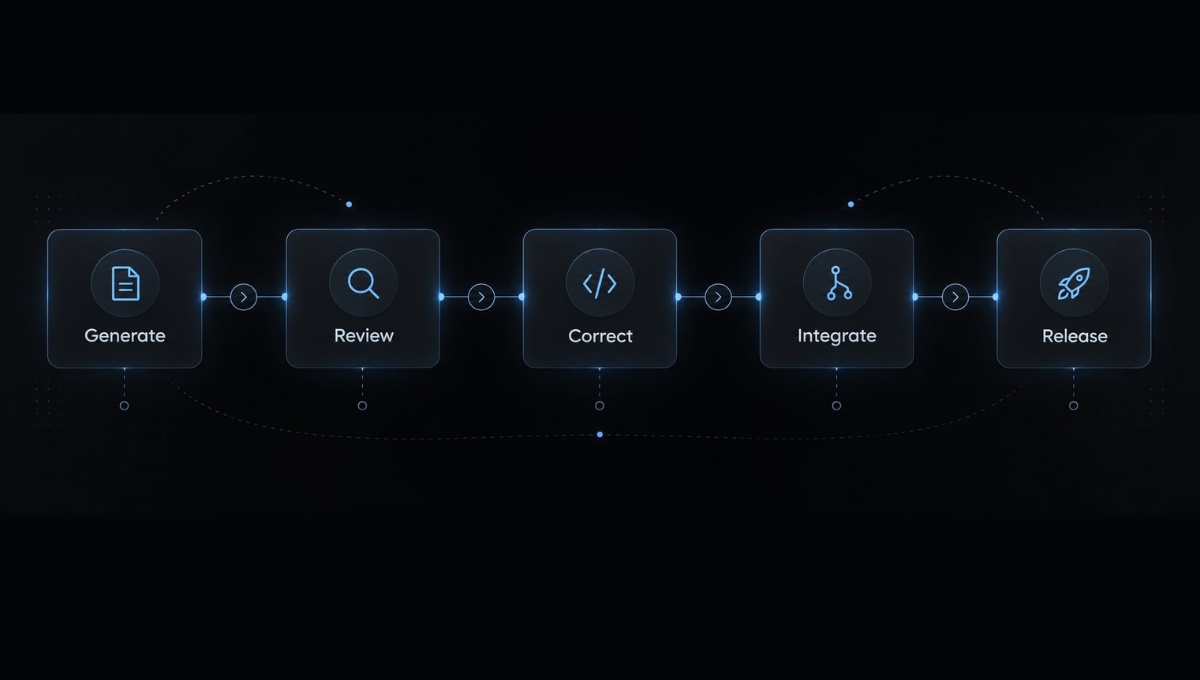
Unowned code becomes technical debt quickly
Technical debt is future work created by shortcuts or unresolved design problems. Poor software maintainability makes that work harder to diagnose and complete.
Ask who can explain the invitation logic, investigate a failure, and locate the relevant decisions. Non-technical founders can still prototype effectively; qualified code review is a release safeguard, not a prohibition on building.
Where vibe coding still works and where it breaks down
Suitability depends on consequences, not project labels. Rapid prototyping is valuable when mistakes are contained and the result can be discarded.
“Low risk” assumes mock or nonsensitive data, restricted permissions, and no consequential external actions. A personal script with access to production customer records does not meet that definition.
Prototype-to-Production risk matrix
Project type | Typical risk | Suitability of minimal-review generation | Minimum oversight |
|---|---|---|---|
Disposable prototype | Limited under isolation | Reasonable for exploration | Mock data; restricted access; discardability |
UI concept or product demo | Low unless connected to live systems | Useful for interaction experiments | Inspect behavior; disable consequential actions |
Personal automation | Depends on permissions and actions | Conditional | Dry runs; inspect writes; protect credentials |
Internal business tool | Potentially high | Not a sufficient release approach | Human review; permission checks; named owner |
Customer-facing SaaS | Customer, data, and availability exposure | Prototype use only without stronger controls | Behavior tests; security review; monitored release |
Financial, healthcare, or similarly sensitive system | Potentially severe; obligations vary | Unsuitable as the release standard | Specialist review; applicable compliance controls; recovery planning |
An internal tool can be more consequential than a public demo if it edits billing records or grants access. Regulatory obligations depend on jurisdiction, data, and use case - not simply the application’s category.
Customer-facing software can use generated code. What changes is the evidence required before release. Human-written code also needs appropriate review; its origin does not establish safety.
When should a team stop “Vibing”?
Increase oversight when any of these thresholds applies:
- Real users depend on the application.
- Confidential or regulated data enters the workflow.
- Several people share code ownership.
- Failures carry material financial, legal, or reputational consequences.
- Changes cannot be confidently reviewed.
- Regressions - broken existing behavior - are slowing delivery.
- Deployment and recovery need to be predictable.
Here, “stop” means add engineering controls, not abandon AI.
For the invitation feature, the prototype-to-production boundary arrives before real customers can grant workspace access. A mock interaction becomes a consequential permission system once invitations create actual memberships.
That transition deserves an explicit decision. A prototype should not quietly become production because its preview looks complete.
What is replacing vibe coding?
Structured AI-assisted engineering is a workflow in which people define expected behavior and constraints, AI helps implement bounded changes, and evidence informs release decisions. It treats generated code as a candidate implementation - not a finished product. The goal is to preserve useful speed while making changes understandable, testable, recoverable, and owned.
Its control stack is straightforward:
- Specifications.
- Relevant context.
- Scoped execution.
- Automated tests and checks.
- Independent review.
- Human approval where risk requires it.
- Controlled release and rollback.
“Agentic engineering” is a related, variably used term for development involving AI agents that can take actions through tools. It does not identify one universally accepted methodology.
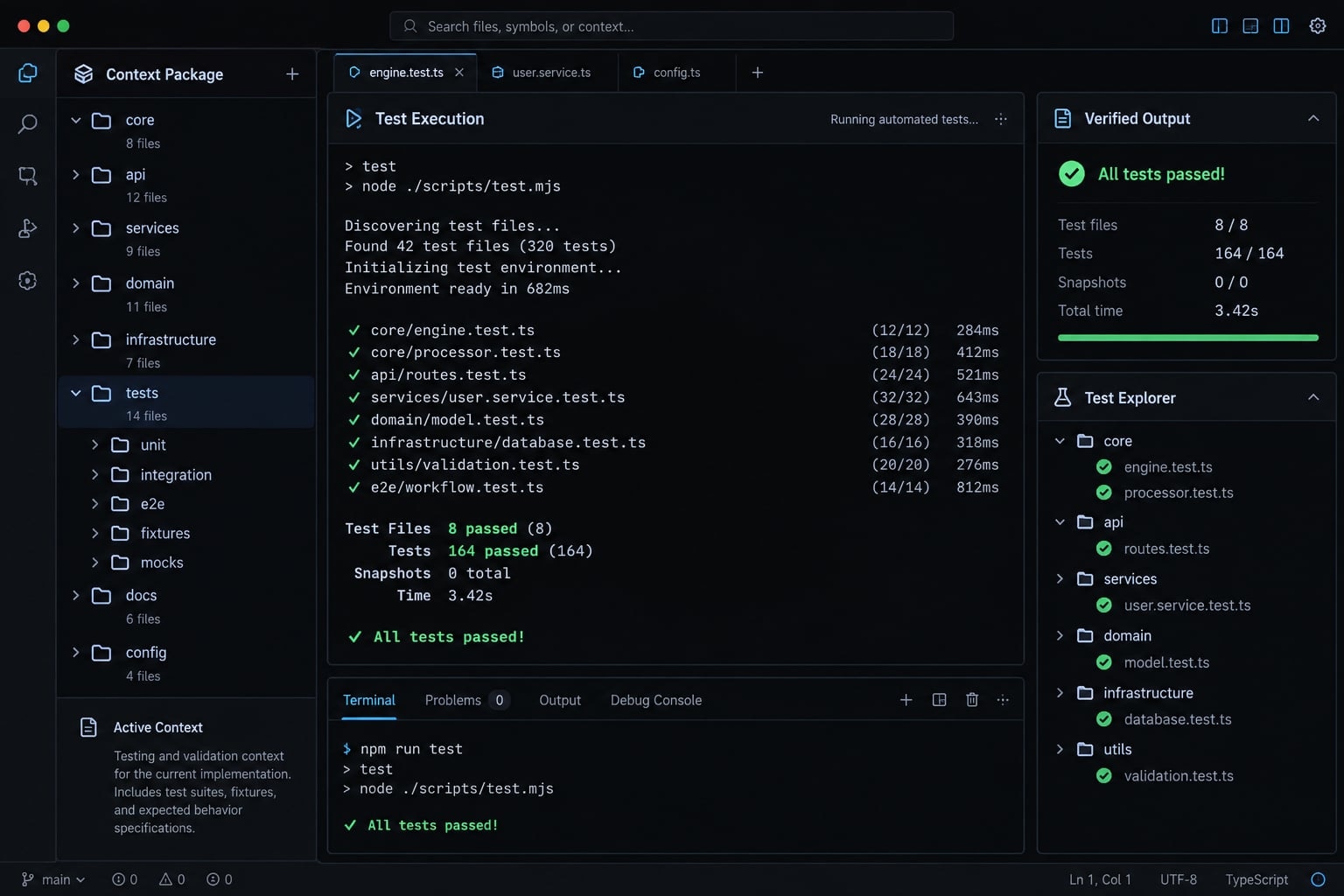
Specification-driven development
Specification-driven development starts with expected behavior, constraints, and acceptance criteria: observable conditions that determine whether work meets requirements.
For a small change, a short issue description may suffice. The invitation feature needs explicit permission rules and failure behavior - not an elaborate document for its own sake.
Non-goals matter too. Adding invitations should not silently redesign account permissions.
Context engineering
Context engineering means selecting the information an AI system needs to perform a task correctly. Repository context includes relevant project files, conventions, interfaces, and prior decisions.
More context is not always better. Irrelevant files can obscure the important constraints. Stale documentation can introduce incorrect assumptions, while casually supplied credentials or customer data create unnecessary exposure.
Agentic execution with verification layers
Agents implement bounded tasks, followed by verification layers: complementary checks addressing different failure modes.
A single well-controlled agent can fit this model. Multiple specialists may divide work, but their number does not establish quality.
Tool permissions must be enforced by the environment, not merely requested in an instruction. An agent asked to avoid production should also lack unnecessary production access.
Human accountability remains the control layer
People remain responsible for requirements, architectural decisions, accepted risks, and release approval.
NIST’s Secure Software Development Framework supports integrating security practices throughout development. OWASP’s Application Security Verification Standard provides relevant application-security requirements. Neither establishes that adopting an agent workflow makes a product secure.
Non-technical founders should obtain experienced engineering review before launching consequential systems. Automation changes execution; it does not transfer accountability.
Vibe coding vs. structured AI-assisted engineering
The difference is operating discipline, with benefits and overhead. Both approaches may use ordinary prompts and similar underlying models.
Here, “pure vibe coding” means a deliberately minimal-review workflow - not every practice described using that label.
Comparison table
Dimension | Pure vibe coding | Structured AI-assisted engineering |
|---|---|---|
Starting point | Idea or desired appearance | Outcome, constraints, acceptance criteria |
Planning | Emerges during prompting | Proportionate plan before material changes |
Context | Whatever enters the conversation | Selected, current project information |
Execution | Broad conversational iteration | Bounded tasks; one agent or several |
Validation | Preview and spot checks | Requirement-based checks and review |
Human responsibility | May remain implicit | Explicit reviewer and release accountability |
Documentation and ownership | Often conversational | Durable records proportionate to risk |
Suitable use | Contained exploration | Maintained software and consequential changes |
Main risk | Hidden defects and unclear ownership | Overhead or false confidence in controls |
Success measure | Demonstration works | Behavior, reviewability, maintainability, recovery |
Why “Agentic” alone is not enough
When comparing agentic engineering with vibe coding, avoid confusing coordination with assurance.
A second agent may share the first agent’s assumptions. If both misunderstand workspace boundaries, agreement between them provides weak evidence. Verification should include checks against requirements and expectations that are not simply copied from the implementation.
Selected validation checks can be repeatable even though model generation is probabilistic. Tests can also be incomplete or flaky - passing inconsistently without a meaningful application change.
A green status therefore does not prove complete correctness. Nor does adding more agents necessarily improve productivity: coordination, duplicated work, and poorly configured access can increase effort.
The useful target is sufficient evidence with proportionate overhead, not the largest possible workflow.
A seven-step framework for moving beyond vibe coding
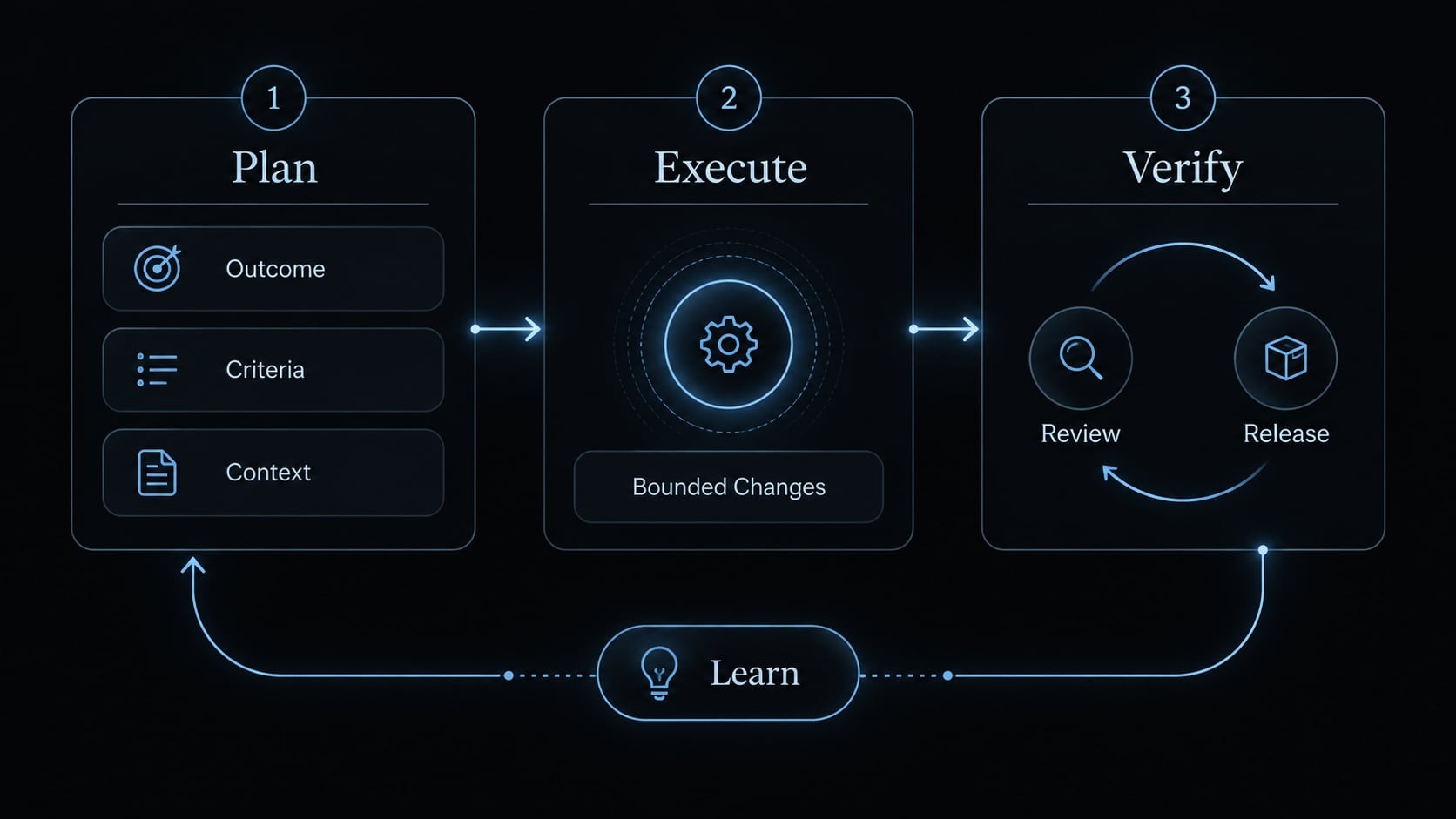
Use Plan-Execute-Verify as an organizing label for this AI development workflow, not a proprietary or independently validated methodology. Each step creates a visible deliverable before work advances.
Scale the depth to consequences. A cosmetic change and a workspace permission change should not require identical review.
Define the outcome and risk level
- Input and action: Start with the user problem. Identify non-goals, sensitive data, affected users, and failure consequences.
- Output: A requirement statement and risk classification. For invitations, the outcome is controlled teammate access - not merely sending email.
- Control point: Assign a responsible reviewer before high-risk implementation proceeds. Record who may accept unresolved risk rather than leaving that decision implicit.
Write acceptance criteria
- Input and action: Convert the requirement into observable behavior, including permissions, errors, and expiration.
Example criterion: “Only authorized workspace administrators can invite teammates, and an invitation cannot grant access to another workspace.”
- Output: Testable pass/fail conditions, including rejection cases.
- Control point: Resolve material ambiguity before implementation. Specification-driven development is useful here because permission decisions become explicit before code embeds assumptions.
Build the minimum required context
- Input and action: Select relevant authorization logic, membership records, invitation interfaces, testing conventions, and prior decisions.
- Output: A task-specific context package explaining the existing behavior and constraints.
- Control point: Check relevance, freshness, and sensitive-data exposure. Context engineering should reduce uncertainty without granting access to unnecessary secrets or unrelated customer information.
Plan before generating code
- Input and action: Identify affected components, bounded tasks, applicable tests, and recovery needs.
- Output: A reviewable implementation plan stating what will change and what will remain untouched.
- Control point: Obtain approval for high-impact changes. If an invitation task unexpectedly requires rewriting account permissions, pause and reassess scope rather than accepting the expansion automatically.
Execute in bounded tasks
- Input and action: Implement small changes using appropriate permissions and checkpoints.
- Output: A focused code change and summary explaining its purpose, affected files, and known limitations.
- Control point: Enforce access restrictions through tooling and inspect scope drift. Version control records changes, but it does not independently ensure safe deployment or prevent harmful external actions.
Validate through independent checks
- Input and action: Compare behavior with acceptance criteria. Apply verification layers such as behavior tests, permission checks, and relevant security scans.
- Output: A validation report listing checks performed, failures, coverage gaps, and unresolved risks.
- Control point: Required failures block advancement until resolved or formally reviewed under policy. Scrutinize generated tests: they may reproduce implementation assumptions. Automated code review supplements necessary human judgment.
Review, release and learn
- Input and action: Review material risks, follow the release process, and monitor production behavior.
- Output: An approved release record, named owner, recovery path, and updated guidance.
- Control point: Confirm observability - the ability to detect and investigate production problems - and practical recovery. Some database changes require restoring data or applying a corrective update rather than simple rollback. Reverting code may not undo memberships already created.
Use these seven deliverables as the release discussion agenda. Missing evidence should become an explicit decision, not an assumption that someone else checked.
What a coordinated agent workflow looks like in practice
AgentKit serves as a prime example of scaffolding and infrastructure designed to construct robust AI Engineering Systems. Rather than acting as a standalone closed platform, AgentKit provides reusable skills, specialized agents, and structured orchestration that bridge developer intent with execution tools like Claude Code, Cursor, Codex, or DeepSeek Harness.
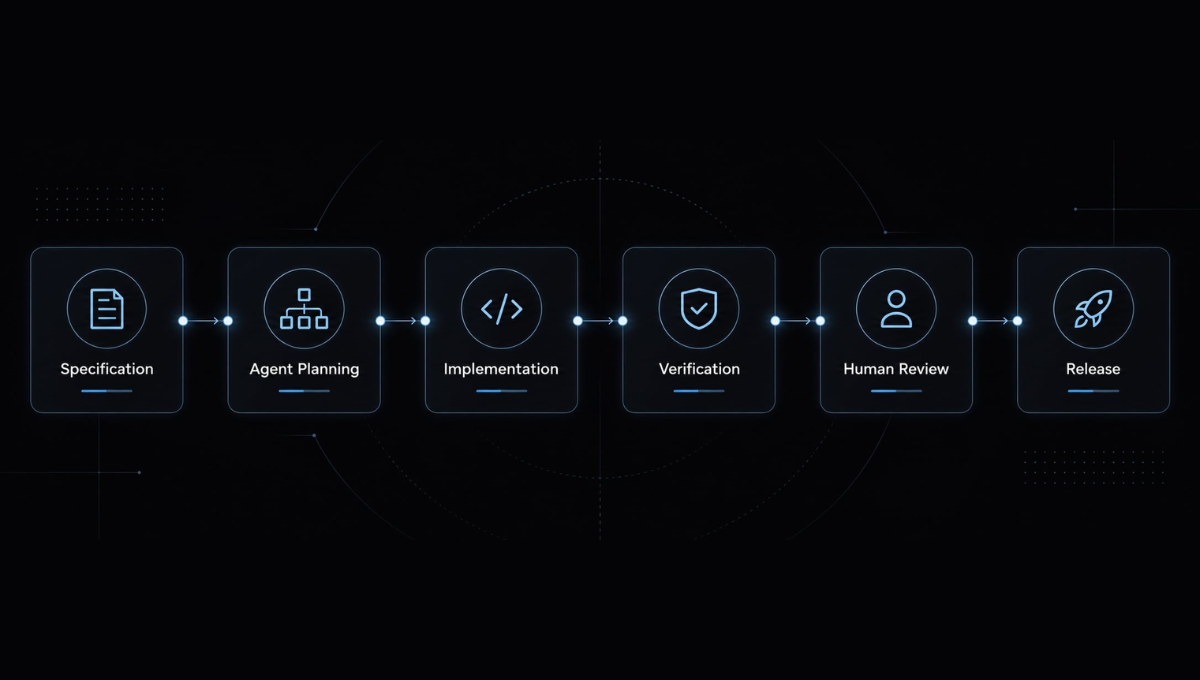
The workflow below illustrates how a structured AI system coordinates engineering tasks. Actual execution depends on the selected kit, environment, and configured integrations.
Example workflow: From feature request to reviewed change
For the workspace invitation feature:
- Specification: A founder or engineer defines permissions, expiration, and acceptance criteria.
- Planning: Planning identifies frontend, backend, membership-data, and testing work.
- Bounded Execution: Implementation tasks receive relevant context packages and restricted tool access.
- Automated Validation: Multi-layer verification compares behavior with the specification, explicitly targeting edge cases like unauthorized cross-tenant requests.
- Human Review: An accountable engineer resolves outstanding risks.
- Controlled Release: The team follows its configured release, monitoring, and recovery process.
Capability | Relevant problem | Required caveat |
|---|---|---|
Reusable skills | Repeatedly rebuilding task instructions | Instructions still need maintenance and review |
Specialized agents and workflows | Repeated coordination across development stages | Coordination does not guarantee independent verification |
MCP integrations | Repeated connections to external tools | Permissions require separate enforcement |
What agent orchestration does and does not solve
Agent orchestration coordinates automated tasks and their handoffs. It supports repeatability, but the workflow still requires sound requirements and human oversight.
Can support | Does not guarantee |
|---|---|
Consistent requirement templates | Correct requirements |
Architecture review tasks | Secure architecture |
Repeated test execution | Complete tests |
Context reuse and review handoffs | Hallucination-free output |
Documented options and decisions | Sound business decisions |
Configured deployment workflows | Safe autonomous deployment |
Frequently asked questions
What does "vibe coding is dead" mean for developers?
It signals that the era of treating AI as an autonomous, unmonitored creator has ended. Developers are now moving toward a "Plan-Execute-Verify" model, where AI agents act as implementation tools under strict architectural constraints, ensuring that software remains maintainable, secure, and understandable by human teams.
Why is vibe coding considered a production risk?
The primary risk is the "debt of existence" and system fragility. Accepting AI code without review creates opaque logic that is nearly impossible for human developers to debug. This leads to critical security vulnerabilities, hardcoded credentials, and architectural drift that can collapse under real-world traffic.
What is replacing vibe coding in professional workflows?
Structured AI-assisted engineering is replacing it. This model emphasizes specification-driven development, where humans define clear acceptance criteria and context, while agents execute bounded tasks that are subsequently validated through automated test suites and independent human review before any production release.
Does "agentic engineering" guarantee production-ready code?
No. Agentic engineering provides a workflow for coordination and repeatability, but it does not automatically ensure correctness. Code quality still depends on sound architectural design, robust testing, effective configuration of permissions, and human accountability for risk acceptance and release decisions.
How can a team add controls without losing speed?
By adopting a seven-step framework: Define requirements, write acceptance criteria, build project-specific context, plan the change, execute in bounded tasks, validate through automated checks, and enforce human approval. This reduces rework and "hidden" technical debt, ultimately accelerating the overall software delivery lifecycle.
Can I still use vibe coding for small projects?
Yes. It remains useful for disposable prototypes, UI concepts, or personal automation projects where the consequences of failure are low. However, once a project handles sensitive data, relies on real users, or requires long-term maintenance, teams must shift to structured engineering practices to avoid future failure.
Read more:
- Vibe code mobile app: Build ideas faster with AI development
- 7 practical vibe coding examples: Build apps faster with AI
- Vibe coding SEO: Build AI-powered assets without developers
Conclusion
Is vibe coding dead? No. Natural-language prototyping remains useful for exploring products and producing contained experiments. What does not hold up is treating unreviewed generation and a successful demo as sufficient evidence for consequential software.
Structured AI-assisted engineering changes the release standard, not necessarily the interface. Teams can keep conversational tools while defining requirements, constraining changes, checking behavior, and assigning ownership. Those controls reduce some risks; they do not eliminate defects or make every generated implementation worth keeping.
Before the next release, assess who depends on the feature, what data it touches, and how failure would be detected and reversed. Add the missing safeguards in proportion to those consequences.