Vibe coding product spec: How to keep AI-assisted building fast without losing structure
Fast AI prototyping often turns chaotic after a few iterations-prompts pile up, features drift, and rapid progress turns into costly rework. A "vibe coding product spec" fixes this by acting as a lightweight source of truth that keeps humans and AI aligned. This guide covers what it is, when to use it, and the minimum structure needed to preserve speed without losing clarity.
What “vibe coding product spec” actually means
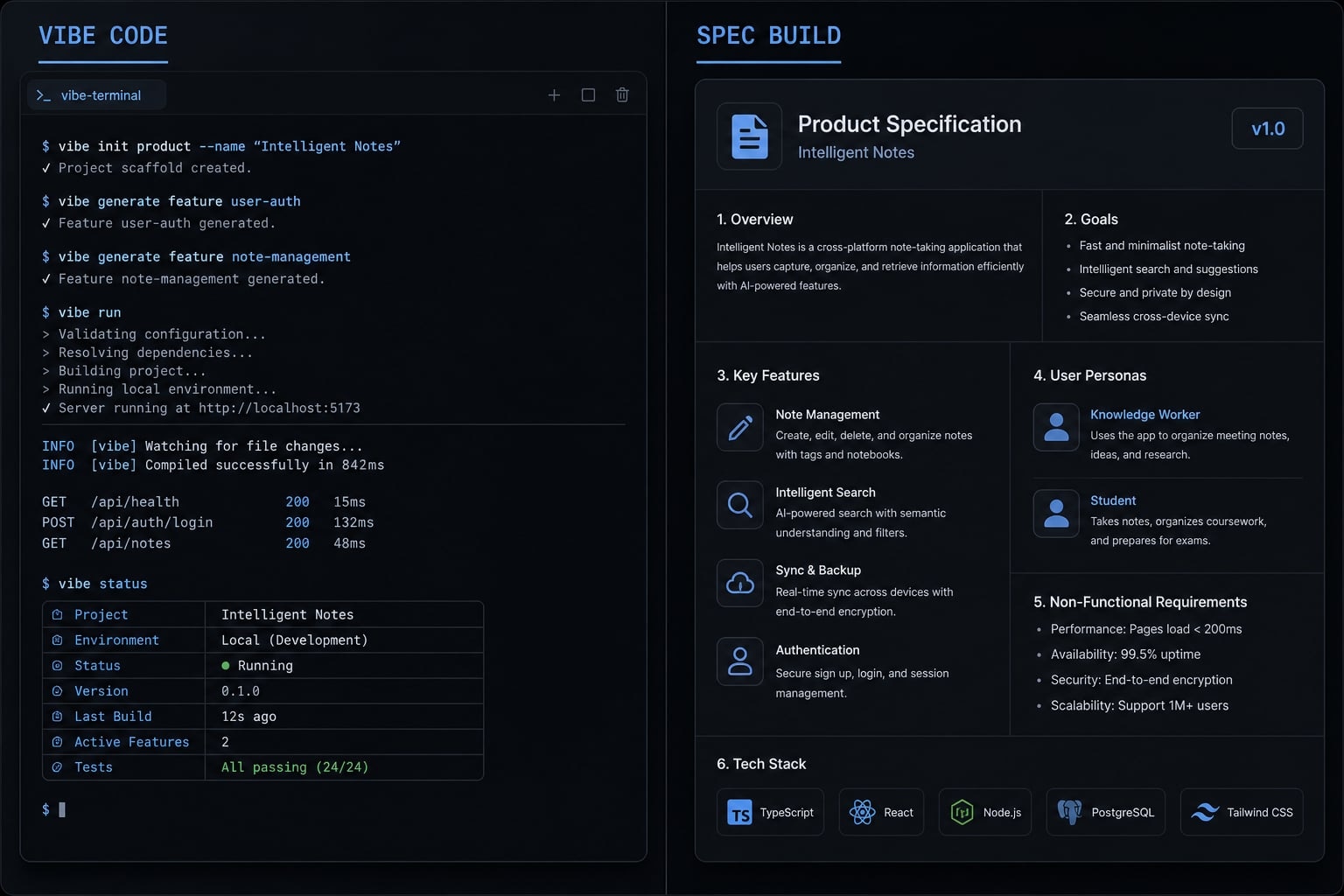
A vibe coding product spec is a lightweight product specification that captures what should be built, for whom, and what “done” should look like, so both AI tools and human collaborators can work from the same intent without relying on scattered prompts.
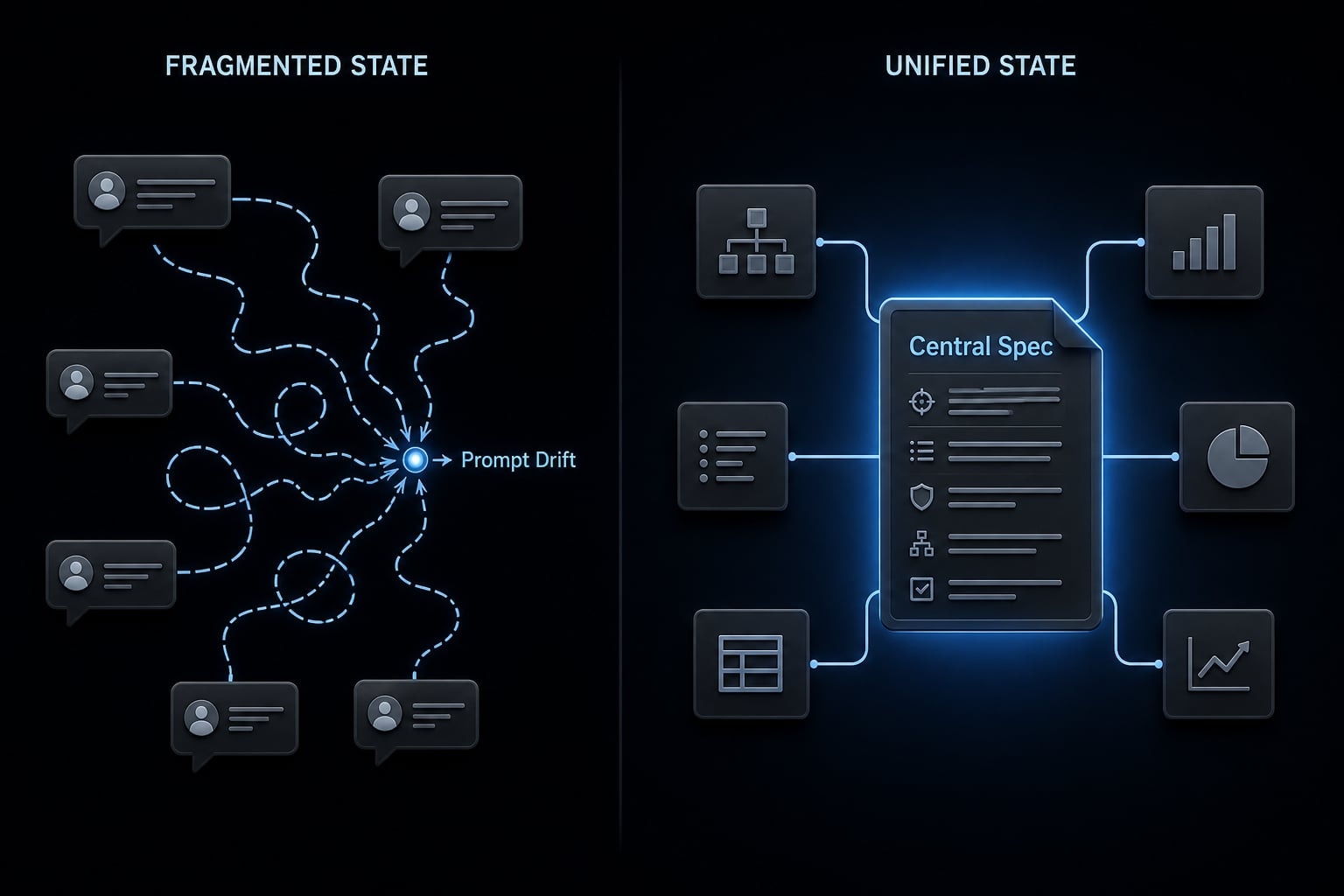
The key idea is simple: Vibe coding is excellent for momentum, but weak at preserving intent over time. Once instructions are spread across chat threads, IDE prompts, and half-remembered decisions, iteration quality starts dropping. The issue is not that prompts are useless. The issue is that prompts alone are a poor long-term memory system.
This is why a vibe coding product spec is best treated as a source of intention. It does not need to be long. It does need to be stable, reusable, and clear enough that future prompts, edits, and decisions stay anchored to the same goal.
It is also important to separate three things that often get mixed together:
- Vibe coding: Fast, prompt-led prototyping focused on exploration and speed.
- Lightweight product spec: A short document that defines user, goal, scope, flow, and expected behavior.
- Engineering design doc: A more technical document covering architecture, dependencies, implementation approach, and tradeoffs.
A vibe coding product spec is not a full PRD (Product Requirements Document). It is also not an engineering design document. It sits in the middle: More structured than raw prompts, far lighter than enterprise documentation.
That distinction matters in AI-assisted development. If you jump from idea straight into code, the AI can move fast. But if the project survives beyond a quick demo, spec-driven AI coding usually becomes more reliable because the model keeps returning to shared intent instead of improvising from fragmented context.
Vibe coding is optimized for speed, not long-term clarity
Vibe coding is best understood as AI-assisted exploration. You describe what you want, accept suggestions quickly, test what appears, and keep moving. That makes it ideal for early discovery, rough prototypes, and solo experimentation.
The tradeoff is that rapid prototyping prioritizes momentum now over clarity later. As features accumulate, prompt-led prototyping struggles to preserve why something was built, what is in scope, and which assumptions should remain fixed.
A product spec is optimized for clarity, not bureaucracy
A lightweight product specification is a practical alignment document, not paperwork for its own sake. Its job is to capture the minimum shared understanding needed to build coherently. For AI tools, that means better context. For humans, that means fewer clarification loops.
A useful spec usually covers:
- Goal.
- User.
- Scope boundaries.
- User flow.
- Constraints.
- Acceptance criteria (plain-English conditions that define correct behavior).
Used this way, the spec becomes a reusable source of intention rather than a bureaucratic artifact.
Why prompt-only building breaks down after the first few iterations
Prompt-only building is valid at the start. In fact, for exploration, it is often the right move. The breakdown happens when the project becomes more than a disposable experiment and intent starts fragmenting across too many conversations.
5 signs your vibe-coded prototype now needs a spec
- You keep repeating the same instructions to the AI.
- Features start conflicting with each other.
- Collaborators ask basic clarification questions.
- Bugs come from missing assumptions, not syntax.
- You want the build to survive beyond a weekend.
Once these signs appear, the bottleneck is rarely typing speed. It is usually prompt drift. The system keeps receiving slightly different instructions, shaped by memory, urgency, or whatever was last discussed. Over time, that creates inconsistency, duplicated work, and accidental scope creep.
This is really a context engineering problem. Better outputs do not come only from better prompts. They come from better context. When intent lives in scattered chat history, AI output quality becomes less stable. Important decisions fall out of the active context, especially in longer AI agent workflows where multiple steps, tools, or collaborators are involved.
Better context usually leads to better AI output quality
Once intent is scattered, the AI starts filling gaps on its own. Sometimes that looks helpful. Often it creates silent mismatches: Extra features, wrong assumptions, or implementation choices nobody explicitly approved. This is where prompt drift becomes expensive.
In simple terms, context engineering means deliberately shaping the information the model uses to reason and act. A lightweight spec is one of the most practical context assets you can create because it is reusable across sessions, tools, and collaborators. Instead of restating the same requirements in every conversation, you point the system back to a stable artifact.
This also helps with context window management. You do not need to keep the entire project history active in every prompt. You need a compact reference that preserves core intent. That makes AI agent workflows more consistent, especially when tasks are split across generation, revision, testing, and debugging.
From a business perspective, the payoff is straightforward:
- Less rework from ambiguous instructions.
- Lower coordination cost across people and tools.
- Better code maintainability as features expand.
- Easier collaboration when someone new joins the project.
When to just vibe, when to add a lightweight spec, and when to formalize further
The right amount of structure depends on four variables: Complexity, number of collaborators, business risk, and project lifespan. More documentation is not automatically better. The goal is to use the minimum structure needed for the level of coordination and risk involved.
Criteria | Vibe coding only | Lightweight product spec | Spec + engineering design | Best choice |
|---|---|---|---|---|
Goal | Explore ideas fast | Build with clarity | Build with reliability | Depends on stage |
Speed to first prototype | Very high | High | Medium | Vibe only |
Alignment for collaborators | Low | Medium to high | High | Spec + design |
Risk of scope drift | High | Medium | Low | Spec + design |
Ease of AI context reuse | Low | High | High | Lightweight spec / Spec + design |
Maintainability | Low | Medium | High | Spec + design |
Best for | Solo experiments, demos | MVPs, validated prototypes, small teams | Production-grade apps, sensitive workflows | Context-dependent |
Use vibe coding only when…
- You are exploring a problem or desirability.
- The project is solo.
- Failure cost is low.
- Operational reliability does not matter yet.
Add a lightweight spec when…
- The idea is validated enough to build seriously.
- You want reusable context for AI agents.
- More than one person needs alignment.
- Rework is becoming more expensive than writing a short spec.
Move to fuller documentation when…
- Security, payments, or customer data are involved.
- Multiple dependencies and edge cases appear.
- Production SLAs (Service Level Agreements) or reliability matter.
- The cost of getting it wrong is high.
This is where spec-driven development becomes useful. Not because every project needs a complex process, but because some projects eventually outgrow pure trial and error. In a healthy AI coding workflow, structure should increase only when the cost of ambiguity increases. That is how you protect speed while still moving toward maintainable software. If needed, a lightweight spec can later expand into clearer product requirements and, eventually, an engineering design document.
The minimum viable product spec for vibe coding
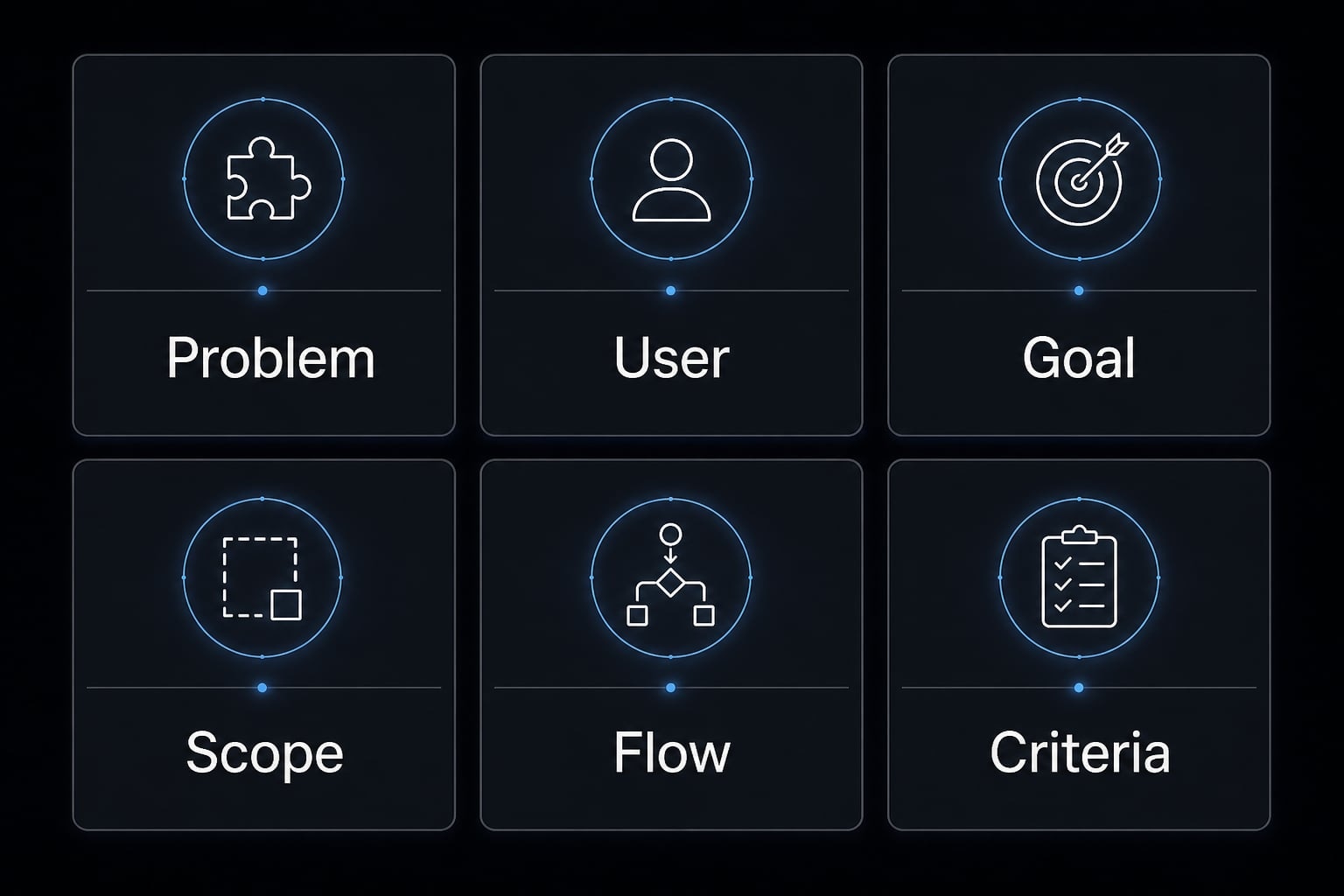
A minimum viable product spec should be short enough to stay usable and detailed enough to prevent drift. In practice, six parts are usually enough for most early-stage AI-assisted builds.
- Problem or opportunity - Example: “Freelancers lose follow-up actions after client calls.”
- Target user - Example: “Independent consultants managing multiple weekly client conversations.”
- Goal and success criteria - Example: “Generate editable action items from a transcript in under two minutes.”
- In-scope and out-of-scope - Example: “Transcript summary is in scope; CRM sync is out of scope for v1.”
- Core user flow - Example: “Upload transcript → review summary → edit tasks → export.”
- Constraints and acceptance criteria - Example: “If the transcript includes an owner or due date, the output should preserve it.”
This is the minimum useful structure for a minimum viable product spec. It helps in AI-assisted product design because it reduces ambiguity without forcing you to write a long document nobody will maintain.
Sections 1 - 3: Problem, user, goal
The first three sections define why the product should exist and who it is for. If these are weak, the rest of the spec becomes unstable.
- Problem or opportunity: State the pain point or job-to-be-done clearly. Avoid generic claims. Good example: “Freelancers lose follow-up actions after client calls.” Weak example: “Help people work better.”
- Target user: Define the user narrowly enough that the AI can reason about actual needs. “Freelancers” is a start. “Independent consultants who handle multiple weekly calls” is better. A clear target user helps prevent generic features that sound useful but do not solve a real workflow problem.
- Goal and success criteria: Explain what should improve and how you will know it worked. “Generate editable action items from a transcript in under two minutes” is specific. “Make it useful” or “make it intuitive” is not. Clear success criteria give AI systems and collaborators a measurable target rather than a vague aspiration.
A practical rule: If your first three sections sound like marketing copy, they are probably too vague to support sound product decisions.
Sections 4 - 6: Scope, flow, constraints, acceptance criteria
For AI-assisted projects, sections four through six often create the biggest improvement in output quality. They narrow the decision space and reduce hallucinated implementation choices.
- In-scope and out-of-scope: This is where you define boundaries. Example: “Transcript upload and summary generation are in scope; calendar sync is out of scope for v1”. Without explicit exclusions, ambiguous requirements turn into accidental feature expansion.
- Core user flow: Describe the basic path the user takes through the product. Example: “Upload transcript → generate summary → edit action items → export”. A simple user flow helps the AI organize logic around actual usage instead of isolated features.
- Constraints and acceptance criteria: Constraints may include platform limits, privacy rules, or version boundaries. Acceptance criteria are the plain-English checks that define what correct behavior must look like. In other words, they answer: What should be true when this feature is done?
Example: “If an owner or due date appears in the transcript, the output should preserve it.” Another example: “Users must be able to edit generated tasks before export.”
These sections matter because they turn loose intent into testable. product requirements. They do not guarantee perfect implementation, but they sharply reduce avoidable ambiguity.
Common mistakes in lightweight specs
- Goals with no measurable outcomes.
- Features with no user flow.
- Requirements with no exclusions.
- Vague language such as “make it smart”.
- Mixing implementation ideas with user needs.
Treat this as cleanup guidance, not perfectionism. In most cases, “clear enough to align” is better than “perfect but unused.”
A simple workflow: From rough idea to product spec to AI-built prototype
The most effective operating model is usually not “keep adding prompts forever.” It is a simple loop: Capture the idea, structure it, add technical detail only if needed, and use that structure as persistent context during iteration. This is the practical core of spec-driven vibe coding.
The “spec first, then build” loop for AI-assisted projects
- Capture the rough idea in plain language - Write the initial concept as simply as possible. Focus on the problem, user, and outcome rather than the stack or implementation.
- Convert it into a lightweight product spec - Turn the raw idea into a short document using the six-part structure above. This step creates reusable context for the project.
- Add design notes only if complexity justifies it - If the build introduces integrations, data dependencies, reliability concerns, or nontrivial architecture, add concise technical notes or an engineering design document.
- Use the spec as persistent context for coding agents and iteration - Keep the spec available to your assistants, chats, or IDE workflows as a stable reference. This is what makes structured AI-assisted development more repeatable than pure prompt improvisation.
Update the spec before adding major features or changing direction.
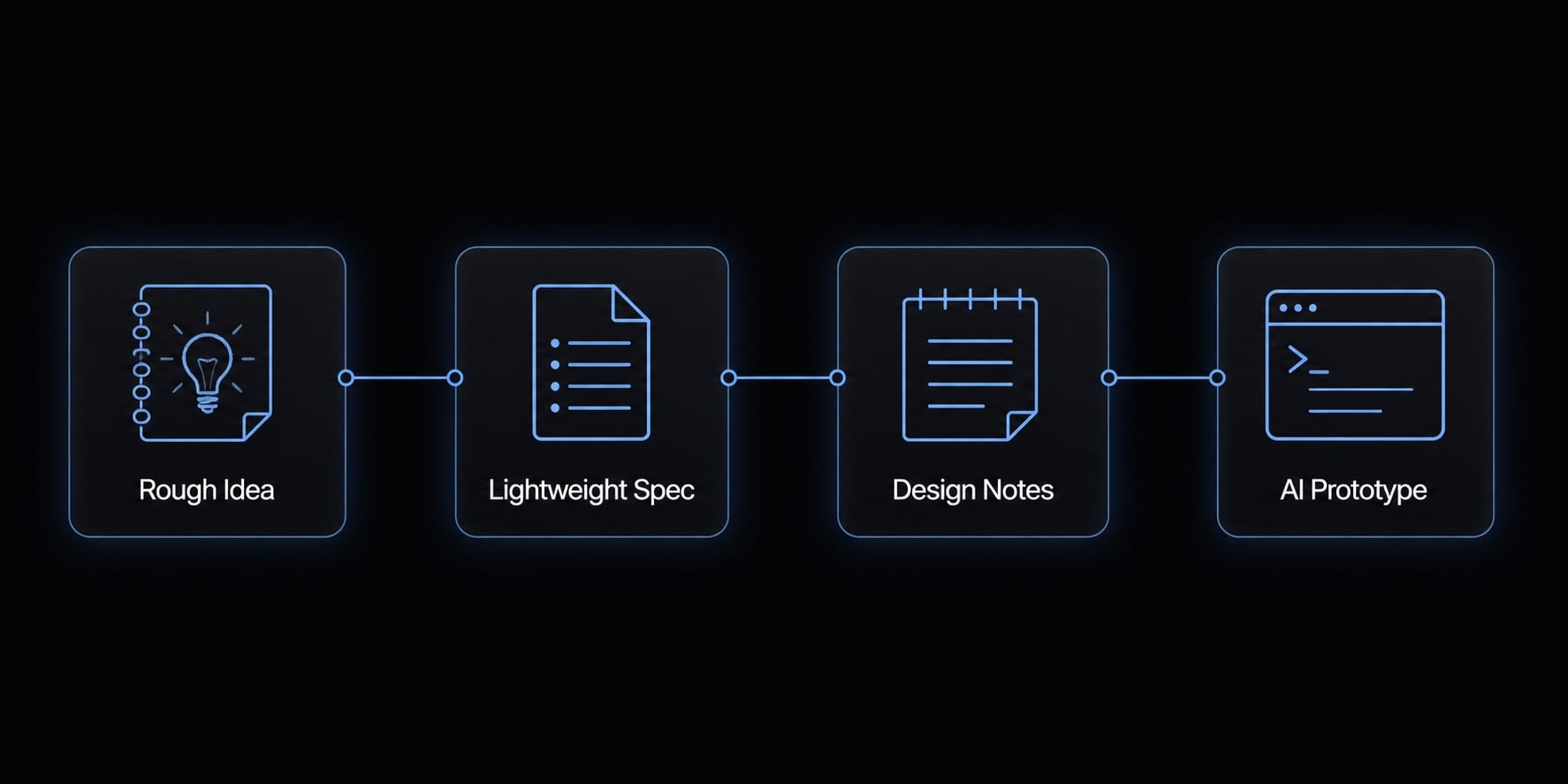
This sequence works because it reduces hidden drift. In real AI agent workflows, the cost of ambiguity compounds quietly. A stable document gives you persistent context and reusable context, which is far more valuable than rewriting intent from memory every time you return to the project.
Why updating the spec is often better than rewriting prompts from scratch
Prompts are transient. Specs are reusable. A prompt may solve the immediate task, but it rarely preserves the rationale behind the decision. That becomes a problem when features expand or the output starts diverging from what you meant.
In spec-driven vibe coding, a mismatch should usually trigger a spec review first. Check whether the intent is unclear, outdated, or missing a boundary. Then adjust prompts or code. This operator habit is simple, but it prevents a common failure mode: Stacking more prompts on top of a broken foundation.
Worked example: Turning a vague app idea into a usable vibe coding spec
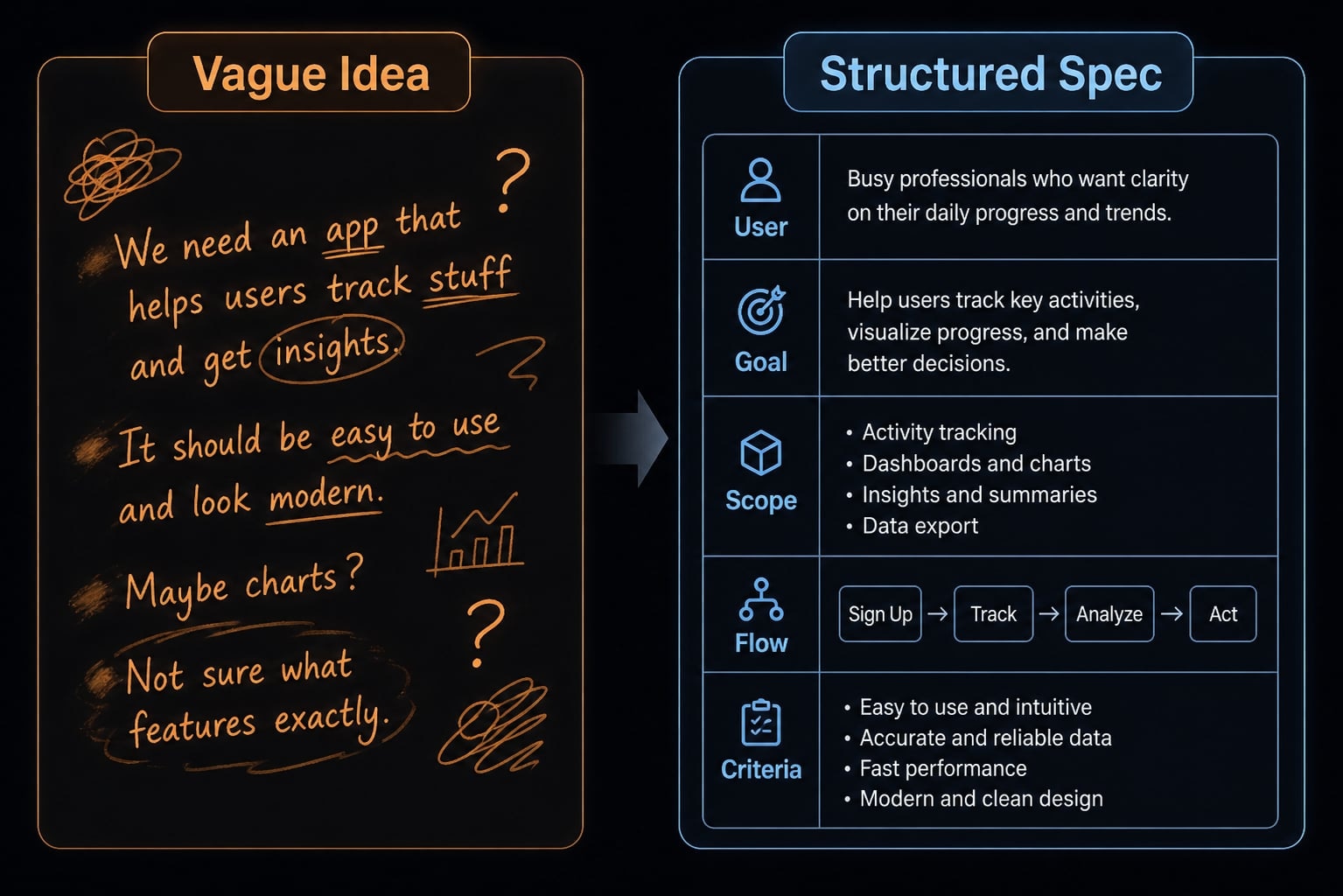
The difference between a vague idea and a usable product spec example is usually not complexity. It is clarity. Even in AI-powered rapid prototyping, a small amount of structure can dramatically improve consistency.
Rough idea version
“Build an app that helps freelancers summarize meetings into action items.”
This is too vague for a reliable vibe coding workflow. The user is broad, the flow is missing, the scope is unclear and there is no success standard.
Lightweight product spec version
This is a small but usable spec:
- User: Freelancers and independent consultants handling many client calls.
- Goal: Generate clear, editable action items from a transcript in under two minutes.
- Scope: Summarize transcript, extract tasks, allow edits before export.
- Core flow: Upload note or transcript → generate summary → edit action items → export.
- Constraint: No calendar integration in v1.
- Acceptance criteria: If owner names or due dates appear in the source text, preserve them in the output.
The improvement here is practical, not theoretical. The AI now has a clearer target user, a defined user flow, a visible boundary, and explicit acceptance criteria. That usually leads to fewer accidental features, fewer clarification loops, and less rework after the first prototype.
Frequently asked questions
What is a vibe coding product spec?
Vibe coding product spec is a concise technical document that bridges the gap between rapid AI-assisted prototyping and structured software development. It serves as a "source of intention," providing enough context to keep AI agents aligned on your project goals without requiring the heavy overhead of traditional enterprise PRDs.
Why does prompt-only building fail as projects grow?
Prompt-only building breaks down because intent remains trapped in transient conversations, leading to "prompt drift." As complexity increases, AI agents lose track of original constraints, features begin to conflict, and rework becomes necessary. A structured spec preserves context, ensuring consistency and maintainability as your prototype scales.
When should I transition from vibe coding to a product spec?
Transition to a lightweight spec when your project moves beyond a solo, low-stakes experiment. If you find yourself repeating instructions, struggling with conflicting features, or needing to align with collaborators, adding a formal spec will reduce coordination costs and prevent the technical debt common in unstructured AI-assisted development.
What are the core components of a minimum viable product spec?
A minimum viable product spec should include six specific sections: a clearly defined problem, the target user, measurable success criteria, defined in-scope and out-of-scope features, a core user flow, and specific acceptance criteria. These elements act as guardrails that focus the AI’s generative capabilities on your business objectives.
How do I use a spec in an AI-assisted workflow?
Adopt a "spec-first, then build" loop: capture your idea, convert it into a lightweight spec, and use that document as persistent context for your AI coding agents. If you need to expand features or change direction, update the spec document first before prompting the agent for new code.
Does a product spec slow down rapid prototyping?
No, when used correctly, it accelerates development. While it requires an initial investment of time, a spec drastically reduces the time spent on "debugging" misaligned features or rewriting failed prompts. By providing clear acceptance criteria, you minimize ambiguity, allowing the AI to generate production-ready code faster and with fewer iterations.
Read more:
- How to vibe code a landing page that actually converts
- How to vibe code: A practical beginner guide to AI development
- Vibe coded websites: Build fast with AI prompt development
Conclusion
Vibe coding is powerful because it compresses the distance between idea and prototype. But once a build becomes real, speed alone is not enough. You need a lightweight way to preserve intent, reduce drift, and keep iteration coherent.
That does not mean writing an enterprise PRD. In most cases, a vibe coding product spec only needs to be clear enough for humans and AI to work from the same understanding. If you want a practical next step, use a lightweight vibe coding product spec template or a simple six-part checklist the next time a promising prototype starts getting messy.