Claude Code Golang: Efficient workflow and best practices
How to use Claude Code for Golang projects
Generated code is not verified engineering. While Claude Code accelerates Go development by editing files and running commands, fast AI output can easily violate architectural or business rules. Go's strict typing and built-in tools (go test, go vet) make it ideal for AI assistance, provided the developer retains final approval. This guide outlines a structured workflow - inspect, configure, plan, implement, validate, and review - to speed up implementation without treating the AI as a production authority.
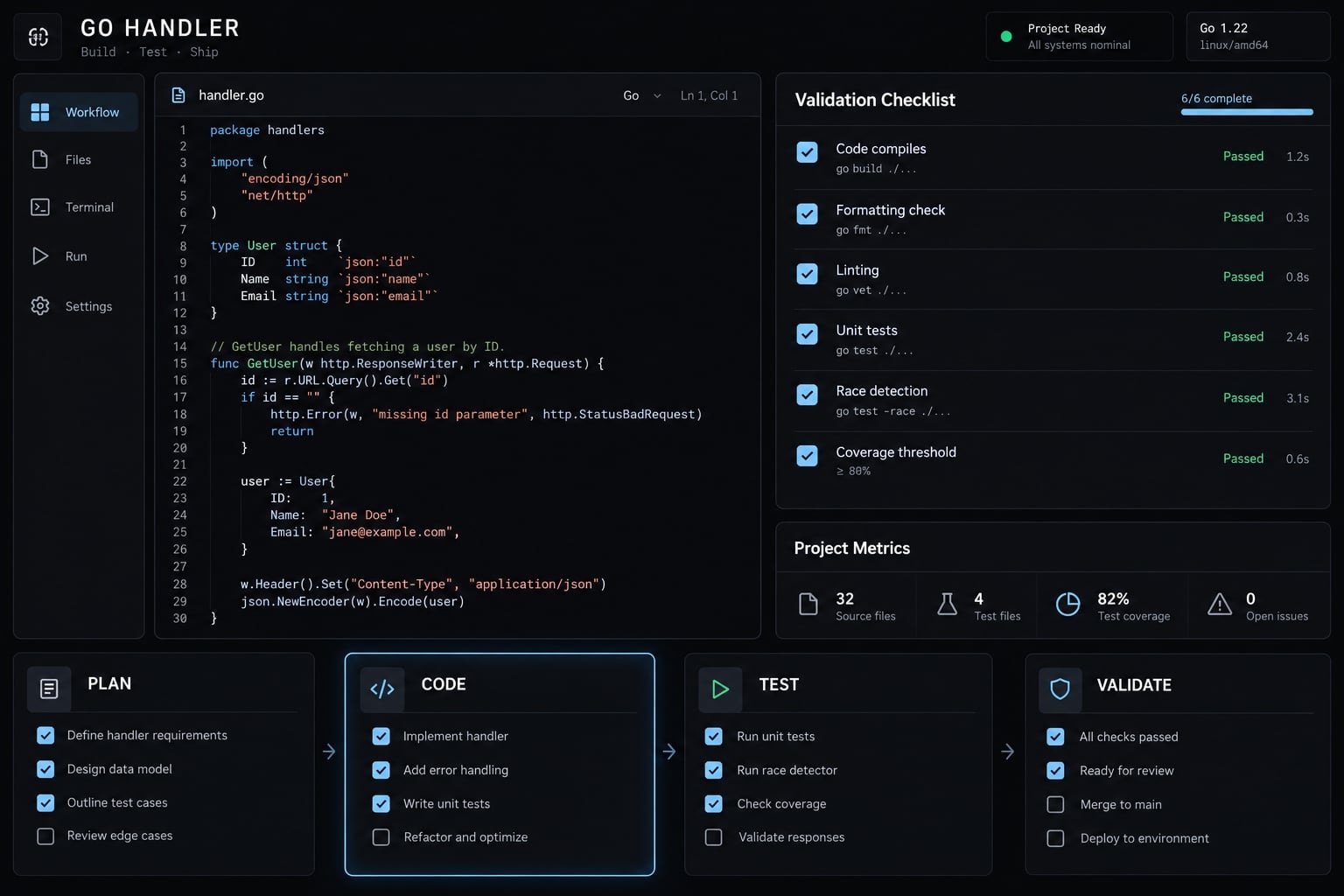
Is Claude Code good for Golang development?
Claude Code is ideal for scoped Go tasks that have clear acceptance criteria, established repository conventions, and automated checks. Go’s compiler, formatting rules, and standard tooling provide fast feedback, improving reviewability. However, Claude Code remains a powerful implementation accelerator for Go, but it is not an authority on architecture, security, or production readiness. Human review is always required.
Suitable starting tasks | Tasks requiring stronger review |
|---|---|
Validation and tests | Concurrency and shared state |
Reproducible bug fixes | Authentication and authorization |
Local handler changes | Migrations and destructive operations |
Repetitive scoped updates | Public API or architecture changes |
Go is inherently well-suited for AI coding agents because gofmt, static typing, explicit package boundaries, and tests constrain many mechanical errors. These controls reduce ambiguity, but they do not prove business correctness or repository fit.
Where Claude Code performs well in Go
A controlled Claude Code Go task usually has observable behavior and a narrow file scope:
- Updating a handler or model from explicit acceptance criteria.
- Adding validation logic with defined failure behavior.
- Creating table-driven tests when that structure improves clarity.
- Applying repetitive changes across a known package.
- Exploring package relationships and tracing straightforward execution paths.
- Running documented build, test, generation, and lint commands.
In practice, the most reviewable tasks are small enough to understand from one diff. Reliability declines when the agent must infer requirements from incomplete documentation.
Where it requires more supervision
Higher-risk work needs a stronger human-in-the-loop process - an explicit approval and review gate before changes are accepted.
- Goroutines, channels, locks, cancellation, and shared state.
- Authentication, authorization, and sensitive data handling.
- Exported interfaces or public API compatibility.
- Database migrations and rollback behavior.
- Destructive infrastructure or deployment operations.
- Ambiguous requirements with undocumented business rules.
- Cross-package architecture changes.
The compiler can detect many type errors. It cannot determine whether a new abstraction matches the team’s architecture. A safe Claude Code Golang workflow treats generated code as a mere starting point rather than final, idiomatic, or production-ready code.
How to set up Claude Code for a Golang project
A safe Claude Code Golang setup begins with repository inspection rather than immediate code generation.
- Open Claude Code from the repository root.
- Inspect
go.mod, documentation, CI files, and package structure. - Identify build, test, lint, and generation commands.
- Define permission and safety boundaries.
- Select a small, testable task.
- Require a plan before edits.
- Run repository validation checks.
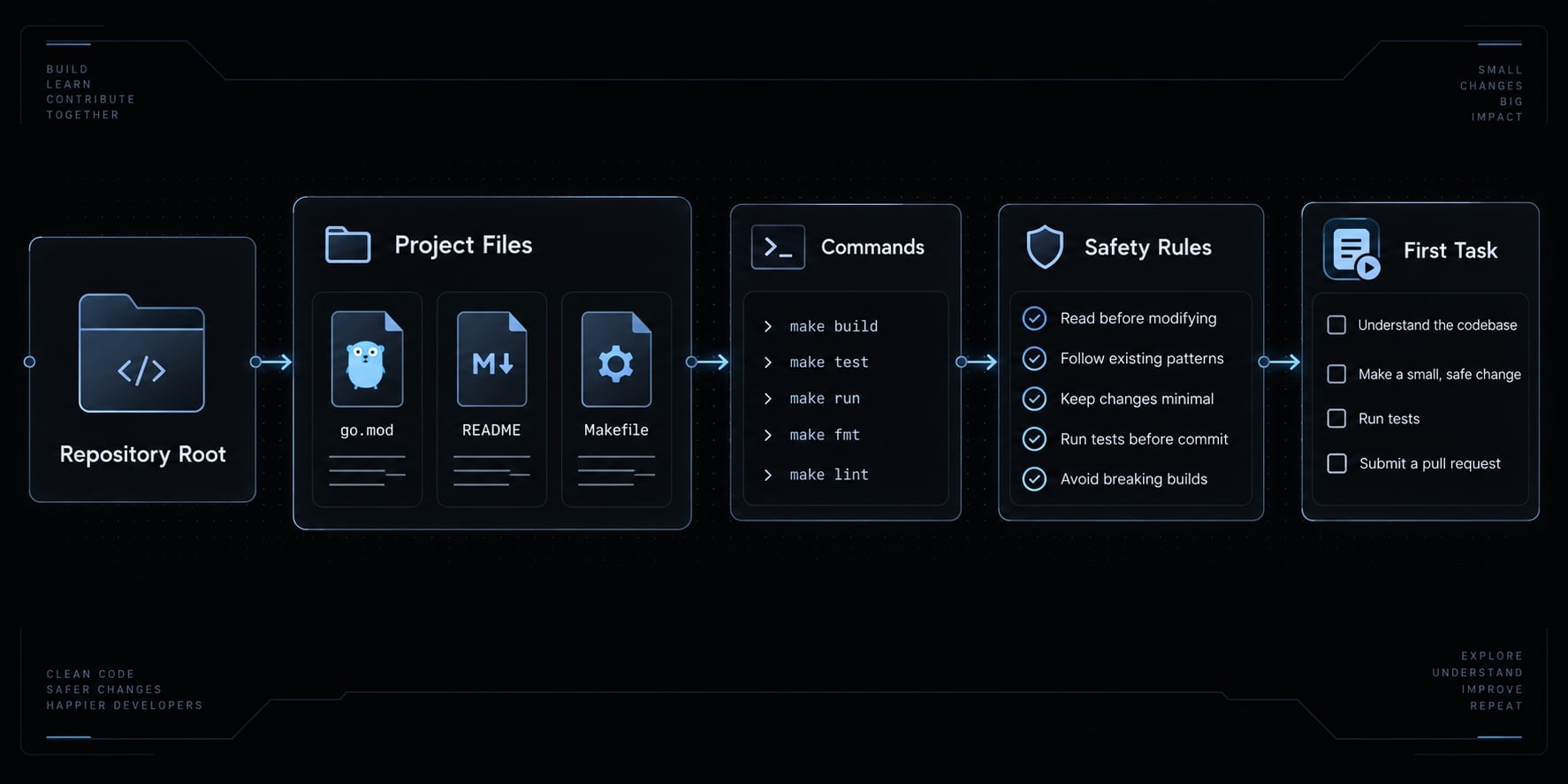
Step 1 - Inspect the repository before coding
Start the Claude Code CLI at the repository root, but prohibit edits during inspection. Repository-specific evidence is more reliable than generic assumptions about Go modules or project structure.
Use this prompt as a starting point:
Inspect this repository without editing files.Summarize:- Module path and Go version from go.mod- Main packages and their responsibilities- Build, test, lint, and generation commands- Existing error, logging, and test conventions- Migrations, schemas, mocks, and generated files- Relevant CI checks- Any unclear ownership or architecture boundariesCite the files supporting each conclusion.Do not implement changes.
Claude Code should examine relevant parts of go.mod, README.md, CI configuration, package-level tests, and task-runner files. It does not need to read every file in a large repository.
Step 2 - Establish safe operating boundaries
Add these restrictions before implementation:
- No unrelated file changes.
- No dependencies without explicit approval.
- No access to
.env, credentials, tokens, or production data. - No destructive database, infrastructure, deployment, or release commands.
- Pause when requirements or package ownership are unclear.
- Report high-impact commands before running them.
- Review changes to
go.modandgo.sum.
Never expose secrets to improve repository context. Keep permissions limited to what the task requires.
Step 3 - Choose a controlled first task
Good first task | Poor first task |
|---|---|
Add input validation | Redesign authentication |
Add focused tests | Modify concurrency-heavy services |
Fix a reproducible local bug | Create schema migrations |
Correct documentation | Redesign a public API |
Refactor code protected by tests | Add cross-repository abstractions |
A suitable first task should produce small reviewable diffs, preserve existing public behavior, and have measurable success conditions.
Create a Go-specific CLAUDE.md file
A Claude Code CLAUDE.md file provides stable repository-level instructions for inspection, editing, testing, and reporting. It should contain actionable coding rules, operating boundaries, and repository validation commands. Temporary ticket details belong in the task prompt or plan. Never place secrets, credentials, production data, or environment-specific values in this file.
Anthropic documents project memory and instruction behavior in its official Claude Code documentation. Confirm current file placement and precedence before publication because product behavior can change.
Minimal CLAUDE.md template for Go
The following Golang CLAUDE.md example is a baseline. Replace generic commands with the repository’s actual CI or task-runner commands.
# Repository- Inspect relevant code before proposing changes.- Do not edit files until the implementation plan is approved.- Keep changes limited to the accepted task scope.# Go conventions- Run gofmt on changed Go files.- Preserve package boundaries and public API compatibility.- Handle errors explicitly; do not silently ignore failures.- Pass context.Context through existing request boundaries.- Do not add dependencies, interfaces, or exported symbols without justification.# Testing- Match existing test conventions.- Add failure-path tests for changed behavior.- Use table-driven tests when they improve clarity.# Validation- Run repository-specific checks first.- Baseline: go test ./... and go vet ./...- Run go test -race ./... for relevant concurrency changes.- Report every check as passed, failed, skipped, or unavailable.# Workflow- Inspect, plan, request approval, implement, validate, and summarize.- Report changed files, assumptions, command results, and remaining risks.
These Go coding instructions reduce ambiguity without assuming model output is deterministic. Explicit scope and validation create a more predictable process.
What to customize for each repository
Replace generic guidance with verified local rules:
- Actual
make, CI, or task-runner commands. - Package responsibilities and ownership boundaries.
- Mock and code-generation commands.
- Migration, rollback, and staging requirements.
- Dependency approval rules.
- Error wrapping and logging conventions.
- Metrics, tracing, and observability patterns.
- Integration-test commands and required services.
- Coverage thresholds where the team enforces them.
- Platform constraints and build tags.
Repository commands take priority over generic go test ./... or go vet ./... examples.
What not to put in CLAUDE.md
Exclude:
- Secrets, tokens, credentials, and
.envvalues. - Temporary ticket acceptance criteria.
- Contradictory or obsolete instructions.
- Vague demands such as “write flawless code.”
- Complete architecture documents.
- Unapproved deployment commands.
- Rules that bypass testing or human review.
Stable repository instructions belong in CLAUDE.md. Task-specific behavior belongs in the current prompt or approved plan.
Use a plan–implement–validate workflow
An agentic development workflow is a structured process in which an AI agent performs repository tasks under explicit scope, approval, and review controls. Planning is not administrative overhead; it separates analysis from implementation and makes scope creep visible.
- Inspect the relevant code without editing.
- Produce a file-level implementation plan.
- Approve the scope before editing.
- Implement the smallest valid diff.
- Validate the change and review the diff.
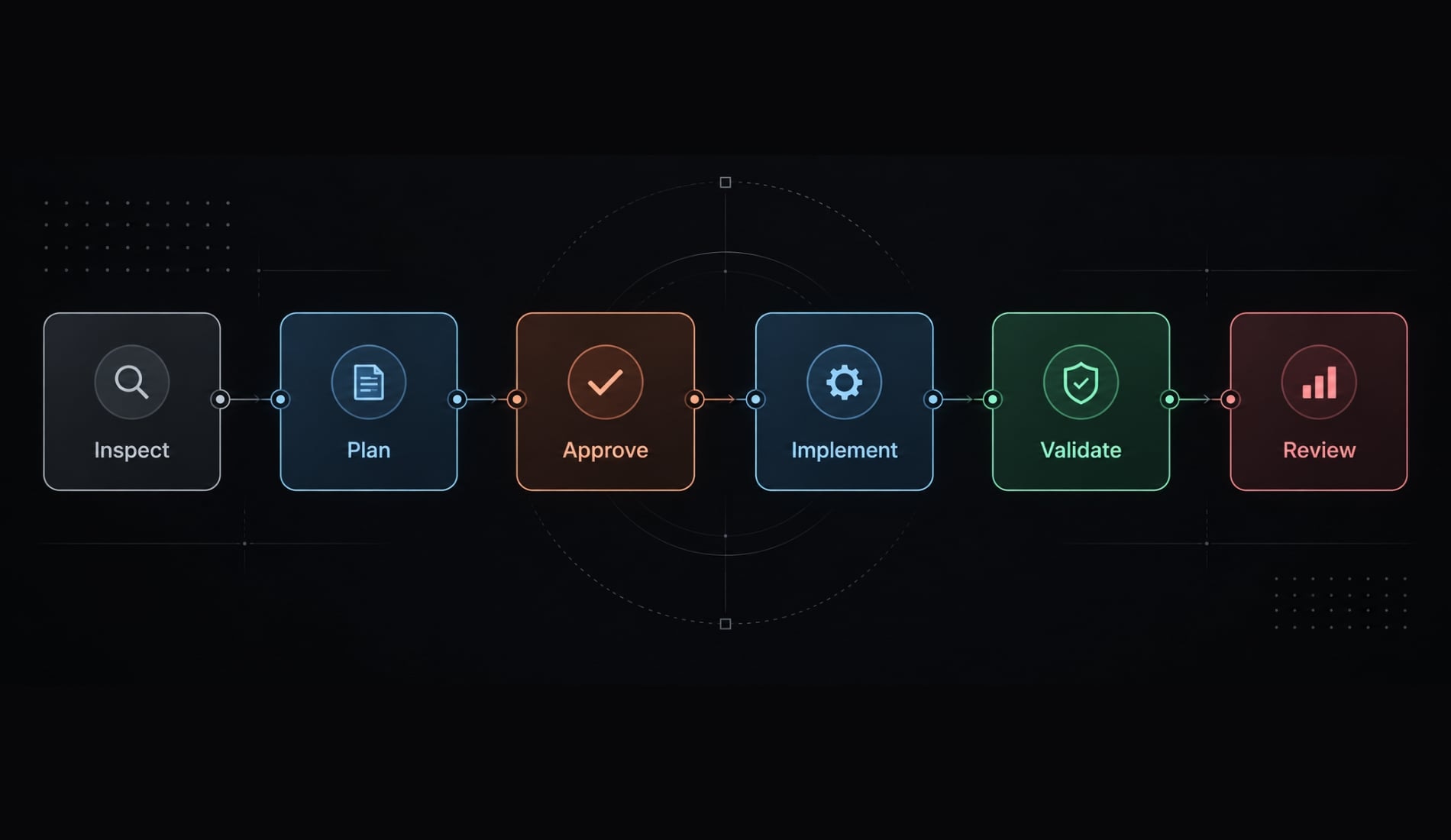
1. Inspect the relevant code
Ask for evidence and a concise summary, not private reasoning:
Inspect the code relevant to this task without editing files.Identify current behavior, entry points, relevant packages,tests, interfaces, dependencies, and error-handling patterns.List ambiguities, assumptions, and risks. Cite relevant files.
The inspection should reveal what the repository does today and where the smallest defensible change belongs.
2. Produce a file-level plan
Create an implementation plan without editing files.For each proposed file, state:- Why it must change- Expected behavior change- Test additions or updates- Validation commands- Risks and assumptionsExclude unrelated cleanup and speculative abstractions.
Reject plans containing broad refactoring, new dependencies, or package changes unrelated to the acceptance criteria. Effective deterministic coding means using deterministic checks and explicit constraints-not expecting identical model output every time.
3. Approve the scope before editing
Apply a human-in-the-loop approval gate:
- Acceptance criteria are measurable.
- Every proposed file is justified.
- No unrelated refactoring is included.
- Dependency changes are expected and approved.
- Public API impact is understood.
- Schema changes receive separate approval.
- The task fits one reviewable pull request.
Do not combine plan approval with implementation for high-impact changes.
4. Implement the smallest valid diff
Implement only the approved plan.Preserve existing public behavior unless the task changes it.Match local package, error, logging, and test conventions.Do not add speculative abstractions or dependencies.Stop and report if architecture or public API changes are required.
The implementation should match existing patterns rather than impose generic design preferences. Do not let blockers justify unapproved scope expansion.
5. Validate and summarize
Run the approved repository validation commands.Report:- Exact commands and results- Passed, failed, skipped, or unavailable checks- Changed and untracked files- Assumptions and remaining risks- Human verification still requiredDo not conceal failures or modify tests only to force a pass.
Good context window management also matters. When old exploration begins conflicting with the accepted plan, summarize the scope and start a fresh session. Preserve acceptance criteria, approved files, and unresolved risks. Keep permanent rules in CLAUDE.md rather than relying on an indefinitely long conversation.
Practical example: Add validation and tests to a Go handler
This Claude Code Go example applies the workflow to a narrow backend task: A create-user HTTP handler must reject a missing or blank email.
Define the task and acceptance criteria
Update the create-user HTTP handler so that:- A missing or blank email returns HTTP 400.- Existing valid requests behave exactly as before.- The existing error response format is preserved.- Tests cover valid, missing, and blank email values.- No new dependencies are added.- No unrelated handlers or packages are changed.Inspect first and provide a file-level plan before editing.
This prompt defines behavior, protects existing functionality, specifies failure cases, and constrains AI code generation for Golang. It is more reviewable than “improve user validation.”
Review the proposed plan
Before approving the Go handler validation change, verify:
- Only the handler and related test file change unless evidence requires more.
- No validation package is introduced for one local rule.
- No interface is added without a real boundary or testing need.
- Trimming whitespace is explicitly included or excluded.
- Tests assert both HTTP status and the existing error response.
- Table-driven tests are used only if they make cases clearer.
Implement and run checks
Use repository commands first. Otherwise, these are reasonable baselines:
gofmt -w path/to/changed/filesgo test ./...go vet ./...
Replace the placeholder with actual changed files. Run go test -race ./... only if the implementation affects concurrency or shared state. Do not run go mod tidy unless a justified module change occurred.
Stage | Expected Output |
|---|---|
Inspect | Existing handler, tests, and error patterns |
Plan | Justified handler and test file changes |
Implement | Minimal validation diff |
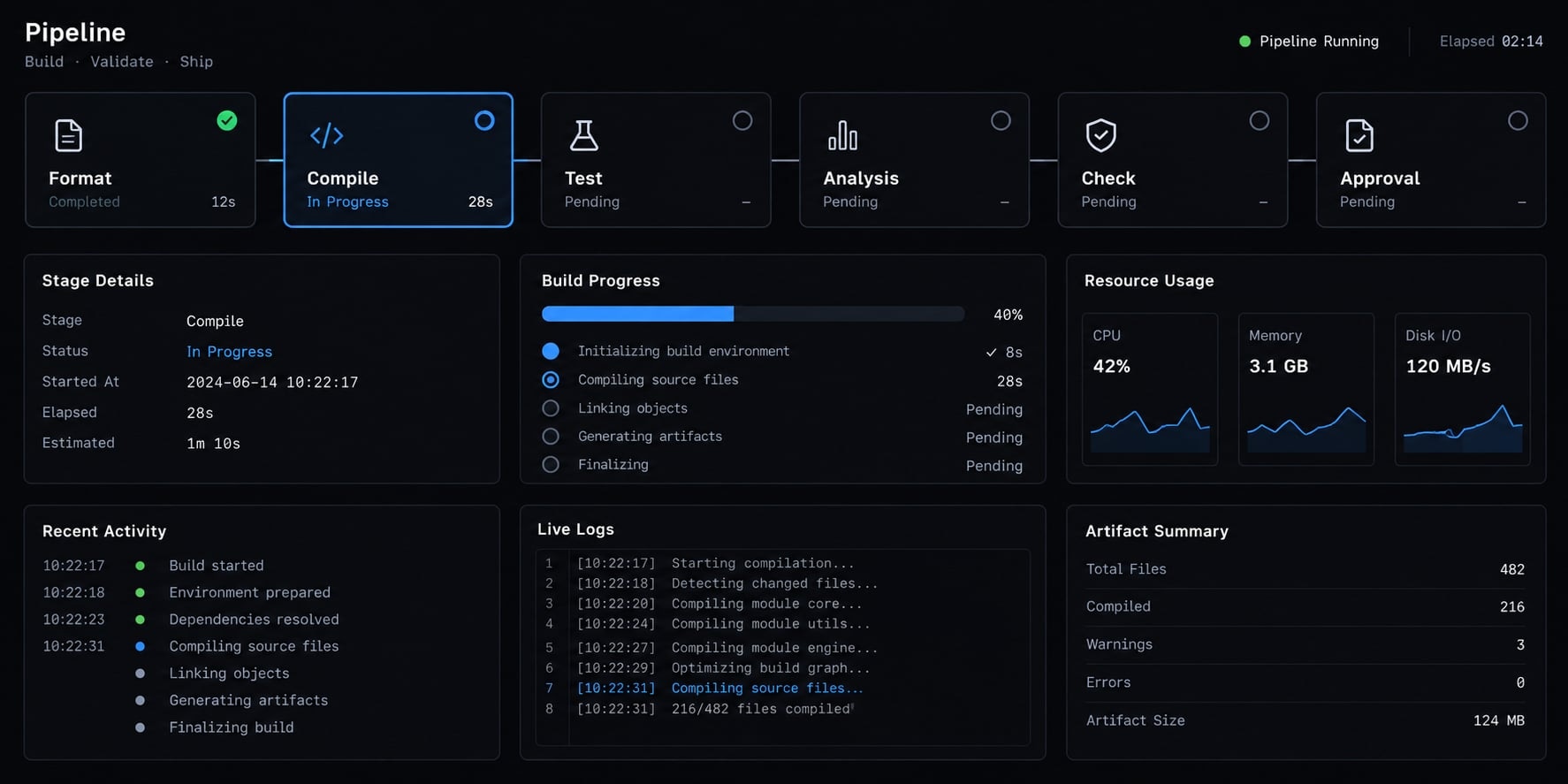
Validate | Formatting, tests, and static analysis |
Review | Behavior, scope, and error handling |
During Go code review, a developer may still need to remove an unnecessary helper, revert unrelated formatting, or restore the existing error envelope. Passing checks does not eliminate the human-in-the-loop requirement.
Validate Claude-generated Go code before accepting it
Automated checks establish a baseline for Go code quality. They do not prove business correctness, architectural fit, maintainability, or security.
Check | Baseline command or action | What it detects | Important limitation |
|---|---|---|---|
Formatting |
| Nonstandard Go formatting | Does not assess design |
Tests |
| Compilation and tested package behavior | Coverage may be incomplete |
Static analysis |
| Suspicious constructs | Not a security guarantee |
Race detection |
| Runtime data races in exercised paths | Use for relevant shared-state changes |
Module review | Inspect | Added or removed dependencies | Requires human justification |
Diff review |
| Untracked, unrelated, or oversized changes | Requires engineering judgment |
Review the diff, not only the final test result
A disciplined Go code review should confirm:
- Changed files match the approved plan.
- No unrelated cleanup appears.
- Code growth is proportionate to the task.
- New exported identifiers are justified.
- Public behavior changes are intentional.
- Errors are handled explicitly.
- No silent fallback was introduced.
- Dependencies are expected.
- Tests fail against the previous incorrect behavior.
- Generated files and migrations are intentional.
git statusshows no unexpected untracked files.
Tests can pass while validating the wrong assumption. Claude Code also cannot verify undocumented business rules.
Apply stronger checks to high-risk changes
Risk area | Additional control |
|---|---|
Authentication and authorization | Security review and negative-path tests |
Concurrency | Race detector, cancellation, and shared-state review |
Database changes | Migration, rollback, backup, and staging validation |
Public API | Compatibility and consumer-impact review |
Infrastructure or deployment | Restricted permissions and separate approval |
Claude Code Go testing should disclose failed, skipped, or unavailable checks. Transparent results are essential to credible code quality assurance.
Common Claude Code mistakes in Golang projects
Many agent output errors begin with weak requirements, incomplete context, or inadequate review rather than the model alone.
Common mistake | Why it happens | How to prevent it |
|---|---|---|
Unnecessary interfaces | Generic abstraction patterns override local needs | Require a consumer or testing justification |
Oversized changes | File scope was never approved | Define files and acceptance criteria first |
Ignored errors | Success paths dominate the prompt | Require explicit failure handling and tests |
Extra packages or wrappers | Reuse is assumed prematurely | Prefer local changes until reuse is demonstrated |
Invented or outdated APIs | Repository or version context is missing | Verify |
Weak tests | Expected behavior is underspecified | Define failure cases and regression behavior |
Context drift | Long sessions accumulate conflicting instructions | Summarize decisions and restart with approved scope |
Avoid unnecessary abstraction
Go interfaces are useful when they represent a genuine boundary, support a clear consumer, or improve testability. They are not inherently good or bad.
Require Claude Code to justify every new:
- Interface.
- Package.
- Wrapper.
- Dependency.
- Exported symbol.
For scoped AI code refactoring, consistency with the existing repository usually matters more than speculative extensibility.
Keep context focused
Practical context management follows several rules:
- Load only files relevant to the current task.
- Keep stable rules in
CLAUDE.md. - Keep temporary requirements in the task prompt.
- Summarize accepted decisions before resetting context.
- Start a fresh session when earlier exploration creates conflicts.
- Preserve acceptance criteria and approved scope across sessions.
A larger context does not automatically produce better output. Unstructured “vibe coding” often creates broad plans and difficult reviews.
Do not delegate final responsibility
These Claude Code Go best practices reduce risk but do not transfer accountability. Passing tests does not guarantee product correctness. Undocumented business rules remain unverifiable. Architecture, security, maintainability, data migrations, and release approval remain the engineering team’s responsibility for all production code.
A repeatable Claude Code Golang workflow
Effective Claude Code Golang use depends on explicit repository rules and narrowly defined behavior. The repeatable process is straightforward:
- Inspect the repository.
- Define stable rules in
CLAUDE.md. - Approve a file-level plan.
- Implement a small diff.
- Run repository-specific validation.
- Complete human review.
This Claude Code Go workflow supports faster AI-assisted programming without weakening normal production controls. Developers still own architecture, security, acceptance, and release decisions.
Copy the Go CLAUDE.md starter and validation checklist above, or save it as a reusable Go development checklist for your team. AgentKit can package these repository instructions and validation gates into repeatable workflows for teams coordinating multiple coding agents.
Frequently asked questions
Is Claude Code a reliable tool for professional Golang development?
Claude Code is an effective implementation accelerator for narrow, well-defined Go tasks. While it produces compilable code, its reliability depends on your repository-specific automated checks, package conventions, and rigorous human review. It should be treated as an assistant for scoped implementation, not an autonomous authority for architecture or production systems.
How does Go's language design help when working with Claude Code?
Go is highly suitable for agentic coding because its opinionated design-enforced via gofmt, static typing, and single build systems-reduces the ambiguity models face. These tools provide fast feedback loops, allowing you to catch syntax or type errors instantly, which keeps the agent aligned with your existing repository patterns.
What is the purpose of a CLAUDE.md file in a Go project?
A CLAUDE.md file acts as a permanent, repository-level instruction set for coding agents. It encodes stable rules, such as required validation commands (go test, go vet), package boundaries, error-handling conventions, and operating boundaries, ensuring the agent adheres to your team’s specific standards across every session.
What workflow should I use when using Claude Code for Go tasks?
Use a Plan–Implement–Validate workflow:
- Inspect code without editing.
- Produce a file-level implementation plan.
- Approve the specific file scope and acceptance criteria.
- Implement the smallest valid diff.
- Execute repository-specific validation commands (like
go testandgofmt) and perform a manual diff review.
Which validation commands should I run before accepting code changes?
Always run the repository’s standard CI commands before approval. This typically includes gofmt to verify formatting, go test ./... to ensure behavioral correctness, and go vet ./... to detect suspicious constructs. For concurrency-heavy changes, incorporate the race detector (go test -race ./...) and always manually review the resulting git diff.
How can I prevent Claude Code from making common Go mistakes?
Prevent errors by enforcing a narrow file scope and providing clear, measurable acceptance criteria in your task prompts. Avoid asking the agent for broad refactoring or speculative abstractions; instead, explicitly restrict it from adding unnecessary interfaces, wrappers, or dependencies unless they directly support the current task's requirements.
Does Claude Code handle authentication and database migrations safely?
No. High-risk operations like authentication changes, schema migrations, and infrastructure deployments should be restricted from agent access. These tasks require dedicated human supervision, manual testing, and separate security-focused code reviews to ensure system integrity, as AI agents are not yet suitable for managing production-level destructive operations.
Conclusion
Claude Code is a powerful accelerator for Golang development, but it thrives on strict boundaries rather than total autonomy. By leveraging Go’s built-in constraints alongside a disciplined workflow-inspecting the repository, enforcing a strict file-level plan, and relying on native tools like go test and go vet-teams can drastically speed up implementation without sacrificing quality.
Ultimately, while AI can write code and run tests, it cannot replace engineering judgment or navigate undocumented business rules, requiring developers to keep tasks narrowly scoped and treat the agent as a highly capable assistant rather than a final production authority.
Read more: