
Vibe coding refactor: A practical workflow for safer changes
While AI-generated prototypes can accumulate technical debt and become hard to modify, this outcome is preventable through supervised development where understanding and validation—not generation speed—form the true bottleneck. Instead of relying blindly on vibe coding, developers must recognize when to continue, refactor, or rewrite an implementation, using bounded workflows to preserve functional behavior and restore accountable ownership.
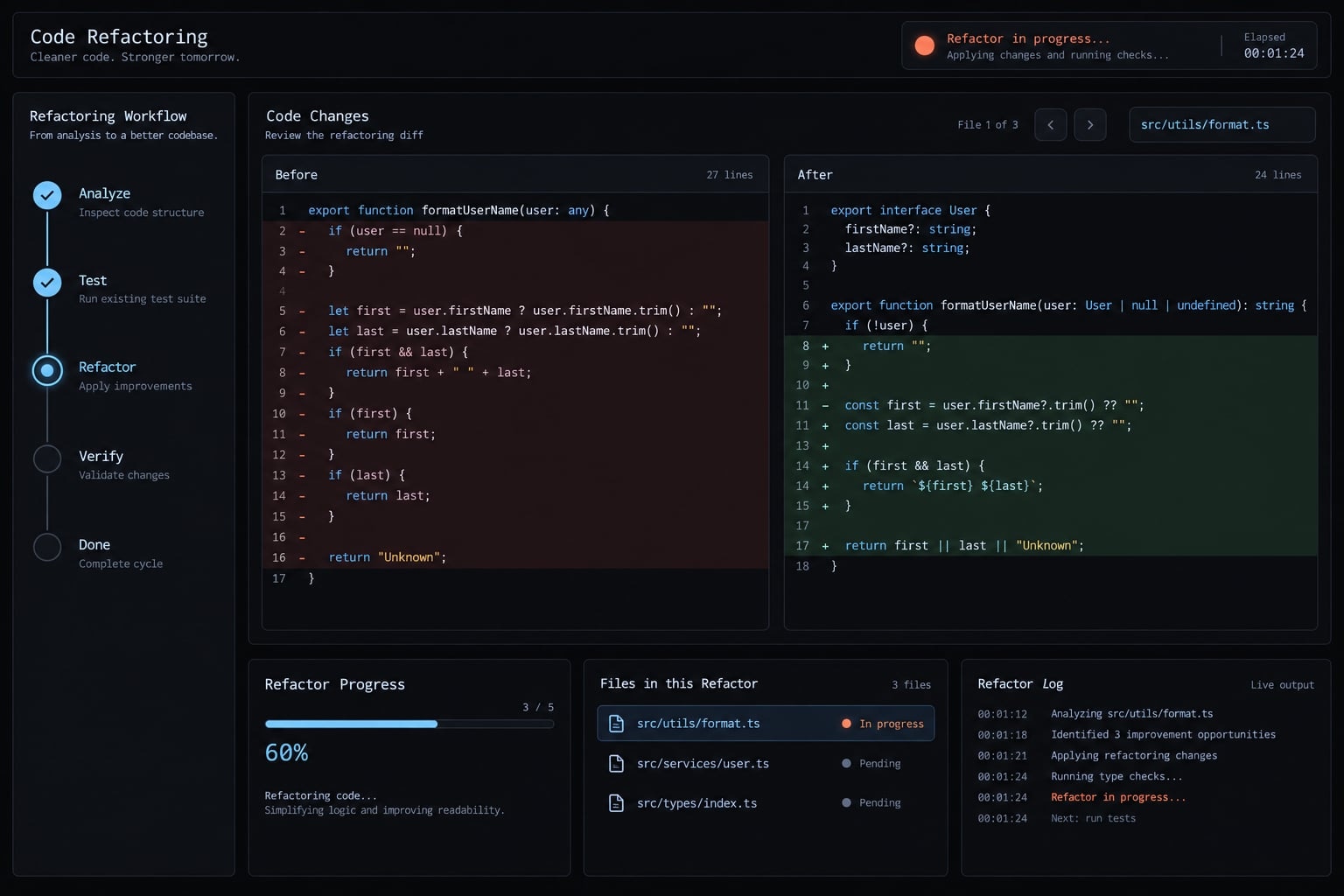
What does “Vibe coding refactor” mean?
A vibe coding refactor is a practical description of restructuring code produced through prompt-led development while preserving its intended external behavior. It aims to improve understanding, testability, and maintainability through bounded changes, protective tests, and human review - not simply make AI-generated code look cleaner or introduce new functionality.
Martin Fowler’s Definition of Refactoring anchors the distinction: internal structure changes without changing observable behavior.
- Refactoring: Reorganize implementation while preserving behavior.
- Bug fixing: Intentionally correct faulty behavior.
- Rewriting: Replace an implementation.
- Feature development or security remediation: Introduce or correct capabilities and protections; review these separately.
“Clean up this repository” leaves the target, protected behavior, prohibited changes, and acceptance criteria undefined. Acceptance criteria are the checks that determine whether the work is complete.
An agent might remove an important edge case while improving readability. Better-looking code is not evidence of success; a human must approve the scope and resulting changes.
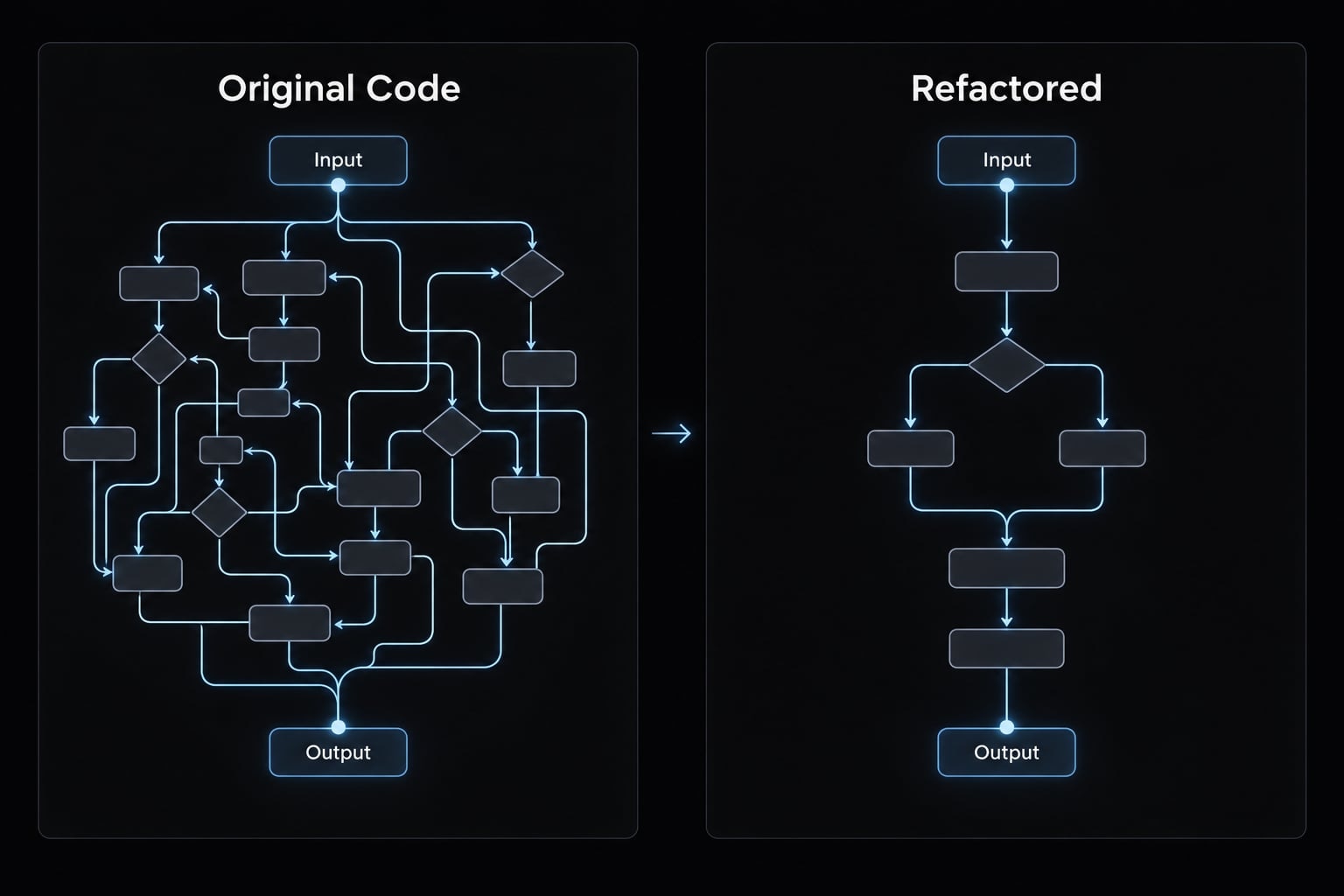
Why vibe-coded projects become hard to change
Repeated local changes can create inconsistent rules and unclear boundaries. Those inconsistencies make understanding and validation harder, increasing regression risk - the likelihood of unintentionally breaking previously working behavior.
For example, separate organization-settings forms may acquire nearly identical validation functions. Later prompts update one function but miss another. Identifier naming drifts, hidden dependencies accumulate, and a bloated settings module absorbs permissions, billing, and integration concerns.
Context window limits contribute when an agent lacks relevant code, conventions, or prior decisions in its active context. But context size is not the only cause. Weak specifications, missing tests, and unclear ownership also matter.
There is no universal codebase-size threshold beyond which agents become unreliable. The practical consequences are slower releases, difficult handoffs, and more debugging effort.
Seven signs it is time to stop adding features and refactor:
- Small changes touch unrelated files. The dependency chain is unclear or unnecessarily broad.
- Previously working behavior repeatedly breaks. Repairs create new regressions elsewhere.
- Business rules are duplicated. Similar implementations drift without coordinated updates.
- No responsible developer can explain the data flow. Inputs, decisions, and side effects remain uncertain.
- Tests are absent, weak, unreliable, or weakened to pass. Validation cannot support confident changes.
- Large modules absorb unrelated features. New work defaults to the same expanding file.
- Production exposure or team handoff is approaching. This triggers a readiness review, not an automatic requirement to refactor.
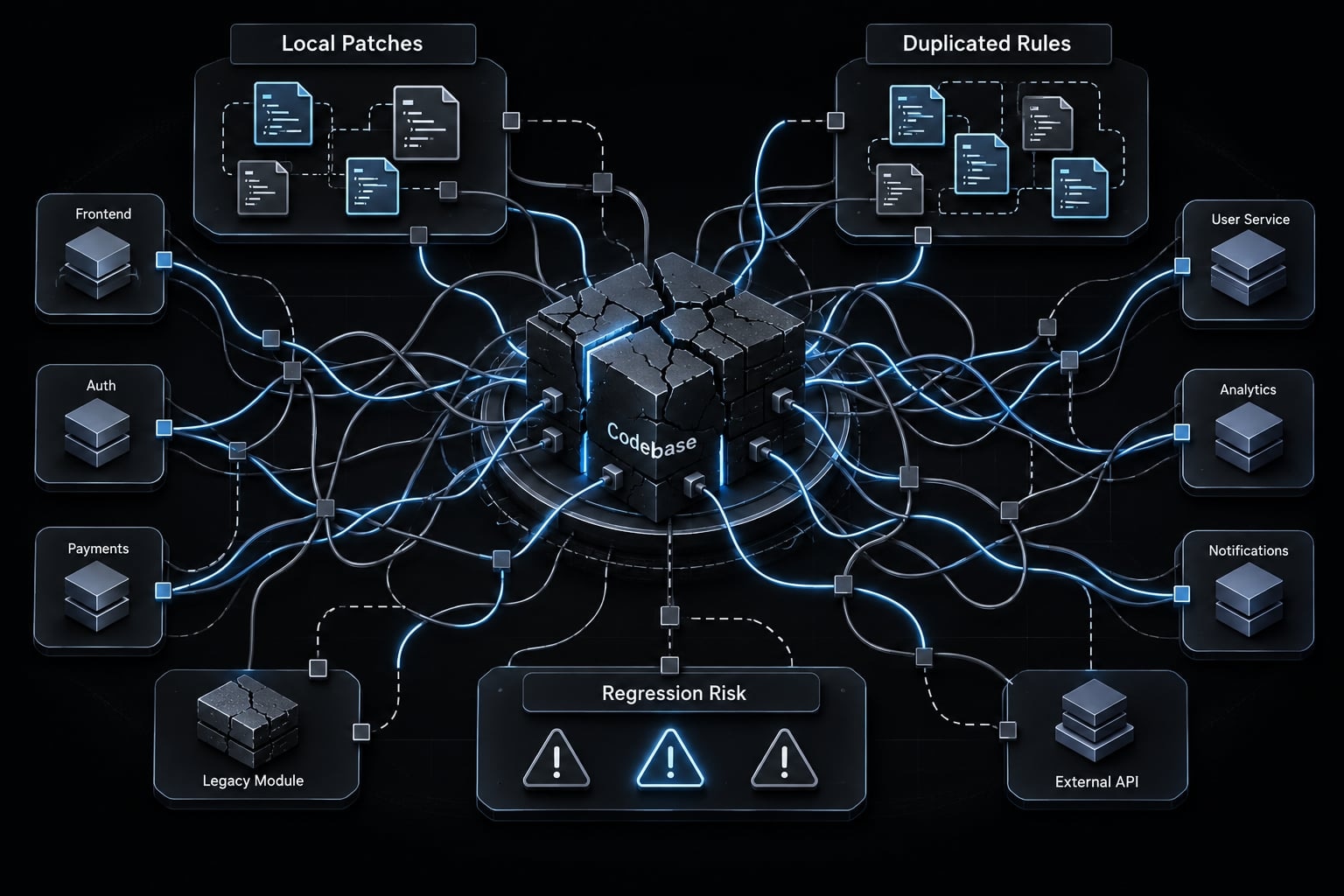
Should you continue, refactor or rewrite?
Evaluate four things: The value of existing behavior, structural fitness, validation confidence, and migration consequences. AI-generated code does not automatically require restructuring, and production exposure alone does not justify replacement.
Condition | Recommended action | Reason |
|---|---|---|
Disposable prototype; no important data or users | Continue experimenting | Avoid restructuring something you may discard. |
Understandable structure and reliable checks | Continue incrementally | Existing controls may be sufficient. |
Valuable behavior; inconsistent implementation | Refactor incrementally | Preserve working value while improving structure. |
Important but poorly understood behavior | Establish a baseline first | Add evidence before changing what you cannot evaluate. |
One unsuitable module | Consider bounded replacement | Contain affected behavior and migration work. |
Unverifiable authentication, payments, or data integrity | Stop for qualified review | Consequences take priority over feature speed. |
Disposable behavior and fundamentally unsuitable architecture | Consider a controlled rewrite | Replacement may be justified after assessing transition costs. |
The real question isn't 'Did AI write this?' but rather 'Do we understand, verify, and safely change this implementation?
A bounded rewrite replaces a limited component, ideally behind a stable interface. Compare old and new behavior before switching consumers. Account for compatibility and data migration. Recovery may be easier when the original implementation remains usable, but shared data changes can eliminate that advantage.
Prepare the codebase before refactoring
Establish a verified baseline before editing. Characterization tests capture what existing code currently does; they do not establish that every recorded behavior is desirable. Michael Feathers describes this approach in Working Effectively with Legacy Code.
Complete seven preparation checks:
- Run the application in a known environment.
- Run existing checks; assess documented failures and resolve critical unexplained blockers.
- Record current behavior separately from known defects.
- Establish a verified version-control checkpoint.
- Name the target and file boundaries.
- Identify dependencies, data stores, and sensitive paths.
- Separate feature development from restructuring.
Never weaken tests merely to accommodate a changed implementation.
Invariants are behaviors or contracts that must remain unchanged during this task:
- Inputs, outputs, and API contracts - the interfaces consumers rely on.
- Database effects and error handling.
- Permissions and user-visible workflows.
- Relevant performance expectations.
Require approval for changes to these invariants. Intentional behavior changes belong in separately classified work.
A Git revert reverses code changes; it does not automatically reverse database writes, messages, payments, or external effects. Plan data recovery separately.
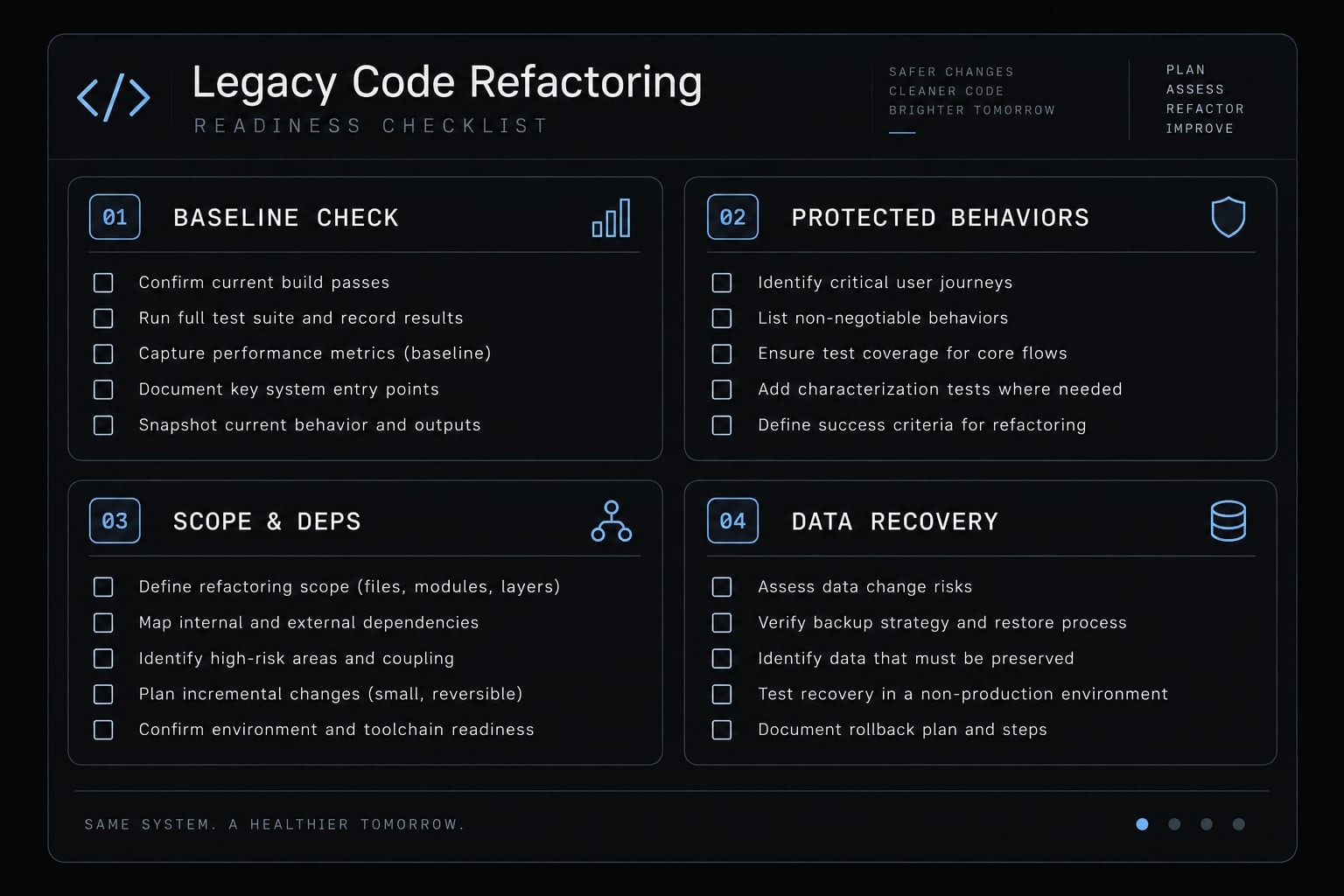
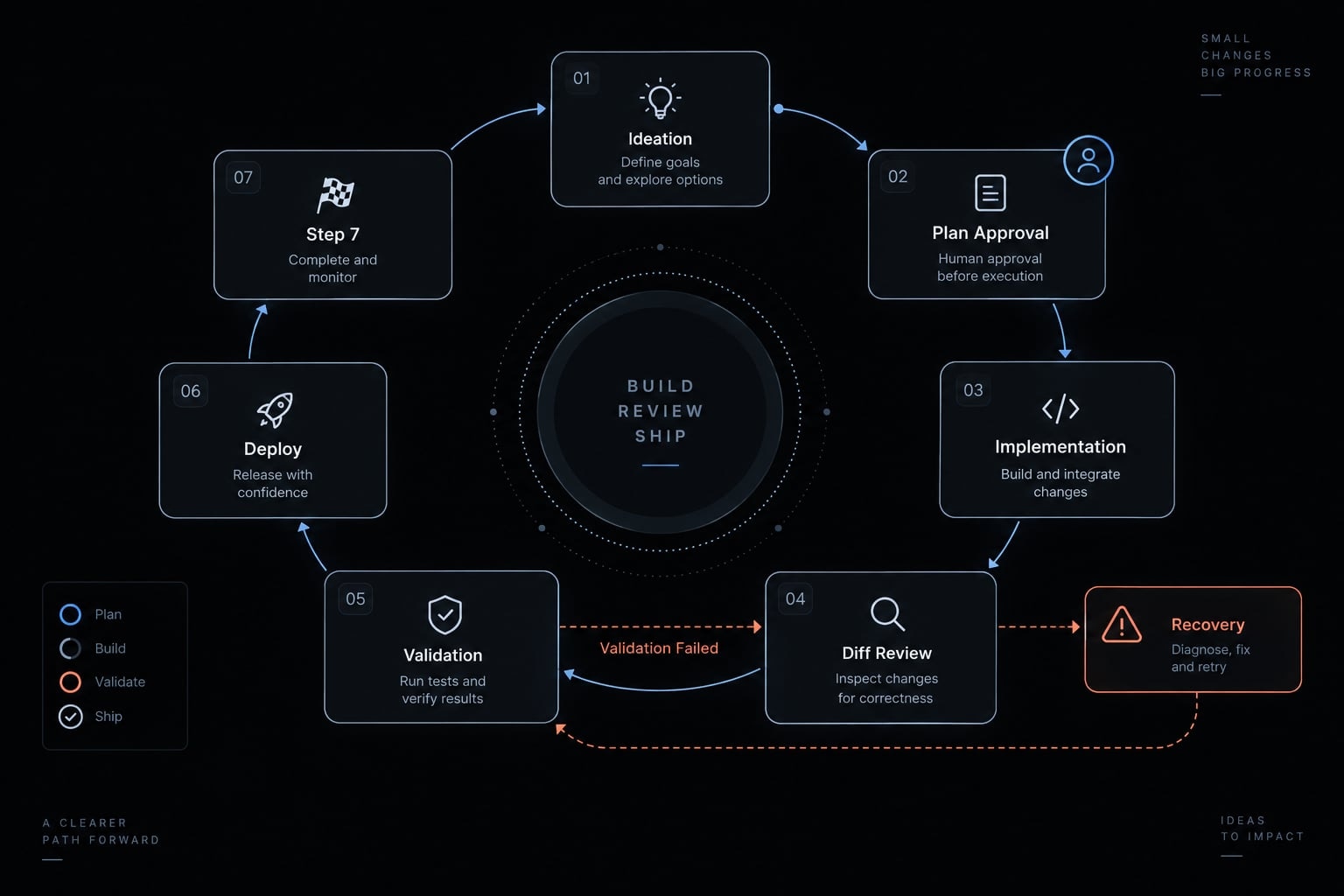
A seven-step vibe coding refactor workflow
Each step should produce inspectable evidence before the next begins.
- Choose one bounded area.
- Record current behavior.
- Add or verify protective tests.
- Map the code before editing.
- Make small, reversible changes.
- Review the diff and run checks.
- Document the structure and ownership.
Choose one bounded area
Select one module or duplicated concern with an observable maintenance problem. For example: organization-settings forms repeat validation, making rule updates difficult to coordinate.
Name allowed files, prohibited changes, and acceptance criteria. Exclude changes to permissions, database structure, and user-visible behavior.
Complete when: A reviewer can identify exactly what may change and what must remain unchanged.
Record current behavior
List inputs, outputs, failure cases, and side effects using tests, documentation, logs, or approved observations.
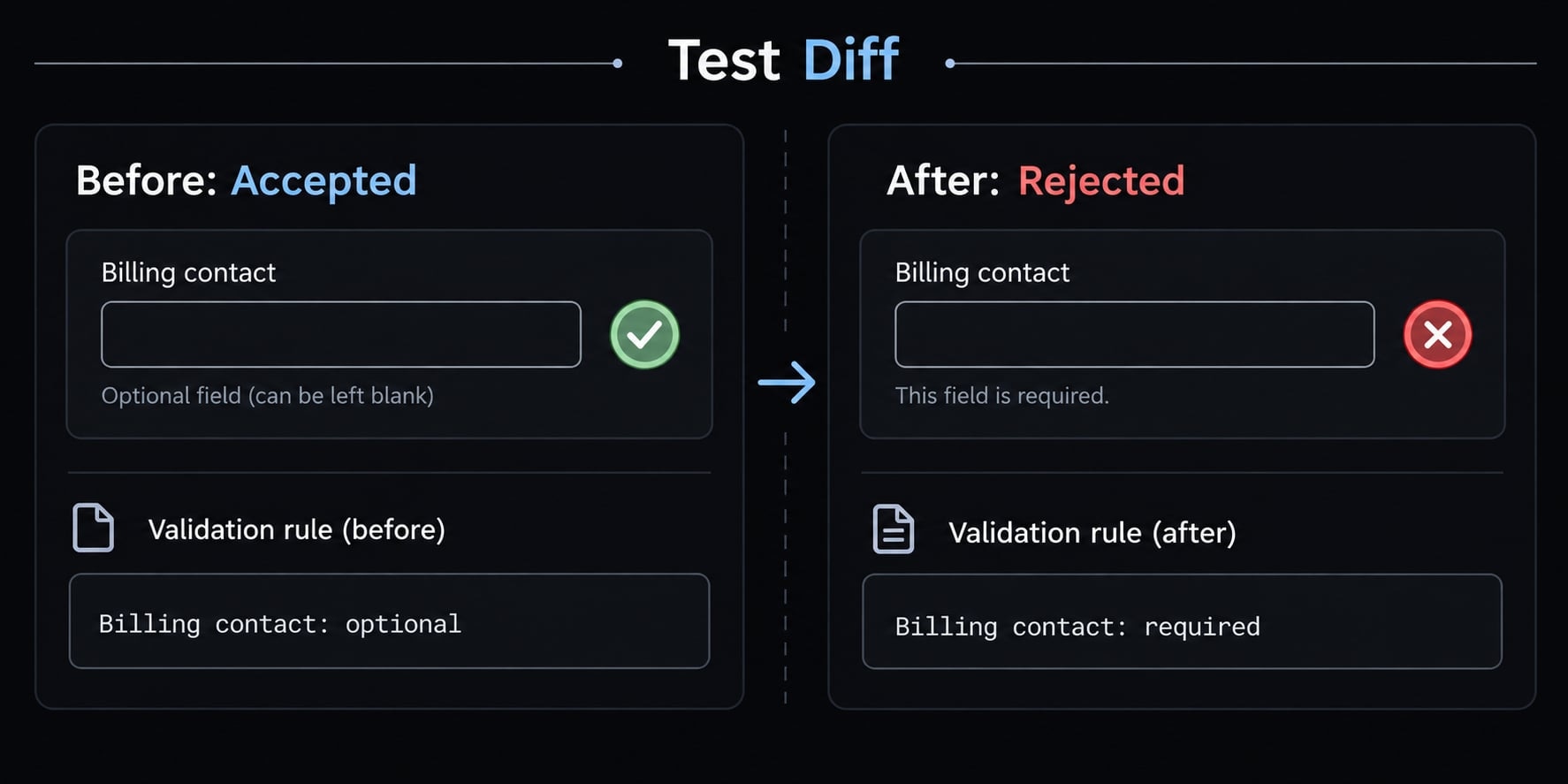
For the settings form, record that the optional billing-contact field accepts blank input. Identify sensitive customer-data paths and track known defects separately. Use sanitized examples, not unrestricted production data in agent prompts.
Complete when: The owner can describe expected outcomes for the targeted paths.
Add or verify protective tests
Run existing checks before editing. Add targeted tests for a successful update, an important edge case, and a failure path.
Verify that assertions would detect the intended failure - for example, rejection of a permitted blank value. Humans approve expected behavior even when AI drafts tests.
Coverage percentage alone does not establish test quality.
Complete when: Tests provide meaningful evidence about the behavior being protected.
Ask the agent to map the code before editing
Request an analysis-only pass. A dependency map identifies entry points, callers, consumers, integrations, and side effects.
A developer must verify the map and approve the plan before edits begin. Use a reusable task brief such as:
Target: [Insert module or issue, e.g., Duplicated organization-settings validation]Instructions:1. Analyze first; do not edit any code yet.2. Allowed files: [List files or paths allowed to be modified]3. Prohibited files: [List files or paths restricted from modification]Execution Steps:- Identify entry points, callers, dependencies, consumers, and side effects.- Preserve invariants: [List invariants, contracts, or non-negotiables]- Validation commands: [List test/build commands, e.g., npm test, pytest]Rules & Constraints:- Propose the smallest behavior-preserving change.- Stop and request approval before editing code or expanding scope.- Flag uncertainty explicitly rather than assuming equivalence.
Complete when: A human has checked the map and approved the bounded plan.
Refactor in small, reversible changes
Make one structural change per iteration, such as extracting a confirmed shared rule. Run relevant checks after meaningful changes and commit verified states.
Stop when scope expands unexpectedly or repairs fail to converge. Three failed repair attempts can be a team heuristic, not a universal standard. Stop earlier for security or data risk.
Complete when: Every accepted change has a reviewable diff - the actual code changes - and a usable recovery point.
Review the diff and run all checks
Inspect changes, not the agent’s summary. Look for unrelated edits, removed edge cases, altered contracts, weakened tests, new dependencies, and permission or data effects.
Run applicable tests, build, type checks, linting, and security/static analysis. Add focused manual verification where automation is insufficient.
Passing checks do not prove the absence of defects or security problems.
Complete when: The accountable reviewer accepts the evidence and remaining risk.
Document the new structure and repeat
Update concise module and ownership notes. Record why the change was made, which behavior remains protected, and what limitations remain.
Require the developer to explain the resulting flow. Continue only after understanding, review, validation and commit - not simply because the agent reports completion.
Complete when: Another responsible developer can inspect the change and understand its purpose and recovery path.
What AI agents can and cannot safely handle
Delegation depends on consequences, reversibility, repository context, and available validation. No task category is universally safe without oversight. Human-in-the-loop means a person actively verifies evidence and authorizes consequential actions not merely watches the agent work.
OWASP ASVS provides a framework for application-security verification. The OWASP Authorization Cheat Sheet supports controls such as least privilege, denying access by default, and validating permissions on every request.
These sources inform security review; they do not endorse this exact delegation matrix. Automated review agents and clean scans cannot replace accountable approval.
Before accepting the change, require a responsible developer to answer:
- Where does the behavior start?
- Where do the business rules live?
- What data changes?
- What can fail?
- How is the change tested?
- How is it rolled back or recovered?
This is a necessary acceptance check, not a production-readiness certification. Understanding must accompany meaningful tests, security review, operational controls, and a workable recovery plan.
Common mistakes and a practical refactoring checklist
Illustrative example: A B2B SaaS organization-settings form duplicates validation. Its optional billing-contact field accepts blank input. The agent consolidates it with a stricter rule from a billing workflow, making blank input invalid. A baseline characterization test detects the change. The patch is rejected or reverted, scope is narrowed, and only rules with confirmed equivalent meaning are consolidated.
Common refactoring mistakes
- Repository-wide cleanup requests: Leave scope and protected behavior undefined.
- Combining features with restructuring: Makes intentional changes harder to distinguish from regressions.
- Accepting unreviewable diffs: Hides unrelated changes inside large patches.
- Weakening tests to pass: Removes evidence instead of resolving the defect.
- Continuing repeated failed repairs: Accumulates uncertainty and competing fixes.
- Assuming abstraction is inherently better: Similar syntax can represent different business rules.
- Treating generated explanations as proof: Plausible summaries may contradict actual changes.
- Shipping without an accountable owner: Leaves maintenance and recovery decisions unresolved.
Vibe coding refactor checklist
Use this checklist for each bounded change, not just once for the repository.
- Current behavior documented.
- Known defects recorded separately.
- One bounded target selected.
- Baseline checks pass or blockers are resolved.
- Critical behavior has protective tests.
- Recovery checkpoint established.
- Allowed and prohibited files identified.
- Feature changes excluded.
- Dependencies mapped before editing.
- Meaningful diffs reviewed.
- Dependencies and sensitive changes approved.
- Applicable tests, build, types, lint, and scans pass.
- Deployment and recovery procedures verified.
- An accountable developer explains the result.
Treat unresolved items as review decisions, not administrative details. If a check is genuinely inapplicable, record why. If behavior remains uncertain, return to baseline discovery rather than asking the agent to continue simplifying.
Frequently asked questions
How does refactoring differ from fixing bugs or adding features?
Refactoring restructures existing code without altering its external behavior. In contrast, bug fixing intentionally corrects errors, and adding features introduces new logic. Refactoring focuses solely on internal design quality, whereas the others modify the application's functional contract and output.
Why do AI-generated codebases become difficult to change?
AI-generated code often suffers from duplicated logic, inconsistent naming, and hidden dependencies because models prioritize local task completion over global architecture. These issues accumulate until the codebase reaches a "technical debt wall," where even minor changes trigger regressions or become impossible to validate.
How do I know if I should refactor or rewrite?
Use a bounded approach: if the code has valuable behavior but inconsistent implementation, refactor incrementally. If the architecture is fundamentally unsuitable or the module is too complex to verify, consider a bounded rewrite behind a stable interface, provided you have a clear migration and validation plan.
What should be done before an AI agent begins a refactor?
You must establish a verified baseline. This involves running existing tests, documenting current behavior, recording known defects separately, ensuring a version-control checkpoint exists, and defining clear boundaries for the target module to prevent the AI from expanding scope unintentionally.
Why is a dependency map necessary before refactoring?
AI models can easily miss cross-file side effects. A dependency map allows you to visualize entry points, consumers, and integrations. Requiring the agent to analyze this map first and obtaining human approval of the plan before any code is edited significantly reduces the risk of breaking unrelated components.
What is the "three-attempt rule" in vibe coding?
The three-attempt rule is a team heuristic for maintaining control. If an AI agent fails to successfully refactor a component or resolve an introduced regression after three iterations, you should revert to the last stable Git commit rather than continuing to patch errors, which often leads to deeper confusion.
Who is responsible for the code after an AI-assisted refactor?
The human developer remains the accountable owner. An AI agent does not understand the business logic, security risks, or long-term maintenance requirements of your system. You must inspect every diff and verify that the final output is understandable, tested, and ready for production before merging.
Read more:
- Vibe Coding technical debt: Risks and pevention guardrails
- How to vibe code: A practical beginner guide to AI development
- Vibe coding MVP: Build fast without fooling yourself
Conclusion
A useful vibe coding refactor preserves functional behavior while making future changes easier to understand, verify, and maintain. By narrowing scope, establishing baselines, inspecting actual changes, and maintaining recovery options, teams ensure that cleaner-looking code translates into real, accountable ownership rather than hidden technical debt.