Vibe Coding and technical debt: Risks, warning signs and guardrails
While AI accelerates software development, vibe coding can quickly build up technical debt if teams merge code they don't fully understand. Working code is not necessarily maintainable code, particularly when dealing with complex system permissions and operational rules. To help technical founders and product owners maximize AI's benefits safely, this framework lays out practical guardrails, risk thresholds, and review habits for long-term code quality.
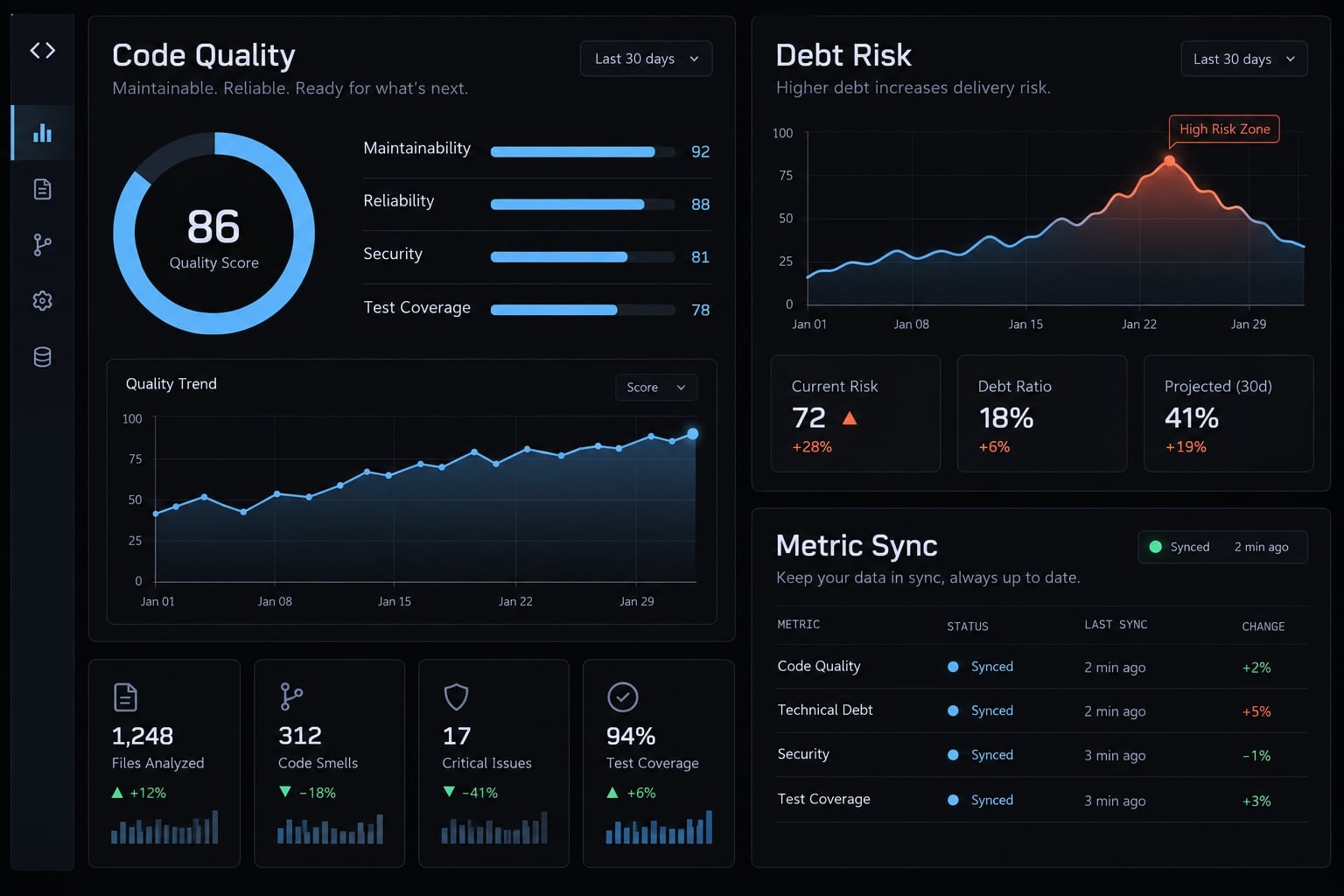
What is vibe coding technical debt?
Vibe coding technical debt is the future maintenance burden created when AI-generated code is accepted without proper understanding, verification, or system alignment. It describes technical debt within an AI-driven workflow, not a separate formal category or an inevitable consequence of using coding assistants.
Prompt-based development turns natural-language requests into proposed software changes. In a loosely governed workflow, contributors may judge those changes mainly by whether the visible result works.
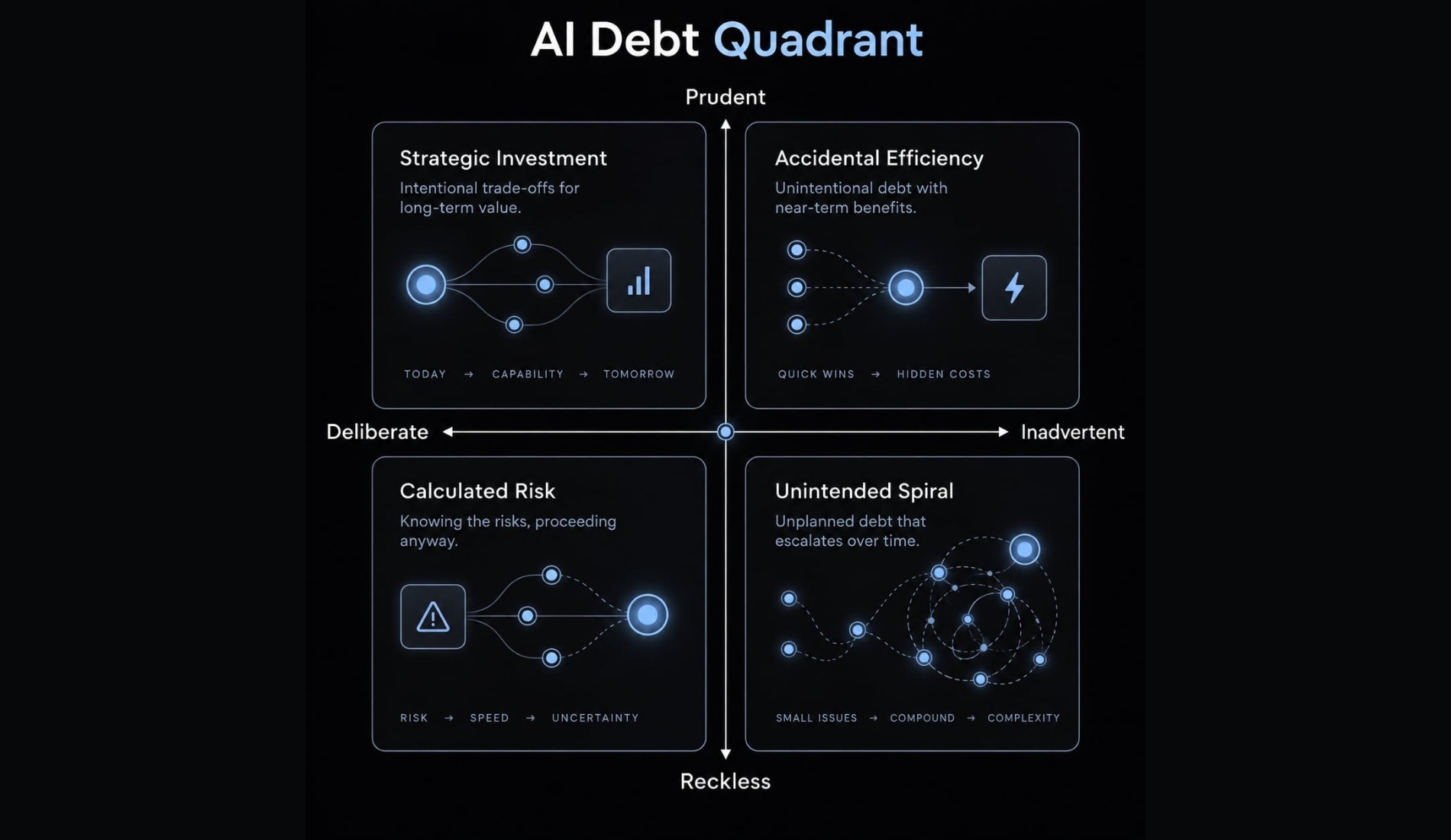
Martin Fowler’s "Technical Debt Quadrant" distinguishes deliberate shortcuts from inadvertent debt. That distinction matters here: a temporary reporting mockup can be a conscious trade-off; accidentally bypassing shared access controls is inadvertent and reckless debt.
A bug is not automatically technical debt. An incorrect export filename may be an isolated defect. Scattered filename rules that make every correction risky represent a structural burden. Routine maintenance, such as a straightforward dependency update, is not necessarily debt either.
These are editorial working modes on a spectrum, not standardized categories. Ordinary AI-assisted coding can include strong testing and review.
Dimension | Vibe coding | AI-assisted coding | AI-assisted engineering |
|---|---|---|---|
Primary goal | Reach working output | Assist coding tasks | Deliver supportable changes |
Human understanding | May be partial | Depends on practice | Required for acceptance |
Context supplied | Immediate request | Relevant task context | System rules and decisions |
Verification | Often visible behavior | May include rigorous checks | Risk-based checks and ownership |
Appropriate use | Bounded experiments | Tasks with suitable controls | Maintained, consequential software |
Repository context means project rules, existing code, architecture, and relevant decisions.
In the recurring illustrative example below, a customer-reporting mockup uses synthetic data. Moving it into multi-tenant SaaS-software serving separate customer organizations-requires existing permission rules, not merely a convincing interface.
Why vibe coding accelerates technical debt
Vibe coding can accelerate debt when accepted output exceeds meaningful verification capacity. A change may satisfy its immediate prompt while violating assumptions elsewhere in the application. If reviewers miss those conflicts, apparent progress becomes later rework, regressions, and slower changes. Speed alone is not the cause; insufficient scrutiny is the enabling condition.
The generation–verification gap
The generation–verification gap is an editorial mental model describing a mismatch between proposed changes and the team’s ability to assess them meaningfully.
Broad changes can overwhelm reviewers by combining unfamiliar dependencies, permission changes, and interface work. A longer review does not necessarily solve this: reviewers need relevant context and evidence, not simply more elapsed time.
Automated checks expand verification capacity. They can detect type errors, failing tests, and known dependency vulnerabilities. They cannot independently establish whether an enterprise customer should be allowed to export another organization’s records.
Google’s Engineering Practices guidance on code review emphasizes design, functionality, complexity, tests, and understandable changes. Generated code deserves the same scrutiny.
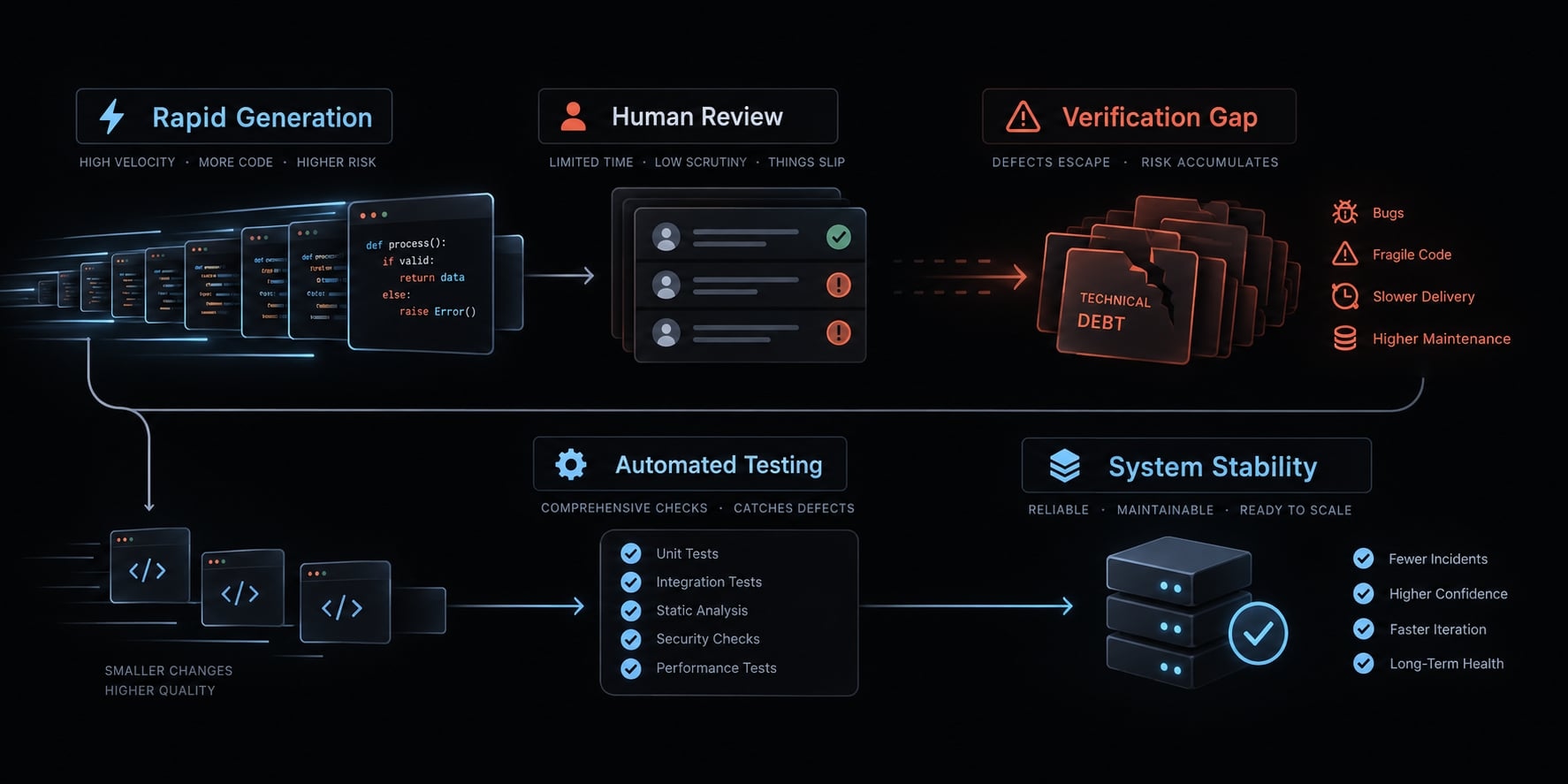
Sustainable throughput means delivering changes that remain supportable, not maximizing generated lines.
Context amnesia and local optimization
"Context amnesia" is shorthand for project information being unavailable, omitted, or poorly retained by an agent.
In the illustrative reporting feature, an agent might recreate a validation helper, duplicate a permission check, or introduce a package despite approved functionality already existing in the repository.
Each choice can look reasonable locally. Together, they create architectural drift, meaning new changes gradually depart from established system patterns.
Repository context tools-such as AgentKit context scaffolding-can reduce these omissions by providing persistent architecture guidelines directly to the agent runtime. Models may still propose different patterns for similar requests, so consistency must be checked. Probabilistic output during generation does not make the resulting program inherently nondeterministic at runtime.
Without documented decisions and an owner, the next contributor must reconstruct why the feature works before safely changing it.
Six types of technical debt common in AI-generated code
Debt extends beyond messy code. These six categories also occur in human-written software; AI-assisted workflows can amplify them when generation outpaces understanding and verification.
Debt type | How it appears | Likely consequence |
|---|---|---|
Code quality | Duplicated logic and inconsistent structure | More places to update and review |
Architecture | Shared boundaries are bypassed | Changes cause unexpected system effects |
Test and reliability | Success cases dominate testing | Failures emerge after release |
Security | Safeguards differ across endpoints | Exposure and corrective engineering |
Documentation and knowledge | Assumptions remain in conversations | Slower diagnosis and handoffs |
Dependency and operational | Packages and recovery needs go unevaluated | Upgrade, outage, and support burdens |
Code quality debt
Duplicated logic increases the number of places a business rule must change. If subscription entitlement rules appear in several reporting modules, a plan update may fix one path while leaving another inconsistent. The cost is not repetition alone; it is the coordination needed to preserve identical behavior across the system.
Architecture debt
A reporting endpoint may query the database directly instead of using the approved tenant-aware access layer, which restricts records to the correct customer organization. The endpoint can return accurate results in a demonstration while bypassing a boundary that other features depend on. Future changes then require exceptional handling.
Test and reliability debt
Happy-path tests verify successful behavior but leave failures unexplored. Export tests might check file creation while omitting invalid filters, retries, interrupted jobs, and unauthorized access. Tests generated from the implementation can preserve its mistaken assumptions. A green test suite is useful evidence, not proof that requirements are correct or complete.
Security debt
Different reporting endpoints may enforce different organization-level access rules. OWASP’s Application Security Verification Standard (ASVS) and Authorization Cheat Sheet provide relevant guidance on access-control verification and consistent permission enforcement. A serious vulnerability is not ordinary backlog debt. An exposed cross-customer export may require immediate containment and remediation.
Documentation and knowledge debt
Knowledge debt appears when nobody records why an integration excludes particular customer records or handles a reporting period differently. If the rationale exists only in an original chat session, future maintainers must guess or reverse-engineer it. Repository documentation should preserve decisions, constraints, and ownership-not every conversational step.
Dependency and operational debt
An export library introduces dependency risk if its identity, maintenance, license, and suitability remain unchecked. Generated suggestions can include package hallucinations (AI generating non-existent or malicious package names); verify packages before installation. Missing failure logging, retry limits, or recovery behavior creates additional operational obligations.
When is vibe coding safe and when does it become risky?
"Safe" means lower-risk conditions, not guaranteed safety. Rapid prototyping with synthetic data, isolated access, and a disposal plan can justify lighter controls than a live export accessing customer records.
Internal scripts are not automatically low risk. Privileged credentials, destructive actions, or network access can make a small utility consequential. Assess what it can affect, not how short it is.
Prototype-to-Production risk matrix
This matrix is an editorial decision aid, not a certified assessment or numerical risk score.
Evaluation factor | Lower risk | Higher risk |
|---|---|---|
User impact | Isolated experimentation | Customers depend on output |
Data sensitivity | Synthetic, non-sensitive records | Personal or confidential records |
Expected lifespan | Explicitly disposable | Persistent or indefinite use |
System complexity | Few isolated connections | Shared services and tenant boundaries |
Failure consequences | Reversible inconvenience | Data loss, exposure, or disruption |
Ownership and handoff requirements | Clear owner and documented behavior | Unclear responsibility or unexplained code |
One serious exposure can justify stronger controls, even when the other factors appear low risk. A solo founder can face substantial ownership risk; a larger team can maintain clear accountability.
For the reporting prototype, substituting live customer records changes the risk assessment even if the interface and code barely change.
The hardening threshold
Hardening is the deliberate process of preparing an experimental feature for consequential use. It includes reviewing its design, testing failure conditions, validating dependencies, documenting assumptions, and checking recovery readiness. The goal is evidence that the feature can be operated and maintained-not merely that it runs.
Begin a hardening phase when:
- Real users depend on the feature.
- Sensitive data or elevated access enters scope.
- Core production systems become involved.
- Other contributors must maintain it.
- Failure has material consequences.
AI-generated features can ship responsibly. The transition requires deliberate evaluation rather than an informal decision that the prototype "looks finished."
Warning signs that vibe coding debt is accumulating
Unexplained changes and repeated repair work deserve investigation before they become normal delivery conditions. These symptoms may reflect weak governance, but they do not establish that AI caused the problem.
Warning sign | What it may indicate |
|---|---|
Contributors cannot explain generated modules | May indicate an ownership or understanding gap |
Similar features use conflicting patterns | Can suggest missing architectural guidance |
Pull requests grow without deeper review | May indicate overloaded review capacity |
Business logic appears in multiple locations | Can suggest missed reuse opportunities |
Small changes trigger unrelated regressions | May indicate hidden dependencies |
Repeated AI repair loops fail to stabilize behavior | Can suggest misunderstood requirements or causes |
Dependencies arrive without evaluation | May indicate missing approval controls |
Prototypes advance without hardening | Can suggest unmanaged production assumptions |
Debugging and rework displace planned delivery | May indicate growing maintenance cost |
Comparable endpoints enforce different security controls | Can suggest inconsistent permission enforcement |
Use four groups of measures:
- Reviewability: Pull-request scope, review turnaround, and substantive reviewer comments. Fast approval alone does not demonstrate meaningful review.
- Rework: Code churn-recently written code repeatedly changed or removed-plus reverts and unplanned maintenance. Interpret changes alongside feature maturity and intentional refactoring.
- Reliability: Escaped defects, meaning problems discovered after release; recurring regressions; and flaky tests that pass or fail inconsistently.
- Control gaps: Duplicate-code findings, unresolved security findings, and dependencies awaiting evaluation. Dependency age alone does not prove risk.
Compare the same team over comparable periods. Account for release size, staffing, requirements changes, and legacy architecture before drawing conclusions.
DORA’s delivery-performance guidance supports examining delivery and stability together. No single measure represents total technical debt.
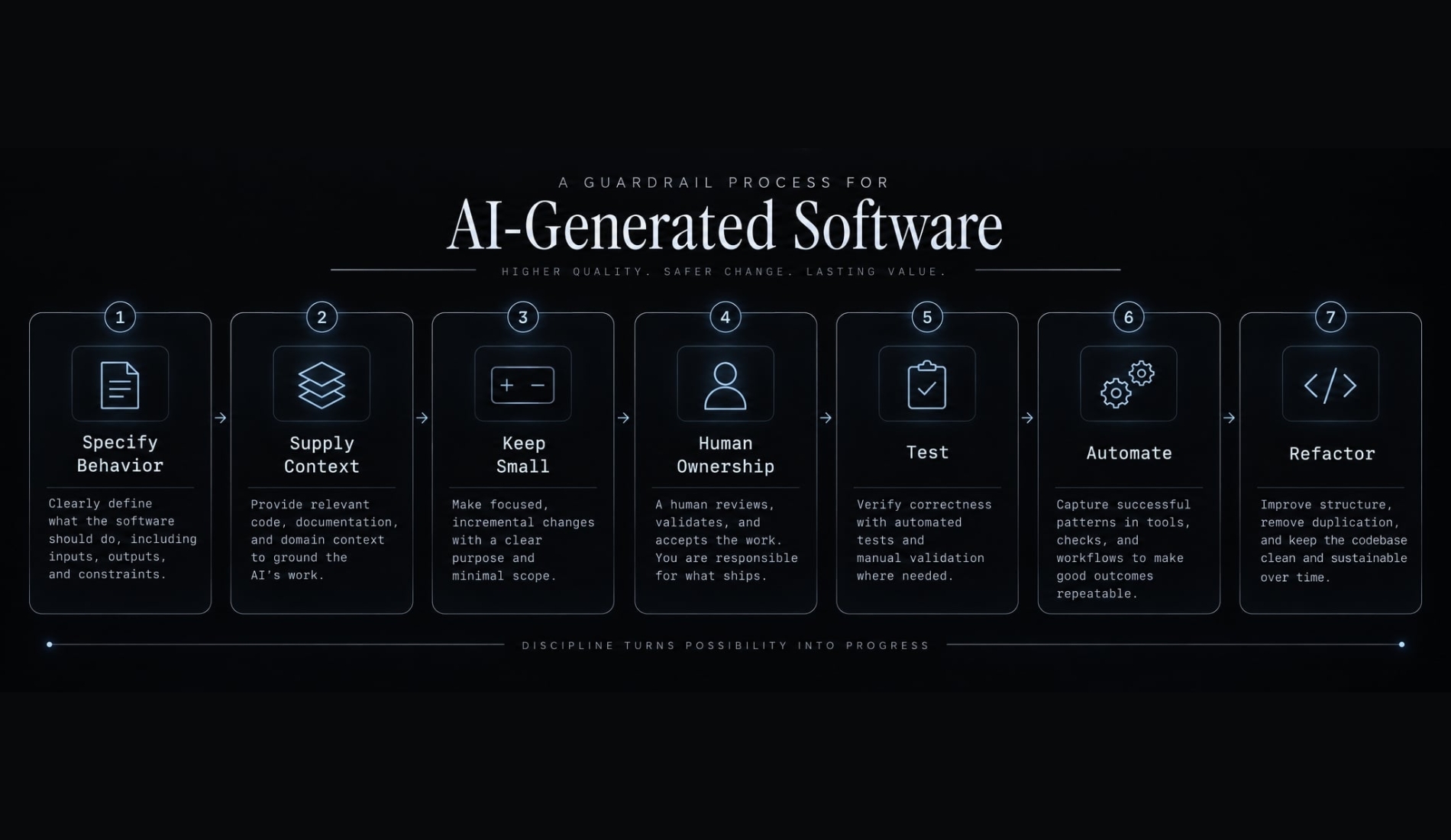
How to prevent vibe coding from becoming technical debt
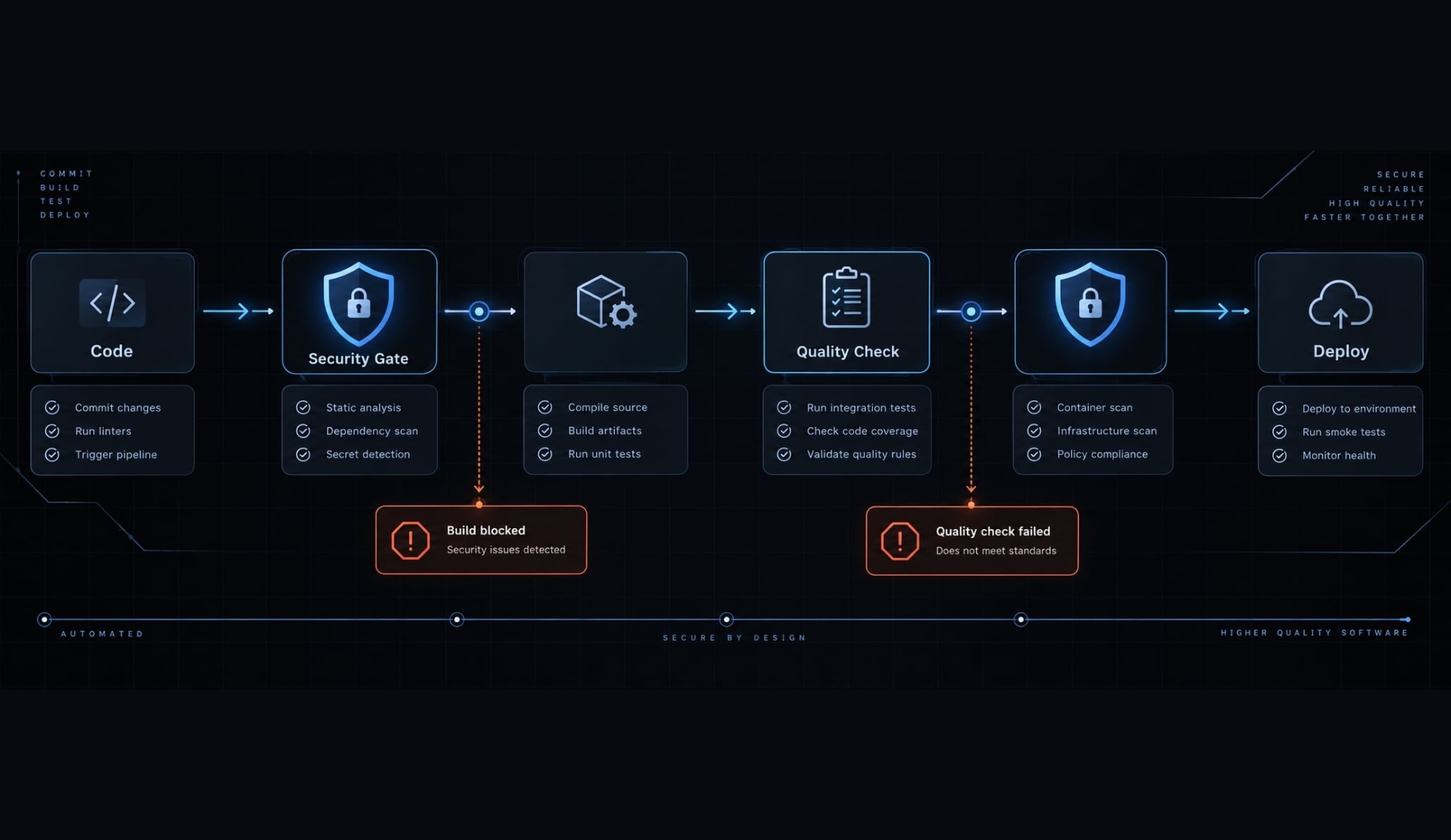
Match controls to failure consequences. A disposable mockup needs less evidence than a customer-data export, but both need clear boundaries. NIST’s Secure Software Development Framework (SSDF) supports integrating security practices throughout development rather than relying on a final inspection.
Start with a specification, not an open-ended prompt
Specification-driven development starts with explicit behavior, inputs, outputs, constraints, and acceptance criteria. The feature owner should resolve ambiguity before implementation.
For reporting, specify: "Only authorized organization members can export their organization’s permitted records." Ask the agent to surface unanswered questions about roles, filters, and restricted fields.
Give the AI repository-level context
Context engineering means deliberately selecting and maintaining information needed for the task. The maintainer should provide relevant architecture, utilities, approved dependencies, security rules, and test commands.
Frameworks like AgentKit assist engineering teams by standardizing context injection across heterogeneous AI coding agents. Store reusable instructions in the repository and require inspection of relevant code. Supplying everything indiscriminately is not the goal; focused context improves alignment.
Keep AI-generated changes small
The contributor should prefer one bounded behavior per change. Separate export formatting from permission changes when each can be reviewed independently.
For broad work, review the plan before implementation. Avoid arbitrary line limits: reviewability depends on complexity and consequences. Small changes still need scrutiny when they affect access or data.
Require human understanding and ownership
Human ownership means a named contributor and reviewer can explain behavior, dependencies, failure modes, and system impact.
The contributor should identify which existing controls the feature relies on and what could break. If the contributor cannot explain the change, it is not ready to merge. Approval must represent accountable judgment.
Test behavior, not just the implementation
The feature owner and reviewer should derive tests from intended outcomes. Cover permissions, invalid inputs, failure paths, and relevant integrations.
For reporting, test that one organization cannot export another’s records. Tests generated from the same mistaken assumptions as the implementation are not independent proof; review their expectations against requirements.
Automate repetitive quality and security gates
The repository maintainer should configure appropriate linting, type checks, tests, dependency scanning, and secret detection.
Shift-left security means checking security earlier in development rather than waiting until release. Automation catches recurring problems, but authorization and business-rule correctness also require targeted tests and human review.
Refactor and document before the prototype becomes permanent
Before consequential deployment, the maintainer should remove duplication, align architecture, document assumptions, and validate operational readiness.
Record ownership, failure logging, and recovery procedures. Where relevant, check deployment rollback and data-migration safety. Track accepted shortcuts with a reason and a review trigger rather than letting temporary decisions become invisible obligations.
AI-generated code review checklist
Apply these observable checks before merging. For context-dependent items, record "not applicable" with a reason. Completion provides review evidence, not a safety certification.
- Contributor can explain behavior, dependencies, and failure modes.
- Change follows relevant repository patterns and boundaries.
- Existing business logic is reused rather than duplicated.
- Inputs, permissions, errors, and edge cases are reviewed.
- Tests reflect intended outcomes, including relevant negative cases.
- New dependencies are verified, evaluated, and approved.
- Required quality and security checks pass; exceptions are documented.
- Sensitive data and logging receive appropriate protection.
- Change scope permits meaningful review.
- Important assumptions and decisions are recorded in the repository.
- A named maintainer can support the feature without the original chat.
- Production hardening and recovery readiness are reviewed where applicable.
Frequently asked questions
What is vibe coding technical debt?
Vibe coding technical debt refers to the maintenance burden and architectural fragility created when code is generated via AI agents without sufficient human verification, system-wide context, or adherence to organizational standards. It manifests as inconsistent logic, duplicated patterns, and silent vulnerabilities that increase future rework costs.
Why does vibe coding accelerate technical debt?
Vibe coding accelerates debt because it prioritizes rapid feature generation over structural design. When AI-generated code is accepted faster than a team can meaningfully review, test, and integrate it into the repository's architecture, teams accumulate "hidden" liabilities like brittle dependencies and bypassed security rules that become costly to fix later.
What are the most common types of technical debt in AI-generated code?
The primary types include:
- Code Quality Debt: Duplicated logic and inconsistent naming patterns.
- Architecture Debt: Bypassing established system boundaries.
- Test and Reliability Debt: Happy-path tests that miss failure cases.
- Security Debt: Missing input validation or authentication checks.
- Documentation Debt: Lost context regarding design decisions.
- Dependency Debt: Unvetted or hallucinated packages.
How can I distinguish between a low-risk prototype and risky production code?
Risk is determined by data sensitivity, user impact, system complexity, and persistence. Prototypes are lower risk when they use synthetic data and have no external dependencies. Conversely, any code accessing customer records, elevated permissions, or core production systems requires formal hardening, thorough security review, and verified test coverage.
What are the warning signs of accumulating vibe coding debt?
Warning signs include developers being unable to explain generated modules, the appearance of conflicting coding patterns across features, rising code churn (frequent reverts), and small changes triggering unexpected regressions. These symptoms suggest the team is struggling to maintain a coherent mental model of the system.
How can teams prevent vibe coding from becoming technical debt?
Teams should adopt a "specification-first" workflow by defining requirements and constraints before generation. Use repository-level context tools like AgentKit to guide agents, enforce small and reviewable pull requests, mandate human ownership for all code, and automate quality gates like static analysis and security scanning to catch common errors early.
Read more:
- Vibe coding PRD: A practical template for AI app development
- How to vibe code a CRUD app without losing control
- Andrej Karpathy vibe coding: What it is and how it works
Conclusion
Vibe coding technical debt is not defined by who-or what-produced the code. It emerges when accepted changes outrun understanding, verification, and ownership. A working demonstration can hide duplicated rules, missing permission checks, and undocumented assumptions that make later changes expensive. AI-assisted engineering preserves the value of generation by treating maintainable software, rather than generated volume, as the outcome. That distinction also keeps debt diagnosis focused on evidence instead of blaming a tool.
Prototypes remain useful when their exposure and lifespan are bounded. Before a feature handles customer data or becomes operationally important, apply proportionate review, testing, documentation, and recovery checks. You do not need to redesign the entire organization. Apply the review checklist to one upcoming AI-generated feature, and resolve its highest-consequence gaps before release.