Human in the loop AI coding: Optimize speed and quality
Human in the loop AI coding: A practical guide to safer, faster AI-Assisted development
AI can generate code faster than most teams can safely validate it. That is why human-in-the-loop AI coding matters now: The bottleneck has shifted from writing code to reviewing code. For CTOs, engineering leads, founders, and senior developers, this is no longer a theory question. It is a workflow design issue. This guide explains what human-in-the-loop AI coding actually means, why human oversight still matters, what AI should handle versus what humans must still own, and how to apply a practical review workflow that improves speed without losing control.
Human-in-the-loop (HITL) AI coding: What it actually means
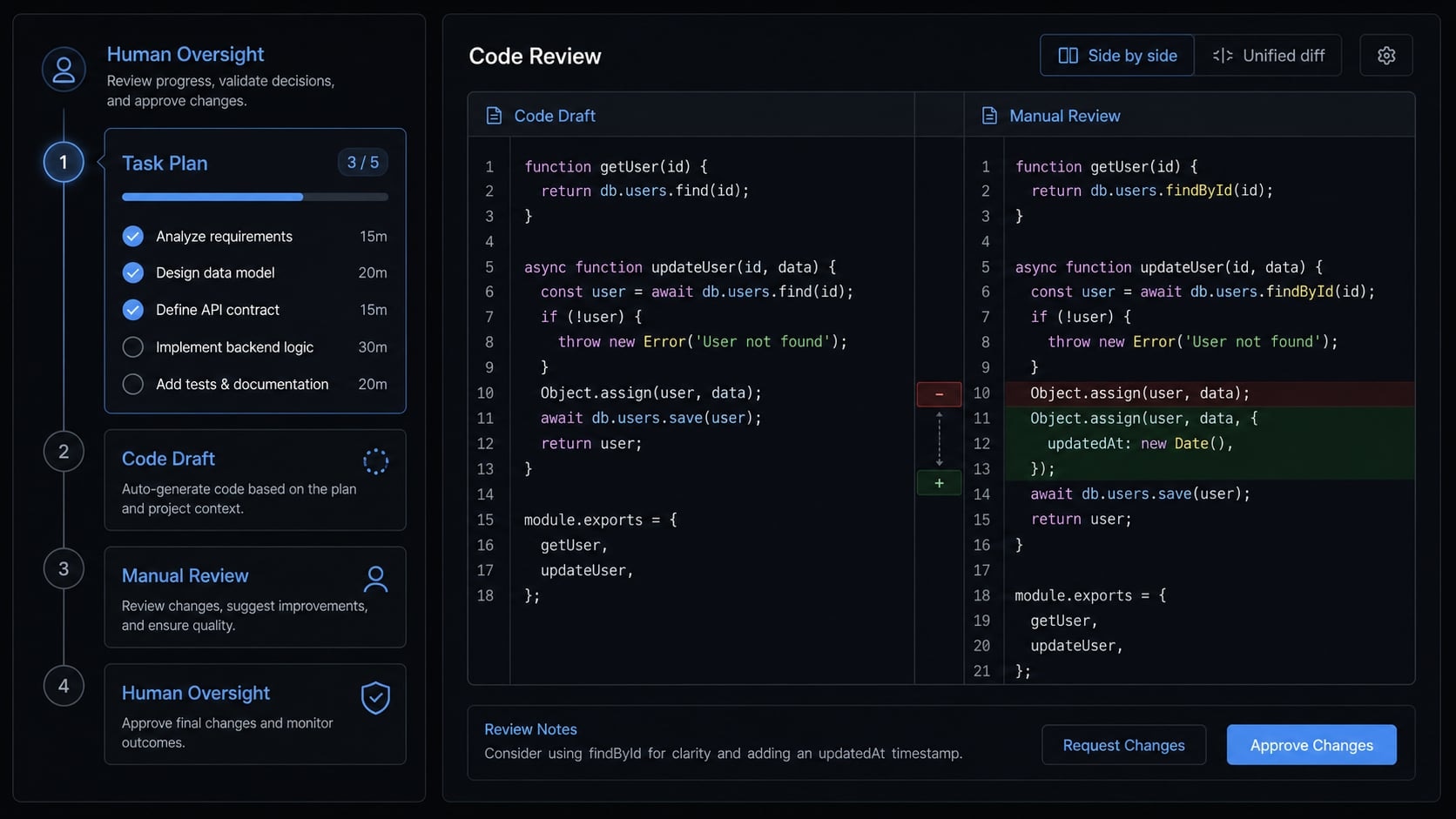
Human-in-the-loop AI coding is a development model where AI helps generate, refactor, or analyze code, but humans remain responsible for decisions, review, approval, and release. The goal is to gain speed without losing control or accountability.
In practical terms, human-in-the-loop AI coding is not a rejection of AI. It is a control model for AI-assisted software engineering. Teams use AI to draft code, suggest tests, summarize files, or explore approaches. But the final authority stays with people who understand the system, own the trade-offs, and carry release responsibility.
The important distinction is not who typed the first version of the code. The important distinction is who owns engineering judgment. In a healthy AI coding workflow, AI accelerates output, while humans decide whether that output matches the intent, fits the architecture, and is safe to support in production.
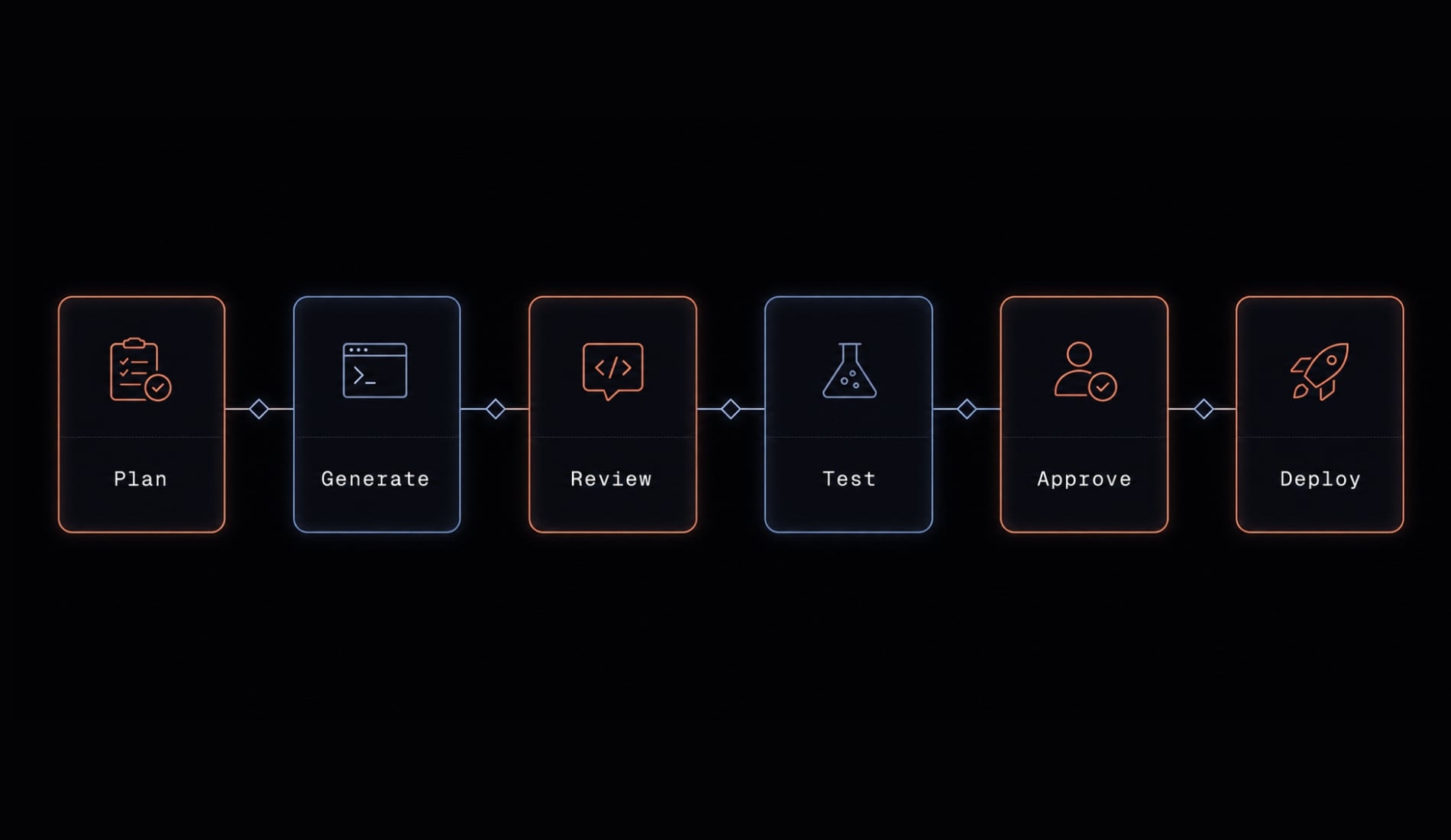
Human checkpoints still matter across the software development lifecycle:
- Planning the task and defining constraints.
- Generating or modifying code.
- Reviewing for correctness and maintainability.
- Testing behavior and failure paths.
- Approving the change.
- Deploying to production.
This is why human-supervised AI development is becoming the practical default for serious teams. As code generation gets easier, disciplined review becomes more important, not less.
Human-in-the-loop vs fully autonomous coding
- Human-in-the-loop AI coding: Human defines intent, reviews outputs, approves changes, and owns the release.
- Fully autonomous coding: AI is allowed to make larger changes with reduced or skipped review gates.
The real difference is not typing speed. It is judgment, accountability, and control.
Why the term matters now
Tools like Claude Code, Codex, and GitHub Copilot have changed the pace of development. Teams can generate far more code in the same amount of time.
That creates a new reality: more generation capacity means more validation demand. The industry question is no longer “Can AI code?” It is “How do we control what ships?”
Why human oversight still matters in AI coding
AI-generated code can look convincing before it is actually trustworthy. That is the core reason human oversight remains necessary. Code can work in a narrow sense and still be the wrong solution for the system, risky in production, or expensive to maintain.
This distinction matters because production-ready code is not the same as code that merely passes a local test. A change might compile, satisfy a basic prompt, and even pass a few checks while still introducing hidden problems. In real teams, those problems show up later as regressions, outages, security exposure, confusing behavior, or rising maintenance cost.
The code review process becomes more important in AI-assisted development because AI increases output volume. And as output volume rises, weak review practices become a business risk.
Common failure modes in AI-generated code
Typical issues in AI-generated code include:
- Plausible but incorrect logic.
- Missed edge cases.
- Security gaps or unsafe defaults.
- Architecture drift that conflicts with existing patterns.
- Overcomplicated code that passes tests but is hard to maintain.
- Misused dependencies or unnecessary libraries.
- Changes that solve the symptom but not the root problem.
These are not rare corner cases. They are normal failure modes when a system produces fast drafts without full operational context.
The bottleneck has shifted from writing to reviewing
In practice, AI can reduce drafting time while increasing validation demand. That is the new constraint.
When teams generate more code than they can review carefully, they create a review bottleneck. Reviewers then face supervision fatigue: The cognitive burden of checking large amounts of mostly plausible output while still holding the system’s real intent in mind.
This is why more output does not automatically create more velocity. Without better gates, it creates more risk. The downstream consequences are familiar:
- More regressions in production.
- Slower incident response.
- Higher support and maintenance cost.
- Confusion about why a change was made.
- Reduced confidence in future releases.
Human oversight protects system reliability because it keeps accountability with the team that ships the software. That part cannot be delegated away.
What AI can help with vs what humans must still own
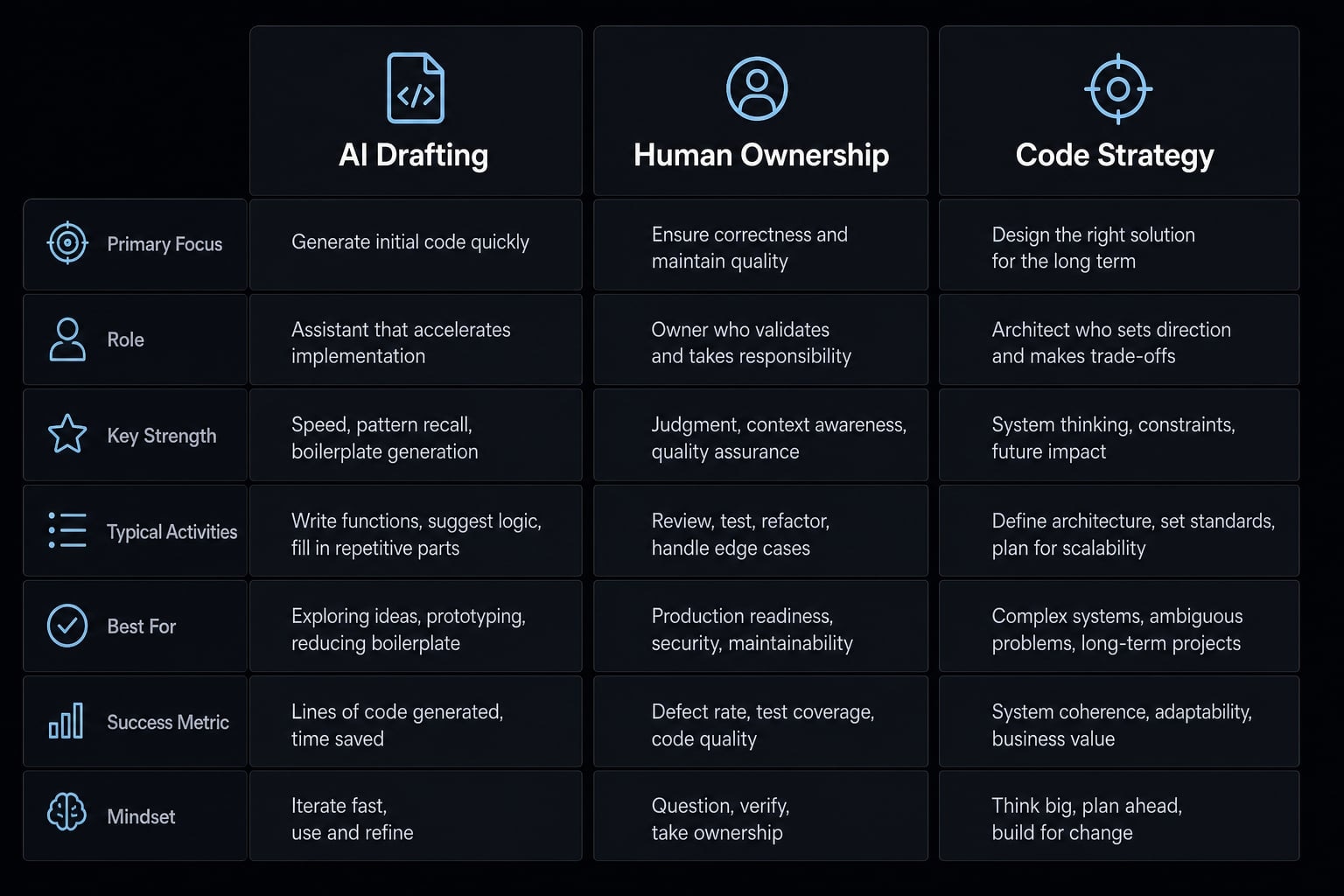
The fastest way to use AI well is to define ownership clearly. In AI-human collaborative programming, AI should assist with drafting and acceleration, while humans retain authority over decisions that affect risk, architecture, and release quality.
Task | AI can assist | Human must own |
|---|---|---|
Requirements breakdown | Summarize tickets, identify subtasks, suggest implementation paths | Clarify business intent, set scope, define constraints and non-goals |
Code generation | Draft functions, refactors, boilerplate, queries, tests | Validate correctness, maintainability, and architecture fit |
Testing | Suggest test cases, create test scaffolds, identify obvious gaps | Decide coverage standards, verify real behavior, approve failure-path testing |
Code review | Summarize diffs, flag suspicious areas, explain changed files | Perform final code review, assess trade-offs, approve or reject |
Security | Surface obvious risks, suggest scans, detect common mistakes | Approve security posture, review sensitive logic, own risk acceptance |
Deployment | Generate release notes, suggest rollback steps, automate scripts | Approve deployment, monitor release impact, own operational response |
This ownership model keeps augmented coding workflows practical. AI is useful when it accelerates drafting, summarization, and exploration. It becomes risky when teams let it blur responsibility.
Humans must still own:
- Architecture decisions.
- Security approval.
- Final code review.
- Release approval.
- Incident accountability after deployment.
That last point matters most. Software shipping accountability cannot be delegated to a model. If the team supports the system, the team must understand what it ships.
A practical human-in-the-loop workflow for AI coding
Implementing human-in-the-loop AI for production code is less about tool choice and more about workflow discipline. Teams do not need a complicated governance model. They need a repeatable path that keeps speed high and errors reviewable.
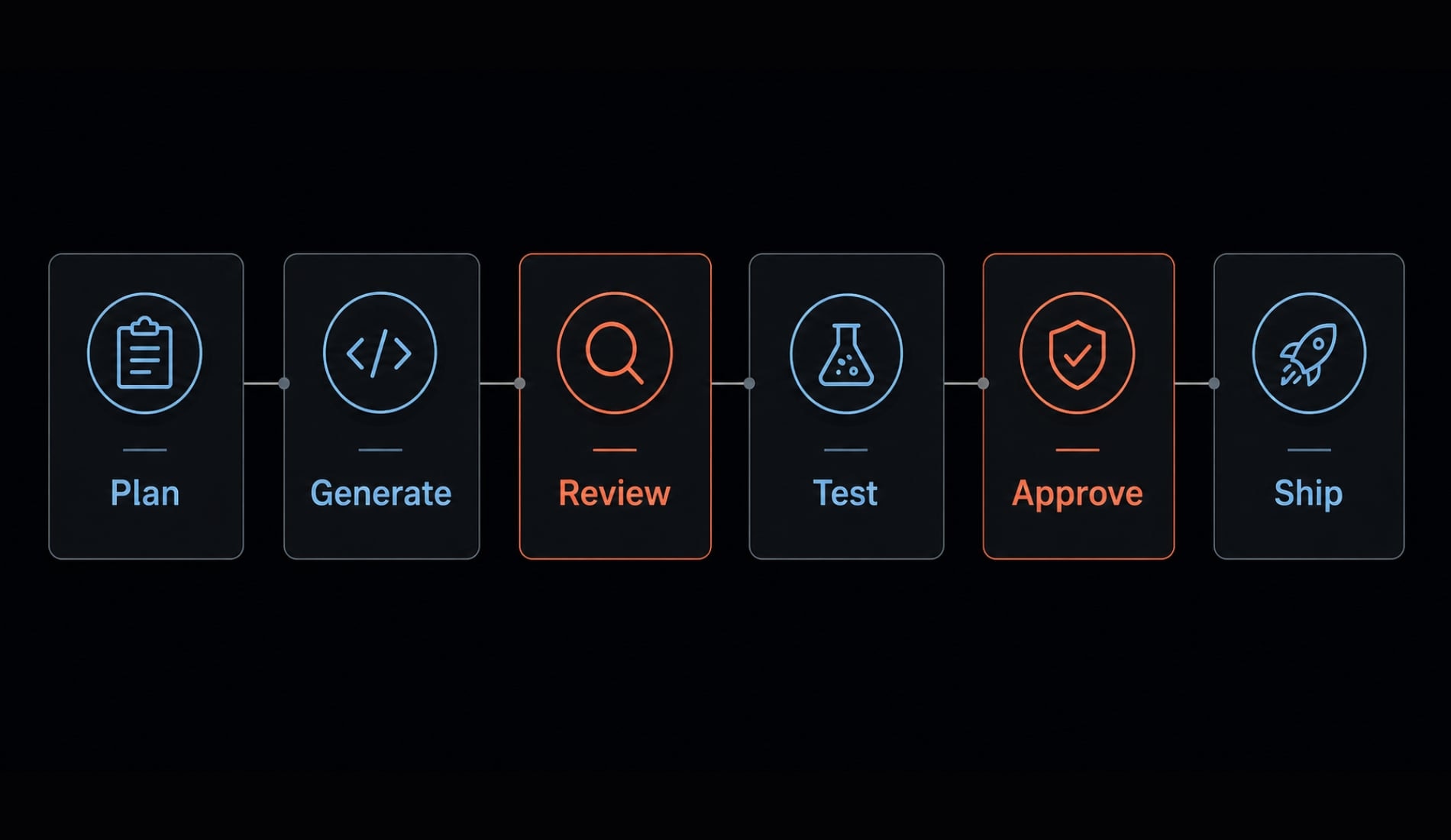
A practical workflow usually looks like this:
- Plan the task and define constraints.
- Generate a draft with AI.
- Review for intent and architecture fit.
- Test behavior and failure paths.
- Approve only explainable code.
- Ship with traceability and post-release review.
Step 1: Plan the task before asking AI to code
Good review starts with good scoping. If the task is vague, the output will be harder to validate. Before prompting, define:
- The exact problem to solve.
- Expected behavior and success criteria.
- Constraints, risks, and non-goals.
- Relevant coding standards.
- Existing architecture patterns to follow.
- Whether the task should be split into smaller parts.
This is where intent-to-execution mapping matters. The clearer the intent, the easier it is to judge whether the generated code actually matches it.
Good prompt engineering for code is not about clever wording. It is about giving enough structure so the model works inside known boundaries.
Step 2: Use AI for draft implementation, not blind execution
The safest posture is to treat AI output as a draft implementation, not a final answer. A few practical rules help:
- Ask AI to propose an approach before making large changes.
- Keep scope narrow: one service, one component, one issue.
- Prefer iterative generation over one large output.
- Request explicit assumptions when the task is ambiguous.
- Avoid mixing unrelated changes into one prompt.
Smaller generated units are easier to review, easier to test, and less likely to hide avoidable errors. This approach also gives teams a cleaner way to course-correct early.
Step 3: Review for intent, not just syntax
If you want to know how to review AI-generated code effectively, start by ignoring the surface polish. The key question is not “Does this look clean?” It is “Does this solve the right problem in the right way?”
Use a checklist like this:
- Does the change solve the intended problem?
- Are the assumptions valid?
- Are dependencies appropriate and necessary?
- Is state handling correct?
- Are important edge cases covered?
- Does it preserve architecture fit?
- Is the code understandable six months from now?
- Is the level of complexity justified?
- Is maintainability acceptable for the team that will support it?
This is where human judgment creates value. Review is not just syntax inspection. It is system-level validation.
Step 4: Test behavior, not only code shape
Code that looks correct can still fail under real conditions. That is why iterative validation must include behavioral testing, not only visual inspection.
At minimum, validate:
- Automated unit or integration tests where relevant.
- Failure-path behavior.
- Real usage conditions.
- Backward compatibility.
- Integration with existing services and APIs.
- Linting and static analysis tools.
- Security scanning for sensitive changes.
Passing tests is useful, but it is not enough on its own. Teams still need to check whether the change behaves correctly under realistic conditions and whether it introduces risk outside the narrow happy path.
Step 5: Approve only what you can explain and support
This is the core rule in a healthy AI coding workflow: if a reviewer cannot explain the code, the code should not ship.
Human approval implies operational responsibility. Once the change is merged and released, the team owns the bugs, support burden, debugging, and incident response. Sensitive areas deserve stricter review:
- Authentication and authorization.
- Payments and billing logic.
- Permissions.
- Data access.
- Infrastructure changes.
- Security-critical logic.
Approval is not a click. It is an ownership decision.
Step 6: Ship with traceability and post-release review
A strong process does not end at merge. It includes enough traceability to understand what changed, why it changed, and how it was validated.
Keep records of:
- What the AI produced.
- What humans edited or rejected.
- What tests were run.
- Who approved the change.
- What was monitored after release.
Then use post-release review to improve the system:
- Capture failed prompts and successful prompts.
- Create reusable rules for future tasks.
- Refine review checklists.
- Strengthen patterns for high-risk changes.
A good HITL workflow gets better over time. The goal is not perfect output from the model. The goal is a reviewable system that improves with use.
How to reduce review fatigue without removing the human from the loop
Review fatigue is real, especially when teams move from writing code to supervising large amounts of generated output. But in most cases, the problem is not oversight itself. The problem is poor workflow design.
Managing AI coding fatigue in development teams starts with scope control. Large prompts create large diffs. Large diffs create shallow review. And shallow review is where risk accumulates.
Tactics that reduce supervision overhead
Use these tactics to reduce supervision fatigue without weakening human control:
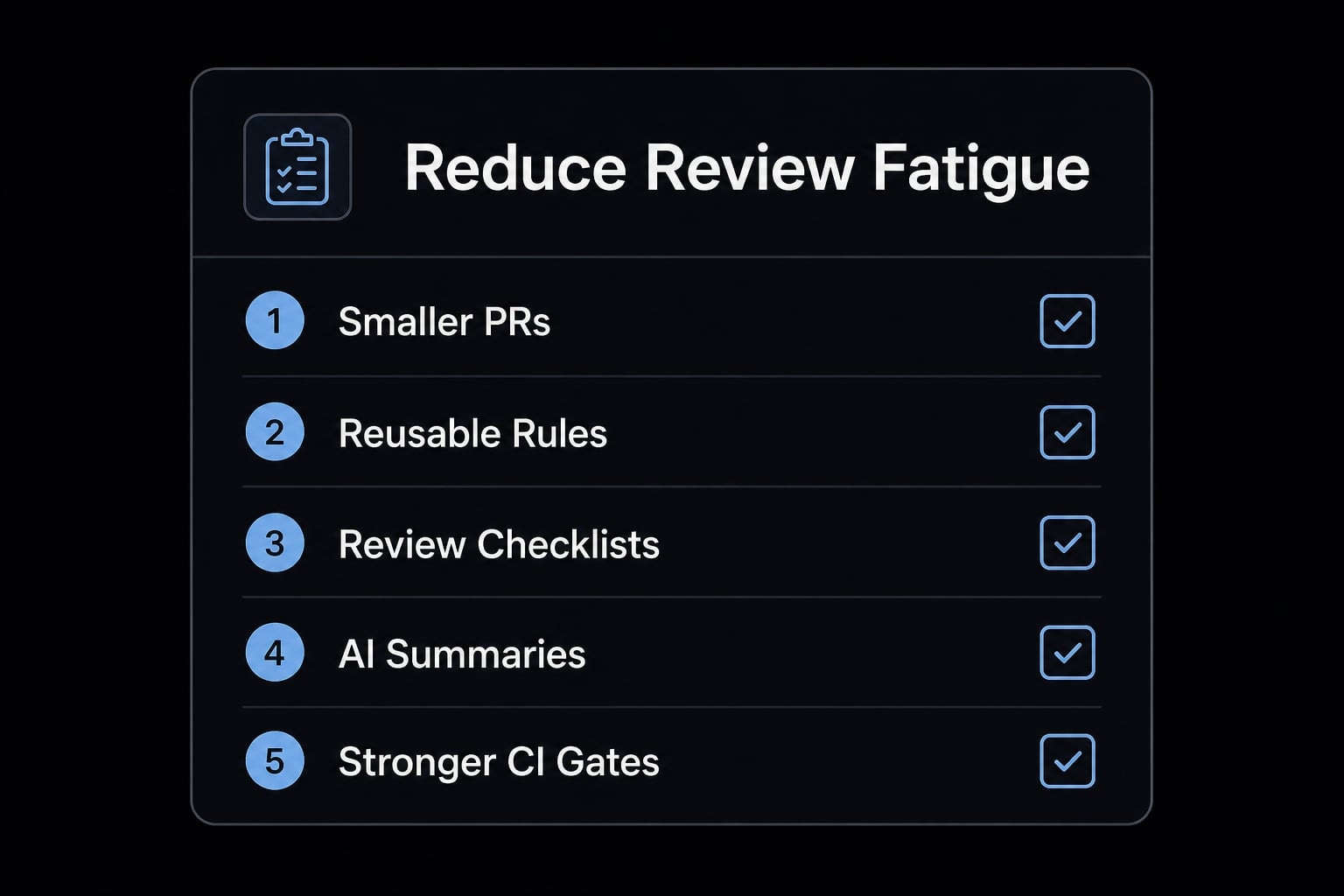
- Start with smaller prompts and smaller PRs.
- Define reusable rules in coding standards or AGENTS.md-style files.
- Use predefined review checklists for common change types.
- Let AI generate summaries to support understanding, not replace judgment.
- Strengthen test and CI gates before human approval.
- Escalate risky changes earlier instead of after implementation.
This is really a cognitive load balancing problem. The goal is not zero-effort review. The goal is higher-quality review with lower unnecessary load.
In practice, the teams that handle AI assistance well are usually the ones that constrain generation, standardize expectations, and make approval easier to do consistently.
Team guidelines for using human-in-the-loop AI coding in production
Teams do not need a heavy compliance framework to apply best practices for human oversight in AI-driven projects. A lightweight internal standard is usually enough, as long as the rules are explicit and enforceable inside a real production environment.
Suggested team rules:
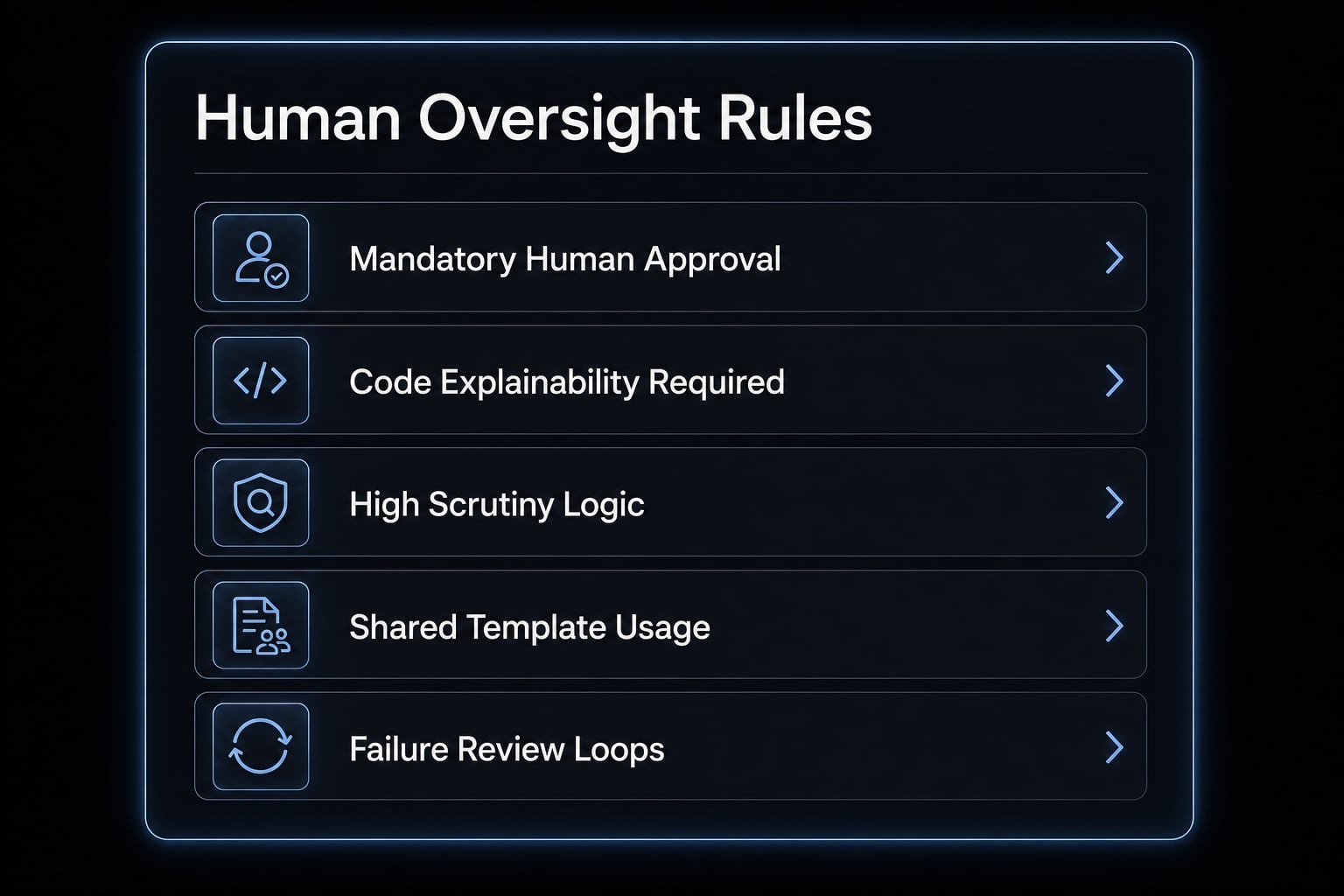
- No production deployment without human approval.
- No merge of code that nobody on the team can explain.
- Apply higher scrutiny to auth, payments, data access, infrastructure, and security-sensitive logic.
- Use shared prompt templates and rule templates for consistency.
- Run a postmortem or review loop for AI-related failures and near-misses.
For some categories, senior review should be mandatory:
- Architecture changes.
- Infrastructure changes.
- Payment or auth logic.
- Sensitive data flows.
These rules are not anti-speed. They are how teams keep AI useful inside a real production environment. They also support software supply chain security by reducing unexplained changes and making release decisions auditable.
Most importantly, they reinforce accountability in software shipping. AI can accelerate implementation, but the organization still owns the consequences of what reaches users.
Practical example: Turning human oversight into a repeatable AI workflow
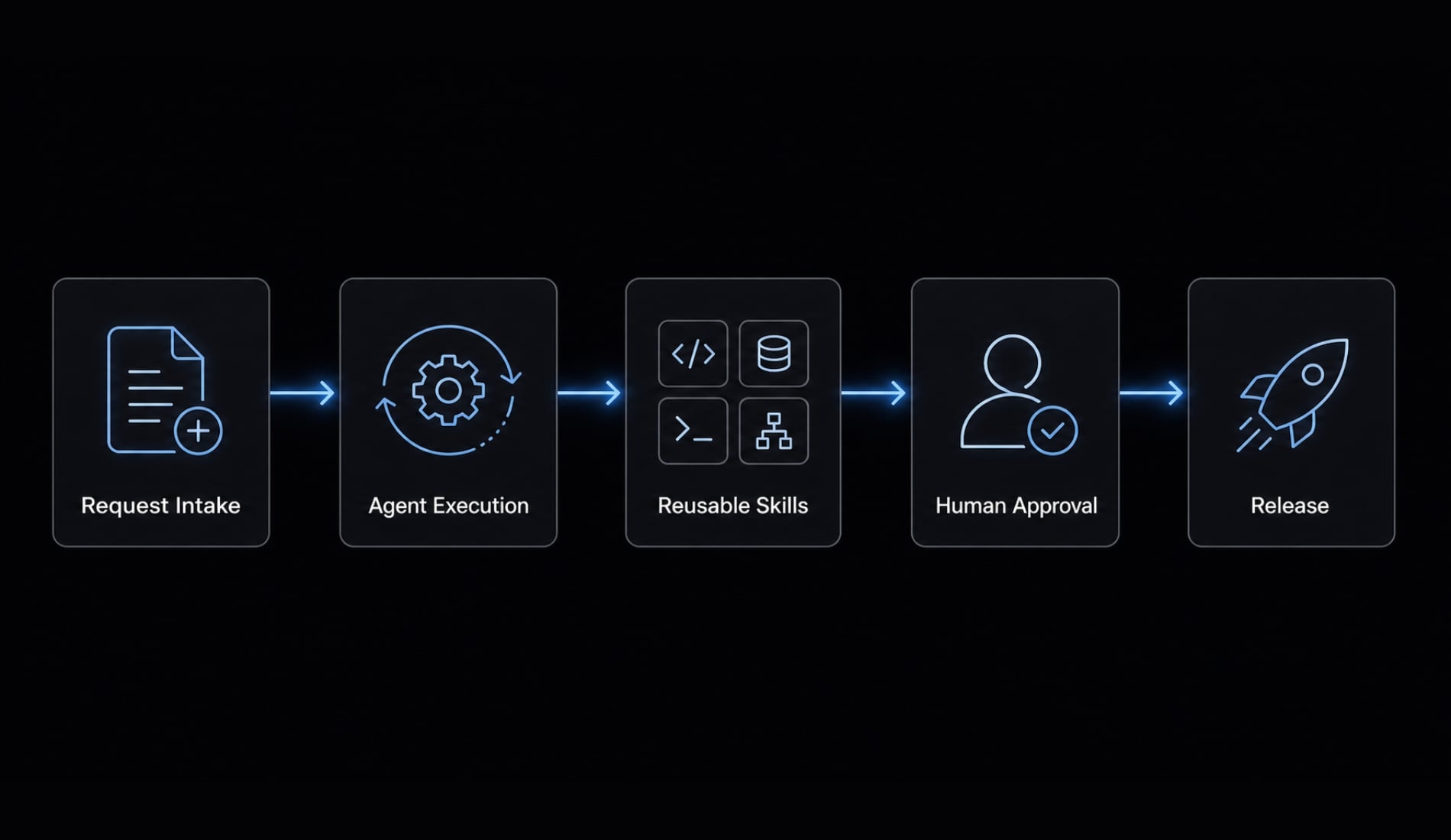
A simple way to make this sustainable is to standardize the path from request to release. That is where structured agent workflows become useful.
In tools like AgentKit, the value is not autonomous shipping. The value comes from making AI-assisted work more repeatable through defined instructions, reusable skills, and explicit review checkpoints. An agent can help draft implementation steps, propose changes, or organize repetitive work, but the process still runs inside controlled execution boundaries.
That means teams can reuse standards instead of rebuilding prompts every time. It also means reviewers see more consistent outputs, which lowers friction and improves validation quality.
Practical lesson: AI becomes more useful when the workflow is standardized, and it becomes safer when humans still control approval, release, and quality gates.
Frequently Asked Questions
What is human-in-the-loop AI coding?
Human-in-the-loop (HITL) AI coding is a software development model in which AI assists with generating, refactoring, or analyzing source code while humans retain final control. The goal is to leverage AI’s speed while people review and approve the work and remain accountable for the product’s quality and safety.
Why do humans still need to participate in AI-assisted coding workflows?
Although AI can generate code quickly, it lacks reliable engineering judgment regarding architecture, security, and long-term maintainability. Human involvement is necessary to prevent subtle logic errors, address edge cases, and ensure that the code aligns with the operational standards of the broader system.
How should responsibilities be divided between AI and humans?
AI should handle tasks such as drafting code, writing unit tests, and summarizing technical documentation. Humans, on the other hand, must retain responsibility for system architecture decisions, security approvals, code reviews, and final decisions about deploying the product to a production environment.
How can teams reduce fatigue when reviewing AI-generated code?
Review pressure can be reduced by dividing tasks into small, focused pull requests, establishing reusable coding standards, and implementing rigorous automated CI/CD checks. Once the system has filtered out basic errors, human reviewers can focus on evaluating intent and system architecture.
What is the standard process for implementing AI in product development?
A safe workflow consists of six steps:
- Create a detailed plan with clear constraints.
- Ask the AI to produce an initial draft.
- Evaluate its architectural suitability.
- Test its real-world behavior.
- Conduct an accountable code approval process.
- Deploy and monitor the product after release.
What are the greatest risks of operating without human oversight?
A lack of human oversight often results in code that appears correct but contains hidden security vulnerabilities, violates system design principles, or introduces low-quality code that is difficult to maintain. Over time, this increases technical debt and the risk of large-scale system failures.
Conclusion
Human-in-the-loop AI coding is a simple idea with serious operational value: let AI accelerate drafting, but keep human judgment in charge of review, approval, and release. That is how teams gain speed without eroding software reliability.
The real risk is not using AI. The real risk is using it without clear ownership boundaries, review discipline, and traceable decisions. Speed without control usually turns into downstream cost. If your team is adopting AI coding tools, the fastest practical next step is to create a short review checklist and a lightweight approval policy. A consistent workflow will do more for safe adoption than any single model or prompt.