
Can vibe coding scale? Production limits and a practical readiness framework
While "vibe coding" speeds up prototyping, rapid execution alone cannot guarantee scalability. True production readiness demands proof that architecture, security permissions, validation, and recovery mechanisms can support real-world workloads without masking critical flaws like data leaks or billing errors. Scaling AI-assisted software is ultimately about applying structured engineering controls proportionate to the risk of failure, rather than simply generating more code.
What “vibe coding at scale” actually means
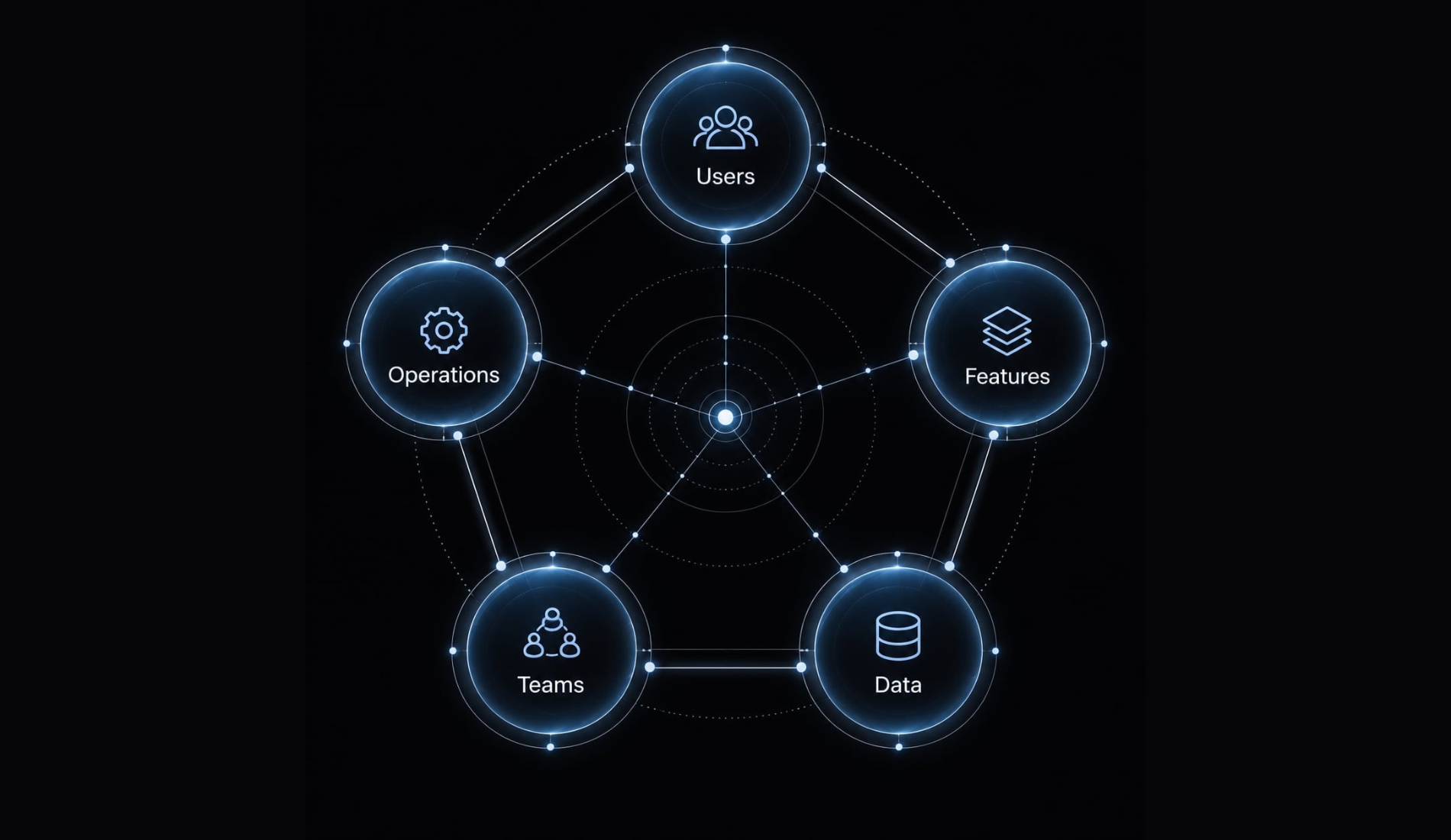
Scaling means supporting a defined increase in demand and complexity - not simply deploying an application. Relevant dimensions include users, data, features, contributors, and operational responsibilities.
In its narrower sense, vibe coding means generating and iterating through natural-language prompts with limited inspection of the implementation. Broader usage sometimes includes disciplined AI-assisted development. Here, “ad hoc vibe coding” describes the former; “structured AI-assisted engineering” describes work governed by specifications, validation, and accountable review.
AI-written code is not inherently unscalable. Its authorship does not determine whether its system architecture supports growth.
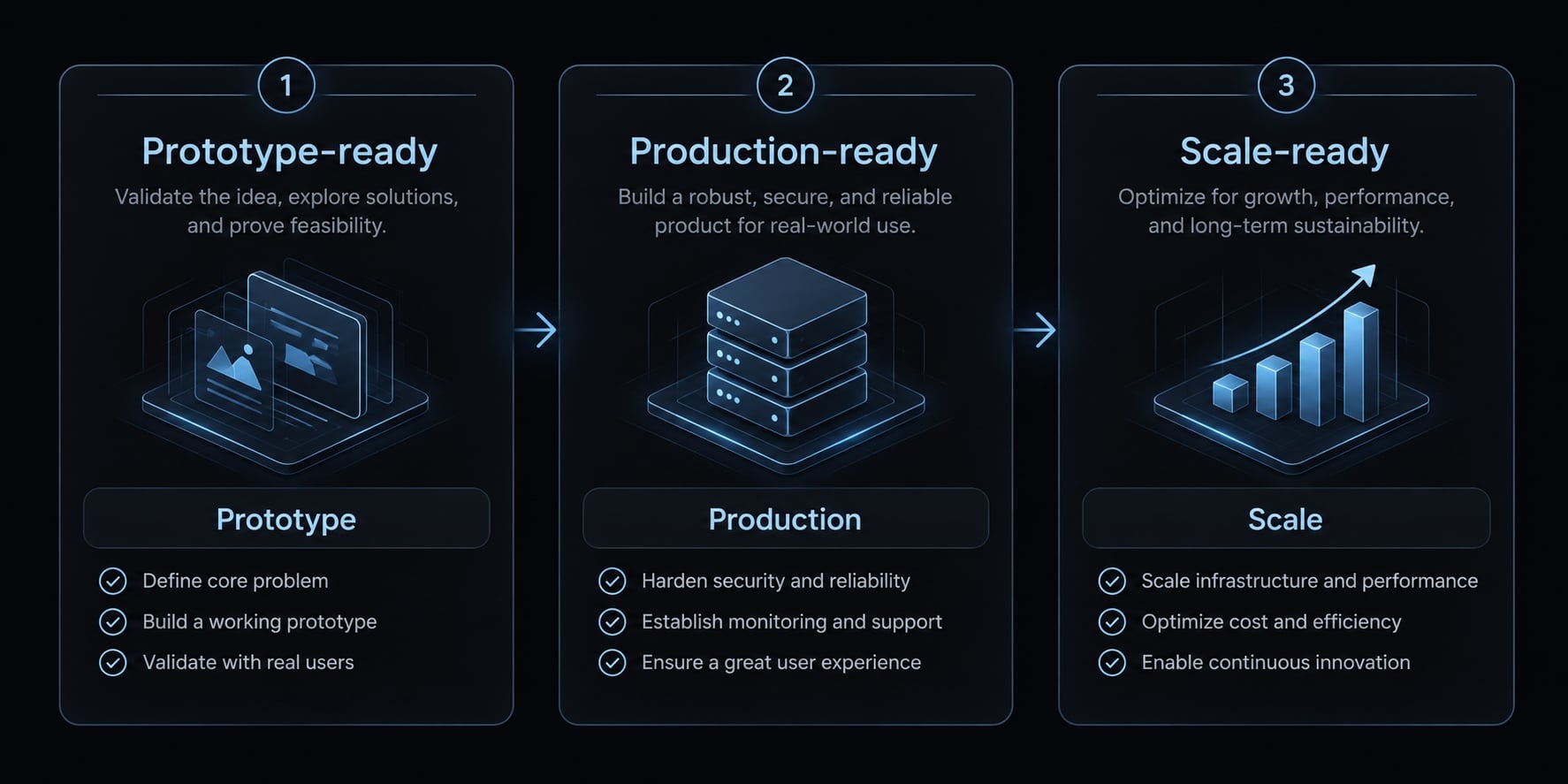
Prototype-ready, production-ready and scale-ready are different standards
Stage | What it proves | What it does not prove |
|---|---|---|
Prototype-ready | A concept or selected journey works under demonstration conditions. | Safe access, reliable recovery, or representative performance. |
Production-ready | The product is fit for its defined intended use, with risk-appropriate controls. | Capacity for substantially different demand or complexity. |
Scale-ready | Evidence supports a defined growth scenario. | Unlimited growth or readiness for every future use. |
Illustrative example: Consider a B2B subscription product with account roles, billing, external integrations, and background jobs - tasks running outside immediate user requests.
Its prototype can demonstrate signup and payment. Customer launch additionally requires permission checks, reliable subscription updates, and a recovery process. Growth readiness requires testing representative customer data, concurrent activity, and integration failures. Critical-flow tests, verified recovery, and representative load checks provide evidence. A functioning interface does not.
More generated code is not the same as more scalable software
The bottleneck shifts from generating changes → validating changes → operating safely → maintaining changeability. Additional code helps only when the team can establish that it behaves correctly and remains understandable. Application scalability concerns the running product; development throughput concerns how quickly contributors deliver validated changes. Improving one does not automatically improve the other.
The five dimensions that determine whether vibe-coded software can scale
One weak dimension can constrain the whole product. Controls should match the workload and business consequences rather than an arbitrary traffic threshold.
Dimension | Readiness question | Business exposure |
|---|---|---|
Users and traffic | Does representative simultaneous activity remain acceptable? | Slow service and lost customer confidence. |
Features and codebase | Can changes remain bounded and understandable? | Longer releases and expensive maintenance. |
Data and integrations | Do retries and partial failures preserve correct records? | Billing errors and reconciliation work. |
Teams and agents | Can contributors follow shared rules and obtain review? | Conflicting changes and delivery queues. |
Operations | Can owners detect, contain, and recover from failures? | Prolonged disruption and support burden. |
User and traffic scale
A local demonstration rarely reproduces production conditions. In the illustrative subscription product, several customers might run large reports simultaneously. Check response delays, resource limits, and background-job completion using representative data.
Feature and codebase complexity
Three warning signs deserve attention:
- Similar features use incompatible patterns.
- Small changes break unrelated behavior.
- Core decisions lack an explainable rationale.
This is architectural drift: inconsistent implementation patterns accumulating across a system. Its cost appears as slower investigation, recurring defects, and less predictable releases.
Data and integration scale
Safe retries should avoid duplicate effects. Reconciliation should compare records and surface discrepancies. Consistent access rules must apply across interfaces, integrations, and background jobs.
Team and agent scale
More contributors increase coordination and review demands. Shared standards should cover naming, error handling, testing, and data access. More agents expand output capacity, not necessarily validated delivery capacity.
Operational scale
Observability means operational signals that help explain system behavior and investigate failures. Infrastructure capacity matters, but ownership adds another constraint: every consequential failure needs someone accountable for response and recovery.
What usually breaks first in a vibe-coded product
These are diagnostic patterns, not a measured ranking of universal first failures. Investigate the missing control before deciding whether a rewrite is necessary.
Every new feature causes unrelated regressions
Symptom → consequence → first check: An invitation change breaks subscription access. Inspect regression tests around that critical journey before adding another patch. Repeated symptom-patching increases technical debt.
No one can explain the entire critical path
Symptom → consequence → first check: Contributors understand individual screens but cannot explain invitation → account access → subscription entitlement. Map this journey end to end, including dependencies, failure states, and named owners. No one needs to memorize every file; the consequential path must be explainable.
Authentication, permissions and sensitive data become patchwork
Symptom → consequence → first check: One customer can retrieve another customer’s record. The underlying assumption is that authentication, verifying identity, also establishes authorization, deciding permitted actions. It does not. Apply consistent server-side permission checks and tenant isolation, keeping customer organizations’ data separate. Verify the correction with cross-account access tests; inspect secret handling alongside access rules.
Failures are discovered by users instead of monitoring
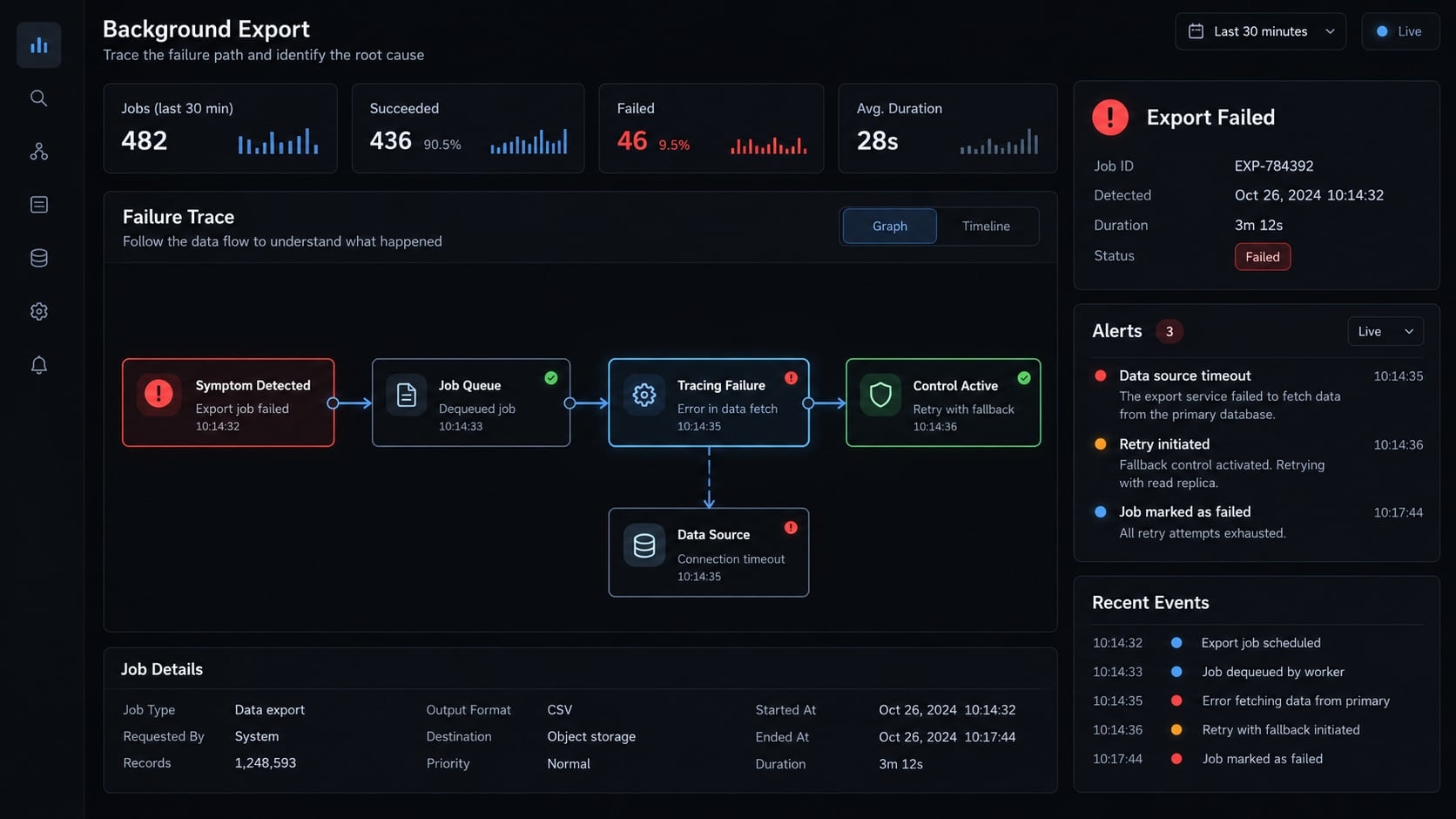
Symptom → consequence → first check: A background export fails silently. Check whether the team can identify failure start time, affected records, and recovery status. An alert on overdue completion may matter more than additional logs.
Review capacity becomes the new bottleneck
Symptom → consequence → first check: Change volume rises while approvals stall. Measure waiting time, reduce change size, and implement automated validation checks.
Measure waiting time and inspect change size. Use smaller changes, automated checks, and risk-based review. An agent reviewing another agent does not guarantee independent assurance.
Where vibe coding is appropriate and where it becomes high-risk
Suitability depends on sensitivity, reversibility, exposure, and failure impact. These ratings concern ad hoc prompting - not whether AI assistance should be allowed.
Use case | Ad hoc prompting suitability | Baseline considerations |
|---|---|---|
Disposable research prototype | Generally suitable | Synthetic data; no production access. |
Isolated UI experiment | Suitable with boundaries | No consequential permissions or data changes. |
Personal utility | Conditional | Limited privileges; recoverable inputs. |
Internal business tool | Conditional to high-risk | Access review; data protection; recovery. |
Customer-facing MVP | Limited without hardening | Critical-flow tests; monitoring; accountable owner. |
B2B subscription billing | High-risk | Reconciliation; safe retries; qualified review. |
Sensitive or regulated workflows | High-risk | Specialist review; documented safeguards and obligations. |
The consequence of failure should determine the level of control
A disposable research prototype can tolerate mistakes that a billing system cannot. Where failures affect money, sensitive data, or contractual commitments, stronger controls remain necessary regardless of code authorship.
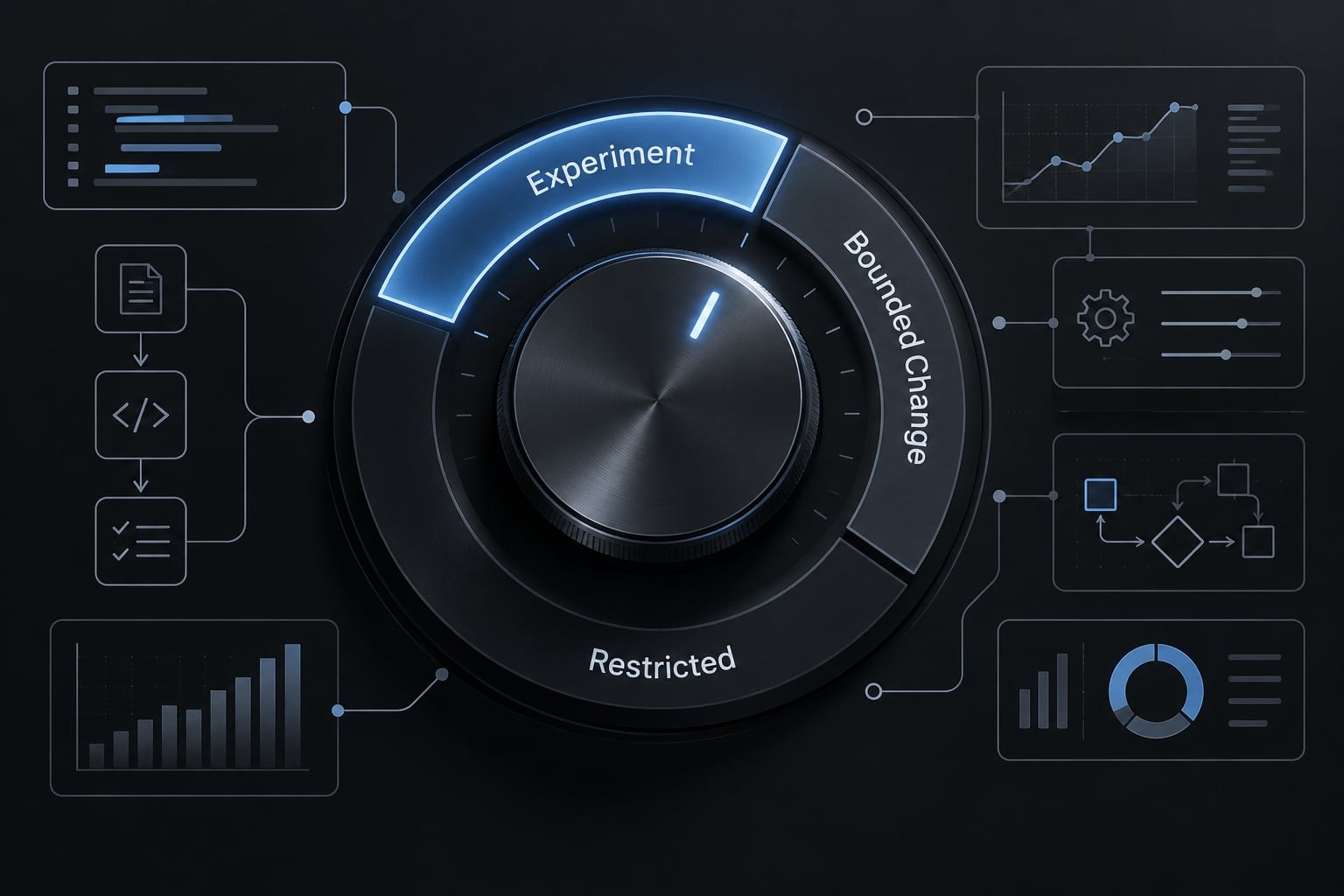
Use a per-task autonomy dial, not one rule for the entire codebase
Task | Appropriate autonomy | Human boundary |
|---|---|---|
Isolated UI experiment | Broader exploration | Review before connection to consequential systems. |
Bounded backend change | Constrained implementation | Approve acceptance criteria and inspect test evidence. |
Payments, permissions, migrations, production access | Restricted execution | Qualified approval and controlled release authority. |
Acceptance criteria are observable conditions a change must satisfy. Even within one product, different tasks warrant different autonomy. A visual experiment and a database migration should not inherit identical permissions simply because the same agent performs both.
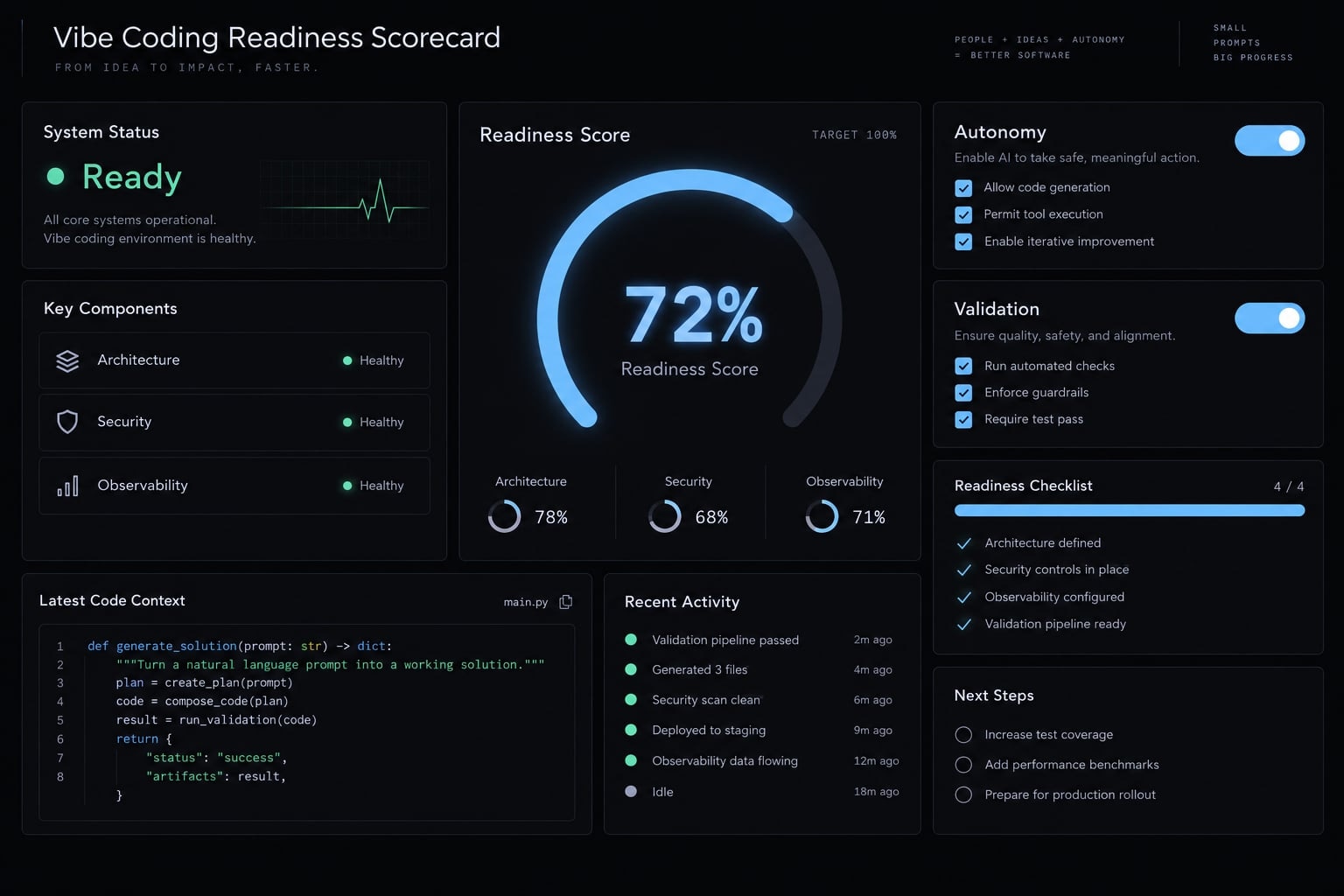
A practical vibe coding scale-readiness scorecard
Readiness requires evidence, not confidence or feature count.
Readiness area | Green: evidenced | Amber: incomplete | Red: material gap |
|---|---|---|---|
Architecture and ownership | Critical flows mapped; owners named. | Dependencies partly understood. | Critical path or owner unknown. |
Testing and validation | Critical outcomes and failures tested. | Important cases missing. | Core behavior unverified. |
Security and data protection | Boundaries reviewed and tested. | Review gaps remain. | Known exposure or access failure. |
Performance and capacity | Representative workload meets targets. | Limited load evidence. | Expected workload fails. |
Observability | Critical failures detected and traceable. | Partial workflow visibility. | Failures remain invisible. |
Deployment and recovery | Release and recovery paths exercised. | Procedures untested. | No credible recovery path. |
Maintainability and economics | Changes reviewable; costs tracked. | Rework or costs unclear. | Delivery persistently unmanageable. |
Attach an artifact to every selected status. Record the failure consequence, risk level, responsible owner, required action, target completion date, and reassessment date.
Architecture and ownership
Can contributors find critical flows, dependencies, owners, and approved implementation patterns?
Evidence might include an architecture map, decision record, and ownership register. Documentation must describe the current system, not an abandoned design.
Testing and validation
Prioritize identity, permissions, billing, data changes, and essential customer journeys. Inspect results against acceptance criteria, including failure cases.
Test counts and coverage percentages alone do not establish correct behavior. A large suite can omit cross-customer access entirely.
Security and data protection
Review secrets, dependencies, authorization, tenant boundaries, and sensitive-data handling.
OWASP’s Application Security Verification Standard and NIST’s Secure Software Development Framework provide relevant guidance. Automated security scans support review but cannot prove complete security or establish compliance approval.
Observability and recovery
Can the team detect a failed critical workflow, identify its owner, and demonstrate recovery?
Rollback is not data restoration. Reverting application code may leave incorrect billing records unchanged. Recovery evidence should address both service behavior and damaged data where relevant.
Maintainability and development economics
Use consistent definitions and measurement windows. Separate development inference costs - model usage during engineering - from customer-facing runtime costs. Include human review and rework when assessing delivery economics.
Use the scorecard on one customer journey first. Prioritize gaps by consequence, assign actions and owners, then reassess with new evidence. Do not average statuses into a safety score; unresolved critical risks require qualified engineering or security review.
How to move from vibe coding to structured AI-assisted engineering
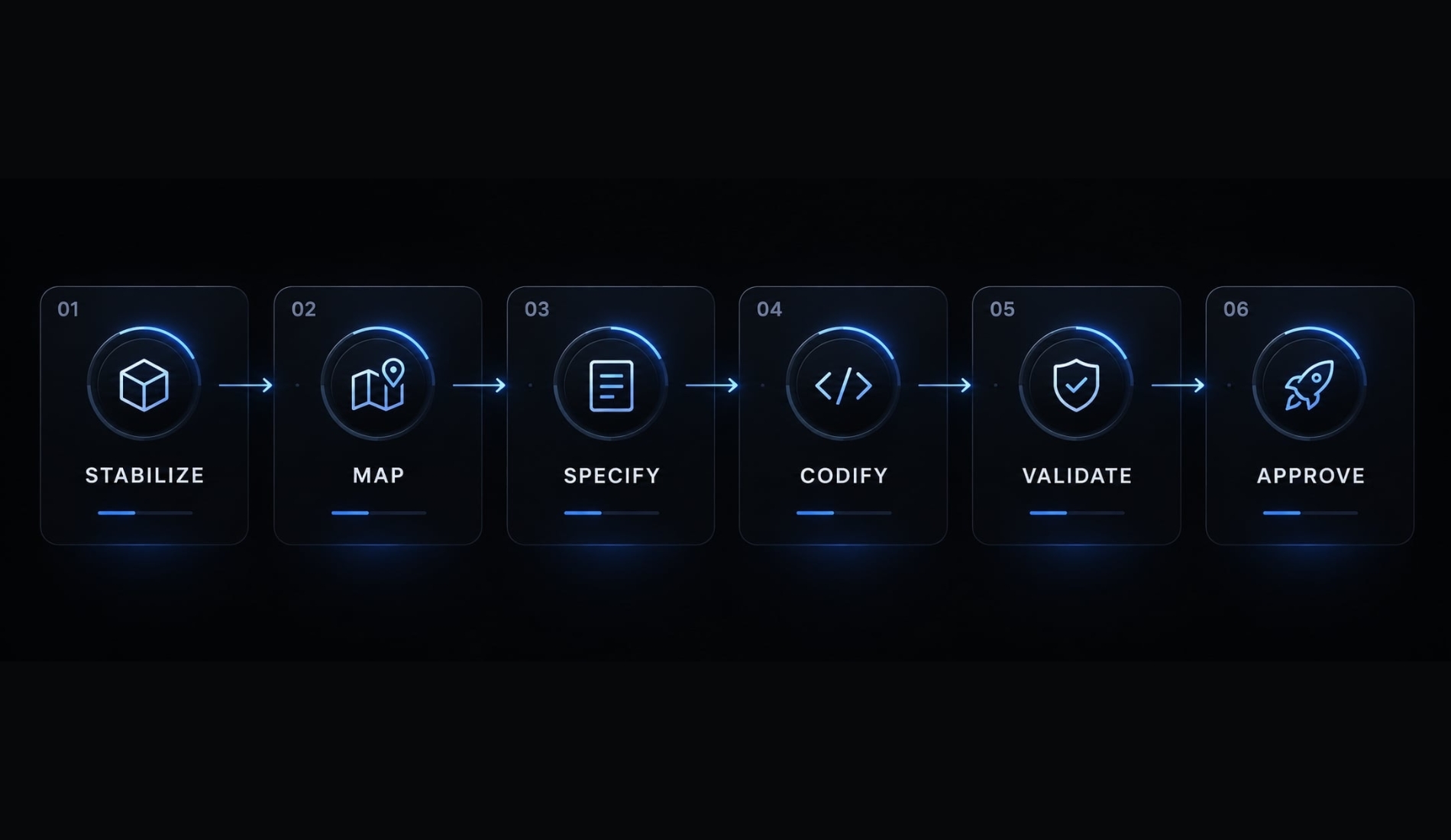
Inspect and stabilize critical paths before choosing a rewrite. Replacement may be justified, but it requires evidence about repair cost, constraints, and migration risk.
Pause uncontrolled feature expansion
Create a prioritized feature and risk backlog. Pause discretionary scope where necessary, while continuing urgent fixes and justified commitments.
Preserve a known baseline. Separate growth-blocking defects from cosmetic improvements so the team can verify that hardening work addresses consequential risks.
Map the current system and its critical paths
Produce a current-state architecture map. Cover users, data, dependencies, integrations, background work, and ownership.
For the illustrative product, trace payment notification through subscription access. Human-validate AI-generated summaries against actual behavior; a plausible diagram is not evidence of correctness.
Convert prompts into specifications and acceptance criteria
Write a bounded specification. Define requirements, constraints, permission boundaries, failure cases, and observable completion conditions.
Request type | Subscription-billing example |
|---|---|
Ambiguous prompt | “Fix subscription upgrades.” |
Abbreviated specification - not a complete billing design | Only authorized account administrators may upgrade. Repeated billing events must not duplicate effects. Failed processing must remain visible and recoverable. Tests must cover unauthorized requests, duplicate events, and interrupted processing. |
This is spec-driven development: implementation follows explicit requirements that can be evaluated, rather than conversational intent alone.
Codify institutional knowledge
Publish shared engineering instructions in version control. Make changes reviewable and keep secrets out.
Include:
- Approved patterns and dependency boundaries.
- Permission and sensitive-data rules.
- Testing expectations and completion criteria.
- Prohibited practices and escalation owners.
Verify that contributors can find and apply the guidance. Outdated instructions can reproduce mistakes consistently.
Automate validation before increasing autonomy
Build a validation pipeline, a repeatable sequence of checks before release.
Proposed six-stage pipeline:
Specification review → static and dependency checks → focused tests → integration and permission tests → protected preview validation → release approval and post-release verification.
CI, continuous integration, runs automated checks as changes are integrated. Use appropriately protected data and credentials in preview environments. Apply stronger review to higher-impact changes; passing automated checks is supporting evidence, not blanket permission to deploy.
Assign human approval boundaries
Create a responsibility matrix. Separate proposal, implementation, review, and deployment authority.
Change | Implementation | Required approval |
|---|---|---|
Routine bounded change | Assigned developer or agent | Accountable reviewer. |
Security-sensitive change | Explicitly authorized contributor | Qualified security or engineering owner. |
Production release | Designated release process | Named release owner. |
Enforce boundaries through permissions where possible. Documented instructions alone do not prevent unauthorized actions.
From ad hoc prompts to coordinated agent workflows
Coordination makes context, roles, and handoffs repeatable. It does not establish architectural quality or security by itself.
The AI development maturity model
Stage | Context and execution | Validation and accountability |
|---|---|---|
Ad hoc prompting | Requirements reconstructed in conversations. | Informal checks; unclear boundaries. |
Bounded AI assistance | Scoped tasks and selected repository context. | Human review of defined changes. |
Specification-led workflow | Shared instructions and explicit outcomes. | Repeatable checks; named approvers. |
Governed agent coordination | Specialist roles and controlled handoffs. | Risk-based permissions, evidence, and ownership. |
Teams can occupy different stages for different tasks. A small project may need one well-scoped agent, not a multi-agent system.
Coordination becomes useful when context rebuilding, inconsistent handoffs, or repeated setup creates friction. Agent count is not a maturity metric.
How AgentKit supports the transition
AgentKit provides a customizable foundation of specialized subagents, reusable skills, and automated workflows for building an AI engineering system. It runs natively on coding agents such as Claude Code and Codex, with Cursor and DeepSeek Harness supported on its beta channel.
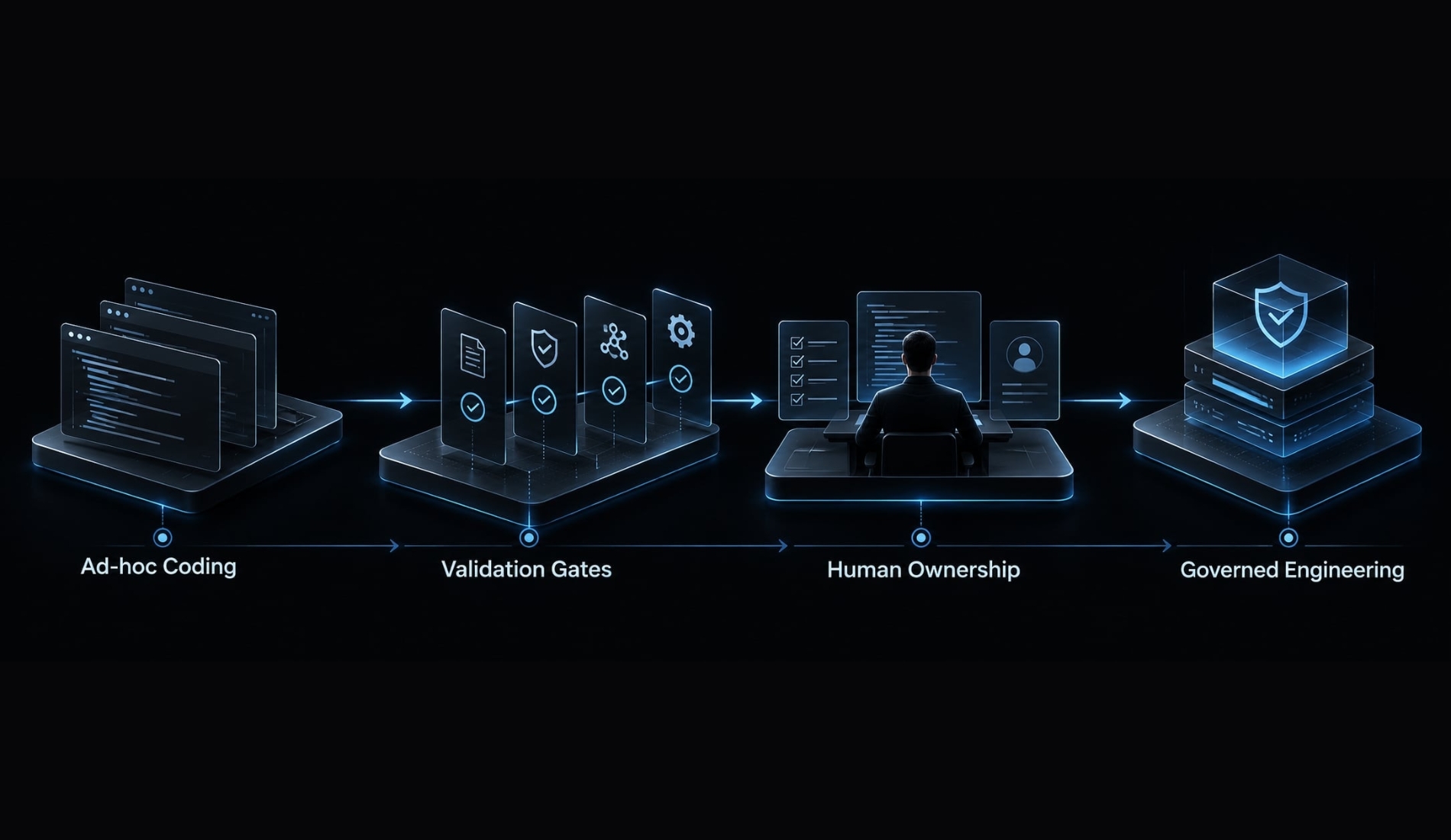
A controlled operating sequence using AgentKit:
- Plan from requirements, constraints, and known risks.
- Implement bounded tasks using shared patterns.
- Test and review against acceptance criteria.
- Inspect configured checks and resolve findings.
- Reuse skills and configurations instead of reconstructing context.
- Retain consequential approvals with designated human engineers.
Frequently asked questions
Can vibe coding be used for production-grade software?
Yes, but it requires transitioning from ad hoc prompting to structured, spec-driven engineering. While vibe coding excels at rapid prototyping, production readiness demands explicit controls for security, data integrity, and recovery.
Why do some vibe-coded projects fail at scale?
Projects often fail due to missing system-level controls, including architectural drift, unmanaged credentials, weak tenant isolation, and lack of operational observability under concurrent load.
What is the difference between "vibe coding" and "agentic engineering"?
Vibe coding relies on informal intuition and natural language prompts. Agentic engineering formalizes development using explicit specifications, version-controlled guidelines, scoped tool permissions, and automated testing suites.
How do I assess if my AI-generated product is ready for growth?
Audit your architecture, security, and recovery using a readiness scorecard. Software is scale-ready for a defined growth scenario when you have verifiable evidence for core customer journeys, representative load and concurrency results, clear ownership, and tested recovery procedures.
How can I make my AI development workflow more repeatable?
Adopt spec-driven development: turn ambiguous prompts into testable acceptance criteria, codify engineering patterns in version control, and set up automated verification pipelines before deploying agent code.
Read more:
- Andrej Karpathy vibe coding: What it is and how it works
- 7 practical vibe coding examples: Build apps faster with AI
- Vibe coding vs low code: Choosing the right development path
Conclusion
Can vibe coding scale? The answer depends less on who generated the code than on what the team can demonstrate about its behavior. Implementation speed is valuable, but production readiness requires validated permissions, reliable data handling, representative performance, recovery, and accountable ownership.
Start with one consequential customer journey, gather evidence using the readiness scorecard, identify high-consequence gaps, and verify corrections. If team coordination becomes the next bottleneck, evaluate workflow framework options like AgentKit to structure agent roles while maintaining strict human engineering oversight.