Vibe coding stack: Tools, workflows and recommended setups for building apps with AI
Generating a convincing interface is easier than operating a reliable application. A well-structured vibe coding stack effectively bridges this gap, while still relying on the developer's technical judgment. This guide explains the essential layers, recommends setups by project type, and provides a repeatable AI-assisted development workflow with concrete release safeguards.
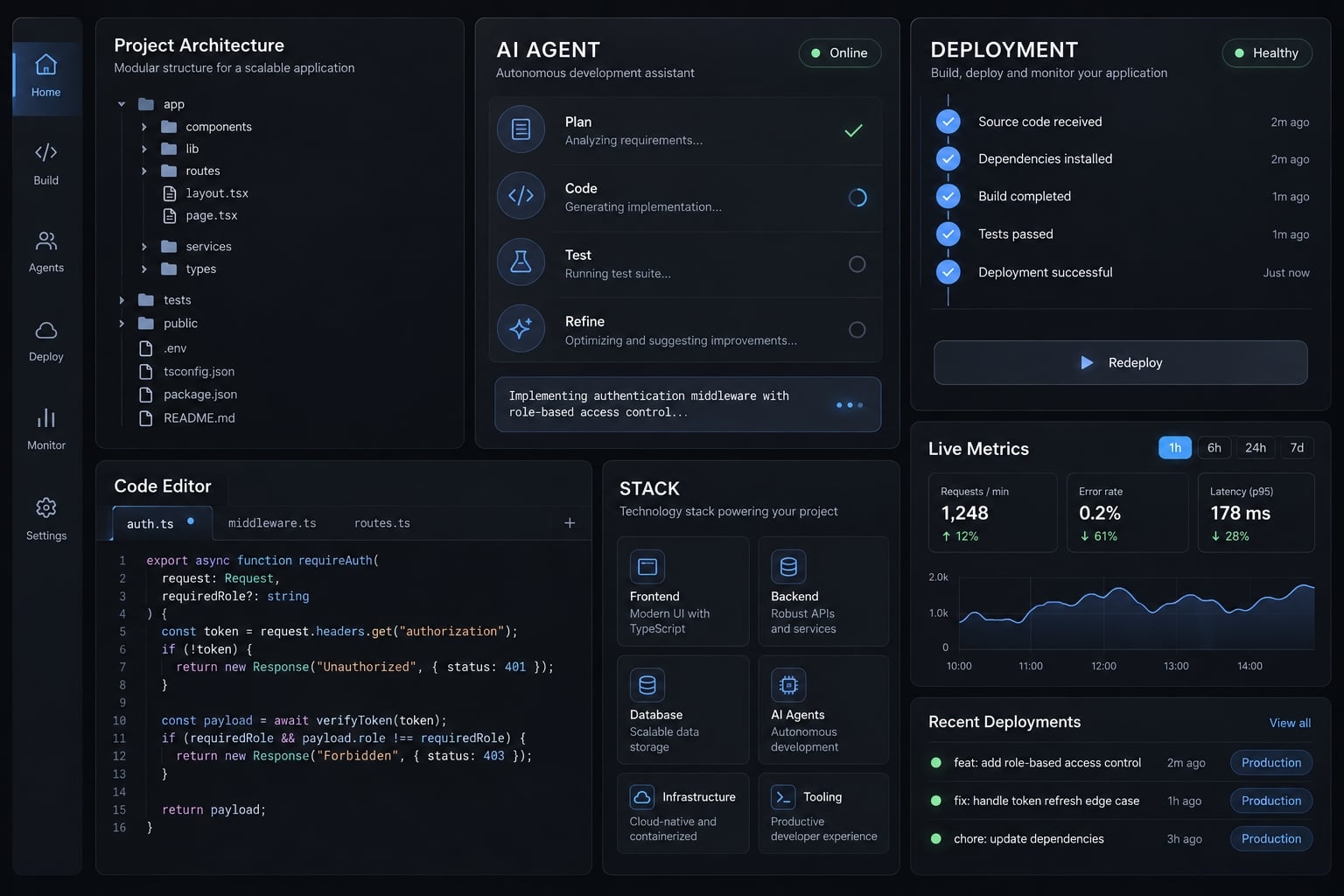
A vibe coding stack combines an AI coding assistant, project context, application components, quality controls, and deployment infrastructure. Together, these support a workflow from natural-language requirements to running software. People remain responsible for implementation decisions, reviewing generated changes, protecting data, and maintaining the application after release.
What is a vibe coding stack?
A vibe coding stack extends an ordinary application stack with AI interaction and supporting context. It does not replace architecture, testing, or operations. In his February 2025 public post, Andrej Karpathy introduced “vibe coding” as a largely hands-off approach, accepting generated changes without closely reading the code. Broader usage now includes more deliberate AI-assisted development.
That distinction matters: reviewed AI-assisted engineering is not the same as trusting generated output without inspection.
To make practical implementation decisions, it is helpful to categorize your stack into three key areas:
- AI interaction: The assistant, instructions, and connected tools.
- Application infrastructure: Interface, business logic, database, and identity services.
- Control and operations: Reviews, tests, deployment, monitoring, and recovery.
These approaches differ in emphasis, not in whether developers use documentation or automation.
Dimension | AI-assisted stack | Traditional development stack |
|---|---|---|
Primary interface | Natural-language instructions plus code inspection | Code editing plus development tools |
Context sources | Documentation and files loaded into agent context | Documentation, project files, and team knowledge |
Code generation | Agents propose or execute substantial changes | Developers write code with libraries, generators, and automation |
Quality controls | Tests, scans, and human review | Tests, scans, and human review |
Main risks | Incorrect code, insecure behavior, misplaced trust in output | Incorrect code, insecure behavior, implementation mistakes |
Human responsibilities | Specification, implementation decisions, review, operations | Specification, implementation decisions, review, operations |
Throughout this guide, an illustrative client reporting portal shows the difference. “Generate a dashboard” can produce a convincing demo. A reviewed specification must also define which clients can access each report and how data is protected.
The seven layers of a practical vibe coding stack
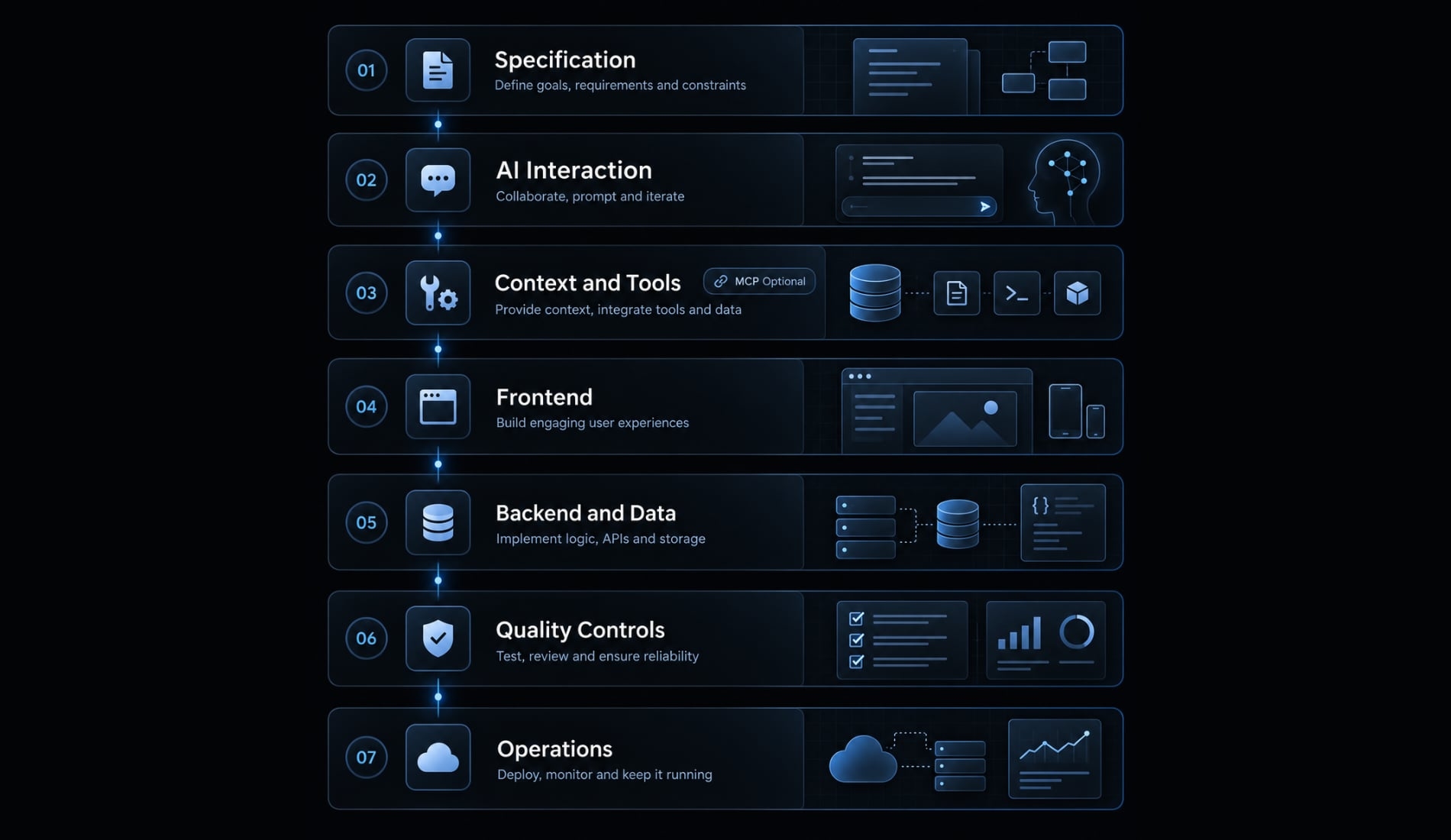
Choose tools by function rather than popularity. This seven-layer model is a practical organizing framework, not an official industry standard.
Layer | Purpose | Common options | Required? |
|---|---|---|---|
Specification | Define behavior and completion | Brief, PRD, acceptance criteria | Yes; detail varies |
AI interaction | Generate and modify code | Terminal agent, IDE, cloud builder | For AI-assisted work |
Context and tools | Supply guidance and controlled access | Instruction files, documentation, MCP | Context yes; MCP optional |
Frontend | Present user interactions | HTML, React, Next.js | Interface as needed; framework optional |
Backend and data | Store data and enforce business rules | Supabase, Convex, custom backend | Not for every static demo |
Quality controls | Detect defects and unsafe changes | Tests, linting, security scans | Basic checks always; stronger for live apps |
Operations | Release and maintain software | Hosting, CI automation, monitoring | Proportionate to use |
1. Product specification and planning for your vibe coding stack
A short specification reduces ambiguity before code generation. A product requirements document (PRD) describes what the application must do and how completion will be judged.
Include:
- Goal and intended user.
- Core workflow.
- Non-goals.
- Data needs.
- Acceptance criteria.
For the portal: “Client users can view only reports belonging to their organization.” A tiny experiment may need only a brief, not a formal document.
2. AI coding agent or IDE
Three working environments are useful to distinguish:
- Terminal-first agents: Work through command-line interactions inside a project.
- Agentic IDEs: Combine an integrated development environment with agent-assisted editing.
- Integrated cloud builders: Bring prompting, editing, and previews into a hosted workspace.
Claude Code, Codex, Cursor, GitHub Copilot, and Windsurf are representative tools; their operating modes overlap. Choose based on inspectable changes, permission controls, and your review workflow—not unsupported model-quality rankings.
3. Context, rules and tool protocols
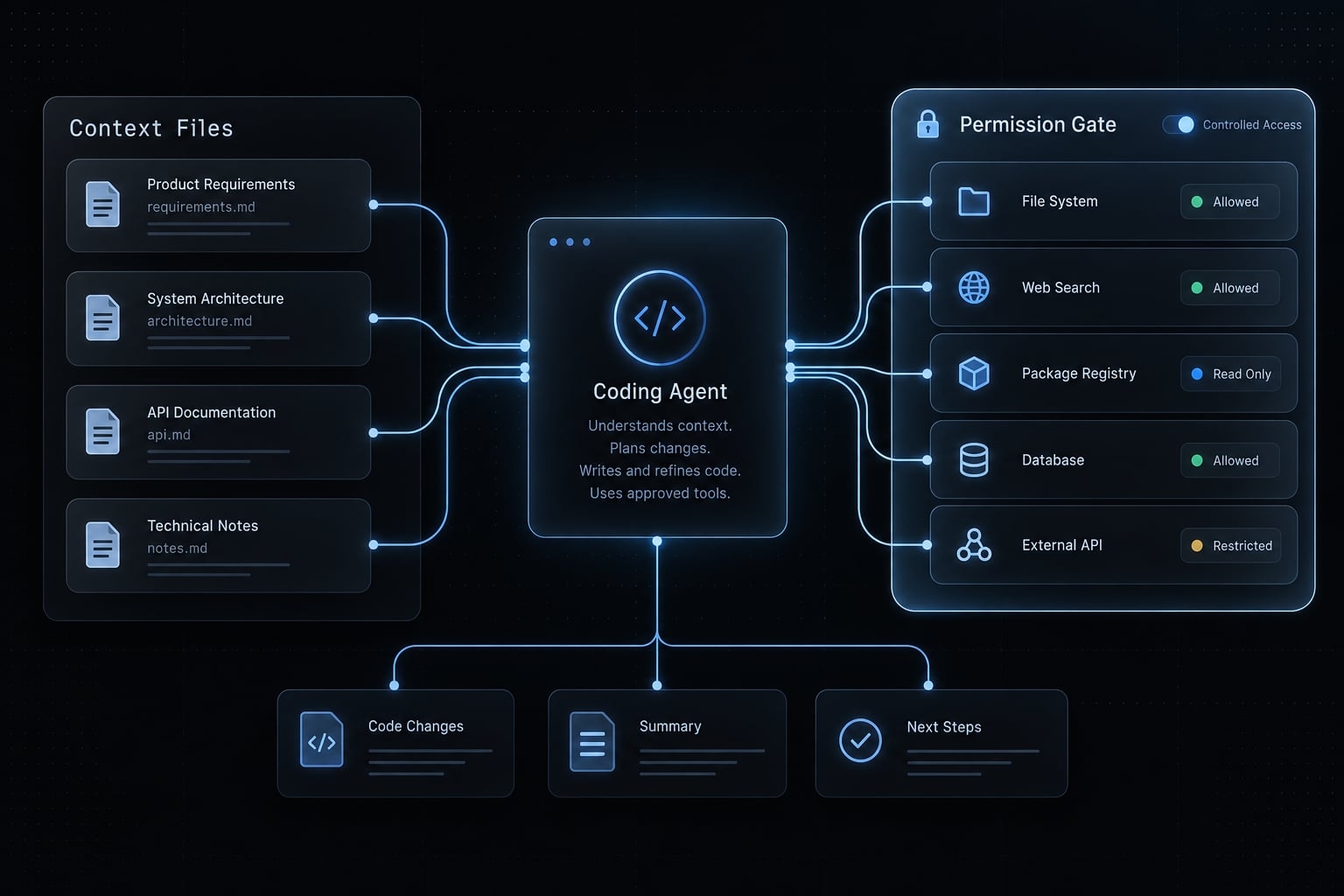
A context file contains repository instructions that a supported tool can load. Include architecture notes, test commands, dependency rules, and prohibited actions. Claude Code documentation describes CLAUDE.md; Codex documentation describes AGENTS.md. Editor-specific rules use other mechanisms. Verify loading behavior: persistent files do not guarantee model recall or compliance.
MCP (Model Context Protocol) connects supported AI applications to tools and resources, as described in the protocol documentation. It is optional, not a trust guarantee. Review external servers, restrict permissions, and exclude production credentials from routine agent access.
4. Frontend and application framework
Familiar conventions reduce implementation ambiguity. React provides interface components; Next.js adds application-framework capabilities. TypeScript adds static type checking.
Tailwind CSS handles styling through utility classes; shadcn/ui supplies component code. Neither is mandatory. Existing team expertise or an established codebase may justify different choices.
5. Backend, database and authentication
Managed services reduce operational work, not permission responsibilities. The following distinctions reflect Supabase and Convex documentation.
Option | Fit | Limitation |
|---|---|---|
Supabase | Managed PostgreSQL, authentication, storage, access policies | Row-Level Security and other permission paths require review |
Convex | TypeScript-oriented backend and reactive data patterns | Different architecture from a conventional SQL-first approach |
Custom backend | Specialized business logic and greater control | More implementation and operational responsibility |
PostgreSQL is a database. Prisma is an object-relational mapper (ORM) for accessing databases through application code, not an interchangeable managed backend.
Authentication identifies users. Authorization determines what those users may access or change.
6. Testing and security controls
Combine type checking and linting with unit, integration, and end-to-end tests. Add dependency and secret scanning.
These checks provide evidence beyond an agent’s assurance, but coverage remains limited. Require qualified human review for authentication, permissions, payments, deletion, migrations, and infrastructure changes.
7. Deployment, monitoring and recovery
Use Git version control, preview environments, staging, production logs, alerts, and backups. Continuous integration (CI) runs automated checks on changes. Vercel’s deployment documentation describes preview deployments; this is one potential hosting option, provided it meets your runtime compatibility requirements.
Rollback means returning to a previous working release. Application rollback and database recovery require separate planning because reverting code may not reverse data changes.
Recommended vibe coding stacks by project type
The best vibe coding stack is the one your team can inspect, operate, and afford to maintain. Start with the project’s risk and lifespan.
Stack comparison by use case
Use case | Recommended approach | What it optimizes | Main trade-off |
|---|---|---|---|
Workflow prototype | Integrated builder with synthetic data | Fast validation and minimal setup | Platform constraints |
SaaS MVP | Modular application with managed services | Customization and maintainability | More integration decisions |
Customer-dependent application | Suitable foundation plus release controls | Operational reliability and accountability | Ongoing engineering effort |
Option 1: Fast prototype stack
Use an AI app builder, such as Lovable, Bolt, Replit, or a comparable platform, to validate the reporting workflow.
A sensible configuration includes:
- The builder’s interface tooling.
- Synthetic reports stored locally or in a managed service when necessary.
- A verified export or repository synchronization route.
- Integrated or compatible hosting.
- Basic error visibility.
The objective is to discover whether clients understand the dashboard and can find relevant reports. Real customer data is unnecessary for that first decision.
Before committing, check current product documentation for export availability, synchronization direction, plan restrictions, and deployment support. Test whether another person can run the exported project.
Exportable code does not necessarily mean a portable application. Authentication, storage, background tasks, and platform-specific services may need replacement.
Sensitive data does not automatically disqualify an integrated builder. Its suitability depends on verified controls, provider terms, and your requirements.
Option 2: SaaS MVP stack
For an authenticated portal, an illustrative SaaS MVP stack could use:
- Claude Code with supported project instructions.
- Next.js and TypeScript.
- Tailwind CSS and shadcn/ui where appropriate.
- Supabase for relational data and authentication.
- GitHub for version control and reviewed changes.
- Core tests and compatible preview hosting.
- Error tracking and application logs.
This configuration makes the code, database policies, and release process inspectable. Managed services reduce setup work while retaining familiar application boundaries.
Its trade-off is coordination: someone must understand how identity, database policies, server code, and hosting interact. Confirm framework and runtime compatibility before adopting the configuration.
The portal now moves beyond synthetic data. Authenticated users can view their organization’s reports, with account-level access reviewed and tested.
Convex is an alternative when reactive data and TypeScript-oriented backend development better match the application. Treat that as an architectural choice, not a drop-in database swap.
Option 3: Production-oriented stack
Production readiness extends suitable foundations; it is not a guaranteed-safe product bundle.
Add controls in three groups:
- Engineering: Documented architecture decisions, reviewed dependencies, and critical-path tests.
- Security: Restricted permissions, authorization tests, protected secrets, and reviewed data handling.
- Operations: Separated environments, monitoring, backups, recovery procedures, and named ownership.
Even a small MVP needs these controls once actual customers depend on it. Conversely, a disposable demo rarely needs every operational mechanism immediately. The deciding question is not “Which builder created this?” It is “What evidence supports releasing and maintaining it?”
How to choose the right vibe coding stack
Start with nonnegotiable requirements. Security, privacy, and review capacity are gates—not minor preferences that a faster interface can outweigh.
Use these criteria before selecting tools
Evaluate the complete workflow, not individual subscriptions.
Criterion | Question to answer |
|---|---|
Skill requirement | Can someone understand and troubleshoot the generated application? |
Setup speed | How quickly can one representative feature run? |
Code ownership | What do contracts and dependency licenses permit? |
Customization | Can required behavior be implemented without platform workarounds? |
Context handling | Which instructions load, when, and within what limits? |
Testing support | Can required checks execute locally and before release? |
Security | Are permissions, provider data handling, retention, and access restrictions acceptable? |
Deployment | Does hosting support the application’s runtime and jobs? |
Portability | Can code, data, identity, and configuration move elsewhere? |
Scalability | What happens as usage and operational demands increase? |
Cost visibility | Are model usage, subscriptions, infrastructure, review, and maintenance included? |
Team readiness | Who approves changes and handles incidents? |
Code ownership and tool portability are different questions. Contractual rights do not eliminate migration work. Likewise, low subscription fees can conceal substantial development costs.
Score each requirement Pass / Partial / Fail, attaching evidence such as a test export, policy document, or executed check. A failed critical requirement blocks adoption.
Simple selection rules
- Choose an integrated builder for rapid workflow validation.
- Prefer a modular setup when customization and portability matter.
- Apply formal release gates whenever actual risk requires them.
- Start with fewer compatible tools before buying overlapping subscriptions.
- Favor established project fit over popularity.
If nobody can assess permissions, migrations, or deployment changes, budget for a qualified reviewer. AI coding tools do not remove that responsibility.
A repeatable vibe coding workflow from idea to deployment
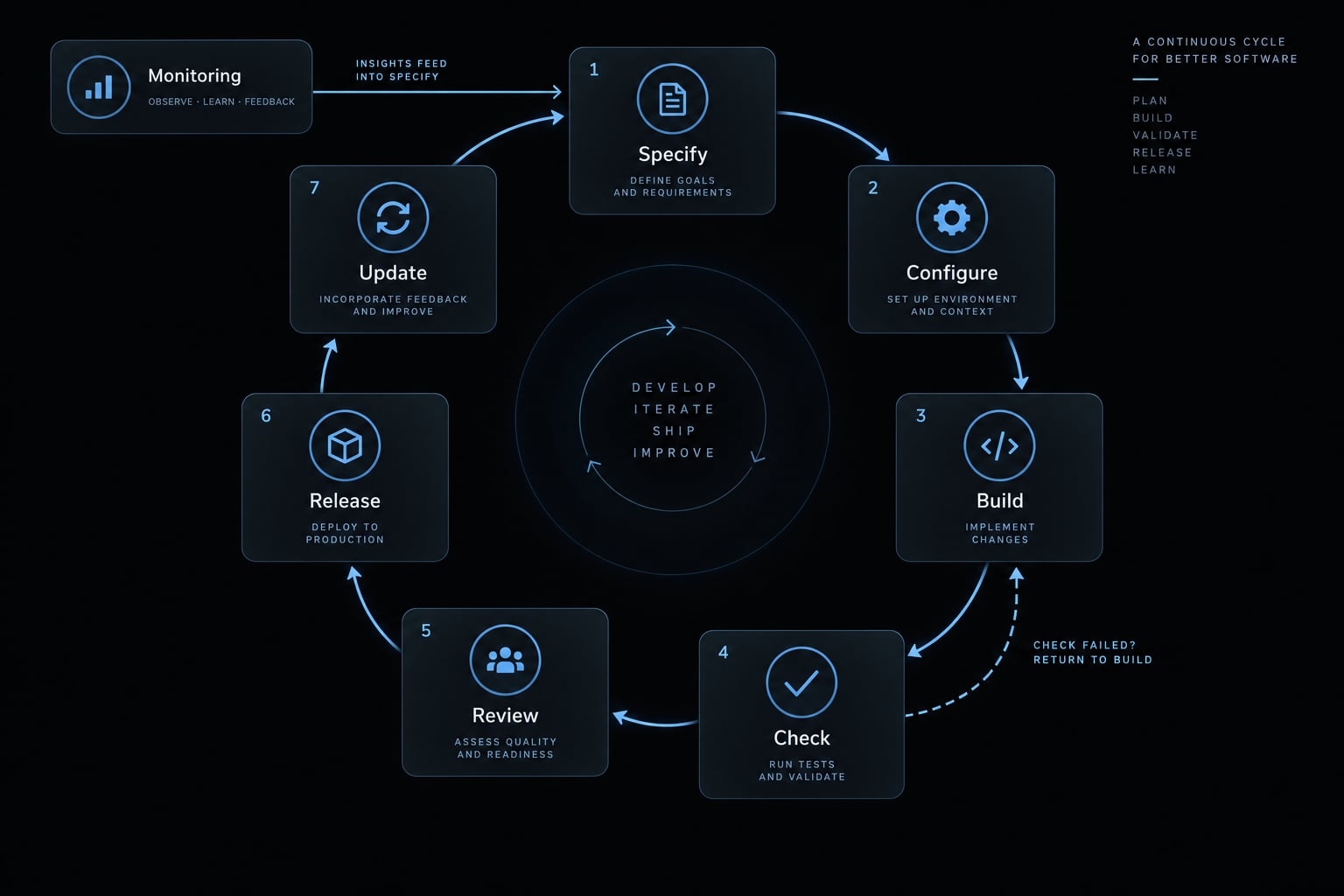
Use short iterations rather than asking an agent to build the entire application at once. Each iteration should produce inspectable work and a clear approval point.
- Define the outcome and constraints.
- Create the PRD and acceptance criteria.
- Set project rules and context.
- Build in vertical slices.
- Run deterministic checks.
- Review before merge and deployment.
- Update documentation and project memory.
Step 1: Define the outcome and constraints
- Action: Describe the client user, reporting problem, core action, data sources, non-goals, and privacy constraints. Begin with synthetic data.
- Deliverable: A one-page brief.
- Review point: Confirm that finding and reading reports solves a real user need. Exclude unrelated features, such as billing or report editing, from the initial scope.
Step 2: Create the PRD and acceptance criteria
- Action: Convert the brief into user flows and pass/fail conditions. Ask the agent to identify ambiguities before implementation.
- For the portal:
- Authorized client users can view their reports.
- Users from another client account cannot retrieve those reports, including through direct requests.
- Deliverable: An approved PRD.
- Review point: The product owner approves scope and expected behavior.
Step 3: Set project rules and context
- Action: Record conventions, allowed dependencies, commands, restrictions, and relevant documentation.
- Deliverable: Supported context files and concise architecture notes.
- Review point: Verify that the tool loads the intended instructions. Apply actual tool permissions separately; written rules alone do not prevent unauthorized actions.
Step 4: Build in vertical slices
A vertical slice is one small feature completed across interface, business logic, data access, and tests.
- Action: Implement sign-in plus viewing one authorized report. Avoid generating every dashboard screen before checking the access model.
- Deliverable: One working end-to-end feature.
- Review point: Validate both permitted access and cross-account denial before adding another feature.
Step 5: Run deterministic checks
- Action: Execute type checks, linting, tests, and applicable scans. Require the agent to report commands executed, results, failures, and skipped checks.
- Deliverable: Actual quality-check results—not a list of proposed commands.
- Review point: Investigate repeated failures or unexplained changes. Stop unlimited patching when the agent cannot explain why the implementation is failing.
Step 6: Review before merge and deployment
- Action: Inspect the diff, authorization logic, migrations, dependencies, and preview behavior. Deploy only the approved revision.
- Deliverable: A reviewed pull request and approved release.
- Review point: A qualified person approves sensitive changes. Solo founders may need outside review. Confirm that production configuration preserves the access restrictions tested earlier.
Step 7: Update documentation and project memory
- Action: Record decisions, completed work, limitations, operational instructions, and unresolved issues in the repository.
- Deliverable: Updated project documentation.
- Review point: Compare documentation against the implementation. Automated documentation can repeat incorrect assumptions; it is not self-correcting or guaranteed agent memory.
This structured workflow for AI coding agents makes handoffs and approval points explicit.
Production-readiness checklist and common failure modes
AI-assisted workflows can contribute to production software. Release suitability depends on ordinary engineering controls and accountable ownership - not the generation method. This checklist is not a security certification.
Prototype-to-production gate
- Code is version-controlled, with a reviewed export or exit path.
- Automated tests cover critical user journeys.
- Authentication and authorization have separate tests.
- Row-Level Security or equivalent controls deny cross-account access.
- Secrets remain outside source control.
- Dependencies are reviewed and scanned.
- Migrations are reviewed, with a viable data-recovery plan.
- Staging and production environments are separated.
- Runtime monitoring produces actionable alerts.
- Rollback or recovery procedures have been tested.
- Sensitive changes require human approval.
- A named owner handles maintenance and incidents.
Row-Level Security (RLS) restricts database access by row. Supabase’s RLS documentation explains policy-based enforcement; enabling RLS alone does not establish that policies are correct.
OWASP’s Authorization Cheat Sheet recommends validating permissions on every request. GitHub’s security documentation describes secret scanning and dependency protections. These controls support AI-generated code security, but passing scans does not prove comprehensive safety.
In the illustrative portal failure, client A requests client B’s report by changing its identifier. Hiding that report in the interface is insufficient. The correction is server-side or database-enforced account scoping, plus a negative test confirming unauthorized retrieval is denied. Record the test result before approving release.
Backups also need a credible restore procedure. Reverting application code may leave changed or deleted data untouched.
Common vibe coding mistakes
Mistake | Why it fails | Better approach |
|---|---|---|
One giant build prompt | Ambiguities compound | Deliver small vertical slices |
Treating instructions as enforcement | Agents can disregard guidance | Restrict permissions at runtime |
Trusting a working interface | Data access may remain unsafe | Test direct unauthorized requests |
Accepting generated tests as proof | Tests may encode wrong assumptions | Review cases and execute checks |
Patching indefinitely | Changes can conceal the cause | Diagnose, narrow scope, or revert |
Launching without an owner | Failures lack a response path | Assign maintenance responsibility |
For each checklist item, record an owner and supporting evidence. This makes human-in-the-loop review an accountable decision rather than a ceremonial approval.
Where an orchestration layer fits
Repeated setup across projects can justify agent orchestration: Coordinating responsibilities and reusing instructions, skills, and workflows. It becomes useful when teams repeatedly reconstruct the same planning, testing, and documentation process.
AgentKit, the publisher’s product, is an optional example of packaging reusable skills, specialized subagents, and workflows. Evaluate any such layer against the actual coding environment and inspect its configuration before adoption.
Plan → Implement → Test → Review → Document
Coordination does not replace engineering accountability. Multiple agents do not automatically provide independent verification, and shared instructions can reproduce shared mistakes. Keep tool permissions, executed checks, and human approval separate from orchestration convenience.
Frequently asked questions
What is a "vibe coding stack"?
A vibe coding stack is a collection of AI coding agents, frameworks, and infrastructure tools chosen for their high compatibility with LLM-assisted development. It prioritizes tools that agents can reliably generate, debug, and maintain, moving beyond basic prompt-based generation into a structured, agentic engineering workflow.
How does a vibe coding stack differ from a traditional development stack?
While both use standard infrastructure, a vibe coding stack optimizes for "agent-readability." It favors TypeScript-first frameworks, standardized component libraries like shadcn/ui, and tools that support Model Context Protocol (MCP) to ensure the AI agent can safely inspect schemas, run tests, and self-correct errors with minimal human intervention.
Which tools are essential for a modern vibe coding stack?
An effective stack includes an AI agent (like Claude Code or Cursor), context documentation (AGENTS.md), a consistent frontend framework (Next.js), a type-safe backend or BaaS (Convex or Supabase), and a deployment runtime (Vercel) that provides immediate feedback loops through automated preview URLs.
What are the main risks of using an AI-assisted development workflow?
The primary risks include "shadow apps" with unvetted data access, missing Row-Level Security (RLS) in databases, and potential tool injection if unverified MCP servers are connected. These risks occur when agents scaffold logic without rigorous human oversight or proper authorization policies.
How can I make my AI-generated code production-ready?
Production readiness requires implementing standard engineering controls: automated testing for critical paths, separate staging and production environments, secret management outside of source control, and manual review of any database migrations or authorization logic before a release is approved.
Do I need to be a professional developer to use these tools?
You can start prototyping with all-in-one cloud builders, but scaling to production requires understanding architectural boundaries. Even if the AI writes the code, the owner remains responsible for security, data privacy, and the operational reliability of the application when real users are involved.
What is the Model Context Protocol (MCP) and why does it matter?
MCP is an open standard that allows AI agents to interact securely with external tools, such as databases or documentation. By using MCP, your agent can "see" your current database schema or API docs in real-time, significantly reducing hallucinations and improving the accuracy of generated code.
Read more:
- Vibe code marketplace: Defining AI-driven development & risks
- Vibe coding cost: The true budget guide for AI app projects
- Vibe code extra income: Building profitable AI products fast
Conclusion
A useful vibe coding stack is a coordinated system, not a single assistant. Specifications establish intent; context guides implementation; application infrastructure delivers behavior. Tests, review, and operations determine whether that behavior remains dependable. Generated code still requires technical judgment, especially where permissions, sensitive data, and irreversible changes are involved.
Start with an integrated builder for a low-risk prototype, or a modular foundation for an extensible MVP. Add production controls whenever customers depend on the application—not only after the project becomes large. Prefer tools your team can understand and maintain. Choose your project category, identify missing layers, and validate one small feature through the full workflow using the on-page production checklist.