
Vibe coding security guardrails: A practical framework for securing AI-generated code
As AI-driven development expands beyond simple code suggestions, securing generated output requires both rigorous software verification and strict system control. This guide outlines the essential safeguards needed to keep development fast, efficient, and fully accountable before human review.
What are vibe coding security guardrails?
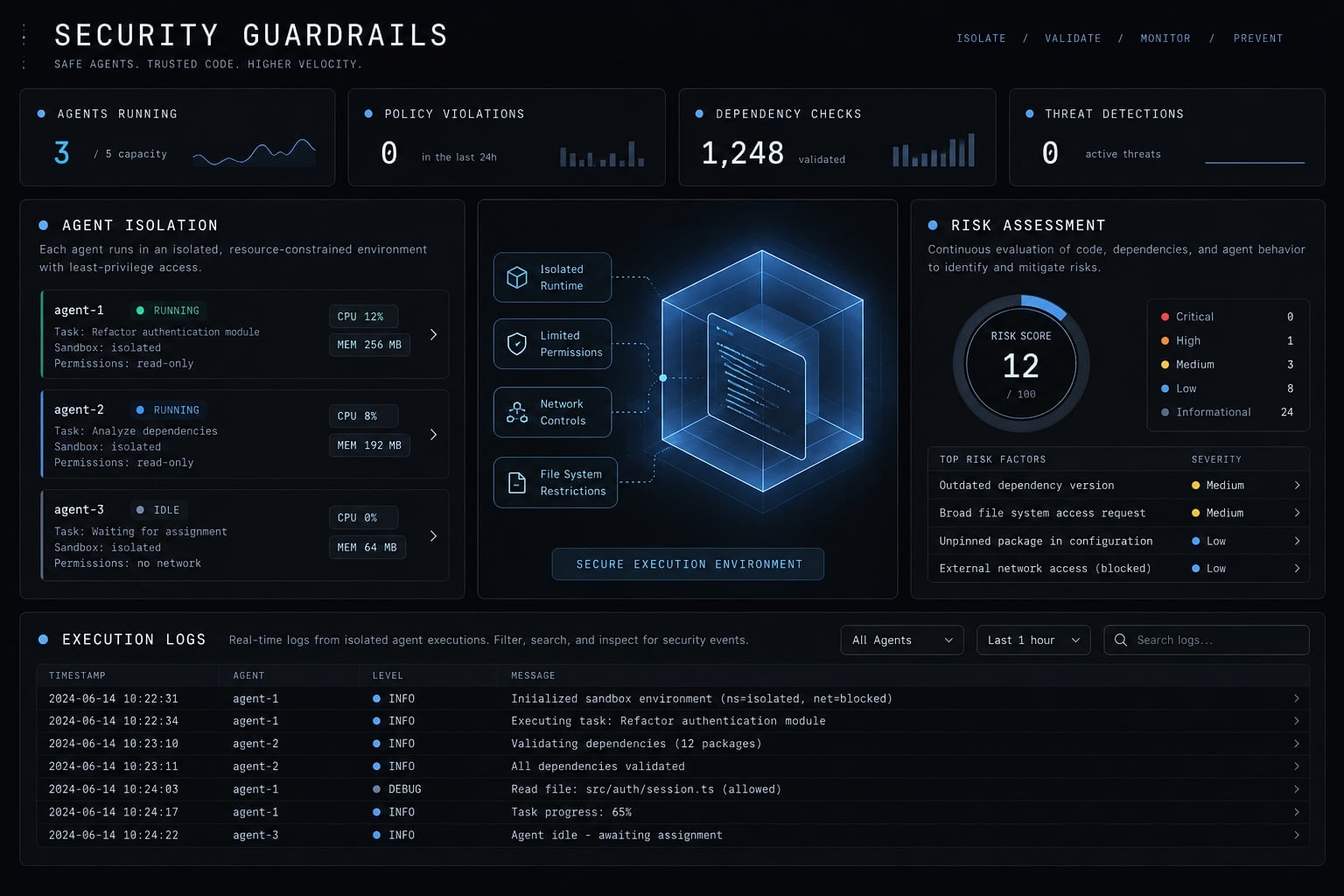
Vibe coding security guardrails are access restrictions, workflow controls, verification checks, and approval requirements that reduce the likelihood or impact of unsafe AI-generated changes and agent actions. They combine behavioral guidance with independently enforced boundaries, so security does not depend solely on an AI assistant following instructions or recognizing its own mistakes.
Vibe coding versus conventional AI assistance
Vibe coding generally emphasizes conversational direction over close inspection of implementation details. It does not require autonomous execution.
Suggestion-oriented assistance leaves editing and execution largely with the developer. Agentic workflows may delegate both, increasing the authority that needs restriction. Neither approach is automatically secure: manually accepted code can contain vulnerabilities, while tightly scoped agents still require output verification.
Guidance is not the same as enforcement
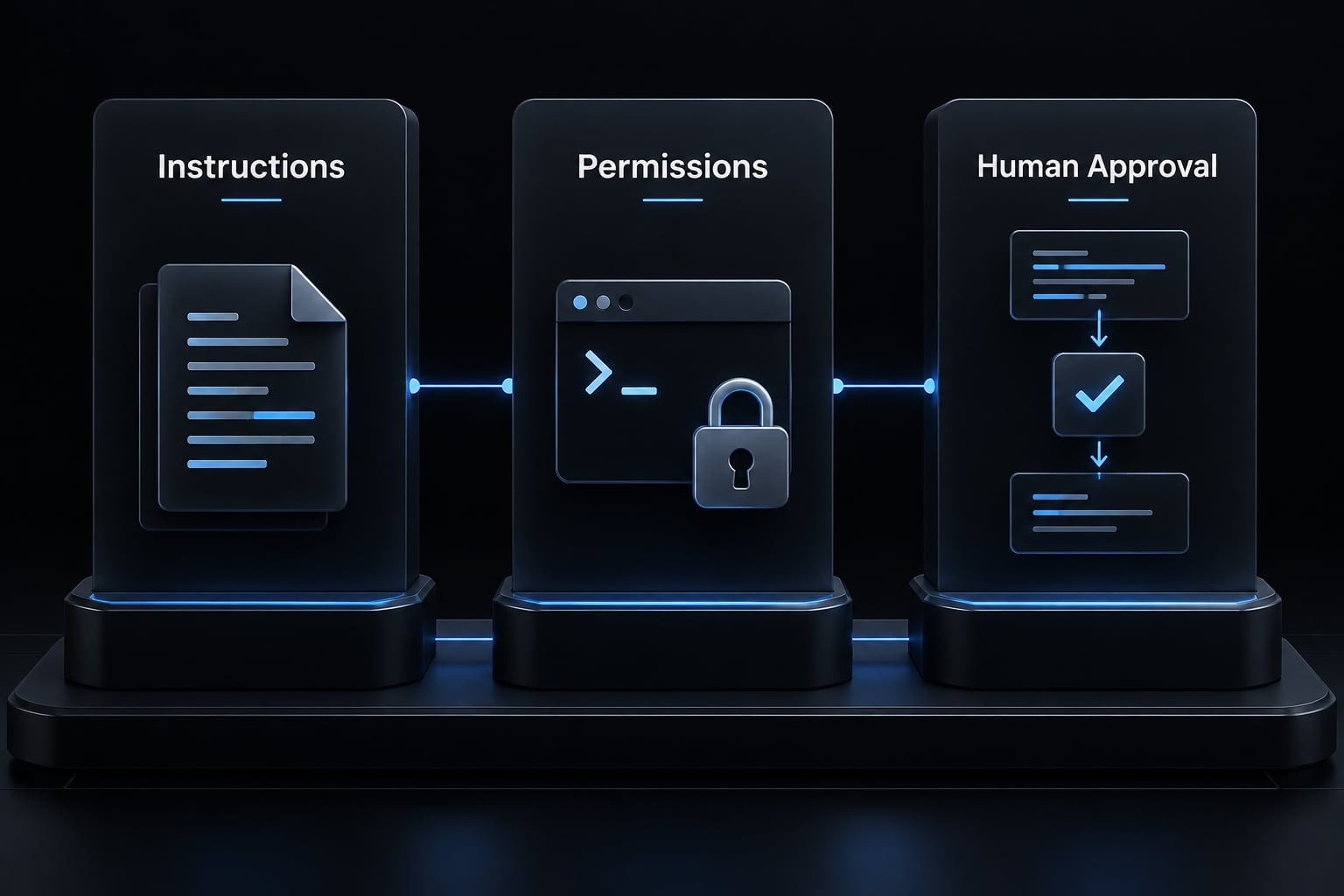
Secure coding policies guide decisions; technical restrictions constrain actions. Repository instruction files are tool-specific guidance mechanisms, not universal security boundaries.
Layer | Function | Example |
|---|---|---|
Instructions | Guide behavior | Repository guidance says “do not deploy” |
Technical controls | Restrict authority | Agent identity lacks production deployment permissions |
Human approvals | Authorize consequential actions | Release owner approves a reviewed deployment |
The difference matters when instructions are misunderstood or ignored. An identity without deployment authority remains restricted regardless of what the model decides.
The security risks vibe coding amplifies
The exposure spans application behavior, development-time actions, and workflow failures. Insecure AI-generated code can contain familiar vulnerabilities; excessive agent authority creates additional paths to harm.
The risk categories below are not a universal severity ranking. The impact of applying vibe coding security guardrails depends on sensitive data, granted permissions, environment, and exposure levels.
Risk category | What can go wrong | Minimum response |
|---|---|---|
Insecure code and logic | Missing authorization or unsafe input handling | Behavioral tests and security review |
Secrets and sensitive data | Credentials enter prompts, logs, or repositories | Data boundaries, secret controls, exposure response |
Unsafe dependencies | Invented, malicious, or vulnerable packages enter builds | Verify identity and control installation |
Excessive permissions | Destructive actions or prompt-injected instructions execute | Scoped identities and enforced execution boundaries |
Unsafe configuration | Public storage, debug settings, or permissive access | Configuration checks and restricted defaults |
Uncontrolled deployment | Unreviewed changes reach production | Protected release workflow and human approval |
Poor auditability | Actions lack traceable owners or evidence | Retained activity records and assigned reviewers |
OWASP Top 10 and the Application Security Verification Standard describe relevant application weaknesses and verification practices. They do not rank every agent-related risk.
Code risks versus agent action risks
Consider an illustrative small SaaS team modifying a multi-tenant customer portal - a service where multiple customer organizations share infrastructure.
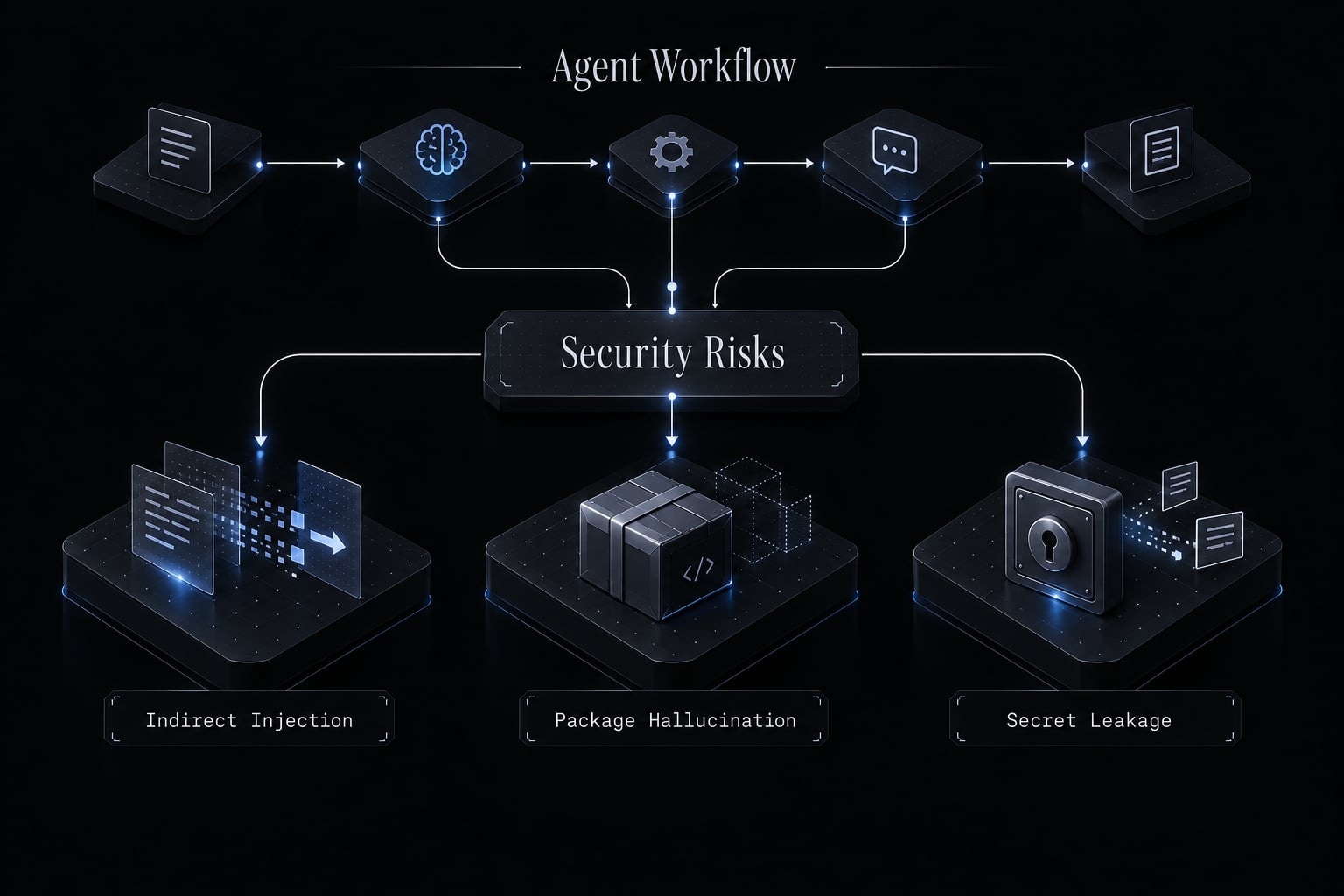
- Application risk: A generated endpoint lets one tenant retrieve another tenant’s records.
- Agent action risk: During development, the agent transmits credentials or executes a destructive command.
A code scanner may help identify the first problem. It cannot fully govern the second, which requires controls before execution.
Indirect prompt injection adds another concern: instructions embedded in documentation, repository content, or tool output may attempt to redirect the agent. Official Model Context Protocol (MCP) security guidance addresses related integration trust boundaries.
Illustrative operational lesson: A final scan cannot undo credentials already transmitted during an agent session. Exposed secrets require revocation or rotation and investigation.
Why non-developer creation expands the risk surface
Shadow AI development—building software without official oversight—can leave valuable internal tools lacking accountable technical ownership and proper governance
For example, an operations or marketing team building an account-management tool should use an approved environment and synthetic data. Technical review must precede operational use. Production credentials, live customer information, direct production-database access, and deployment authority should remain restricted by default.
The issue is missing governance, not the builder’s job title.
The eight essential vibe coding security guardrails
Implementing security guardrails for vibe coding requires controls over both generated changes and the agent’s operating environment:
- Isolate agent execution.
- Apply least-privilege agent permissions.
- Protect secrets and sensitive data.
- Verify every new dependency.
- Automate code, configuration, and supply chain checks.
- Require risk-based human review.
- Protect merge and deployment workflows.
- Log agent actions and preserve rollback.
Isolate agent execution
Limit filesystem, network, process, and credential access through an enforced execution boundary. Use disposable workspaces or appropriately restricted containers, excluding production systems and credentials.
A container is not automatically a secure sandbox. Host mounts, privileged execution, or exposed management sockets can undermine isolation. Validate what the agent can actually reach, not merely whether its process runs inside a container.
Apply least-privilege agent permissions
Least-privilege permissions grant only the authority necessary for the assigned task. Separate reading, writing, execution, installation, publishing, and deployment through identities and tool permissions.
Gate schema, infrastructure, dependency, and external-publishing changes. An unexpected package installation should pause for approval rather than inherit permission from an approved coding task. Natural-language restrictions alone do not enforce this boundary.
Protect secrets and sensitive data
Keep credentials out of prompts and repositories. Use approved services, explicit data boundaries, and secret-management systems that restrict retrieval. Add secret scanning and push protection where supported.
GitHub’s secret-scanning documentation describes detection and push-blocking capabilities for supported patterns. Coverage is incomplete. Environment variables are readable by sufficiently privileged processes, and scanning cannot reverse disclosure. Revoke or rotate exposed credentials and investigate their use.
Verify every new dependency
Enforce dependency validation through manifest review and controlled installation:
- Confirm necessity.
- Verify the exact registry identity.
- Assess ownership and maintenance.
- Check known vulnerabilities and license suitability.
- Approve installation through controlled sources.
OpenSSF guidance supports evaluating software supply chain risks beyond package names. Approved registries and lockfiles help control resolution; popularity and age do not prove trustworthiness. A lockfile can pin an unsafe package.
Automate code, configuration and supply chain checks
Run required checks in continuous integration (CI): SAST - static analysis of source code and SCA - dependency analysis - alongside secret scanning and configuration checks.
For the illustrative portal, add a test confirming tenant A cannot retrieve tenant B’s records. Scanners can miss authorization defects and produce false positives. Blocking findings need resolution; any accepted residual risk needs a named owner and recorded justification.
Require risk-based human review
Use human-in-the-loop review - human assessment and approval - for production-bound changes. Require enhanced scrutiny for identity, authorization, payments, sensitive data, cryptography, infrastructure, and databases.
For the portal’s tenant-access change, an independent reviewer should examine assumptions and unauthorized-access tests, not syntax alone. Another AI review can supplement this work but cannot replace accountable human approval. Reviewers need enough context and expertise to judge consequences.
Protect merge and deployment workflows
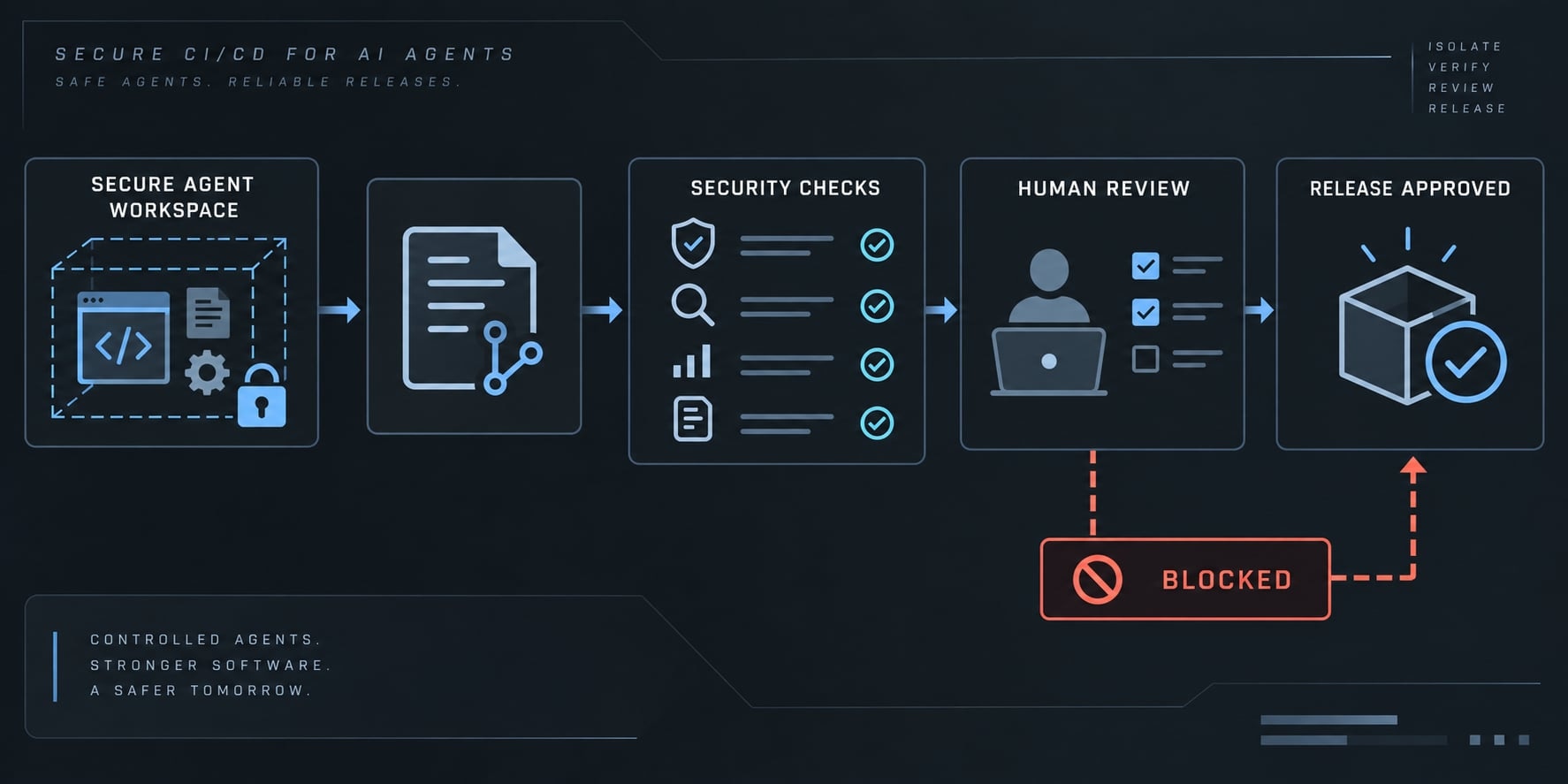
Enforce protected branches, passing checks, reviewer approval, and limited deployment identities in the CI/CD pipeline, the automated integration and delivery workflow.
Keep production approval separate from agent execution. Agents must not approve their own changes or disable required gates. Emergency exceptions need narrowly restricted authorization and an audit trail - not a permanent bypass available to the coding identity.
Log agent actions and preserve rollback
Record material commands, tool calls, changed files, approvals, and deployments. Link records to pull requests or change records, with sensitive content redacted and retention controlled.
Provide a way to stop sessions and revoke access. Logging creates evidence, not prevention. Code rollback may not restore deleted data or reverse external publication; recovery planning must address those consequences separately.
Control group | Enforcement point | Review evidence |
|---|---|---|
Execution and access | Sandbox and identities | Permission configuration |
Secrets and dependencies | Data boundaries and installation gates | Scan and dependency-review results |
Verification and release | Repository and pipeline | Tests, reviews, release approval |
Logging and recovery | Activity records and recovery systems | Action history and recovery tests |
NIST’s Secure Software Development Framework, SP 800-218, supports integrating verification and responsibilities throughout development.
Where to enforce guardrails across the AI development lifecycle
Security controls belong throughout the AI software development lifecycle, not only at release. This is the practical role of DevSecOps: integrating security into development and operations.
Assign an owner and retain evidence at each stage. Small teams may combine roles, but the agent must never become its own approver.
Development stage | Primary risk | Required guardrail | Typical owner |
|---|---|---|---|
Before prompting | Undefined scope or data exposure | Task brief and data classification | Engineering lead |
During generation | Unsafe tool execution | Sandbox and permission gates | Platform owner |
Before commit | Secrets or unintended changes | Diff review and local checks | Developer |
Before merge | Vulnerable production-bound code | Required tests and independent review | Maintainer |
Before deployment | Unsafe release or migration | Release gate and recovery validation | Release owner |
After release | Undetected failure or misuse | Monitoring and incident response | Service owner |
Before prompting: Establish the change contract
A change contract is a task brief, not an enforcement mechanism. For the illustrative customer portal, use eight fields:
- Objective: Update customer-record retrieval.
- Allowed files/services: Named endpoint and test files.
- Prohibited actions: Production access and deployment.
- Data classification: Synthetic tenant records only.
- Dependency constraints: No unapproved additions.
- Required tests: Tenant isolation and authorized access.
- Approval requirements: Authorization reviewer and release owner.
- Definition of done: Passing checks, understood changes, recorded review.
State explicitly that one tenant must never read another tenant’s records. Translate restrictions into actual permissions before generation starts.
During generation: Intercept high-risk actions
Apply pre-execution checks to shell commands, file access, network destinations, package installation, and Model Context Protocol (MCP) tools. MCP connects agents with external tools and data; it is not a security guarantee.
Permit only approved actions inside enforced boundaries. Route consequential legitimate actions to approval; deny prohibited actions.
Reading documentation and running tests are not inherently low-risk. Documentation can carry hostile instructions, while tests and build scripts can execute arbitrary code.
Before release: Validate behavior, not only code patterns
Verify negative tests - tests showing prohibited behavior is rejected - alongside expected functionality. Check tenant and data isolation, safe error handling, deployment configuration, and recovery readiness.
Passing scans is insufficient evidence of correct authorization or business logic. Preserve the test run, review decision, and release record so an owner can explain why the change proceeded.
Low-risk work remains faster when teams define these gates in advance rather than negotiate every action during execution.
A practical permission model for autonomous coding agents
AI agent permission control should consider action impact, data access, and reversibility. This recommended baseline applies least-privilege permissions; it is not a universal legal requirement.
All allowed actions remain scoped, with material activity logged. Approval must be enforced outside the agent’s judgment.
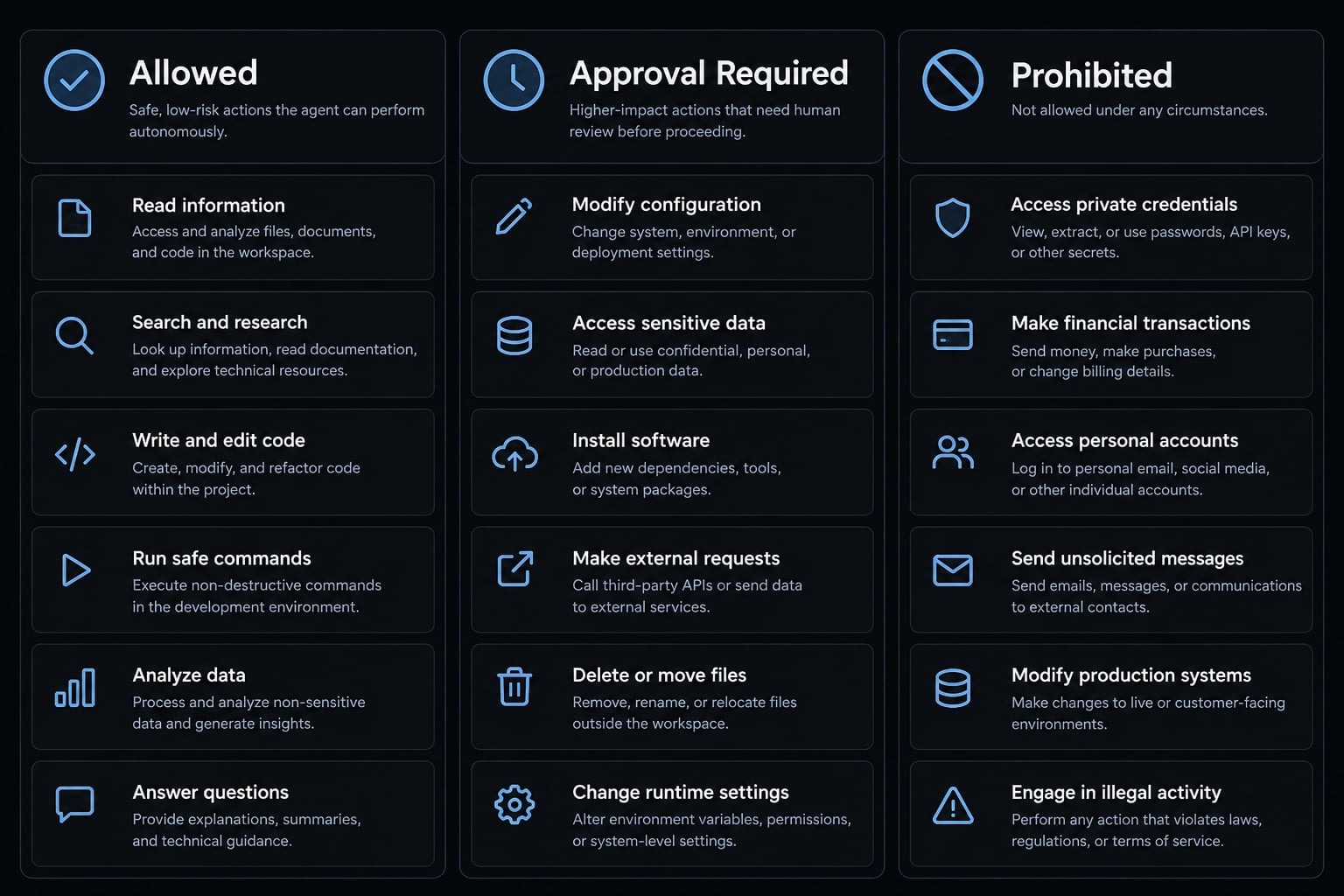
Schema approval does not grant broad production access. MCP security review should assess server origin, granted scopes, data destinations, and tool capabilities before connection.
Approvers need the proposed action, target environment, expected effects, and recovery options. A bare “Allow?” prompt rarely supplies enough context.
How to keep guardrails from becoming workflow friction?
- Preapprove narrowly scoped, reversible actions.
- Gate consequential actions according to impact.
- Return immediate, understandable denial or approval feedback.
- Standardize approved environments and command patterns.
- Monitor false positives and approval delays.
Approval frequency alone is not a security metric. Reduce unnecessary interruptions without broadening credentials or removing review from production-bound changes.
Minimum vibe coding security policy and deployment checklist
Use this vibe coding security checklist as an observable release baseline. Record evidence against each check in a pull request, CI run, review, release record, or recovery test.
Minimum policy for solo founders and small teams
This is a minimum recommended policy, not a certification standard:
- Generated code remains untrusted until reviewed and tested.
- Production secrets and restricted data stay outside AI tools under this baseline.
- Agents use isolated environments without direct production access.
- New and changed dependencies require verification.
- Production changes pass required tests, scans, and review.
- Deployment requires separate approval and a recovery path.
- High-risk features receive enhanced review.
A solo founder may serve as human reviewer. Changes beyond that person’s security expertise need qualified external review. A second prompt is not separation of duties.
Pre-merge checklist
Make AI-generated code verification part of the secure coding policy:
- Approved scope and every changed file have been reviewed.
- Approved-tool usage, sensitive-data handling, and available scan evidence have been checked.
- Dependency identities and suitability have been verified.
- Relevant positive and negative tests have passed.
- Required scans have completed with blocking findings resolved.
- Security-sensitive logic has received appropriate review.
- A human understands the generated changes and their consequences.
- Material agent activity is available for review.
Available evidence cannot prove that sensitive information never entered a prompt. Suspected exposure must trigger incident handling rather than a checked box.
For the illustrative customer portal, negative tests must demonstrate that cross-tenant requests fail without disclosing records.
Pre-deployment checklist
Treat pre-deployment security as a separate decision:
- Deployment credentials are limited to the approved release task.
- Production secrets are delivered through protected mechanisms.
- Database/storage access and tenant isolation - including row-level security where applicable - have been verified.
- Monitoring and error reporting are configured and checked.
- Recovery readiness is validated for the proposed change.
- A human release owner has approved deployment.
- Agent identities cannot bypass merge or release gates.
For high-impact data changes, recovery readiness requires tested backup/recovery or a validated migration-reversal plan. Documentation alone is insufficient.
Record exceptions with a named owner, justification, compensating controls, and expiry. Checklist completion reduces uncertainty; it does not prove security or justify silent bypasses.
Common guardrail mistakes and how standardized workflows help
The most damaging implementation gaps arise when written policy and actual authority diverge. Correct those gaps before adding more instructions.
Mistake | Practical correction |
|---|---|
Instructions without enforcement | Restrict identities, filesystem access, and network reach |
Broad credentials | Issue task-specific, short-lived access |
Security only at the end | Add controls before execution and throughout delivery |
Inconsistent policies across tools | Map shared policy to each tool’s enforced capabilities |
Equal treatment of unequal risks | Separate reversible edits from consequential changes |
Logs without ownership or review | Assign reviewers and escalation criteria |
Reusable security workflows reduce multi-tool policy fragmentation by standardizing task briefs, approval requirements, and evidence expectations. Shared documentation does not guarantee identical enforcement across platforms.
For engineering teams seeking a structured, production-ready implementation, AgentKit provides a powerful AI Engineering System scaffolding framework. Designed to integrate with modern AI agent execution environments - including Claude Code, Codex, Cursor and DeepSeek Harness.
AgentKit helps organize reusable skills, tool configurations, structured workflows, Model Context Protocol (MCP) integrations, and security guardrail checks across diverse developer environments. It operates alongside traditional application security (AppSec) tools, human peer review, CI/CD pipeline controls, and secure infrastructure to enforce accountable AI development.
Frequently asked questions
What are vibe coding security guardrails?
Vibe coding security guardrails are a set of enforced boundaries, workflow controls, and automated checks designed to constrain AI-driven coding agents. They move security from a probabilistic "instruction" in a prompt to a deterministic, technical restriction that prevents unauthorized actions or vulnerable code output during development.
What are the primary security risks of AI-generated code?
Key risks include insecure logic (such as broken authorization), hardcoded secrets, and the injection of malicious or vulnerable third-party dependencies (known as slopsquatting). Additionally, agents may inadvertently expose sensitive data or perform destructive shell commands if they operate with excessive system permissions.
Why should teams verify AI-generated dependencies?
AI agents often hallucinate package names or suggest insecure, unmaintained libraries. Verification ensures that dependencies are necessary, originate from official registries, and have undergone vulnerability scanning. Using locked dependency versions and internal proxy registries is essential to prevent the automatic ingestion of compromised or non-existent packages.
Can prompt instructions effectively secure AI agents?
No. Prompt instructions (like "do not delete databases") guide behavior but are not enforceable boundaries. Secure coding policies must be backed by technical controls, such as sandboxed execution, least-privilege API tokens, and deterministic command-line interceptors that block unauthorized tool calls regardless of the model's intent.
Where should security guardrails be enforced?
Guardrails must be applied across the entire development lifecycle: in the IDE via restricted agent environments, during the CI/CD pipeline via automated SAST and SCA scans, and at the deployment layer by requiring separate approval gates and immutable infrastructure policies.
Do vibe coding guardrails make software unhackable?
No. Guardrails reduce the likelihood and impact of vulnerabilities and accidental agent actions, but they do not guarantee code is secure. Effective security requires a layered defense, including persistent monitoring, independent verification, and a clear rollback path for when issues reach production.
Read more:
- Vibe coding documentation: A guide for AI-assisted projects
- Vibe coding feedback: Improve your AI-generated code quality
- Vibe coding tools: How to choose the right AI app builder
Conclusion
Ultimately, securing AI-driven development relies on isolating execution, limiting authority, and verifying production-bound changes with clear accountability. By starting with a single workflow and enforcing strict governance before granting broader access, teams can safely harness AI generation while keeping customer data and production environments fully protected.