Vibe coding feedback: Improve your AI-generated code quality
Vibe coding feedback: How to improve AI-generated code
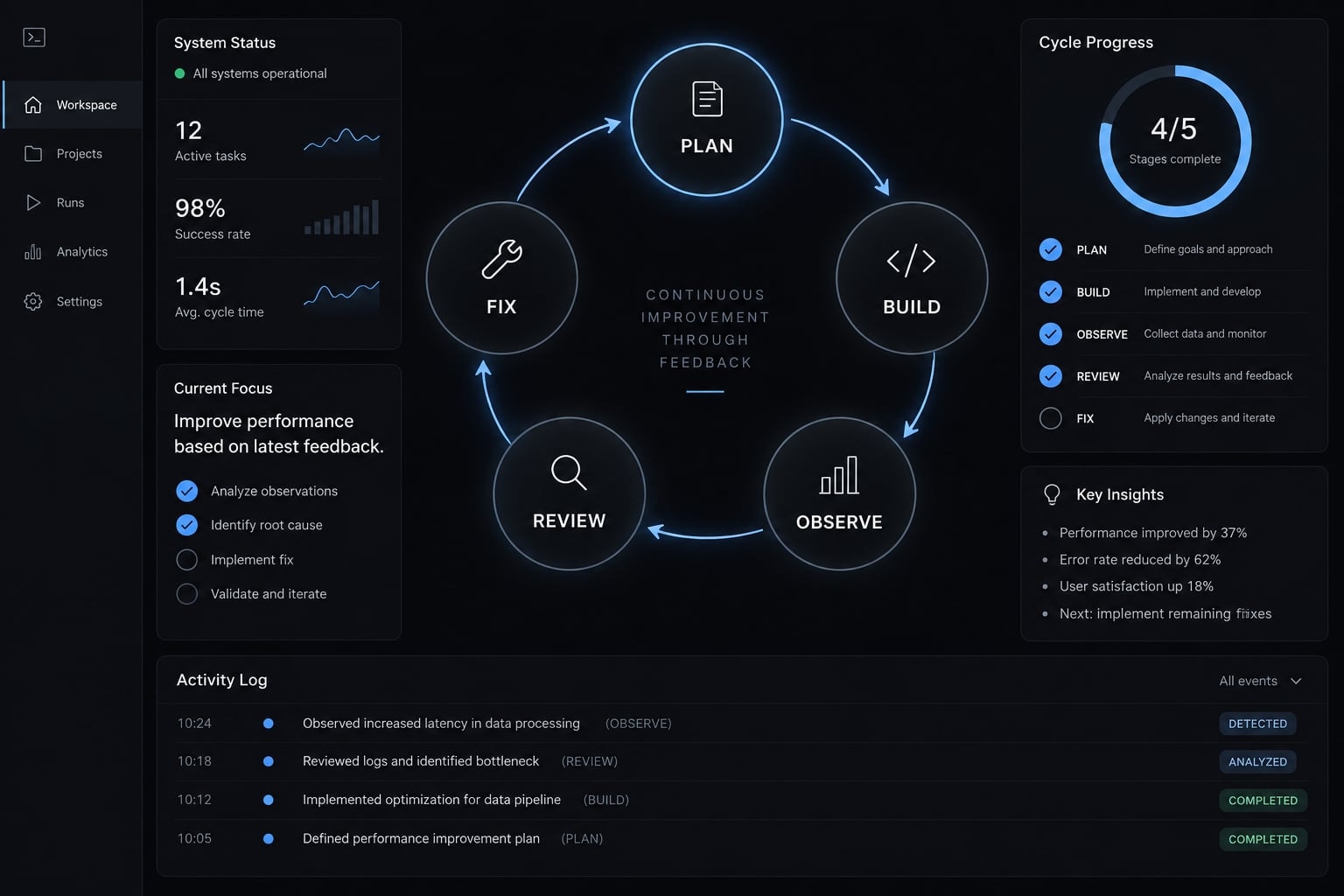
Prototypes often fail in real-world scenarios due to issues like expired sessions or high traffic. Effective vibe coding feedback goes beyond asking the AI to simply "make it work"; it involves validating generated code against expected behavior using test results, runtime logs, and requirement reviews. By following a structured Plan–Build–Observe–Review–Fix loop, teams turn observations into verified repairs rather than speculative guesses.
What is vibe coding feedback?
Vibe coding commonly describes creating software through natural-language instructions, sometimes with little inspection of the underlying code. Usage varies; “vibe coding feedback” is a descriptive phrase, not a standardized engineering discipline.
Adding systematic inspection and testing moves the practice toward disciplined AI-assisted development. The key shift is moving from accepting plausible output to comparing it against observable expectations. Those expectations become acceptance criteria: observable conditions that determine whether a task is complete. Feedback identifies where the proposed or implemented behavior meets-or misses-those conditions.
An instruction establishes intent. Feedback evaluates an output against that intent.
Input type | Purpose | Example | Is it feedback? |
|---|---|---|---|
Initial task instruction | Define the task | “Add workspace login.” | No; establishes intent |
Vague correction | Signal dissatisfaction | “Login is still broken.” | Yes, but weak |
Reproducible observation | Expose a behavior gap | “Refreshing after login signs me out.” | Yes |
Automated check | Check an expectation | “Session-persistence test fails after refresh.” | Yes |
User validation | Assess practical usability | “Administrators cannot find workspace switching.” | Yes |
Feedback can arrive inside a prompt. Its function and supporting evidence-not its message format-make it feedback. It can address requirements, usability, security, or implementation, rather than only error messages.
Why one-shot vibe coding breaks down
One-shot code generation can leave important behavior unverified. A small, well-specified task may succeed immediately. More connected features introduce assumptions about permissions, existing components, external services, and failure handling.
Repeated attempts become counterproductive when each repair substitutes a new guess for diagnosis. Broad patches also make it harder to identify which change caused a regression: behavior that previously worked but now fails.
The vibe coding doom loop
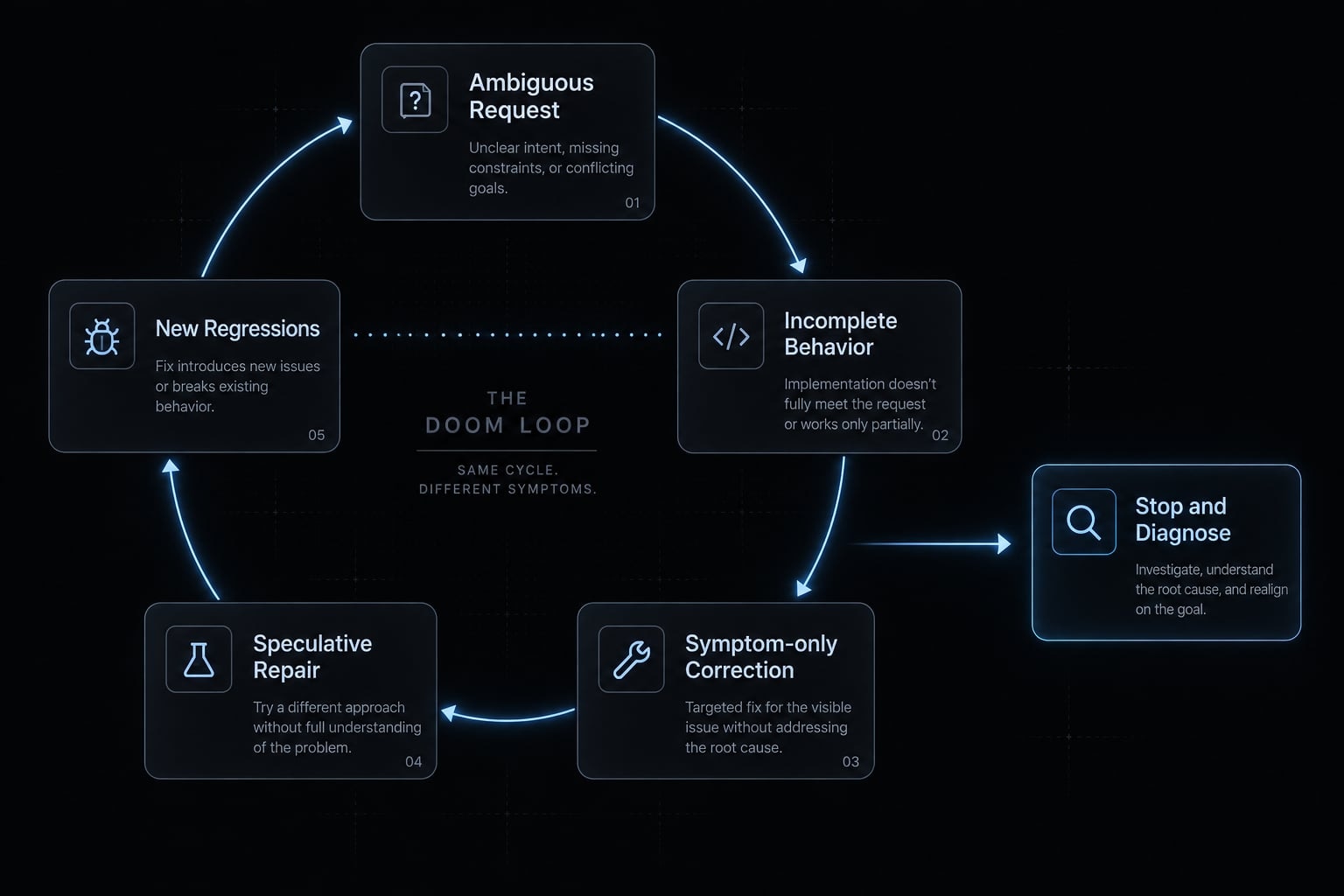
A typical failure pattern looks like this:
- Ambiguous request: “Make workspace login reliable.”
- Incomplete behavior: Login succeeds, but refreshing loses the session.
- Symptom-only correction: “Stop signing users out.”
- Speculative repair: The agent rewrites shared session handling without confirming the cause.
- New regressions: Refresh works, but logout no longer invalidates access.
The repair addressed a visible symptom while a broader check exposed another failure. Continuing without diagnosis can create technical debt: Implementation shortcuts that increase future maintenance work.
Accumulated conversation assumptions can compound the problem. “Context rot” is informal shorthand for stale, conflicting, or irrelevant conversational context. Conversation length alone does not establish that this has happened.
Why “try again” is low-quality feedback
The instruction usually omits:
- Expected behavior: What should happen instead?
- Reproduction steps: Under which conditions does it fail?
- Supporting evidence: What result was actually observed?
- Completion criteria: Which checks would establish that the repair worked?
Without those details, the agent has little basis for choosing among competing explanations. More attempts may simply expand the change set-and the review burden.
The five types of feedback that improve AI-generated code
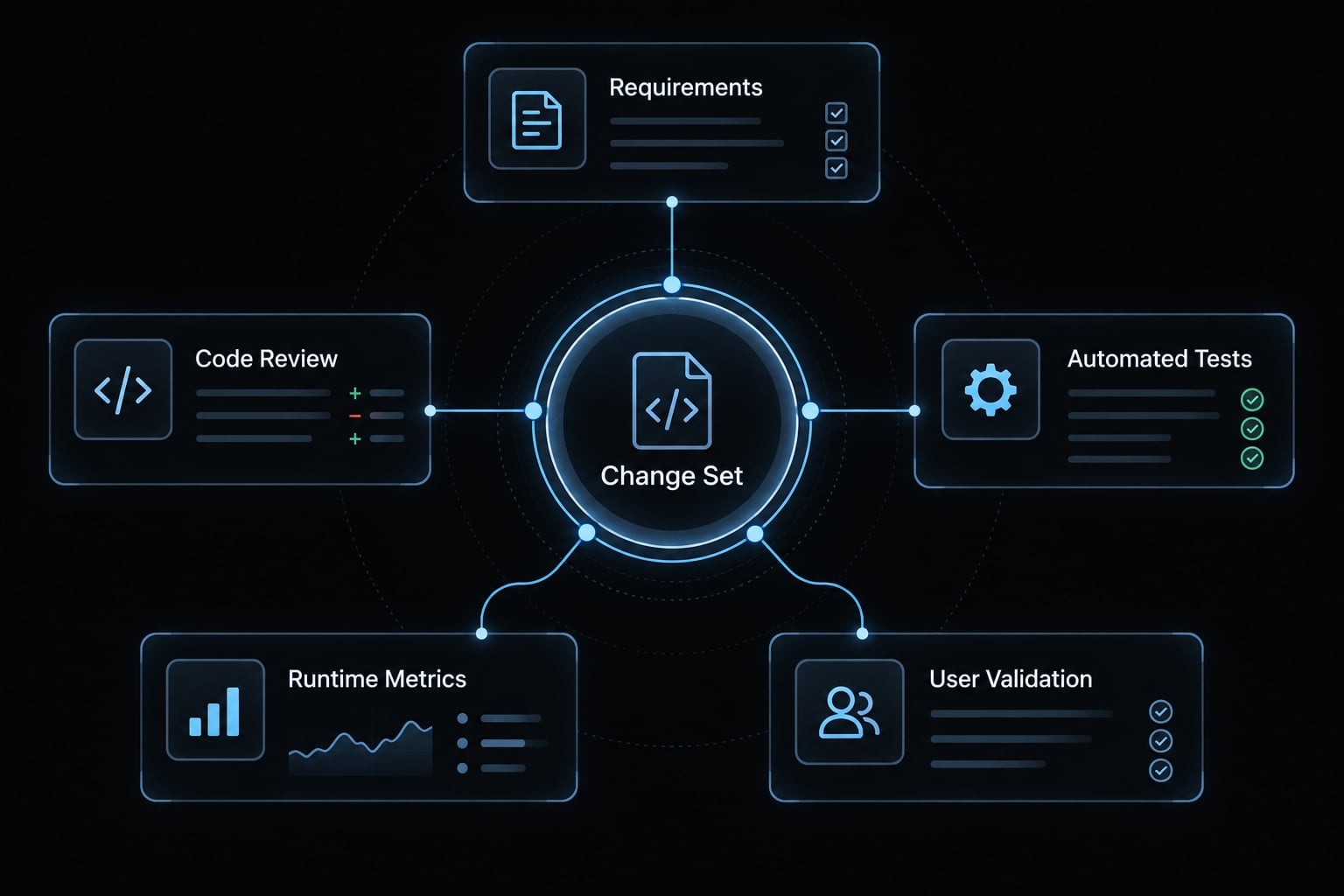
Different feedback sources answer different questions. Combine them according to the feature’s risks rather than treating any single source as sufficient.
Feedback type | What it checks | Typical evidence | Main limitation |
|---|---|---|---|
Requirements feedback | Whether intended behavior is appropriate | Acceptance criteria, clarified edge cases | Does not demonstrate implementation |
Code and design review | Structure, maintainability, access boundaries | Findings tied to changed components | Reviewers can miss defects |
Automated test feedback | Specified behavior under test conditions | Failed assertions, regression results | Expectations may be incomplete or wrong |
Runtime observation | Behavior while software is running | Logs, responses, browser observations | One environment reveals only part of the picture |
User feedback | Whether people can accomplish the task | Observed confusion, task failures | Does not establish technical security |
Requirements feedback: Validate before building
Clarify the behavior before asking an agent to implement it:
- Intended user outcome.
- Scope and exclusions.
- Important edge cases.
- Observable acceptance criteria.
- Contradictions or unanswered questions.
For workspace administration, “admins can manage members” leaves critical questions open. Can they remove the last administrator? Can they change another workspace’s membership?
Requirements feedback resolves those ambiguities. It does not prove that the resulting access controls work.
Tests and runtime observation: Give the agent evidence
Automated testing provides repeatable checks against specified expectations. Runtime observation captures actual behavior in a running environment. Both are useful, but neither covers every possible condition.
An illustrative password-reset evidence panel might contain:
Check: reused reset token must be rejectedExpected: second submission rejected; password unchangedObserved: second submission accepted; password changedSanitized response: {"status":"password_updated"}
A failed integration test checks cooperating components. A sanitized API response-data returned by an application interface-shows what the service reported. A browser screenshot can expose misleading user-facing behavior.
Tests based on incorrect assumptions can pass while the product remains wrong. Check the expectations themselves, not just the result color.
Review feedback: Evaluate more than whether the code runs
Code review should examine:
- Maintainability and unnecessary complexity.
- Error handling and dependencies.
- Access boundaries and sensitive data.
- Consistency with requirements and repository rules.
Useful findings identify the affected component: “The workspace-members endpoint checks login but not workspace membership.” A separate reviewer context can reduce exposure to the implementer’s reasoning. However, multi-agent review is not independent proof; agents may share assumptions.
User validation adds another perspective. An administrator who cannot locate password reset has identified a usability failure, even when the underlying endpoint passes every test.
The Plan–Build–Observe–Review–Fix feedback loop
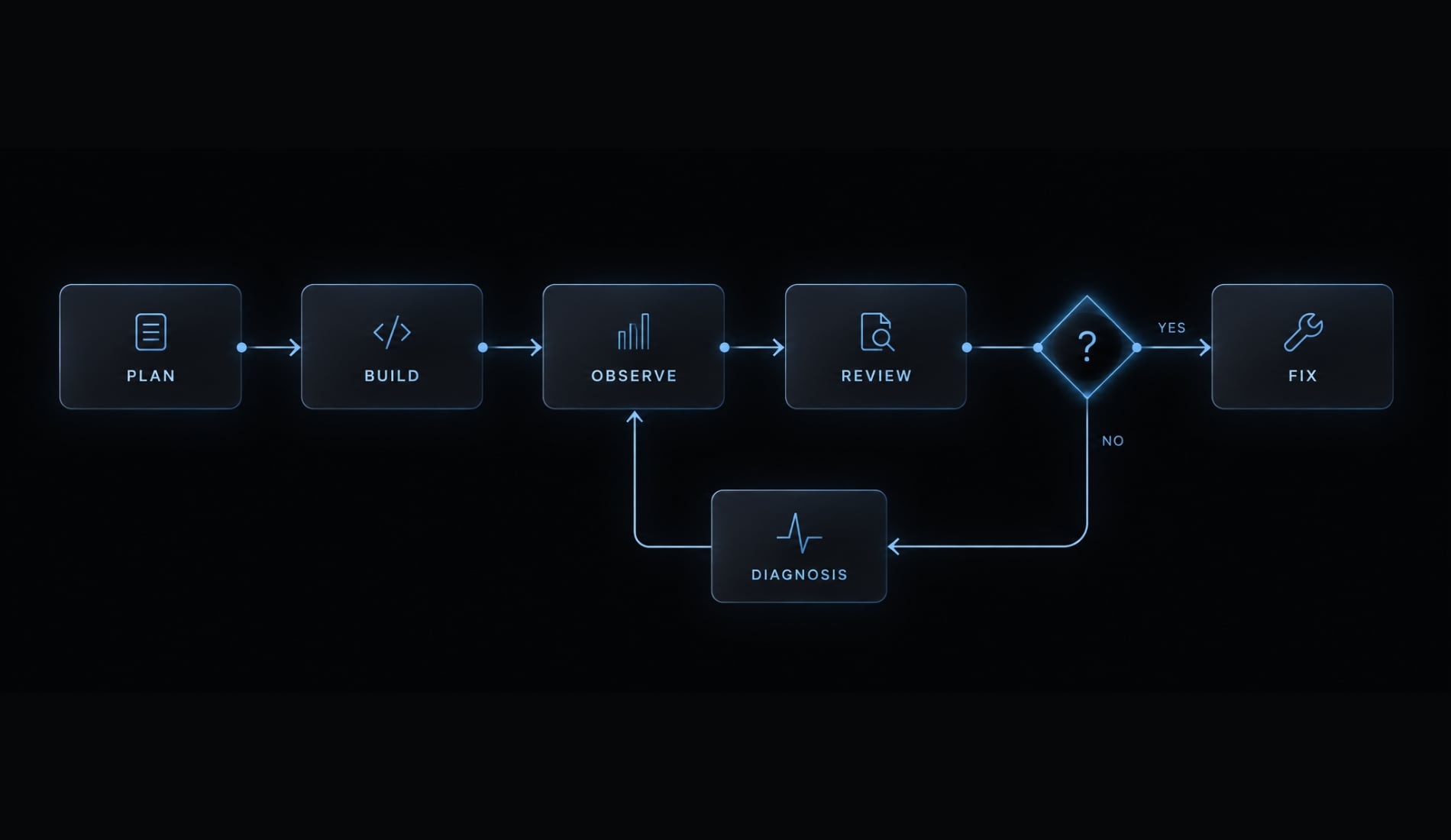
This five-stage workflow is a practical synthesis for applying vibe coding feedback, not a formally validated methodology. Its operating rule is simple: Carry evidence forward and keep changes inspectable.
Step 1: Plan the intended behavior
Define the user outcome, scope, non-goals, dependencies, and acceptance criteria. Resolve uncertainties before they become implementation guesses, especially around permissions or destructive actions.
Output: A short approved task description that states what success means and which questions remain open.
Step 2: Build a small, bounded change
A bounded change is narrowly scoped enough to inspect and test. Follow relevant repository instructions and avoid unrelated refactoring.
Output: An inspectable change set. If the task requires widespread changes, split it into smaller units with explicit dependencies.
Step 3: Observe the actual result
Run the relevant build and checks. Capture actual behavior and compare it with acceptance criteria.
Output: Test results, logs, or interface observations. Distinguish checks that actually ran from suggested checks; an agent’s claim of success is not execution evidence.
Step 4: Review independently
Use a separate review context when practical. Supply the requirements, relevant code, and collected evidence—not just the implementation summary.
Output: findings tied to behavior, code locations, or tests, including unresolved questions. Separate context helps, but shared assumptions remain possible.
Step 5: Fix, re-run and close the loop
Make the smallest justified repair. Repeat the failed scenario and check relevant previously working behavior.
Output: verified completion against the defined scope, or an explicit unresolved status. Escalate high-risk findings rather than treating exhausted attempts as completion.
Illustrative example: Adding password reset
This example demonstrates the workflow, not a customer result or complete authentication specification.
Stage | Task or evidence |
|---|---|
Plan | Define valid, expired, and reused token behavior; prevent account disclosure for unknown addresses. |
Build | Implement a bounded reset flow with server-side token validation. |
Observe | Check email delivery, interface messages, password changes, and rejected-token behavior. |
Review | Inspect token handling, information disclosure, and access boundaries. |
Fix and verify | Repair the supported defect; repeat reset checks and existing login checks. |
The OWASP Forgot Password Cheat Sheet recommends protections including expiring, single-use reset tokens and consistent responses for existing and nonexistent accounts. Client-visible success does not establish security.
Automated verification-repeatable automated checks against specified expectations-supports iterative refinement. It is not mathematical proof.
Optional workflow coordination
One person can maintain these roles manually. Reusable configurations can support agent orchestration: Coordinating agent roles, instructions, outputs, and handoffs. Keep the task description and evidence explicit regardless of tooling. Role separation organizes work; it does not create automatic security or independent correctness.
How to give an AI coding agent useful feedback
Actionable feedback reduces uncertainty before requesting another edit. Include five attributes:
- Specific: Describe the exact gap between expected and actual behavior.
- Reproducible: Supply steps, conditions, and relevant environment details.
- Localized: Identify the observed area without assuming its root cause.
- Prioritized: Explain severity, affected users, and consequences.
- Verifiable: State which checks must pass after repair.
Weak feedback vs. Actionable feedback
Weak feedback
“Billing is wrong. Fix it.”
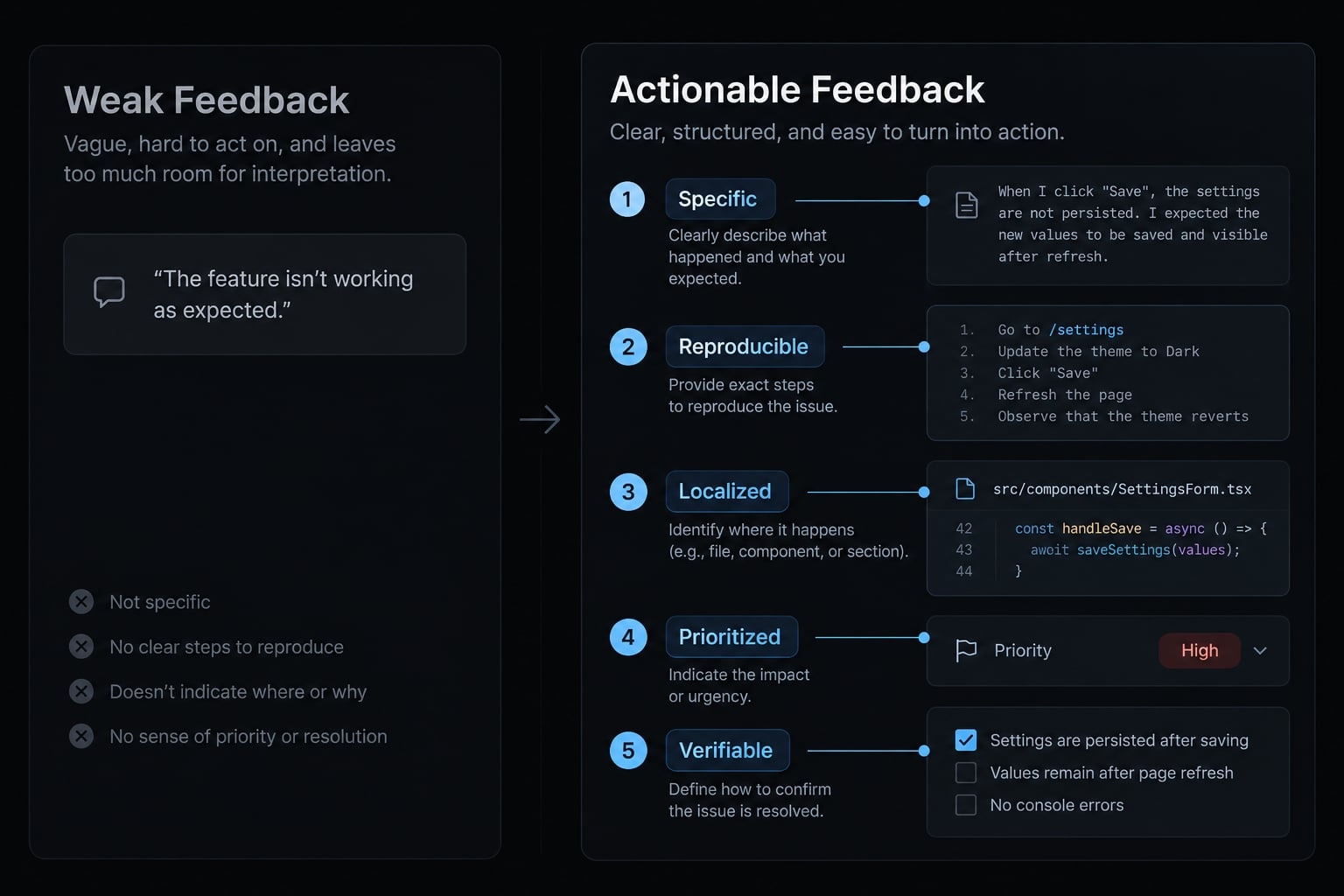
Actionable feedback - illustrative example
As a signed-in workspace administrator, open Billing after increasing seats from five to eight in the test workspace. The summary still shows five seats after refresh, while the sanitized billing API response contains seat_count: 8. Investigate where the displayed value comes from before editing. Do not change payment processing or subscription updates. Verify that the summary shows eight seats and that an unchanged subscription still displays its existing count.The response is evidence of a mismatch, not proof that the interface alone caused it. Root-cause diagnosis should test that hypothesis.
Ask for diagnosis before asking for a fix
Copy this template when reporting reproducible errors:
Expected behavior:Actual behavior:Reproduction steps:Environment/configuration:Supporting evidence:Severity and affected scope:Constraints / excluded changes:Verification method:First, diagnose without editing.Separate observations from hypotheses.State uncertainty and request missing evidence.Then propose the smallest supported repair.After approval, implement and report:- checks actually run and their results;- checks not run;- unresolved findings.
Include only sanitized evidence. Remove credentials, reset tokens, customer identifiers, and sensitive logs. The template makes acceptance criteria explicit while preventing a local symptom from becoming permission for an unrelated rewrite. It also makes incomplete verification visible rather than allowing “looks fixed” to close the task.
How to escape a vibe coding doom loop
Repeated failures, expanding change sets, and new regressions signal that implementation should pause.
- Stop the current implementation loop: Do not request another speculative patch.
- Preserve evidence: Save the failing state, code differences, logs, and reproduction steps.
- Start a fresh diagnostic context: Transfer relevant requirements and evidence, excluding stale speculation.
- Request diagnosis only: Ask for competing explanations and checks that distinguish them.
- Compare the explanation with evidence: Reject causes that do not explain the observed behavior.
- Revert speculative changes when appropriate: Preserve recoverable work and inspect changes before undoing them.
- Implement one bounded repair: Keep unrelated improvements out.
- Re-run the failed scenario and regression checks: Record remaining uncertainty.
A fresh context can reduce context rot, but it cannot supply missing facts or repair architecture by itself.
Failure-to-feedback decision table:
Symptom | Possible cause | Evidence needed | Next action |
|---|---|---|---|
Wrong feature | Ambiguous intent | User outcome, acceptance criteria | Clarify requirements |
Working behavior breaks | Shared behavior changed | Change set, failing check | Isolate the regression |
Tests pass; user behavior is wrong | Incomplete expectations | Observed user journey | Correct the test expectations |
Same repair fails repeatedly | Unsupported diagnosis | Minimal reproduction | Test alternative explanations |
Code becomes difficult to maintain | Accumulated patches | Review findings | Plan a separate cleanup |
Environments behave differently | Configuration mismatch | Versions, settings, logs | Compare environments |
Regression testing checks whether changes broke previously working behavior. Include nearby flows, not just the latest failing assertion.
Involve a qualified human for authentication, payments, sensitive data, deployment, architecture, and irreversible changes. Escalation is especially important when the repair’s consequences exceed the reviewer’s ability to inspect or recover from them.
Can feedback make vibe coding production-ready?
Feedback improves a release decision; it does not make that decision automatically. Passing tests and agreeing agents leave blind spots. Agent agreement is not independent proof, and human review is not a guarantee either.
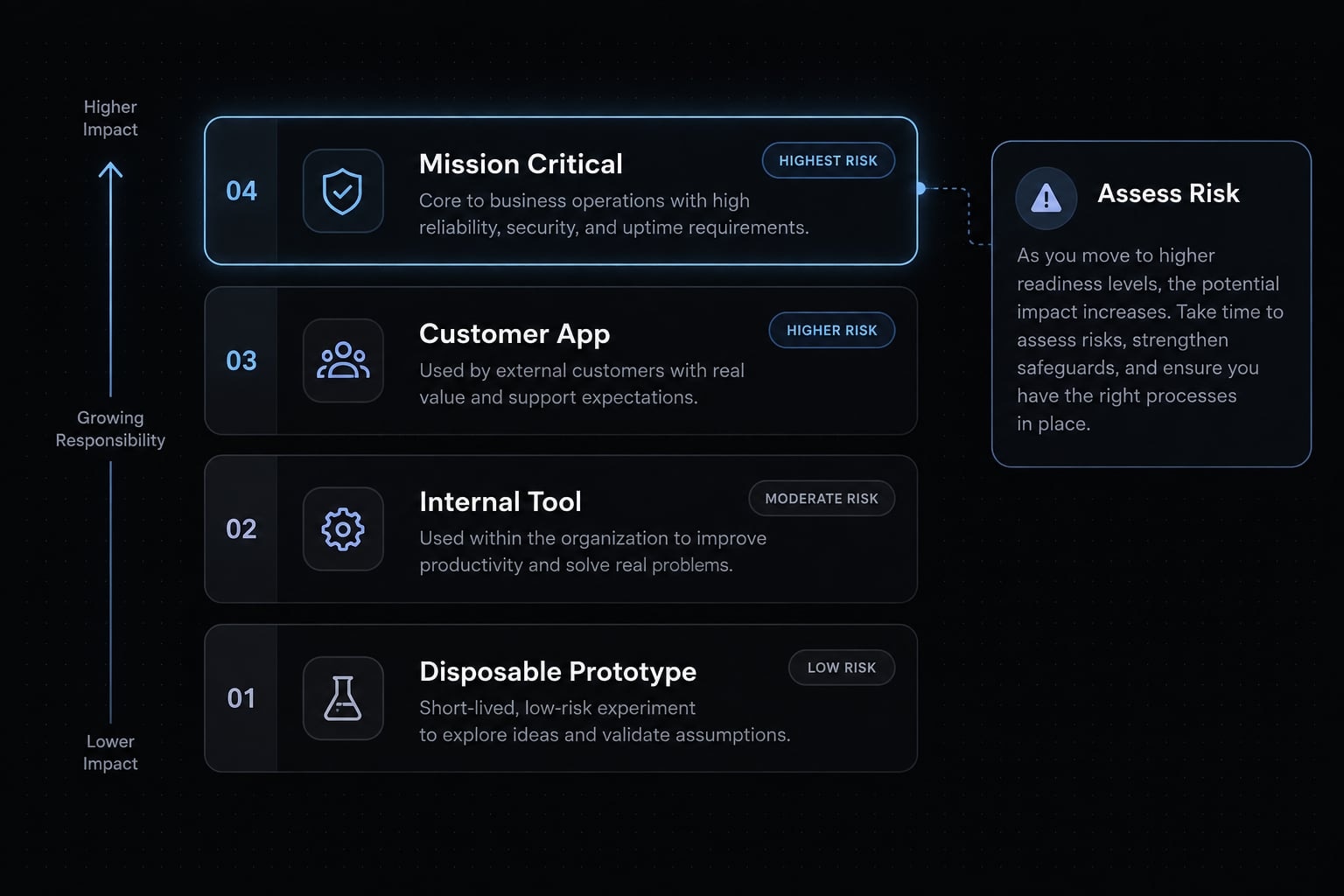
The following is a recommended baseline, not a universal or legal requirement.
Project type | Minimum feedback and release checks | Human oversight |
|---|---|---|
Disposable prototype | Core behavior checks; isolate data and credentials | Builder confirms limited exposure |
Low-risk internal tool | Acceptance tests, permissions, recoverability | Named owner reviews scope |
Customer-facing application | Regression and security review; deployment, rollback, monitoring | Qualified release reviewer |
Sensitive or mission-critical system | Risk-specific testing, security assessment, recovery validation | Accountable specialists approve changes |
Risk follows access and consequences, not labels. A prototype connected to real data may carry substantial risk. An internal tool with broad permissions may need extensive review.
The NIST Secure Software Development Framework places review, testing, and vulnerability response within a broader development lifecycle. Production readiness also requires deployment preparation, rollback capability, monitoring, and an accountable owner.
Compliance obligations depend on the system and jurisdiction. Match human oversight to potential harm-not to how confidently the agent describes its output.
Feedback loop checklist
Copy this checklist for one bounded task. It supports development feedback; it is not a complete security or release-readiness checklist.
Plan
- Intended outcome: ______
- Scope and non-goals: ______
- Acceptance criteria: ______
- Risk-sensitive areas: ______
Build
- Bounded task: ______
- Repository constraints checked: ______
- Unrelated changes excluded.
Observe
- Reproduction steps recorded: ______
- Expected vs. actual behavior: ______
- Test and runtime evidence captured: ______
- Relevant environment/configuration: ______
Review
- Correctness and regression findings: ______
- Maintainability concerns: ______
- Security and access concerns: ______
- Uncertainty requiring human review: ______
Fix and Verify
- Supported diagnosis: ______
- Smallest justified repair: ______
- Failed scenario rechecked.
- Relevant regression checks completed: ______
- Final status and accountable reviewer: ______
Better evidence before more attempts
Effective vibe coding feedback starts with a disciplined comparison: What should happen, what actually happened, and what evidence explains the difference. Increasing attempts without improving that evidence can create more work without resolving the underlying problem.
Use Plan–Build–Observe–Review–Fix to keep each change bounded and each decision reviewable. After a repair, repeat the failed scenario and check nearby behavior. Treat passing tests as scoped evidence, not universal correctness.
Start with one narrowly defined task in a test environment. Record uncertainty as carefully as success, and keep a human accountable for consequential changes. That creates a stronger basis for improving AI-generated code quality without mistaking confidence for verification.
Copy the feedback loop checklist above into your next task, and complete it before accepting the agent’s final result.
Frequently asked questions
What is vibe coding feedback?
Vibe coding feedback is the process of providing an AI coding agent with specific, observable information-such as failed test results, system logs, or UI behavior-to bridge the gap between to compare what the agent produced with the behavior you intended. It narrows that gap; it does not by itself make the result secure or ready for release.
Why does one-shot vibe coding often fail for production systems?
One-shot generation often ignores edge cases, security requirements, and architectural consistency. When an AI receives only vague "fix it" feedback, it may perform speculative repairs, leading to the "vibe coding doom loop" where symptom-based fixes inadvertently introduce new regressions.
How can I escape the vibe coding doom loop?
Stop speculative repairs immediately. Preserve the failing state, diffs, and logs, then start a fresh diagnostic conversation. Instruct the agent to analyze the evidence and report the root cause before implementing any code changes.
What types of feedback are most effective for improving AI code?
Effective feedback includes requirements validation, automated test results, runtime observations (logs/behavior), structured code reviews for security, and user-validated functional outcomes. Combining these evidence-based inputs is essential for transitioning from a prototype to reliable software.
Should I trust AI-generated code for mission-critical systems?
No. AI-generated code requires human oversight. Even with automated feedback loops, developers must manually verify access controls, sensitive data handling, and deployment architecture. Automated systems identify behavioral gaps but cannot establish the accountability required for mission-critical software.
How can I make my feedback to AI coding agents more actionable?
Provide specific, reproducible evidence by including the expected behavior, actual results, reproduction steps, and clear constraints. Explicitly ask the agent to diagnose the issue using the provided logs or test failures before it attempts to write or modify any code.
Read more:
- Vibe coding threat model: Secure AI-assisted development guide
- Spec-driven vibe coding: A smarter way to build with AI
- DeepSeek vibe coding: A practical workflow and safety guide
Conclusion
Effective vibe coding feedback turns vague fixes into evidence-based iterations. By following the Plan–Build–Observe–Review–Fix loop and combining runtime logs, test results, and independent reviews, you can eliminate speculative guessing and build significantly more reliable software with AI.