Vibe coding risks: Seven production failure modes and how to control them
The most serious risks in vibe coding appear when code generation moves faster than verification. This allows convincing prototypes - still untested for security, architecture, and error handling - to reach production. Because a working demo is not proof of production readiness, this guide outlines seven major risk categories, acceptable deployment limits, a minimum deployment checklist, and essential guardrails for accountable AI-assisted development.
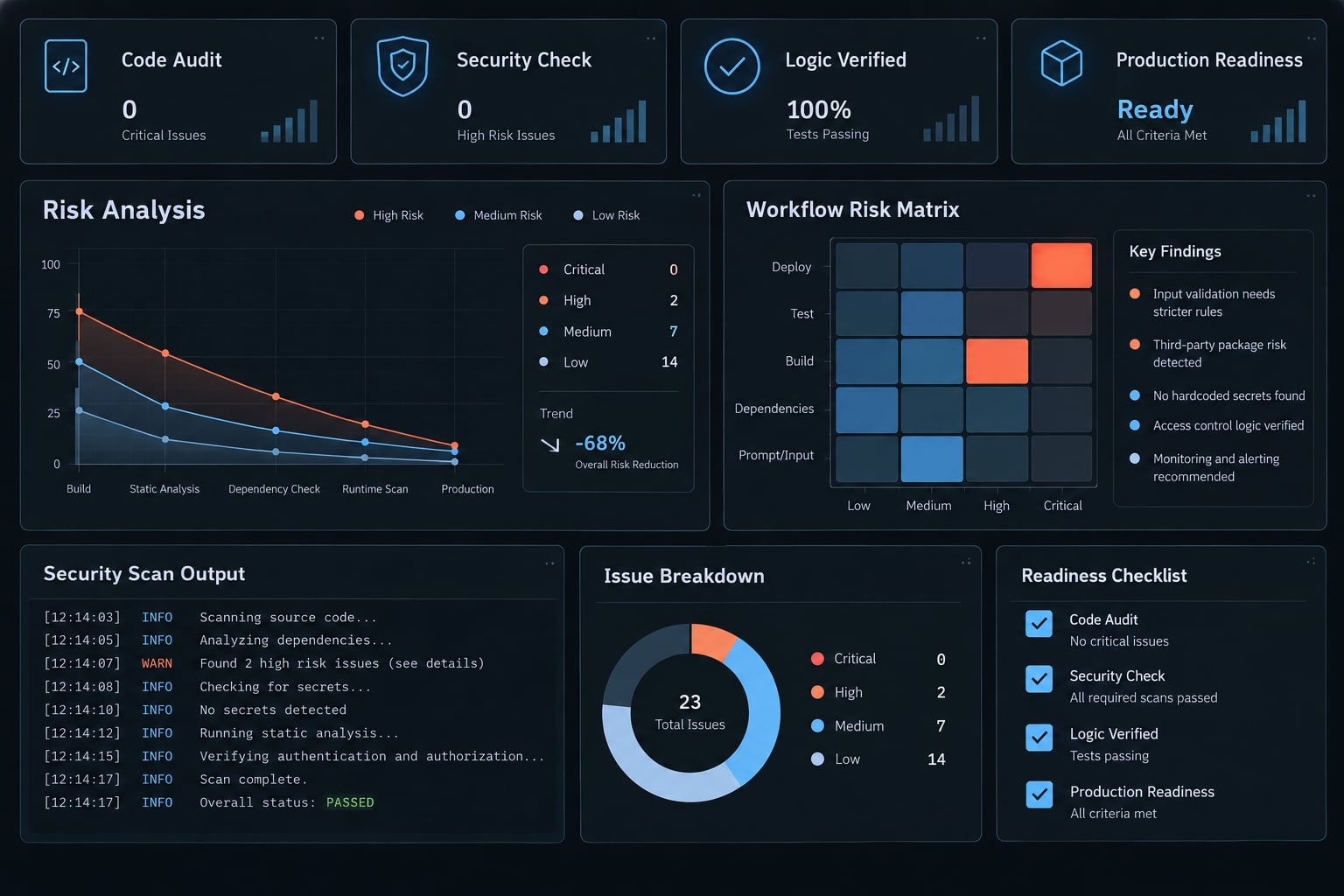
What are vibe coding risks?
Vibe coding risks are the security, quality, governance, and operational consequences of generating software primarily through natural-language prompts without sufficient human review, testing, or production controls. They emerge when the speed of AI-prompt-driven development exceeds a team’s capacity to verify the code, its dependencies, permissions, behavior, and readiness for real-world failure.
The relevant question is not simply whether AI contributed code. Risk depends more directly on review depth, system exposure, agent permissions, potential impact, and deployment ownership.
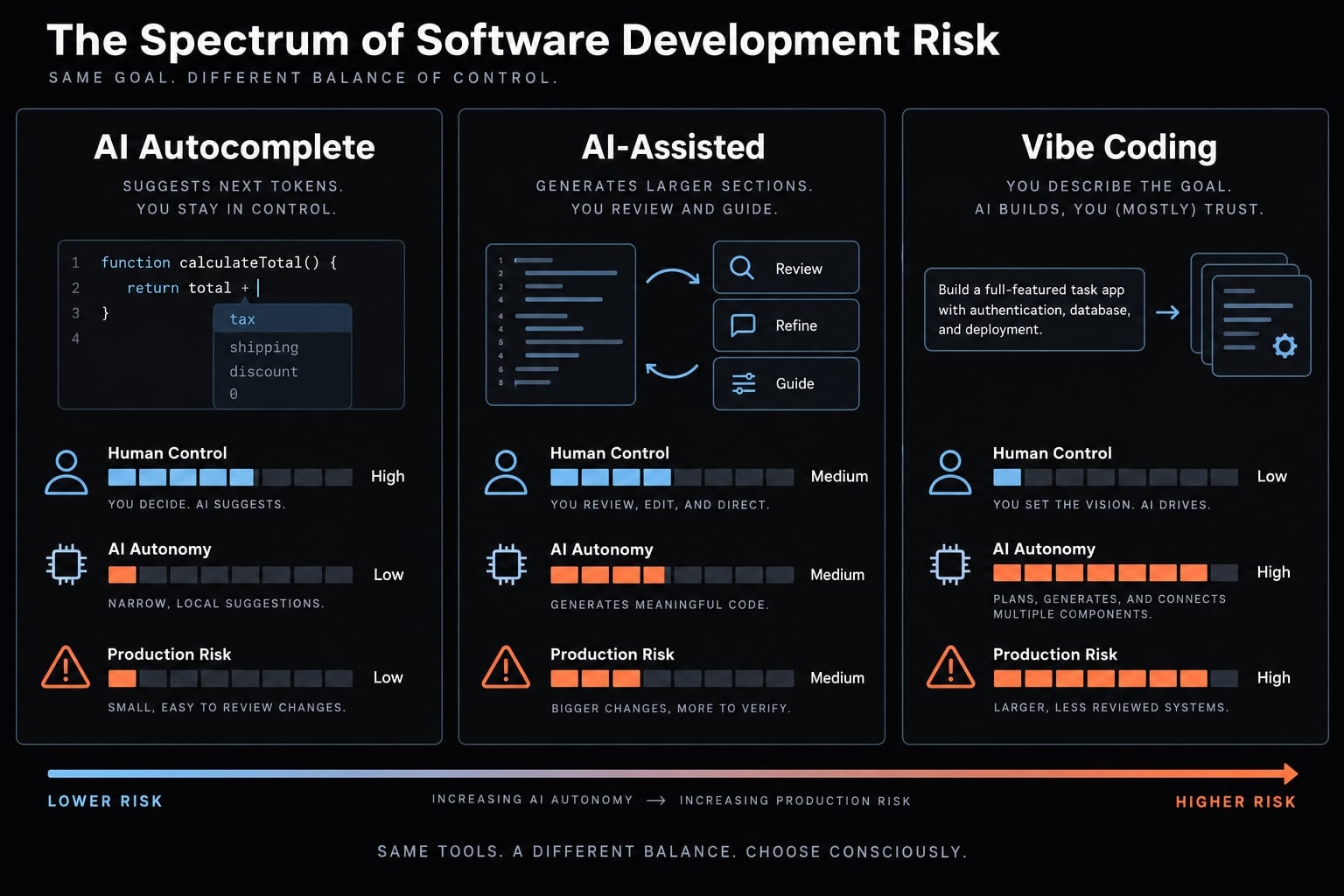
AI autocomplete usually leaves the developer as the primary author. Agent-assisted development delegates defined implementation tasks but retains explicit specifications and review. Pure vibe coding places greater emphasis on outcome prompts and surface-level validation.
A human-in-the-loop review only works when the reviewer can understand the implementation, challenge its assumptions, and reject unsafe changes. An approval from someone unable to inspect the code is not meaningful oversight.
Development mode | Human control | AI autonomy | Review depth | Typical production risk |
|---|---|---|---|---|
AI autocomplete | High | Low | Line-level review during implementation | Lower when normal controls remain |
Controlled AI-assisted coding | Moderate to high | Scoped to defined tasks | Pull requests, tests, and accountable approval | Depends on exposure and control quality |
Vibe coding | Often outcome-focused | High, potentially across entire features | Frequently limited to visible behavior | Higher when connected directly to production |
These distinctions belong within the Software Development Lifecycle, or SDLC, which covers planning, implementation, testing, deployment, and maintenance. Running code demonstrates functionality. It does not prove that the software is secure, maintainable, observable, compliant, recoverable, or production-ready.
The seven biggest vibe coding risks
The seven most important production failure modes are:
- Security vulnerabilities and unsafe defaults.
- Exposed secrets and sensitive data.
- Hallucinated or vulnerable dependencies.
- Incorrect logic, missing edge cases, and weak tests.
- Excessive agent permissions and prompt injection.
- Maintainability problems and technical debt.
- Governance, compliance, and operational failure.
1. Security vulnerabilities and unsafe defaults
Generated code may deliver the requested feature while omitting input validation, rate limiting, safe error handling, or access-control checks. These weaknesses overlap with categories in the OWASP Top 10, but visible functionality rarely reveals them.
Consider an authenticated data endpoint that confirms a user is logged in but never checks whether that user owns the requested record. Authentication verifies identity; authorization determines permitted actions. The endpoint works during testing yet enables cross-account data access.
The required controls include secure coding standards, separate authentication and authorization review, and misuse-case testing. Static Analysis Security Testing, or SAST, can detect known unsafe source-code patterns. However, manual review remains necessary because scanners may not understand record ownership or other business-specific permissions.
2. Exposed secrets and sensitive data
Sensitive information can enter prompts, source files, generated configuration, logs, browser extensions, or personal AI accounts. Data-handling policies vary by provider, plan, and configuration, so teams should review retention and training terms before submitting proprietary material.
Never include the following in unapproved tools:
- Production API keys.
- Database credentials.
- Customer records.
- Payment, health, or identity data.
- Proprietary source code.
- Access tokens or cloud credentials.
If a credential reaches a prompt or repository, deleting it from the latest commit is insufficient. Copies may remain in history, logs, caches, or external systems. The credential must be revoked and rotated.
Minimum controls include an approved secret manager, automated secret scanning, data classification rules, a tool approval policy, and a documented credential-rotation process.
3. Hallucinated or vulnerable dependencies
A coding model may suggest a package that does not exist, is incorrectly named, abandoned, unnecessary, or affected by known vulnerabilities. Attackers can register plausible package names that AI models are likely to suggest. This supply-chain attack technique is known as slopsquatting (informally: hijacking suggested package names).
Even legitimate packages may contain malicious install scripts, unstable transitive dependencies, or versions with published security advisories. Every new dependency increases the project’s maintenance and attack surface.
Before installation:
- Confirm the package in the official npm, PyPI, or relevant registry.
- Check ownership, maintenance activity, release history, and documentation.
- Verify that the package is necessary.
- Pin an approved version.
- Check the GitHub Advisory Database or relevant ecosystem advisory service.
- Generate a Software Bill of Materials when project risk justifies it.
Download counts can support evaluation, but they do not prove that a package is trustworthy or appropriate.
4. Incorrect logic, missing edge cases and weak tests
AI-generated implementations frequently show happy-path bias: They optimize for the example in the prompt rather than the conditions found in production. Invalid input, concurrent requests, retries, partial failures, time zones, and permission boundaries may remain unaddressed.
A billing flow, for example, can charge correctly under normal conditions. If the payment provider times out after processing a transaction, an automatic retry may create a duplicate charge. Tests generated from the same prompt can repeat the implementation’s assumptions and miss the defect.
Controls should include independent test design, negative tests, boundary tests, integration testing, and idempotency checks for retryable operations. Business-critical rules also require manual validation. High test coverage measures executed code; it does not prove that the tests challenge the right assumptions.
5. Excessive agent permissions and prompt injection
Coding agents may access repositories, terminals, integrations via the Model Context Protocol (MCP)-a standard for connecting models to data sources-plus cloud accounts, databases, CI/CD systems, and deployment environments. A mistake becomes far more consequential when the agent can perform irreversible actions.
Prompt injection occurs when malicious or untrusted instructions influence an agent’s behavior. Context poisoning occurs when repository files, documentation, issues, or retrieved pages manipulate the information used for a decision.
The practical concern is the agent’s authority after manipulation or error. Apply:
- Least-privilege access.
- Read-only permissions by default.
- Sandboxed execution.
- Isolated credentials.
- Command allowlists.
- Tool-call logging.
- Mandatory approval for destructive or production actions.
6. Maintainability and AI-generated technical debt
Prompt-driven iteration can create duplicated logic, inconsistent abstractions, undocumented dependencies, non-idiomatic patterns, and architectural drift. The application may continue working while its design rationale becomes increasingly difficult to reconstruct.
Early warning signs include:
- Similar logic implemented differently across files.
- Large generated changes that reviewers cannot explain.
- Repeated regeneration instead of targeted maintenance.
- Dependencies without documented purpose.
- No named owner for critical modules.
The business impact is slower debugging, fragile refactoring, longer onboarding, and a higher total cost of ownership. Teams should require architecture standards, small pull requests, named code ownership, documentation, refactoring gates, and Architecture Decision Records for important design choices.
7. Governance, compliance and operational failure
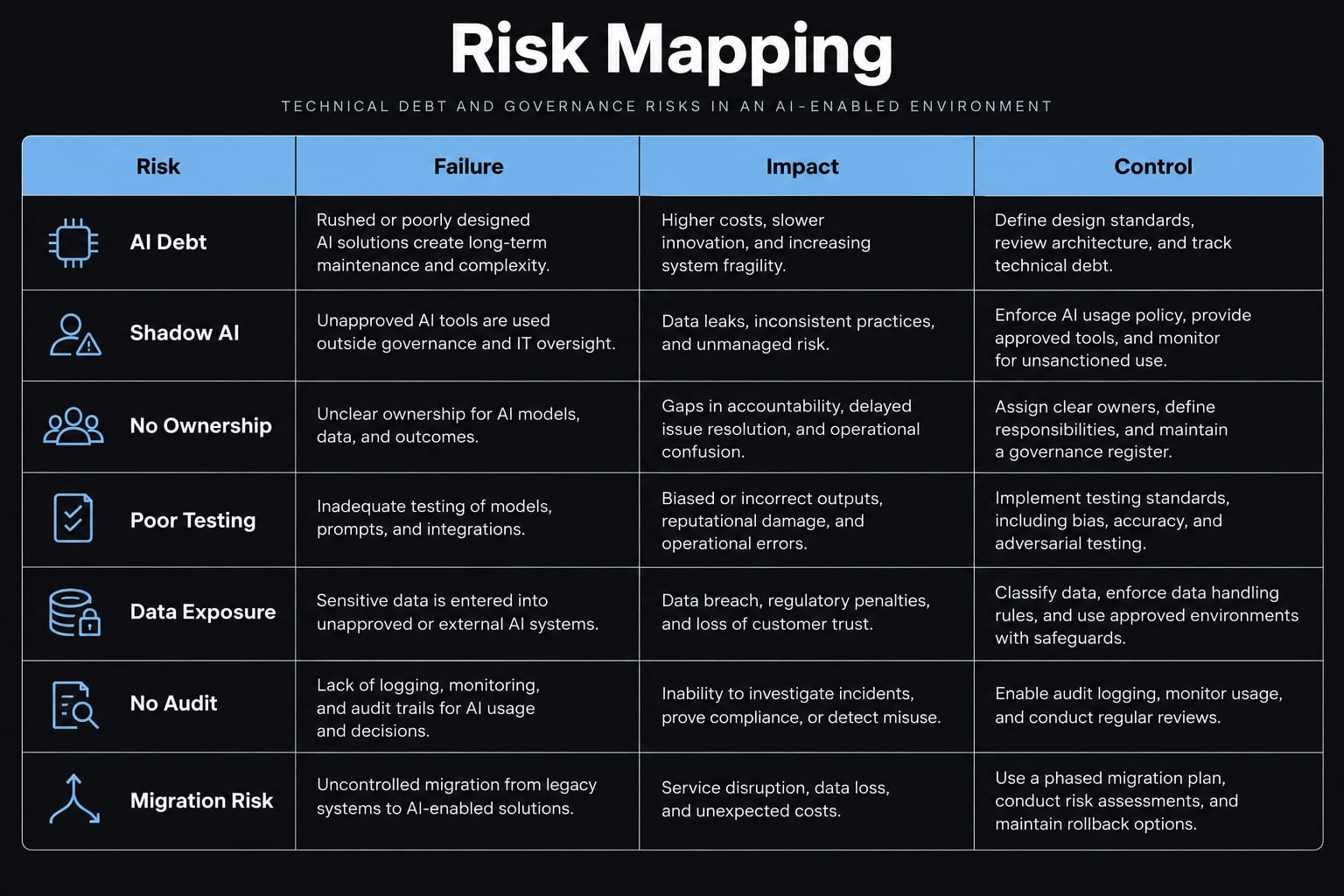
Shadow AI emerges when employees use unapproved models, extensions, agents, or personal accounts outside organizational controls. The resulting application may have no reliable record of which tools processed proprietary code, personal data, or internal system details.
Operational gaps create similar exposure. A generated migration may work on sample data but lack a safe rollback. An application may have no audit logs, backup restoration test, incident owner, or monitoring for failed permissions and critical business actions.
Risk area | Minimum control |
|---|---|
Tool governance | Approved AI tool inventory and data-use policy |
Auditability | Prompt, tool-call, code-change, and approval records where appropriate |
Environment control | Development, staging, and production separation |
Deployment | Human approval and recorded release evidence |
Operations | Monitoring, tested restoration, rollback, and incident ownership |
Privacy obligations such as GDPR or healthcare requirements such as HIPAA may introduce additional controls. These examples are informational and are not legal or compliance advice.
When does vibe coding become too risky for production?
Vibe coding is not automatically unsuitable for production. Production risk becomes unacceptable when system exposure and potential impact exceed the team’s ability to review, test, monitor, and recover.
A practical model is:
Risk = insufficient verification × system exposure × potential impact
Six factors should shape the risk assessment:
- External exposure: A local prototype has a smaller attack surface than a public application available to unknown users.
- Data sensitivity: Customer records, financial data, identity information, and production credentials require stronger controls.
- Permissions: Risk increases when the application or coding agent can write to databases, cloud resources, or deployment environments.
- Business criticality: Failures affecting payments, identity, revenue, or business-critical workflows require deeper application security review.
- Regulatory obligations: Auditability, privacy, retention, and data residency requirements may impose additional review and recordkeeping.
- Recoverability: Irreversible transactions, destructive migrations, and prolonged downtime increase potential impact.
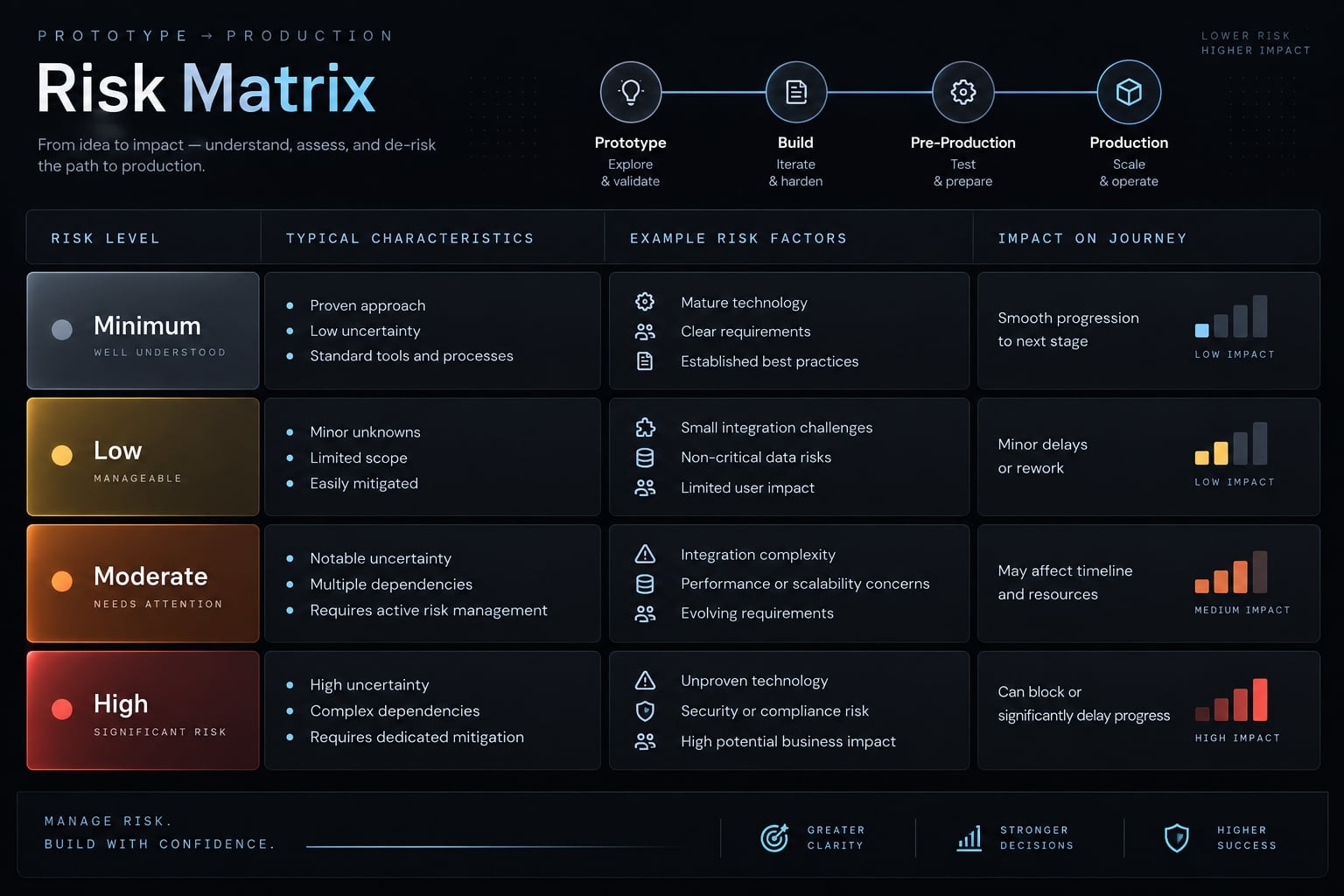
Prototype-to-production risk matrix:
Risk level | Typical characteristics | Minimum recommendation |
|---|---|---|
Low | Local prototype, synthetic data, no external access, no persistent production writes | Basic review, version control, dependency verification, and secret scanning |
Moderate | Restricted internal tool, limited users, noncritical data, reversible actions | Named owner, staging, access review, automated scans, tests, monitoring, and rollback |
High | Public application, customer data, production database writes, material downtime impact | Qualified engineering and security review, threat modeling, strict deployment gates, and tested recovery |
Critical | Payments, identity, regulated data, safety impact, irreversible actions, or essential infrastructure | Formal architecture, specialist review, documented assurance, separation of duties, and continuous operational controls |
Before deployment, the team should answer:
- Who is accountable for the application and final deployment decision?
- What data and systems can the application access?
- Which actions are reversible, and how has rollback been tested?
- What independent evidence shows that permissions, dependencies, failure paths, and business rules were reviewed?
- Who responds when monitoring detects a security or operational failure?
An internal tool is not automatically low-risk. A payroll dashboard, customer-data exporter, or infrastructure console may have limited users but a significant blast radius.
For nontechnical founders, the rule should be direct: If no qualified person can explain and independently review the production-bound code, do not connect it to real users, production credentials, or sensitive data.
Applications that should not rely on vibe coding alone
Vibe coding can still support prototyping, scaffolding, isolated components, or test generation in high-consequence domains. It should not be the only assurance method for the following systems:
- Authentication, authorization, and identity systems: Small access-control mistakes can expose accounts, administrative functions, or cross-tenant data.
- Payment processing and financial transactions: Retries, rounding, reconciliation, fraud controls, and irreversible transfers require explicit design and expert review.
- Healthcare and regulated personal-data workflows: These systems may process regulated data subject to strict privacy, access, auditability, and retention requirements.
- Encryption, key management, and security controls: Correctness depends on specialist knowledge, secure defaults, lifecycle management, and careful selection of established implementations.
- Production database migrations and destructive operations: A migration that succeeds on test data may lock tables, corrupt records, or become impossible to reverse at production scale.
- Critical infrastructure and safety-sensitive systems: Failures can affect physical safety, essential services, equipment, or environments where recovery is slow.
- Legal, lending, hiring, surveillance, and automated decision systems: Consequential decisions require explainable criteria, documented oversight, bias assessment, appeal mechanisms, and clear accountability.
These boundaries do not mean critical systems can never contain AI-generated code. They mean implementation speed cannot substitute for formal architecture, qualified validation, and operational assurance.
If a founder cannot inspect the code, obtain qualified review. If failure can cause irreversible harm, require formal controls. If an application makes consequential decisions, establish documented human oversight and accountability before deployment.
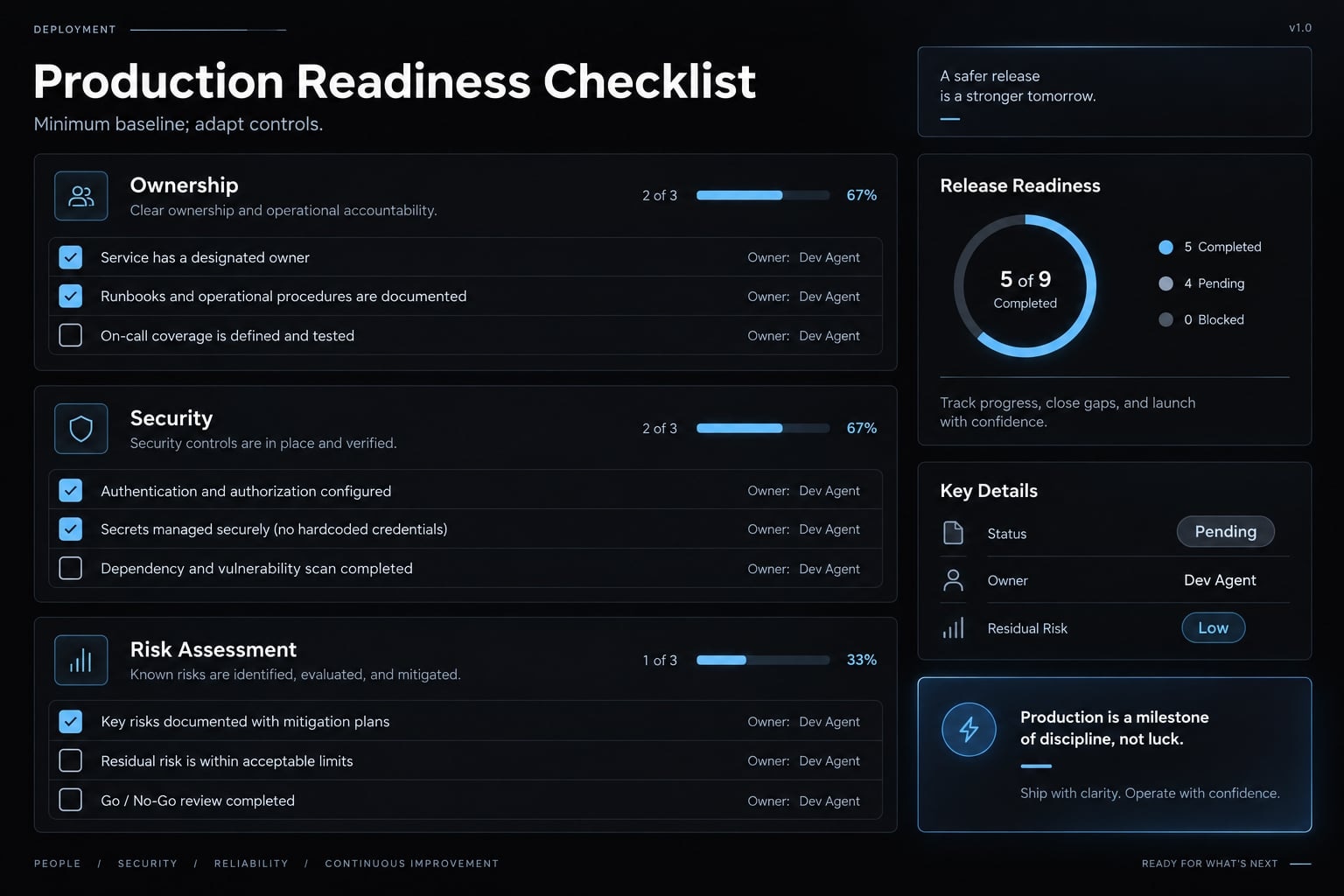
Minimum production-readiness checklist for vibe-coded applications
This production-readiness checklist is a minimum gate, not a security guarantee. Controls should increase with exposure and potential impact. Automated checks can find known problems, but they cannot validate every business rule, architecture decision, or operational assumption.
Ownership and change control
- Assign a named human owner for the application and deployment decision.
- Store code and configuration in version control with traceable change history.
- Keep AI-generated pull requests small enough for meaningful review.
- Require production approval from someone other than the implementation agent.
- Document architecture and high-impact decisions, including important assumptions and data flows.
One autonomous process should not plan, implement, test, approve, and deploy a high-impact change without independent oversight. A human-in-the-loop control is meaningful only when the reviewer examines the evidence and can reject the release.
Secrets, dependencies and permissions
- Verify that prompts, logs, and source code contain no credentials or confidential data.
- Store secrets in an approved manager and rotate them after suspected exposure.
- Confirm dependencies are real, maintained, necessary, pinned, and scanned.
- Give coding agents least-privilege access to repositories, MCP integrations, cloud systems, and databases.
- Block autonomous deployment and destructive operations unless an accountable human explicitly approves them.
Secret scanning and dependency scanning address different risks. The first detects exposed credential patterns. The second supports dependency management by identifying vulnerable or unapproved third-party components.
Security and quality validation
- Review authentication and authorization separately.
- Validate inputs and use safe, parameterized database operations.
- Test retries, failures, misuse cases, permission boundaries, and edge conditions.
- Run relevant source, dependency, secret, infrastructure, and runtime-package checks.
- Require independent manual testing and qualified review for business-critical workflows.
The relevant security checks depend on the technology stack:
- SAST checks source code for known unsafe patterns.
- Software Composition Analysis, or SCA, checks third-party packages.
- Secret scanning detects exposed credential patterns.
- Infrastructure-as-Code, or IaC, scanning checks infrastructure configuration.
- Container scanning checks packaged runtime components when containers are used.
These tools strengthen code validation but do not reliably detect every authorization defect, race condition, incorrect business rule, or unsafe architectural assumption.
Deployment and operational readiness
- Separate development, staging, and production environments.
- Review and test database migrations, including reversal or recovery where possible.
- Monitor errors, authentication events, permission failures, and critical business actions.
- Maintain backups and prove they work through restoration testing.
- Document rollback and incident response, including who acts during failure.
A backup is not proven until restoration succeeds. A rollback plan must also account for database migrations and incompatible data-format changes.
The CI/CD pipeline should retain test and scan results as deployment evidence. Monitoring must cover business-impacting behavior, not only server uptime.
Production gate summary
Control area | Minimum evidence before deployment |
|---|---|
Ownership | Named service owner and deployment approver. |
Code review | Reviewable pull request with recorded approval. |
Secrets | Secret scan passed; credentials stored outside source code. |
Dependencies | Registry verification, pinned version, vulnerability scan. |
Access control | Authentication and authorization reviewed separately. |
Testing | Happy-path, failure-path, and permission-boundary tests. |
Environments | Development, staging, and production separated. |
Operations | Monitoring, tested restoration, rollback, and incident owner. |
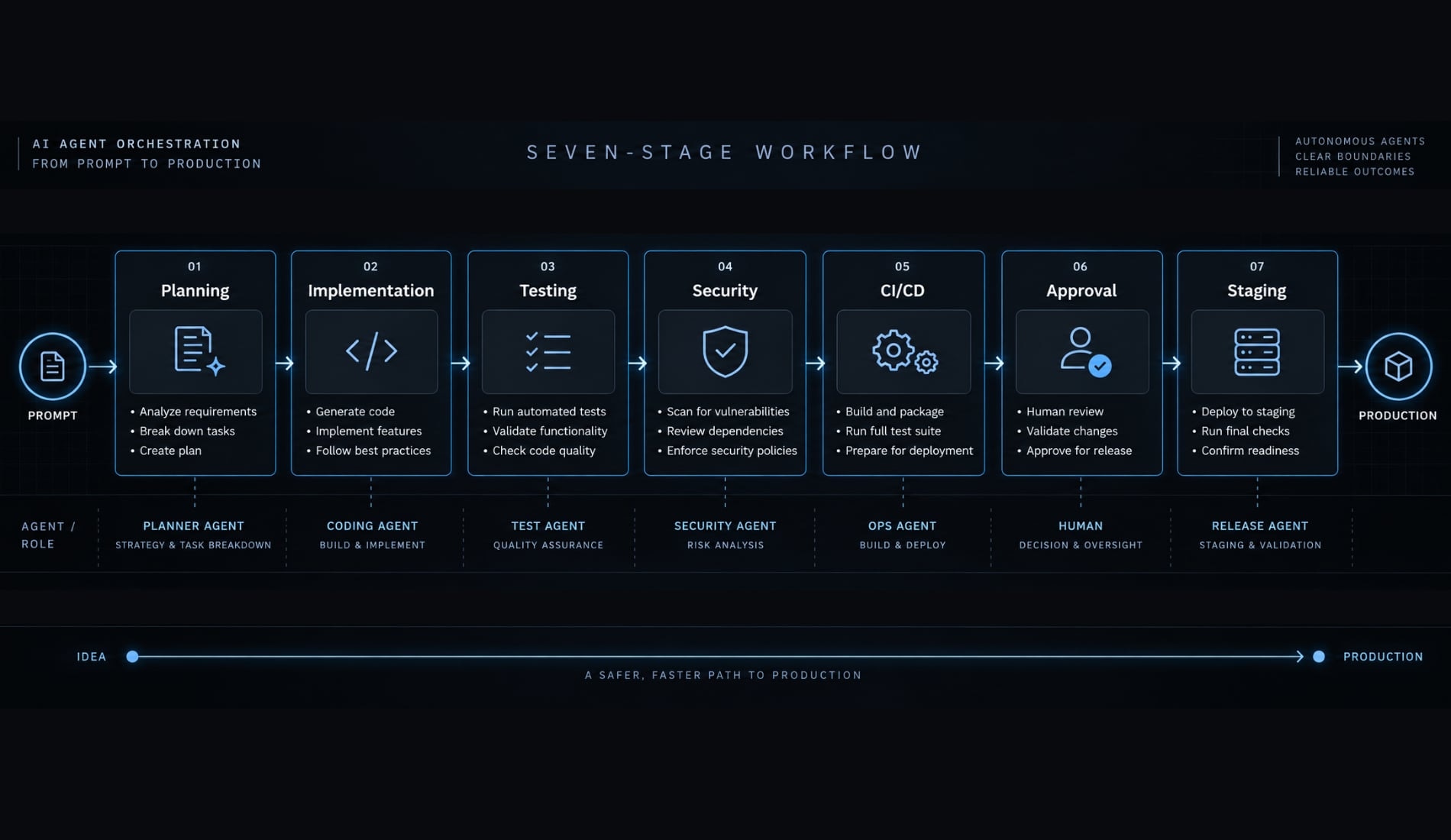
A governed AI development workflow: From prompt to production
AI agent orchestration coordinates specialized agents or roles across planning, implementation, testing, review, and deployment. Its purpose is not to assume that multiple agents are inherently reliable. It creates clearer responsibilities, evidence, and human approval gates.
The same autonomous process should not define requirements, implement code, validate its own assumptions, approve the result, and deploy a high-impact change.
- Planning agent: Produces scope, assumptions, data flows, risks, and acceptance criteria.
- Implementation agent: Creates a limited, reviewable code change.
- Independent testing agent: Produces failure-path, misuse, and boundary tests.
- Review or security agent: Reports issues involving permissions, secrets, dependencies, and unsafe patterns.
- CI/CD checks: Record automated test, scan, build, and policy results.
- Human owner approval: An accountable reviewer accepts, rejects, or requests changes.
- Staging deployment: Validates observability, behavior, migration safety, and rollback readiness before production.
Step | Expected evidence |
|---|---|
Planning | Scope, assumptions, data flows, acceptance criteria |
Implementation | Limited, reviewable change |
Testing | Failure-path and boundary tests |
Review | Findings on permissions, secrets, dependencies, and unsafe patterns |
CI/CD | Recorded automated check results |
Human approval | Accountable acceptance or rejection |
Staging | Observability evidence and rollback readiness |
For example, an implementation agent adds a customer data-export endpoint. Independent testing discovers that one account can request another account’s records. Security review also identifies excessive data access and missing audit logs. Human approval is withheld. Deployment proceeds only after record-level authorization, logging, boundary tests, staging validation, and rollback requirements are satisfied.
AgentKit can help standardize specialized agent responsibilities, reusable skills, security checks, MCP access boundaries, and approval-oriented workflows. It does not guarantee secure code or replace qualified review, threat modeling, or accountable deployment ownership.
Production readiness depends on evidence, not demo quality
The central vibe coding risks come from the gap between implementation velocity and verification capacity. AI can accelerate delivery without automatically making the result unsafe, but visible functionality cannot establish production readiness.
Four principles remain nonnegotiable: named human ownership, restricted permissions, independent validation, and tested recoverability. Higher exposure, sensitive data, consequential actions, and limited rollback options demand stronger security guardrails and deeper human review.
Before connecting a prototype to production systems, use the risk matrix and production-readiness checklist to document controls, evidence, owners, and residual risk. A successful demo shows that a feature can run. Whether it is production-ready must remain an evidence-based, accountable decision.
Frequently asked questions
What are vibe coding risks?
Vibe coding risks are the security, governance, and operational vulnerabilities that arise when AI-generated software is moved into production environments without sufficient human review, testing, or security guardrails. These risks bridge the gap between rapid, prompt-driven prototyping and the rigorous requirements necessary for secure, production-ready enterprise systems.
Does vibe coding create more vulnerabilities than manual workflows?
Yes. While AI does not inherently create insecure code, it generates software at a volume and speed that often exceeds a team’s capacity for thorough review. This velocity leads to the uncritical acceptance of AI output, resulting in common security flaws like SQL injection or weak authentication entering production unchecked.
Can I secure vibe-coded applications with traditional tools?
Only partially. Traditional security tools like SAST and SCA are essential for identifying known code-level patterns and vulnerable dependencies. However, you also need purpose-built controls to manage AI-specific risks, such as prompt injection, agent permission management, shadow AI usage, and the lack of proper architectural oversight.
What is the difference between vibe coding and AI-assisted coding?
In AI-assisted coding, the human developer remains the primary author, reviewing suggestions line-by-line in context. In vibe coding, the AI model generates entire features, services, or applications from high-level natural language prompts, shifting the human's role from writing code to reviewing the functional outcomes of an autonomous agent.
What types of applications should not rely on vibe coding alone?
Systems where security or operational failure could cause irreversible harm require mandatory expert review. This includes payment processing, authentication services, healthcare software, critical infrastructure, and any application handling regulated personal data where auditability and specific legal compliance are required for deployment.
How can teams mitigate the risks of vibe coding?
Teams should treat AI-generated code as untrusted input. Key controls include establishing clear human ownership, mandating independent code reviews, enforcing least-privilege access for coding agents, implementing automated CI/CD security gates (SAST/SCA), and ensuring a strict separation between development, staging, and production environments.
What is the biggest mistake teams make with AI-generated code?
The most significant error is the uncritical acceptance of output. When a prototype functionally performs its task, teams often prematurely connect it to production databases or sensitive data, bypassing the threat modeling and security verification steps essential for ensuring that the underlying code handles edge cases and failures safely.
Read more:
- Vibe coding SEO: Build AI-powered assets without developers
- Andrej Karpathy vibe coding: What it is and how it works
- Vibe coding cost: The true budget guide for AI app projects
Conclusion
In conclusion, while vibe coding drastically accelerates software development, it cannot replace the rigorous controls required for production stability and security. Moving from a functional prototype to a release-ready system demands independent code validation, strict secret management, least-privilege agent access, and accountable human oversight.
By embedding structured security gates and clear ownership into the AI development lifecycle, teams can harness the velocity of AI generation without compromising on safety, compliance, or system reliability.