Vibe coding business impact: Balancing speed and maintenance
Vibe coding business impact: Where it creates leverage and where it creates future cleanup
The vibe coding business impact is real, but it should be evaluated as a speed-versus-maintainability trade-off, not as an AI novelty story. AI can compress build time from weeks to days, sometimes hours. That speed is useful. But if unmanaged, it also creates downstream complexity in testing, maintenance, ownership, and governance. For founders, product leads, and operations teams, the real question is not whether vibe coding works. It is where it creates meaningful business leverage, where it introduces avoidable risk, and how to adopt it without turning short-term momentum into long-term cleanup.
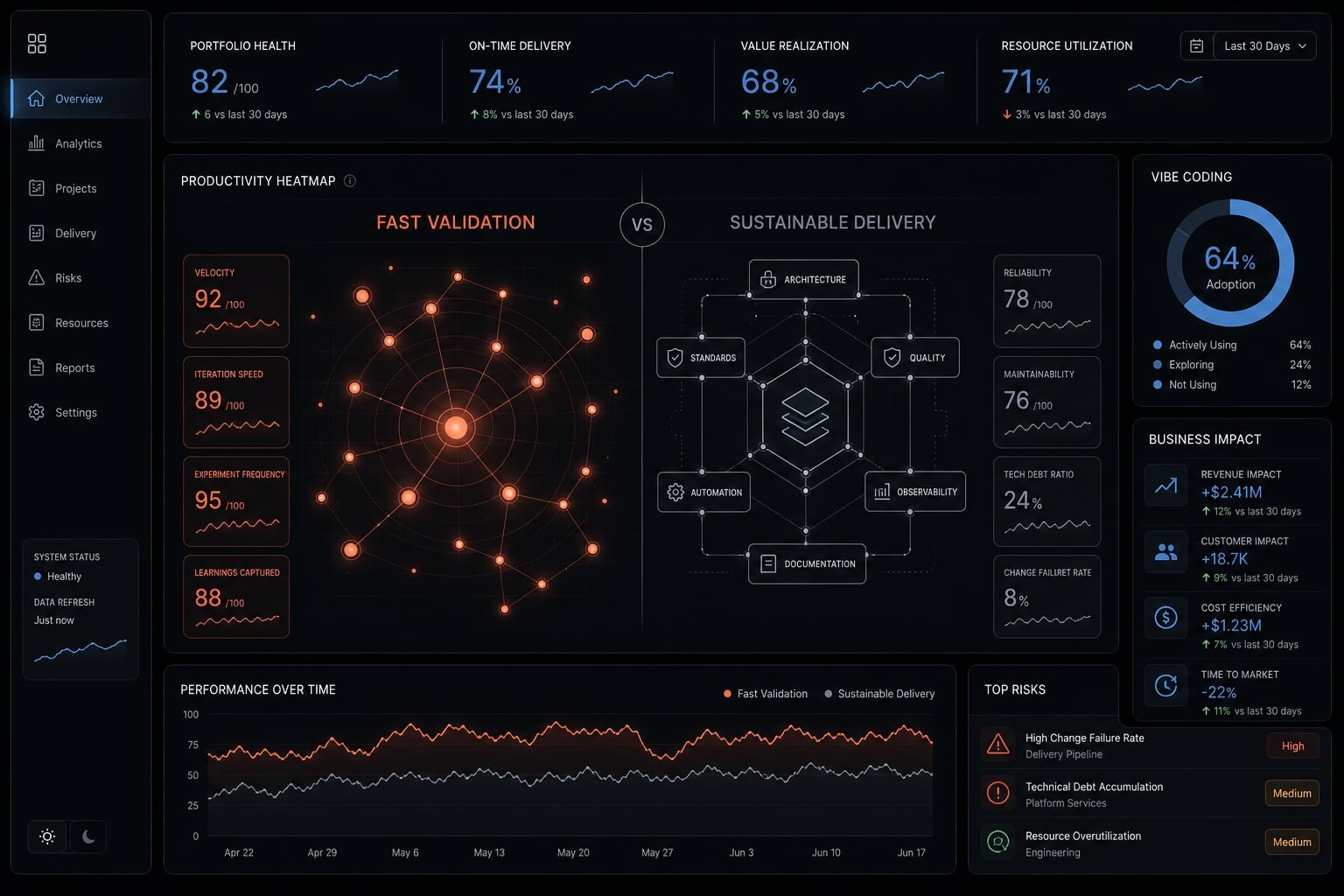
What vibe coding means in a business context
Vibe coding is the practice of creating software through natural language instructions, with AI handling more of the implementation work than traditional coding tools. In business terms, it shortens the path from idea to usable prototype. But the output still requires review, testing, and governance before it should be trusted in real operations.
What makes vibe coding relevant is not just that AI can suggest code. It is that newer systems can interpret intent, generate multiple components, revise output, connect steps, and support AI-assisted prototyping with much less back-and-forth. That changes how quickly a team can move from concept to something testable.
What is actually new about vibe coding?
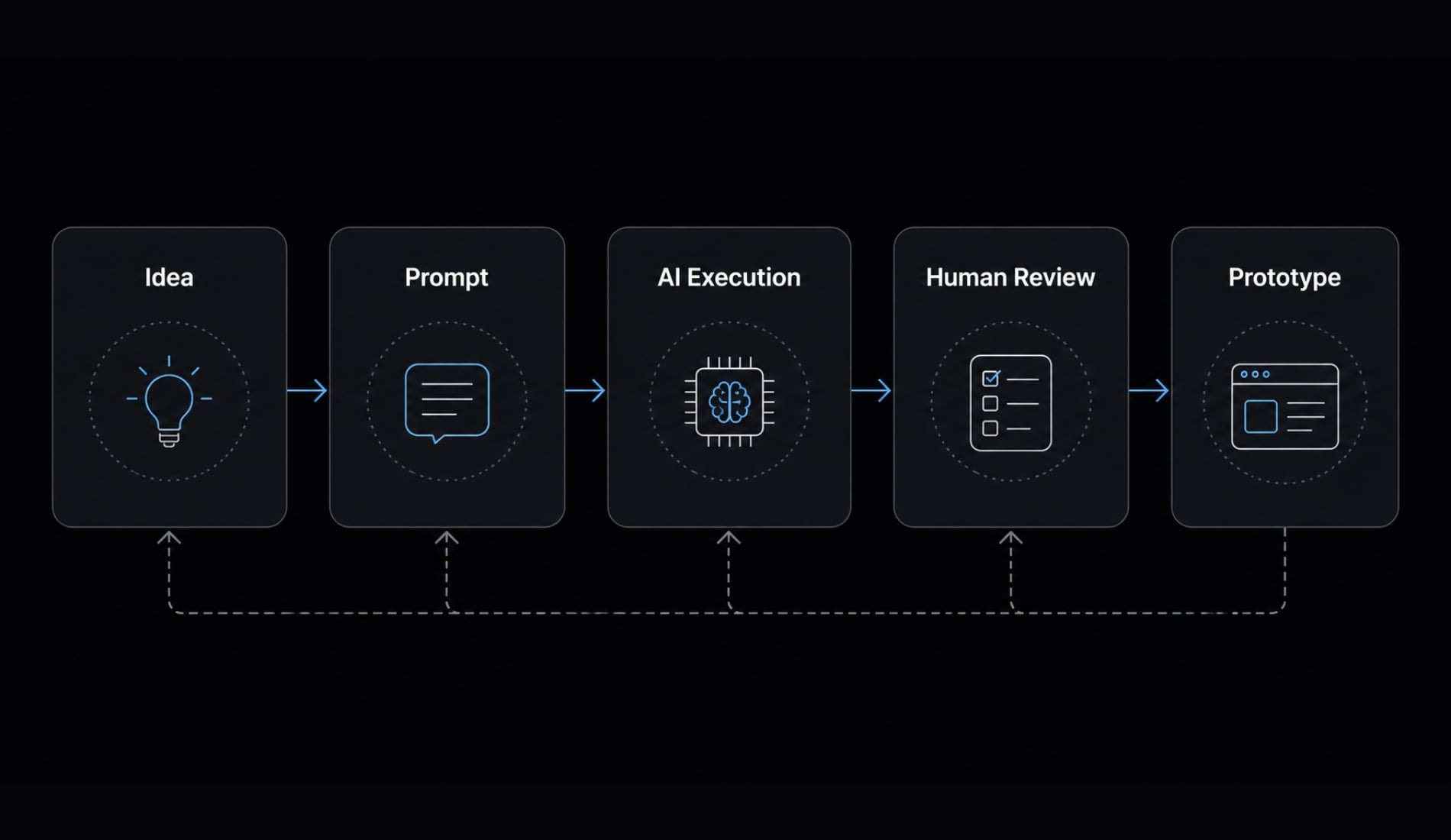
What is new is the shift from code assistance to broader execution. Older tools mainly helped developers autocomplete lines of code or suggest small improvements. Natural language programming changes that interaction. A user describes the intended outcome in plain English, and the AI handles a larger share of the build process.
With agentic AI systems, that execution can extend across multiple steps. The AI may generate screens, connect logic, revise broken sections, and sometimes run through tasks in sequence with limited supervision. The operational difference is significant: fewer translation layers between business intent and usable output.
For business teams, this matters because idea-to-delivery delays often happen in the handoff between concept, specification, and engineering capacity. Vibe coding reduces some of that friction. It does not eliminate the need for engineering judgment. It simply makes early execution more accessible and faster.
Why the term matters to business leaders
For business leaders, the value of AI-assisted prototyping is practical:
- It lowers the barrier to experimentation before major engineering investment.
- It reduces handoff friction between non-technical teams and builders.
- It allows earlier validation of workflows, interfaces, and customer needs.
- It expands execution capacity for lean teams with limited resources.
This is especially relevant for cross-functional teams trying to test ideas quickly. A product lead, operator, or founder can move from concept to working draft faster than before. The business impact comes from that compressed cycle. The constraint is that accessible software creation is still not the same as production-grade software. A prototype can be useful long before it is reliable enough to depend on.
Where vibe coding creates real business leverage
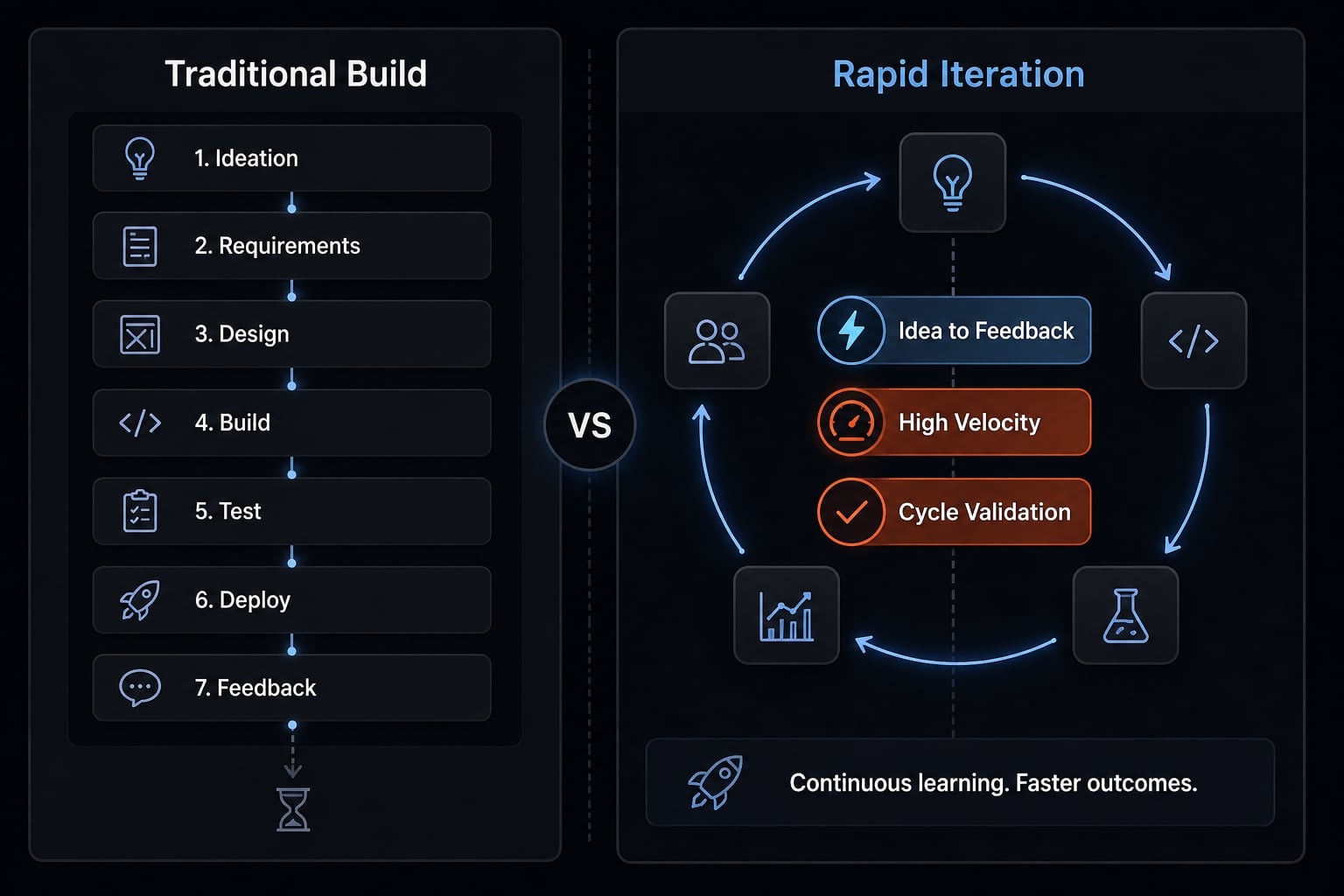
The strongest value of vibe coding is not novelty. It is rapid iteration. Teams can test assumptions faster, learn sooner, and avoid heavy commitment before evidence exists.
- Faster idea validation.
- Lower upfront development costs.
- More execution capacity for lean teams.
- Faster internal tool creation.
- Shorter time to customer feedback.
Speed only matters if it improves decision quality. Shipping more drafts has little value if the business is not learning faster, reducing uncertainty, or making better investment decisions.
Faster path from idea to validation
The biggest upside is faster movement from concept to evidence. Instead of waiting for a formal build cycle, teams can create rough demos, test workflows, and gather customer or internal feedback earlier. That accelerates rapid iteration and reduces the lag between assumption and reality.
This matters in product-market fit work. Early-stage teams rarely fail because they lacked features on day one. They fail because they spent too long building the wrong thing. If vibe coding helps a team show a usable draft to customers next week instead of next quarter, the gain is not just speed. It is higher learning velocity.
That faster loop can also improve decision quality across product and go-to-market discussions. Teams can test onboarding ideas, pricing interfaces, internal forms, or lightweight portals before committing roadmap time. The result is better evidence before larger investment.
Better economics for early-stage decisions
For many startups and small product teams, the most immediate benefit is startup capital efficiency. Lower upfront spend gives the company more room to test before locking into a full development path.
Key advantages often include:
- Lower upfront development costs before customer demand is clear.
- Better runway preservation during uncertain early-stage exploration.
- Improved timing on engineering investment after validation appears.
- Reduced need for immediate full-time development commitment.
This matters because pre-validation spending is often the most expensive type of uncertainty. If a founder can validate demand, workflow usefulness, or customer behavior with a smaller initial commitment, the company preserves flexibility. That is often more valuable than simply reducing cost. It improves the sequence of capital allocation.
This is also where “concurrent building and selling” becomes relevant. Teams can test a real workflow while still learning whether the market actually wants it.
Broader use beyond product engineering
The leverage extends well beyond MVPs. Some of the strongest use cases sit inside operations, where speed to usefulness matters more than perfect architecture.
Common examples include:
- Internal tools: Lightweight dashboards for pipeline visibility, campaign tracking, or delivery status
- Sales or CRM (Customer Relationship Management) utilities: Lead-routing helpers, enrichment workflows, follow-up trackers
- Marketing workflow automation: Content approval flows, handoff tools, and campaign coordination apps
- Reporting automation: Tools that pull recurring metrics into one usable interface
- Internal request systems: Small apps for approvals, intake, or resource coordination
In these environments, AI-assisted prototyping can unlock usable software without waiting for scarce engineering bandwidth. The core takeaway is simple: The more bounded the problem, the greater the leverage from rapid iteration.
The hidden costs and risks behind the speed
The biggest mistake is treating faster software creation as cheaper software ownership. Vibe coding often reduces initial friction, but it does not remove the long-term costs of maintaining, reviewing, monitoring, and improving software that the business comes to depend on.
The problem is not speed itself. The problem is assuming that a fast prototype automatically becomes a durable system. In practice, many teams experience prototype-to-production drift: Something works well enough at first, then becomes harder to maintain, debug, document, or safely expand as usage grows.
Technical debt in business terms
In business terms, technical debt is the future cost, delay, and maintenance friction created by taking shortcuts today. It shows up as slower roadmap execution, recurring bugs, higher support load, and cleanup work that crowds out more strategic priorities.
This is the most important way to understand technical debt in business terms. It is not an abstract engineering complaint. It is a drag on delivery capacity. When AI-generated output is accepted too quickly, the codebase may become inconsistent, brittle, or poorly documented. The result is not just rework. It is reduced maintainability, more time spent troubleshooting, and less time available for planned growth initiatives.
Support burden increases as more people rely on the system. A quick internal app that nobody reviews carefully can become mission-critical in six months. Once that happens, defects become operational issues, not just technical annoyances.
Security, quality, and compliance concerns
The risk profile rises quickly when the software touches important workflows, customer data, or regulated processes. Common concerns include:
- Inconsistent code quality → Harder quality assurance, less predictable bugs, and slower debugging.
- Weak access control → Greater exposure around sensitive data and internal permissions.
- Thin testing discipline → Higher chance that edge cases break important workflows.
- Poor documentation → Support teams and future builders struggle to maintain the system.
- Security and compliance gaps → More risk in finance, healthcare, legal, or customer-data-heavy environments.
These issues matter because AI-generated output can look complete before it is actually safe or reliable. A tool can appear functional in a demo while still failing basic governance expectations. That gap becomes expensive when users depend on it or when auditors, customers, or internal stakeholders ask for traceability.
Why “cheap now” can become “expensive later”
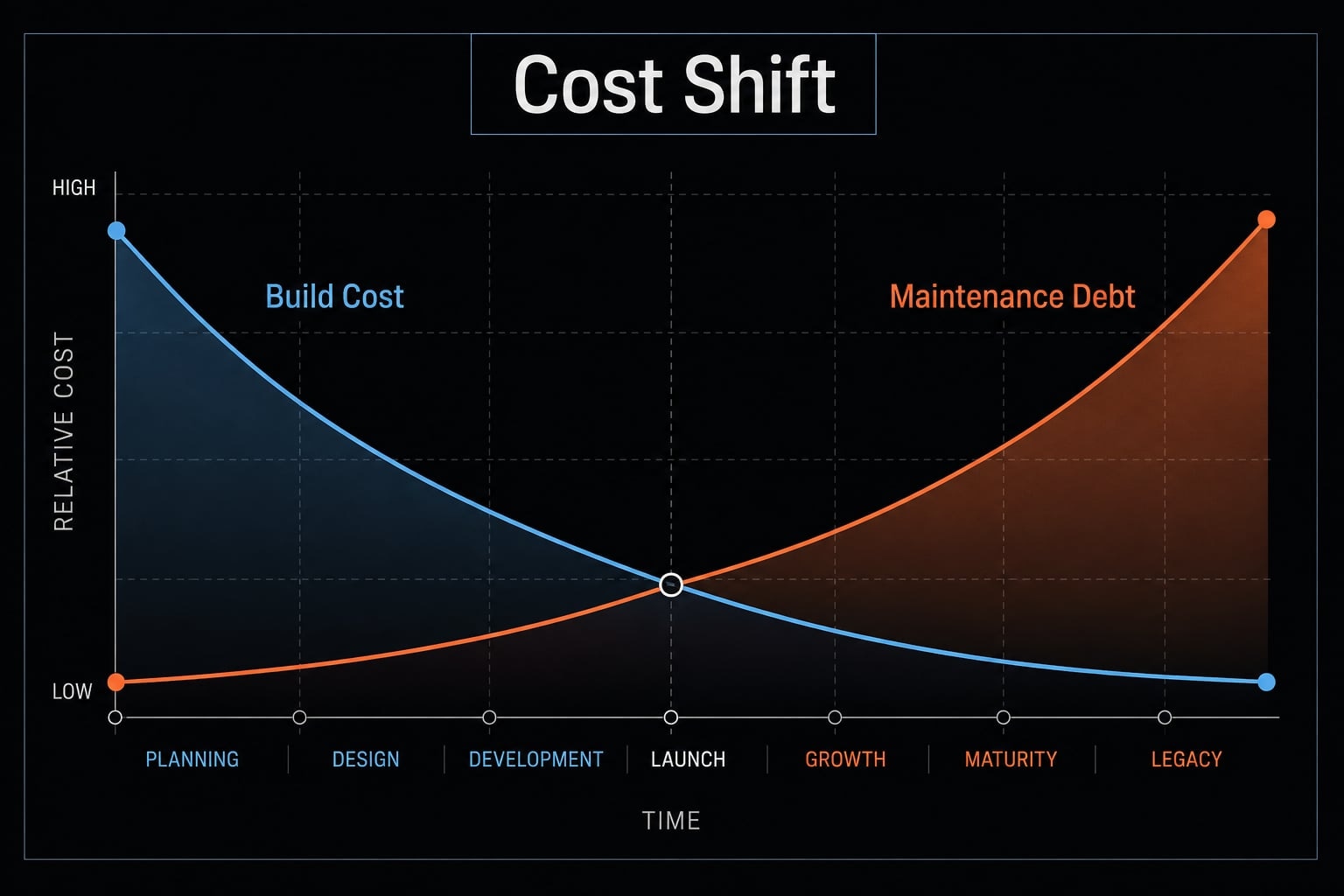
The total cost often shifts rather than disappears. Teams save time at the front end, then absorb the cost later through review, rework, support, and system hardening.
That cost migration usually shows up in several forms:
- Inference costs: Ongoing model or API usage costs that grow with system activity.
- AI observability: The ability to monitor, trace, and troubleshoot AI-driven workflows when something fails.
- Refactoring cost: Cleanup and restructuring work when early outputs no longer support growth.
- Production support burden: More incidents, fixes, and ownership demands once real users depend on the system.
- Scalability planning: Additional work needed when a lightweight prototype must handle more users, data, or complexity.
This is why “cheap now” can become “expensive later.” The build may be faster, but ownership can become heavier. The takeaway is direct: Cost does not vanish. It often moves from labor-heavy early build into downstream maintenance, monitoring, and production risk.
When vibe coding makes sense and when it does not
The right question is not whether AI-driven software development is good or bad. The right question is where it fits. A useful decision framework starts with the cost of failure. Use vibe coding aggressively where failure is cheap, and cautiously where failure is expensive.
Use case | Business value from vibe coding | Risk level | Recommended approach |
|---|---|---|---|
MVP / prototype | Very high | Low-Medium | Use aggressively for speed |
Internal tool | High | Low-Medium | Strong fit with basic review |
Marketing / ops automation | High | Low | Strong fit |
Customer-facing app | Medium-High | Medium-High | Use with human review and testing |
Regulated / sensitive system | Medium | High | Limited use without formal engineering controls |
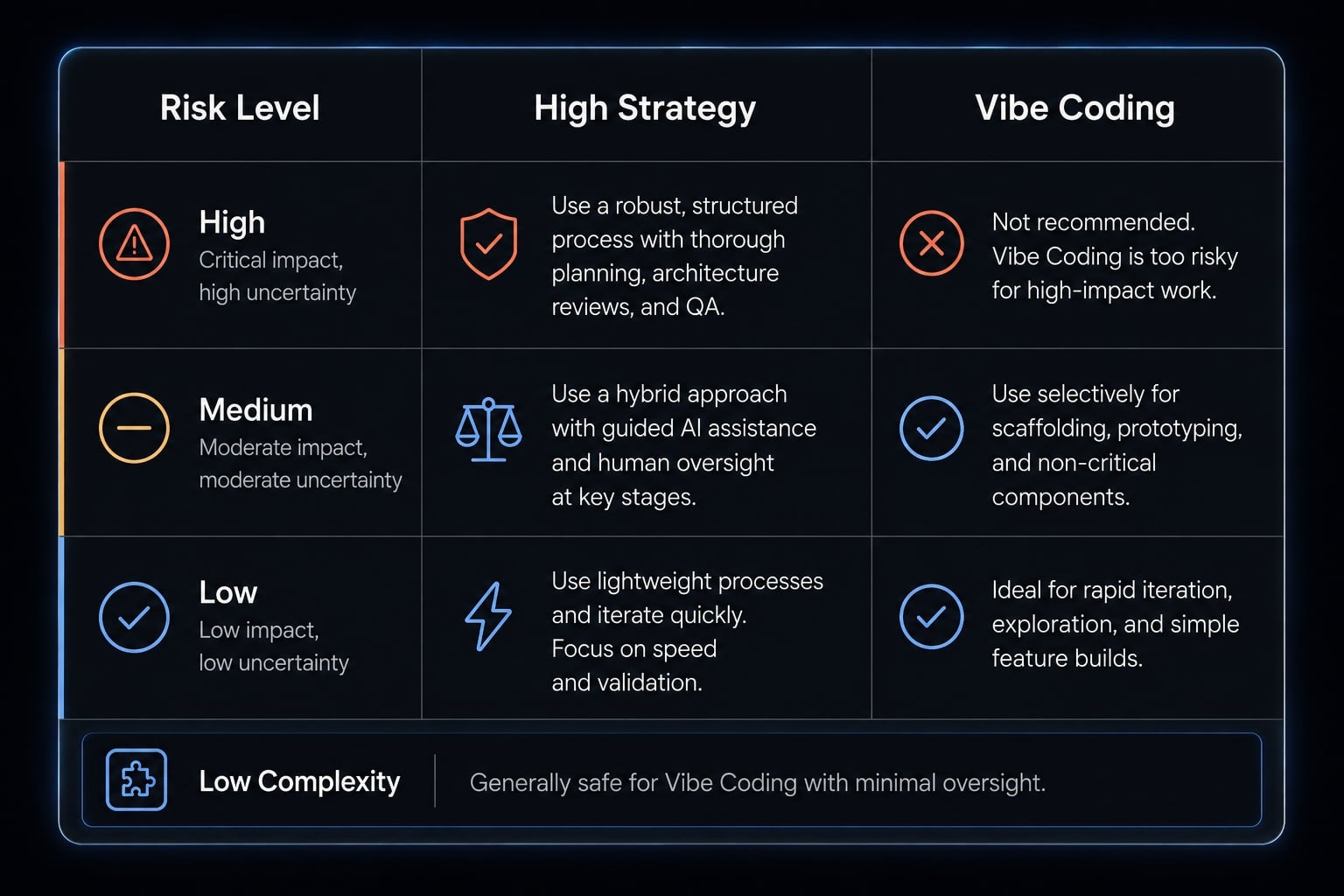
A practical decision framework should evaluate two factors: How expensive failure is, and how dependent the business will become on the output. That keeps the conversation grounded in business risk, not hype.
Best use cases
Strong-fit use cases usually share one trait: They are bounded and easy to review.
- MVPs that help test customer demand before major engineering commitment.
- Internal tools that improve visibility, routing, or team coordination.
- Workflow automation for marketing, reporting, intake, or approvals.
- Lightweight customer-facing prototypes with clear limits and active testing.
- Fast validation projects for non-technical founders who need evidence before hiring or scaling engineering.
These use cases benefit from speed while keeping the blast radius manageable. They are also the most practical entry point for teams exploring scaling AI-generated prototypes carefully.
Higher-risk scenarios
Caution is warranted when failure is costly or when oversight demands are high.
- Payments systems where bugs can create direct financial loss.
- Healthcare, finance, or legal workflows involving sensitive data.
- Infrastructure-heavy products where reliability and uptime are critical.
- Audit-heavy products that require traceability, controls, and documentation.
- Regulated systems with strict security and compliance requirements.
In these cases, human-in-the-loop oversight is not optional. Vibe coding may still play a role, but only within tighter controls and stronger engineering review.
A simple governance framework for responsible adoption
Vibe coding is a force multiplier, not a replacement for engineering discipline. The goal of governance is not to slow teams down. It is to make sure speed does not quietly create avoidable operational risk.
A lightweight model is enough for many businesses. The right level of governance depends on whether the output is a prototype, an internal tool, or something connected to production workflows.
Set clear usage boundaries
Define usage boundaries before adoption expands:
- Prototype-only: This is suitable for fast experimentation and limited testing, provided there is no critical data involved and no business dependency.
- Internal-only: Suitable for team-facing tools with basic review, permissions checks, and ownership assigned.
- Production use: Requires explicit review, documented acceptance, stronger testing, and human-in-the-loop oversight.
- Ownership should be clear in every case: Who requested it, who reviews it, and who supports it if it breaks.
This separation helps teams avoid treating every output the same. A rough draft can be useful, but it should not automatically be turned into a production asset.
Minimum review checklist
Use this simple review checklist before broader rollout:
- Who reviews the output? Assign a named owner or reviewer.
- What gets tested? Define minimum quality assurance for the workflow.
- What data is involved? Check whether sensitive or regulated data is touched.
- What happens if it breaks? Estimate business impact and support consequences.
- Is there a rollback plan? Make sure the team can disable or revert safely.
This checklist is intentionally simple. It covers accountability, testing, data risk, operational impact, and rollback planning without creating a heavy approval process.
When to transition to structured engineering
Ad hoc prompting eventually stops being enough. Teams should move toward structured engineering when:
- The user base is growing and reliability expectations are rising.
- Compliance pressure increases due to customer, legal, or audit demands.
- Maintenance friction becomes recurring and slows new work.
- Performance or stability issues appear more often.
- Business dependency expands beyond experimentation.
- Production readiness becomes a real requirement rather than an assumption.
This is the point where repeatability matters more than improvisation. Agentic AI can still be part of the workflow, but within a more defined delivery model. The takeaway: Keep adoption lightweight early, then add process as dependency grows.
Practical example: The difference between fast validation and sustainable delivery
A small B2B team wants a lead-routing dashboard to assign inbound requests by territory, deal size, and response SLA. Instead of waiting for a full engineering cycle, the operations lead uses AI-assisted prototyping to build a working internal version in a few days. The team immediately gains faster visibility, cleaner handoffs, and better response speed. From a startup capital efficiency perspective, this is a strong win: They learn what the workflow should be before committing larger development resources.
Then the tool becomes popular. Sales relies on it daily. Exceptions appear. Permissions matter. Managers want audit history. Suddenly the original version is harder to maintain. Logic is duplicated, documentation is thin, and small fixes create new issues. The team is now feeling the early signs of technical debt.
The lesson is straightforward. Fast validation helped the business move closer to product-market fit for its internal process. That was valuable. But once the tool became operationally important, ad hoc building was no longer enough. The next step was not to abandon AI. It was to move into repeatable, structured AI workflows with clearer review, ownership, and change control.
Frequently asked questions
What is vibe coding in a business context?
Vibe coding is the practice of creating software applications through natural language instructions rather than traditional programming languages. For businesses, it represents a shift from code-heavy development to intent-driven execution, allowing teams to build functional prototypes rapidly by using AI to handle technical implementation.
How does vibe coding impact startup capital efficiency?
It improves capital efficiency by lowering upfront development costs and accelerating product-market fit testing. Founders can validate ideas through functional prototypes before committing significant capital to full-scale engineering, effectively preserving runway and allowing for more "shots on goal" within the same budget.
What are the main business risks of vibe coding?
The primary risks include unmanaged technical debt, inconsistent code quality, and ongoing inference costs. When development barriers are low, teams often overlook long-term maintenance, security, and observability requirements, which can lead to higher downstream cleanup costs and integration challenges as systems scale.
Should businesses use vibe coding for production apps?
Generally, no, unless combined with structured engineering. Vibe coding is ideal for internal tools, rapid prototyping, and workflow automation where failure is low-risk. For mission-critical, customer-facing systems, you must implement human-in-the-loop oversight, rigorous testing, and formal governance to ensure production readiness.
How can a company adopt vibe coding responsibly?
Adopt a tiered governance model: Use vibe coding freely for non-sensitive prototypes, but require formal code review, security audits, and observability for anything touching live production data. Always establish a clear transition path to structured engineering as project dependency and complexity grow.
Does vibe coding replace the need for software engineers?
No. Vibe coding changes the role of engineers from writing every line of code to acting as reviewers, architects, and governors of AI-generated systems. It increases output, but it does not remove the need for technical oversight, strategic roadmap planning, and quality assurance.
Read more:
- Is vibe coding bad? Pros, cons and responsible AI practices
- Agentic coding vs vibe coding: A practical guide for developers
- Vibe coder meaning: How AI is changing software development
Conclusion
The vibe coding business impact is most valuable in experimentation, internal tooling, and faster validation cycles. It helps teams reduce friction between idea and usable output, improve learning speed, and delay heavy engineering commitment until evidence is stronger.
The risk appears when businesses confuse prototype speed with production readiness. That is where maintenance burden, technical debt, and governance gaps begin to compound. A practical next step is to evaluate your use cases by risk and business dependency, create a lightweight review checklist, and define when work should move from ad hoc prompts into structured AI workflows.