Vibe code waitlist: What it means and what to check before launch
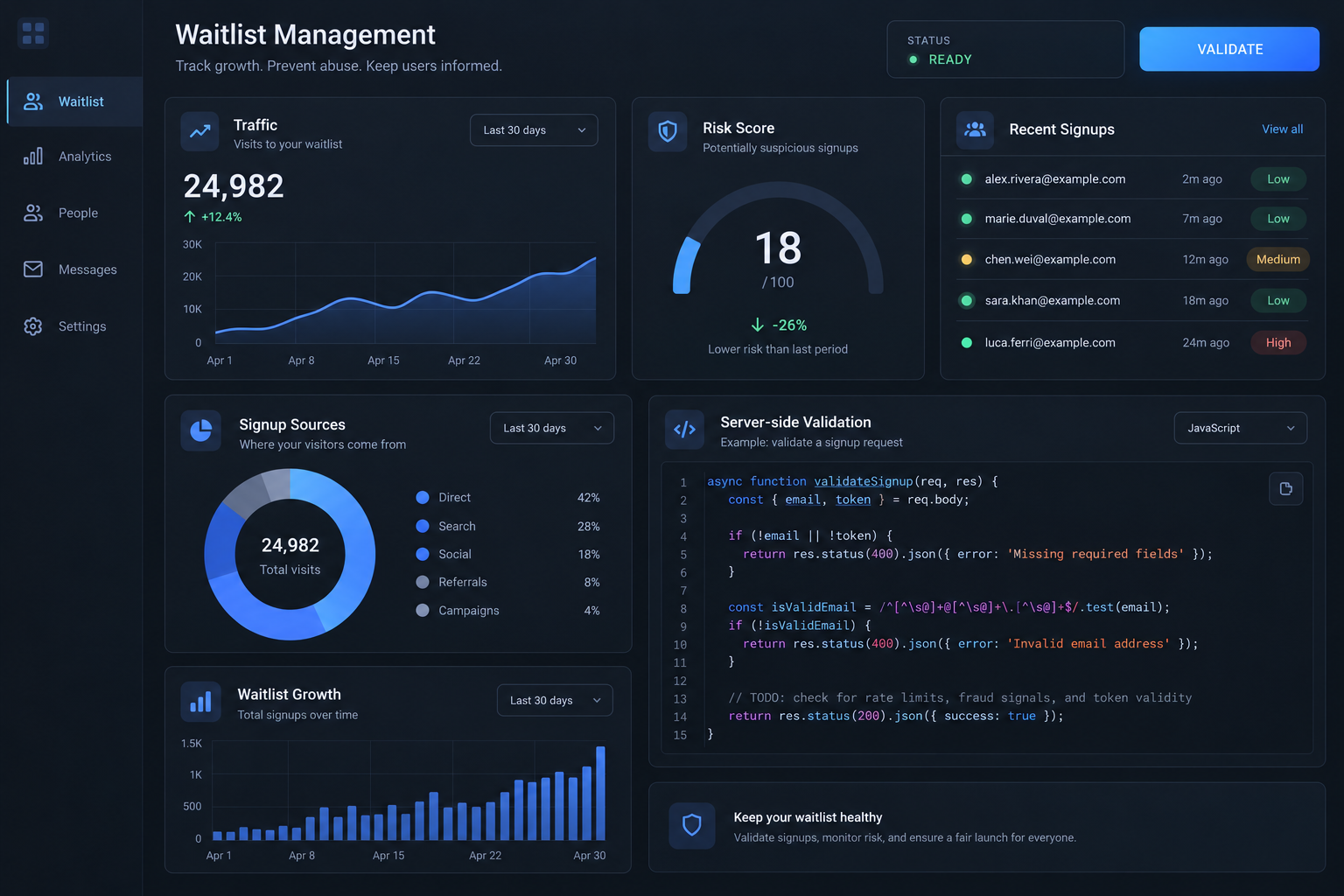
Using AI to quickly build a waitlist lets founders test early interest without developing a full product. However, a working form doesn't guarantee secure data handling, reliable delivery, or true market demand. This guide provides a practical checklist to ensure your launch is both safe and effective.
Vibe Code Waitlist: What It Means and What to Check Before Launch
A vibe-coded waitlist is… an early-access registration flow built or modified through natural-language instructions to an AI coding tool. It helps teams test initial interest before expanding a product. Before collecting real user information publicly, teams should review data handling, access controls, integration reliability, and applicable privacy requirements.
What does “vibe code waitlist” mean?
The phrase describes two different intentions. There is no universal “Vibe Code” waitlist; product availability must be checked with the specific provider. Two common uses of the term:
Use case | Meaning | Why it matters |
|---|---|---|
Joining a product waitlist | Requesting access to a particular AI product | Availability and eligibility depend on its provider |
Building an AI-powered sign-up flow | Using prompts to create an early-access waitlist | The builder remains responsible for launch readiness |
Prompt-based development uses natural-language instructions to generate or modify software. Vibe coding is a prompt-led approach within AI-assisted programming, not a synonym for every reviewed, AI-supported engineering workflow.
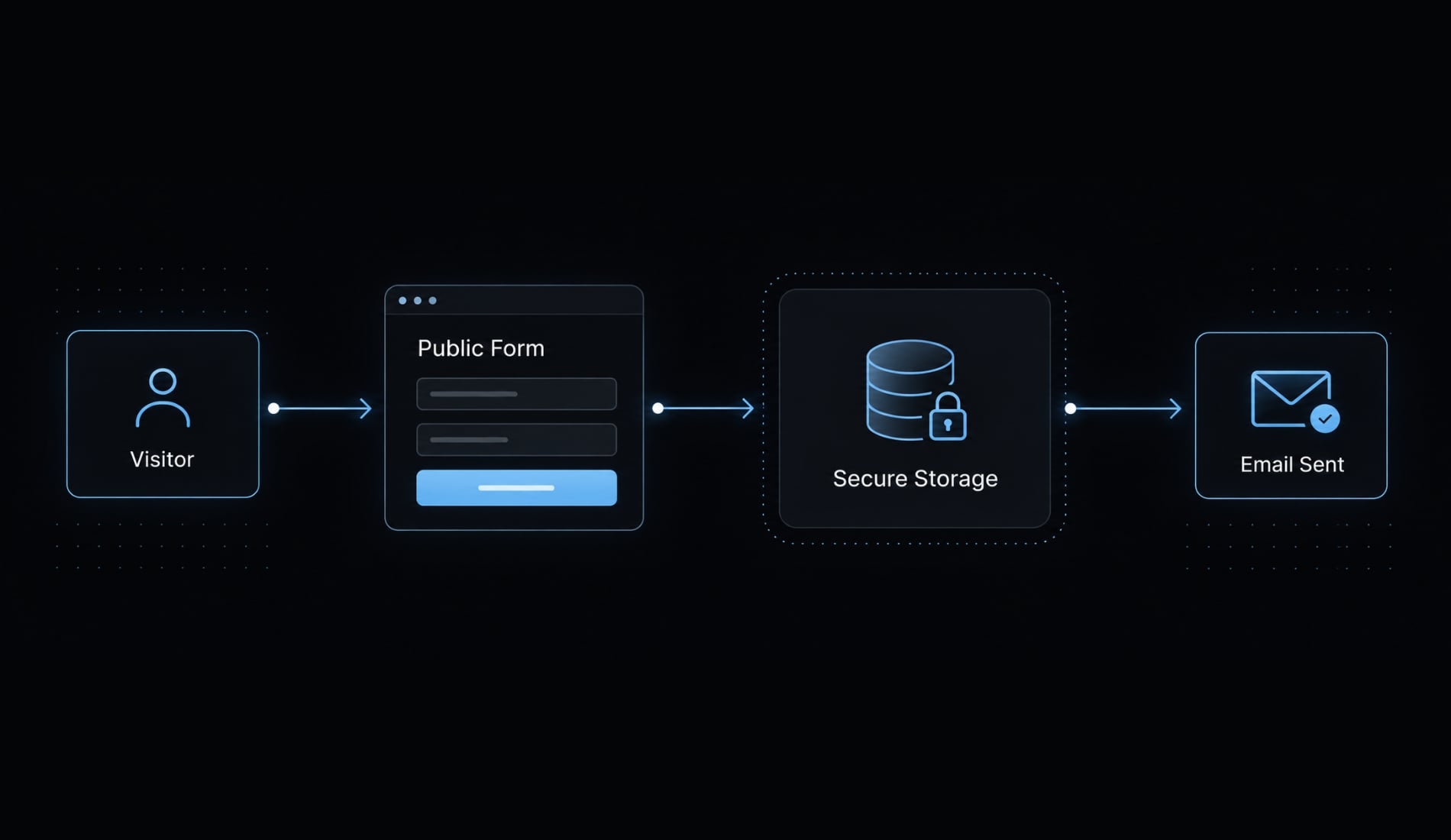
Consider a hypothetical team launching a B2B SaaS product—business software delivered online. Its waitlist includes a landing page, email form, storage, and confirmation message. Custom code is optional; a managed service may suffice.
The rest of this guide examines that AI-built flow.
Why founders use vibe coding to launch waitlists
A narrow waitlist lets founders test an offer before committing to a larger application. In the hypothetical B2B example, the team could compare two value propositions before adding features. The useful outcome is clearer positioning—not simply publishing sooner.
What a waitlist can actually validate
- Positioning resonance: Which promise attracts interest?
- Audience relevance: Are intended users registering?
- Channel effectiveness: Which sources bring relevant visitors?
- Beta willingness: Will registrants accept early access?
- Problem urgency: Will they discuss their needs in interviews?
These signals help prioritize further investigation. Interview participation can reveal why someone registered, which a conversion count cannot explain.
What sign-up volume does not prove
Registrations alone do not establish willingness to pay, retention, or product-market fit—a product satisfying sustained market demand. They also say nothing about security or scalability.
AI may reduce implementation effort, but review, hosting, email delivery, and maintenance still consume resources. Faster creation is valuable when it accelerates trustworthy learning.
What vibe-coded launches need beyond a working demo
A demo proves only what was observed. The following patterns are illustrative, not documented AgentKit projects or claims about particular tools.
Lesson 1 - Generated code can work without being understood
In the hypothetical team’s first test, the form displays “success.” That observation does not identify where the address was stored or whether the confirmation email arrived.
A useful review follows the registration through every configured component. AI-generated code should be understandable enough for someone to explain this path.
Lesson 2 - A Polished interface does not demonstrate security
A professional page can coexist with incorrect backend permissions. Equally, an unattractive prototype can have appropriate controls.
Review who can retrieve records and what submission responses contain. Neither visual polish nor a successful demonstration answers those questions.
Lesson 3 - Real traffic changes the risk profile
Public promotion introduces automated submissions, delivery limits, unexpected failures, and support requests.
For example, the illustrative team might store registrations successfully while its email integration fails. The lesson is to test storage and delivery separately, rather than treating the confirmation screen as end-to-end evidence.
Private tests also need safeguards when they use real personal information. A smaller audience reduces exposure; it does not remove responsibility.
Prototype vs. Validated MVP vs. Production-ready ưaitlist
Readiness depends on controls and recoverability, not appearance. This editorial model is not a certification.
Here, a validated MVP (minimum viable product) means a controlled experiment with reviewed critical flows and initial demand evidence—not established product-market fit.
Criterion | Validated MVP | Production-ready waitlist | |
|---|---|---|---|
Objective | Explore flow | Test assumptions | Collect reliably |
Audience | Internal testers | Limited invitees | Public visitors |
Real personal data | Prefer synthetic | Minimize and protect | Govern collection |
Testing | Basic behavior | Critical flows | Failures and regressions |
Database controls | Restricted access | Tested permissions | Tested public boundaries |
Monitoring | Manual inspection | Delivery checks | Alerts and ownership |
Recovery | Rebuild experiment | Tested recovery | Documented restoration |
Code ownership | Named builder | Accountable maintainer | Release owner |
Promotion | None | Controlled invitations | Approved acquisition |
Weak permissions are not acceptable at any stage. Synthetic data—fictional test records—helps avoid unnecessary exposure during experimentation.
The practical readiness test:
- Where does submitted data go?
- Who can read or export it?
- What does the browser receive?
- Where are private credentials stored?
- What happens when an integration fails?
- Can a working release be restored?
Public launch requires a flow the team can test, observe, and recover without blind prompting. Operational readiness and market validation remain separate: reliable collection can reveal weak demand, while strong demand cannot make unsafe collection acceptable.
The main risks of a vibe-coded waitlist
AI-built waitlists are not inherently unsafe. Risk depends on implementation, access controls, review, and operations.
Risk | Business impact | Minimum control |
|---|---|---|
Excess records returned | Personal-data exposure | Minimize responses |
Weak database permissions | Unauthorized access | Test access policies |
Exposed private credentials | Service misuse | Protect and rotate secrets |
Invalid or abusive submissions | Polluted demand signals | Validate and limit submissions |
Integration failures | Lost follow-up | Monitor delivery |
Missing recovery options | Extended disruption | Test restoration |
Unreviewed dependencies | Vulnerabilities or regressions | Review packages and changes |
These are starting controls, not complete remedies.
User data returned to the browser
Information in a network response reaches the recipient even when the interface hides it. Minimal responses do not replace authorization—permission to access specific data.
Weak database permissions
Supabase’s “Row Level Security” documentation and Firebase’s “Security Rules” documentation describe platform-specific access controls. Enabling these features is not equivalent to verifying their policies.
Exposed API keys and environment variables
Public identifiers are not necessarily secrets; privileged credentials are. Environment variables can enter browser-delivered code. Exposed secrets may require revocation or rotation and investigation, not merely deletion.
Fragile dependencies and hidden technical debt
Duplicated logic, unreviewed packages, and regressions can increase maintenance costs. These problems are possible in any development process, not inevitable consequences of AI.
Missing validation, abuse protection and recovery
Validate submissions on the server, not only in the browser. Spam and failures can distort validation, increase costs, or lose registrations. OWASP’s “Input Validation Cheat Sheet” explains the server-side boundary.
Pre-launch checklist for a vibe-coded waitlist
This practical launch review is not legal advice, a penetration test, or security certification. Passing it does not establish that vulnerabilities are absent. Assign specialist checks when necessary.
Data and privacy checks
- Minimize collected fields to the stated purpose.
- Verify a clear privacy notice and consent where applicable.
- Inspect public responses and endpoints for unauthorized personal records.
- Test logged-out and unauthorized access restrictions.
- Test deletion and communication opt-out processes.
- Document storage locations and third-party data processors.
Privacy requirements vary by purpose and jurisdiction. Access registration does not automatically authorize unrelated marketing.
Application and integration checks
- Test valid, invalid, duplicate, and blank submissions, including server-side validation.
- Inspect submission responses for unnecessary data.
- Check browser-delivered assets for private credentials.
- Test each configured email, analytics, referral, or CRM integration separately; CRM means customer relationship management.
- Limit third-party permissions and remove unused integrations.
- Verify proportionate submission-rate limits or spam protection.
Reliability and recovery checks
- Test mobile, desktop, and common browsers.
- Inspect useful error logs for unnecessary personal data.
- Restore test data from a protected backup or export.
- Verify recovery of a previous working deployment.
- Document how to pause collection.
- Assign an incident and delivery-failure owner.
Restoring application code does not restore lost registration data.
Final external test
- Ask someone other than the builder to complete the flow.
- Repeat in a logged-out private session.
- Trace the registration through every configured component.
Private browsing provides one test condition, not a complete security assessment. Test only systems you own or are authorized to assess.
Apply this checklist before promotion. Record each check’s owner, pass/fail/not-applicable status, evidence, remediation, and retest date. Unknown high-impact controls require review before launch.
Is the waitlist validating real demand?
Relevant users and follow-through matter more than raw registrations. Define waitlist conversion as valid registrations divided by relevant visitors over a stated period, using consistent counting rules.
Waitlist validation scorecard
Metric | What it shows | Warning sign |
|---|---|---|
Visitor-to-sign-up conversion | Initial offer response | Few valid registrations |
Email verification, if used | Reachable, confirmed interest | Many unverified addresses |
Target-user fit | Audience relevance | Wrong roles or needs |
Acquisition source quality | Relevant interest by source | Poor-fit traffic |
Interview participation | Willingness to engage | Little follow-through |
Beta activation—after access | Invited users completing a meaningful action | Few reach that action |
Waitlist-to-active conversion—after access | Active users across the waitlist cohort | Limited progression |
Retention—after access | Repeat product use | Users stop returning |
Define the activation action and measurement window before interpreting results. Beta activation uses invited users; broader waitlist-to-active conversion includes the defined waitlist cohort.
Missing acquisition attribution is a measurement limitation, not proof of poor-quality demand. No universal conversion threshold fits every offer.
A simple decision rule
- Continue validating when relevant users register and engage.
- Revisit positioning or targeting when conversion and fit are weak.
- Investigate onboarding and value when activation is weak.
- Delay acquisition scaling until significant readiness and measurement issues are understood.
When one-shot vibe coding is no longer enough
Replace ad hoc prompting with a repeatable release process when consequences or coordination requirements increase.
Escalation triggers include:
- Personal or confidential information, accounts, or payments.
- Multiple integrations and external permissions.
- Public acquisition traffic or business-critical flows.
- Frequent releases or multiple contributors.
Even a simple public email waitlist needs proportionate controls. Greater complexity does not automatically require an orchestration product: a managed waitlist platform, conventional development process, or focused expert review may suffice.
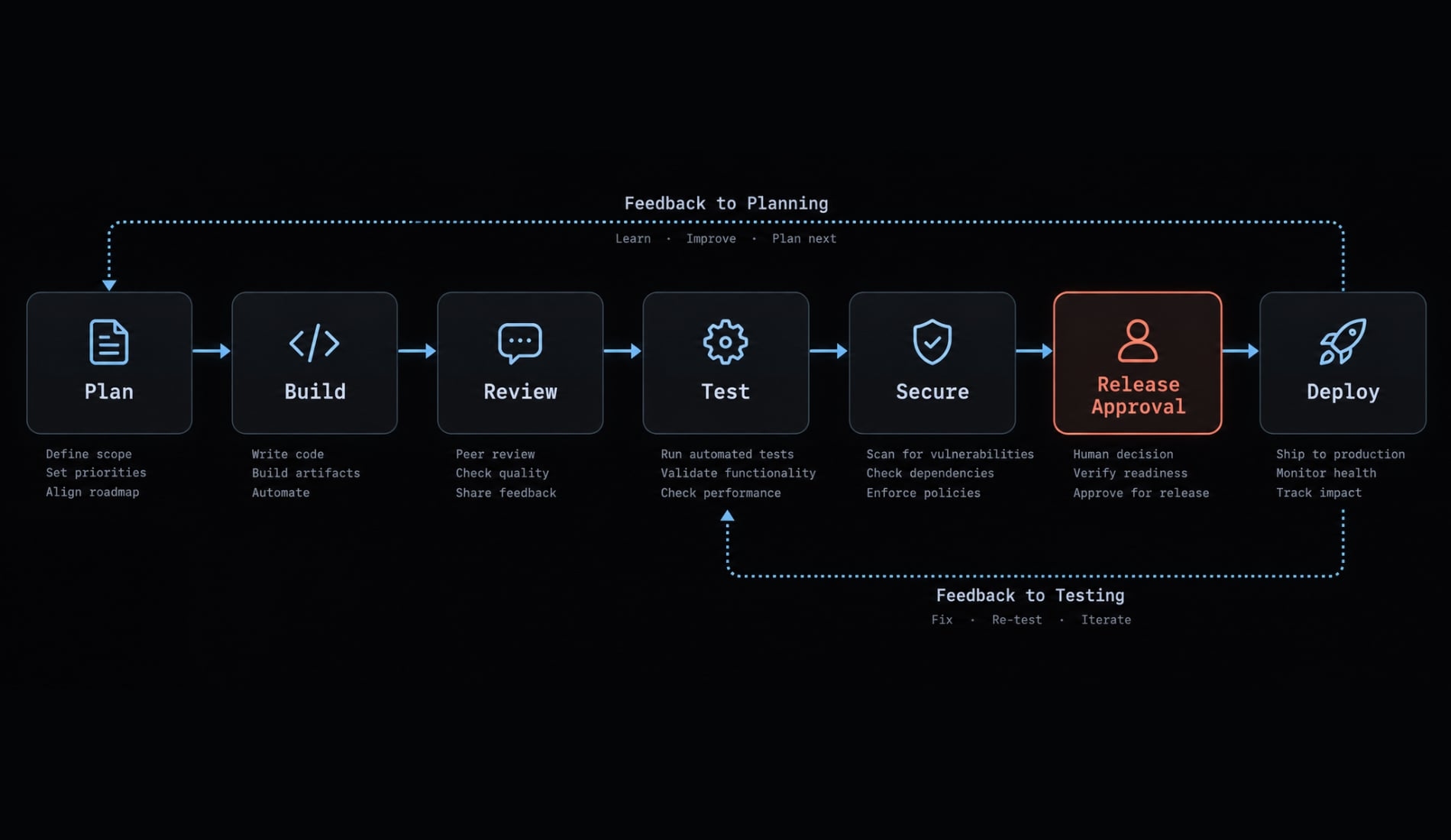
The build-to-ship workflow
- Plan: Define scope, data, acceptance criteria, and failure states.
- Build: Implement only the required flow.
- Review: Inspect changes, dependencies, and data access.
- Test: Check critical paths, failures, integrations, and regressions.
- Secure: Verify private credentials and access boundaries.
- Deploy and observe: Approve release, monitor behavior, and preserve recovery options.
Security belongs throughout development; step five is a release check, not its starting point. Keep evidence of checks alongside the release decision.
Where AgentKit Fits
AgentKit Engineer supports coordinated AI development through specialized subagents, reusable skills, and workflows spanning planning, implementation, testing, review, and deployment. Its pre-tool hooks can prompt for approval before sensitive operations, and its review stage includes security scanning, but these checks support the process rather than establish security.
Any MCP servers you connect extend the agent's tool access, and their permissions still require explicit review. Humans remain responsible for approval and release decisions. Explore AgentKit when repeatable coordination is the bottleneck, not as a substitute for engineering judgment.
Frequently asked questions
What is a "vibe code waitlist"?
A "vibe code waitlist" refers to two things: an early-access sign-up for an AI-research platform or product branded around "vibe coding," or a waitlist landing page created using AI coding tools. These pages are built by giving natural-language prompts to AI agents to generate code quickly.
Why do founders use AI to build waitlists?
Founders use AI-assisted tools to rapidly iterate on landing pages and capture initial user interest. This approach allows them to test value propositions and audience resonance with minimal technical overhead, helping them gather early signals of demand before investing in full-scale product development.
What are the main security risks of AI-generated waitlists?
The primary risk is a lack of backend authorization. AI may generate code that works visually but fails to secure data. For example, submission endpoints sometimes leak the entire database of captured emails to the browser's network tab, exposing sensitive user information to anyone inspecting the page.
Is sign-up volume on a waitlist proof of product-market fit?
No. Registration volume is only an early signal of interest or marketing effectiveness. Real demand validation requires analyzing the quality of the audience, interview participation, and whether users follow through to activate the product once access is granted.
How can I verify my waitlist is ready for public launch?
Before sending traffic, perform a pre-deployment review: verify that database permissions (like Row-Level Security) are active, ensure submission responses return minimal data (not the full record), test for unauthorized access, and check that no sensitive API keys are exposed in frontend code.
Does "vibe coding" mean I don't need to understand the code?
While you can build features without writing code manually, you must still understand your application's data flow. Understanding where data enters, how it is stored, and what your application returns is essential for shipping a secure, reliable product that you can debug if things break.
When should I move from simple AI prompting to a structured workflow?
You should transition to a more structured development process when your project involves personal data, payments, multiple complex integrations, or public traffic. A repeatable workflow—including planning, code review, testing, and security checks—is necessary once your application handles business-critical operations or real user information.
Read more:
- Vibe Coding technical debt: Risks and pevention guardrails
- Vibe coding a customer portal: Process, tools and checklist
- Vibe code directory: Set up your AI coding workspace guide
Conclusion
A vibe-coded waitlist can help test positioning and recruit early users without building the entire product. Its value comes from useful learning, not the number of generated files or registrations. A functioning form establishes neither safe data handling nor durable demand.
Before promoting it, verify permissions, private credentials, integration failures, monitoring, and recovery. Keep the review proportionate to the information collected and the consequences of failure. Resolve important unknowns rather than interpreting an unchecked box as a minor detail.
Apply the launch-readiness checklist first, then evaluate audience fit and follow-through. If repeated changes require clearer coordination, explore AgentKit’s AI development workflow while keeping human approval central to every release decision.