Is vibe coding the future of programming? Trends and insights
Is vibe coding the future of programming?
Is vibe coding the future of programming? It is likely to become an important part of it, but not a replacement for software engineering. Natural-language development can accelerate prototypes, routine implementation, internal tools, and product experiments. However, serious systems still require architecture, testing, security review, ownership, and maintenance. This article explains the practice, its future impact, benefits, risks, suitable use cases, and the role coding agents may play in moving prototypes toward production.
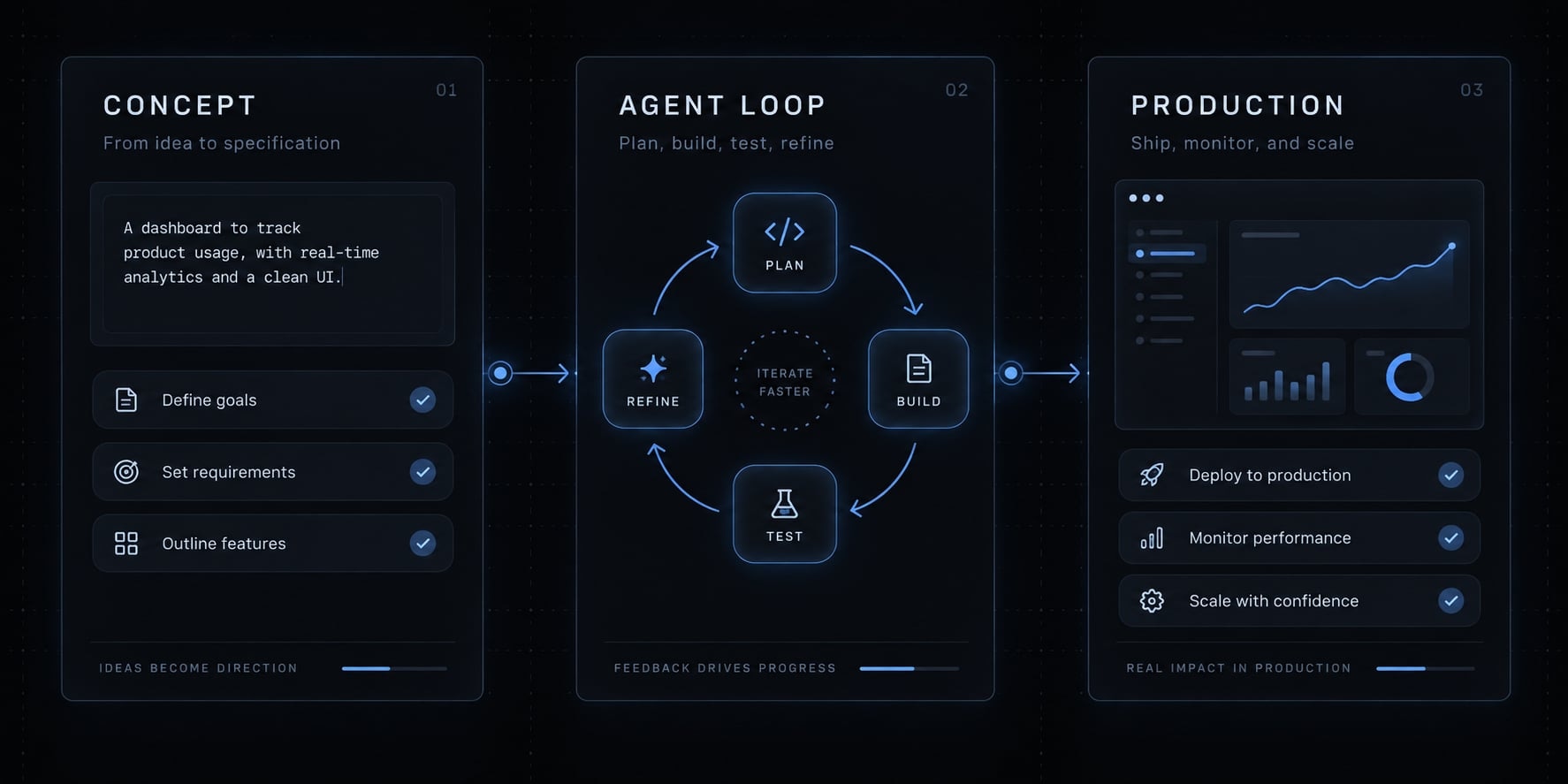
Direct answer: Vibe coding is part of programming’s future because it makes software creation faster and more accessible. Pure, unreviewed vibe coding is unlikely to become the standard for production systems. The more durable model combines human direction, AI execution, and systematic verification.
What is vibe coding?
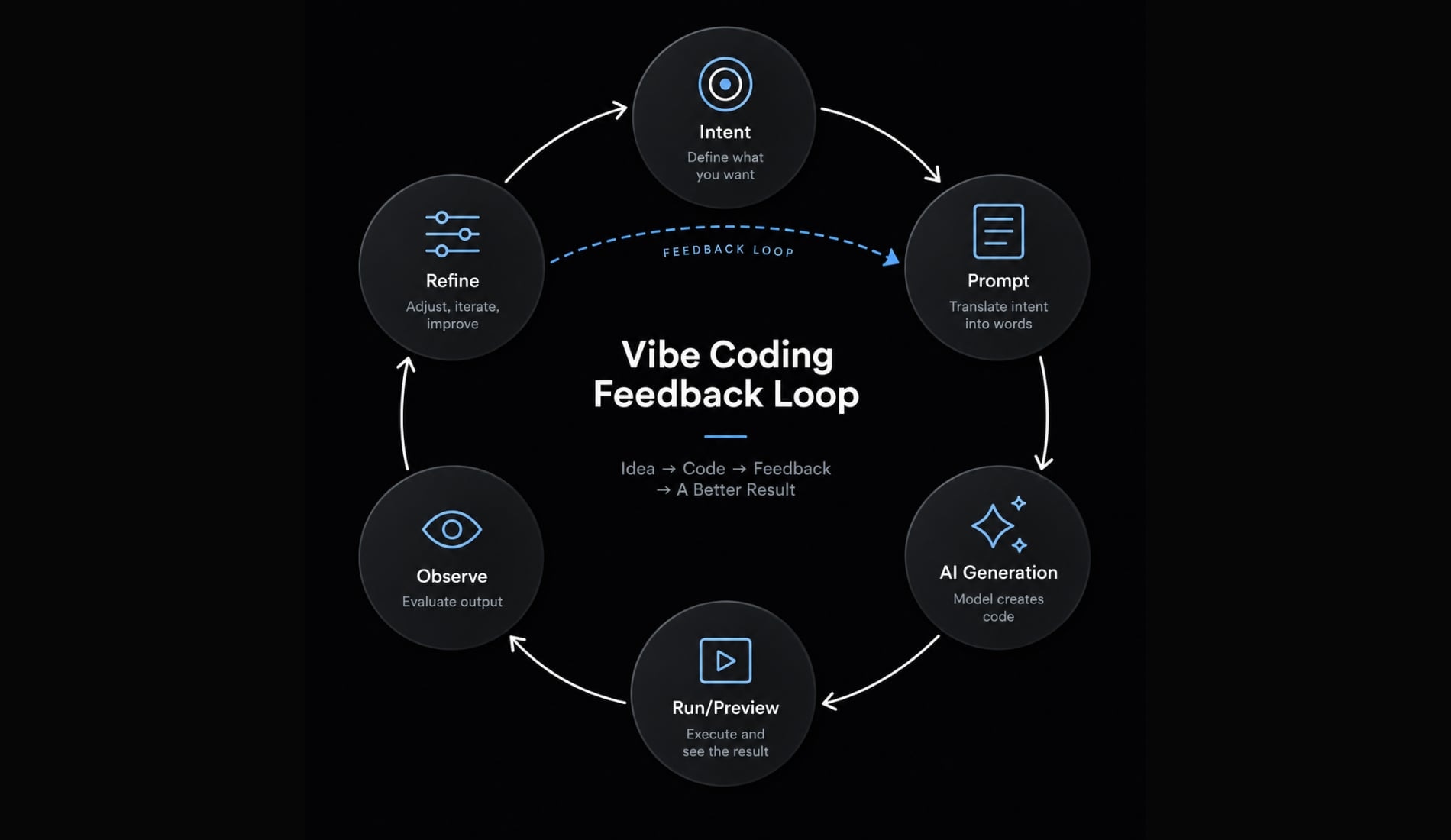
Vibe coding is a software development practice in which users describe intended behavior through natural-language prompts, ask an AI system to generate or modify code, and improve the result through iterative refinement. The user focuses primarily on visible behavior and feedback rather than manually writing and inspecting every line.
AI researcher Andrej Karpathy popularized the term in February 2025. His original framing described a highly conversational workflow in which the developer accepts AI-generated changes, runs the software, returns errors, and continues prompting until the application works well enough for the immediate goal.
That original meaning matters. Using artificial intelligence during development does not automatically qualify as pure vibe coding. A developer who reviews every generated change, writes independent tests, and understands the resulting system is practicing AI-assisted development, not simply coding “on vibes.”
How the vibe coding loop works
- Describe the intended application, feature, or behavior.
- Ask an AI coding assistant or agent to generate or modify code.
- Run the output in a local, sandbox, or preview environment.
- Observe errors, missing requirements, or unexpected behavior.
- Return logs, screenshots, errors, or change requests to the AI.
- Repeat until the result appears to satisfy the immediate goal.
Vibe coding is not the same as all AI-assisted coding
- Pure vibe coding: Fast, conversational development with limited inspection of generated code.
- Responsible AI-assisted development: AI generates changes, while developers review, test, understand, and own the result.
- Agentic engineering: Coding agents work through documented plans, persistent context, approved tools, automated checks, and human approval gates.
- Low-code/no-code development: Users assemble software through visual interfaces and predefined components rather than open-ended code generation.
The dividing line is not whether AI participated. It is how much understanding, verification, and human accountability surrounds the output.
Is vibe coding really the future of programming?
Verdict: Vibe coding is likely to influence the future of programming, especially where speed and experimentation matter. Pure vibe coding is unlikely to become the production default for high-stakes systems. The more durable approach appears to be human-directed, AI-executed, and systematically verified development.
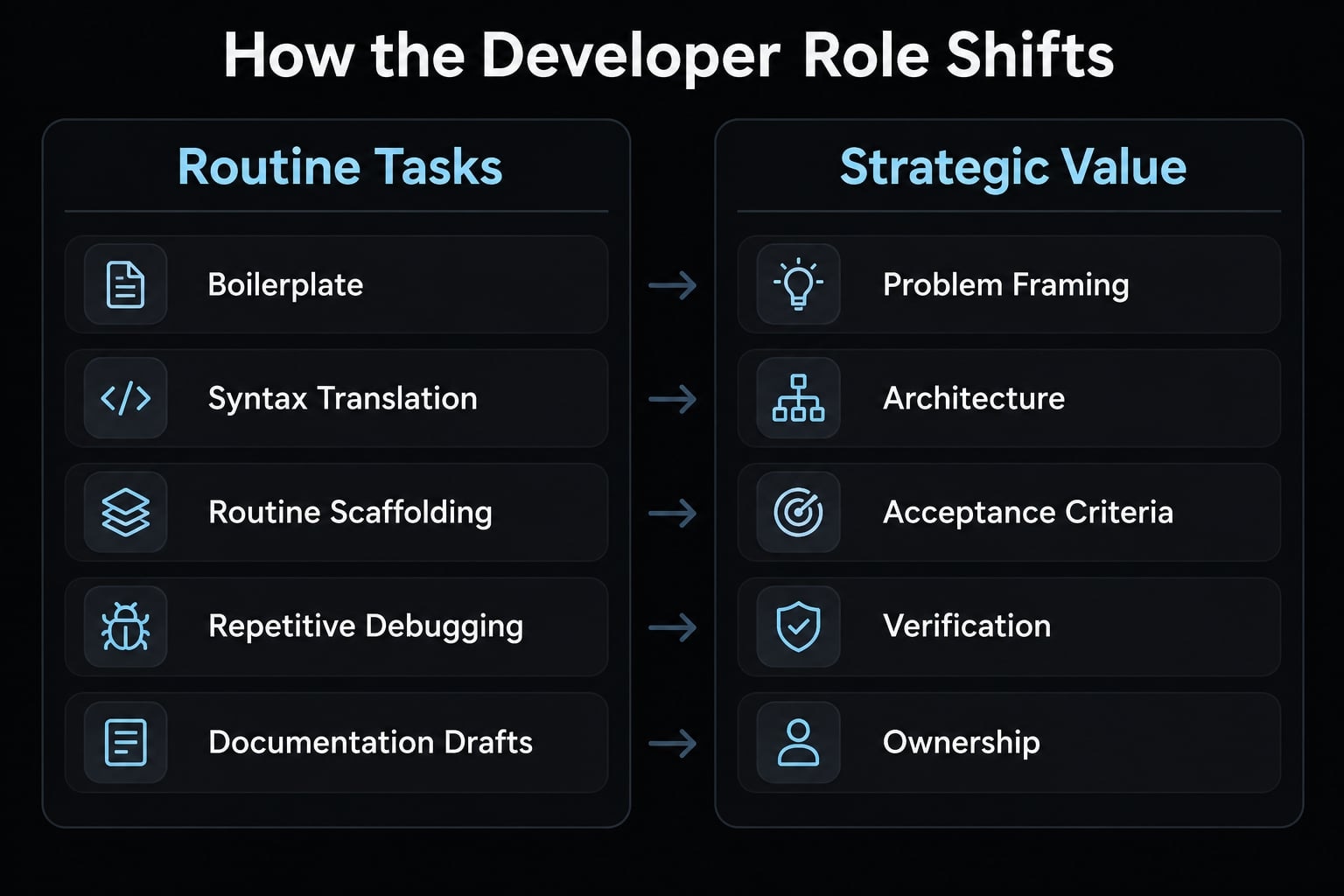
Natural language will increasingly become an interface for software creation. Developers may spend less time translating straightforward requirements into syntax and more time defining behavior, constraints, and acceptance criteria.
What vibe coding is likely to change
- Natural-language input will replace some syntax-first interaction.
- Prototypes will be produced and tested more quickly.
- Product experiments will become less expensive to initiate.
- Coding agents will handle broader, multi-step implementation tasks.
- Boilerplate, scaffolding, documentation drafts, and routine debugging will require less manual effort.
- Problem framing, system design, review, and verification will become more valuable skills.
Implementation may become cheaper, but sound judgment will not. When code is easier to produce, teams can explore more ideas. They must also reject more plausible-looking but poorly designed output.
What vibe coding will not eliminate
- Product judgment: Teams must still decide which problems deserve investment.
- Requirements definition: Ambiguous inputs usually create inconsistent behavior and expensive rework.
- Software architecture: Architecture determines whether a system can scale without disproportionate rebuilding.
- Code review: Generated changes can be plausible, functional, and still incorrect.
- Testing and quality assurance: Tests must validate business requirements, not merely repeat implementation assumptions.
- Security and privacy responsibility: Accountability remains with the organization operating the software.
- Monitoring and incident response: Someone must detect, diagnose, and address production failures.
- Maintenance ownership: Long-lived software needs an accountable team after the original AI conversation disappears.
- Conceptual knowledge: Users still need enough understanding to identify missing constraints and poor design choices.
Developer and practitioner Simon Willison makes a useful distinction: if someone ships code, they should be able to understand, explain, and maintain it, regardless of who-or what-typed it. His assessment of vibe coding supports a pragmatic conclusion: it is highly useful for exploration, but insufficient by itself for accountable production engineering.
Vibe coding vs. traditional and AI-assisted development
The comparison should not be reduced to “human code versus AI code.” Traditional development can also produce insecure or unmaintainable systems. The more useful comparison examines understanding, verification, ownership, and lifecycle cost.
Factor | Traditional coding | Pure vibe coding | Responsible AI-assisted development |
|---|---|---|---|
Code creation | Primarily written manually | Generated through conversation | Generated and edited by humans and AI |
Human understanding | Usually direct, but quality varies | May be limited | Expected for critical behavior |
Initial speed | Methodical and often slower | Usually fastest | Fast, with review overhead |
Requirements | Defined before or during implementation | Often discovered through prompting | Documented and refined with AI |
Review and testing | Depends on team discipline | Limited or informal | Normal engineering controls remain |
Human role | Architect and implementer | Director and visual evaluator | Owner, reviewer, and operator |
Reliability | Depends on engineering quality | Low assurance without verification | Higher assurance when controls are effective |
Best use | Long-lived or specialized systems | Experiments and disposable prototypes | Product features and production systems |
Primary risk | Slow delivery or human error | Hidden defects and weak ownership | Superficial review or overreliance on tools |
Suitability depends on project risk and lifecycle requirements.
Code generation is only one component of total software cost. Requirements, integration, testing, deployment, incident response, onboarding, upgrades, and maintenance often consume more effort than the first implementation.
A prototype may appear complete while hiding weak permissions, unsuitable dependencies, scalability constraints, or inconsistent architecture. These problems become visible when the application acquires users, sensitive data, team dependencies, or uptime expectations.
The decisive question is whether a responsible person or team can explain, test, operate, and maintain the result.
- Ownership: Who is accountable for important behavior and failure consequences?
- Verification: How is correctness tested independently of the generated implementation?
- Lifecycle: Can the codebase be maintained after its original AI conversation is unavailable?
AI can resemble a form of pair programming, but the analogy has limits. An AI system does not share human accountability, may produce plausible but incorrect output, and cannot own production consequences.
Responsible AI-assisted development preserves much of AI’s implementation speed while applying the same engineering controls expected for manually written code.
Why vibe coding matters and where it falls short
Vibe coding materially lowers the cost of experimentation. Its limitations become more serious when a project progresses from “Does this idea work?” to “Can this system safely support real operations?”
Main benefits of vibe coding
- Faster proof-of-concept development: Teams can test feasibility before funding a complete build.
- Lower entry barriers: Founders and domain experts can express product ideas without mastering every implementation detail.
- Economical personal utilities: Small scripts may become worthwhile even when manual development would cost too much time.
- Bespoke internal tools: Teams can address narrow workflow gaps when users, data sensitivity, and failure consequences remain limited.
- Reduced boilerplate: AI can handle repetitive structure, syntax lookup, and common integration patterns.
- Faster interface exploration: Multiple layouts and workflows can be evaluated before committing to a design.
- More product discovery: Teams can learn from working prototypes before making substantial engineering investments.
This is a qualified democratization of software creation. More people can participate in implementation, but that does not give every user the expertise required to operate production software safely.
Main limitations and risks
Technical Issue | Business Impact |
|---|---|
Incorrect behavior that passes basic testing | Users or teams act on wrong output |
Weak authentication or authorization | Data exposure or account misuse |
Poor dependency choices | Vulnerabilities, licensing issues, and upgrade problems |
Inconsistent architecture | Expensive rework as the product grows |
Generated tests mirror implementation assumptions | False confidence in incorrect requirements |
Context remains in chat history | Difficult onboarding, maintenance, and auditability |
Non-deterministic output behavior | Inconsistent results across sessions or tools |
Slop generation risk | More code volume without proportional product value |
These risks are not exclusive to AI-generated code. Human developers also introduce defects, weak dependencies, and technical debt. AI can increase the frequency or reduce the visibility of such problems when users accept outputs without sufficient scrutiny.
A visually complete application may still lack data controls, reliable error handling, monitoring, rollback procedures, or clear ownership.
Illustrative scenario: A prototype that outgrows its purpose
Illustrative scenario-not an AgentKit customer case.
- A founder generates a customer dashboard through conversational prompts.
- The prototype performs well in demos and validates initial demand.
- The team prepares to connect real customer accounts and operational data.
- Review identifies weak permissions, missing tests, incomplete error handling, and undocumented dependencies.
- Engineering work becomes necessary before deployment.
The prototype was still valuable because it reduced the cost of product validation. The mistake would be treating validation success as evidence of production readiness.
When vibe coding works and when it does not
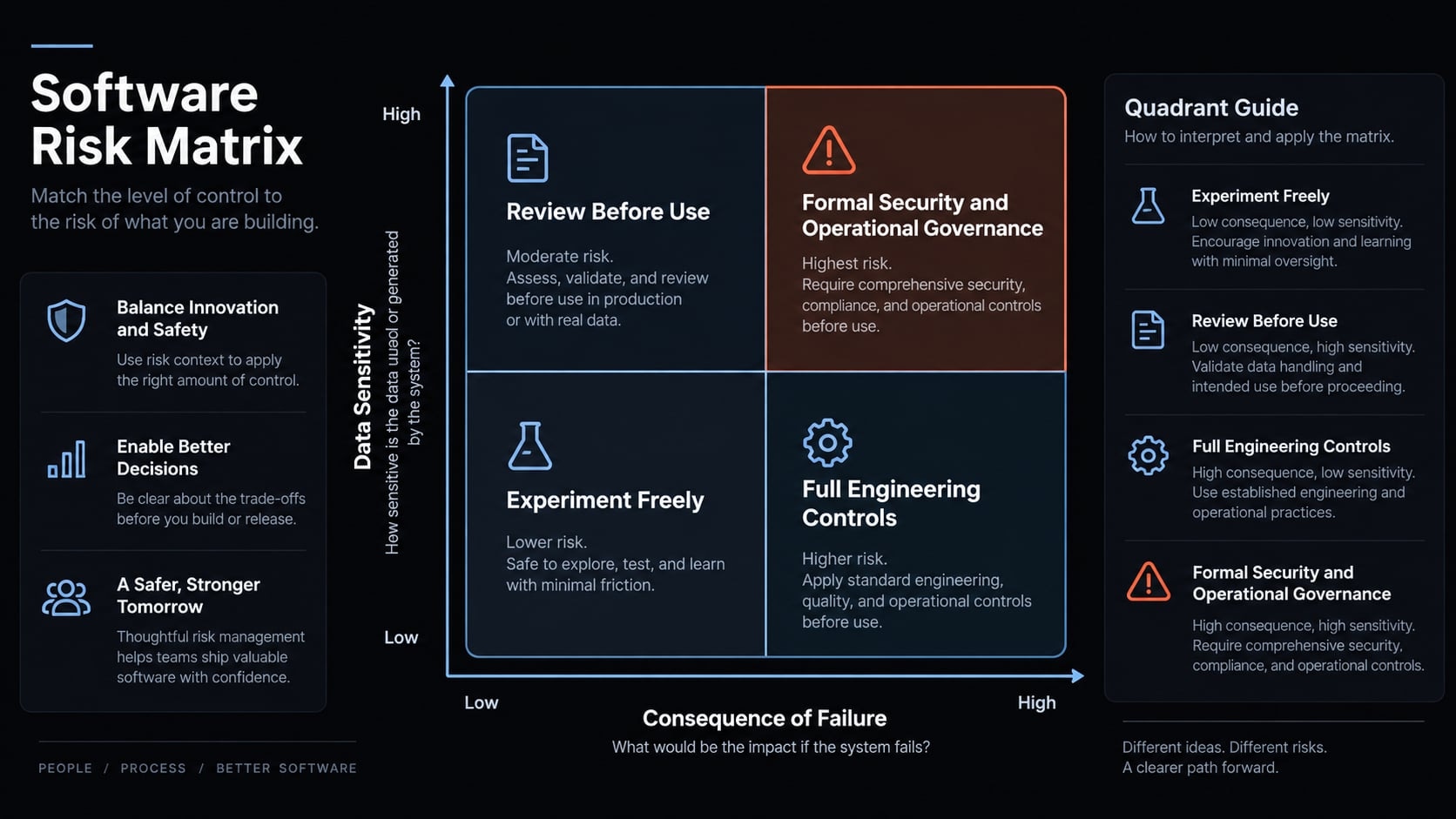
The higher the consequence of failure, the less appropriate pure vibe coding becomes. Project selection should consider four factors: Failure consequences, data sensitivity, system complexity, and expected maintenance lifespan.
Good uses for pure or lightly reviewed vibe coding
- Disposable prototypes
- Personal scripts
- UI mockups
- Early product validation
- One-off transformations of non-sensitive data
- Low-risk internal tools
- Educational experiments
- Small, manually verifiable automations
These uses are strongest when the project has no sensitive data, few users, limited operational dependency, easy rollback, and outputs that can be checked manually.
An internal tool is not automatically low risk. A payroll calculator, permissions dashboard, or customer-data utility may require stronger controls despite having few users.
Poor uses without professional engineering controls
- Authentication and authorization systems
- Payment or financial software
- Healthcare and safety-critical systems
- Applications handling sensitive customer or employee data
- Large shared codebases
- Core business infrastructure
- Regulated software
- High-availability public systems
- Systems where errors create significant financial or operational harm
AI-generated code may still be used in these domains, but not as unreviewed output. Professional engineering controls must govern requirements, architecture, security, testing, deployment, and operations.
Five questions before using vibe coding
- What happens if the software produces the wrong result?
- Does it process sensitive, regulated, or financially important data?
- Can someone review and explain the critical code paths?
- Will a team need to maintain or extend it?
- Are testing, monitoring, rollback, and ownership defined?
Low consequences and high reversibility support lighter controls. Sensitive data, long maintenance horizons, and costly failures require reviewed AI-assisted development or structured production engineering.
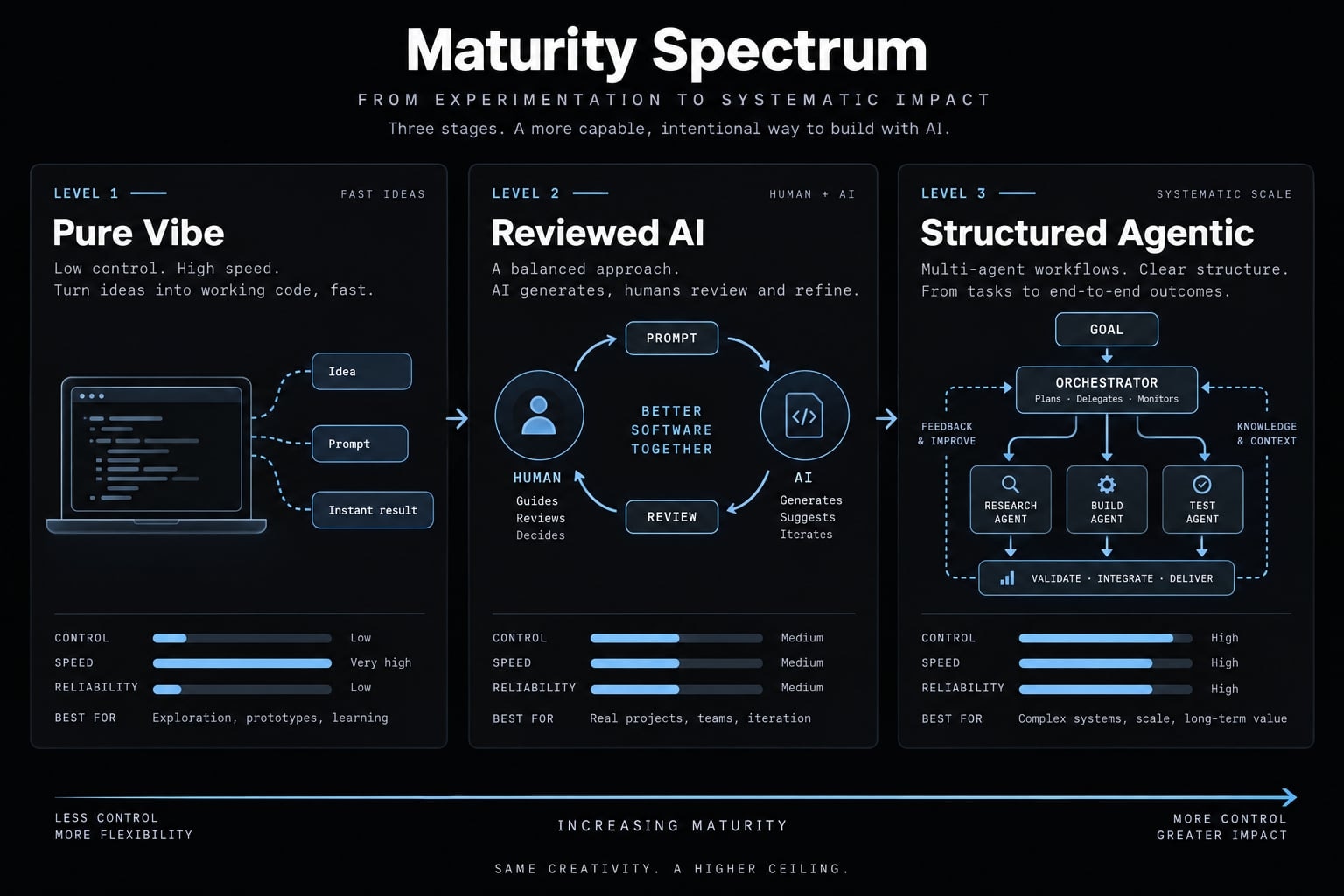
The three stages of AI-native development
Vibe coding is better understood as an entry point on a maturity spectrum, not the final form of AI-native development. As project consequences increase, automation should operate within more systematic controls-not less human responsibility.
Level | Development practice | Human control | Appropriate use |
|---|---|---|---|
Level 1: Pure vibe coding | Prompt, run, accept, and refine with limited review | Low | Experiments and disposable prototypes |
Level 2: Reviewed AI-assisted coding | AI generates changes that developers review and test | Medium to high | Product features and controlled applications |
Level 3: Structured agentic engineering | Specialized agents use plans, context, checks, and approval gates | High and systematic | Long-lived products and production systems |
Level 1: Pure vibe coding
Level 1 prioritizes speed, discovery, and immediate results. Requirements evolve through conversation, while code-level understanding and formal assurance may remain limited.
This is not inherently an inferior choice. It can be the most efficient method for a disposable experiment where failure has minimal consequences. Problems arise when a Level 1 prototype is deployed into a Level 2 or Level 3 risk environment without additional engineering work.
Level 2: Reviewed AI-assisted coding
At Level 2, AI acts as an implementation collaborator. Developers inspect generated changes, maintain code-level understanding, and apply normal testing and review practices.
This model suits bounded product features and controlled applications. However, merely approving a large AI-generated change does not establish reliability. Review quality depends on clear requirements, manageable change size, appropriate expertise, and independent verification.
Level 3: Structured agentic engineering
Agentic engineering is a structured practice in which specialized coding agents participate across the Software Development Lifecycle (SDLC)-planning, implementation, testing, debugging, review, database work, and deployment.
Agents receive persistent requirements, project context, defined tools, permissions, and standards. Automated checks run before high-impact actions, while humans approve plans and critical changes.
The objective is not maximum code generation. It is repeatable delivery with visible responsibilities and controls.
The Model Context Protocol (MCP) can provide a standardized way for AI applications or agents to access approved tools and data sources. MCP does not provide security automatically. Server trust, permissions, credentials, and human approval must still be configured appropriately, as reflected in the official MCP documentation.
From vibe coding to production-ready software
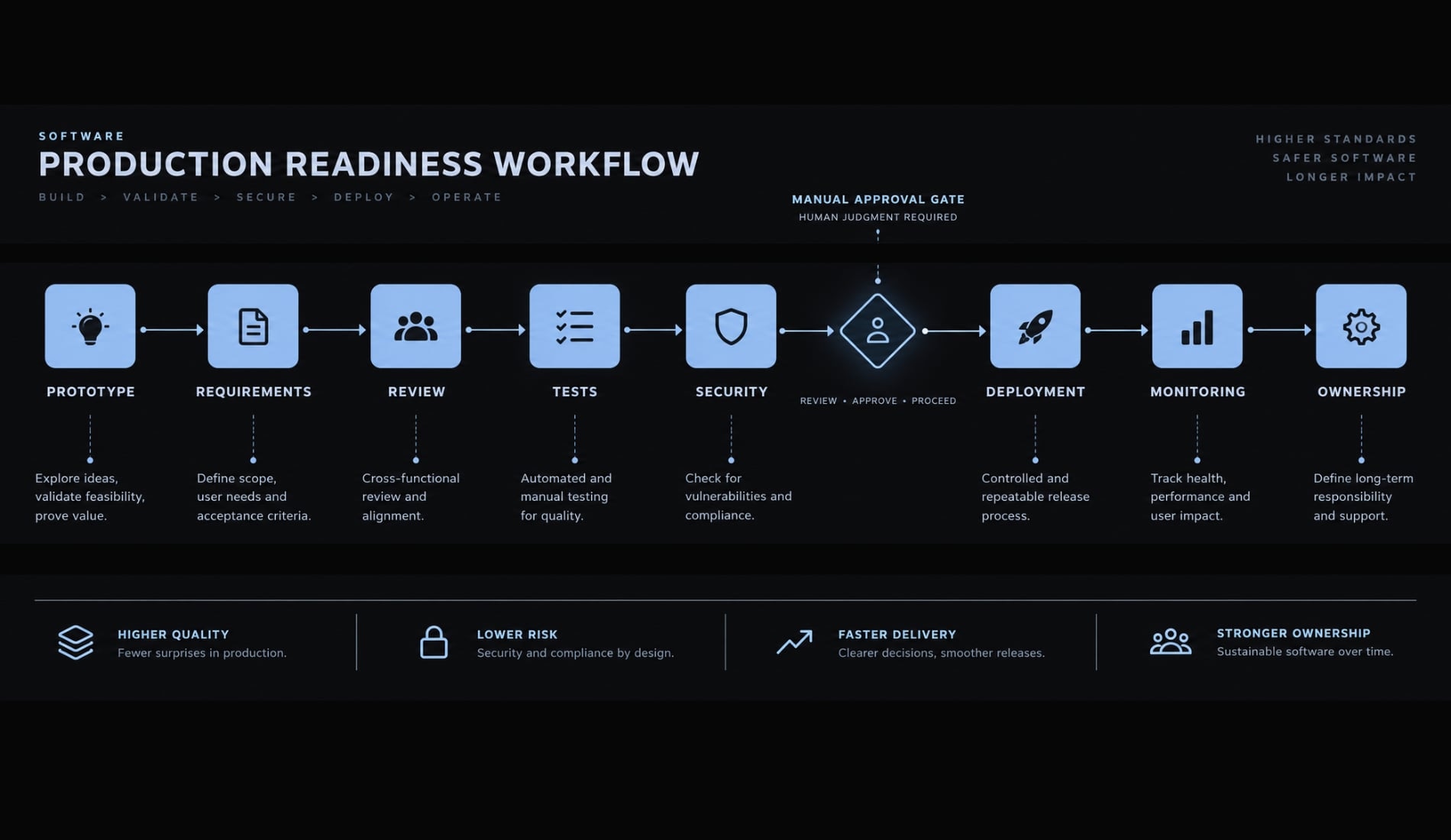
A demo proves that an idea can appear to work. Production readiness requires confidence that the system can be secured, operated, monitored, updated, and maintained under real conditions.
In practice, the first working version is often the easiest part. The gap becomes visible when a prototype encounters real users, sensitive data, third-party integrations, team collaboration, or service-level expectations.
Prototype-to-production checklist
- Document requirements and acceptance criteria. Define expected behavior, prohibited behavior, edge cases, and measurable completion conditions outside the AI conversation.
- Assign a human owner. Ensure someone understands critical workflows, dependencies, and failure modes.
- Review generated changes. Inspect architecture, data flows, dependencies, and critical code paths rather than approving output solely because it runs.
- Test business-critical behavior independently. Use automated testing alongside manual or scenario-based validation. Review generated tests against requirements, not only the implementation.
- Check security-sensitive components. Assess authentication, authorization, secrets, permissions, dependencies, and relevant licensing obligations.
- Configure operational controls. Establish logging, monitoring, incident response, deployment approval, and rollback procedures.
- Document the system outside the conversation. Record architecture, decisions, dependencies, configuration, and operating instructions in version-controlled artifacts.
- Assign long-term maintenance ownership. Define who handles upgrades, vulnerabilities, incidents, data changes, and future development.
Why prompting alone does not scale
Prompting problem | Structured response |
|---|---|
Instructions vary across users | Reusable project instructions and skills |
Context is lost between sessions | Persistent project context and plans |
Agents receive excessive access | Defined tools and permissions |
Quality depends on manual memory | Automated tests and review workflows |
Responsibilities overlap | Specialized agents for implementation, testing, review, and deployment |
High-impact actions happen too easily | Human approval gates |
Conversation history is not a substitute for requirements, version-controlled documentation, test artifacts, review records, or operational ownership. Context must remain accessible after a model changes, a session ends, or another developer joins the project.
The future is not coding without engineers
The vibe coding future of programming is not a world where software engineering disappears. Vibe coding improves experimentation, implementation speed, and access to software creation. It does not eliminate architecture, security, testing, operations, or maintenance. The appropriate level of control depends on data sensitivity, failure consequences, system complexity, and expected lifespan.
Teams can begin with informal prompting, move to reviewed AI-assisted development, and adopt structured agentic engineering as operational risk increases.
Explore AgentKit Engineer to coordinate coding agents, reusable skills, tests, review workflows, security checks, and human approvals when moving toward production-ready software. The durable future is human-directed, AI-executed, and systematically verified software development.
Frequently asked questions
What is vibe coding?
Vibe coding is a software development practice where users leverage natural language prompts to guide AI models in generating, refining, and debugging code. Rather than writing syntax line-by-line, developers focus on high-level goals, relying on iterative conversational feedback to build applications quickly.
Is vibe coding the future of programming?
Vibe coding represents the future of programming for prototyping and routine tasks, but it is not a complete replacement for software engineering. The durable model involves human-directed, AI-executed development that remains subject to systematic verification, security reviews, and human accountability for production systems.
How does vibe coding differ from traditional programming?
Traditional programming requires manual syntax construction and deep technical training. In contrast, vibe coding prioritizes natural-language instructions and iterative refinement. While vibe coding excels at speed and accessibility, traditional development offers more granular control over system architecture, long-term maintainability, and security-critical infrastructure.
What are the main risks of vibe coding?
The primary risks include the generation of insecure or buggy code, lack of test coverage, and poor maintainability. Because AI can produce plausible but incorrect output, unreviewed code often contains hidden vulnerabilities (such as OWASP top-ten flaws) and technical debt that can be expensive to remediate later.
How can I make AI-generated prototypes production-ready?
Transitioning to production requires a structured workflow: review all generated code, implement independent testing, perform security assessments, define clear ownership, and ensure the system includes monitoring, logging, and rollback capabilities. A prototype is only production-ready once these engineering controls are integrated outside the AI conversation.
What is agentic engineering?
Agentic engineering is a structured evolution of vibe coding where developers orchestrate specialized AI agents within a governance framework. Instead of simple prompting, agents operate using persistent context, defined project plans, reusable skills, and automated approval gates to ensure repeatable and verifiable software delivery.
When should you avoid using vibe coding?
You should avoid pure vibe coding for systems where failure has significant consequences, such as financial or payment software, healthcare applications, or infrastructure handling sensitive data. These high-stakes environments require professional engineering controls, architectural oversight, and rigorous compliance standards that conversational prompting cannot guarantee.
Read more:
- 7 practical vibe coding examples: Build apps faster with AI
- Is vibe coding bad? Pros, cons and responsible AI practices
- Vibe coding vs traditional coding: Which approach wins?
Conclusion
In conclusion, while vibe coding makes rapid prototyping and software creation more accessible than ever, it will complement rather than replace professional software engineering. The future of programming lies in combining human leadership, AI execution, and systematic verification-ensuring that rapid natural-language development is matched with robust architecture, security, and long-term accountability.