Agentic coding vs vibe coding: A practical guide for developers
Agentic coding vs vibe coding: What actually changes in real development work
While both "vibe coding" and "agentic coding" generate functional software fast, they leave drastically different review burdens in their wake. Choosing between them isn't about AI trends-it's about balancing raw speed against long-term code quality. This guide breaks down what sets them apart, where each breaks down, and how to pick the right strategy for your team.
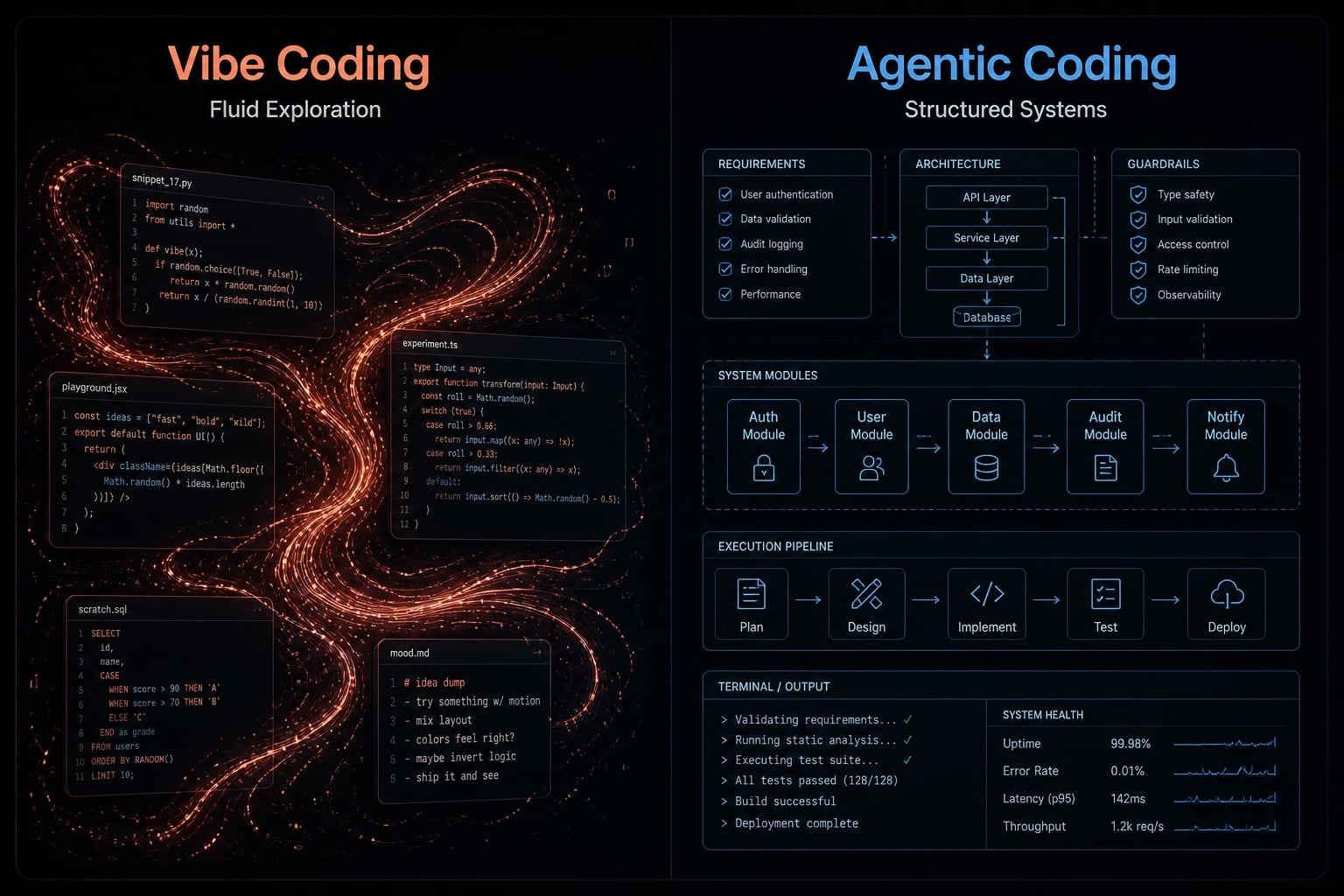
What is vibe coding?
Vibe coding is a prompt-first, conversational way of building software where a human guides an AI through rapid iterations-usually by describing what to build, running the generated code, and adjusting prompts until it works. It is a working style focused on momentum and exploration, not a formal engineering methodology.
Define vibe coding in one sentence
Vibe coding is a fast, conversational approach to software creation where you describe the outcome you want, let AI generate code, test the result, and keep iterating until the feature or prototype behaves as expected.
If you are asking what is vibe coding, the simplest answer is this: It is prompt-based development with a loose, fast feedback loop. The goal is usually not perfect structure on the first pass. The goal is to get from idea to visible output quickly.
The term spread because it names a real behavior many developers already recognized. You open a chat or coding assistant, describe a feature, run the output, fix what breaks, and keep moving. In practice, vibe coding works especially well for experiments, mockups, and short-lived builds.
Typical workflow
At its core, the loop looks like this:
- Prompt the AI.
- Generate code.
- Run it.
- Tweak it.
- Repeat quickly.
The shorthand version is: Prompt → generate → run → tweak.
This is still a human-in-the-loop (a workflow where a person remains involved in decisions and corrections) process, even if the structure is loose. The human is guiding the conversation, validating outputs, and deciding whether the result is “good enough” for the immediate goal.
Tools and examples
You can vibe code in many environments:
- Chat-based coding assistants.
- IDE copilots with inline prompts.
- Browser-based AI tools.
- Lightweight code-generation interfaces.
The tool matters less than the behavior. The same environment can support AI-assisted prototyping, conversational programming, or a more disciplined workflow depending on how you use it.
That is also why vibe coding should not be dismissed as automatically low quality. For a fast internal tool, a one-off script, or a feature mockup that may be rewritten later, it can be an efficient way to learn, test, and move.
What is agentic coding?
Agentic coding is a goal-driven software workflow where AI handles a larger share of execution-such as planning tasks, editing files, generating tests, and preparing changes-while the human still defines constraints, reviews outputs, and retains responsibility for correctness, maintainability, and final approval.
Goal-oriented workflow instead of line-by-line prompting
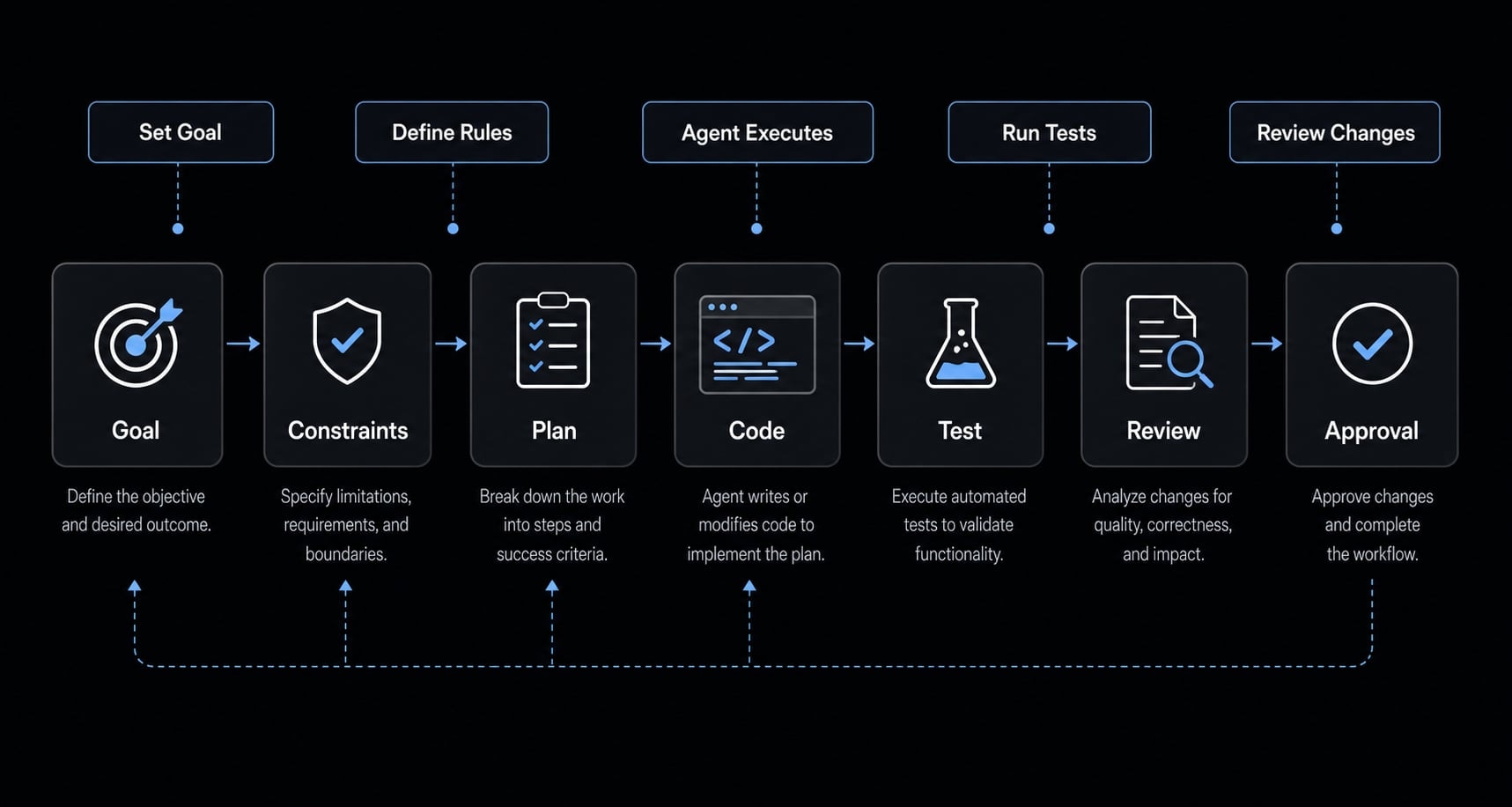
The key shift in agentic coding is delegation. Instead of prompting line by line, you give the system a bounded goal, clear constraints, and an expected outcome. The workflow is closer to: Define the task, specify rules, let the agent execute multiple steps, then review what it produced.
That makes agentic coding different from simple chat-based generation. The difference is not just that more code gets produced. The difference is that execution becomes a structured sequence rather than a constant back-and-forth prompt loop.
A typical pattern looks like this:
- Set a goal.
- Define constraints.
- Let the system plan steps.
- Generate or modify code.
- Run checks or tests.
- Review and approve changes.
This is an autonomous agent workflow (a process where the AI can execute multiple connected steps toward a goal), but “autonomous” should not be confused with “hands-off.” Agentic coding does not mean no-review execution.
Human ownership still matters
In strong agentic engineering (using AI agents inside disciplined engineering processes), humans still own the important decisions:
- Humans define architecture.
- Humans set constraints and acceptance criteria.
- Humans review outputs.
- Humans retain accountability.
This is where code ownership (clear human responsibility for understanding and maintaining code) becomes critical. The agent can accelerate implementation, but it should not become the final authority on correctness, design trade-offs, or long-term maintainability.
Structured systems and guardrails
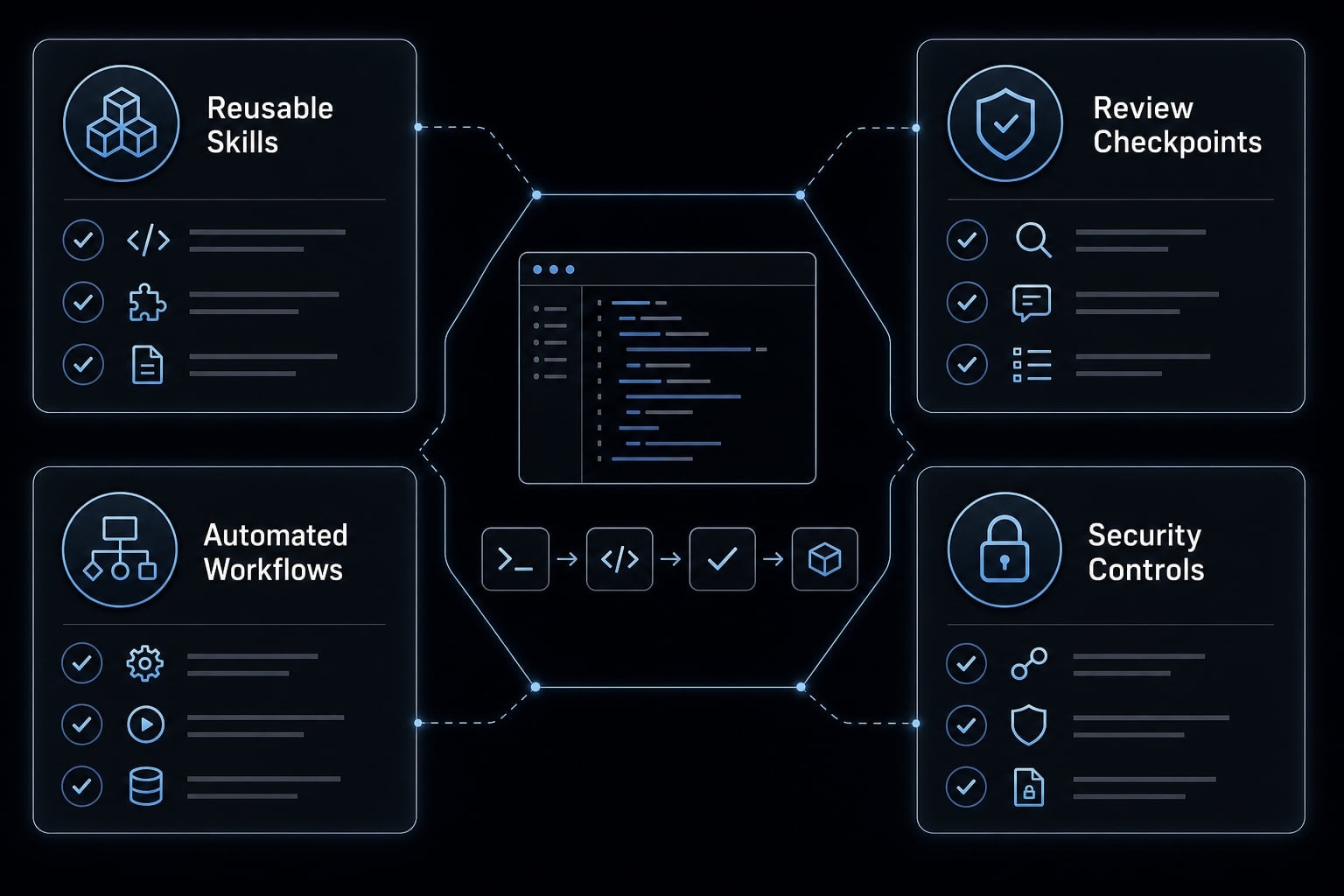
Where AI coding agents become more useful is inside structured setups with repeatable rules. Reusable skills, guardrails, and review checkpoints reduce randomness and help teams get more consistent results.
That is the practical difference between experimenting with AI and operationalizing it. The more repeatable the workflow, the safer agentic coding becomes for ongoing software work.
Agentic coding vs vibe coding: The core differences
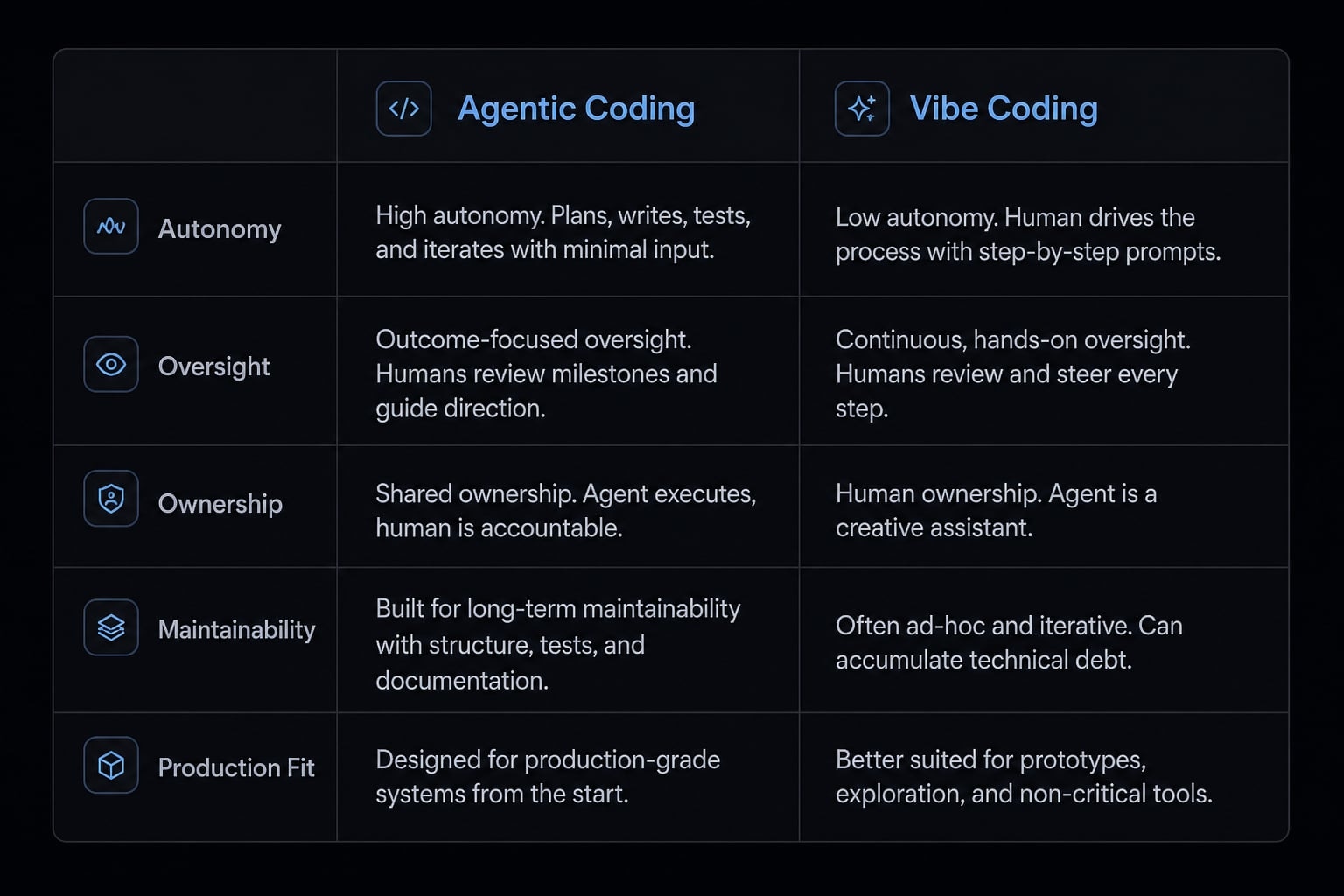
The difference between agentic coding and vibe coding is mainly about workflow design. Vibe coding favors fast conversational iteration and immediate output. Agentic coding favors bounded delegation, structured execution, and stronger review checkpoints. Neither is always better. The right choice depends on how much control, repeatability, and maintenance your project actually needs.
Side-by-side explanation before the table
When comparing these two approaches, teams often focus too much on tool branding. That misses the point. The more useful lens is how work gets organized: Who makes implementation decisions, how changes are reviewed, and whether the output can survive growth, debugging, and handoff.
Criteria | Vibe coding | Agentic coding | Practical takeaway |
|---|---|---|---|
Primary mode | Conversational, prompt-first iteration. | Goal-driven, multi-step execution. | One optimizes flow; the other optimizes structured delegation. |
Human role | Active prompter and quick tester. | Supervisor, reviewer, decision-maker. | Human effort shifts from prompting to oversight. |
Autonomy level | Low to moderate. | Moderate to high within constraints. | Autonomy level matters only if review remains strong. |
Speed to first output | Usually very fast. | Fast, but depends on setup and constraints. | Vibe coding often wins early speed. |
Code ownership | Can become blurry if changes are accepted casually. | Usually clearer because review is expected. | Code ownership is a major dividing line. |
Best use case | Mockups, scripts, early feature exploration. | Tests, refactors, upgrades, routine engineering tasks. | Choose based on task shape, not hype. |
Maintainability | Can drop quickly across many iterations. | Usually stronger with guardrails. | Long-term cost often appears later, not on day one. |
Risk profile | Low risk if rewrites are cheap. | Better for higher-stakes tasks with review gates. | Risk depends on failure cost, not AI alone. |
Review style | Ad hoc checks during iteration. | Structured code review workflow. | Formal review becomes more important as systems grow. |
Production fit | Limited unless tightly controlled. | Stronger production readiness. | Production use requires discipline in both models. |
The 3 differences that matter most
- Who makes implementation decisions: In vibe coding, decisions often emerge through rapid prompting. In agentic coding, decisions are more bounded by goals, constraints, and review expectations.
- How errors are discovered: Vibe coding often catches issues through live trial and error. Agentic coding relies more on a structured code review workflow, test steps, and explicit acceptance criteria.
- How work scales beyond one session: Vibe coding can feel efficient in a single burst. It starts to weaken when the codebase grows, more contributors join, or maintenance becomes unavoidable.
When vibe coding works best - and where it breaks down
While vibe coding has its place, it is generally not suitable for production software that requires long-term maintenance, stability, and team collaboration.
Use vibe coding when speed and exploration matter most
Vibe coding is strongest when the main goal is rapid prototyping and learning:
- MVP mockups.
- Internal tools with limited lifespan.
- One-off scripts.
- Landing page or feature experiments.
- Early product exploration where rewrites are acceptable.
For solo founders and indie makers, this is often enough. A fast prototype can validate demand before you invest in heavier engineering structure.
Why maintainability becomes the failure point
Where teams run into trouble is not usually the first output. It is what happens after the fifth or tenth iteration. Code generated through repeated prompt patching often becomes uneven. Naming drifts. Structure gets inconsistent. Context gets lost. Debugging takes longer because the logic was never designed as a coherent system.
This is how technical debt (future engineering cost created by fast but fragile implementation choices) starts to accumulate. At first, the velocity feels great. Later, the maintenance burden rises faster than expected. That is why maintainability is the real pressure point, not whether the first demo worked.
Do not rely on vibe coding alone when…
Use this checklist as a warning sign:
- The codebase is growing quickly.
- Multiple contributors are touching the same system.
- Handoff will be required.
- A bug would create meaningful business or operational cost.
- Repeated patch-fix cycles are already visible.
When those conditions appear, do not rely on vibe coding alone. That is usually the point where speed starts to hide risk.
When agentic coding makes more sense
The best agentic coding use cases are not abstract. They are the repeatable engineering tasks that consume time, follow patterns, and benefit from stronger structure.
Good use cases for agentic coding
For most small teams, agentic coding makes sense in areas like:
- Test generation and test scaffolding.
- Refactoring repetitive patterns.
- Framework upgrades and migrations.
- Documentation updates tied to code changes.
- CI preparation and routine maintenance.
These tasks are good candidates because the expected output is easier to describe, evaluate, and verify.
Why repetitive work is ideal for coding agents
Repetitive engineering work tends to have clearer rules. Pattern repetition makes output easier to evaluate. Bounded scope improves reliability. Clear constraints reduce ambiguity. As a result, review becomes faster and safer.
This is why AI-driven maintenance can deliver value without pretending the system understands your product strategy. The agent does not need to invent the roadmap. It needs to complete structured work under constraints.
That is also how teams get closer to production-ready code (code that can survive review, testing, deployment, and maintenance). Not because the AI is magical, but because the task is shaped in a way that supports disciplined execution.
Structured execution improves repeatability
The biggest gain is often repeatability, not raw novelty. A reusable setup means less prompt rebuilding, more consistent outputs, and a cleaner path to review. In practice, refactoring, test creation, and routine upgrade work are where many teams see the clearest return.
Which one should you use? A simple decision framework
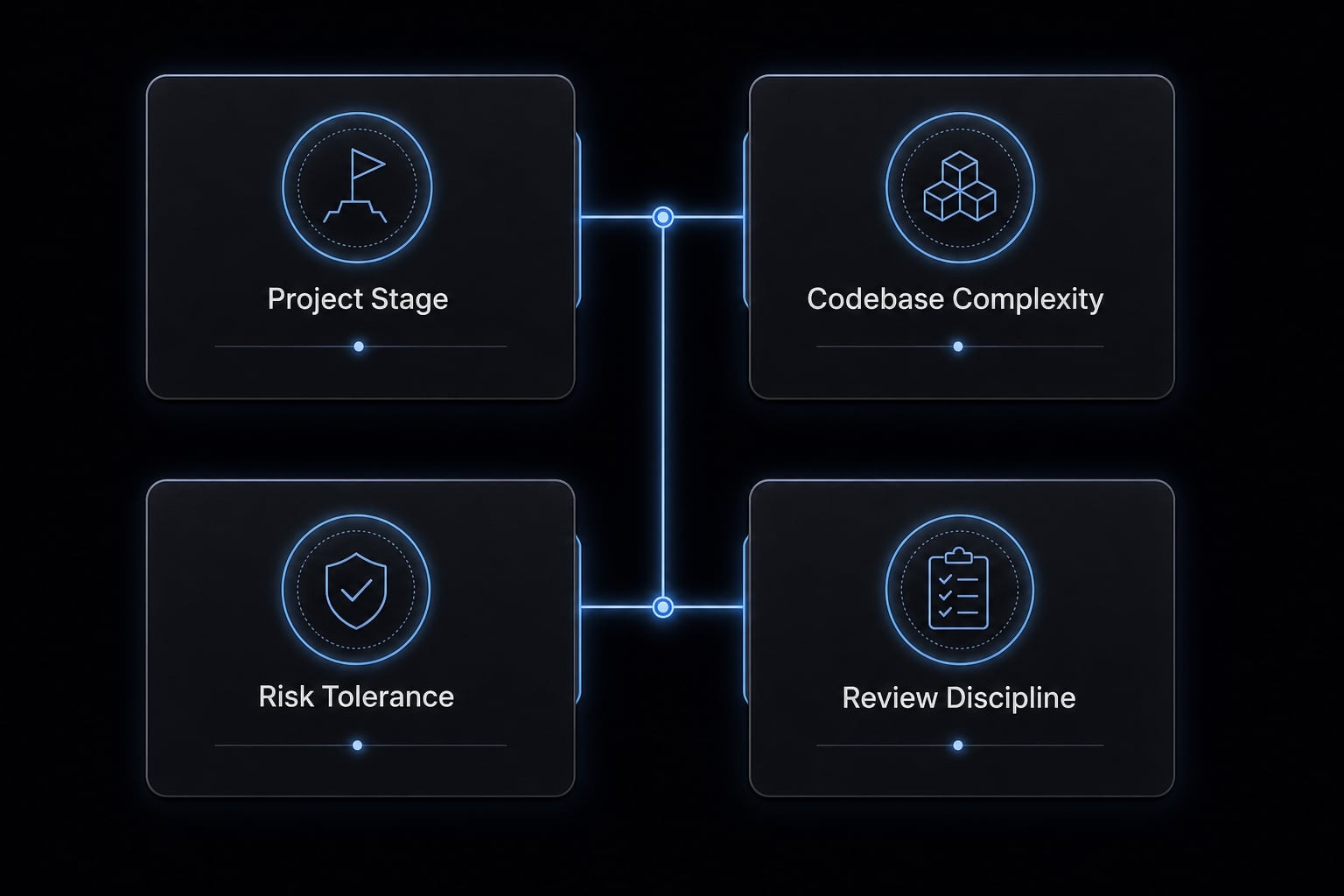
If you are asking which is better vibe coding or agentic coding, the honest answer is that neither is universally better. The right choice depends on your project stage, codebase shape, risk profile, and review discipline. For many teams, a hybrid workflow is the practical default. Use this four-part decision framework:
- Project stage - Are you in discovery mode or delivery mode?
- Codebase complexity - Is this a small isolated task or a growing system?
- Risk tolerance - Is failure cheap to rewrite or expensive to fix?
- Review discipline - Are checks informal or built into the workflow?
Use vibe coding when…
- Exploration matters most.
- Scope is small.
- Speed matters more than structure.
- Rewrites are acceptable.
This usually fits solo founders validating an idea, developers testing UI directions, or anyone building something disposable on purpose.
Use agentic coding when…
- The task is repeatable.
- Requirements are clear.
- Output must survive review and maintenance.
- More structured human oversight is needed.
This often fits experienced developers and small product teams working on upgrades, tests, maintenance, and tasks that touch shared systems.
Use a hybrid workflow when…
- Vibe coding is used for discovery.
- Agentic coding is used for hardening, tests, refactors, and docs.
- Your AI development workflow needs both speed and discipline.
For most capable teams, this hybrid model is the practical default. Use conversational iteration to find the shape of a feature. Then use a more structured system to clean it up, add tests, tighten review, and make it easier to maintain.
What structured agent workflows add beyond the hype
Ad hoc prompting works well for solo experimentation. It starts to break down when multiple people need consistency, shared conventions, and repeatable outcomes. That is where structured agent workflows become more useful than raw autonomy alone.
Why ad hoc prompting does not scale for teams
In practice, teams usually hit the same problems:
- Inconsistent outputs across contributors.
- Setup friction every time a task starts.
- Repeated prompt rebuilding.
- Too much variance in how work is executed.
Those issues create hidden overhead. The problem is not lack of AI capability. The problem is lack of operating structure.
Examples of useful guardrails
The most valuable guardrails are often simple:
- Reusable subagents.
- Reusable skills.
- Review checkpoints.
- Automated workflows.
- Token, config, and security management.
These controls matter because they improve repeatability. In other words, structured agent workflows are often less about maximum autonomy and more about safer agent orchestration (coordinating AI agents, skills, and steps inside a managed workflow).
Soft brand bridge
This is the gap systems like AgentKit are designed to address. Rather than treating Claude Code workflows, subagents, and automation as one-off experiments, they help package them into repeatable AI coding operations with controls around skills, plugins, plans, tokens, and security checks. For teams that want a developer-first structured AI workflow, that operational layer matters more than hype about “fully autonomous coding.”
Frequently asked questions
What is the difference between vibe coding and agentic coding?
The primary difference lies in workflow design and oversight. Vibe coding relies on iterative, line-by-line conversational prompting with minimal review, prioritizing speed and experimentation. Agentic coding uses goal-oriented, multi-step autonomous execution where the human retains ownership of architecture, testing, and final code quality review.
Is vibe coding suitable for production software?
Vibe coding is effective for rapid prototyping, internal tools, and one-off scripts where speed is the priority. However, it is generally unsuitable for complex production systems, as it often bypasses structured testing, documentation, and maintainability, leading to technical debt and difficult debugging over time.
Which is better: vibe coding or agentic coding?
Neither is universally better; the choice depends on your project stage and risk tolerance. Use vibe coding for exploration, discovery, and quick MVPs. Switch to agentic coding for repeatable engineering tasks, refactoring, test generation, and any work requiring consistent code quality and long-term maintainability.
What is a hybrid AI coding workflow?
A hybrid workflow combines the best of both approaches: using vibe coding to quickly explore new features or mock up interfaces, then transitioning to agentic coding to harden that work with unit tests, proper module structure, documentation, and rigorous review gates before merging into the main codebase.
Do I need to be an expert developer to use agentic coding tools?
While agentic coding automates tedious tasks like test scaffolding or refactoring, it is designed for developers who understand architectural constraints. Success requires setting clear goals, establishing acceptance criteria, and performing consistent code reviews—skills that are essential for maintaining professional, production-ready software.
How do structured agent workflows improve consistency?
Structured workflows replace ad hoc prompting with reusable skills, subagents, and pre-defined guardrails. By codifying best practices into the agent’s instructions and tool access, teams ensure that every autonomous task follows consistent security and quality standards, regardless of which developer initiates the request.
Read more:
- Is vibe coding bad? Pros, cons and responsible AI practices
- How to vibe code: A practical beginner guide to AI development
- Vibe coding jobs: How to land AI-assisted developer roles
Conclusion
Agentic coding vs vibe coding is ultimately a question of workflow fit, not ideology. Vibe coding is great for speed, experimentation, and low-friction building. Agentic coding is better for repeatability, control, and production-oriented support where review and maintenance matter.
The best choice depends on context. If the work is exploratory and disposable, vibe coding can be efficient. If the work is repeatable and needs to survive debugging, review, and handoff, agentic coding is usually the stronger model. For many teams, the smartest default is to use both with clear boundaries, then explore structured agent workflows that make those boundaries easier to maintain at scale.