Claude Code integration testing: A practical workflow guide
Claude Code integration testing: A practical workflow guide
The goal of integration testing isn't just generating a higher test count-it's proving your system works across real database and API boundaries. Claude Code assists with planning, execution, and failure diagnosis, while leaving critical risk decisions to human developers. This guide outlines a repeatable testing workflow complete with reusable prompts and verification gates to keep your releases safe.
Can Claude Code perform integration testing?
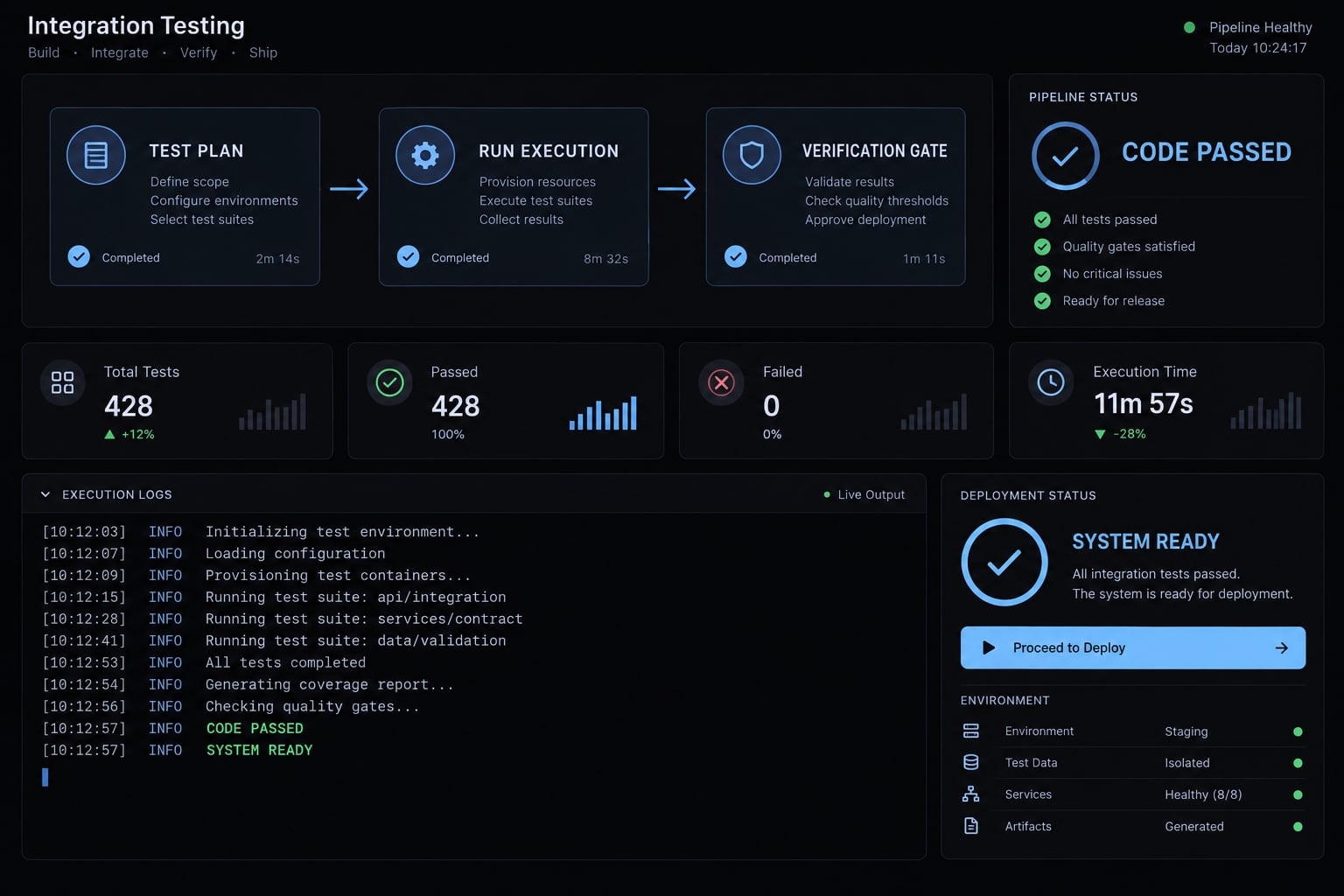
Yes. Claude Code can inspect repository code, write integration tests, invoke available test tools, and interpret their results. Execution depends on installed dependencies, configured permissions, and a usable environment. Human-reviewed requirements and independent acceptance remain necessary: generating tests, running them, verifying behavior, and approving a release are separate activities.
Anthropic’s Claude Code documentation describes file inspection, editing, and command execution capabilities. Claude Code is not itself a test runner; Claude Code test automation uses the repository’s available tools.
Unit vs. integration vs. End-to-end testing
Test type | What it validates | Typical Claude Code role | Main limitation |
|---|---|---|---|
Unit | Configuration validation logic | Write focused assertions | Does not prove database integration |
Integration | Workspace API persists configuration correctly | Exercise API and test database | Proves only exercised boundaries |
End-to-end testing | User saves configuration through the UI | Use configured browser tools | More setup and failure sources |
Integration tests may cover internal or external component boundaries. Classification depends on scope and what actually runs, not filenames. A mocked database cannot establish that real persistence works.
Choose the narrowest test that proves the required behavior. Broader coverage is useful only when it exercises additional requirements.
What Claude Code should not decide alone
Human approval is required for:
- Whether scenarios represent the actual requirement.
- Whether application-code changes are justified.
- Whether destructive test-environment operations are permissible.
- Whether residual failures are acceptable for release.
- Whether security-sensitive changes are ready for acceptance.
Agent self-verification supports review; it does not replace acceptance. Production access is prohibited throughout this workflow.
What Claude Code needs before it starts
Vague instructions invite incorrect assumptions about commands, fixtures, and dependencies. Resolve these eight readiness items before generating tests:
- Feature behavior and acceptance criteria.
- Relevant integration boundaries.
- Existing test framework and conventions.
- Approved commands.
- Local, containerized, or sandbox dependencies.
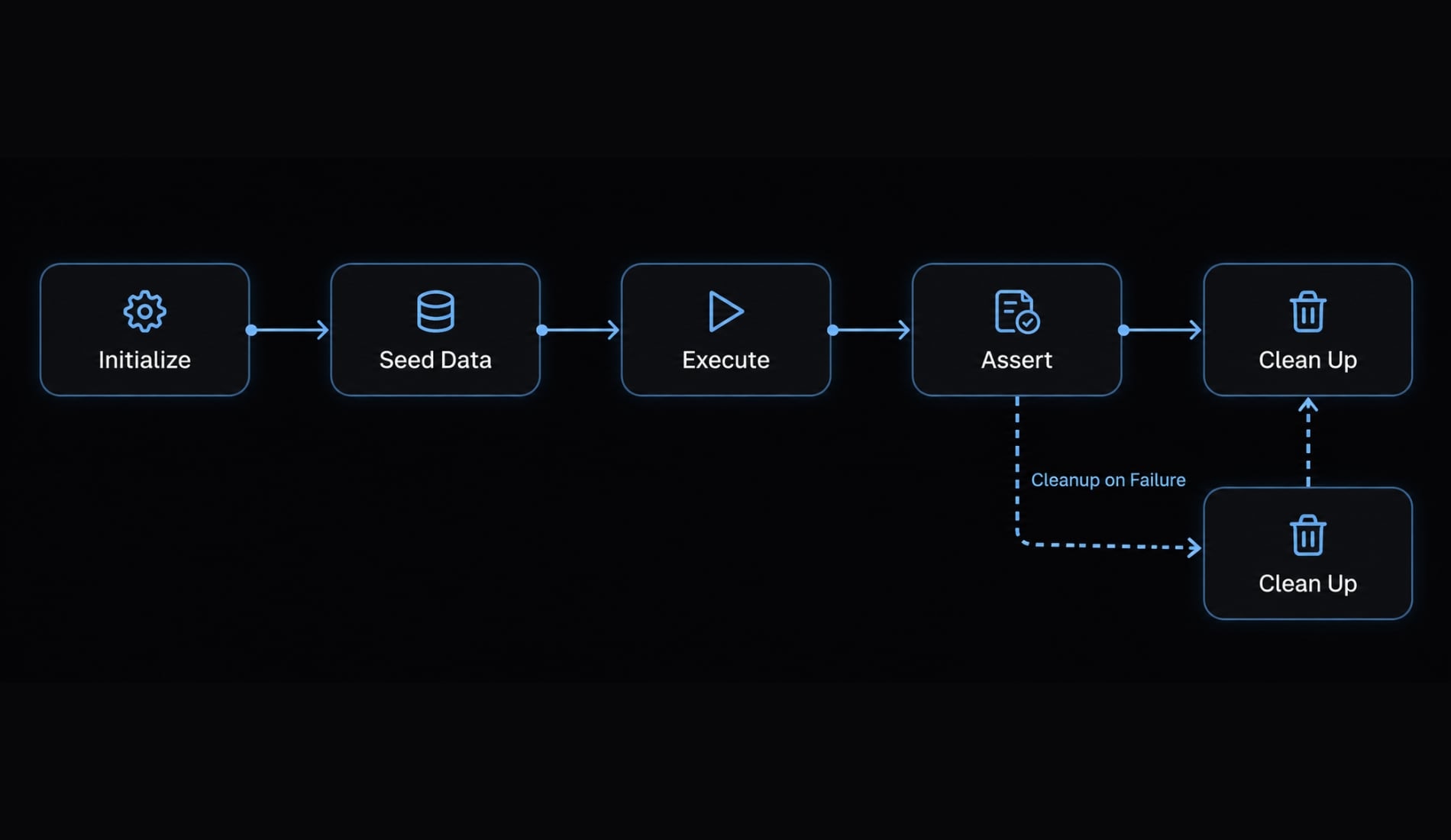
- Fixture setup and cleanup.
- Credential and environment restrictions.
- Definition of done and reporting requirements.
Repository and Architecture Context
Inspect source and test directories, API contracts, schemas, migration files, test-runner configuration, existing CI workflows, and applicable repository instructions.
For the illustrative workspace feature, paths might include src/routes/workspaces/, src/services/configuration/, db/migrations/, and tests/integration/. These are inspection examples, not verified repository paths.
Document assumptions before edits. Prefer existing test patterns over introducing another framework. Continuous integration (CI) automated checks, which run against repository changes, provide essential context for commands and environment differences.
CLAUDE.md supplies repository guidance. It does not automatically enforce every instruction. Applicable restrictions require configured permissions, infrastructure controls, hooks, and CI checks. Anthropic’s Claude Code documentation separates these mechanisms.
Test environment and dependency rules
A fixture is controlled data or setup used by a test. Test isolation means one test’s state cannot change another test’s result.
Area | Required rule |
|---|---|
Database setup | Disposable database; approved schema and migrations |
External services | Approved substitutes or verified nonbillable sandboxes |
Fixtures and cleanup | Synthetic test fixtures; scoped cleanup after failures too |
Restricted credentials; never print or commit them |
Prohibit production credentials, production databases, real customer data-including production-derived snapshots-and billable third-party endpoints.
Containers alone do not block unsafe credentials or networks. Check sandboxes for billing and real-world side effects. Use only repository-approved startup commands.
Definition of done
Completion requires meaningful assertions for approved scenarios, successful required checks, demonstrated cleanup and isolation, reported changed files and unresolved risks, and completed human review.
A six-step Claude Code integration-testing workflow
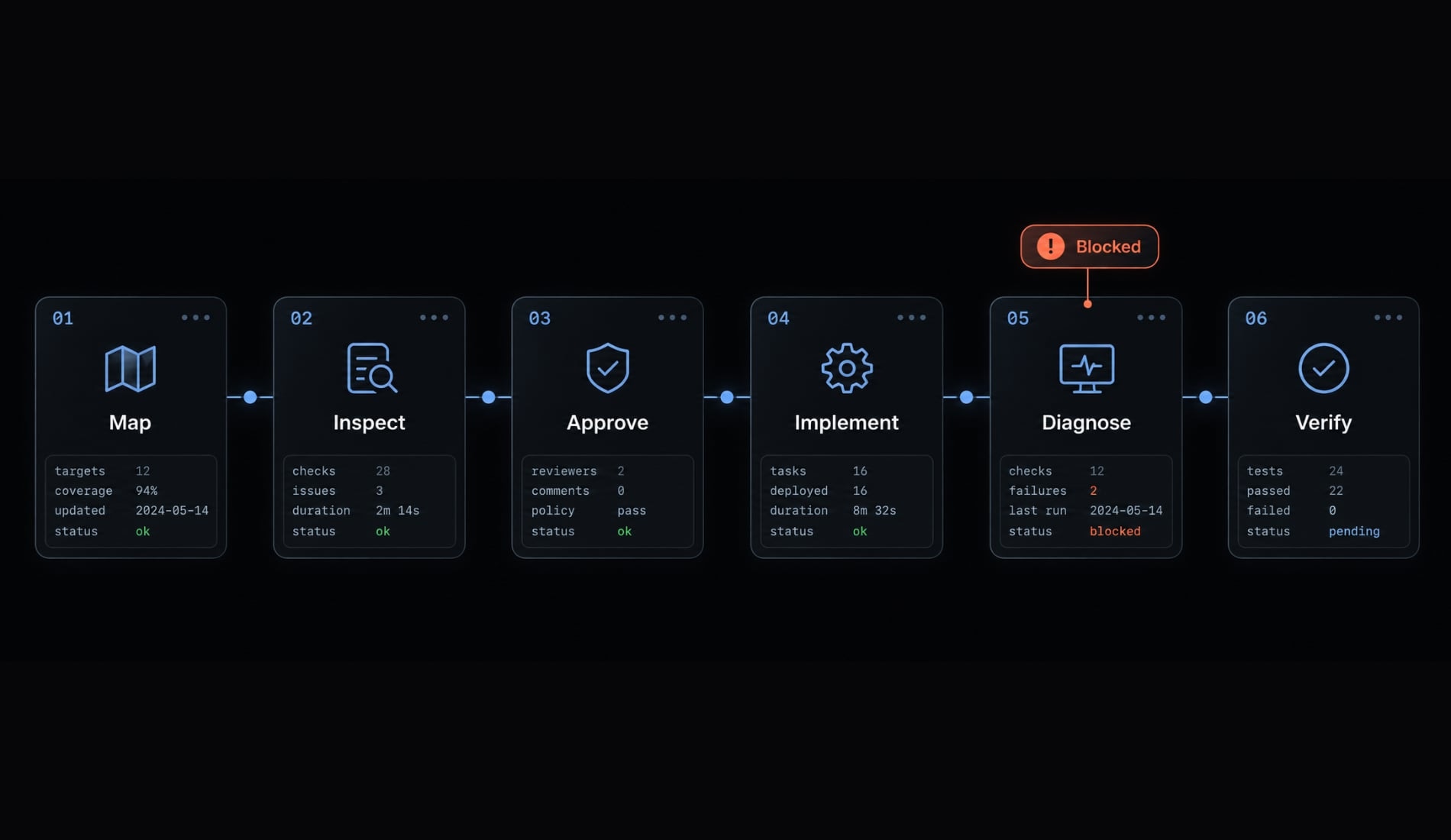
Follow this phase-based Claude Code integration testing workflow: Each stage produces evidence before the next stage begins.
- Map boundaries.
- Inspect the setup.
- Approve a plan.
- Implement small batches.
- Diagnose failures.
- Complete verification.
Stage | Claude Code action | Human checkpoint | Exit criterion |
|---|---|---|---|
Map | Inspect dependencies | Confirm scope | Boundary map and questions recorded |
Inspect | Review setup; establish baseline | Approve environment | Commands and baseline report accepted |
Plan | Map scenarios to requirements | Approve assertions | Approved scenario matrix retained |
Implement | Write and run batches | Review scope | Passing batch evidence retained |
Diagnose | Classify failures | Approve correction | Evidence-backed corrective plan accepted |
Verify | Run required checks | Review acceptance evidence | Complete report and approvals retained |
Step 1 - Map the integration boundaries
Inspect without editing. Identify the entry point, authentication context, service logic, database operation, expected response, and persistent side effects.
For the workspace feature, trace:
Authenticated request → workspace API → service → test database → response
Mark which boundaries are real and which use approved substitutes. If authentication is substituted, state what authorization behavior remains exercised.
Record unresolved questions, including how the workspace identifier reaches the write operation. Stop if ownership requirements are ambiguous.
Step 2 - Inspect the existing test setup
Read existing tests, naming conventions, fixtures, data factories, and seed scripts. Inspect dependency startup, runner settings, approved commands, and CI configuration. Run a baseline when feasible, before changing files. Record existing failures separately from failures introduced later.
Compare local and CI database versions, environment variables, migration state, and parallel execution settings. Confirm that the intended tests are actually discovered.
If dependencies are unavailable, record the baseline as blocked-not passed-and resolve setup before proceeding.
Step 3 - Generate a test plan before writing code
Map requirements to observable outcomes. For illustration, workspace A belongs to the authenticated user; workspace B does not.
Scenario | Boundary | Preconditions | Main assertion | Side-effect assertion | Cleanup |
|---|---|---|---|---|---|
Authorized persistence | API/database | User owns A | Contract-defined success | Correct value stored under A | Delete fixtures |
Invalid input | API/database | Invalid configuration | Validation rejection | No state change | Delete fixtures |
Unauthorized workspace | Authorization/database | User cannot access B | Access rejection | B remains unchanged | Delete fixtures |
The reviewer approves this mapping before implementation. Response assertions alone are insufficient. Add retries or idempotency-repetition without unintended additional effects-only when the contract requires them.
Step 4 - Implement tests in small, verifiable batches
Implement one behavior or boundary per batch. Run the smallest relevant approved command, then inspect its output and database assertions.
Report test-harness changes separately from application-code changes. Limit the test-fix loop; for example, a team might allow two repair attempts before escalation. That is a policy choice, not a Claude Code default.
A failed gate blocks automatic progression. Reproducibility concerns expected behavior and controlled state, not identical model wording or log timestamps. Retain passing evidence before expanding scope.
Step 5 - Diagnose failures before modifying production Code
Use failure classification before patching:
Classification | Evidence direction |
|---|---|
Product defect | Behavior contradicts an approved requirement |
Test defect | Assertion or setup misrepresents the requirement |
Fixture/data defect | Seeded state is missing or inconsistent |
Environment defect | Required service or configuration is unavailable |
Timing/concurrency issue | Failure varies with timing or shared state |
External dependency failure | Approved dependency fails or behaves unexpectedly |
Support the root-cause hypothesis with logs, inspected state, or a reproducible command. If a successful response accompanies a write under workspace B, compare the stored identifier against the approved requirement.
Editing application code in a development branch is different from touching live production systems. Both require appropriate authority; this workflow prohibits the latter. Obtain approval for the corrective action.
Step 6 - Run the full verification gate
Run the integration suite, related regression testing, and applicable build, lint, type, and migration checks. Verify cleanup, repeat relevant tests, and inspect the final diff.
Record commands, environment, repository revision, exit statuses, test totals, failures, and skips. Retain redacted command output rather than only an agent summary.
CI-equivalent checks are local checks intended to match documented CI steps; they do not guarantee identical conditions. Run actual CI or mark it pending. The report must distinguish passed, failed, blocked, and not run. Acceptance requires completed checks and human reviews.
Copy-ready prompt structure for Claude Code integration testing
Customize this Claude Code prompt before execution. Replace placeholders with repository evidence, never secrets.
Prompt template components
Objective: Verify [FEATURE / REQUIRED BEHAVIOR].Inspect [PATHS], [CONTRACTS], and [EXISTING TEST CONVENTIONS].Exercise [REAL DEPENDENCIES]; use only [APPROVED SUBSTITUTES].Environment: [DISPOSABLE DATABASE / APPROVED SANDBOX].Approved commands:Focused: [FOCUSED TEST]Full suite: [FULL SUITE]Additional: [OTHER REQUIRED CHECKS]Start with inspection only. Document assumptions, integration boundaries,environment prerequisites, and baseline status. Propose a requirement-linkedtest plan covering success, invalid input, authorization, persistence,relevant failures, and cleanup. Await human approval before editing.Implement one approved behavior per batch. Run the focused command andinspect response assertions, stored state, and cleanup. Separate test-harnesschanges from application-code changes.Classify failures using logs, state, and reproducible commands. Obtainapproval before application-code fixes or scope changes. Allow at most[MAX REPAIR ATTEMPTS] repair attempts per batch, then stop and report.Do not access production, use customer data, make billable calls, exposesecrets, weaken assertions, or expand scope without approval. Destructivetest-environment operations require explicit approval.Stop when prerequisites, authority, or evidence are insufficient. Neversubstitute a mock for a required real boundary without approval.Report commands, environment, revision, exit status, test totals, failures,skips, changed files, side-effect evidence, cleanup, and unresolved risks.Label each check passed, failed, blocked, or not run. Identify pending CIand human reviews. Do not certify production readiness.
Recommended stop conditions
- Stop if required services or environment variables are unavailable.
- Stop if unapproved destructive operations are needed.
- Stop if the repair cap is reached.
- Stop if changes exceed approved scope.
- Stop if evidence cannot support failure classification.
Where to store the instructions
Instruction type | Location |
|---|---|
Stable repository guidance |
|
Feature-specific requirements | Task specification |
Repeated procedures | Reusable skills |
Enforced checks | Configured hooks, CI, and permissions |
Anthropic’s Claude Code documentation describes skills, hooks, and permissions. Enforcement depends on configuration; documenting a restriction does not enforce it.
Verification gates, safety controls and common failure modes
A verification gate is a required check with an expected outcome and inspectable evidence. An executable gate needs a command, expected result, and retained output. A review gate needs an explicit decision and accountable reviewer. Not every judgment about behavior or release risk can be automated.
Verification gate matrix
Gate | Required focus | Evidence requirement |
|---|---|---|
Build | Applicable build/type checks succeed | Exact command and exit status |
Test | Intended tests execute successfully | Totals, failures, skips, and command |
Behavior | Assertions reflect requirements | Scenario mapping and reviewed assertions |
Data | Persistence and side effects are correct | Relevant before/after state assertions |
Isolation | No dependence on leaked state | Independent or reordered runs where supported |
Safety | Approved environment and access boundaries | Redacted endpoint configuration and applicable access controls |
CI | Checks execute in intended CI environment | Actual CI result; local equivalence labeled separately |
Diff | Scope and assertions remain intact | Reviewed diff and approval record |
Zero discovered tests cannot satisfy the test gate. Explain skipped tests against the definition of done. A successful local run does not establish CI reproducibility.
A failed gate blocks automatic progression. If the required scope changes, replan and obtain approval rather than silently removing checks.
Preventing self-certification
Self-certification means accepting an agent’s work based only on checks shaped by the same potentially mistaken assumptions. An agent might implement incorrect workspace selection and write assertions that repeat that mistake.
Reduce that risk:
- Approve requirements before implementation.
- Review assertions for behavior, not just syntax.
- Assign another reviewer to high-risk changes.
- Treat subagents or separate sessions as supplementary review.
A second agent provides another perspective, not guaranteed independence or correctness. Compare both implementation and assertions against the original requirement, rather than asking only whether they agree.
Safety controls for databases and external services
Require:
- Disposable environments with synthetic data.
- Least-privilege credentials limited to required test operations.
- Approved network destinations.
- No live email, payment, or billable side effects.
- Approval for destructive operations within test infrastructure.
- Secret redaction in prompts, logs, screenshots, and commits.
- Repair-attempt, runtime, and resource limits.
Prompt instructions communicate intent; externally enforced access restrictions constrain capability. Verify credential scope and network policy outside the agent’s narrative. A model-generated environment summary is not proof that production access was impossible.
Common failure modes and responses
Failure mode | Why green may mislead | Immediate response |
|---|---|---|
Excessive mocking | Required database boundary never runs | Restore the approved real dependency |
Weak assertions | Status succeeds despite wrong stored workspace | Assert ownership, values, and unintended writes |
Order dependency | Earlier tests provide hidden state | Run independently; repair fixture isolation |
Assertion weakening | Edits remove the requirement being tested | Review the diff against approved scenarios |
CI-only failure | Local success hides environment differences | Compare CI configuration and retained logs |
Premature application-code edits | A harness failure triggers unnecessary changes | Require evidence-backed classification first |
Flaky reruns | A later pass hides intermittent failure | Retain failures; investigate timing and shared state |
Repeat runs provide evidence of stability; they do not prove the absence of flakiness. Preserve failed attempts alongside later passes. The central lesson is straightforward: a green test run provides weak evidence when the relevant boundary is mocked or persistence is not asserted. Verification gates should evaluate meaning, not merely process completion.
Practical application and workflow reusability
Example - Testing an API and database change
Illustrative scenario. This example describes expected investigation artifacts, not a completed test run or client result.
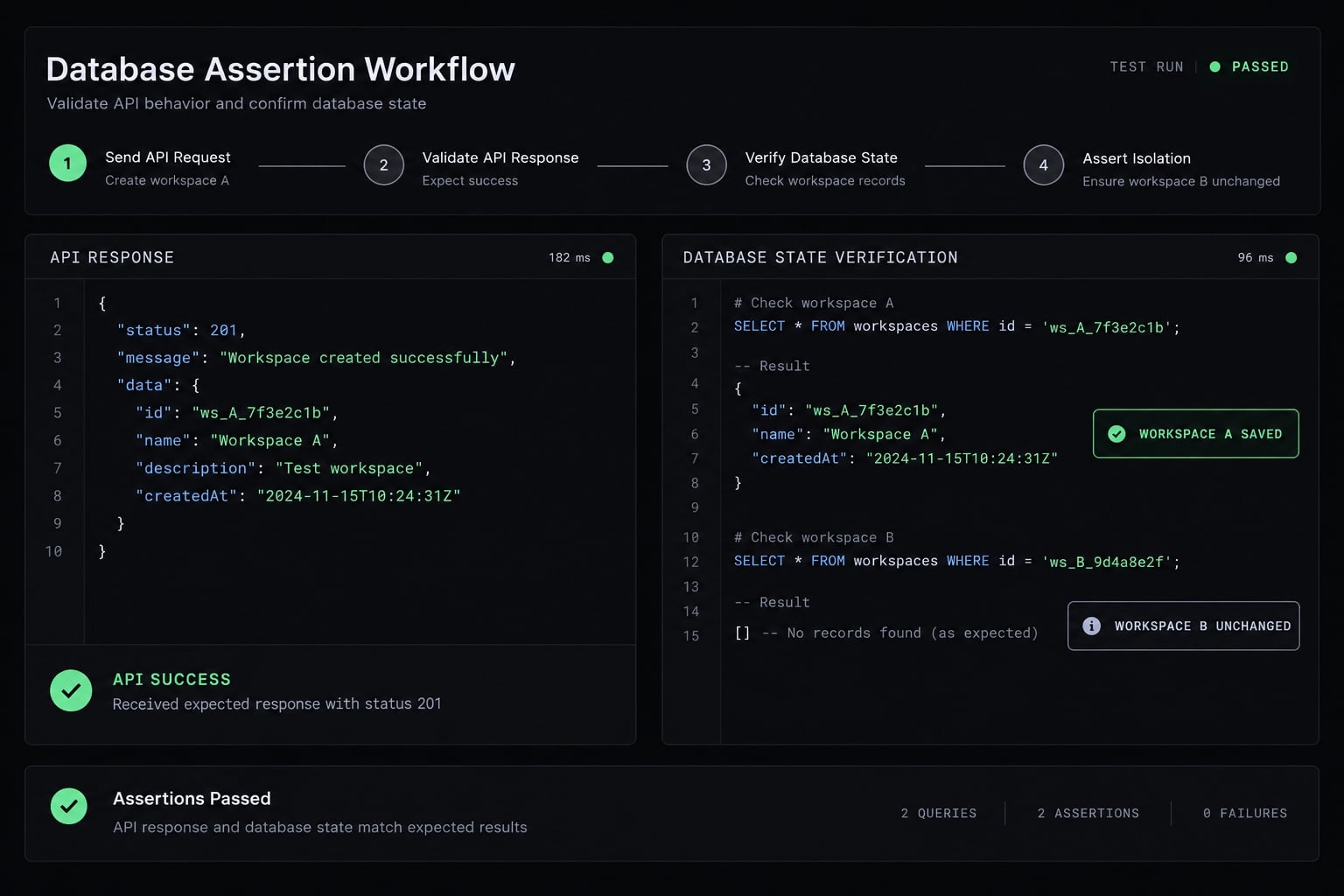
- Define: An authorized request must save configuration under workspace A, leaving workspace B unchanged.
- Inspect: Review the route, service, schema, migration, and synthetic fixtures. Trace the workspace identifier into the database write.
- Approve: Accept scenarios for valid persistence, invalid input without writes, and unauthorized workspace access without writes.
- Implement: Create one focused batch using the existing API test harness and disposable database.
- Block: A response-only assertion would pass, but a database assertion reveals configuration stored under B. The data gate blocks progression.
- Correct and verify: Obtain approval for the identifier fix, rerun required checks, and review application and assertion diffs.
If a migration is involved, validate schema compatibility and relevant application behavior-not merely the migration command’s success. The evidence sought includes failing state assertions, corrected persistence, cleanup results, and review records. No execution results are claimed here.
Standardizing the workflow across repositories
Keep a shared prompt structure while preserving repository-specific commands, dependencies, and restrictions. Package repeated procedures as reusable skills; enforce required CI checks separately. AgentKit offers reusable skills, specialized subagents, workflows, and configurations that can help organize this reusable testing workflow.
An optional testing subagent can review scenario coverage. Its findings remain review input, not independent certification. Port procedures between repositories, but reapprove environment assumptions.
Frequently asked questions
What is Claude Code integration testing?
Claude Code integration testing is the practice of using Anthropic’s agentic CLI tool to design, execute, and diagnose test suites that validate interactions between system components, such as API endpoints and databases. It ensures that application code functions correctly across boundaries rather than just in isolation.
How does Claude Code handle integration test failures?
Claude Code parses test output and stack traces, inspects the relevant code, and classifies the failure — product defect, test defect, fixture, environment, timing, or external dependency. It proposes a correction backed by logs or reproducible commands. Application-code changes require approval, and repair attempts are capped before it stops and reports.
Is it safe to let Claude Code run integration tests autonomously?
No, you should not grant full autonomy. Use "verification gates"—human-approved checkpoints—to review the test plan and implementation. You must also ensure the test environment uses sandboxed dependencies, disposable databases, and least-privilege credentials to prevent accidental modifications to production systems or data.
What are verification gates in this workflow?
They include build, test, behavior, data, isolation, safety, CI, and diff gates. An executable gate needs a command, an expected result, and retained output - a status code alone is not enough; the data gate checks what was actually stored and what stayed unchanged.
Can Claude Code replace the need for human integration testing?
No. While Claude Code assists with generating and running tests, it cannot independently certify production readiness. A human must define the requirements, approve the test scenarios, inspect the generated assertions, and perform a final review of the diff to confirm that the business logic aligns with the project’s goals.
What should be included in a Claude Code integration test prompt?
An effective prompt should define the feature behavior, required integration boundaries, approved test runner commands, and specific scenario requirements (e.g., success cases, authorization checks, and persistence validation). It must also include clear prohibitions against accessing production data, billable third-party endpoints, or storing secrets in the repository.
How can I prevent Claude Code from self-certifying its own work?
To prevent self-certification, implement role separation. Use one agent session or a manual human step to define the integration requirements and test assertions, while a separate session or process handles the implementation . Always verify that test assertions are based on the documented requirements rather than the agent’s generated assumptions.
Read more:
- Claude Code unit testing: Guide to generate reliable tests
- Claude Code automation: Build repeatable and low-risk workflows
- Claude Code prompt engineering: A practical guide for developers
Conclusion
Claude Code integration testing is most useful when repository context, meaningful assertions, and controlled execution reinforce one another. Start with explicit boundaries and synthetic fixtures. Approve the test plan, implement small batches, and inspect database state rather than relying on response codes alone.
Test isolation and verification gates make results easier to review and reproduce. Keep commands, exit statuses, test summaries, failed attempts, and final diffs together. Missing infrastructure means blocked or not run-not passed.
Independent review remains essential, especially for authorization, persistence, and application-code changes. Claude Code can assist with testing, but it cannot independently certify production readiness. Copy the readiness checklist and prompt from this article, then apply them to one scoped integration change. Judge completion by stronger evidence and accountable acceptance, not test count.