Claude Code database migration: A safe, practical workflow
Claude Code database migration: A safe, practical workflow
A Claude Code database migration workflow uses AI assistance to draft plans, generate assets, and prepare validation while enforcing strict human controls. Because faulty migration code can trigger table locks or data loss, production write credentials must stay strictly isolated from the agent. This eight-stage framework ensures all changes undergo rigorous local testing and human approval before running through controlled deployment automation.
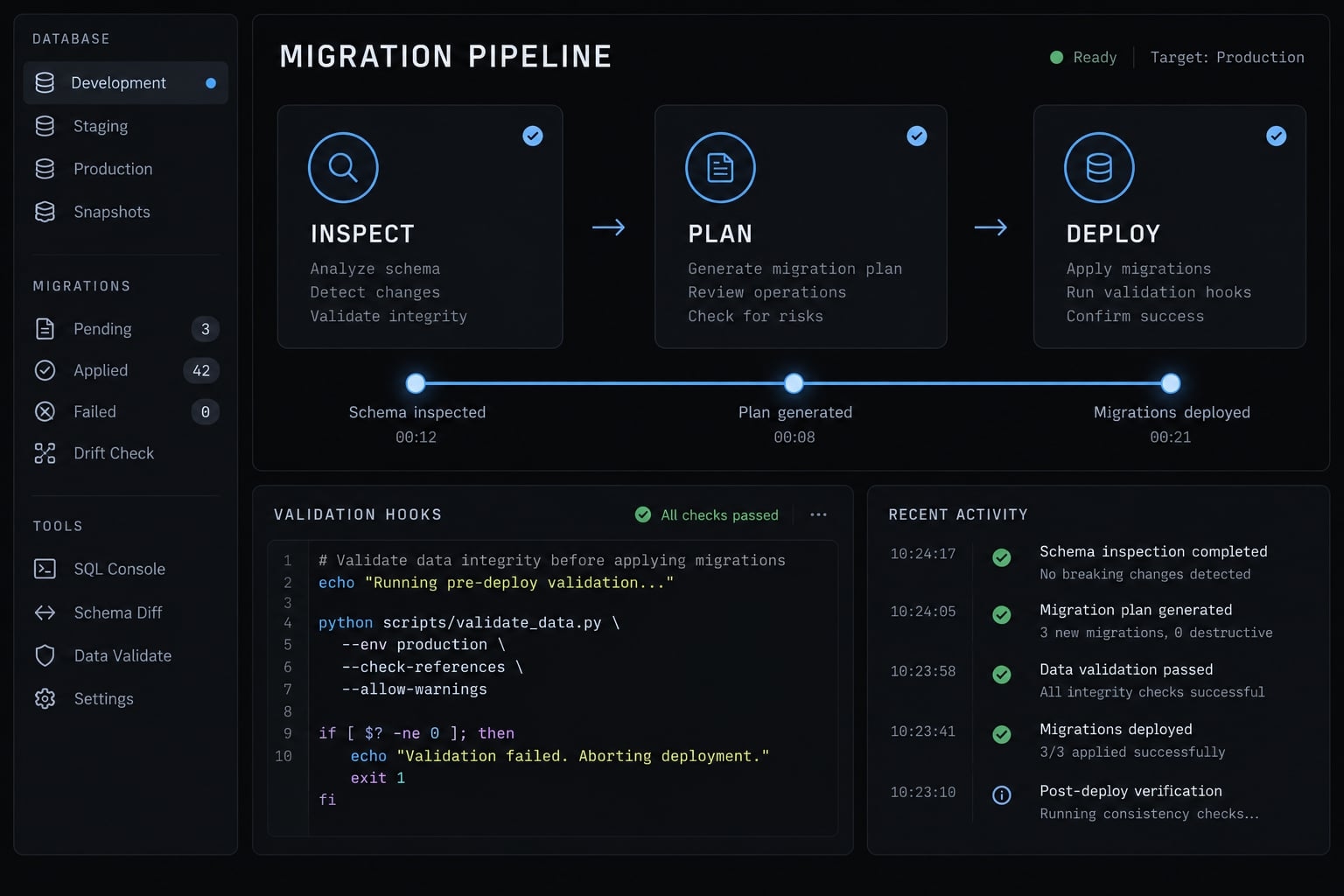
What Claude Code can and cannot do for a Claude Code database migration
The following matrix describes recommended workflow policy, not universal product restrictions.
Operation | Claude Code role | Human approval |
|---|---|---|
Read repository schema and migrations | Inspect authorized files | Repository scope |
Review sanitized metadata | Compare supplied evidence | Data-sharing scope |
Draft plans and migrations | Propose changes | Plan before editing |
Generate tests and validation queries | Prepare reviewable assets | Coverage and query review |
Run disposable-environment commands | Execute approved tests | Commands and environment |
Access staging | Only within explicit scope | Separate authorization |
Read production, optionally | Restricted, reviewed access | Privacy and query limits |
Obtain production write access | Excluded | Keep credentials external |
Deploy to production | Prepare artifacts only | Protected deployment approval |
Repair production | Support authorized analysis | Incident owner controls repair |
Appropriate Claude Code responsibilities
Claude Code can draft SQL migration scripts and support ORM synchronization—keeping object-relational mapping models aligned with schema changes. Schema introspection requires supplied metadata or authorized tools.
Mandatory human responsibilities
Humans confirm production assumptions, review material changes, authorize deployment and recovery, and verify business outcomes. An AI-generated explanation is not independent verification. Read-only access still risks sensitive-data exposure and expensive queries. Anthropic’s Claude Code documentation on permissions and security provides the product-level reference; access policy remains your responsibility.
Context Claude Code needs before generating a migration
Plausible migration code can be wrong when the environment description is incomplete. Supply evidence before requesting changes.
Input | Why it matters | Safe way to provide it |
|---|---|---|
Database engine and exact version | Determines operation behavior | Reviewed environment manifest |
ORM/migration tool and version | Establishes framework compatibility | Dependency files and conventions |
Schema and migration paths | Locates definitions and history | Scoped repository access |
Applied migration state and drift | Reveals deployment differences | Sanitized status export |
Affected models, queries, APIs, jobs | Identifies readers and writers | Relevant application files |
Table size and distributions | Informs testing and execution | Approved aggregates |
Deployment order and compatibility | Exposes release overlap | Release plan and version inventory |
Technical context
Repository migration history is not proof of applied state. Stale schema files, unapplied migrations, and manual database changes require reconciliation. Include Prisma, Alembic, Flyway, or your actual framework’s conventions in the CLAUDE.md context. Do not substitute generic commands.
Production reality
Record volume, nulls, duplicates, legacy values, concurrent writes, and lock sensitivity shape production-like data. For users.timezone, identify every writer - including older application instances - and the product-approved source of existing users’ values. Missing inputs become questions, not assumptions.
Security and access boundaries
Prefer schema-only exports and sanitized aggregates. Sanitization should preserve useful distributions without exposing customers.
Privacy boundary: Keep credentials and customer records out of prompts, screenshots, and committed files. MCP (Model Context Protocol, a tool-connection interface) integrations require the same access review.
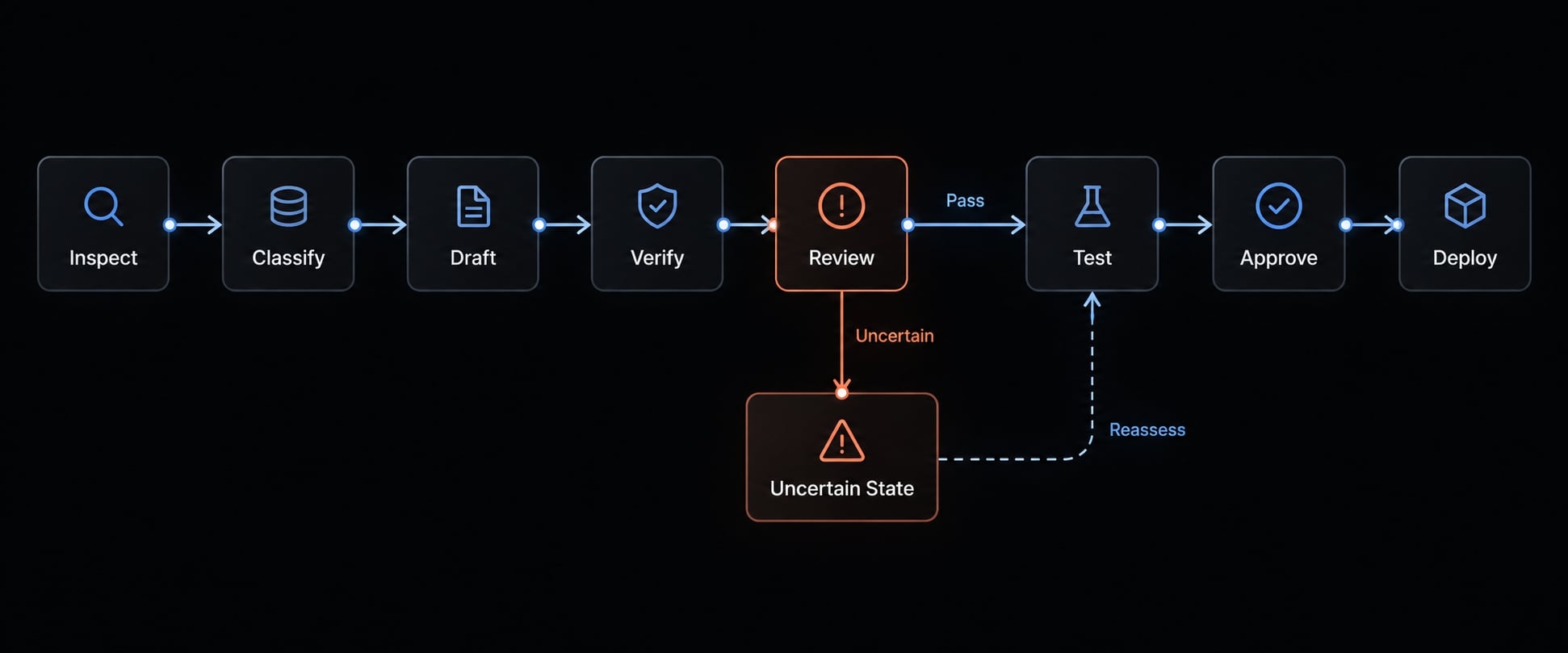
A safe Claude Code database migration workflow
- Inspect the existing state.
- Classify the migration risk.
- Require a written migration plan.
- Generate the migration and supporting assets.
- Review the generated change.
- Test against a disposable production-like database.
- Approve and deploy through controlled automation.
- Monitor and verify the result.
This Claude Code migration workflow separates drafting, verification, and production authority.
Step 1 - Inspect the existing state
Ask Claude Code to inspect schema, migrations, application dependencies, and supplied deployed-state evidence without editing files. Compare definitions with actual applied state.
For users.timezone, identify missing values and every process creating users. A human confirms evidence freshness and resolves conflicting inputs. Proceed with a current-state summary listing dependencies, assumptions, and unanswered questions - not an inferred production schema.
Step 2 - Classify the migration risk
Have Claude Code assess data loss, locks, table rewrites, backfill volume, compatibility, and recovery feasibility. A backfill populates existing records separately from the schema change.
The reviewer assigns a conditional risk rating and required controls. Record the reasons, not just a label. Unknown row counts or unresolved deployment overlap should block approval rather than receive optimistic estimates.
Step 3 - Require a written migration plan
Require operation order, application releases, validation, monitoring, stop conditions, recovery, and anticipated files. Approve this plan before generation.
For the timezone change, use expand–migrate–contract: introduce a compatible schema, transition application behavior and data, then enforce stricter requirements. Explicitly account for old writers and concurrent writes. A one-time backfill cannot establish completeness while incompatible writers remain active.
Step 4 - Generate the migration and supporting assets
Claude Code generates framework-aligned migrations, model changes, tests, validation queries, and recovery notes. Never silently rewrite already-applied migration files. Humans confirm package scope. Large backfills should be bounded and restartable where appropriate, with reviewed retry behavior and progress tracking. Choose batch limits from environment evidence; no universal batch size or dry-run command applies across frameworks.
Step 5 - Review the generated change
Compare the patch with the approved request. Review defaults, constraints, types, cascades, indexes, and generated SQL where available.
A human checks database-specific behavior against the deployed version’s documentation. Transactions and DDL (data definition language) operations behave differently across engines. PostgreSQL’s ALTER TABLE and CREATE INDEX references illustrate why operation-level review matters. Record concerns and resolutions against an identifiable artifact.
Step 6 - Test against a disposable production-like database
Test fresh setup and upgrades from the deployed schema. An empty-database test does not validate existing-record behavior.
Include missing and invalid timezone values, overlapping application versions, concurrent writes, interruption, and restart. Require data integrity validation, application tests, and recovery evidence. Rollback verification applies only when reversal is the chosen strategy. Staging timing informs planning; it does not guarantee production timing.
Illustrative validation artifact - not executed evidence: Environment: disposable database matching the target engine/version.Dataset: synthetic existing users, missing timezones, invalid legacy values, and concurrent writers. Checks: upgrade, reader/writer compatibility, restartability, constraint readiness, recovery. Observed outcomes: not measured; deployment remains blocked pending recorded results.
Step 7 - Approve and deploy through controlled automation
Verify the target environment, artifact identity, recovery readiness, approver, incident owner, and deployment mechanism. Approval covers a specific revision; material changes require renewed review.
Established deployment automation executes the migration without giving the agent production write credentials. Capture execution records and apply predefined stop conditions. A backup’s existence alone is insufficient: recovery must be feasible within the change’s operational requirements.
Step 8 - Monitor and verify the result
Check application behavior and records, not merely exit status. Monitor errors, lock waits, latency, replication lag where relevant, and scheduled jobs.
For timezone changes, verify that new writes remain complete and notifications follow the approved policy. Humans decide whether to proceed, pause, or recover. Delay transitional-code removal until compatibility is demonstrated and the observation criteria are satisfied.
Stage | Claude Code contribution | Human decision | Evidence |
|---|---|---|---|
Inspect | Compare context | Resolve unknowns | State summary |
Classify | Identify hazards | Set controls | Risk rationale |
Plan | Sequence work | Approve approach | Approved plan |
Generate | Draft assets | Confirm scope | Migration package |
Review | Explain changes | Accept patch | Reviewed revision |
Test | Run permitted checks | Accept coverage | Test/recovery report |
Deploy | Prepare handoff | Authorize release | Execution record |
Verify | Summarize evidence | Proceed/pause/recover | Outcome report |
Risk classification and migration review checklist
Migration risk assessment starts with provisional categories. Engine/version, workload, table size, deployment method, and application dependencies can change any rating.
Risk level | Typical examples | Minimum controls |
|---|---|---|
Low | Additive, backward-compatible changes | Review, upgrade tests, recovery consideration |
Medium | Indexes, constraints, bounded backfills | Lock assessment, realistic testing, monitoring |
High | Destructive changes, conversions, large rewrites, sensitive transformations, engine changes | Specialist review, staged execution, tested recovery, explicit authorization |
Low-risk migrations
An additive column may be a low-risk starting classification. Defaults, dependencies, and engine behavior can still introduce blocking or correctness problems.
Medium-risk migrations
Indexes, constraints, and backfills can become high risk on large or busy tables. Assess table locks and resource pressure before choosing execution methods.
High-risk migrations
Destructive DDL can remove structures and data. A live-column rename also creates compatibility risk, even without deleting records.
Cross-engine migration requires a separate plan, behavioral compatibility checks, and specialist review. This schema-change workflow is not sufficient.
Copyable migration review checklist
- Correct database engine and exact version recorded.
- Deployed schema and applied migration state verified.
- Existing records checked against intended requirements.
- Destructive operations and conversions explicitly reviewed.
- Defaults and timezone value policy justified.
- Backfills bounded, observable, and restartable where needed.
- Lock and rewrite behavior assessed.
- Old and new application versions remain compatible.
- Concurrent writes and background jobs covered.
- Fresh setup and realistic upgrade tests completed.
- Change-specific recovery tested.
- Post-deployment validation and stop conditions defined.
- Named reviewer approves the artifact and environment.
Local success is not production proof. If production contains unexpected nulls, reassess test distributions and incoming writers - not just the constraint statement.
Copy this checklist into the migration pull request and attach evidence to each approval-critical item.
Claude Code guardrails for database changes
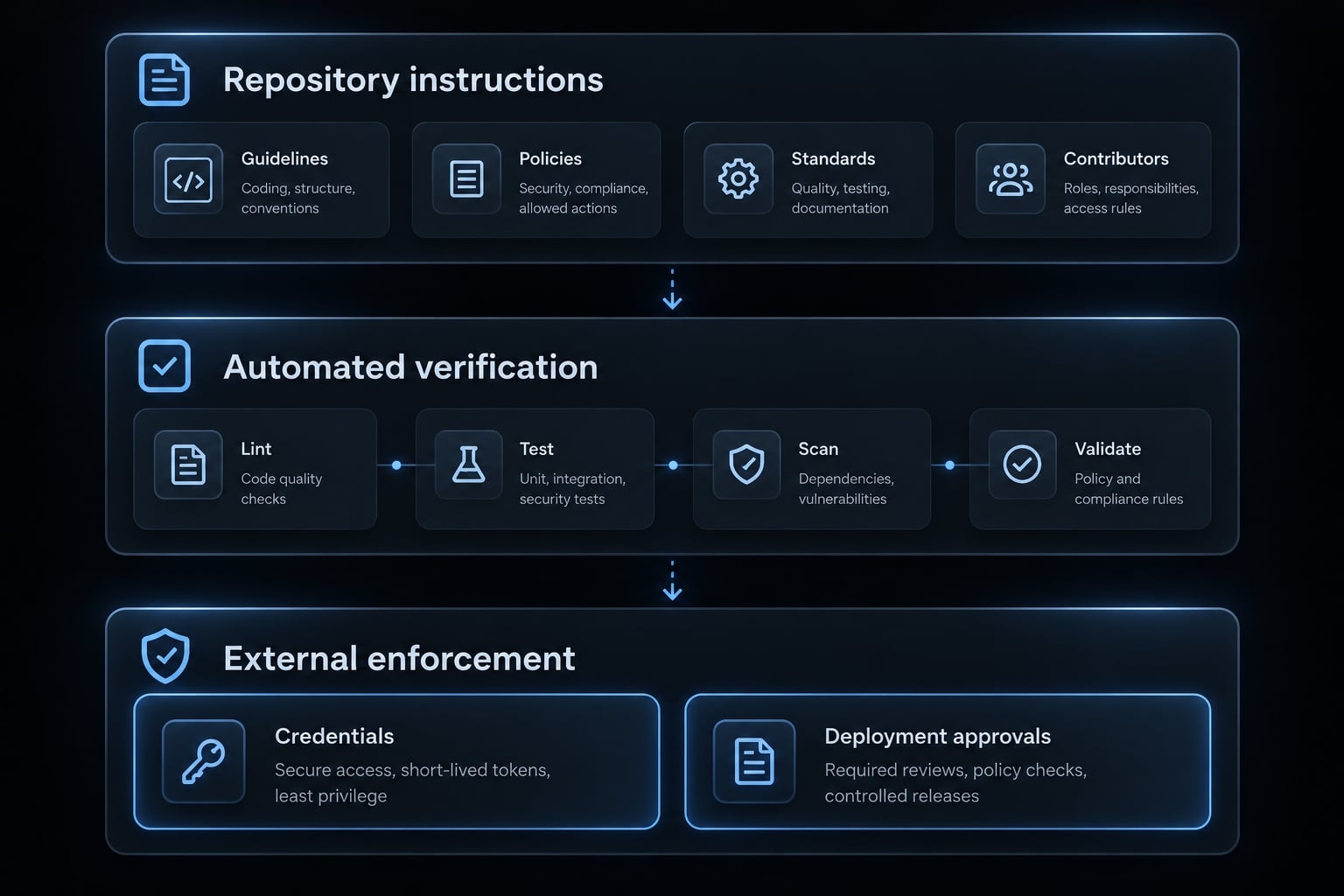
Use three layers: instructions guide behavior, automated checks detect problems, and external controls enforce boundaries. CLAUDE.md guardrails are not a security boundary.
Copy-ready CLAUDE.md rules
## Database migration rules- Do not connect to production or execute production migrations.- Never request, store, or use production write credentials.- Inspect schema, migration history, and supplied applied-state evidence first.- State assumptions and missing information; do not invent inputs.- Obtain written plan approval before changing files.- Flag destructive operations, conversions, constraints, indexes, and large backfills for explicit review.- Prefer staged, backward-compatible changes.- Never silently rewrite already-applied migrations.- Generate tests, validation queries, and change-specific recovery notes.- Execute tests only in explicitly approved disposable environments.- Stop autonomous actions immediately on uncertain state or an unexpected production migration failure; notify the incident owner.- Never equate successful execution with proven safety.
Deterministic verification hooks
Run framework validation, SQL linting, disposable-database migration tests, and integration tests. CI (continuous integration) should check prohibited patterns and required review. Pattern detection can miss semantic hazards. Passing a linter does not establish correct timezone values, acceptable locking, or recoverability.
Local hooks are not equivalent to protected CI gates. Anthropic’s Claude Code hooks documentation describes configuration mechanisms; verify supported behavior for your installed release before implementing hooks.
Credential and MCP Boundaries
Separate environments, use least privilege, restrict tools, protect secrets, and audit access. Check inherited shell variables and connection profiles, not only explicit agent configuration. MCP is optional and does not automatically supply deployment controls. A connected database tool inherits the risks of its credentials and exposed operations.
Keep protected deployment approvals outside agent-editable configuration. Copy the repository rules, then verify the external controls that make the production boundary enforceable.
How to respond when an AI-generated migration fails
Stop autonomous retries and repairs immediately after an unexpected production failure or uncertain database state. Do not allow a speculative repair attempt first.
Stop, preserve and diagnose
- Stop automated retries and further agent-issued changes.
- Assign an incident owner.
- Preserve errors, logs, commands, migration artifacts, and available state evidence.
- Determine whether the migration never applied, fully rolled back, partially applied, or completed incorrectly.
A failed database migration does not imply automatic reversal. Transactional behavior depends on the engine, framework, and operations involved. Preserve evidence before altering migration status records.
Choose the recovery path
Path | Decision requirement |
|---|---|
Reversal is verified and data-preserving; schema reversal alone cannot recover deleted or overwritten data. | |
Restore | A validated recovery point exists; subsequent writes may be lost or require reconciliation. |
Forward repair | Correcting observed state presents less risk than reversing the change. |
Incident recovery requires owner approval for production repair. Not every framework provides safe automatic down migrations. There is no universal rescue command. Controlled experimentation in a disposable database is separate from production recovery.
Validate before reopening traffic
Perform data integrity validation, application read/write tests, and operational monitoring. For timezone changes, verify notification behavior as well as field completeness.
If traffic was restricted, reopen it against explicit acceptance criteria. Do not indiscriminately stop a shared production database.
Reusable prompt for planning a Claude Code database migration
This Claude Code migration prompt separates planning from editing and execution. Replace placeholders with approved context, not credentials.
Migration planning prompt
Plan a database migration. Do not edit files or execute changes.Context:- Database engine and exact version: <engine/version>- ORM/migration tool and version: <tool/version>- Schema path: <path>- Migration history path: <path>- Applied-state/drift evidence: <approved evidence>- Requested change: <change>- Approximate production size and distributions: <details>- Deployment and compatibility constraints: <constraints>- Relevant application files and jobs: <paths>- Approved value policy: <policy or unresolved question>Requirements:1. Inspect supplied files and evidence before proposing changes.2. Summarize current state, readers, writers, and dependencies.3. List assumptions, missing information, and conflicting evidence. Do not invent missing inputs.4. Classify risk and explain locks, rewrites, compatibility, data correctness, and recovery concerns.5. Propose an ordered schema/application/data rollout.6. Plan production-like testing, validation, monitoring, stop conditions, and change-specific recovery validation. Distinguish planned tests from tests actually executed.7. List anticipated file changes.8. Wait for explicit plan approval before editing.Boundaries:- No production connections or modifications.- No destructive execution.- Stop when database state is uncertain and request clarification.
How to adapt the prompt
- Include framework conventions and explicitly approved commands.
- Add realistic distributions, concurrent writers, and release-overlap constraints.
- Escalate cross-engine work to a separate migration plan with behavioral compatibility testing.
Worked example - Adding a required field without breaking existing data
Illustrative scenario: A B2B SaaS application introduces users.timezone for scheduled notifications. This is a design example, not a documented deployment result.Unsafe one-step approach
Immediately enforcing a required field can fail when existing users lack values or older writers still omit them. A large data backfill may create operational pressure.
An automatic UTC default may satisfy a constraint while scheduling notifications incorrectly. A valid identifier is not necessarily the user’s correct timezone.
Safer staged approach
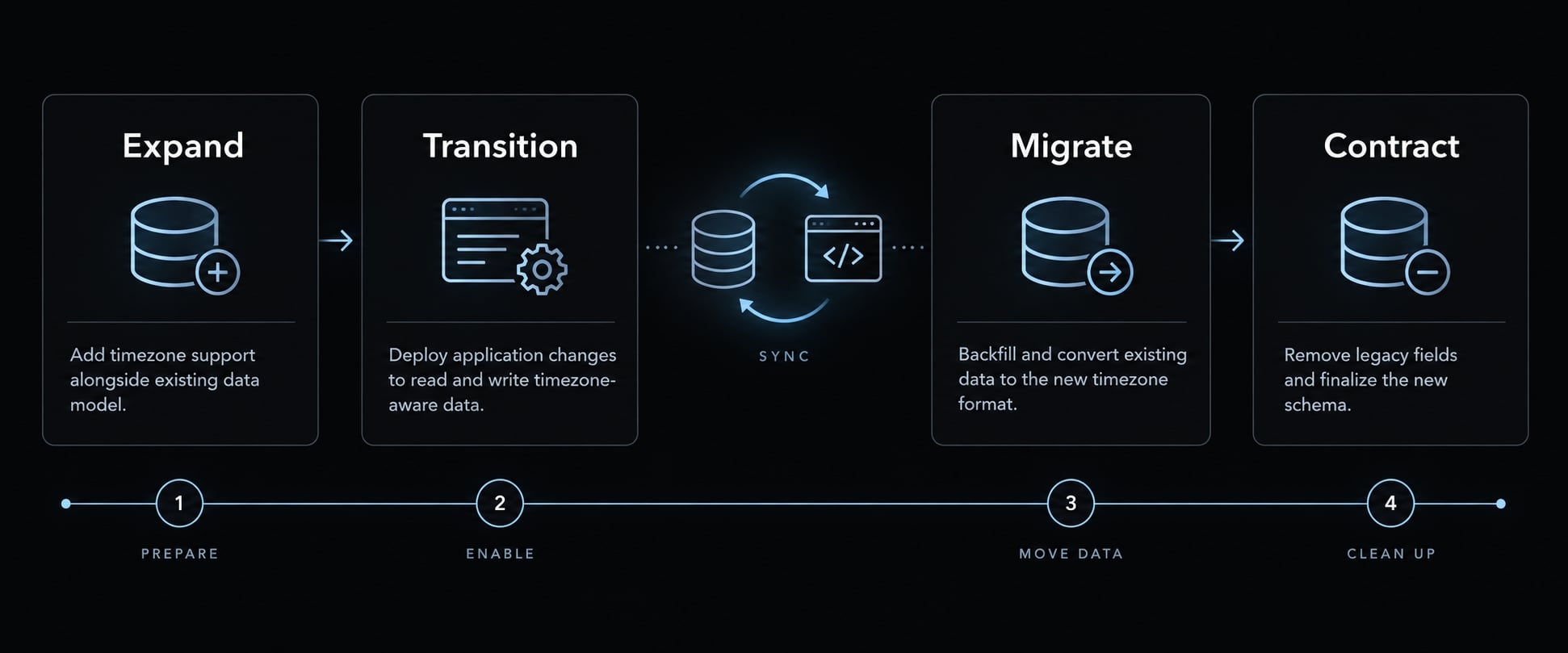
Apply expand–migrate–contract through four phases:
- Expand: Add a compatible nullable column.
- Transition application behavior: Deploy compatible readers and writers using a product-approved source or documented fallback policy.
- Migrate: Backfill in controlled batches; reconcile writes occurring during the transition.
- Contract: Retire incompatible writers, verify completeness, and approve the non-null constraint. Remove transitional logic later.
Claude Code drafts the plan, code, tests, and validation assets. Humans approve value semantics and release gates. Do not infer timezone from weak signals merely to complete records.
Evidence required before contracting
Require:
- No unexpected nulls.
- Valid identifiers and a justified value policy.
- Complete new writes.
- Retired incompatible application versions.
- Acceptable observed performance.
- Recovery readiness and human approval.
If these conditions fail, postpone the constraint rather than manufacture values.
Frequently asked questions
What is Claude Code database migration?
Claude Code database migration is the process of leveraging Anthropic’s terminal-based coding agent to inspect, plan, draft, and validate database schema changes. It automates repetitive SQL generation, ORM synchronization, and test-case creation while relying on human oversight for production deployment and data-integrity validation.
Can Claude Code execute migrations directly on my production database?
Technically, Claude Code can be configured to execute commands, but it is highly recommended to isolate production environments. Always keep write-access credentials restricted. Use Claude Code to draft migration files in a local, disposable environment, then deploy through your standard, authorized CI/CD release pipeline.
Is Claude Code capable of handling cross-engine database migrations?
Claude Code can help draft translated schemas and queries, but cross-engine migration is a separate project. It needs its own plan, behavioral compatibility testing against the source system, and specialist review; this schema-change workflow is not sufficient.
What should I do if an AI-generated migration fails in production?
Immediately stop all automated retries or further agent-issued changes. Identify the incident owner to preserve logs, executed commands, and state evidence. Depending on the observed damage, choose between a verified data-preserving rollback, a clean restoration from a known good point, or a manual forward-repair authorized by your engineering lead.
How can I ensure Claude Code's migrations are reversible?
Decide the recovery strategy first: rollback, restore, or forward repair. If reversal is chosen, test it in a disposable production-like environment and confirm it preserves data, since schema reversal alone cannot recover deleted or overwritten values.
Does Claude Code understand my production data scale?
No, Claude Code is typically blind to live production row counts, index fragmentation, and data distribution. Because an operation that is fast on 1,000 rows can lock a table of 80 million rows, you must verify all migration plans against realistic staging data volumes before proceeding to production.
Read more:
- Claude Code refactoring: A safe and repeatable workflow guide
- Claude Code automation: Build repeatable and low-risk workflows
- Claude Code Cloudflare deployment: A safe 5-step workers guide
Conclusion
A reliable Claude Code migration workflow turns AI assistance into reviewable artifacts rather than unchecked production access. Because generated code is only part of a safe release, production credentials must stay isolated from the agent. By requiring staged changes, realistic tests, and post-deployment proof, this process ensures every database modification is backed by verified evidence rather than confident claims.