Claude Code refactoring: A safe and repeatable workflow guide
Claude Code refactoring: A safe, repeatable workflow for existing repositories
Claude Code can inspect dependencies, propose structural changes, edit multiple files, and run approved validation commands. However, Claude Code refactoring can also produce oversized diffs, break implicit contracts, or add abstractions that are difficult to review. The safest pattern is simple: establish a baseline, analyze without editing, approve one bounded change, implement narrowly, validate the diff, then commit or revert. This article provides copy-ready prompts, repository guardrails, validation procedures, and recovery steps for controlled AI-assisted code refactoring.
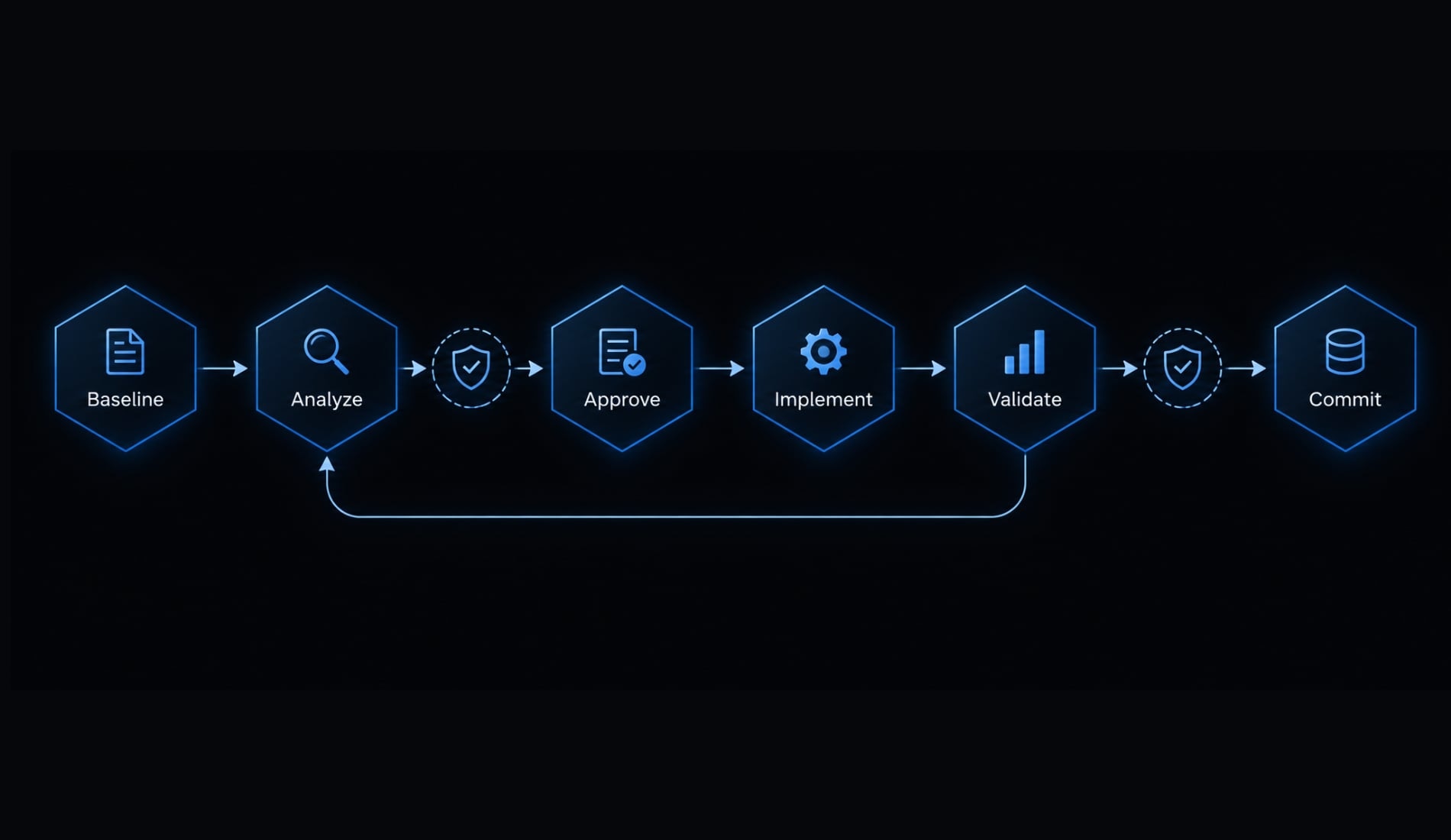
The safest Claude Code refactoring workflow at a glance
Claude Code refactoring is a method for analyzing and restructuring existing code while preserving the system’s observable behavior. The safest approach limits work to small changes, requires developer approval before editing, validates each diff with project checks and human review, then ends with a deliberate commit, revision, or revert decision.
Use this six-step Claude Code refactoring workflow:
- Establish a clean baseline.
- Analyze without editing.
- Review and approve a bounded plan.
- Implement one behavior-preserving change.
- Run checks and inspect the Git diff.
- Commit, revise, or revert.
Here, behavior preservation means the refactor should not intentionally change observable outputs, exceptions, side effects, integrations, or external contracts.
Claude Code may inspect the repository, develop a plan, modify approved files, and execute permitted commands. The developer owns scope control, accepts implementation risk, and makes the final approval decision. This is a human-in-the-loop process, not autonomous repository maintenance.
Step | Claude Code’s role | Developer approval gate | Expected output |
|---|---|---|---|
Baseline | Read instructions and run approved checks | Confirm repository state | Recorded baseline |
Analyze | Inspect code, callers, and risks | Review findings | Prioritized recommendations |
Approve | Convert one recommendation into a plan | Define exact boundaries | Bounded plan |
Implement | Modify approved files only | Inspect first result | Reviewable diff |
Validate | Run commands and summarize changes | Verify evidence manually | Validation report |
Commit/Revert | Stop and await direction | Accept, revise, or reject | Clean checkpoint |
Claude Code supports repository-aware coding and command execution, but its behavior depends on current configuration and permissions. Verify tool-specific behavior in the official Claude Code documentation.
Claude Code refactoring is an AI-assisted process that uses the Claude Code CLI to analyze, restructure, and improve existing codebases while preserving observable behavior.
Prepare the repository and set refactoring guardrails
Claude Code guardrails are concrete repository constraints. They specify what may change, what must remain stable, which commands define success, and when Claude Code must stop for approval.
A safe refactor should begin from a known state. Otherwise, new regressions become difficult to distinguish from pre-existing failures.
Run the baseline checks
Complete this checklist before allowing edits:
- Confirm that
git statusis clean. - Create a dedicated branch or isolated worktree.
- Run the documented build or compile command.
- Run relevant unit and integration tests.
- Run lint and formatting checks.
- Run static analysis and type checking.
- Record all known failures and flaky tests.
- Capture a relevant performance baseline where applicable.
- Confirm that current behavior is understood well enough to define success.
- Create a reversible Git checkpoint.
Use the repository’s documented commands rather than asking Claude Code to guess. If the project lacks clear instructions, identify the correct commands before implementation.
Pre-existing failures should be recorded with their output and date. A failing test that existed before the refactor should not automatically be attributed to the generated change.
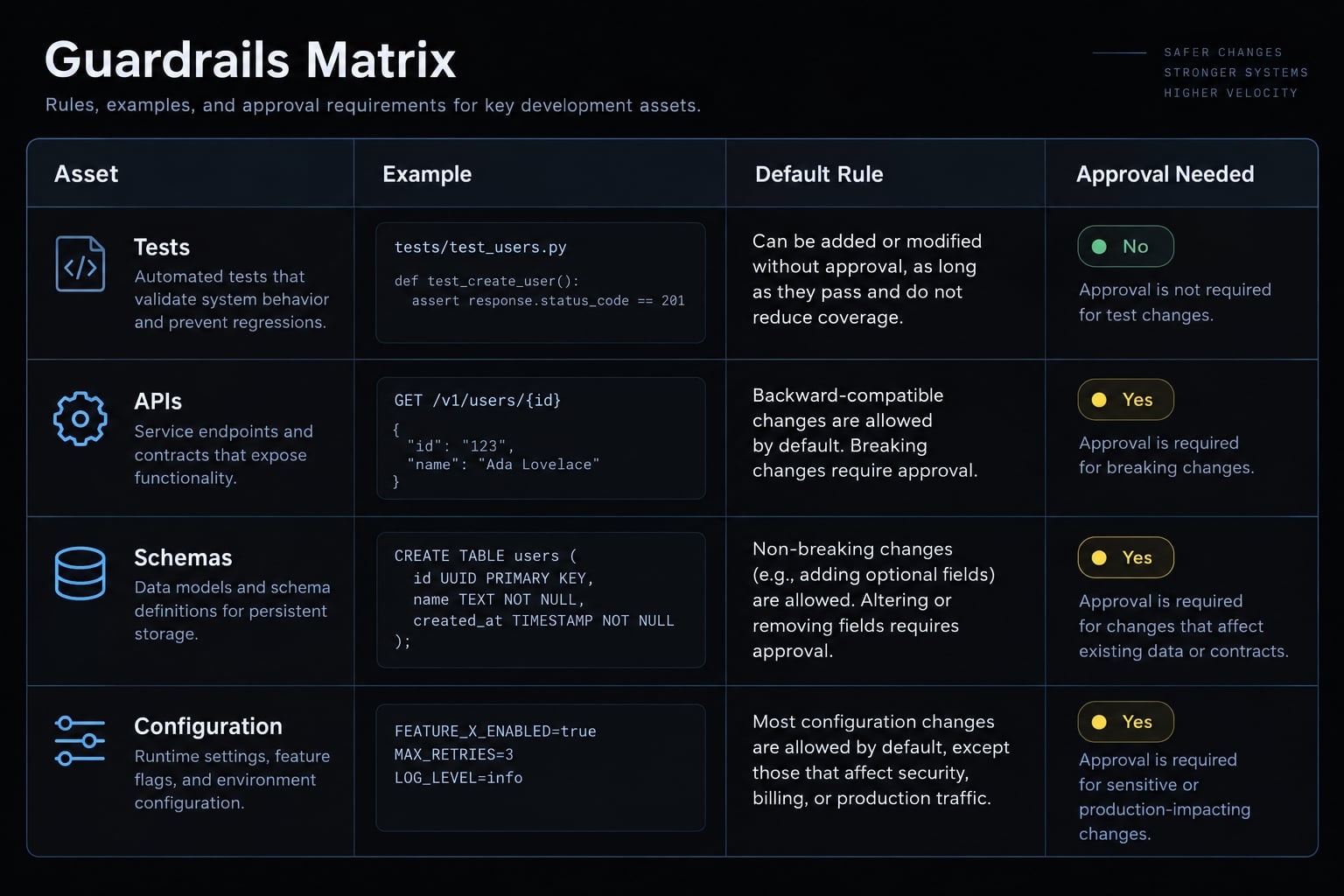
Define protected files and contracts
Public contracts include more than function signatures. They cover APIs, CLI flags, routes, schemas, serialized outputs, events, exceptions, configuration formats, and other interfaces used by external callers.
Define protection rules by category:
- APIs: Preserve public methods, parameters, return types, and documented exceptions.
- Routes and CLI: Preserve paths, flags, exit codes, and output formats.
- Data: Do not modify schemas, migrations, serialization, or event payloads.
- Security: Do not change authentication or authorization behavior.
- Operations: Protect deployment files and environment configuration.
- Dependencies: Do not add packages or modify lockfiles without approval.
- Generated assets: Do not edit generated files directly.
- Tests: Preserve existing tests and fixtures during the first implementation pass.
- Excluded modules: List directories that are explicitly out of scope.
Production code and tests should not be modified together unless each change is separately justified and approved. Otherwise, a generated test rewrite can conceal a regression.
Add one explicit stopping rule: If implementation requires crossing a protected boundary, stop and request approval without editing that boundary.
Add characterization tests when coverage is weak
Characterization tests are tests that record current observable behavior before weakly tested or legacy code is restructured. They capture outputs, exceptions, and important side effects, including awkward behavior that may need to remain stable during refactoring until a separate behavior change is explicitly approved.
Use this analysis prompt before touching production code:
Analyze [target module] without modifying production code.Propose minimal characterization tests for representative inputs, outputs,exceptions, and important side effects. Identify behavior that cannot bevalidated automatically.Do not rewrite existing tests. Do not implement the refactor. Stop afterpresenting the proposed tests, assumptions, and coverage gaps for approval.
Characterization tests improve regression testing, but they only cover recorded scenarios. Security-sensitive, concurrent, performance-sensitive, and data-migration code may require specialized validation.
Ask Claude Code to analyze and plan before it edits
Diagnosis and implementation should be separate stages. Before making changes, Claude Code should inspect the target, direct callers, dependencies, side effects, and protected contracts.
Recommendations should be prioritized by maintainability value, regression risk, and review effort. Abstract advice such as “apply SOLID” is insufficient unless it identifies specific code, consequences, and implementation boundaries.
Bad prompt vs. better refactoring prompt
Prompt type | Example | Likely outcome |
|---|---|---|
Vague | “Refactor this module and clean up related code.” | Broad edits, optional cleanup, unclear stopping point |
Bounded | “Analyze | Reviewable diagnosis and explicit approval gate |
Copy-ready analysis prompt
Analyze [target file] and related direct callers without editing any files.Identify:1. Current responsibilities.2. Direct callers.3. Dependencies.4. Side effects.5. Public contracts.6. Material code smells.7. The top five behavior-preserving improvements.8. Regression risk for each improvement.9. Expected maintainability impact.10. Any recommendation that could change external behavior.Prioritize recommendations by maintainability value, regression risk, andreview effort. State assumptions and missing evidence.Do not implement anything until I approve one recommendation.
This prompt combines static code analysis, code smell analysis, and dependency identification without authorizing changes.
Approve a bounded plan
A usable refactoring plan should define:
- One approved structural change.
- Exact files allowed to change.
- Files and modules that remain protected.
- Public contracts that must remain stable.
- Build, test, lint, and type-check commands.
- Assumptions requiring verification.
- Known technical debt deferred to later iterations.
- A stopping condition if scope expands.
A plan is not bounded when it includes phrases such as “update related code as needed.” Every additional file or responsibility should require a new approval decision.
Execute one small refactor at a time
Incremental refactoring means completing and reviewing one structural change before beginning another. It reduces review cost, simplifies failure isolation, and creates an independent rollback point.
A small change is defined by conceptual scope, not only line count. Changing five lines can still be unsafe if those lines alter a public contract, exception type, or side-effect order.
Implementation prompt for a single change
Goal:Implement only this approved refactoring: [approved change].Constraints:- Preserve observable behavior.- Modify only [approved files].- Do not modify existing tests or public APIs.- Do not add or update dependencies without approval.- Do not perform unrelated formatting, renaming, or cleanup.- Stop if implementation requires changes outside the approved scope.Validation:Run [validation commands].If repository instructions are unclear, stop rather than inventing commands.Report:- List every changed file.- Explain why each change was necessary.- Report failed checks, assumptions, and remaining risks.- Stop after this first implementation.
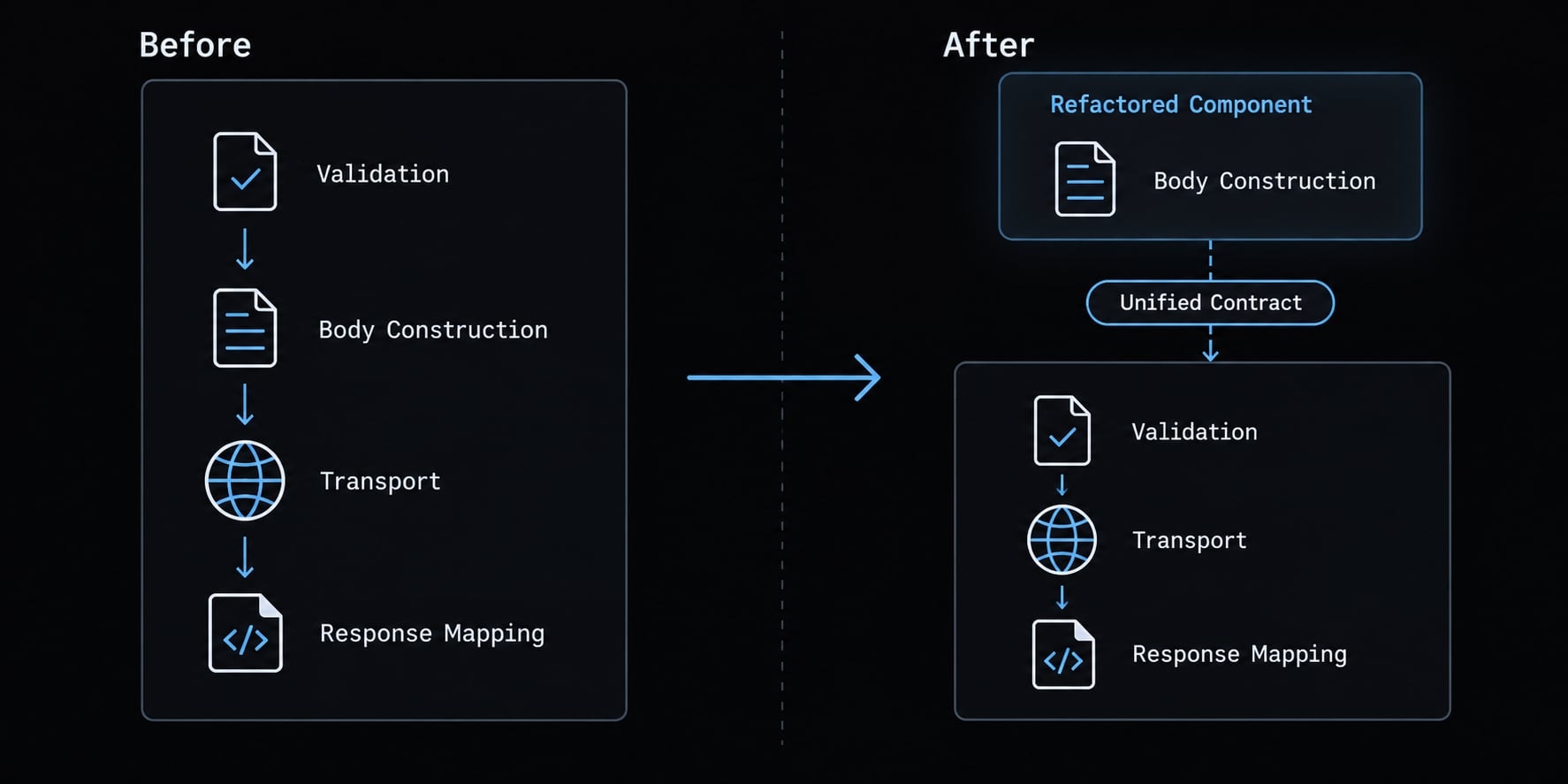
Realistic example: Extract one responsibility from a large class
Consider a representative request-handling class with four responsibilities:
- Validate request settings.
- Construct the request body.
- Configure the transport.
- Map the response.
Do not approve full modularization in one pass. Approve only the extraction of request-body construction.
Before editing, require Claude Code to identify:
- Inputs used to create the body.
- Returned value or resulting state.
- Direct callers.
- Exceptions and side effects.
- Existing tests covering that behavior.
- Files required for the extraction.
The first iteration may introduce one focused component and update the original class to call it. The public contract remains stable, while validation, transport setup, and response mapping remain untouched.
Review the result for excessive parameters, hidden coupling, and unnecessary interfaces. If the extracted method requires too many arguments, record that as a separate design issue. Do not automatically expand the current task.
Commit or revert before continuing
After each behavior-preserving change, make one decision:
- Commit: The diff is understood, validated, and fully within scope.
- Revise: The goal is valid, but the implementation is broader or less clear than expected.
- Revert: Protected files changed, behavior is uncertain, or the diff cannot be explained confidently.
Do not stack several unreviewed AI-generated changes. A sequence of individually reversible commits is safer than one large multi-file modification with mixed goals.
Validate the refactor beyond “The tests passed”
Passing tests lowers risk, but it does not prove that every output, exception, side effect, integration, or production condition remains equivalent. Automated checks only validate the scenarios and properties they encode.
Validation should combine project checks, Git diff review, and human design review.
Validation layer | What to check | What it does not prove |
|---|---|---|
Build or compile | Syntax, references, generated artifacts | Correct runtime behavior |
Unit tests | Encoded component scenarios | Untested inputs and integrations |
Integration tests | Cross-component interactions | Every production condition |
Lint and type checks | Style, types, selected static risks | Design quality or stable side effects |
Git diff review | Scope, contracts, hidden modifications | Correctness of every changed line |
Human review | Intent, clarity, architecture, risk | Complete semantic equivalence |
Run git diff --stat before line-level inspection. It provides a fast scope check and makes unexpected multi-file changes visible. Then inspect the full diff using the repository’s normal code review workflow. See the official git diff documentation for command behavior.
Check specifically for:
- Unrelated files.
- Deleted assertions.
- Rewritten tests or fixtures.
- Lockfile or dependency changes.
- Public API modifications.
- Different exception types or messages.
- Changed output or serialization formats.
- Reordered side effects.
- Configuration changes.
- Generated-file modifications.
- Unexplained formatting churn.
Post-refactoring review prompt
Review the current diff without editing any files.Compare it with this approved goal: [approved goal].Report:1. Every changed file.2. Any change outside the approved scope.3. Contract or observable behavior changes.4. Test, fixture, configuration, or dependency changes.5. Validation commands run and their results.6. Assumptions and remaining regression risks.7. Exact changes that should be reverted if scope was exceeded.Recommend one outcome: accept, revise, or revert. Explain the reasons.
Claude Code’s explanation may help organize the review, but it cannot replace direct inspection.
Human review checklist
- Every changed line maps to the approved goal.
- Existing tests and assertions remain intact.
- Error handling remains stable.
- Side-effect order remains stable.
- Public contracts and serialized outputs remain stable.
- No unnecessary abstraction or dependency was added.
- The resulting code is easier to understand.
- The change can be reverted independently.
Security, performance, concurrency, caching, and migrations require additional evidence beyond ordinary regression testing.
Copy-ready Claude Code prompts and CLAUDE.md rules
Effective Claude Code prompts identify the task stage, target scope, protected behavior, validation requirements, and stopping condition. Keep analysis and implementation separate unless the change is already approved and narrowly defined.
1. Decompose a large class
Analyze [target class] without editing. Map its responsibilities, callers,dependencies, side effects, and public contracts. Identify the smallestindependently extractable responsibility, expected files, relevant tests,and regression risks. Wait for approval before implementation.
2. Simplify a long function
Analyze [target function] without editing. Map branches, early returns,exceptions, and side effects in execution order. Recommend one extractionthat preserves return values and exceptions. State risks and wait for approval.
3. Remove duplicate logic
Analyze suspected duplication in [approved files] without editing. Distinguishexact behavioral duplication from superficially similar code. Compare callers,contracts, edge cases, and side effects. Recommend consolidation only whereequivalence is supported by evidence. Wait for approval.
4. Identify dead code safely
Identify dead-code candidates in [target scope] without deleting anything.Check direct references, reflection, dependency injection, frameworkregistration, configuration, plugins, hooks, tests, and generated use.Report evidence, uncertainty, and validation needed before removal.
5. Analyze regression risk
Review the proposed change to [target module] without editing. Assess risks toAPIs, serialization, exceptions, side effects, concurrency, caching, databaseaccess, and performance-sensitive paths. Rank risks and identify requiredvalidation. Stop after the report.
6. Review the final refactor
Review the final diff without editing. Compare every changed file with[approved goal]. Detect scope drift and changes to contracts, tests,dependencies, configuration, exceptions, or side effects. Recommend accept,revise, or revert, with reasons and exact corrective actions.
Minimal CLAUDE.md refactoring rules
Repository guidance can be stored in CLAUDE.md. Confirm current file discovery and instruction behavior in Anthropic’s official CLAUDE.md and memory documentation.
# Refactoring Rules- Plan and report risks before editing.- Preserve observable behavior unless a behavior change is explicitly approved.- Complete one structural change per iteration.- Do not modify tests and production code together without separate approval.- Protect public APIs, schemas, dependencies, and configuration.- Do not perform unrelated cleanup, renaming, or formatting.- Modify only the files approved in the task prompt.- Run these validation commands: [validation commands].- Summarize the diff and list every changed file after implementation.- Stop when the task requires expanding scope or crossing a protected boundary.- Report assumptions, failed checks, and behavior that cannot be validated.
CLAUDE.md is persistent guidance, not an enforcement mechanism. Task-specific prompts must still define the approved scope, and developers must inspect the resulting diff.
Model, CLI, permission, and instruction behavior may change after updates. Verify current behavior against official documentation rather than assuming repository instructions will always be followed exactly.
Common mistakes, recovery steps, and final checklist
The most common failure in AI-assisted refactoring is uncontrolled scope, not invalid syntax. A change may compile and pass tests while still modifying contracts, hiding regressions, or creating AI-generated technical debt.
Mistake | Why it fails | Corrective action |
|---|---|---|
Broad repository-wide request | Produces mixed, difficult-to-review changes | Restrict work to one responsibility |
Tests and implementation changed together | Test rewrites can conceal regressions | Separate and approve each change |
Multiple refactors in one pass | Failures cannot be isolated reliably | Complete one iteration at a time |
Unrelated cleanup accepted | Adds scope drift and review noise | Revert unrelated edits |
Passing tests treated as proof | Untested behavior remains uncertain | Add diff and human review |
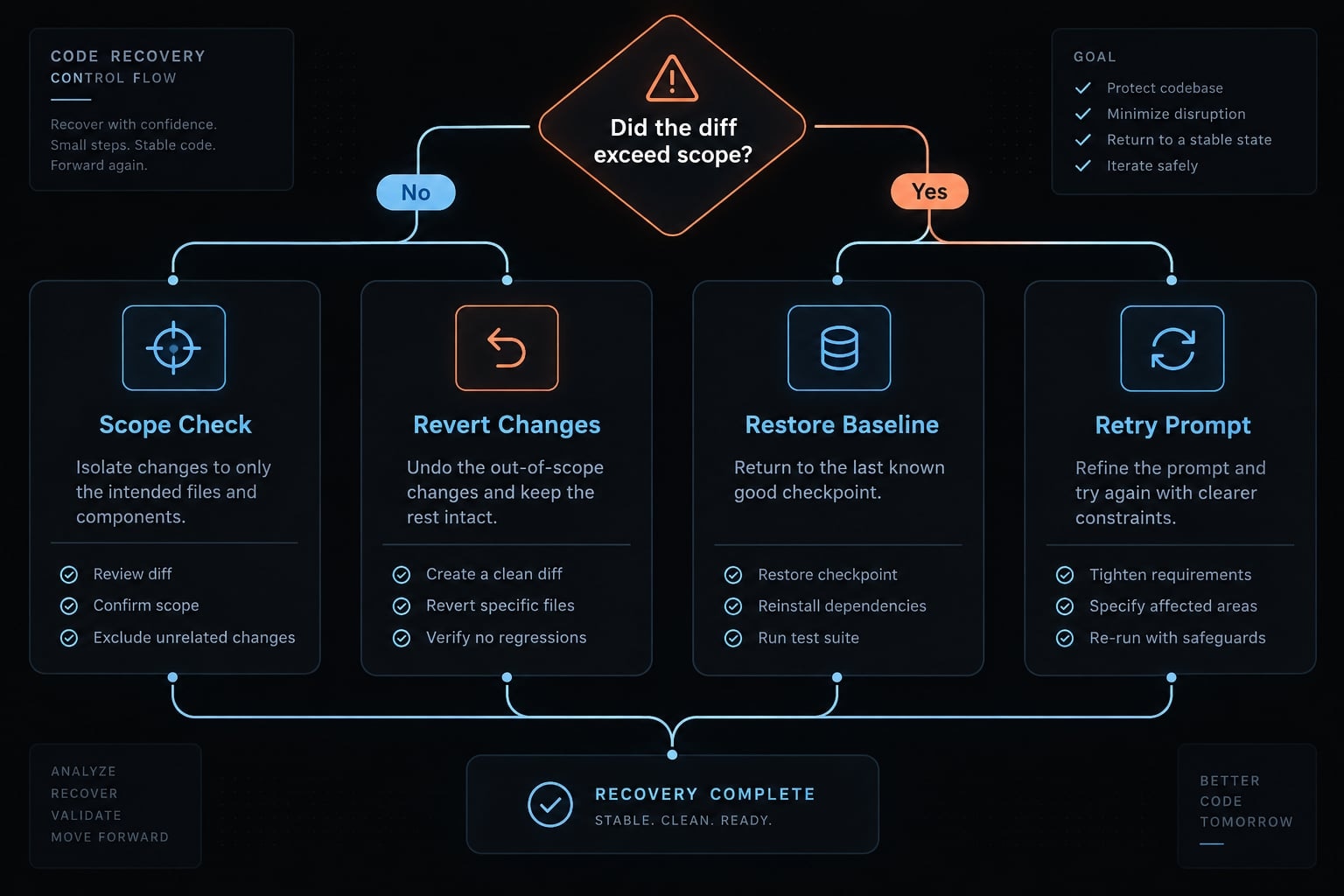
Recovery procedure for an oversized or incorrect diff
- Stop further implementation.
- Run
git statusandgit diff --stat. - Inspect the full diff.
- Preserve useful analysis separately if needed.
- Revert unrelated or unexplained changes.
- Restore the last clean checkpoint when separation is impractical.
- Ask Claude Code to explain the failure without editing.
- Rewrite the prompt with narrower scope, rerun the baseline, and attempt one smaller change.
Use git status and your team’s normal restoration procedure. Do not run destructive commands such as git reset --hard unless you understand that uncommitted work may be permanently discarded. Treat an unexplained diff as unresolved risk. Continuing to edit on top of it makes later Git rollback more difficult.
Final pre-commit checklist
- The diff addresses one approved goal.
- Only expected files changed.
- Tests were not weakened or silently rewritten.
- Build and automated checks completed.
- Public APIs and observable behavior remain stable.
- Error handling and side-effect order remain stable.
- Integrations and data contracts remain stable.
- Assumptions and unresolved risks are documented.
- A developer reviewed the complete diff.
- The change has an independent rollback point.
Treat Claude Code as a controlled refactoring partner
Effective Claude Code refactoring depends less on generated volume than on explicit boundaries, stable contracts, and reviewable diffs. Use the same operating loop every time: Baseline, analyze, approve, implement narrowly, validate, then commit or revert. Passing tests provides evidence of behavior preservation, but untested exceptions, side effects, integrations, and production conditions may still differ.
Copy the Claude Code refactoring workflow, prompt pack, and CLAUDE.md checklist into your repository documentation. For coordinating separate analysis, implementation, testing, and review roles, explore the AgentKit Engineer workflow.
Frequently asked questions
What is Claude Code refactoring?
Claude Code refactoring is an AI-assisted process where you use the Claude Code CLI to analyze, restructure, and improve existing codebases while preserving observable behavior. It relies on a human-in-the-loop approach, requiring you to define scope, approve specific plans, and validate changes incrementally.
Can I use Claude Code for repository-wide refactoring?
No. Broad requests like "clean up the entire codebase" are dangerous and prone to failure. The safest approach is to use Claude Code to execute small, bounded changes—such as extracting one responsibility from a large class—and verifying each step before proceeding to the next.
How do I prevent Claude Code from breaking my project?
To minimize risk, establish a clean Git baseline, define protected files (like public APIs and schemas), and use characterization tests to lock in current behavior. Always review every diff before committing and perform changes in small, independently reversible iterations rather than bulk edits.
Do passing tests guarantee that refactoring is successful?
No. Passing tests only validate scenarios covered by those tests. They do not prove full semantic equivalence or ensure that side effects, integrations, or edge-case conditions remain unchanged. Always supplement automated tests with manual diff inspection and human code review.
What should I do if Claude Code generates an oversized diff?
Immediately stop the implementation. Run git diff --stat to identify the scope of changes. If the changes are too broad to review confidently, revert to the last clean checkpoint, refine your prompt to narrow the focus, and re-run the process with a smaller, more specific goal.
How can I make Claude Code follow my repository rules?
Create a CLAUDE.md file in your repository root to document persistent constraints, such as required validation commands and protected module boundaries. However, remember that CLAUDE.md is guidance; you must still provide task-specific instructions in your prompts to maintain precise control.
Why is a "human-in-the-loop" approach necessary for refactoring?
Even advanced AI can misinterpret complex dependencies or introduce regressions in untested paths. A human developer must act as the final approval gate to verify that the generated changes align with the original architectural intent and maintain the integrity of external contracts.
Read more:
- Mastering the Claude Code workflow for reliable AI development
- Claude Code prompt engineering: A practical guide for developers
- Claude Code react: Best practices for faster frontend dev
Conclusion
In conclusion, Claude Code refactoring works best when you keep each change small, well-scoped, and easy to review. By validating every step and preserving behavior, you reduce risk and make AI-assisted refactoring safer and more reliable.