
Vibe coding governance: A practical framework for secure AI-assisted development
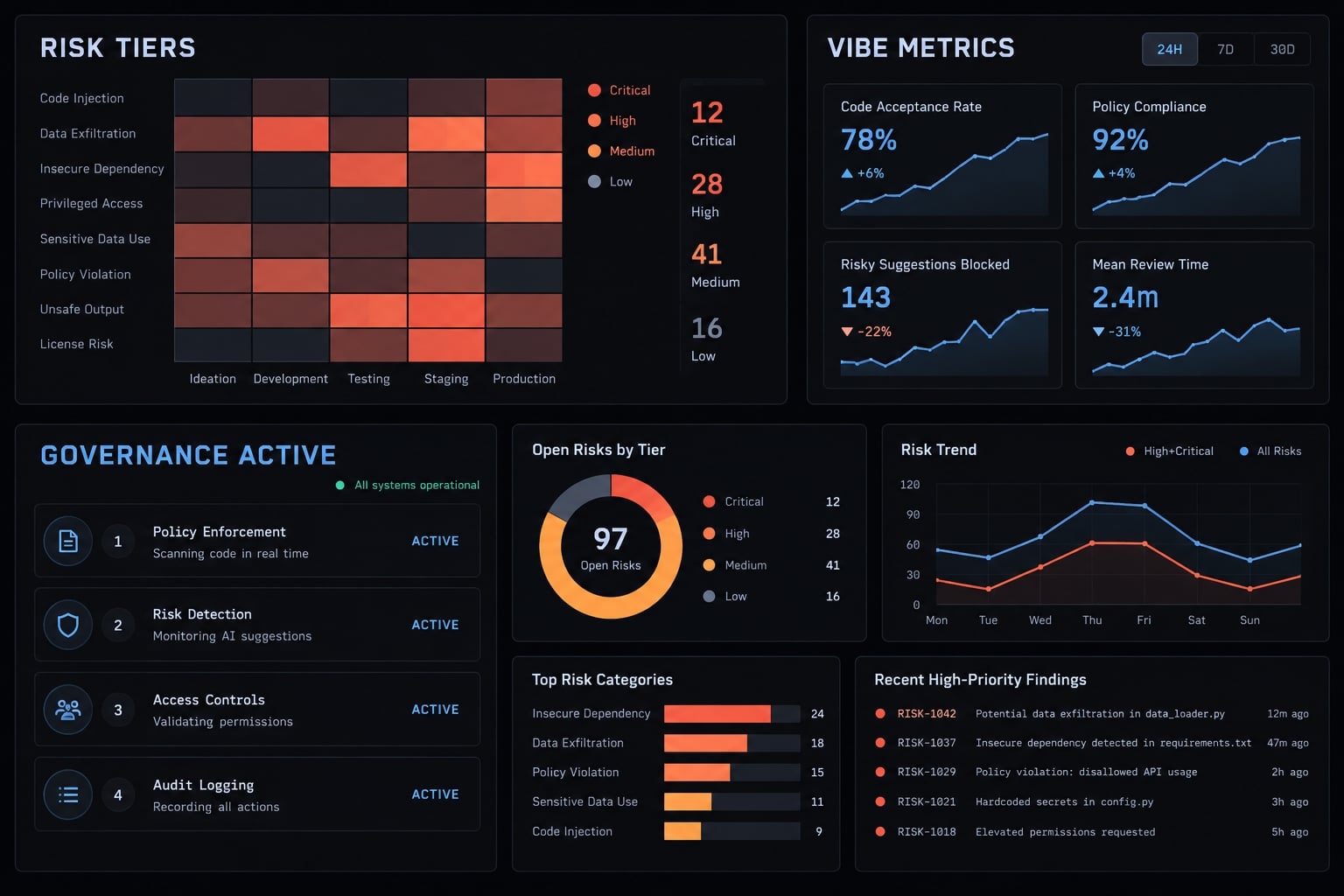
Generating usable software is no longer the primary bottleneck; establishing safe operational ownership is. Vibe coding governance bridges this gap by connecting risk tiers, safeguards, and production gates, ensuring teams can preserve development speed without sacrificing accountability as AI experiments transition into consequential use.
What is vibe coding governance?
Vibe coding governance is the combination of policies, roles, controls, and evidence used to oversee outcome-led, AI-assisted software development throughout its lifecycle. It covers generated code, agent behavior, connected tools, data access, dependencies, release decisions, and ongoing operations, with safeguards proportionate to the consequences of failure or misuse.
Andrej Karpathy’s February 2025 description emphasized informal development through conversational instructions, with limited attention to the underlying code. That narrower meaning differs from professional AI-assisted development, where engineers may review every change.
Here, the term concerns oversight of outcome-led workflows not every use of autocomplete. Agents may modify files, invoke tools, install dependencies, or propose deployment actions. Governance therefore extends beyond reviewing the final code.
Code provenance means traceability of relevant sources, dependencies, changes, and build artifacts. Identifying the model alone does not establish complete provenance or reveal its training-data lineage.
Vibe coding governance vs traditional SDLC governance
Existing software development lifecycle (SDLC) governance remains the foundation. Human-written software can also be poorly understood or inadequately reviewed; AI changes the pressure on those controls.
Dimension | Established SDLC governance baseline | AI-assisted pressure point | Governance implication |
|---|---|---|---|
Input and intent | Requirements and acceptance criteria | Conversational instructions may omit constraints | Record consequential requirements explicitly |
Change volume | Review changes before release | Generation can exceed review capacity | Limit change scope; prioritize risky changes |
Human understanding | Maintainers understand critical behavior | Output may be accepted without understanding | Require explanation and substantive review |
Tool permissions | Developers and services receive scoped access | Agents can chain available capabilities | Bound execution and credentials |
Generation variability and controlled artifacts | Version sources and build inputs | Identical prompts may produce different output | Preserve accepted changes and build evidence |
Non-deterministic generation means outputs can vary; it does not mean versioned builds must be irreproducible. Comprehension debt is a useful descriptive term for understanding knowledge gaps, but it is not a standardized audit measure.
The business risks behind ungoverned vibe coding
AI-generated code is not inherently insecure. AI-generated code security depends on behavior, deployment context, access, and verification not authorship alone. The management question is which failures matter and who controls them:
Risk | Business consequence | Minimum control | Primary accountable function |
|---|---|---|---|
Vulnerable behavior | Data exposure or service abuse | Critical-path testing and review | Engineering |
Sensitive prompt/context data | Confidential information disclosure | Approved data-handling rules | Data owner |
Exposed secrets | Unauthorized system access | Secret management and scanning | Platform/security |
Unverified dependencies | Compromise or licensing disputes | Dependency verification and review | Engineering |
Unapproved production use | Unsupported outages or changes | Explicit release authorization | Engineering management |
Low human understanding | Slow maintenance and recovery | Qualified maintainer review | Technical owner |
Excessive agent permissions | Unauthorized consequential actions | Scoped execution and credentials | Platform/security |
Missing evidence | Weak investigation and assurance | Change-linked release records | Engineering management |
Unowned applications | Unresolved failures and neglect | Named technical and business owners | Business leadership |
Security, secrets, and software supply-chain exposure
Separate application behavior, data/secrets, dependencies, and connected tools. Each needs different checks.
Software Composition Analysis (SCA) identifies dependencies and known vulnerabilities; it can flag licensing information but does not prove legal clearance or detect every supply-chain threat.
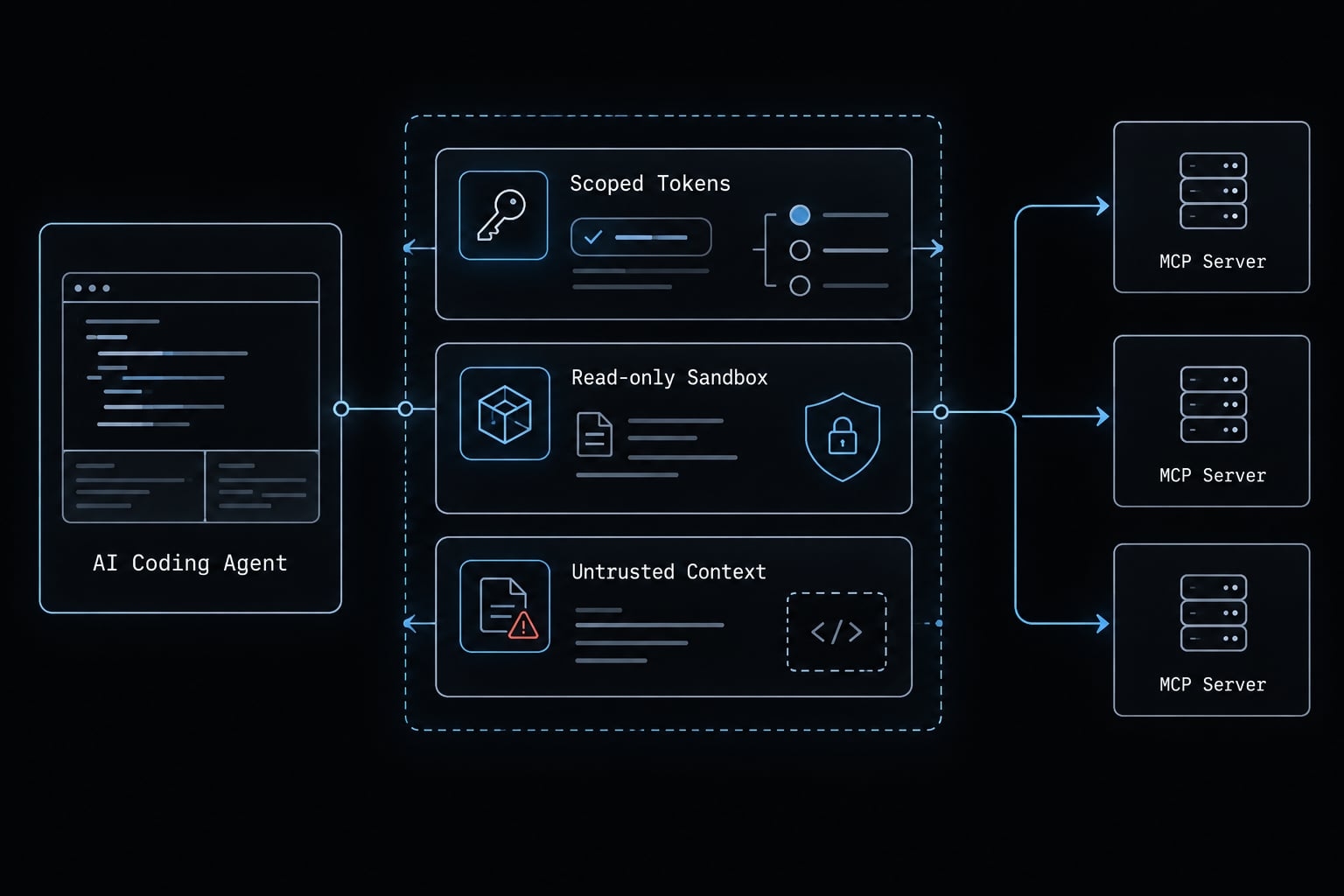
Model Context Protocol (MCP) connects agents with tools and resources. Its risk depends on connected capabilities, credentials, permissions, and trust boundaries—not the protocol name.
Untrusted repository or tool content may influence agent actions through prompt injection. OWASP’s guidance on excessive agency supports restricting consequential capabilities rather than relying only on instructions. CISA’s Secure by Design guidance similarly emphasizes security ownership and safer defaults.
Shadow operations and prototype-to-production drift
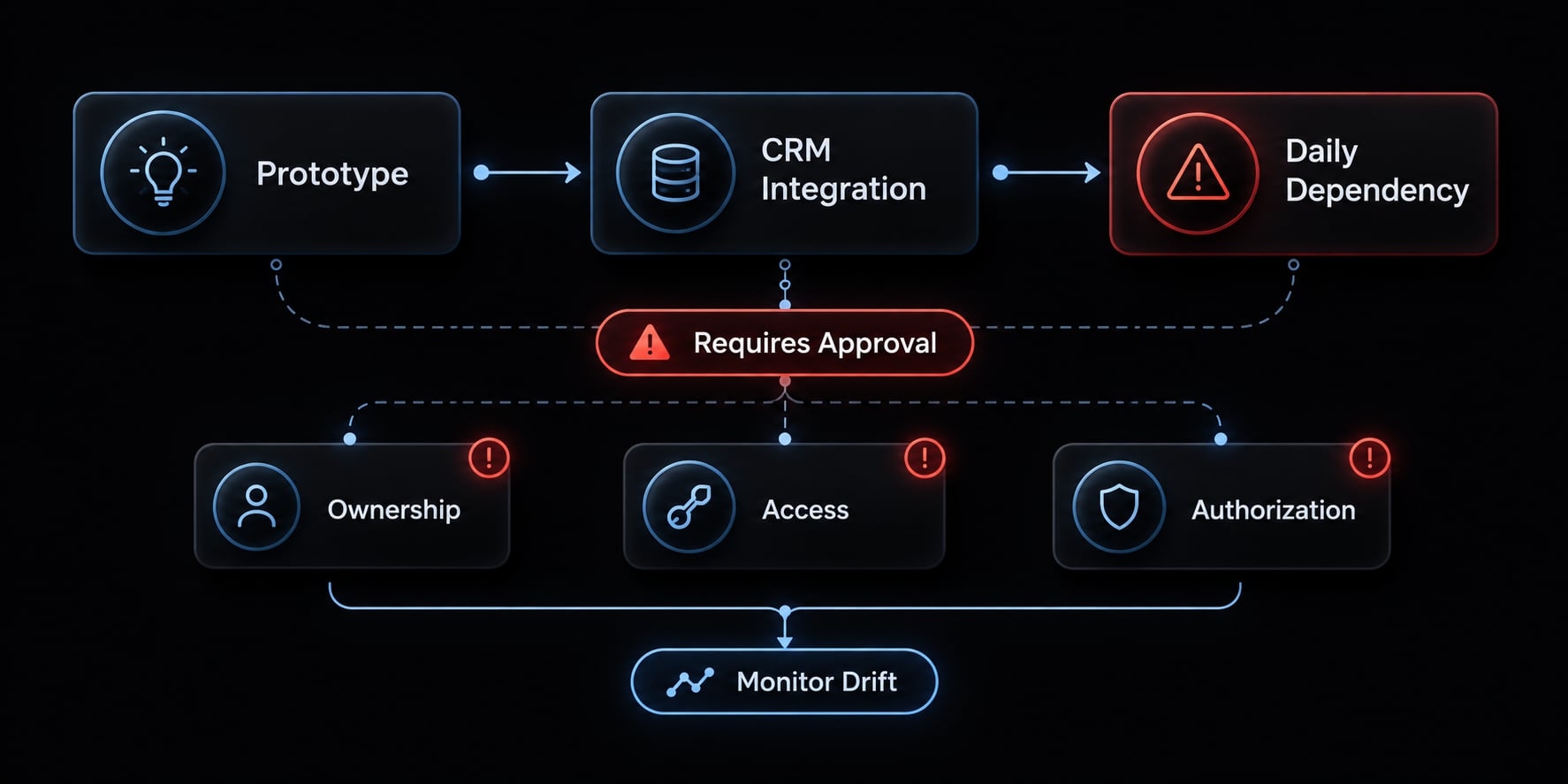
Shadow IT concerns unapproved technology adoption. Shadow operations, as used here, means an unmanaged workflow becoming operationally necessary.
In the illustrative onboarding scenario, a utility connects to a customer relationship management (CRM) system and becomes a daily dependency. Yet nobody owns support, reviews changes, or authorizes its release.
Technical debt and comprehension debt
- Technical debt: Structural compromises increase future change costs.
- Comprehension debt: Understanding gaps weaken maintenance, review, and incident response.
Both can exist in human-written software. Rapid generation can make either harder to notice before adoption.
Accountability, Compliance, and Audit Gaps
A named owner must investigate failures; an authorized person must accept residual risk. Missing approvals, access records, and release evidence weaken the audit trail connecting decisions to consequences.
Legal obligations depend on jurisdiction, data, purpose, contracts, and impact, not simply on whether AI wrote the code. Regulated or high-impact uses need specialist review. Scans and human reviews reduce risk; neither guarantees security or legal compliance.
Classify the risk before applying controls
Risk-based governance starts with consequences, not approval volume. Assess six factors before assigning controls:
- Data sensitivity.
- User exposure.
- Business criticality.
- Production access.
- Regulatory relevance.
- Agent autonomy and potential consequences.
These factors support judgment, not a validated scoring formula. A severe factor should trigger escalation rather than be averaged away by lower-risk characteristics.
NIST’s AI Risk Management Framework supports contextual, lifecycle-based assessment. The following tiers are a proposed operating model, not NIST’s classification scheme.
A Three-tier vibe coding risk model
Tier | Typical use | Data/access boundaries | Minimum governance |
|---|---|---|---|
Tier 1: Experiment | Isolated prototype or learning exercise | Synthetic/public data, no production credentials or consequential use | Owner, approved tools, isolation, disposal decision |
Tier 2: Internal Operational Tool | Bounded reporting or workflow utility | Approved integrations; scoped, non-high-risk access | Ownership, tests, review, access controls, monitoring, release decision |
Tier 3: Production or High-Risk System | Customer-facing, critical, regulated, sensitive, or consequential system | Explicitly authorized sensitive or production capabilities | Stronger review, release evidence, recovery planning, accountable approval |
Internal does not automatically mean low risk. An internal billing utility capable of changing customer balances belongs in Tier 3. High-risk systems need stronger controls before launch, not only after production deployment.
The onboarding scenario illustrates two escalation points:
- Moving from synthetic data to a limited, approved CRM integration requires reassessment. Tier 2 may apply if access and consequences remain bounded.
- Requesting production write access that changes customer entitlements or billing pushes the workflow toward Tier 3.
Reassess the project risk tier when data, access, users, autonomy or operational importance changes. Even lower-risk internal tools need release controls appropriate to their use.
When human review must increase
An AI coding policy should trigger deeper review for changes involving:
- Authentication and authorization.
- Cryptography.
- Financial logic.
- Personal or regulated data.
- External network access.
- Infrastructure configuration.
- Destructive database operations.
- Autonomous consequential actions.
Review depth should match the change and impact, every trigger does not require the same committee.
Human-in-the-loop oversight requires competence, context, authority, and time. An approval click without these conditions is not meaningful review. Assign reviewers who can challenge the implementation and stop release when evidence is insufficient.
The VIBE governance framework
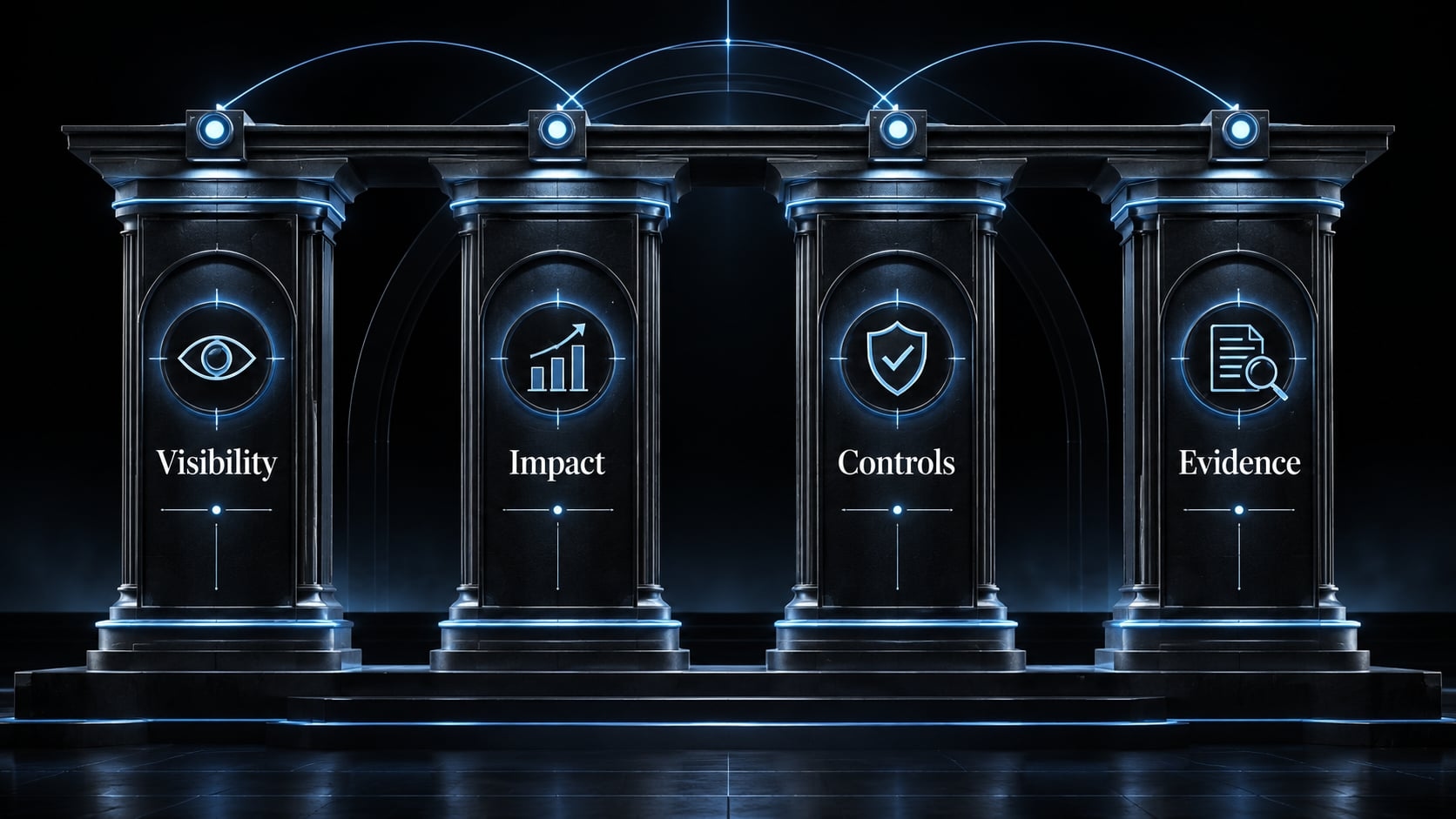
VIBE is AgentKit’s practical organizing framework, not an external standard. It groups governance into four responsibilities:
- Visibility: Know what exists, who owns it, and what it can access.
- Impact Classification: Match controls to operational consequences.
- Built-In Controls: Make safe execution and verification repeatable.
- Evidence and Accountability: Preserve decisions and assign human responsibility.
This governance framework for AI-generated software complements established secure development practices. NIST’s Secure Software Development Framework (SSDF) supports verification and release integrity; it does not endorse VIBE.
V - Visibility
Maintain a minimum inventory containing:
- Project, repository, technical owner, and business owner.
- Agent/model and material configuration.
- Plugins, MCP servers, application programming interfaces (APIs), and connected tools.
- Data sources and execution/deployment environments.
- Current tier and operational status.
The inventory should expose systems without accountable ownership and workflows exceeding approved scope. Record actual use, not merely intended use: an “experiment” used every morning is an operational dependency.
Assign responsibility for updates and connect inventory changes to access and release requests. A register nobody maintains becomes historical documentation rather than a control.
I - Impact Classification
Use the three-tier model to select applicable controls. Name an authority for classification and escalation; security or privacy specialists should participate when relevant.
Follow a simple decision flow:
Register → classify → approve applicable controls → monitor change → reassess.
Provide a fast escalation route with a response expectation set by your organization. A blocked team needs a clear decision-maker, not an indefinite committee queue.
Reassessment should follow material changes, including broader credentials, new customer exposure, or increased dependency. Record both the decision and its rationale.
B - Built-In Controls
Combine preventive, detective, and corrective controls. Each addresses a different failure stage.
Control type | Practical controls | Intended result |
|---|---|---|
Preventive | Approved tools/data settings, least privilege, sandboxed execution, protected branches, repository-based changes, secret management | Limit unauthorized actions and exposure |
Detective | Tests, static code analysis, SCA, secret scanning, monitoring, alerting | Identify defects, unsafe changes, and abnormal behavior |
Corrective | Rollback, credential rotation, incident response | Contain harm and restore service |
Least privilege means granting only the access required for an approved task. A sandbox limits execution exposure, but its effectiveness depends on network access, mounted files, and available credentials.
Prompt instructions and agent skills are not enforced permission boundaries. Enforcement belongs in identity, repository, infrastructure, tool-access, and continuous integration/continuous delivery (CI/CD) systems.
“Verify before trust” is an assurance principle, not an allegation that generated output is malicious. Automated security scanning supports—not replaces—review of business logic and consequential behavior.
E - Evidence and Accountability
Retain proportionate evidence connecting:
- Pull requests, commits, and material agent/model configuration where available.
- Test results, scan results, and dependency records.
- Review decisions, approvals, build identifiers, and deployments.
- Exceptions, owners, and expiration dates.
Evidence access and retention must follow organizational policy. Do not retain raw prompts indiscriminately; they may contain confidential data. Prefer minimized or redacted records sufficient to explain decisions.
AI agents cannot carry organizational accountability. ISO/IEC 42001:2023 provides AI management-system context, but tool adoption alone creates neither certification nor a universal certification obligation.
From prototype to production: Operating model and readiness gates
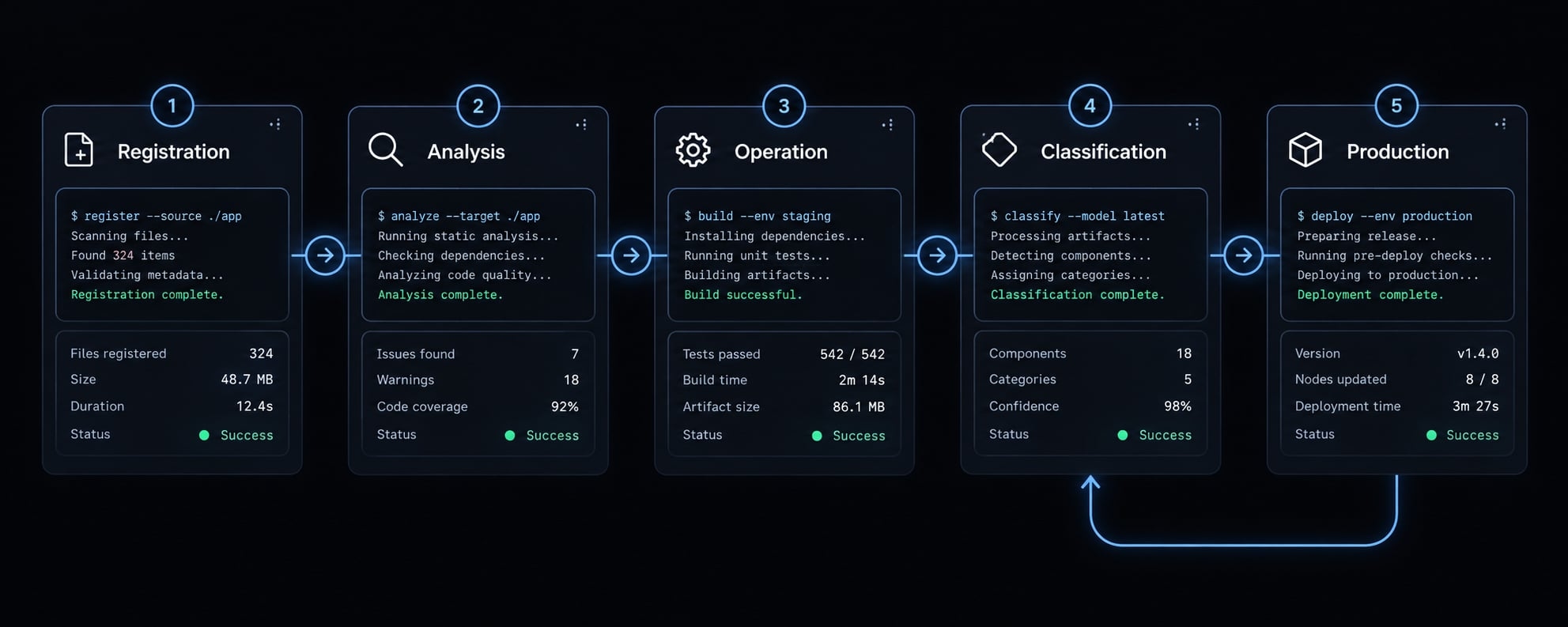
Production readiness is an accountable decision supported by evidence. Use five stages, each producing a concrete output:
- Register and classify: Inventory entry and risk decision.
- Build in an approved environment: Versioned change set.
- Verify according to risk: Change-linked test, scan, and review evidence.
- Authorize deployment: Approval tied to the release artifact.
- Monitor, reassess, and retire: Operational record and lifecycle decisions.
Role and accountability matrix
Role | Primary responsibility |
|---|---|
Builder | Implement changes and provide supporting evidence |
Technical owner | Maintain architecture, reliability, and supportability |
Business/product owner | Define intended use and acceptable business consequences |
Engineering manager | Resource reviews and enforce delivery policy |
Application security (AppSec) | Assess security-sensitive changes and findings |
Platform engineering | Enforce environment, identity, and delivery boundaries |
Privacy/legal/governance, risk, and compliance (GRC) | Evaluate applicable data, contractual, and legal obligations |
Deployment approver | Authorize release within delegated risk authority |
Smaller teams may combine roles, but must preserve accountability and required independent review. Each project needs named people or explicitly designated functions.
For the onboarding utility, write access requires evidence tied to the proposed change: authorization tests, duplicate-action handling, failure recovery, scoped credentials, and approval. Earlier read-only testing is insufficient.
Minimum production readiness checklist
- Owners: Named technical and business owners.
- Repository: Approved repository and version control.
- Classification: Recorded tier and reassessment date.
- Tools: Approved agents, models, integrations, and tools.
- Secrets: Kept outside code and exposed prompt context.
- Data: Sensitive data use identified and authorized.
- Dependencies: Scanned; licensing issues reviewed.
- Testing: Critical behavior and failure modes tested.
- Review: Required human review completed.
- Authority: Generation and deployment appropriately separated.
- Operations: Monitoring, alerting, rollback, and incident procedures available.
- Maintainability: Documentation sufficient for another qualified maintainer.
- Lifecycle: Review or retirement date assigned.
A successful workflow run does not prove every item is satisfied. Exceptions require an owner, rationale, compensating controls, approver, and expiration date.
Metrics that measure outcomes, not code volume
Metric | Management question |
|---|---|
Inventory coverage | Do we know what operates? |
Ownership coverage | Who supports each system? |
Tier reassessment coverage | Are classifications still accurate? |
Required-review completion | Did consequential changes receive review? |
Release-evidence completeness | Can releases be reconstructed? |
Pre-release security findings | What are checks detecting? |
Escaped production defects | What bypassed controls? |
Exception age and expiry compliance | Is temporary risk becoming permanent? |
Review and approval lead time | Where does governance create friction? |
Define numerators and denominators for rates, reporting windows, severity criteria, system populations, and risk-tier segmentation. Define start and end events for elapsed-time measures.
Separate findings detected before release from defects escaping into production. More detected findings may indicate improved visibility rather than worsening security. Pair delivery-friction measures with operational outcomes; faster approvals alone do not demonstrate better governance.
Governance by design for AI coding agents
Standardize repeatable work, while enforcing permissions outside the agent’s instructions. A practical AI coding workflow is:
- Choose approved tools and reusable skills.
- Load project standards and constraints.
- Scope file, shell, API, credential, and MCP access.
- Review plans before consequential changes.
- Keep modifications in version control.
- Run required tests and security checks.
- Route risk-triggered reviews.
- Authorize deployment separately.
These steps describe an operating model, not capabilities automatically enforced by a single product. Reusable workflows can reduce repeated setup and inconsistent checks, but controls must remain effective when a workflow is skipped.
How AgentKit can support a governed workflow
AgentKit is stated product scope includes specialized subagents, reusable skills, automated workflows, MCP integrations, a cross-platform command-line interface, and a desktop control center.
These capabilities can support coordination. Their presence does not establish non-bypassable approvals, immutable records, or organization-wide enforcement.
Governance need | AgentKit support described in its product scope | Remaining organizational or external control |
|---|---|---|
Repeatable implementation patterns | Agent kits, specialized subagents, reusable skills | Approve patterns and maintain standards |
Visible planning and coordination | Planning workflows and plan management | Assign reviewers and release authority |
Configuration and integration management | Configuration management and MCP integrations | Enforce agent permissions and credential scope |
Reusable testing/review/security workflows | Testing, code review, and security-check support | Enforce required repository and CI/CD gates |
Operational visibility | Desktop management of plans, configurations, and usage-related information | Maintain authoritative inventory and audit evidence |
Do not interpret token management as proof of credential authorization or rotation. Usage accounting and access security are separate requirements.
AgentKit does not replace secure SDLC controls, human ownership, AppSec, legal review, runtime monitoring, or incident response. Continuous compliance monitoring means ongoing control checks—not a determination of complete legal compliance.
Before adoption, validate relevant behavior in your environment, including bypass paths and external enforcement dependencies.
Suggested 30-Day Adoption Sequence
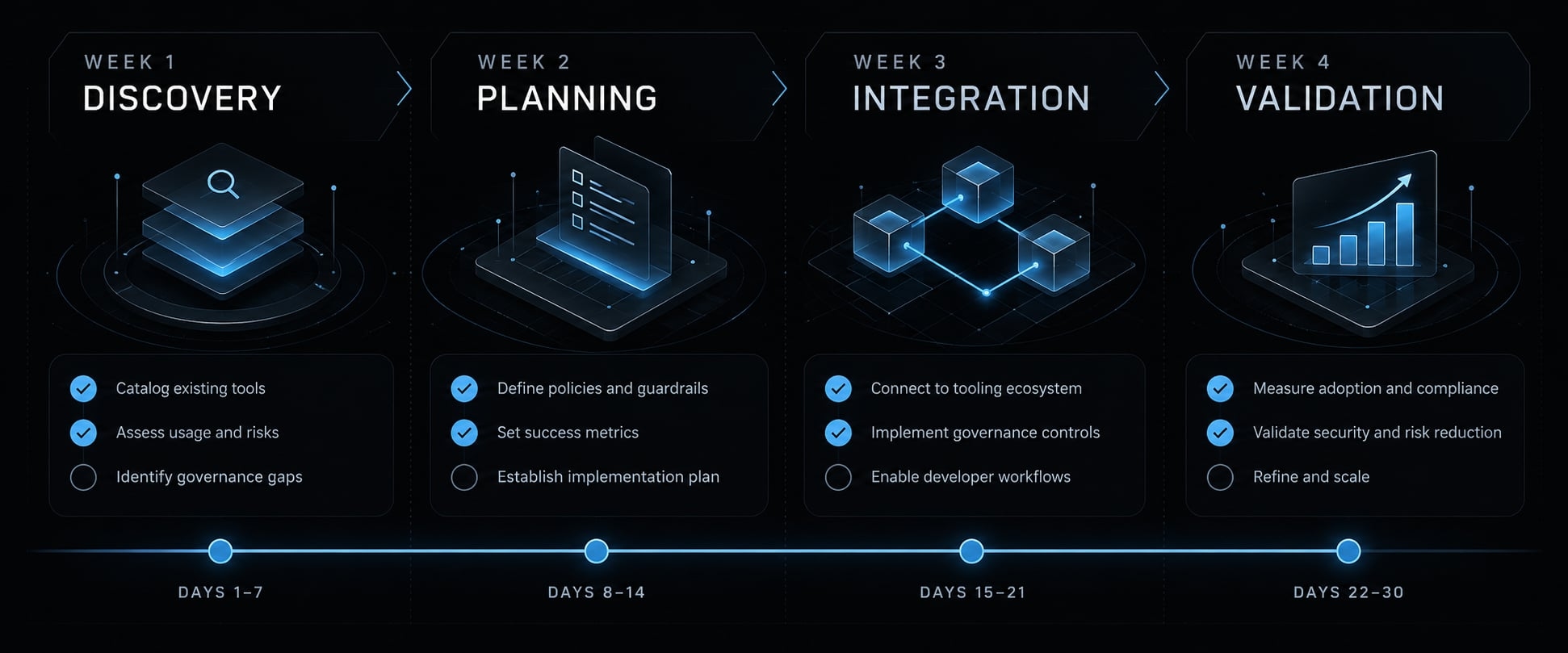
Treat minimum viable governance as a bounded pilot, not enterprise-wide maturity.
- Week 1 - Inventory and ownership: Deliver a project register identifying owners, integrations, environments, and actual operational use.
- Week 2 - Policy and boundaries: Deliver a lightweight AI coding policy, risk tiers, approved tools, and access boundaries.
- Week 3 - Enforced controls: Deliver repository protections, automated checks, review triggers, and release authorization rules.
- Week 4 - Pilot evidence: Deliver findings from one bounded workflow, friction measurements, and prioritized improvements.
Use the onboarding utility as a pilot with synthetic data or narrowly approved read-only access. Avoid unnecessary sensitive data and high-consequence permissions. Test whether unauthorized actions are blocked and evidence remains connected to the released change.
Thirty days establishes a starting sequence, not certification, security assurance, or mature enterprise governance.
Frequently asked questions
What is vibe coding governance?
Vibe coding governance is a framework of policies, toolchains, and human oversight designed to manage the operational and security risks of AI-assisted software development. It ensures that code generated by autonomous agents or prompts is traceable, secure, and aligned with organizational standards before entering production environments.
How does vibe coding differ from traditional SDLC governance?
While traditional SDLC governance relies on manual code reviews and version control for human-written code, vibe coding introduces high-velocity, non-deterministic generation. Governance here must shift toward automated pipeline gates, model-context restriction, and runtime monitoring to handle the rapid pace and inherent opacity of AI-generated output.
What are the primary business risks of ungoverned AI-assisted development?
The main risks include "comprehension debt," where generated code becomes unmaintainable; security vulnerabilities from unvetted dependencies; excessive agent permissions allowing unauthorized access to production systems; and "shadow operations," where business units deploy critical tools without visibility or formal accountability from security teams.
How can organizations classify the risk level of AI-generated projects?
Organizations should use a risk-based approach by evaluating data sensitivity, business criticality, and deployment scope. Projects are typically segmented into tiers: experiments using synthetic data (low risk), internal operational tools with bounded access (medium risk), and production systems handling sensitive or regulated data (high risk).
What is the VIBE framework for AI governance?
The VIBE framework for vibe coding governance (Visibility, Impact Classification, Built-In Controls, and Evidence) is an organizing model for software management. It requires teams to register projects, categorize their risk impact, enforce preventative and detective technical controls, and maintain an audit trail for all human-authorized deployment decisions.
Are human reviews still necessary with AI coding agents?
Yes. Human-in-the-loop review is a critical governance requirement. While AI can draft code, human engineers must remain the final authority on critical system components, including authentication logic, cryptographic modules, and infrastructure configurations, to ensure the output aligns with architectural standards and security requirements.
Read more:
- How to vibe code an AI agent: Build prototypes to production
- Vibe coding benefits: Uses, risks and best practices
- Vibe coding documentation: A guide for AI-assisted projects
Conclusion
Vibe coding governance works when visibility, classification, controls, evidence, and ownership reinforce one another. The objective is not to approve every prompt. It is to recognize when software gains sensitive access, becomes operationally necessary, or acquires authority to affect customers and business outcomes.
Start with one workflow and follow its transition from experiment to supported operation. Use risk-based governance to keep isolated experimentation lightweight while strengthening review where consequences justify it. Preserve the connection between a change, its verification evidence, its release approval, and the people responsible after deployment.