Vibe coding benefits: Where it saves time and where it still needs human oversight
Describing software through natural language accelerates prototyping and reduces initial setup effort for teams validating new ideas. However, functional AI-generated code is not inherently secure or maintainable, making human review—such as checking permissions and verifying behavior—essential. Balancing these benefits with potential risks enables teams to determine when prompt-led creation is appropriate and when a more rigorous development process is required.
What is vibe coding?
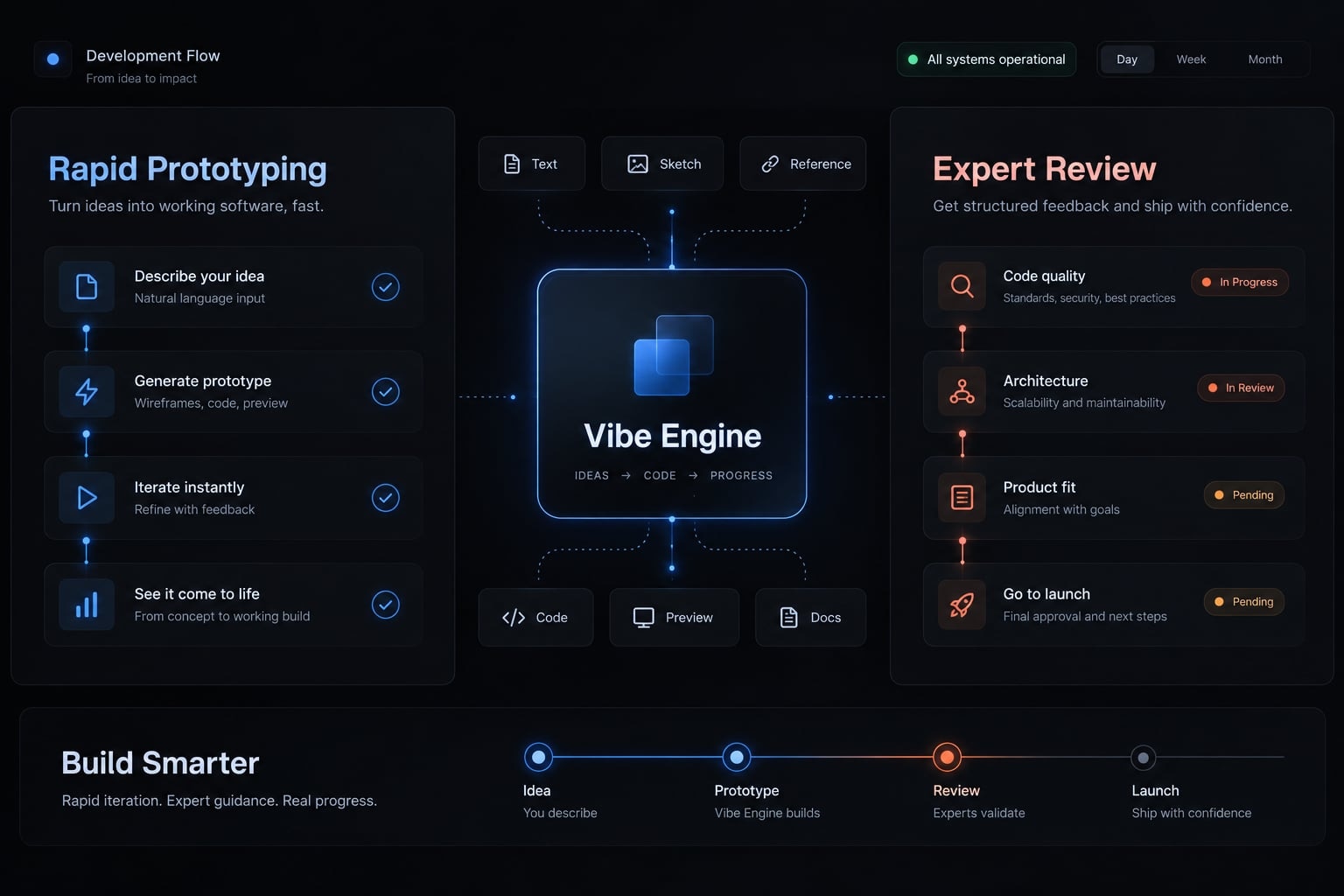
Vibe coding is a way of creating software by describing desired behavior to an AI tool, running its generated code, and requesting changes through further prompts. In its original sense, the builder largely judges visible results rather than closely inspecting or fully understanding the underlying implementation.
Andrej Karpathy introduced the term in his February 2025 social media description of this hands-off approach. Popular usage has broadened, but using AI to write code does not automatically mean abandoning implementation review.
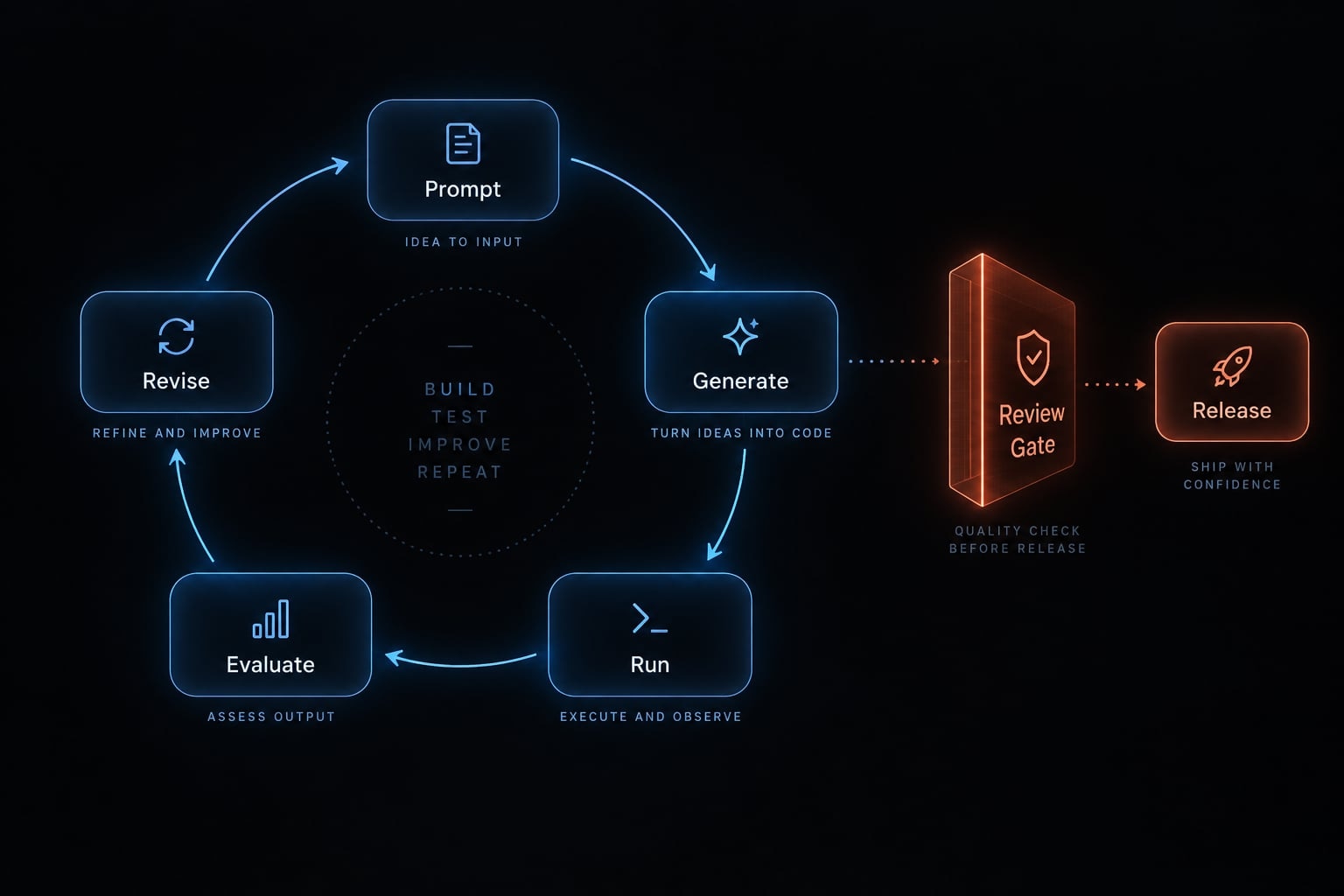
How vibe coding usually works
- Describe the desired result.
- Generate or modify the code.
- Run the application.
- Report errors or request changes.
- Repeat and evaluate the output.
Functioning code does not mean it is ready for release.
Vibe coding vs. AI-assisted development
AI-assisted development is broader and can include rigorous engineering. These are typical workflow differences, not categories determined by tool choice.
Vibe coding | Reviewed AI-assisted development |
|---|---|
Desired outcomes drive prompts | Specifications and outcomes guide changes |
Limited implementation inspection | Deliberate code review |
Fast exploration | Reviewed delivery |
Often disposable experiments | Systems intended for maintenance |
Prompt iteration | Tests, documentation, approval gates |
Seven key benefits of vibe coding
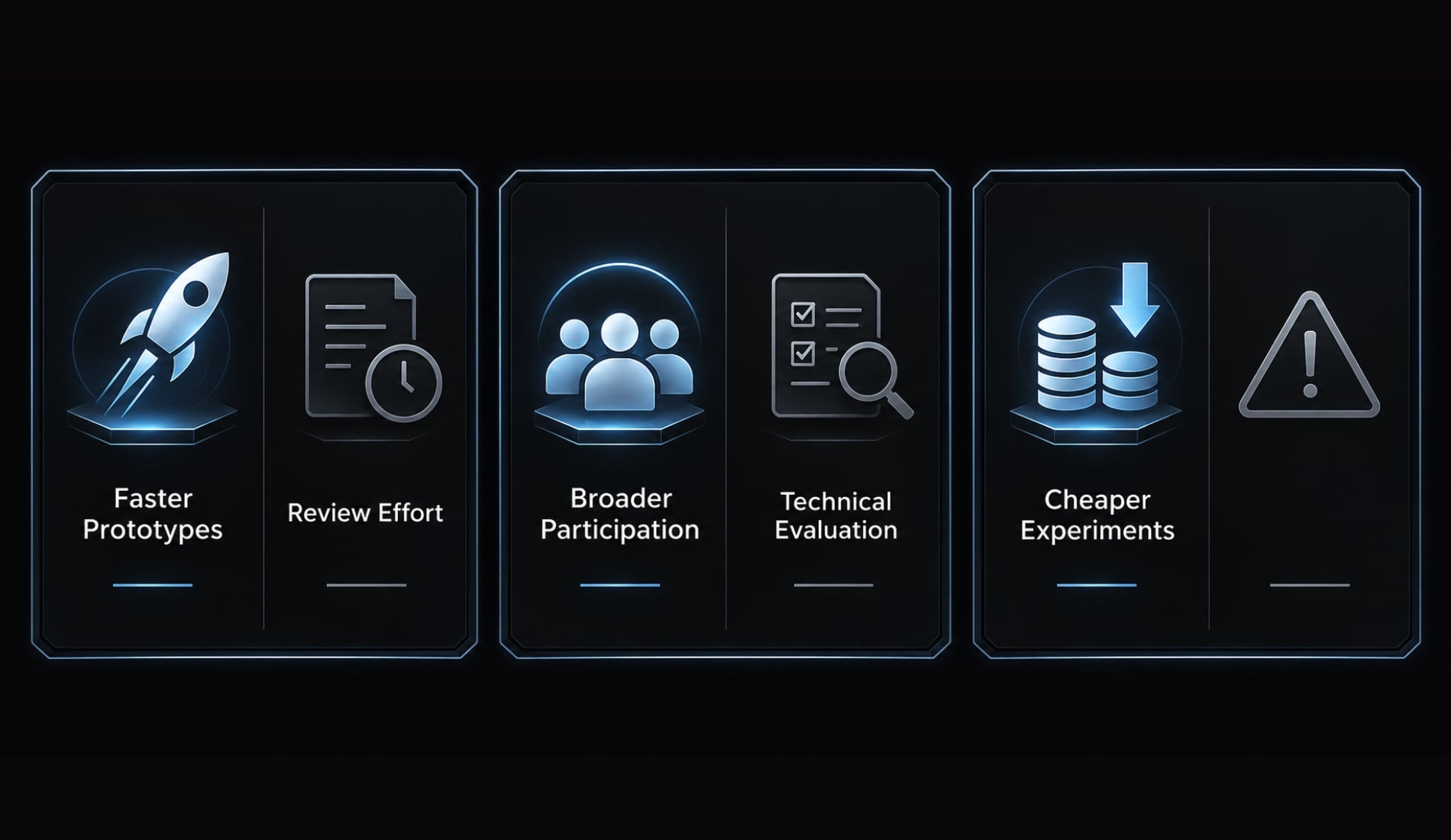
The main vibe coding benefits come from reducing the effort between intent and a testable result. Many also apply to reviewed AI-assisted development; skipping review is not their source. The examples below are illustrative, not measured project outcomes.
- Faster prototyping.
- Lower building barriers.
- Less repetitive setup.
- Faster experimentation.
- More attention to product intent.
- Potential developer productivity gains.
- Lower initial validation cost.
1. Faster prototyping and shorter time to first version
AI can draft setup and basic behavior, making rapid prototyping more accessible. A software-as-a-service founder might create an interactive onboarding demonstration before committing to implementation. However, debugging, review, and cleanup can offset early gains. A faster first version does not establish faster delivery.
2. Lower barrier to building software
Natural-language instructions let domain experts express requirements through working examples. A growth operator could prototype a campaign-budget calculator using dummy data instead of waiting for development capacity. However, producing an interface does not establish the ability to evaluate its calculations, permissions, or safety.
3. Less repetitive and boilerplate work
Boilerplate means repeated setup or standard code needed before useful functionality works. AI can draft form scaffolding and test templates, reducing manual repetition. This boilerplate reduction leaves more attention for project-specific decisions, provided developers check that generated patterns match existing conventions and requirements.
4. Faster experimentation and feedback loops
Once a prototype exists, prompt-led changes can make alternatives easier to compare or discard. A B2B product team could test two onboarding flows with prospective users. Software experimentation still needs evaluation criteria: generating more variants does not necessarily produce better evidence or decisions.
5. More focus on product intent and user experience
Less manual syntax work can leave more attention for task flow and usability. A designer might test whether buyers understand a configuration journey before specifying its implementation. But unclear requirements still produce unsuitable results; the tool cannot determine business priorities simply from a polished screen.
6. Higher productivity for experienced developers
Experienced developers can direct generation toward bounded tasks and recognize weak output. Drafting tests or exploring an unfamiliar library may reduce manual work. However, AI-generated code still needs verification, and gains vary by task. Review and integration can become the bottleneck rather than writing.
7. Lower initial cost of testing an idea
Teams may spend less engineering effort before learning whether a proposed feature solves a problem. A founder could test interest through a disposable demonstration before funding development. Initial savings do not establish lower lifetime cost, especially if experimental code later becomes a maintained application.
A prototype tests an idea. An MVP, or minimum viable product, delivers a limited useful offering to users. A production application must operate dependably in its intended environment. An MVP handling real records needs controls appropriate to those records, regardless of its limited scope.
Benefit | Primary value | Relevant user | Main limitation |
|---|---|---|---|
Faster prototypes | Earlier demonstration | Founder | Rework |
Lower barrier | Direct participation | Domain expert | Evaluation skills |
Less boilerplate | Reduced repetition | Developer | Convention mismatch |
Faster experiments | Earlier comparison | Product team | Unclear criteria |
Product focus | Usability exploration | Designer | Weak requirements |
Developer productivity | Task acceleration | Engineer | Review bottleneck |
Lower initial cost | Affordable validation | Founder | Lifetime costs |
Who benefits most from vibe coding?
The strongest fit combines a bounded objective with access to appropriate evaluation.
- Non-technical founders and indie makers: Non-technical founders can validate ideas, but need technical evaluation before relying on generated software.
- Product managers, designers and growth teams: These teams can turn requirements into interactive examples and explore constrained utilities.
- Professional developers and small engineering teams: Software developers can accelerate directed tasks while retaining responsibility for implementation and release.
User group | Primary benefit | Appropriate goal | Required oversight |
|---|---|---|---|
Nontechnical founder | Idea expression | Disposable prototype | Technical evaluation |
Product manager or designer | Interactive requirements | Interface experiment | Behavior review |
Marketing or growth operator | Domain-led creation | Dummy-data calculator | Calculation checks |
Professional developer | Reduced repetition | Bounded implementation | Tests and review |
Engineering leader | Earlier feasibility evidence | Isolated experiment | Ownership and release criteria |
Review depends on project risk, not job title. Internal tools connected to a CRM, or customer relationship management system, may expose customer information or modify important records. Developer expertise improves evaluation but does not eliminate testing.
Where vibe coding works best
Vibe coding use cases depend more on failure consequences and review conditions than on whether AI can generate an application.
Assess five criteria: Failure impact, data sensitivity, user exposure, expected lifespan, and availability of qualified review.
Good-fit use cases
Disposable proofs of concept, interface experiments, and static B2B landing-page mockups are useful starting points. Isolated utilities using synthetic data and reversible workflow experiments can also fit. Good fit means constrained, recoverable, and low-impact; it does not automatically mean safe.
Use with caution
Customer-facing MVPs, CRM-connected automations, persistent databases, third-party integrations, and applications requiring authentication need stronger review. They can affect real users, stored records, or connected systems even when their interfaces look simple.
Poor fit without expert engineering review
Payment processing, healthcare systems, identity and access management, sensitive personal information, and core enterprise or safety-critical infrastructure demand expert evaluation. Specialist controls and compliance work may also be necessary.
Illustrative project | Suitability | Review requirement |
|---|---|---|
Disposable onboarding mockup | Good fit | Verify intended behavior |
Synthetic-data dashboard | Good fit if isolated | Check calculations and isolation |
Subscription MVP | Caution | Review access, data, recovery |
Procurement-record automation | Caution | Validate permissions and rollback |
B2B billing payments | Poor fit without experts | Engineering and security evaluation |
A “simple” tool changes category when it gains sensitive data, write permissions, or operational importance. Reassess suitability whenever its scope changes.
The main trade-offs and risks of vibe coding
Visible functionality can conceal defects. Complexity, sensitive data, external users, and limited implementation understanding increase the consequences of missed problems.
Security vulnerabilities
Insecure defaults, excessive permissions, mishandled credentials, and vulnerable dependencies can expose records or enable unauthorized changes. These risks require investigation; they do not establish that all AI-generated software is insecure.
Technical debt and architectural drift
Technical debt is future work created by shortcuts or unresolved design problems. Architectural drift means successive changes follow inconsistent patterns. Duplicate logic can make one correction require several incompatible fixes.
Limited understanding and maintainability
Code maintainability describes how easily someone can understand, fix, and extend software. Without an owner who understands critical behavior, debugging and handover become harder.
False confidence from a working demo
A hypothetical change might fix onboarding while breaking account settings through shared logic. A successful demonstration does not establish access control, recovery, or reliable operation.
Risk | Business impact | Control |
|---|---|---|
Security flaws | Exposure or customer harm | Qualified review; targeted security checks |
Inconsistent architecture | Higher maintenance costs | Specifications; architectural review |
Unreviewed dependencies | Reliability, supply-chain, licensing problems | Inventory; license review; fixed dependency versions |
Limited understanding | Slow debugging and handover | Documentation; named ownership |
Weak testing | Regressions and operational failures | Automated tests; acceptance checks |
Prototype overconfidence | Premature deployment | Explicit production-readiness gate |
Production readiness means evidence that software can operate reliably and safely for its intended users. Tests and security scanning reduce risk, but neither certifies correctness. Human judgment remains necessary for deciding whether the evidence is sufficient.
How to use vibe coding responsibly
Define what success means before generation, then evaluate the result against those requirements—not merely its appearance.
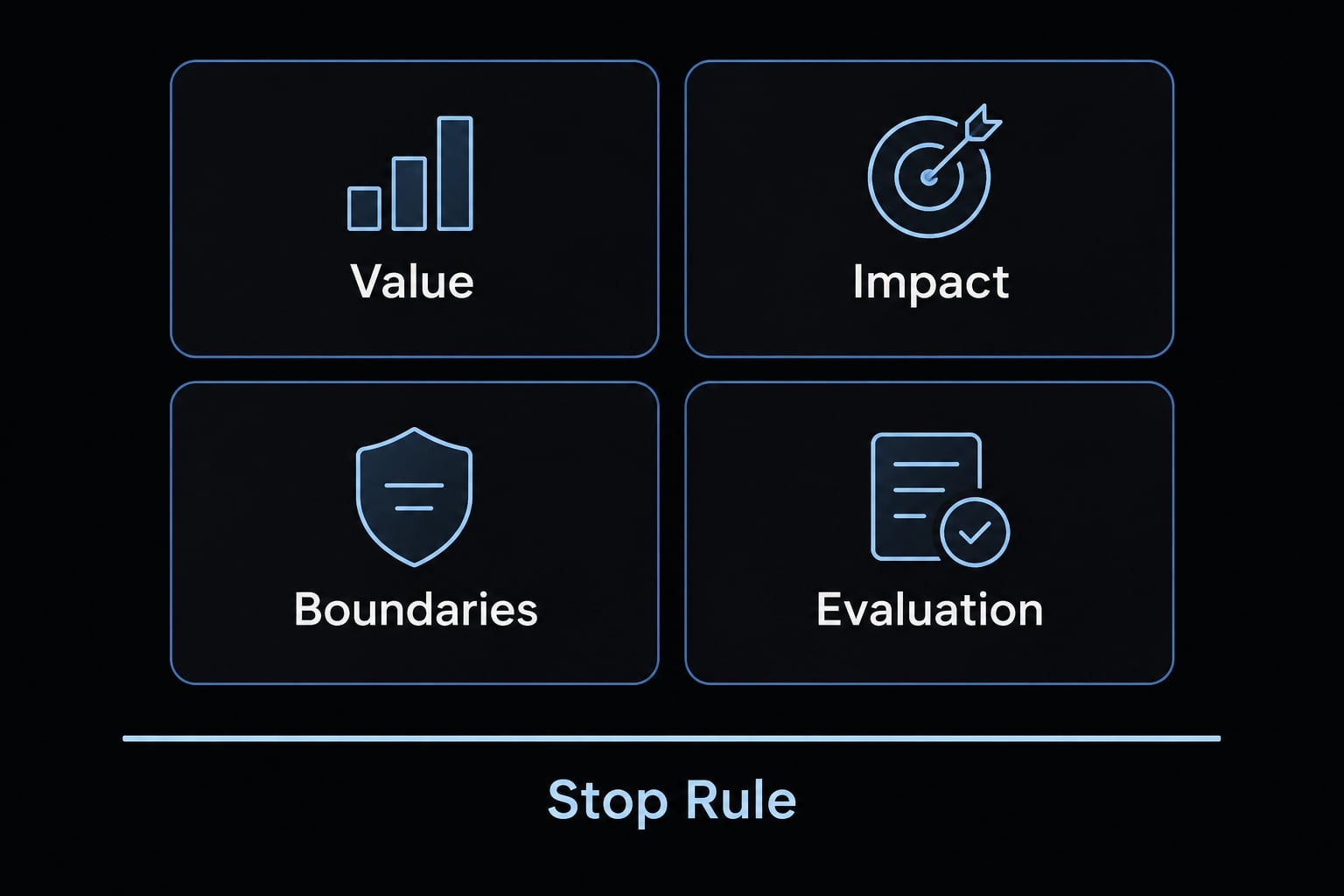
The VIBE fit model
This is an editorial decision aid, not an industry standard or validated risk score.
- V - Value: Is there a clear reason to prototype or automate?
- I - Impact: What happens if the result is wrong or fails?
- B - Boundaries: Can scope, data, permissions, and integrations stay constrained?
- E - Evaluation: Can someone qualified assess and approve the result?
Stop rule: If failure impact is high or qualified evaluation is unavailable, narrow the experiment or move to a governed engineering process.
Responsible vibe coding checklist
- Define the feature and acceptance criteria.
- Keep the first version narrow and reversible.
- Use version control to track changes and preserve rollback.
- Do not paste passwords, API keys, customer records, CRM exports, or confidential information into prompts.
- Review dependencies, permissions, and data access.
- Test important behavior, failure paths, and access restrictions.
- Run linting-automated checks for common code issues-plus dependency and security checks.
- Require qualified human code review before production deployment.
- Document operation, deployment, and ownership.
- Monitor released software and maintain a recovery plan.
- Reassess or redesign prototypes before they become business-critical.
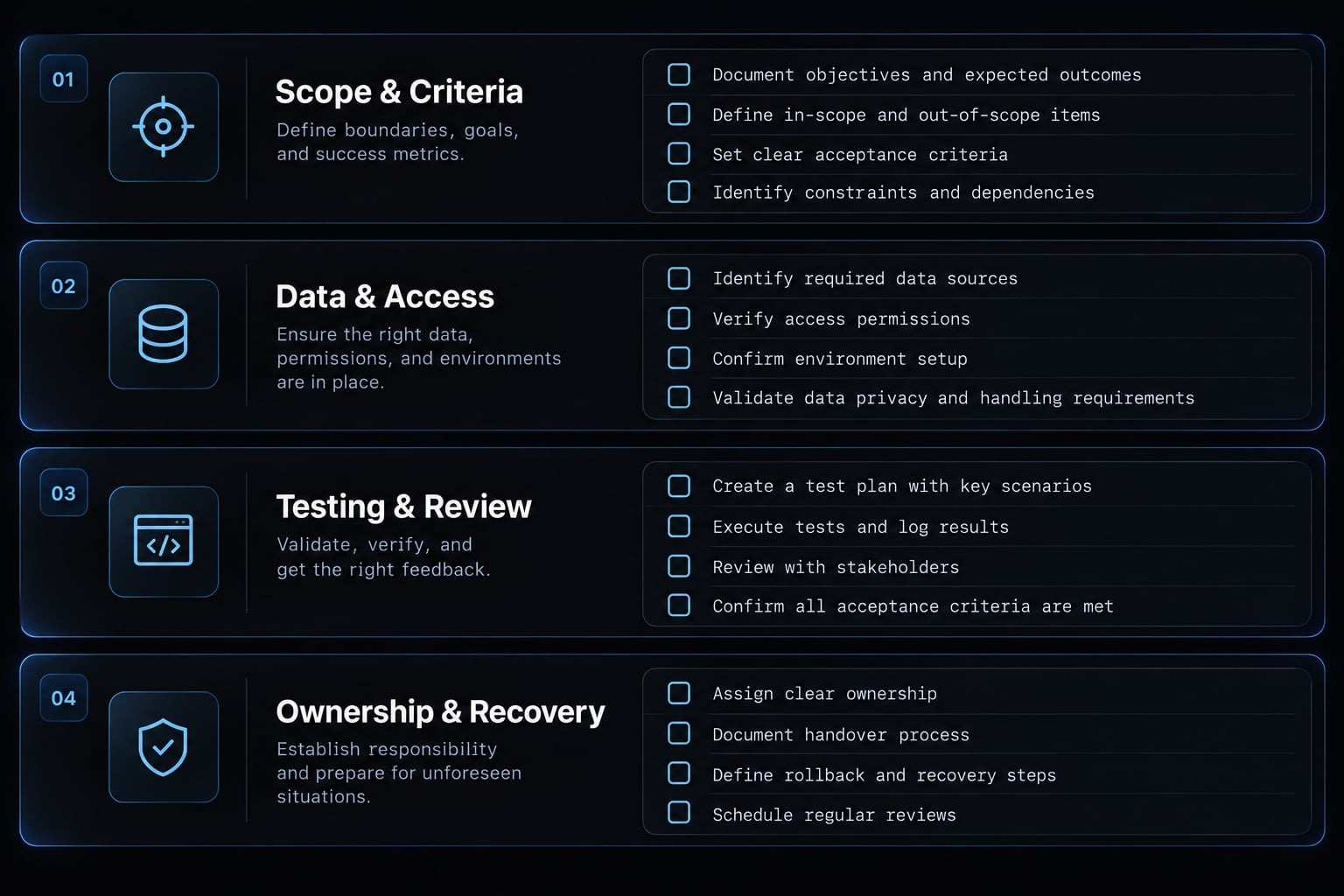
Automated testing should verify meaningful outcomes, not merely execute generated code. Track time to first version separately from review, debugging, and rework. That distinction shows whether generation speed becomes a delivery benefit.
From Ad Hoc vibe coding to structured AI development
Exploration and maintained delivery need different controls. A structured AI workflow makes specifications, tests, ownership, and review repeatable.
The following is an illustrative progression, not a validated maturity standard.
Stage | Primary goal | Typical controls | Appropriate outcome |
|---|---|---|---|
Ad hoc prompt-led experimentation | Explore | Isolation; narrow scope | Disposable prototype |
Reviewed AI-assisted development | Deliver maintainable changes | Specifications; tests; review | Reviewed application |
Coordinated agent workflows | Organize specialized tasks | Task boundaries; review gates | Repeatable delivery process |
AI agent orchestration means coordinating specialized AI agents within a defined workflow. AgentKit is one example, combining specialized agents, reusable skills, and workflows under developer control.
Coordination is optional. A reviewed single-assistant workflow may suit a small team better than a complex multi-agent system. More agents do not guarantee security or replace accountable reviewers. Choose the simplest process that preserves visibility, ownership, and control.
Frequently asked questions
What exactly is "vibe coding"?
Vibe coding is a software creation method where developers use natural-language prompts to generate and revise code, often prioritizing speed and intuition over manual syntax writing. Coined by Andrej Karpathy, it emphasizes rapid iteration and high-level behavioral descriptions rather than traditional, detailed line-by-line programming.
Is vibe coding suitable for production-ready software?
Not inherently. While vibe coding is useful for disposable prototypes and isolated experiments using synthetic data. Internal tools are not automatically low risk: once one touches a CRM, stored records, or write permissions, it needs the same review as customer-facing software.
What are the main vibe coding benefits for development teams?
Vibe coding provides rapid prototyping, lowers the barrier for non-technical founders to build MVPs, reduces repetitive boilerplate setup, and shortens experiment cycles. It lowers the initial effort to validate an idea — though initial savings do not establish lower lifetime cost.
Can non-technical users build software with vibe coding?
Yes, non-technical users can build functional interfaces and simple utilities. However, they should exercise caution. Building an application is not the same as securing or maintaining it; non-technical builders should partner with experienced developers or security experts before exposing AI-generated applications to real user data or critical systems.
What are the main risks of relying on AI-generated code?
The primary risks include the accumulation of technical debt, architectural drift, and serious security vulnerabilities such as insecure defaults, excessive permissions, mishandled credentials, and vulnerable dependencies. These need investigation in any codebase — they are not evidence that AI-generated software is inherently insecure.
How can teams use vibe coding responsibly?
To use it responsibly, teams should implement the "VIBE Fit Model": assess Value, Impact, Boundaries, and Evaluation. Always keep prototypes narrow, avoid pasting sensitive data into prompts, enforce human code reviews, run automated tests, and ensure that a qualified person manages the transition from prototype to production.
How does vibe coding differ from structured AI development?
Vibe coding is typically ad hoc and exploratory, focusing on immediate results. In contrast, structured AI development integrates AI agents into a managed lifecycle that includes version control, strict specification definitions, automated security testing, and human-in-the-loop oversight to ensure long-term stability and maintainable delivery.
Read more:
- Is vibe coding bad? Pros, cons and responsible AI practices
- Vibe coding business impact: Balancing speed and maintenance
- Is vibe coding the future of programming? Trends and insights
Conclusion
Vibe coding accelerates initial prototyping and lowers validation costs, helping teams quickly explore new concepts. However, generated code does not guarantee security, maintainability, or long-term cost efficiency.
Teams should start with constrained, low-impact experiments and thoroughly verify critical behavior, permissions, and dependencies—assigning clear operational ownership—before transitioning any prototype into a production-ready application.