Vibe coding cleanup: Turn AI prototypes into reliable software
Vibe coding cleanup: How to turn an AI-built prototype into production-ready software
When AI-built prototypes face unpredictable releases, single-device deployments, and opaque changes, cleanup becomes essential. Vibe coding cleanup assesses, stabilizes, and remediates conversational software across testing, security, and operations. This guide covers warning signs, remediation processes, and delivery choices to ensure production readiness.
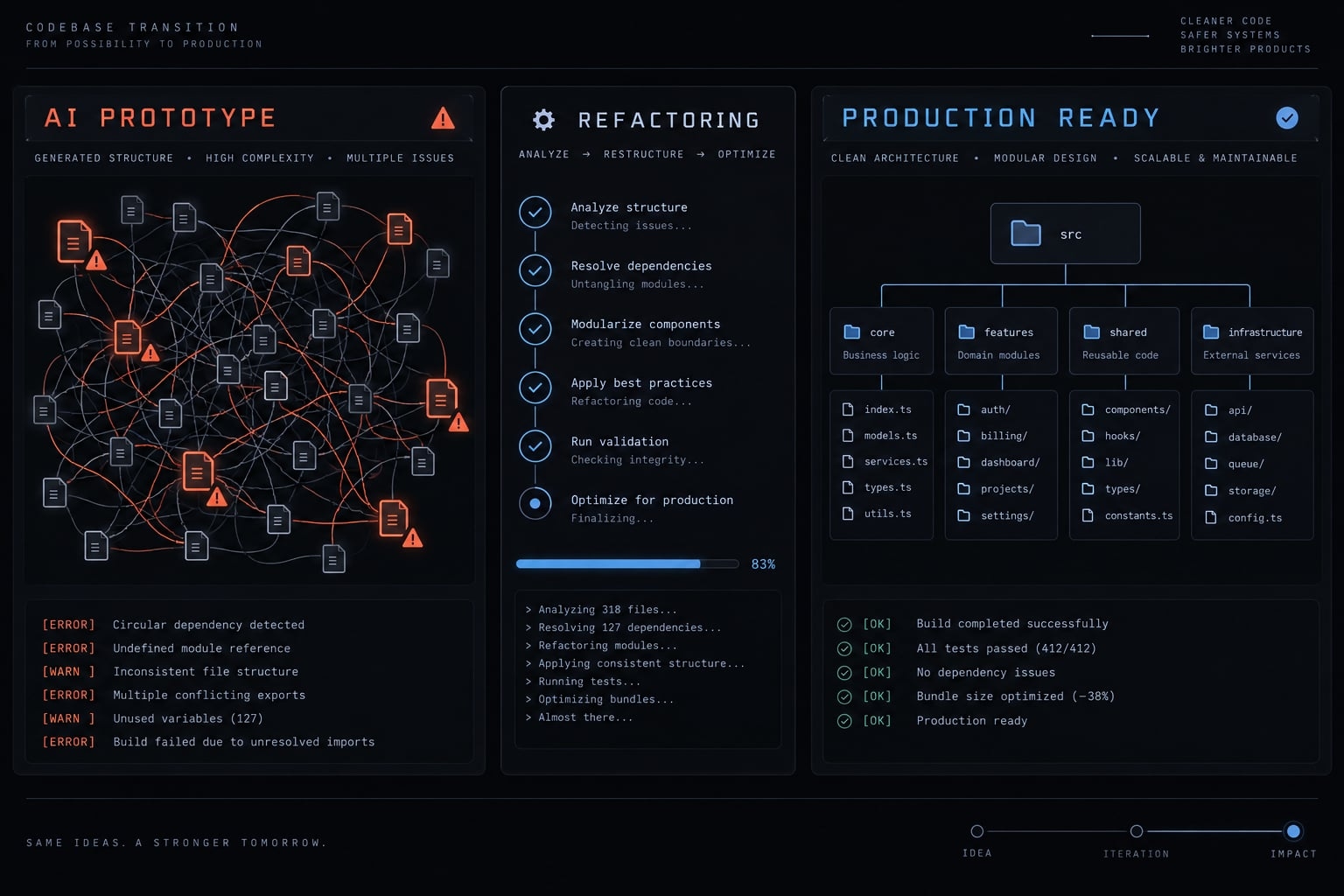
What vibe coding cleanup actually means
Vibe coding cleanup focuses on the state of the repository, not who wrote the code. It is important to note that AI-generated code is not inherently defective or unsafe. Human-written applications can develop the same weaknesses when review, testing, and operational controls lag behind delivery.
Production readiness is contextual. An internal reporting tool and a customer-facing financial application need different controls, depending on users, data sensitivity, availability requirements, and operating environment.
Cleanup is broader than code refactoring
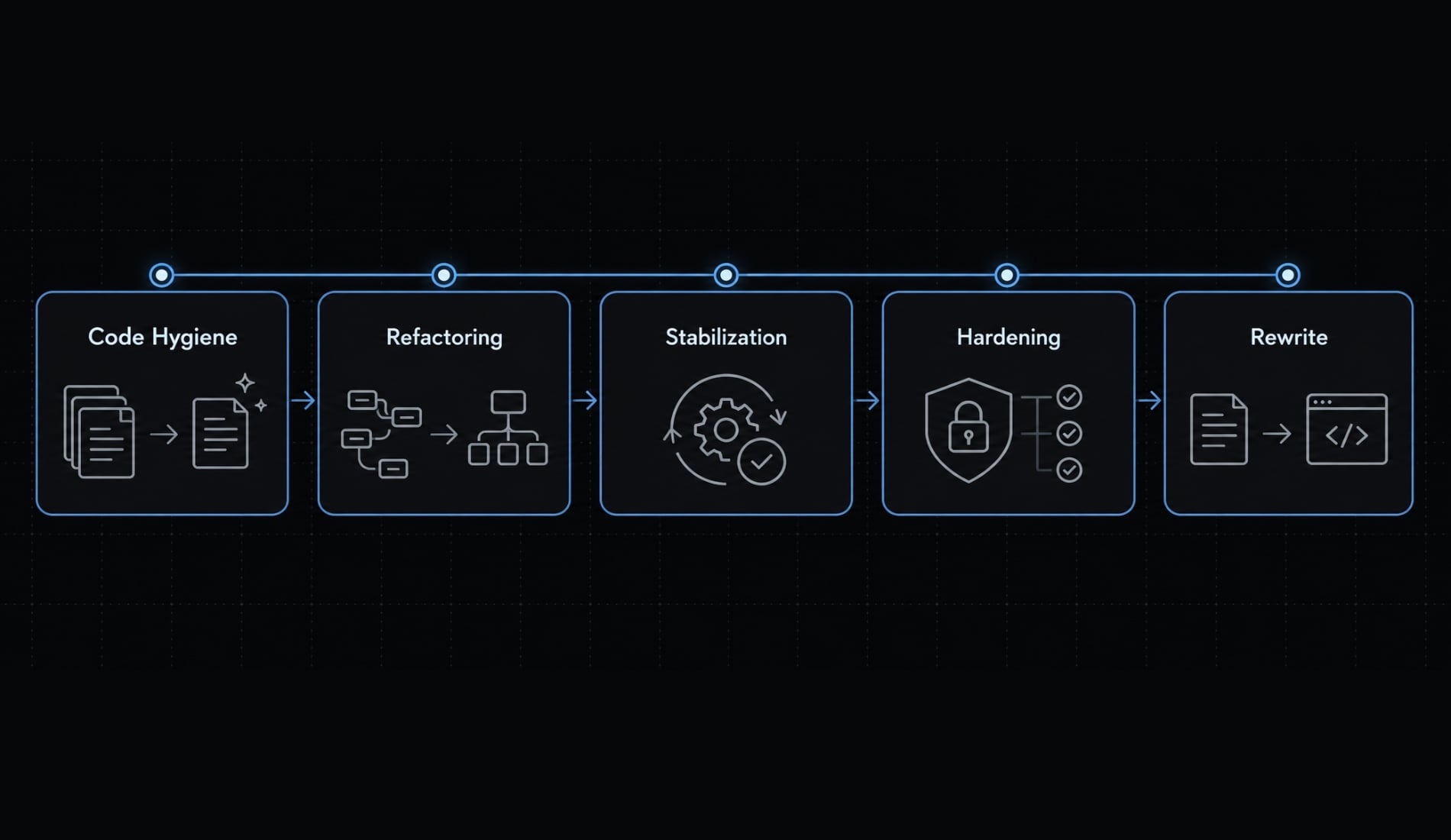
Martin Fowler’s Refactoring defines refactoring around improving internal structure without changing observable behavior. In practice, teams must distinguish behavior worth preserving from defects requiring deliberate correction.
Stabilization makes behavior and releases dependable. Production hardening adds appropriate security, monitoring, deployment, and recovery controls. Rewriting replaces substantial implementation, creating additional migration and behavior-matching obligations.
Formatting, naming, and removing unused code improve code hygiene. They do not establish reliable permissions, correct billing, or recoverable deployment.
A vibe coding cleanup specialist, or expert in AI-generated code maintenance, is an emerging descriptive label, not a standardized credential. Relevant competence comes from software engineering, testing, security, data management, and operations.
Cleanup, Refactoring, Hardening, and Rewriting Compared
Activity | Main purpose | Typical output | Change risk |
|---|---|---|---|
Cleanup | Assess and remediate | Findings and validated improvements | Scope-dependent |
Refactoring | Improve structure | Simpler, behavior-preserving code | Depends on affected workflows |
Stabilization | Make operation dependable | Reliable builds and corrected behavior | Depends on repair scope |
Production hardening | Strengthen operational controls | Permissions, monitoring, recovery procedures | Potentially high-impact |
Controlled rewrite | Replace implementation | Replacement plus migration plan | Includes transition risk |
Illustrative scenario: A B2B subscription application contains duplicated entitlement rules. Consolidating them is refactoring AI-generated code. Validating tenant permissions, adding regression tests, and documenting deployment expands the work into cleanup.
Keep in mind that disruption depends on context: a small change in authentication logic can sometimes be riskier than a large, isolated structural improvement.
7 signs an AI-generated codebase needs cleanup
These symptoms justify investigation; none independently proves that an AI-generated codebase needs rewriting.
1. Nobody can explain the system end to end
Authentication, data flows, integrations, and deployment decisions exist only in prompt history or someone’s memory. Request a system map and setup demonstration.
Business consequence: Slow onboarding and dependence on individual contributors.
2. Each new feature breaks existing behavior
Changes unexpectedly disrupt unrelated workflows, suggesting hidden dependencies or inconsistent rules. Compare recent changes with reported failures.
Business consequence: Unreliable releases, repeated rework, and less predictable delivery commitments.
3. The same logic exists in multiple places
Subscription entitlements, validation, or service behavior have competing implementations. Trace which version each customer-facing path uses before consolidating duplicate logic.
Business consequence: Inconsistent customer experiences and increasingly expensive rule changes.
4. Tests are missing, superficial, or untrustworthy
Tests may confirm current output without checking intended requirements. Inspect assertions around permissions, billing, and data changes, not just whether tests pass.
Business consequence: False confidence and greater regression risk when modifying existing functionality.
5. Secrets or privileged operations appear in client code
Private credentials require investigation; intentionally public identifiers are not automatically secrets. Hiding a button does not enforce authorization on the server.
Business consequence: Potential unauthorized access, data exposure, or account abuse.
6. Builds and deployments depend on one machine
Undocumented configuration or local-only dependencies undermine deployment reproducibility. Ask another qualified person to recreate the application in an approved environment.
Business consequence: Release delays and slower incident response when the original developer is unavailable.
7. Small changes take longer over time
Comparable tasks require more investigation as engineers trace side effects and competing conventions. Review change history before blaming application size.
Business consequence: Technical debt reduces delivery predictability and consumes roadmap capacity.
Severity snapshot
Diagnostic framework, not a repository assessment:
Severity | Example condition | Initial response |
|---|---|---|
Low | Isolated naming or hygiene issues | Schedule targeted cleanup |
Moderate | Recurring regressions or weak tests | Establish a baseline and remediate incrementally |
High | Material access-control, data, or deployment risks | Prioritize expert assessment and stabilization |
Critical | Active exposure or data-integrity incident | Contain immediately, then plan remediation |
Severity determines response priority, not architectural strategy. An exposed credential may require immediate revocation without requiring an application rewrite.
Before commissioning work, assemble a short evidence pack: affected workflows, recent failures, deployment instructions, and known data risks. This supports a more useful initial discussion than describing the repository as “messy.”
A practical vibe coding cleanup process
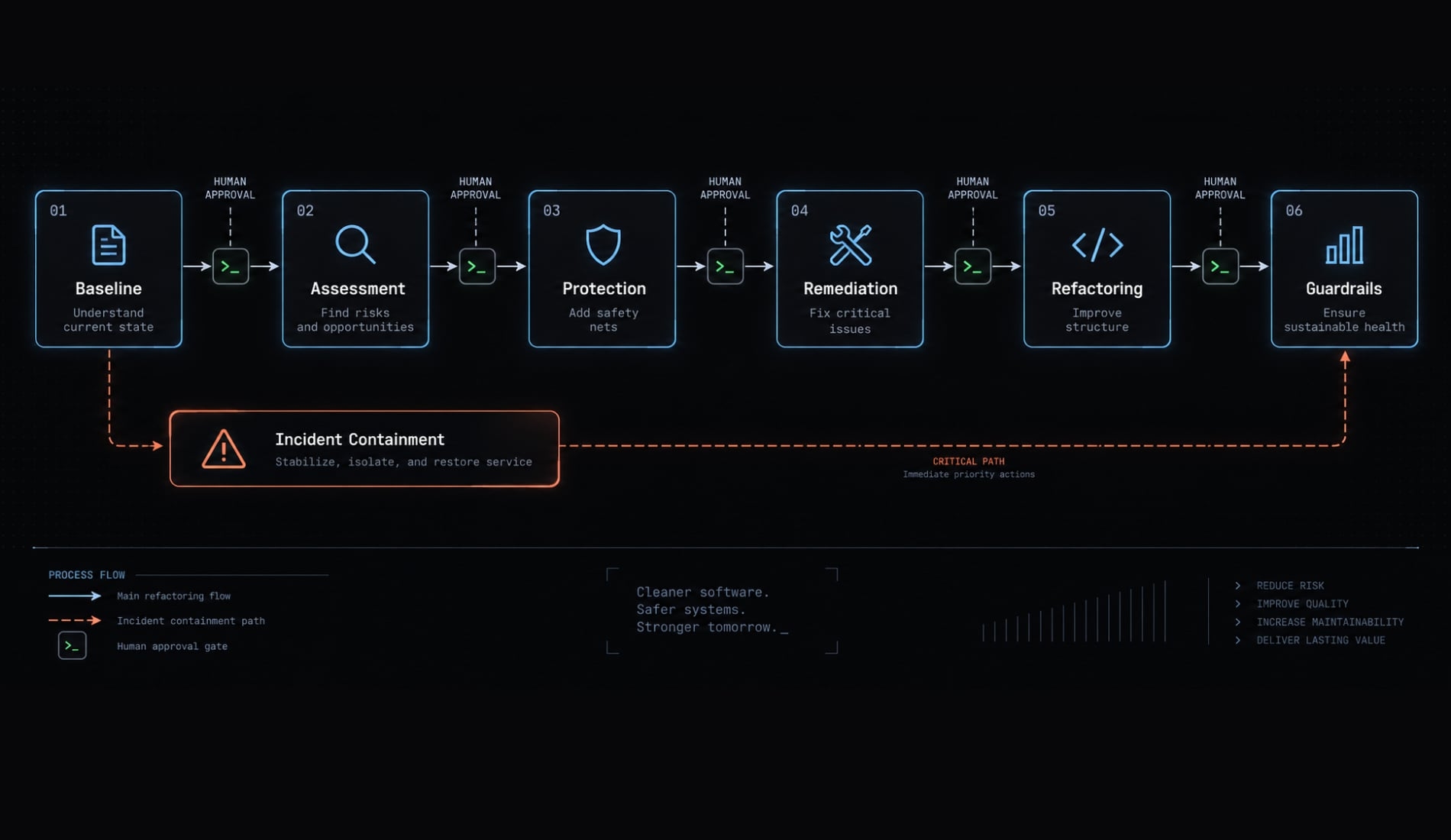
The process should protect valuable behavior before broad structural change. Each stage needs reviewable outputs and an explicit acceptance condition.
- Establish a baseline.
- Assess architecture and risks.
- Protect critical behavior.
- Address priority security and data issues.
- Refactor incrementally.
- Enforce ongoing guardrails.
1. Freeze uncontrolled changes and establish a baseline
Pause nonessential expansion, not urgent fixes. Record the release state, configuration, access, known defects, and critical customer workflows so subsequent changes have a reference point.
- Outputs: Baseline release, workflow inventory, ownership map, and backup/recovery record.
- Acceptance: The team can identify the reference version and demonstrate an appropriate recovery path.
2. Audit code, architecture, dependencies and security
Combine automated checks with manual examination of permissions, data flows, dependencies, and deployment. A repository audit should connect findings to operational consequences.
- Outputs: Architecture map, dependency inventory, validated findings, and prioritized risk register.
- Acceptance: Material findings identify affected behavior, impact, and supporting evidence. A scanner report alone is not a comprehensive security audit.
3. Protect existing behavior with characterization tests
Characterization tests record existing behavior so changes can be checked against a baseline, as described in Michael Feathers’ Working Effectively with Legacy Code. Prioritize tenant boundaries, identity, entitlements, integrations, and data changes.
- Outputs: Reviewed tests, known-defect register, and baseline continuous integration execution - automated checks run when changes are submitted.
- Acceptance: Assertions reflect agreed requirements; known bugs and AI-generated expectations receive explicit review.
4. Address security and data risks first
Contain active exposure immediately. Revoke or rotate compromised credentials; removing them from Git history does not invalidate them. Repair authorization and validate data integrity.
OWASP’s Application Security Verification Standard provides relevant control requirements, not automatic certification.
- Outputs: Remediation log, permission tests, validated fixes, and mitigation owners.
- Acceptance: Priority findings are retested; unresolved issues and release implications remain explicit.
5. Refactor in controlled, testable increments
Consolidate duplicated rules, simplify boundaries, and remove verified unused components. Preserve stable interfaces where practical.
Large pull requests (proposed change sets) make review, regression tracing, and recovery harder. Avoid broad automated rewrites that reviewers cannot meaningfully inspect.
- Outputs: Small reviewed changes, updated interfaces, and regression-check evidence.
- Acceptance: Every change has a purpose, validation evidence, and an appropriate recovery plan.
6. Install guardrails to prevent debt from returning
Enforce relevant checks, protected branches, repository instructions, and code review protocols. Define what AI coding agents may change and where human approval is mandatory.
- Outputs: Setup documentation, deployment procedures, agent boundaries, and named maintenance owners.
- Acceptance: Required checks and approvals actually block noncompliant changes. Separate builder and reviewer agents can assist review, but do not replace accountable human judgment.
Use these acceptance conditions when scoping a pilot milestone before authorizing broader remediation.
Should you clean up, refactor or rewrite the application?
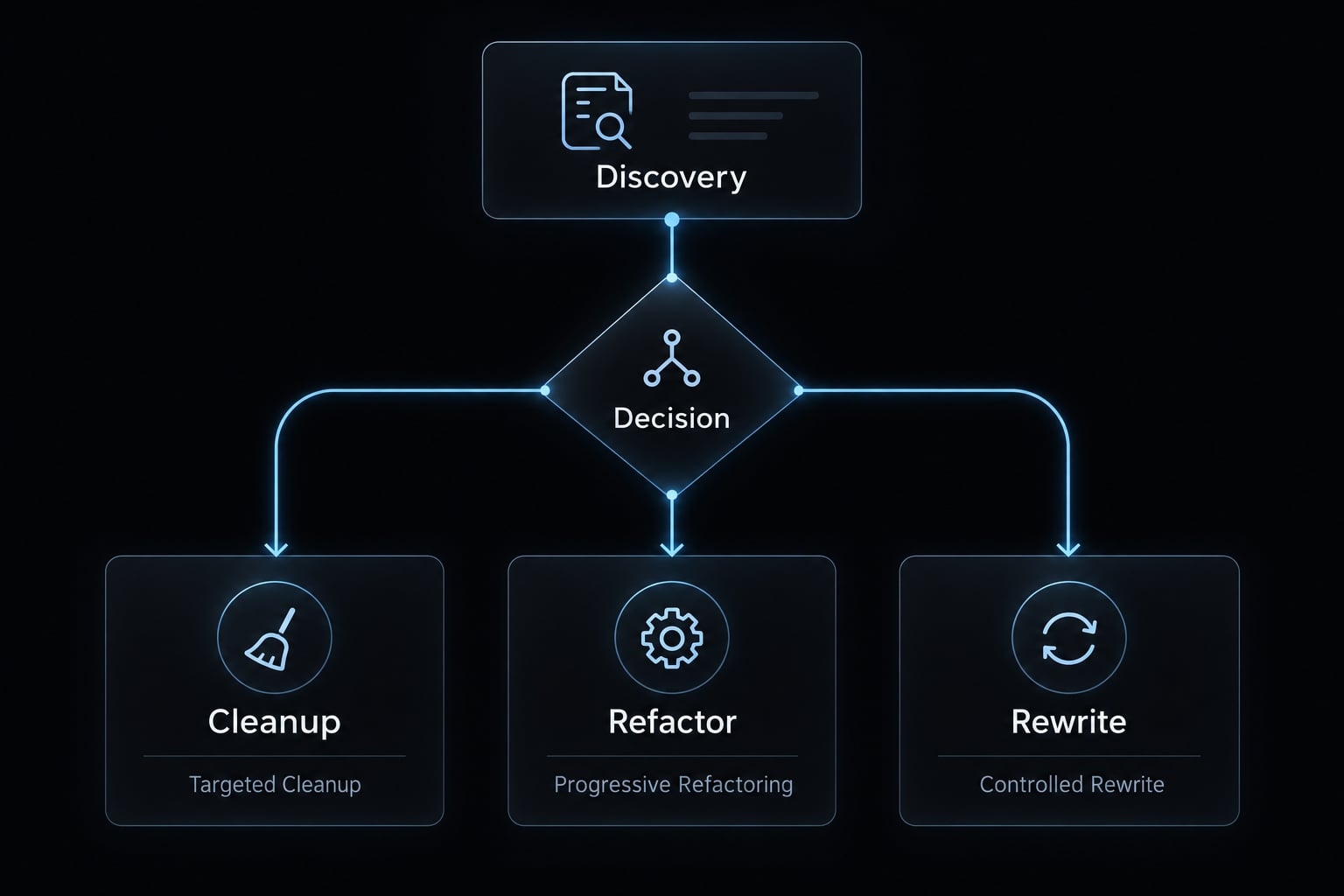
Preserve reliable business behavior when practical. The refactor-or-rewrite decision should compare full transition costs, not just estimates for writing replacement code.
Both options become uncertain when requirements are missing. Discovery comes first; rewriting does not automatically reveal what the application should do.
Choose targeted cleanup when
- Core behavior is correct and problems are localized.
- Data relationships are coherent.
- Issues can be tested, isolated, and repaired.
This approach can suit production applications as well as prototypes. The deciding factor is repairability, not application age.
Choose progressive refactoring when
Live users require continuity, but internal structure makes changes costly. Progressive refactoring improves the system through bounded changes rather than replacing everything simultaneously.
It works best when valuable rules can be protected behind stable interfaces. Phased work also creates checkpoints for reassessing risk and spending.
Consider a controlled rewrite when
Replacement may be justified when foundational constraints block required behavior and cannot be repaired economically.
Intended behavior must still be specified, and the transition must remain controllable. Replacing one subsystem may be preferable to rebuilding the application. Include data migration risk, operational training, parallel operation, and validation in the estimate.
Refactor-or-rewrite decision matrix
Factor | Supports cleanup/refactoring | May support replacement |
|---|---|---|
Business behavior | Valuable, verifiable workflows | Required behavior needs extensive redesign |
Architecture and testability | Boundaries can be isolated | Necessary changes cross pervasive constraints |
Data model | Relationships remain suitable | Required relationships demand redesign |
Security boundaries | Validated defects are repairable | Required isolation needs subsystem replacement |
Production continuity | Incremental releases protect users | Controlled transition is feasible |
Dependencies | Components have viable upgrades | Unsupported foundations block requirements |
Migration complexity | Replacement creates substantial uncertainty | Migration and recovery can be demonstrated |
Total cost and capacity | Phased repair fits available capacity | Replacement has lower evidenced total cost |
This matrix guides repository-specific judgment; it is not an automated recommendation. In the illustrative subscription application, the team might preserve reliable reporting while replacing a permissions subsystem whose boundaries cannot economically support required customer isolation.
Compare customer disruption and engineering availability alongside implementation cost. Maintaining old and new systems during migration can materially affect the decision.
Recommended decision rule
Favor preserving useful behavior when risks can be isolated and improvements verified. Consider replacement when essential constraints cannot be repaired economically. Before committing, assess migration, equivalent business behavior, recovery, operating continuity, and total cost. Unknown requirements require discovery, not an automatic rewrite.
DIY, internal team, freelancer, AI tools or specialist partner?
Tools and delivery models are not interchangeable. AI tools can support every human-led option, but they do not supply accountable ownership. Evaluate demonstrated engineering capability, available capacity, and scope, not a specialist title alone.
Delivery model comparison
Option | Appropriate fit | Main limitation | Accountable owner |
|---|---|---|---|
AI-assisted DIY | Small, low-risk, understood repository | Owner’s review capability | Qualified owner |
Internal engineering team | Relevant expertise and available capacity | Roadmap opportunity cost | Engineering lead |
Freelance specialist | Bounded work matching demonstrated skills | Availability and coverage | Named contracted engineer |
Specialist engineering partner | Coordinated, multi-discipline remediation | Cost and coordination overhead | Named engagement lead |
AI tools without qualified oversight | Diagnostic suggestions and exploration | Insufficient sole production-remediation ownership | Still requires a qualified human |
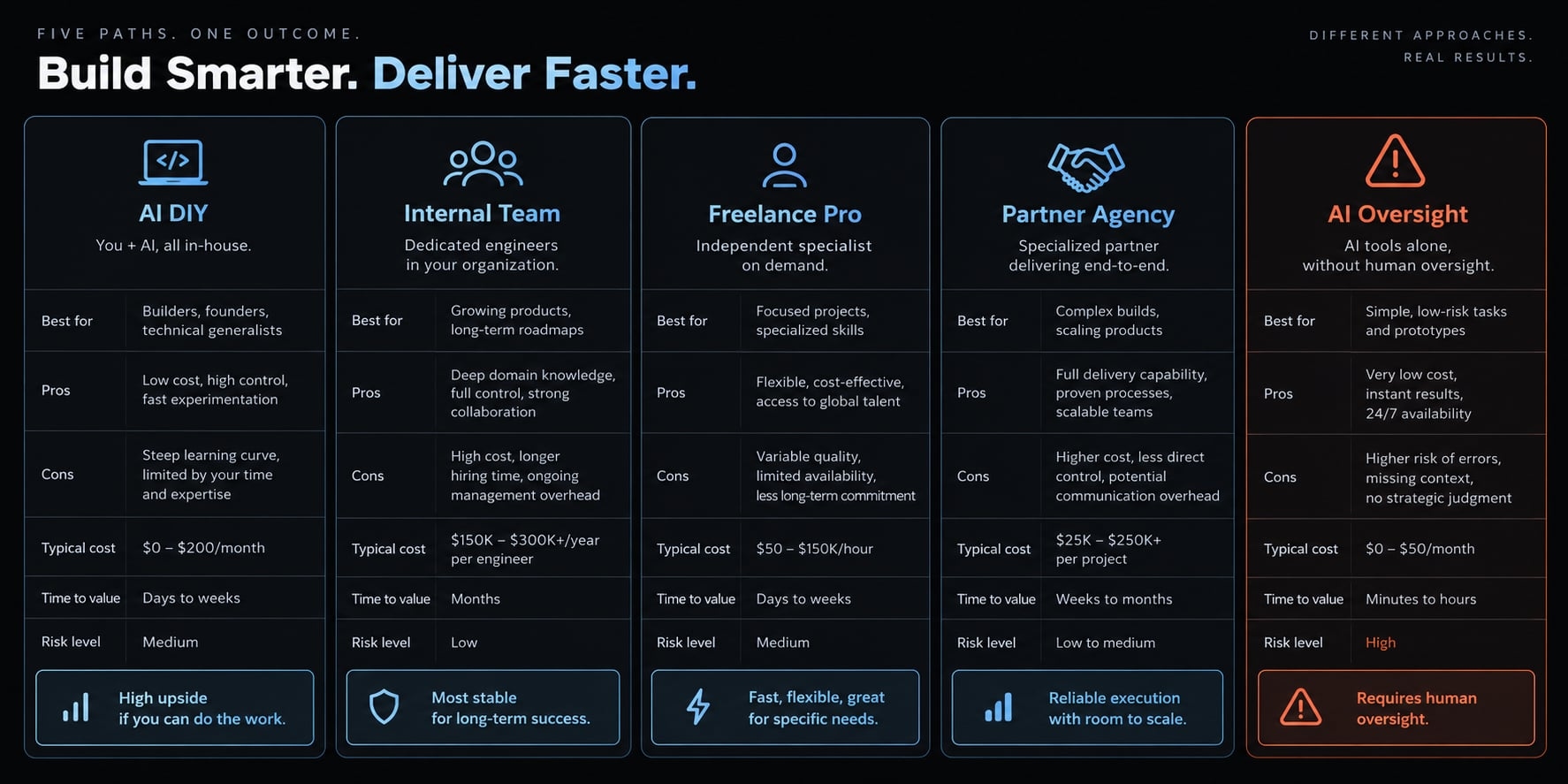
Neither organizational size nor delivery model guarantees security expertise. Verify the people assigned, review arrangements, and escalation responsibilities.
When AI-assisted DIY is reasonable
DIY can suit a small repository with reproducible setup, no sensitive production data, and a technically competent owner.
That owner must understand the proposed changes, verify requirements, and recover from mistakes. Being a solo founder does not automatically mean being a qualified reviewer.
Start with bounded improvements rather than unfamiliar changes to authentication, billing, or data storage.
When an internal team is the better choice
An internal team may be best positioned when it has repository knowledge, sufficient senior capability, available capacity, and long-term ownership.
Confirm those conditions rather than assuming them. Inherited applications can be unfamiliar even to the company’s own engineers. Cleanup also has an opportunity cost: internal effort competes with product delivery even without an external invoice.
When specialist support is justified
External support can help when material security or data risks exceed internal competence, or when remediation capacity is missing.
Cross-functional issues spanning application logic, databases, deployment, and testing may require several specialties. An additional evidence-based opinion can also clarify a disputed replacement proposal.
An engineering partner should demonstrate the required coverage rather than imply it through broad positioning.
How to evaluate a vibe coding cleanup provider
Ask prospective providers:
- What evidence supports the proposed remediation strategy?
- How will critical business behavior be protected?
- Which architecture, security, testing, data, and deployment areas are included?
- What are the acceptance criteria, exclusions, and change-control rules?
- Who controls repositories, credentials, AI tooling, and customer data?
- What review, recovery, reporting, and handoff evidence will be provided?
An AI code audit service may identify risks without implementing fixes. An AI code refactoring service may improve structure without assessing security. Compare written scope, not service labels.
Cost depends on repository size, integrations, test gaps, data sensitivity, migration needs, and internal support. Ask providers to separate assessment from implementation estimates and identify assumptions that could change either.
What a professional vibe coding cleanup engagement should deliver
Assessment produces a decision; implementation changes the software. Treat them as separate commitments unless explicitly bundled. Contractual deliverables should define evidence, ownership, exclusions, and acceptance, not simply promise “clean code.”
Service/solution specifications
What the scope should specify:
Specification | Required detail |
|---|---|
Assessment scope | Repositories, environments, integrations, and exclusions |
Assessment outputs | Validated findings, architecture summary, test gaps, and recommendation |
Implementation scope | Approved changes and separately scoped phases |
Acceptance criteria | Evidence required to consider each deliverable complete |
Schedule and cost basis | Assumptions, dependencies, access requirements, and change control |
Security and data handling | Least-privilege access, approved tools, retention, and confidentiality |
Ownership and handoff | Client control of agreed assets, documentation, and operational access |
Reporting and residual risk | Finding status, validation evidence, remaining risks, and named owners |
Timelines depend on repository evidence, access, integrations, and agreed scope. A fixed completion date without those inputs needs explicit qualifications.
Phase 1: Repository assessment
An AI-generated codebase assessment should establish what is known, what remains uncertain, and which options are defensible. Require decision-ready findings with evidence and limitations, including inaccessible systems or untested assumptions. Distinguish automated alerts from manually validated risks.
If the assessor also sells implementation, disclose that relationship. “Independent” should describe genuine independence, not merely a separate invoice.
Phase 2: Stabilization and remediation plan
The remediation roadmap should define risk-based milestones, dependencies, owners, acceptance conditions, human approval points, and deferred risks.
Illustrative milestone, not a client result:
Risk | Action | Acceptance evidence | Owner |
|---|---|---|---|
Inconsistent tenant permissions | Centralize and validate authorization | Reviewed cross-tenant denial tests across scoped routes | Named engineering lead |
Approvals should include business owners when correcting behavior changes customer expectations or contractual entitlements.
Phase 3: Controlled implementation
Require traceability throughout delivery: Finding → approved change → review → validation → release evidence
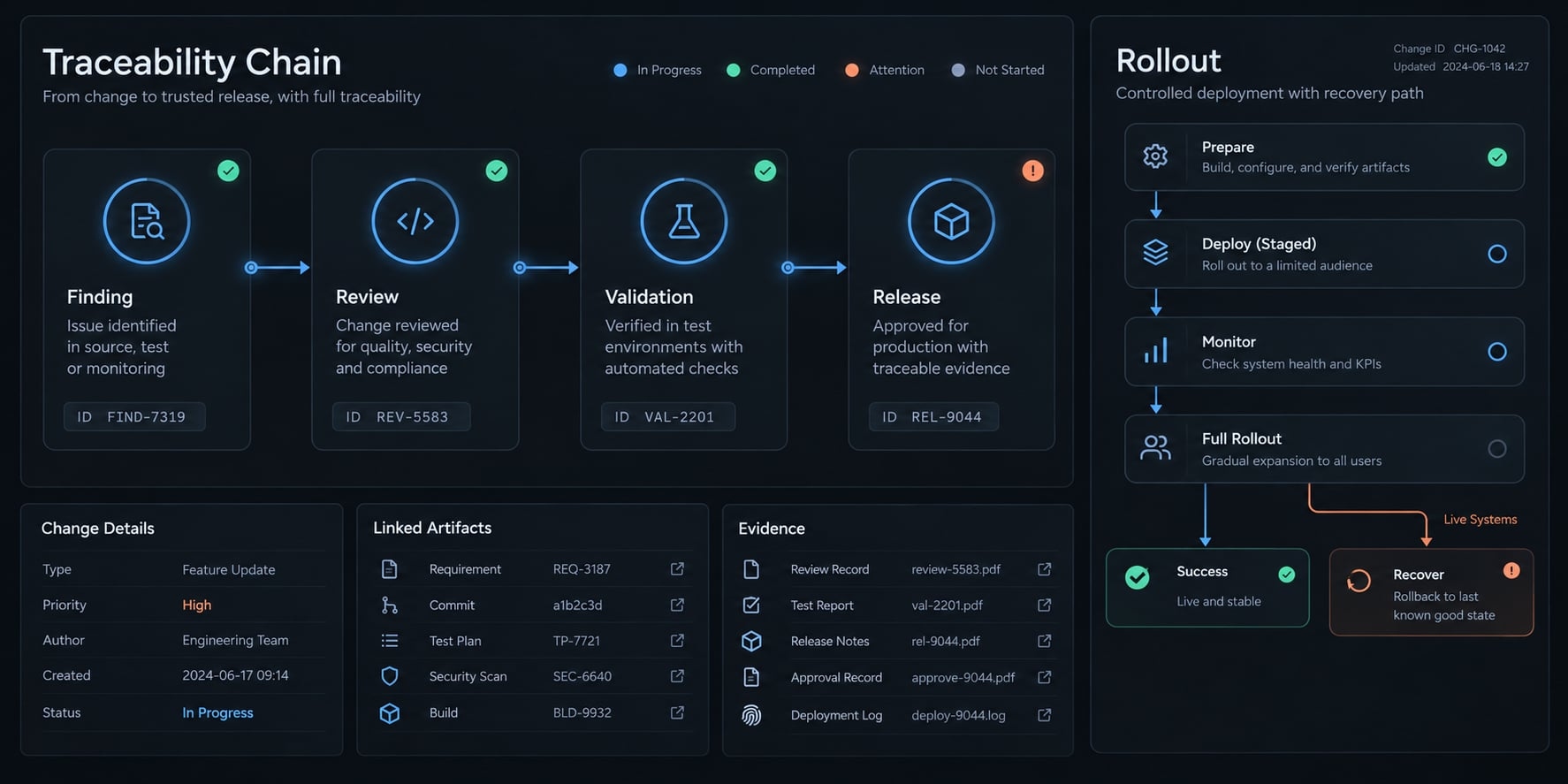
For live systems, define staged rollout and recovery arrangements. Database changes may need backups, reconciliation, or forward repair; a simple rollback is not always safe. Review scope changes before implementation rather than allowing cleanup to become an undocumented redesign.
Phase 4: Handoff and ongoing guardrails
Handoff should include setup and deployment instructions, architecture records, agent operating boundaries, maintenance responsibilities, and a residual-risk backlog.
Transfer or revoke access as appropriate. Record who owns unresolved issues and who approves accepting their remaining risk. Monitoring, incident response, and ongoing support are separate obligations unless expressly included.
Sample before-and-after scorecard
Illustrative acceptance scorecard, not reported client results.
Measurement | Baseline evidence to collect | Agreed target and validation |
|---|---|---|
Critical workflows | Current tests and observed behavior | Scoped requirements pass reviewed checks |
High-severity findings | Validated issues and affected components | Retest fixes; document unresolved release decisions |
Build reproducibility | Setup attempts and configuration gaps | Clean-environment build using approved instructions |
Deployment and recovery | Existing procedures and exercises | Demonstrate agreed release and recovery paths |
Ownership and documentation | Current records and access holders | Named owners accept handoff |
Remaining technical debt | Known constraints and investigation gaps | Prioritized backlog with accountable owners |
Define the assessed scope and observation period. Keep open, resolved, retested, accepted, and deferred findings distinguishable.
Code coverage and automated-check pass rates are supporting indicators, not standalone quality guarantees. Remediation reduces identified risks; it cannot eliminate every defect or future incident.
Where AgentKit engineer fits
AgentKit Engineer supports coordinated planning, development, testing, debugging, code review, database work, and deployment workflows. Reusable skills, specialized agents, and automated workflows can help teams structure repeatable engineering tasks. It is a development workflow product, not an accountable remediation team or independent security auditor. Engineers retain responsibility for reviewing changes, approving releases, and determining whether acceptance conditions are met.
Frequently asked questions
What is the vibe coding cleanup process?
Vibe coding cleanup is a systematic process of auditing, stabilizing, and remediating software built through conversational prompting. It involves identifying architectural drift, securing sensitive data, establishing reliable automated tests, and enforcing production guardrails to make it maintainable and ready for its intended production environment.
Why do vibe-coded applications often require cleanup?
Rapid prompting can produce working features faster than teams review, test, and document them. When that gap persists, duplicated logic, weak tests, and missing controls can accumulate, as they can in any codebase where review lags behind delivery. Without human oversight, these systems accumulate "technical debt" that makes them difficult to update, scale, or protect against security vulnerabilities once they reach production.
How do I know if my AI-generated codebase needs cleanup?
Warning signs include frequent regressions when new features are added, secret keys exposed in client-side code, redundant logic scattered across multiple files, and an inability for the team to explain the application’s complete data flow. If small changes take increasingly longer, it is worth investigating with a structured assessment.
Is it better to refactor vibe-coded code or rewrite it entirely?
Prefer preserving useful behavior when risks can be isolated and verified rather than full rewrites. Targeted cleanup is preferred when core business behavior is correct but structural integrity is lacking. A controlled rewrite should only be considered if foundational architectural constraints prevent necessary security or scaling requirements from being met.
What is the typical process for a vibe coding cleanup engagement?
The process involves six steps: freezing uncontrolled changes to establish a baseline, auditing security and dependencies, protecting core workflows with characterization tests, remediating high-risk vulnerabilities, refactoring in controlled increments, and finally, installing permanent CI/CD guardrails to prevent future degradation of code quality.
Who should perform the cleanup of an AI-generated codebase?
Cleanup can be handled by internal teams, freelance specialists, or dedicated engineering partners. The choice depends on your team's existing repository knowledge, current capacity, and the complexity of the risks. Regardless of the model, the team must maintain accountable human oversight rather than relying solely on automated agents.
Read more:
- Vibe coding technical debt cleanup: A risk-first framework
- Vibe coding feedback: Improve your AI-generated code quality
- Vibe Coding Stack: Build AI-Powered Apps with This Guide
Conclusion
Vibe coding cleanup is fundamentally a risk and maintainability decision rather than a judgment on AI usage. The responsible path requires establishing a baseline, assessing code, protecting core behavior, prioritizing fixes incrementally, and enforcing guardrails - with active security incidents always taking precedence.
Depending on validation and cost, teams can choose targeted cleanup, refactoring, or full replacement while retaining full control over repositories and acceptance criteria. Ultimately, tools like AgentKit can support workflows, but they never replace accountable engineering ownership.