Vibe coding monitoring: How to move fast without losing control
Generating a feature takes less effort than proving it is safe to release. Vibe coding monitoring aligns fast AI output with solid proof by tracking code updates, test results, and live app behavior. Since a working preview guarantees neither security nor maintainability, this guide establishes six practical monitoring layers, risk-based controls, and explicit stop criteria to keep rapid AI development safe.
What vibe coding monitoring actually means
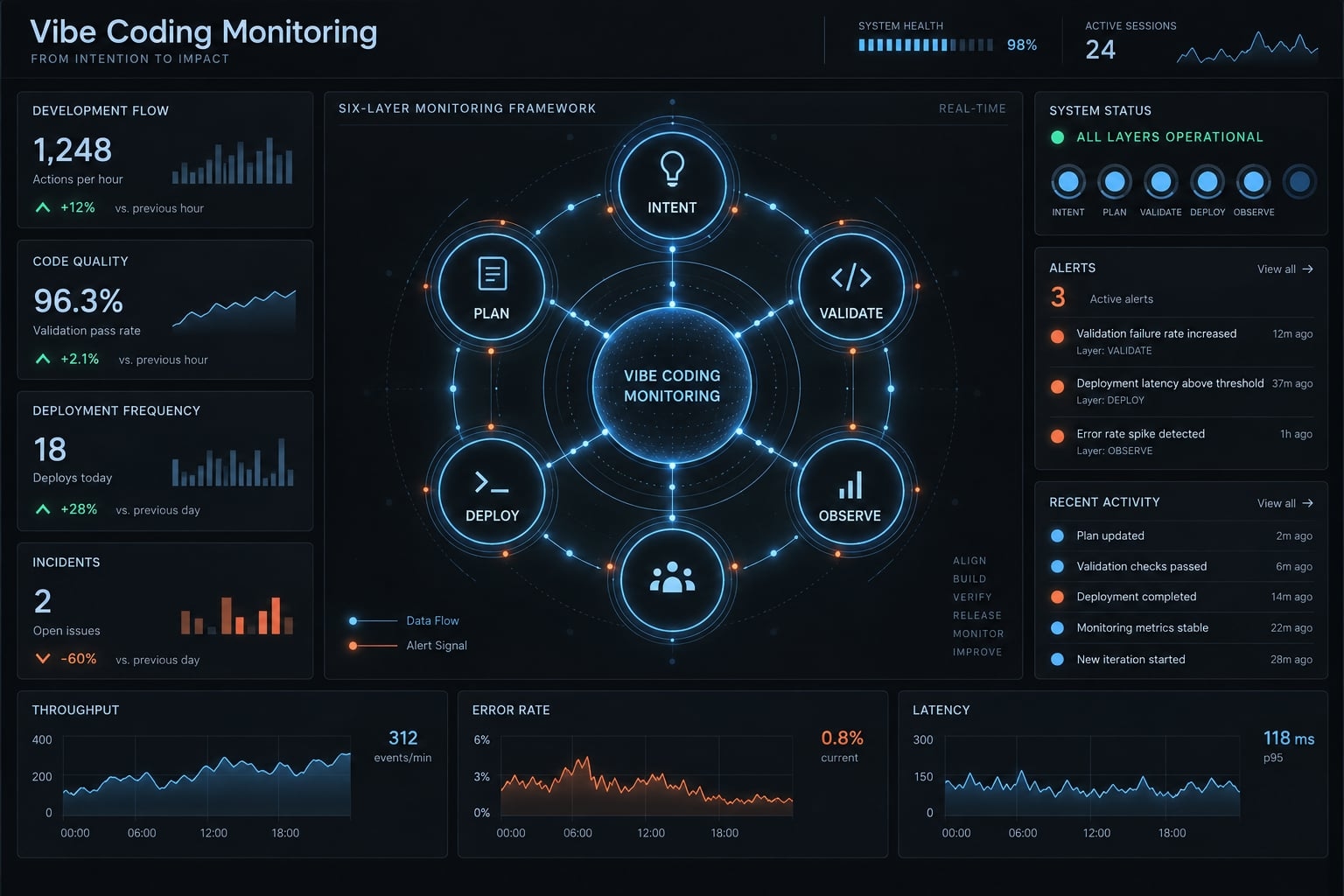
Vibe coding monitoring is the practice of inspecting what an agent plans and changes, retaining evidence of validation and release decisions, and observing software behavior at runtime. Its purpose is to make prompt-led development visible, assign accountability, and support intervention and recovery when implementation or operational behavior departs from expectations.
Here, “vibe coding” means prompt-led development with limited initial implementation oversight—not every use of an AI coding assistant. Monitoring becomes useful when a signal leads to verification, approval, or intervention.
Monitoring the product and the generation process
AI agent observability concerns inspectable agent actions and outputs. Application monitoring concerns the running software.
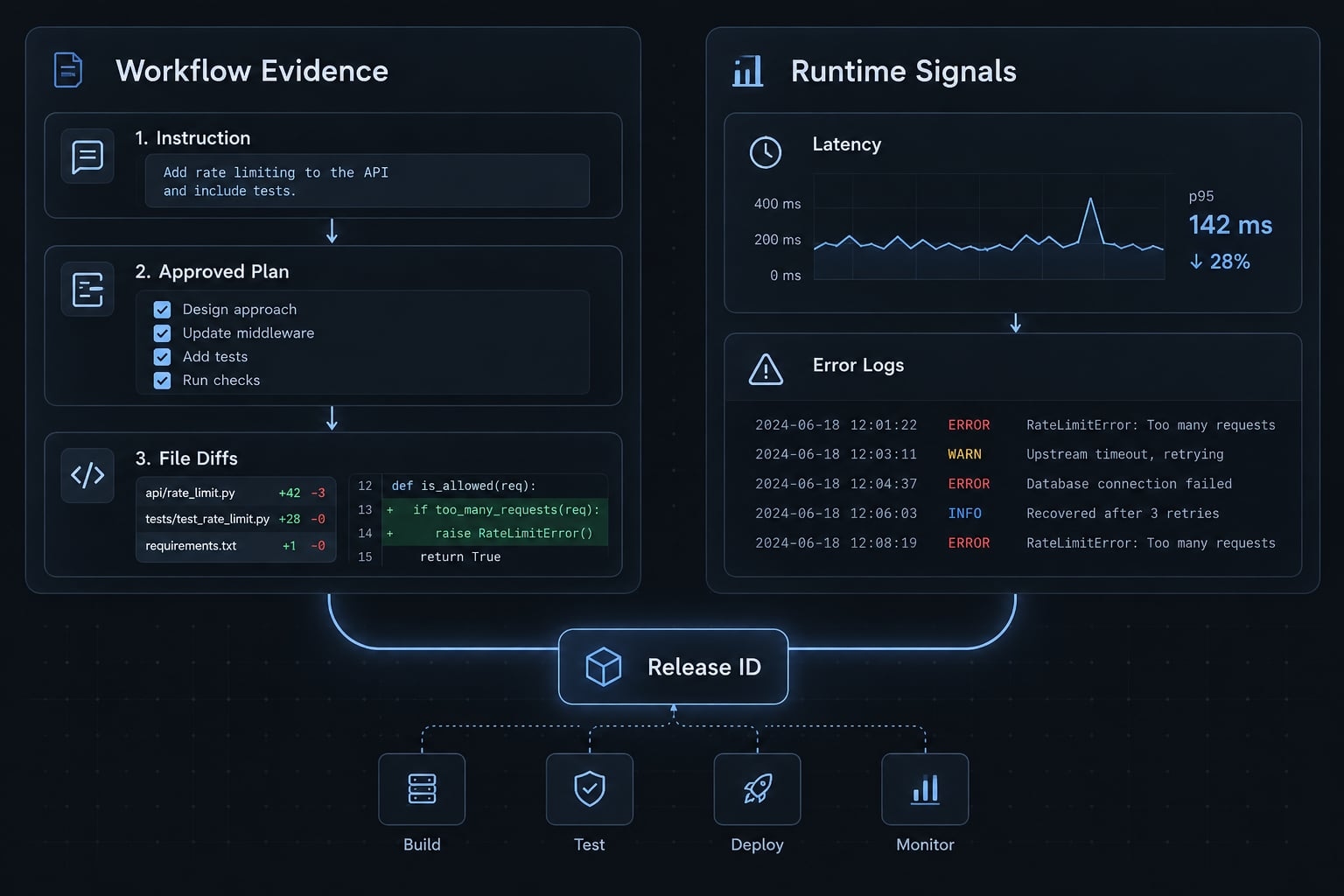
Development workflow evidence | Application runtime evidence |
|---|---|
Prompts, scope, and approved plans | Failed account workflows and errors |
Tool calls, permissions, and file changes | Integration failures and access denials |
Test results and release approvals | Latency, resource use, and usage cost |
A diff shows the exact changes made to files. Inspecting it helps connect the requested feature to the implementation.
Application telemetry alone doesn't capture original prompt instructions or approved plans. Explicitly linking release IDs to change records makes post-incident investigation far easier.
What monitoring does not guarantee
Monitoring does not guarantee correctness or security. Tests can omit important behavior, and business assumptions can be wrong even when every check passes. Sensitive changes still require accountable review. Visibility helps people investigate and intervene; it does not replace developer judgment or preventive controls.
Why fast AI-generated development creates hidden risk
A successful demonstration proves only the behavior it exercises. Hidden risk comes from unchecked assumptions, not AI authorship alone. Investigate AI-generated code through observable evidence.
Failure pattern | Visible symptom | Why a demo can miss it |
|---|---|---|
Scope drift | Unrelated files change | Only the requested screen is shown |
Invented interfaces or assumptions | Unknown package or field | Mock data satisfies the assumption |
Regression | Existing behavior breaks | Older workflows are not exercised |
Security gap | Cross-account records appear | Demonstration uses one account |
Architecture drift | Duplicate rules accumulate | Both copies initially agree |
Operational failure | Repeated calls increase cost | Short sessions hide repetition |
Missing diagnostics | Failures lack context | Successful requests need no investigation |
The difference between “it works” and “it is ready”
Consider an illustrative scenario: A team adds CSV export to a customer account dashboard.
- Demo success: Clicking Export creates a readable file.
- Deployment success: The change builds and runs in its target environment.
- Production readiness: Permissions, failure behavior, operational visibility, and recovery have been verified.
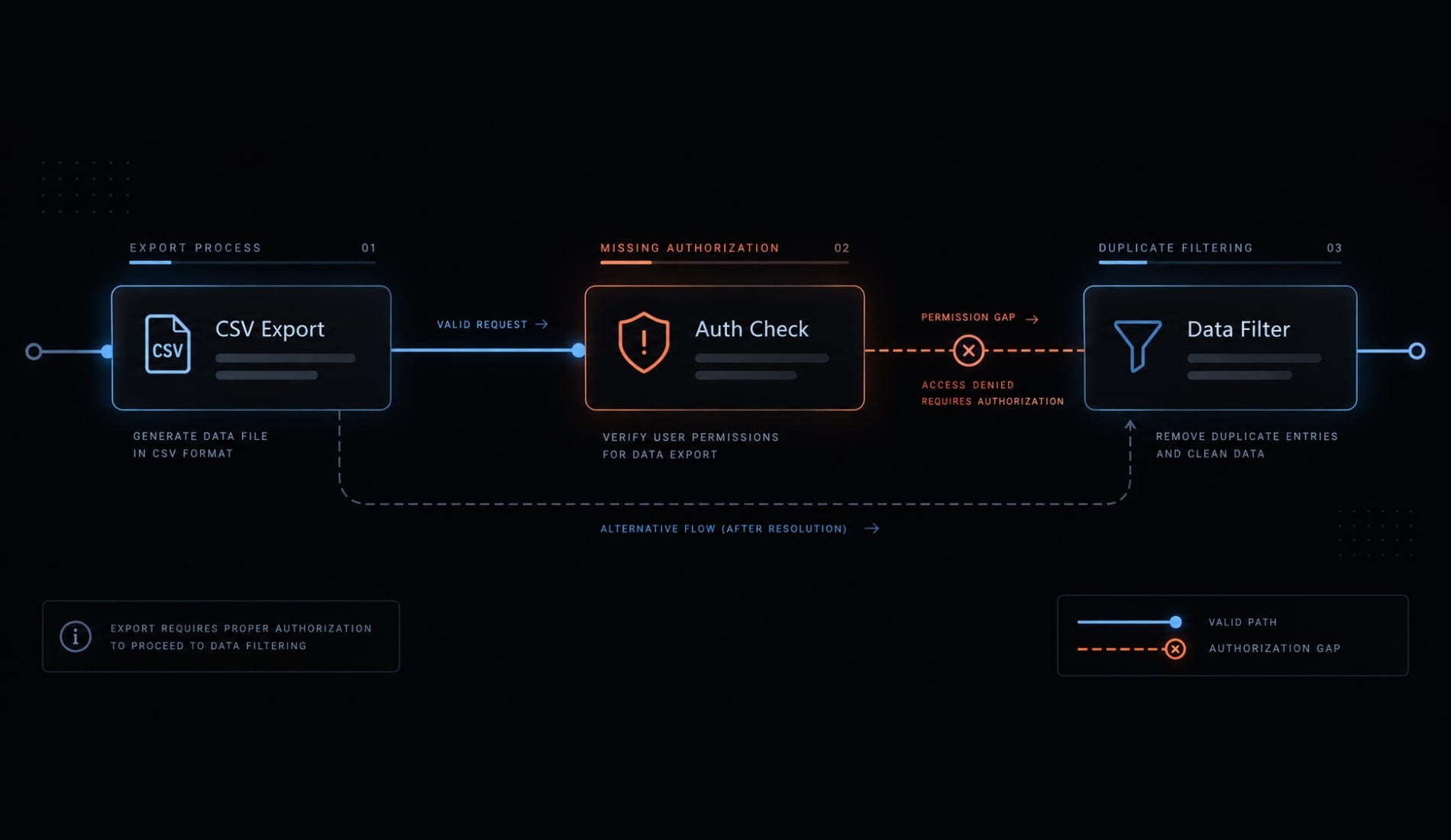
The file’s existence does not prove users can export only their organization’s records. The OWASP Authorization Cheat Sheet recommends validating permissions on every request; a hidden button is not an authorization boundary.
Why more prompting can make the system less predictable
Prompt-to-logic drift describes implementation moving away from the intended requirement through successive prompt-driven edits. In this scenario, the problem is an export test covering only successful access. The evidence is a test fixture containing one organization. The adjustment is a second organization and an explicit denied-access test.
Another prompt might instead add duplicate filtering in the browser, leaving server authorization unchanged. That increases technical debt and creates inconsistent rules. When fixes contradict one another, inspect the current implementation and return to an explicit plan.
The six-layer vibe coding monitoring framework
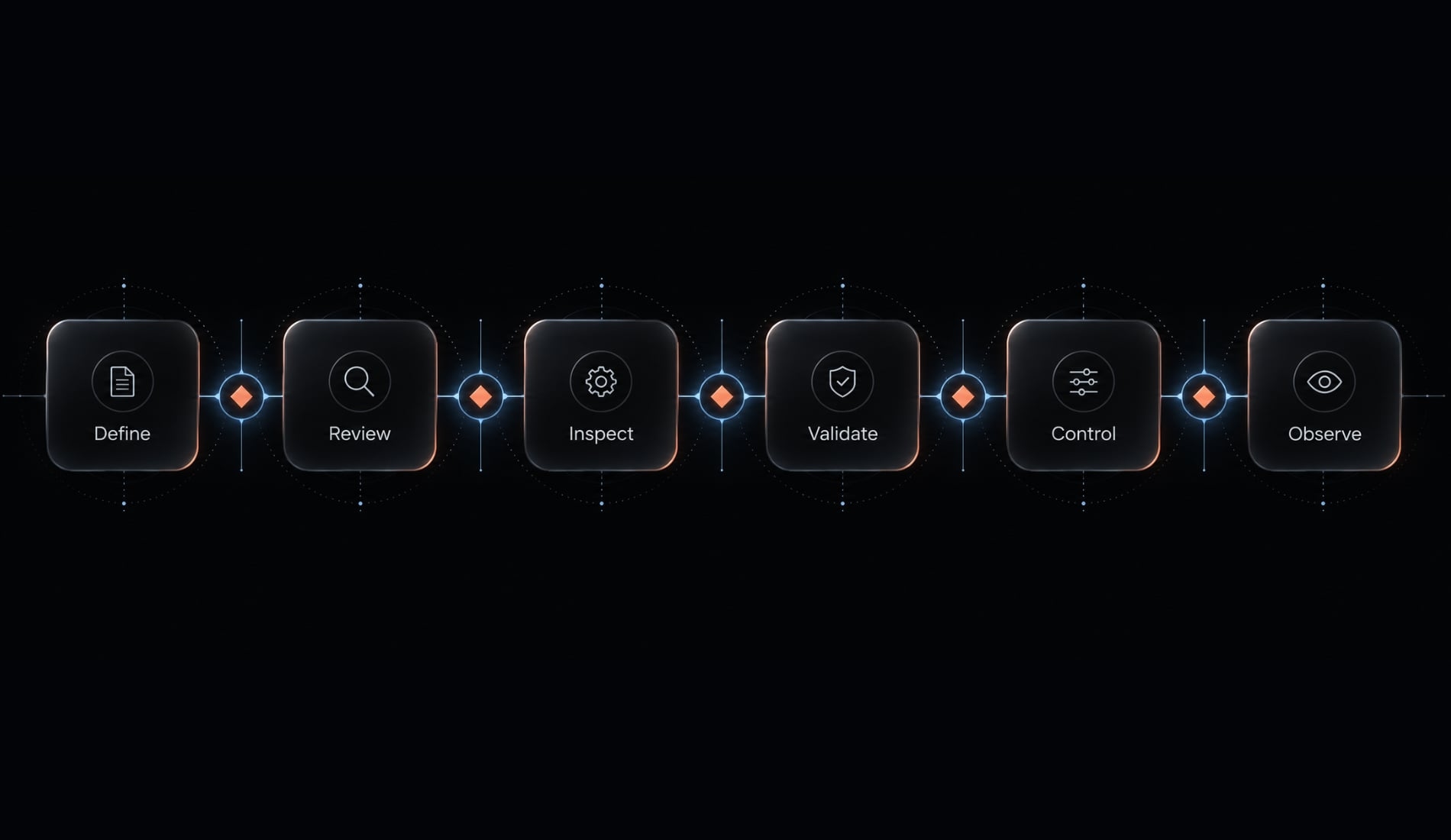
This is a practical organizing model, not a certified standard or six additional tools:
- Define intent.
- Review the plan.
- Inspect changes.
- Validate behavior.
- Control release.
- Observe runtime.
For a solo developer, these checkpoints can live in one task record. Their value comes from evidence and decisions, not documentation volume.
Layer 1: Monitor intent and scope
- Inspect: Define the outcome, exclusions, affected components, initial risk, and permitted data, files, tools, and actions. Acceptance criteria are observable conditions defining a successful change.
- Retain evidence: Keep a short task brief. For the export: “Export only the current organization’s permitted records; exclude permission-model redesign.”
- Minimum checkpoint: A reviewer can explain success, boundaries, and whether the task is small enough to validate. Split ambiguous work before execution. Written scope supports coordination, but does not enforce access restrictions.
Layer 2: Review the agent’s plan before execution
- Inspect: Check expected files, dependencies, tests, security assumptions, migration implications, and release steps. Require renewed review if the agent proposes work outside those boundaries.
- Retain evidence: Save a concise implementation plan with assumptions and a recovery approach. A plan-first workflow makes intended actions inspectable; it does not reveal hidden model reasoning.
- Minimum checkpoint: Approve non-trivial work only when the plan matches the brief. Stop if the export unexpectedly requires rewriting shared authorization or changing unrelated database structures.
Layer 3: Inspect the change set
- Inspect: Use version control, small commits, and a branch or worktree. Review the actual diff for unrelated edits, deleted checks, secrets, dependencies, and permission changes.
- Retain evidence: Preserve the diff and a summary verifiable against it.
- Minimum checkpoint: Every changed file has a justified relationship to the task and supports code maintainability.
Git’s git-diff and git-worktree documentation describe change inspection and working trees. Branches isolate code changes, not execution privileges. Worktrees are not security sandboxes. Source reversal cannot undo every external action or data mutation.
Layer 4: Run automated validation
- Inspect: Group checks into code hygiene, behavior, and security: formatting and type checks; unit, integration, and critical-path tests; secret and dependency scans.
- Retain evidence: Save actual runner output or CI, an automated environment that runs checks against a change, results. An agent can trigger tests, but “tests passed” in chat is not execution evidence.
- Minimum checkpoint: Failed required checks block progression. Humans verify coverage, including whether one organization can export another’s records. Passing tests may still miss important behavior.
Layer 5: Control deployment
- Inspect: Validate in staging or preview. Apply least privilege, meaning access limited to what the task requires, especially for production credentials.
- Retain evidence: Record the release decision, owner, recovery criteria, and recovery plan.
- Minimum checkpoint: An accountable human approves high-risk changes involving authentication, payments, migrations, infrastructure, or sensitive permissions. Deployment gates should block unauthorized progression.
Distinguish source rollback from backup restoration or forward repair. Some migrations cannot safely reverse. NIST’s Secure Software Development Framework, Version 1.1 supports incorporating security practices throughout development rather than relying on final inspection alone.
Layer 6: Observe runtime behavior
- Inspect: Prioritize errors, failed journeys, latency, timeouts, authorization failures, integration health, and cost anomalies.
- Retain evidence: Keep actionable logs, metrics, and, where useful, a trace, a record connecting work across components or services. Tie evidence to releases where feasible.
- Minimum checkpoint: Failures are investigable; alerts identify an owner and response. OpenTelemetry’s What Is OpenTelemetry? documentation describes instrumentation, not a complete monitoring backend.
Separate development-agent token spending from runtime model spending; the application may use no runtime model. Preserve incident evidence and sanitize diagnostics before sharing them with an agent.
Layer | Main question | Evidence | Gate or response |
|---|---|---|---|
Intent | What is permitted? | Task brief | Narrow unclear scope |
Plan | Is the approach justified? | Approved plan | Review deviations |
Changes | What actually changed? | Diff | Reject unexplained edits |
Validation | Does required behavior hold? | Runner results | Block failed checks |
Deployment | Can we release and recover? | Release decision | Approve sensitive changes |
Runtime | What happened after release? | Linked diagnostics | Investigate and respond |
Prototype vs. production: How much monitoring is enough?
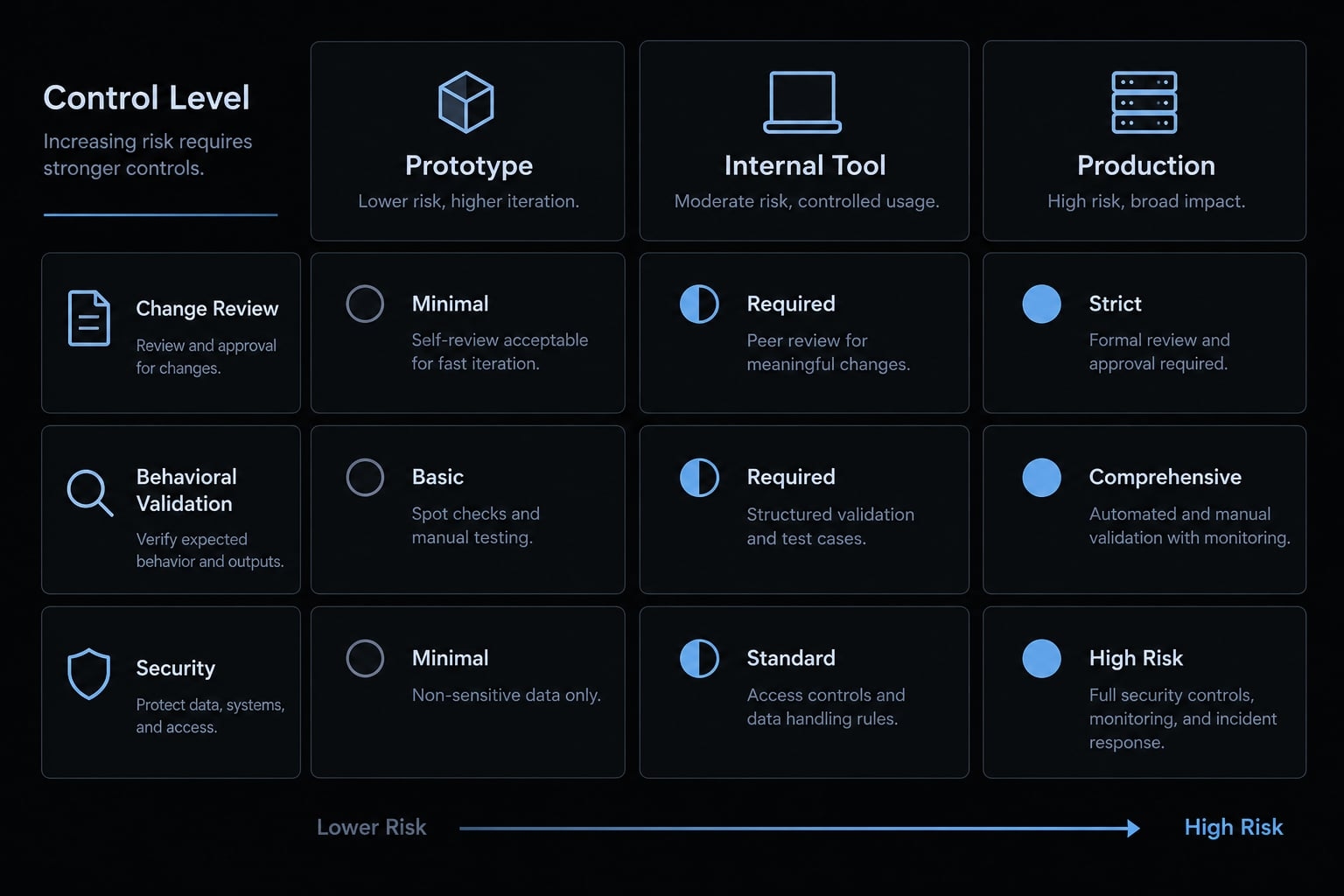
Risk-based monitoring follows exposure, not project labels. An internal tool with customer-database access can require stronger safeguards than a public, read-only website.
The following matrix is editorial guidance, not a universal compliance rule. It assumes prototypes use synthetic data, limited privileges, and disposable environments.
Control area | Disposable prototype | Internal tool | Customer-facing production |
|---|---|---|---|
Scope and plan | Brief outcome | Document affected systems | Explicit criteria and release scope |
Change review | Inspect important edits | Review integration changes | Review release diff |
Behavioral validation | Basic success and failure checks | Critical workflows and permissions | Critical paths and regressions |
Security and permissions | No real secrets or data | Restricted access and scanning | Verified access boundaries and scanning |
Release and recovery | Reset environment | Named owner and recovery plan | Controlled release and tested recovery where needed |
Runtime signals and ownership | Visible local errors | Errors, costs, and responder | Actionable alerts and release correlation |
Real data, external access, or irreversible actions can immediately raise a prototype’s risk. Conversely, a small application does not automatically need distributed tracing.
Four factors that determine the required control level
- User and business impact: Consider severity, not just user count. One administrator can affect every customer record.
- Data sensitivity: Identify personal information, customer documents, credentials, and confidential business records.
- Reversibility: Determine whether actions can be undone, restored, or only repaired.
- Operational exposure: Consider public access, connected systems, unattended execution, and spending authority.
Use the highest consequential exposure to guide safeguards. Averaging these factors can conceal a serious permission or recovery problem.
The prototype-to-production trap
The illustrative export begins with synthetic records. Later, someone connects real customer data and makes it part of account operations.
The interface has barely changed, but its consequences have. Risk-based monitoring requires a production readiness checkpoint before exposure increases, not after an incident. Reassess ownership, permissions, negative tests, diagnostics, and recovery before enabling that connection.
Warning signs that your vibe coding workflow is losing control
Stop when evidence becomes weaker while changes become broader. More prompting is not necessarily the right response to code drift or unexplained failures.
Warning sign | Likely concern | Immediate action |
|---|---|---|
Unrelated file edits | Scope drift | Review and separate changes |
Repeated regressions | Conflicting fixes | Reproduce; inspect shared logic |
Passing tests, failing journeys | Incomplete coverage | Add the missing behavior check |
Unexplained dependencies | Unnecessary or unverified package | Verify origin and purpose |
Unreviewed permission changes | Access boundary weakened | Block release; request review |
Incident lacks release context | Missing correlation | Connect deployment and change records |
Unexpected cost or repeated calls | Retry or loop problem | Limit execution; inspect calls |
Patch loop lacks explanation | Unstable understanding | Freeze edits; create a smaller reproduction |
For debugging AI-generated code, capture the failing behavior before asking for another fix. Otherwise, a disappearing symptom may be mistaken for a resolved cause.
When to stop vibe coding and switch to structured engineering
Increase structure when:
- Shared repository changes lack coordination.
- Sensitive data or payments are involved.
- Downtime affects customers or revenue.
- Recovery is uncertain.
- Architecture decisions exceed task scope.
- Rework consumes the time saved.
Some conditions require stronger controls before work begins, not an emergency halt later. Structured engineering can still use AI; the difference is explicit boundaries, evidence, and human review.
A practical production-readiness gate
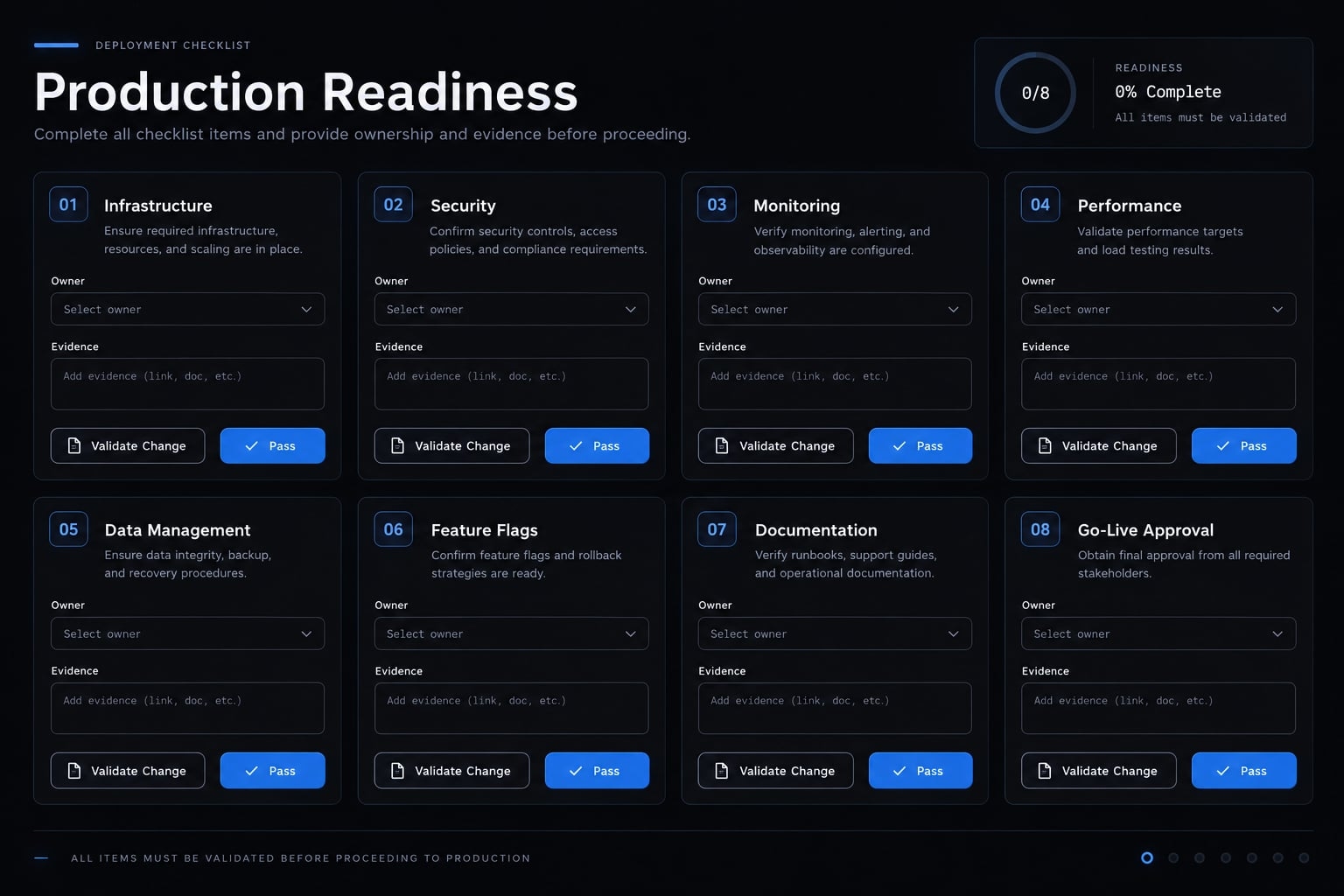
Reuse this checklist for the next release:
- Acceptance criteria are explicit.
- The actual diff has been reviewed.
- Independent checks have passed.
- Secrets and dependencies have been scanned.
- Permissions and data access have been verified.
- A credible rollback or recovery path exists.
- Relevant errors, latency, and usage costs are observable.
- A human owner accepts release responsibility.
This is a baseline gate, not proof of universal readiness. Independent checks mean inspectable execution evidence, not merely another agent agreeing.
Copy it into a release record with the change identifier, risk level, reviewer, evidence location, release decision, and recovery notes.
Where coordinated coding agents improve monitoring and control
Multiple agents can reinforce the same mistaken assumption. A single agent with strong tests and review boundaries may be sufficient. Defined responsibilities and evidence matter more than agent count.
Coordination becomes useful when repeated setup and inconsistent handoffs make the controls difficult to maintain.
Example of a monitored multi-agent change
For the illustrative dashboard export:
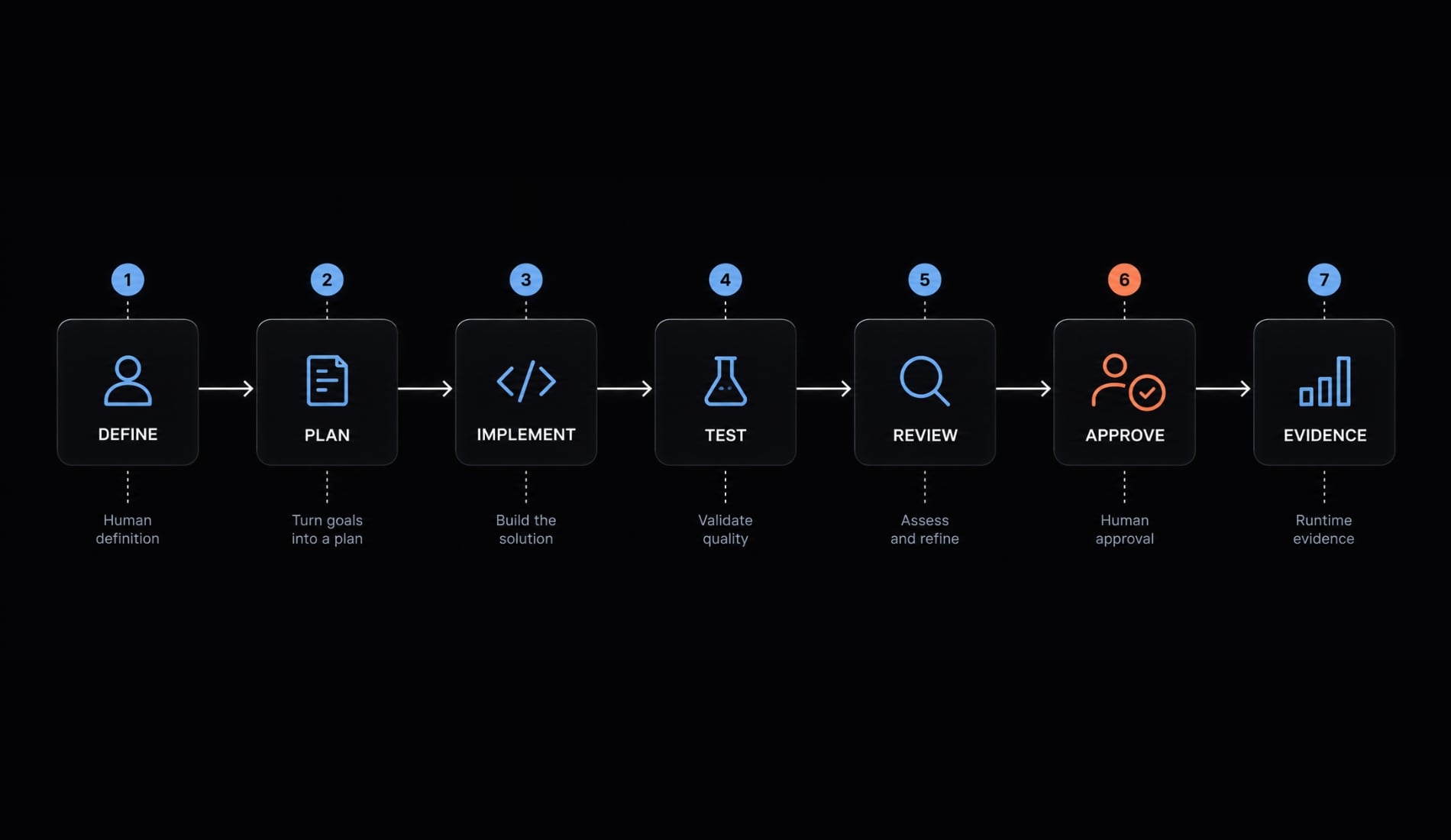
- A human defines organization boundaries and acceptance criteria.
- A planner identifies components and authorization risks.
- An implementer creates the bounded change.
- A testing role executes checks through a real runner.
- A review/security role challenges the diff and access assumptions.
- A human approves high-risk changes and release.
- Runtime evidence supports investigation after deployment.
Role separation distributes work; it does not guarantee independent reasoning or security assurance. Review criteria must come from requirements, not simply repeat the implementer’s explanation.
What AgentKit adds to the workflow
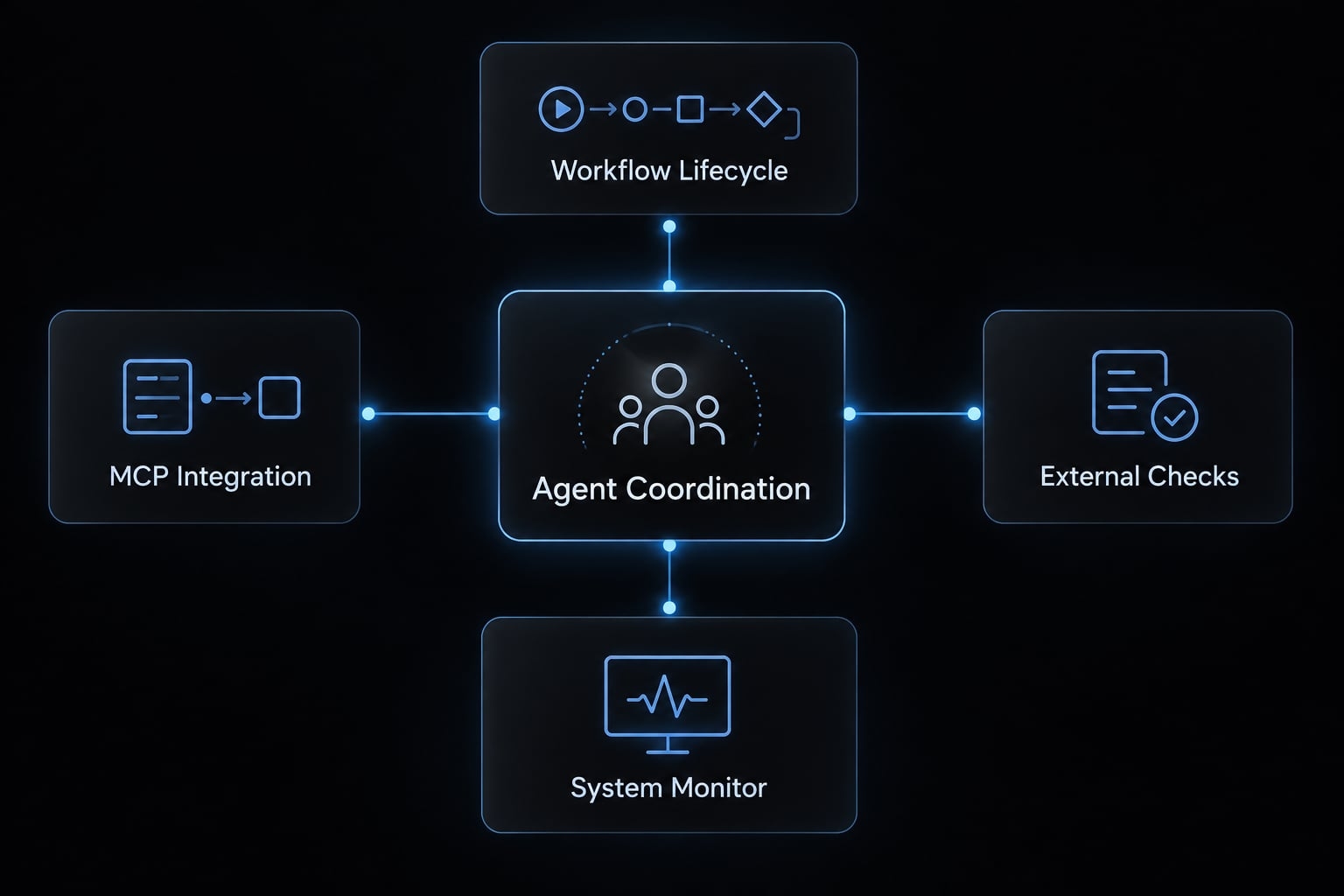
AgentKit Engineer supports software-development lifecycle workflows. Its product offering includes the following coordination capabilities:
Capability | Practical contribution |
|---|---|
Specialized subagents and lifecycle support | Organize planning, implementation, testing, and review roles |
Reusable skills and workflows | Reduce repeated instructions and setup |
MCP integrations | Connect tools through Model Context Protocol |
Cross-platform CLI, a command-line interface | Manage workflows from a terminal |
Desktop control center | Manage skills, plugins, configurations, plans, tokens, and security-check functions |
Enforcement mechanisms and hook coverage vary by coding agent harness. Workflow instructions are not necessarily enforced approval gates, and post-merge checks do not replace application observability. Connected tools and permissions determine what actually executes and what can be blocked.
Frequently asked questions
What is vibe coding monitoring?
Vibe coding monitoring is the practice of tracking both the AI-driven development process and the resulting application’s runtime behavior. It makes agent plans, code changes, validation results, and runtime behavior visible so people can verify, approve, and intervene when something departs from expectations.
Is vibe coding monitoring just standard application monitoring?
No. While standard monitoring focuses on system health, vibe coding monitoring also tracks the "generation process." It requires linking AI-generated changes, prompt instructions, and agent plans to runtime evidence. This helps developers understand why code was implemented a certain way when investigating production incidents.
Why do "working" vibe-coded features often fail in production?
Features may pass visual tests but fail due to "silent" issues like missing database Row-Level Security (RLS), incorrect API assumptions, or unindexed queries. A demo proves only the behavior it exercises. Unchecked assumptions, such as single-account test data or missing permission tests, can hide failures until real users and data arrive.
How do I know when to stop vibe coding and use structured engineering?
You should switch to structured engineering when the task involves sensitive data, complex permission models, or high financial impact. If you notice repeated regressions, "patch loops" where the agent keeps breaking its own fixes, or unrelated file edits, it is time to halt and review the implementation plan.
Read more:
- Vibe coding security: Risks and pre-deployment checklist
- Vibe Coding technical debt: Risks and pevention guardrails
- Vibe coding maintenance: A practical guide for AI-built apps
Conclusion
Vibe coding monitoring connects execution speed with inspectable evidence across six key questions from task planning to runtime behavior. Keep experimentation lightweight for low-risk tasks, but enforce stricter controls before changes impact production, security, or data. Use the provided checklist to attach verified evidence, ensuring AI generation speed translates into real long-term productivity without compromising release safety.