Vibe coding technical debt cleanup: A risk-first framework for stabilizing AI-generated software
Vibe coding technical debt creates a dangerous control gap where AI-accelerated code outpaces a team's ability to safely test and operate it. Rather than defaulting to full rewrites, combat this by adopting a risk-first approach: protect critical system behaviors, implement bounded improvements, and maintain lightweight controls to keep future changes sustainable and accountable.
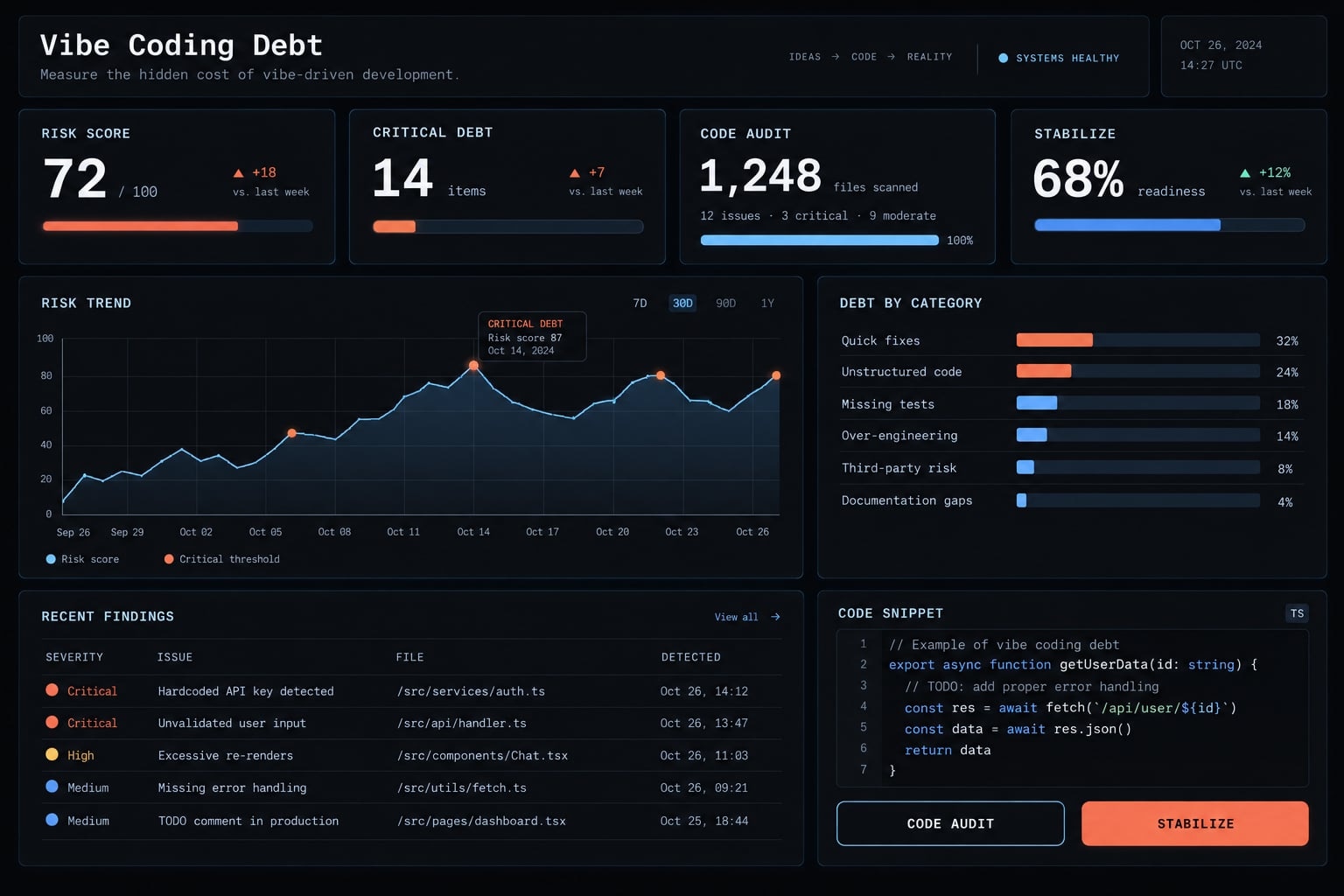
What is vibe coding technical debt?
Vibe coding technical debt is the accumulated maintenance, understanding, security, and operational burden created when prompt-led development outpaces inspection, testing, and ownership. It describes a control gap, not all AI-assisted development. Cleanup reduces that burden by establishing intended behavior, correcting consequential weaknesses, and making future changes safer to review and release.
Andrej Karpathy’s original description emphasized generating software without closely inspecting the code. Broader AI-assisted engineering can include substantial planning, review, and validation.
AI-generated code is not inherently low quality. Similar debt exists in human-written software. Martin Fowler’s Technical Debt Quadrant distinguishes between deliberate and inadvertent debt, though neither form necessarily requires AI involvement.
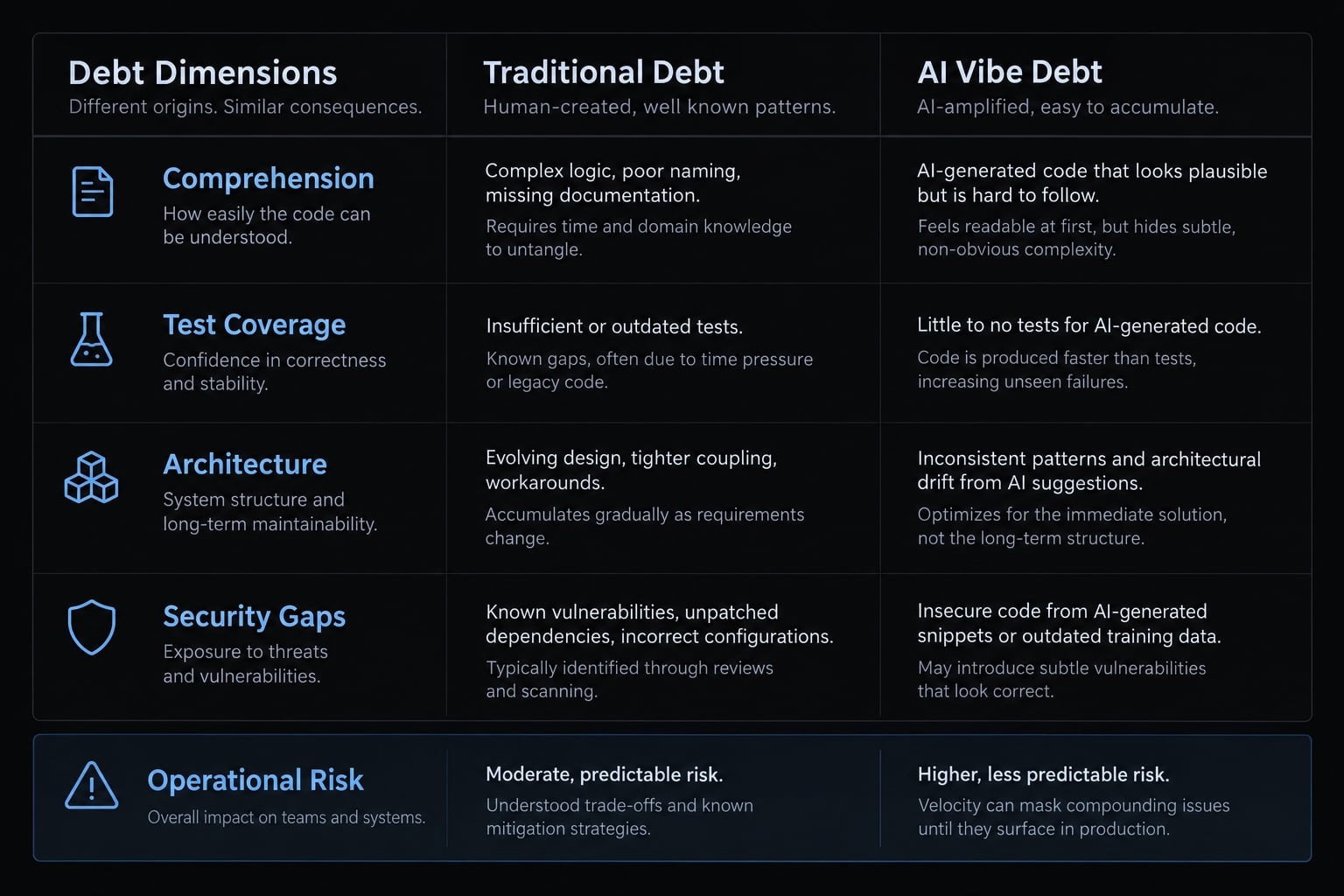
How vibe debt differs from traditional technical debt
These are possible amplification patterns, not separate classes of software quality.
Dimension | Debt in any codebase | Pattern rapid generation may amplify |
|---|---|---|
Creation | Shortcuts or accidental complexity | Changes accumulate before review |
Awareness | Documented or undiscovered | Working output masks incomplete understanding |
Ownership | Clear or fragmented | No accountable maintainer after generation |
Consistency | Rules drift across modules | Separate sessions recreate conflicting helpers |
Cleanup effort | Discovery, testing, remediation | More behavior must be rediscovered |
Operations | Failures, exposure, slow recovery | Release volume exceeds operating controls |
The six common forms of vibe coding debt
- Comprehension: Unexplained behavior makes debugging and estimation unreliable.
- Test: Missing behavioral checks allow customer-facing regressions.
- Architecture: Tightly connected modules turn small changes into broad projects.
- Dependency: Unnecessary or unvetted packages increase maintenance and security exposure.
- Security: Weak access controls can expose customer data or capabilities.
- Documentation and ownership: Missing decisions and maintainers delay safe incident response.
“Comprehension debt” is a descriptive concept here, not a standardized assessment category.
Illustrative example: A software-as-a-service product checks subscription eligibility differently in its dashboard and export service. A canceled customer loses dashboard access but retains exports. The priority is resolving the access rule - not simply removing duplicate code.
How to tell whether a vibe-coded application needs cleanup
Operational evidence usually reveals codebase fragility more clearly than formatting or file counts. Look for patterns affecting delivery, customer trust, and recovery.
Operational warning signs
- Small changes spread across unrelated modules.
- Isolated updates trigger unexpected regressions.
- Debugging takes progressively longer.
- Estimates repeatedly miss because dependencies emerge late.
- Engineers avoid particular modules.
- The same incidents return.
- Rollback is unclear or unsafe.
- Nobody can explain a critical customer workflow.
Together, these signals can increase support burden, delay roadmap commitments, and complicate enterprise readiness assessments.
Repository warning signs
- Duplication: Logic duplication produces conflicting subscription or permission rules.
- Dependencies and configuration: Dependency sprawl, unexplained packages, and environment drift complicate releases.
- Behavioral tests: Checks confirm execution but omit prohibited actions.
- Observability: Logs and alerts cannot explain failed customer journeys.
- Ownership and review: Unowned modules and unrelated pull request changes obscure accountability.
A pull request, or PR, is a proposed code change submitted for review.
Illustrative permissions failure: Tests confirm that a customer can open their workspace, but never verify that they cannot open another customer’s workspace.
Vibe debt triage scorecard
Use the planning heuristic below to evaluate each operational and structural area based on real-world evidence.
Assessment area | 0 | 1 | 2 | 3 |
|---|---|---|---|---|
Access controls | Negative cases verified | Minor gaps | Critical cases untested | Unauthorized access confirmed |
Critical-flow tests | Relevant behavior protected | Edge gaps | Main journeys missing | Known regressions undetected |
Business rules | Consistent | Local duplication | Conflicting implementations | Customer-impacting conflict |
Dependencies | Reviewed inventory | Minor excess | Unreviewed reachable packages | Confirmed exploitable exposure |
Change isolation | Bounded edits | Occasional spillover | Frequent cross-module edits | Changes repeatedly destabilize |
Production visibility | Actionable signals | Minor blind spots | Critical failures opaque | Incidents cannot be diagnosed |
Recovery | Tested procedure | Partial rehearsal | Manual, uncertain steps | Known recovery failure |
Understanding/ownership | Named, documented | Local gaps | Critical areas unexplained | No accountable maintainer |
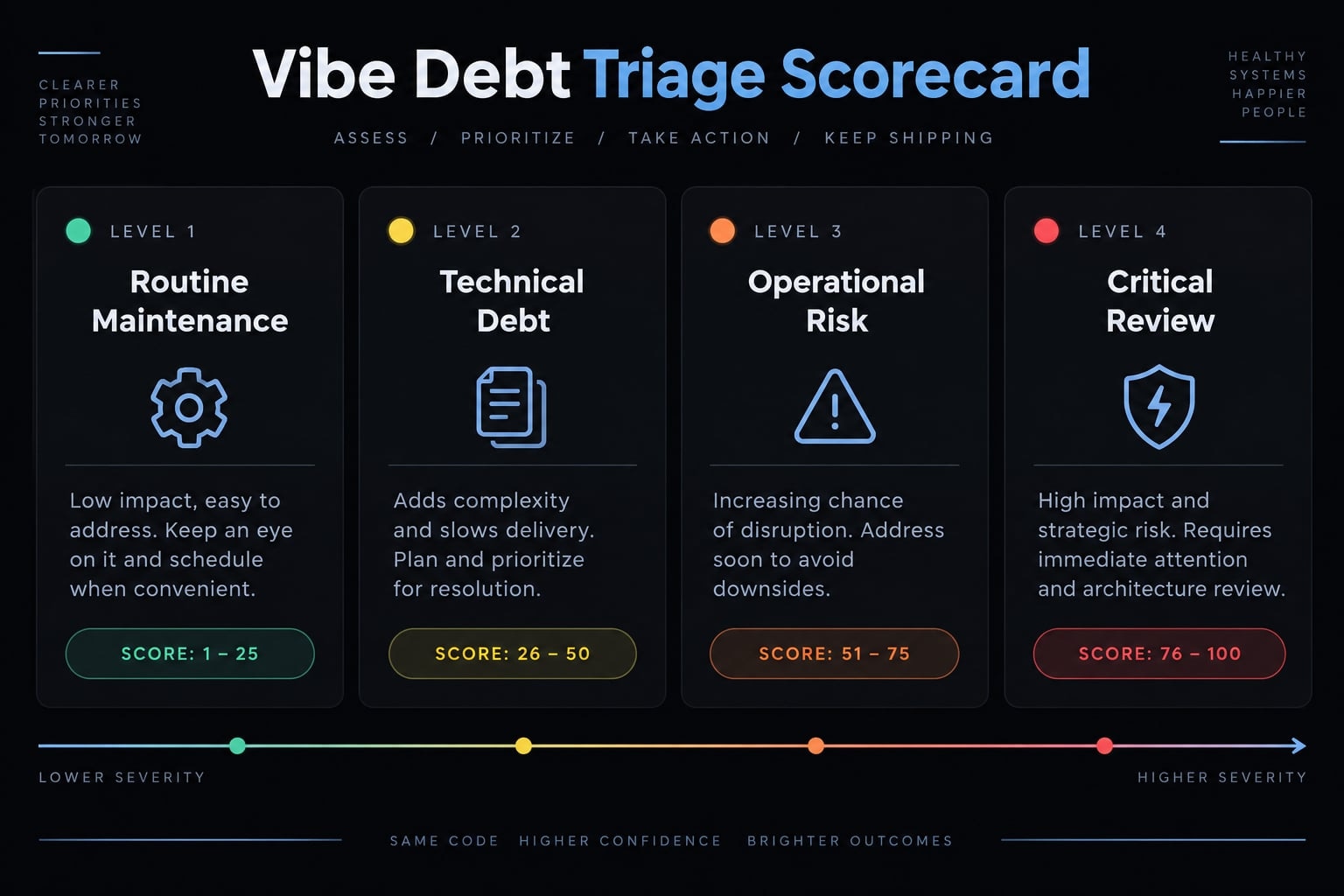
Interpret totals:
- 0-6: Routine maintenance.
- 7-13: Focused stabilization sprint.
- 14-19: Formal remediation backlog.
- 20-24: Independent architecture and security review before expansion.
These thresholds are unvalidated editorial heuristics. Assign an “unknown” status, evidence reference, and investigation owner to unknown controls instead of an automatic zero. Treat incomplete totals as provisional.
Critical-risk override: Active exposure, broken authorization, exposed credentials, or credible data-loss risk require escalation regardless of the total. Dependency risk depends on exploitability, reachability, provenance, and business exposure. An advisory alone does not establish criticality.
Copy this table into your issue tracker; add evidence, owner, and next action before using it to allocate work.
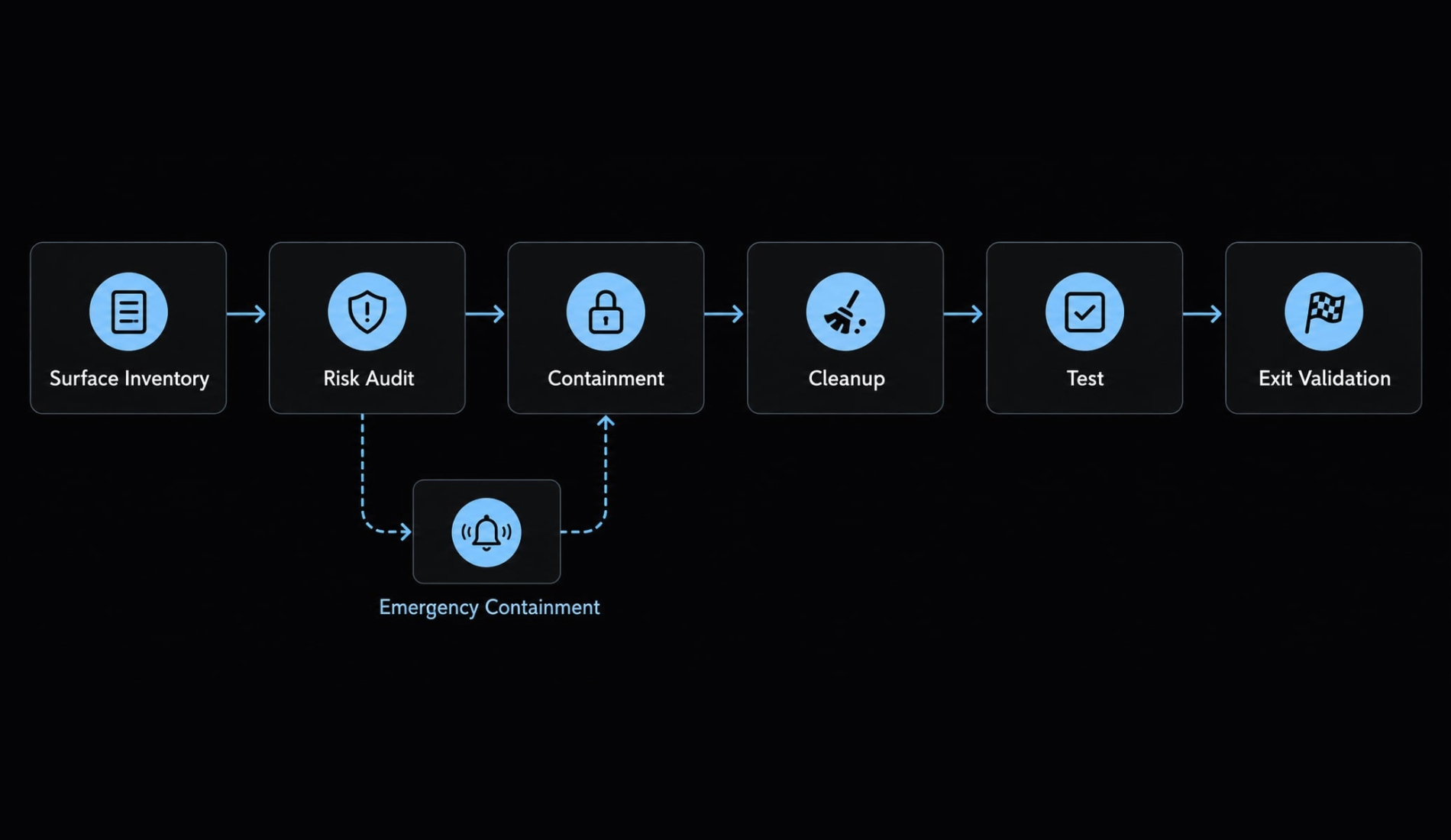
A risk-first framework for vibe coding technical debt cleanup
Treat cleanup as controlled stabilization, with explicit boundaries and stopping conditions.
- Define business-critical workflows.
- Audit and rank risks.
- Protect behavior with tests.
- Consolidate architecture incrementally.
- Strengthen operations and recovery.
- Validate exit criteria.
Active incidents require immediate containment. Do not wait for complete discovery or comprehensive test coverage before responding to exposed credentials or unauthorized access.
Step 1: Define the business-critical surface area
Start with behavior affecting customer access, revenue, sensitive data, contractual commitments, and business continuity. Include authentication, authorization, subscriptions, customer workspace provisioning, data export or deletion, and customer-facing interfaces where relevant. Authentication verifies identity; authorization determines permitted actions.
Map incidents and support tickets to affected modules. Define what must remain stable during remediation.
Produce:
- A critical-workflow inventory.
- A code ownership map.
- An incident-to-module map.
- Explicit remediation boundaries.
A workspace-permission failure should outrank a cosmetic dashboard inconsistency. Business exposure determines priority, not how visible an issue appears in the interface.
Step 2: Audit the repository and rank risks
Inspect findings against actual use, permissions, data sensitivity, and deployment conditions. Automated findings are leads for investigation, not final judgments.
The following P0-P3 labels are local planning categories; your organization may define incident priorities differently.
Priority | Example | Recommended action |
|---|---|---|
P0 | Active data exposure or imminent severe loss | Contain immediately; invoke incident response |
P1 | Critical billing or customer-access behavior at risk | Prioritize protected remediation |
P2 | Recurring failures or unreliable recovery | Schedule stabilization with operational validation |
P3 | Low-risk duplication or confusing organization | Improve during bounded maintenance |
Create a risk-ranked debt register containing finding, evidence, impact, owner, next action, and validation method. Attach a dependency inventory, confirmed security findings, and areas with excessive interdependence or unclear ownership.
Use OWASP’s Application Security Verification Standard to inform security review categories - not to imply certification.
Caution: Avoid broad formatting changes. Revoke or rotate exposed secrets; deleting them from source is insufficient. Pause affected releases or expansion when necessary, without automatically stopping safely separated work.
Step 3: Pin current behavior with characterization tests
Characterization tests capture what software currently does so changes can be evaluated against a baseline. Michael Feathers explains this approach in Working Effectively with Legacy Code.
Distinguish two questions:
- Observed behavior: What does the application do?
- Acceptance criteria: What must it do to satisfy product and security requirements?
Do not turn a known authorization flaw into an approved requirement merely because a test records it.
Prioritize complete customer journeys, integration boundaries, tenant isolation, invalid inputs, timeouts, and previously reported incidents. Tenant isolation means keeping each customer organization’s data and actions separate.
Produce a critical-flow baseline, regression suite, and risk-based coverage map showing which failures each check detects. Test volume and coverage percentages do not prove useful protection. AI-generated tests can repeat implementation misunderstandings. Humans must inspect assertions and missing negative cases, especially prohibited actions.
Step 4: Consolidate architecture incrementally
Change one bounded area at a time. Consolidate repeated rules and reuse approved patterns without bundling unrelated improvements.
Illustrative before/after: Several modules independently calculate subscription eligibility. After remediation, those modules use one approved rule, with tests covering relevant subscription states.
Before removing an apparently unnecessary abstraction, confirm whether it supports undocumented customer behavior or integration requirements. Produce documented boundaries, approved implementation patterns, targeted duplication reduction, and small PRs with validation evidence.
Prefer changes that reviewers can understand and operators can reverse. Run relevant tests before merge and release. If consolidation broadens the failure impact, introduce it in smaller stages rather than treating fewer files as sufficient evidence of improvement.
Step 5: Add operational scaffolding
Make failures diagnosable and recovery executable. Add structured, privacy-aware logs, actionable workflow monitoring, appropriate health checks, and controlled database migrations. Logs should identify relevant events without exposing credentials or unnecessary customer data.
Document deployment prerequisites, release verification, recovery triggers, and the incident owner. A code rollback may not reverse data changes. Database updates may require backward-compatible migrations or forward recovery - a corrective change that restores a safe state without reverting the database.
Produce a logging and monitoring checklist, deployment checklist, and tested recovery procedure. These controls improve diagnosis and recovery capability. They do not guarantee uptime or make a security scan comprehensive proof of safety.
Step 6: Close with measurable exit criteria
Finish the bounded effort when evidence supports completion:
- Critical workflows have human-reviewed behavioral protection.
- Identified P0/P1 issues are remediated and validated.
- Lower-priority residual risks have owners and deadlines.
- Priority-module inconsistencies are resolved.
- Production signals expose relevant failures.
- Recovery procedures have been tested.
- Ownership and release authority are clear.
Assigning an owner does not make active critical exposure acceptable. Record validation evidence and unresolved uncertainty alongside the completion decision.
Before approving cleanup work, adapt these outputs into acceptance criteria. This makes the assignment measurable without promising a debt-free codebase.
Refactor, partially replace or rewrite?
Incremental remediation is the starting preference for established live products, not an absolute rule. It preserves working behavior while reducing the uncertainty introduced by replacement. Refactoring changes internal structure while preserving intended behavior. Partial replacement substitutes a bounded subsystem. A rewrite replaces most or all of the application.
Decision matrix
Decision factor | Refactor | Partially replace | Rewrite |
|---|---|---|---|
Production use | Preserve live workflows | Isolate affected users | Plan whole-system transition |
Business-logic value | Retain existing rules | Retain surrounding rules | Rediscover and specify rules |
Testability | Add protective checks | Test subsystem contract | Validate old/new equivalence |
Architecture | Correct local boundaries | Replace weak subsystem | Address systemic constraints |
Data migration | Often limited | Scoped reconciliation | Broad migration obligations |
Security | Correct specific weaknesses | Replace unsafe component | Redesign and revalidate controls |
Delivery impact | Incremental disruption | Parallel subsystem work | Significant competing capacity |
Default fit | Valuable, repairable product | Concentrated structural weakness | Evidence-backed exceptional case |
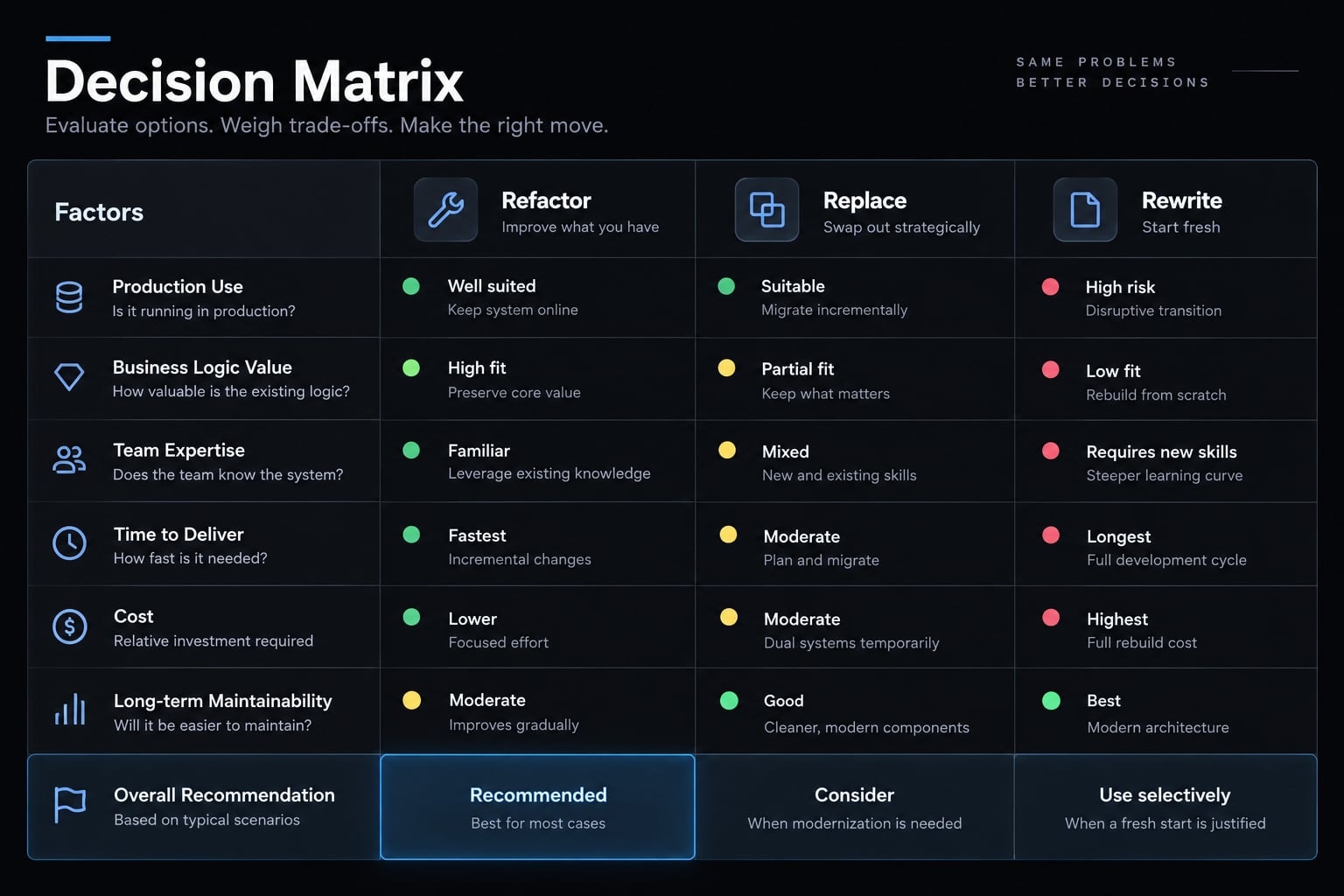
The matrix supports judgment; it does not mechanically choose a path. Poor testability alone does not prove rewriting is cheaper. Low adoption reduces some migration risk but does not establish replacement’s business value. Conversely, a live application can justify a rewrite when documented constraints make incremental correction impractical.
Questions founders should ask before approving a rewrite
- Which documented risks cannot be corrected incrementally?
- What customer behavior must be rediscovered?
- How will migration and reconciliation be validated?
- Can both systems operate in parallel?
- What triggers rollback or forward recovery?
- Which milestones demonstrate reduced risk?
- What happens to feature delivery?
- Who owns the replacement and its operations?
Illustrative example: A B2B subscription product has an unstable billing integration but reliable workspace management. The team replaces the billing adapter, reconciles subscription states, and validates event handling without rebuilding the product. This preserves valuable behavior while containing data migration risk. Hidden edge cases still require discovery.
When deciding whether to refactor or rewrite an AI-generated application, assess architectural health and transition obligations - not code origin. A rewritten system still needs specifications, review, tests, and operating controls. Rewriting does not automatically eliminate debt.
How to prevent vibe coding debt from returning
Retain AI speed through seven lightweight controls:
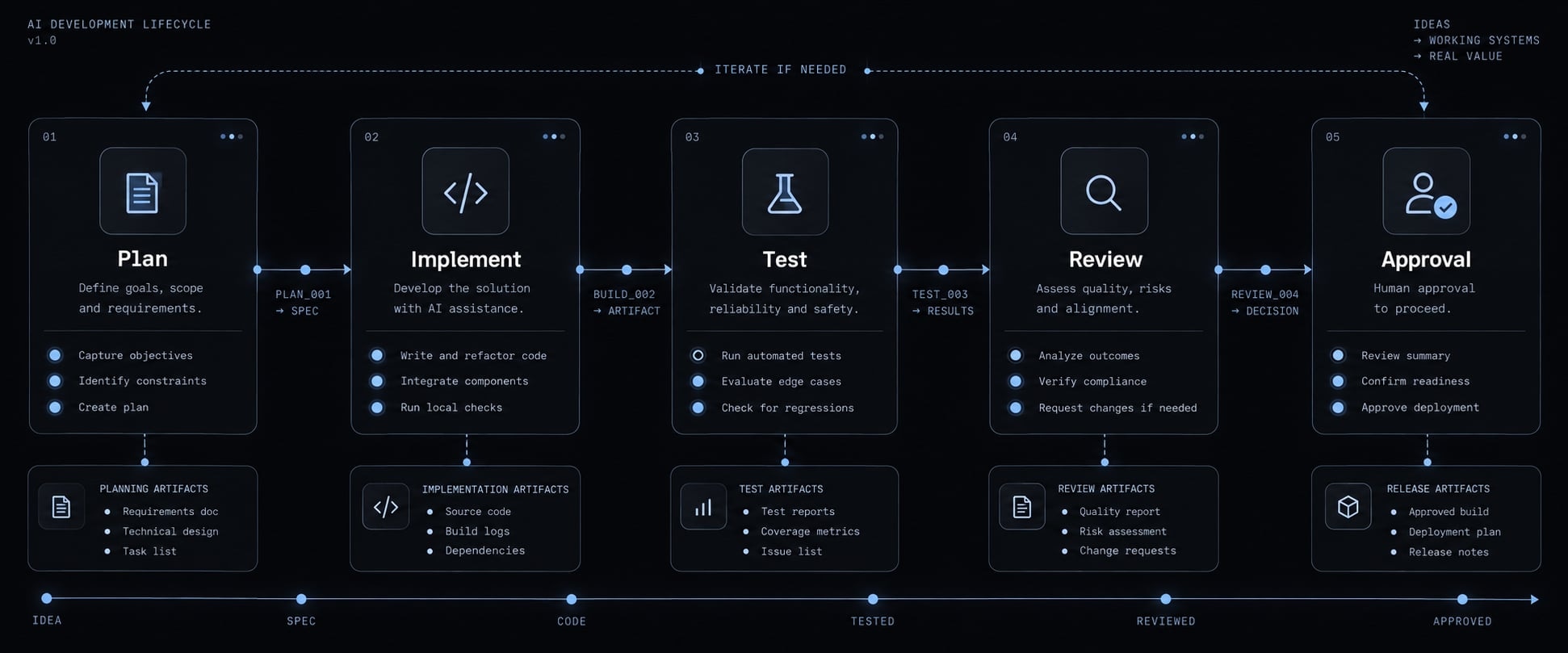
- Plan before editing.
- Supply repository context.
- Bound each change.
- Separate implementation and review.
- Define completion evidence.
- Monitor delivery trends.
- Assign human decision authority.
Require a written plan
Document requirements, acceptance criteria, affected modules, constraints, and non-goals. The deliverable is a short implementation plan, not a lengthy specification for every change.
Maintain repository context
Version-control architecture boundaries, approved dependencies, testing expectations, and security rules. Verify which instruction files each tool actually loads. Repository instructions guide agents; they do not enforce security boundaries.
Limit change scope
Use a scoped PR checklist: reuse existing utilities, seek dependency approval, separate unrelated refactoring, and favor reversible changes. Explain every expansion beyond the approved task.
Separate review from implementation
Require a distinct review pass and risk-appropriate human inspection. Record findings and resolution. A second agent may share the first agent’s assumptions; separation alone does not establish independent assurance.
Include tests and documentation in completion
The definition of done should include behavioral tests, relevant documentation, migration notes, and recovery guidance. Test changes are permitted when justified; weakening assertions merely to pass checks is not.
Track team-level delivery indicators
Use consistent periods and definitions. These codebase maintainability metrics are indirect indicators, not a complete quality score.
Metric | What it indicates | Interpretation caution |
|---|---|---|
Change failure rate | Failed deployments / total deployments | Define failure; show deployment count |
Lead time for changes | Commit-to-production duration | Shorter does not prove better architecture |
Recovery time | Detection-to-restoration for defined incidents | Not interchangeable with every DORA measure |
Reopened defects | Reopened / resolved defects | Apply a consistent reopening window |
Repeated incidents by module | Recurring operational weaknesses | Normalize for usage and reporting changes |
PR size and review time | Review burden and waiting | Small changes can still be dangerous |
Protected critical workflows | Protected / inventoried workflows | Review assertion quality and inventory scope |
DORA research informs delivery measurement, but incident-recovery terminology varies by metric and version. Specify your definition. Avoid universal targets or individual productivity rankings.
Keep humans accountable for architecture and production risk
Name who approves architecture decisions, accepts residual risk, authorizes merges, and releases production changes. Keep a decision record. NIST’s Secure Software Development Framework supports integrating responsibilities and security practices throughout development.
A practical 30-day cleanup plan
Four weeks is a starting cadence for bounded stabilization, not a guarantee of complete production readiness or elimination of debt.
Week | Actions | Checkpoint |
|---|---|---|
1: Assess and contain | Inventory critical journeys, review incidents, inspect dependencies and exposure, assign owners | Agreed priorities and containment actions |
2: Protect behavior | Capture critical behavior; convert relevant incidents into regression cases | Human-reviewed test baseline |
3: Remediate one area | Consolidate targeted rules, standardize failure handling, validate dependency changes, add monitoring | Reviewed change with validation and recovery evidence |
4: Prevent recurrence | Add instructions, review gates, dependency rules, completion criteria, and residual-risk planning | Owned next-stage backlog |
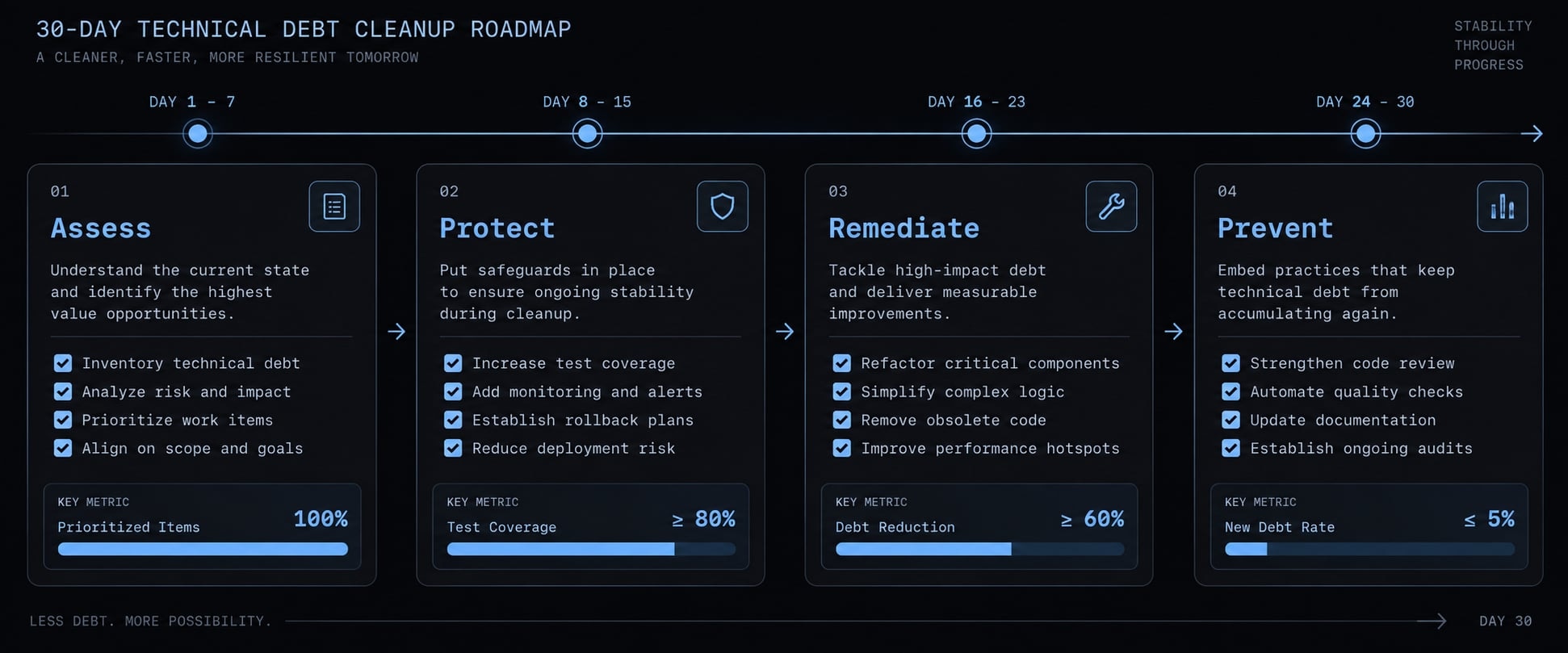
Immediate escalation applies throughout. Never defer active security incidents to a scheduled week. Likewise, do not begin structural remediation because the calendar says “Week 3.” Require the necessary behavior protection first.
Continue unrelated feature development only where separation is safe. Allocate capacity according to team availability, incident pressure, and business exposure - not a universal cleanup percentage.
At the month-end checkpoint, compare the bounded scope against its exit criteria. Record unresolved risks, evidence gaps, and decisions requiring additional expertise. A 60–90-day backlog may be useful for subsequent planning. It is a planning horizon, not a standard technical-debt cycle.
Read more:
- Vibe coding SEO: Build AI-powered assets without developers
- How to vibe code: A practical beginner guide to AI development
- 7 practical vibe coding examples: Build apps faster with AI
Frequently Asked Questions
What is vibe coding technical debt?
Vibe coding technical debt is the maintenance burden that accumulates when rapid, AI-assisted development outpaces architectural oversight and testing. It typically manifests as fragmented logic, inconsistent error handling, and dependency sprawl, leaving teams with a codebase that works on the surface but is fragile and difficult to scale.
How does vibe debt differ from traditional technical debt?
Both can be deliberate or inadvertent. Vibe debt is distinguished by how it accumulates: changes are generated faster than they are reviewed, so working output can mask incomplete understanding, and separate sessions may recreate conflicting logic.
What are the warning signs that an AI-generated codebase needs cleanup?
Critical signs include changes that unexpectedly break unrelated modules, escalating debugging times, unreliable feature estimates, and recurring regressions. If developers avoid touching certain legacy "vibe-coded" modules or if simple feature requests trigger cascading failures, it is time to prioritize remediation.
What is the most important first step in vibe coding debt cleanup?
The first step is to identify and protect business-critical workflows. Before changing any code, implement characterization tests to "pin" the current behavior. This creates a safety net, ensuring that your remediation efforts do not inadvertently break essential features or introduce new regressions into the system.
Should teams refactor or rewrite an AI-generated codebase?
Most teams should prefer incremental refactoring over a full rewrite. A rewrite carries high delivery risk and may not solve the underlying lack of architectural rigor. Incremental remediation allows you to stabilize critical paths, consolidate logic, and build a sustainable engineering workflow while keeping the product operational for users.
How can teams prevent vibe coding debt from returning?
Prevention requires shifting from ad-hoc prompting to spec-driven development. Implement repository guardrails like project-wide instruction files, enforce strict PR review gates, require behavioral test coverage for new features, and maintain clear human ownership over architectural and security decisions.
Read more:
- 7 practical vibe coding examples: Build apps faster with AI
- How to vibe code: A practical beginner guide to AI development
- How to vibe code a RAG chatbot: A practical step-by-step guide
Conclusion
Cleaning up vibe coding technical debt is about restoring confidence in safe changes, not just writing cleaner code. By prioritizing business risk, protecting core behaviors, validating operational visibility, and applying rigorous evidence-based reviews, teams can safely regain control over AI-generated software. Start with a single critical customer workflow, assess its risks, assign an owner, and complete the checklist to establish a repeatable, defensible process for future releases.