Vibe coding a Multi-Tenant SaaS: What it takes to make it production-ready
Vibe coding a multi-tenant SaaS can produce a convincing interface before it establishes a safe customer-data boundary. AI agents can accelerate screens, endpoints, database drafts, and tests. None of those outputs, individually, makes an application production-ready.
The harder task is tenant isolation: keeping each customer organization’s data and actions within its authorized boundaries. This guide explains feasibility, a practical build process, common failure patterns, and the evidence needed before launch. It uses an illustrative B2B reporting platform-not a verified customer case study. The central challenge is maintaining consistent rules as generated changes accumulate across the application.
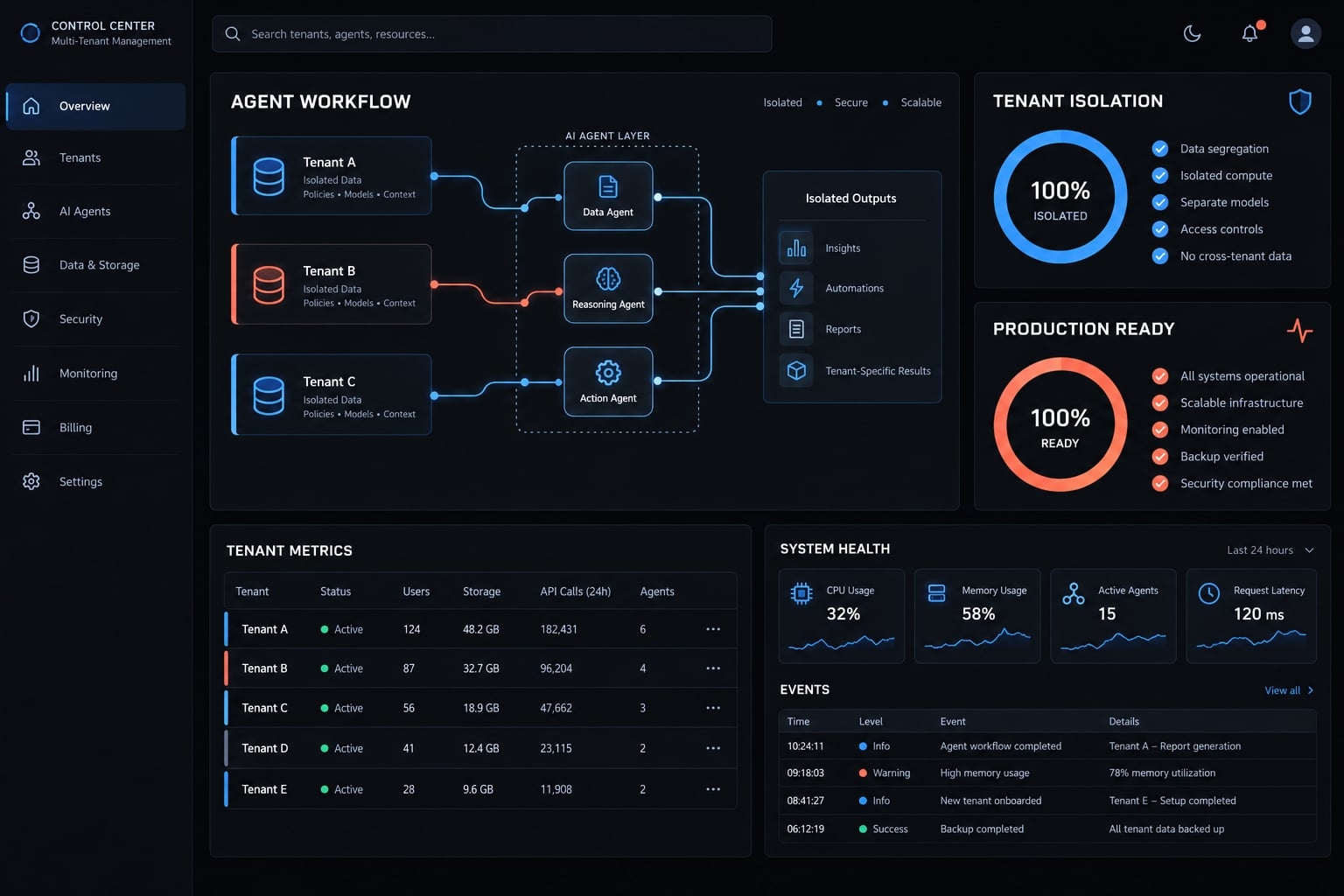
Can you really use vibe coding for a production-ready Multi-Tenant SaaS?
Yes, but AI-assisted implementation must sit inside an engineering process with explicit boundaries, independent verification, and accountable release approval. AI coding agents can contribute to production-ready software. They cannot establish readiness merely by generating working features, passing self-written tests, or deploying an application that appears complete in a demonstration.
Here, vibe coding means generating and iterating on software through natural-language instructions. For production work, that process must include deliberate inspection.
AI-assisted work | Human ownership |
|---|---|
Interface scaffolding | Acceptance and accessibility criteria |
Endpoint implementation | Authorization rules and access review |
Schema and migration drafts | Data-safety and recovery review |
Test generation | Independent expectations and coverage |
Documentation and release preparation | Final production approval |
Why Multi-tenancy changes the risk profile
A tenant is a customer organization or another deliberately defined isolation unit. Customers may share application infrastructure without sharing access to their records.
In the reporting-platform example, Tenant A must not retrieve Tenant B’s report by changing a record identifier. A tenant_id field identifies ownership; enforced access rules create the boundary.
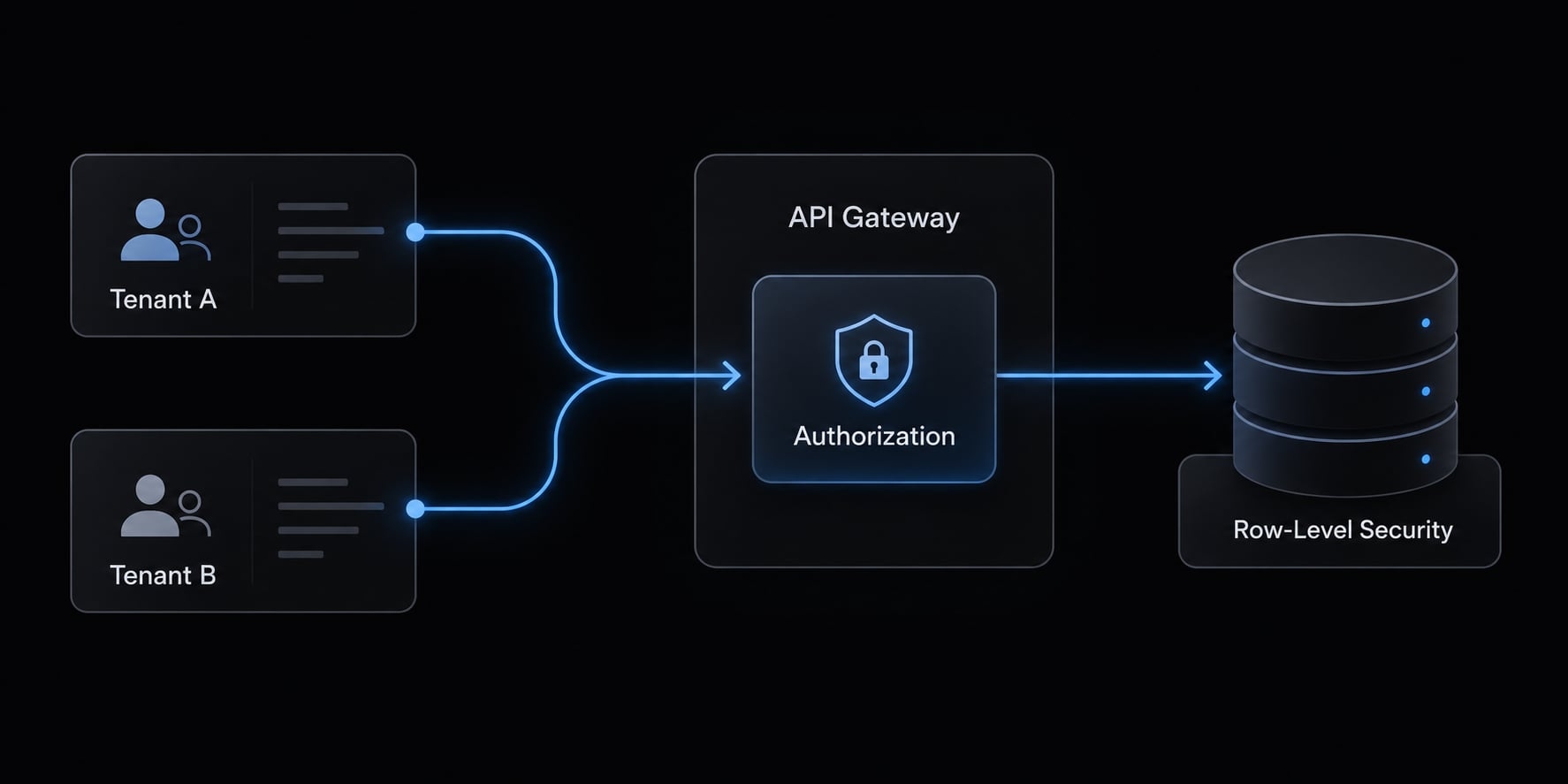
Authentication establishes who a user is. Authorization determines which organizations, records, and actions that user may access. Confusing these responsibilities can create customer-data exposure, contractual risk, and substantial rework.
OWASP’s Authorization Cheat Sheet recommends least privilege, denial by default, and permission validation on every request.
The practical verdict
Judge readiness by documented acceptance criteria and verified behavior-not demo completeness or generation speed. Humans remain responsible for architecture, security acceptance, and release decisions.
What “Production-Ready” means for an AI-built Multi-Tenant SaaS
Production readiness means having sufficient evidence that an application can operate within its declared customer, data, and service boundaries. It includes access control, controlled changes, detection, and recovery. The required evidence depends on risk and operating scope; it is not a universal feature list or a certification earned by deployment.
Control | Required evidence | What it establishes |
|---|---|---|
Tenant isolation | Cross-tenant read/write tests, including workers and exports | Tested paths respect ownership |
Authorization | Permission matrix, server-side membership checks, negative tests | Unauthorized actions are rejected |
Environment separation | Verified resources, credentials, and deployment configuration | Release targets the intended environment |
Database changes | Reviewed migration and exercised recovery approach | Change failures have a response |
Observability | Sanitized logs, routed alerts, exercised alert | Failures can reach an accountable operator |
Recovery | Restore test against agreed recovery objectives | Recovery works within tested limits |
Change control | Approved plan, reviewed diff, required automated checks | Release follows an approved process |
CI (Continuous Integration) runs automated checks when code changes. Successful CI is useful evidence, but only for the checks actually executed.
Production readiness also requires system coherence: consistency with the approved architecture. A feature may pass its local tests while violating the platform’s permission model.
PostgreSQL’s Row Security Policies documentation explains database enforcement behavior. OWASP’s authorization guidance addresses application-level access decisions. Neither makes a completed checklist comprehensive assurance.
Prototype, deployment and production are different milestones:
- Prototype: Demonstrates an idea in a restricted setting.
- Deployment: Places an application into an executable environment.
- Production: Operates within approved safeguards for actual users and data.
Backups being enabled does not demonstrate successful restoration. Likewise, migration recovery may require rollback, restoration, or a forward fix; not every migration is reversible.
A practical build process for AI-Assisted Multi-Tenant SaaS
Establish tenant rules before broad feature generation. Preserve approved decisions in project artifacts rather than relying on chat history.
The example below is a recommended workflow for a reporting platform serving Tenant A and Tenant B. PostgreSQL illustrates one database option; no specific toolchain, delivery period, or production outcome is claimed.
Recommended workflow
Define tenant rules → Specify core journey → Baseline access boundaries ↓ Bound task → Generate → Verify ↑ │ └── Revise if needed ┘
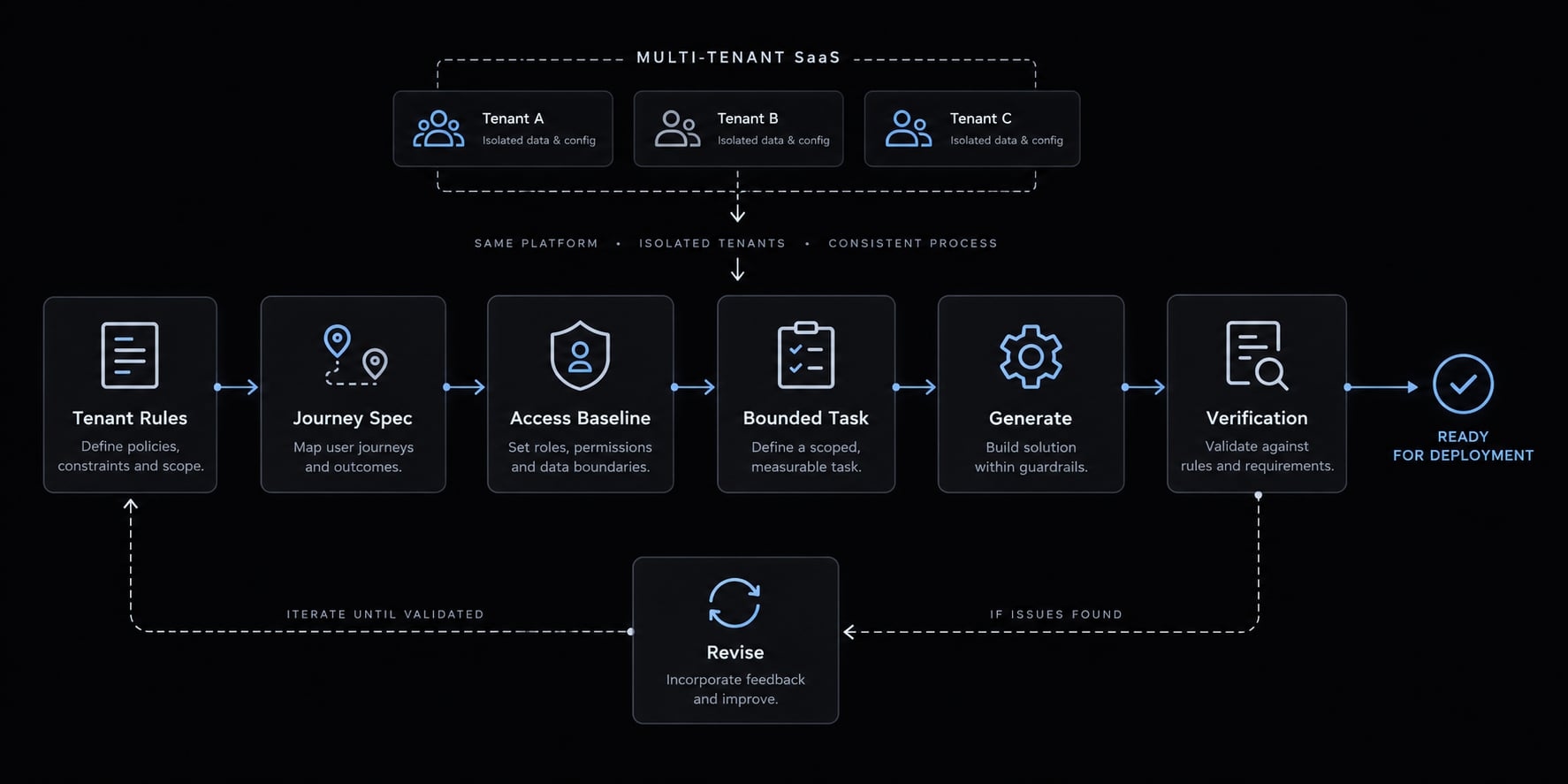
Step 1 - Define the Tenant model and Non-negotiable rules
Document relationships among users, organizations, roles, reports, and subscriptions. Distinguish shared reference data from tenant-owned records.
Assign one human owner for tenancy decisions. Require server-validated organization membership and denial when tenant context is missing or invalid.
A browser may submit an organization selection. The server must verify that the user belongs to that organization before accepting the selection.
Output: An approved tenant model and permission matrix.
Step 2 - Build the core user lourney before expanding the backend
Start with one bounded journey:
Sign in → select an authorized organization → create a report → share or export it.
Define API contracts, the expected requests, responses, and permission behavior between system components, from this journey.
This sequencing limits scope. It does not mean building screens before deciding architecture.
Output: Journey states, failure states, and access expectations.
Step 3 - Lock the data model and access boundaries
“Lock” means baseline and review-not prohibit future change. Shared tables, separate schemas, and separate databases offer different operational and isolation trade-offs.
Row-Level Security (RLS) uses database policies to restrict which rows a role can access. PostgreSQL documents exceptions involving privileged roles and table ownership.
Protection depends on policies, roles, execution paths, and trustworthy tenant context. RLS is one option, not a universal requirement.
Output: Reviewed ownership rules and approved access paths.
Step 4 - Generate features as confined tasks
Use spec-driven development: approved requirements guide implementation instead of an expanding conversation.
Task field | Illustrative export task |
|---|---|
Goal | Export an authorized report |
Allowed/protected files | Export module allowed; authentication protected |
Tenant boundary affected | Reports and export storage |
Acceptance criteria | Only permitted organization members receive files |
Required tests | Cross-tenant, revoked membership, missing context |
Review questions | Can another organization obtain this file? |
Step 5 - Verify each change before the next generation cycle
Run tests against independently defined expectations. Inspect the diff, the actual code changes, and check architectural conformance.
Ask: “Which approved rule could this change violate?” and “What happens without valid tenant context?”
These questions support review; they do not validate correctness. Record outcomes before expanding scope.
What can break during the build and why it matters
Working code can violate system-wide access rules. These are generalized failure patterns, not incidents observed in a supplied project. They are among the practical challenges of vibe coding for production SaaS.
Failure | Root cause | Control | Verification | Business risk |
|---|---|---|---|---|
Tenant isolation bypass | Record lookup lacks ownership checks or uses excessive privileges | Layered authorization and scoped credentials | Normal runtime role cannot disclose or alter another tenant’s data | Cross-tenant data leak |
Worker loses context | Job lacks trusted tenant scope | Validated job context and fail-safe execution | Missing context produces no delivery or mutation | Misdelivered customer reports |
Integration state fails | Tokens expire or attach to the wrong organization | Centralized, tenant-scoped token handling | Expiry, revocation, and reconnection tests | Incorrect reporting or account exposure |
Environments diverge | Resources, policies, or secrets differ | Deployment preflight validation | Wrong target blocks deployment | Data corruption or outage |
Agent contradicts architecture | Local task omits approved constraints | Persistent specifications and bounded changes | Conformance tests and diff review | Recurring defects and rework |
Tenant isolation can be bypassed
Retrieving a report by record ID without checking ownership creates an insecure direct object reference: possession of an identifier substitutes for permission.
Privileged credentials can also bypass intended database restrictions. Test using the normal runtime role, not only an administrator.
Verify no unauthorized disclosure or mutation. A denial response is insufficient if the request already changed data or exposed content elsewhere.
Background jobs can lose tenant context
Workers do not automatically inherit authenticated request context.
In the illustrative platform, Tenant A’s scheduled report must carry trusted organization context into the delivery job. The worker should revalidate permissions where execution-time changes matter.
Missing context must fail safely. Clear context between jobs so Tenant B’s next job cannot inherit Tenant A’s scope.
OAuth and integration state can fail in non-obvious ways
OAuth 2.0 enables delegated access to external services. Tokens can expire, refresh, rotate, or be revoked.
Centralize token handling and associate each connection with the correct tenant. Test reconnection and failure paths against the provider’s documentation.
The OAuth state parameter helps correlate authorization requests and callbacks. It is distinct from token lifecycle management. OAuth 2.0 Security Best Current Practice addresses broader authorization-flow protections.
Preview and production can drift apart
Environment-variable drift means configuration values differ unintentionally between environments.
Check database targets, credentials, applied migrations, access policies, and external-service endpoints. A successful preview does not establish equivalent production behavior.
Validation should confirm resource identity without printing secrets into logs or screenshots.
The agent can break decisions it cannot see
Agent drift occurs when a generated change satisfies a local request but contradicts an approved architectural rule.
An export feature might bypass the platform’s shared authorization function because the task omitted that requirement. Persistent specifications, bounded diffs, and conformance tests reduce this risk together.
Documentation alone does not enforce the boundary.
Controls for safer, more repeatable vibe coding
Prioritize access and deployment risks before orchestration convenience. The aim is a small, repeatable control system-not governance that nobody can maintain.
Priority | Controls |
|---|---|
Critical | Server authorization, tenant enforcement, secret protection, cross-tenant tests, release approval |
Important | Reviewed migrations, environment checks, tested restore, observability, bounded tasks |
Supporting | Document navigation, reusable prompts, orchestration conveniences |
“Important” does not mean optional. Recovery can become a release blocker because of data sensitivity or customer commitments.
Maintain a living architecture contract
Store a concise architecture contract in the project repository. Cover tenant ownership, identity, permissions, protected modules, environments, migration policy, and release gates.
Name the technical owner who approves changes. Include relevant sections in each agent task and verify conformance during review.
This combines context preservation with enforceable checks.
Enforce tenant boundaries below the generated application layer
Use defense in depth: multiple controls that address different failure paths.
Validated identity and organization membership ↓Server-side action and resource authorization ↓Least-privilege credentials + appropriate database controlsSeparate boundaries: files | caches | exports | integrations
RLS does not replace application authorization or automatically secure storage, caches, queues, and external connections.
Test for Cross-Tenant access before testing feature success
Prioritize negative tests alongside successful journeys; this is not a mandatory chronological order.
Scenario | Required outcome |
|---|---|
Tenant A reads or changes Tenant B’s report | No data returned; no mutation |
Tenant A requests Tenant B’s export | No file or download access |
Worker receives missing tenant context | Job fails safely; no side effect |
Privileged credential appears in client assets | Check fails; release blocked |
Deployment points at the wrong resource | Deployment blocked |
Automated verification should inspect outcomes, not merely status codes. OWASP’s Insecure Direct Object Reference Prevention Cheat Sheet supports object-level authorization checks.
Use Plan → Task → Review Instead of continuous chat
- Approve the plan.
- Bound the task.
- Generate the change.
- Run checks and inspect the diff.
- Approve or return for revision.
This creates reviewable decision points without requiring a large team.
Keep human approval at High-Risk gates
Assign owners for tenancy, authorization, migrations, credentials, billing, and production release. Approval must reference evidence, unresolved issues, and the relevant release.
NIST’s Secure Software Development Framework supports integrating security practices throughout development. A superficial approval checkbox is not meaningful supervision.
Use the production-readiness checklist to identify missing controls before the next release.
Prototype vs. MVP vs. Production-Ready Multi-Tenant SaaS
A minimum viable product (MVP) describes limited product scope, not reduced responsibility for customer data. A SaaS MVP can already be production-ready for its supported features.
AI-driven rapid prototyping is useful when simplified controls remain confined to a restricted environment with non-sensitive data.
Criterion | Prototype | MVP | Production-ready SaaS |
|---|---|---|---|
Purpose | Validate an idea | Validate limited customer value | Operate within approved scope |
Users | Restricted evaluators | Initial target users | Supported customer population |
Data | Synthetic or non-sensitive | Real data only with safeguards | Approved data categories |
Tenant controls | May be simulated in isolation | Enforced for real tenants | Verified across supported paths |
Identity | Restricted or simulated | Appropriate authentication and authorization | Reviewed lifecycle and permissions |
Testing | Concept-focused | Functional and security checks | Release-specific regression evidence |
Monitoring | Basic diagnostics | Actionable failure visibility | Assigned alerts and response |
Recovery | Disposable data may suffice | Tested protection for real data | Recovery objectives exercised |
Ownership | Prototype owner | Accountable technical owner | Named release and operations owners |
AI autonomy | Broader within disposable boundaries | Bounded, reviewed changes | Controlled tasks and release gates |
Free users can submit sensitive data too. Payment is not the threshold for appropriate safeguards.
Require experienced review when the application involves:
- Real customer or regulated data.
- Infrastructure shared by customer organizations.
- Complex organization permissions.
- Billing or other financial operations.
- Jobs that change customer data.
- Enterprise security commitments.
These conditions call for stronger review, not automatically a larger team or an outsourced engagement.
Scaling AI-coded applications also requires capacity planning and operating-cost visibility. Track review, rework, infrastructure, model usage, and incident response-not just the time spent generating code.
Where a coordinated agent workflow improves reliability
Coordination can make roles, artifacts, and handoffs more repeatable. Reliability still depends on the underlying controls and verification. Multiple agents can reproduce the same mistaken assumptions.
A practical Multi-Agent delivery model
Treat planning, architecture review, implementation, testing, code review, and deployment preparation as roles. They need not be separate agents or parallel stages.
Plan → Architecture review → Human approval ↓Implement → Test → Review → Deployment preparation ↓ Human release approval
The planner produces acceptance criteria. Implementation produces a bounded change. Testing evaluates behavior against those criteria. Review examines the change and its architectural consequences.
A small team can perform these roles with fewer agents.
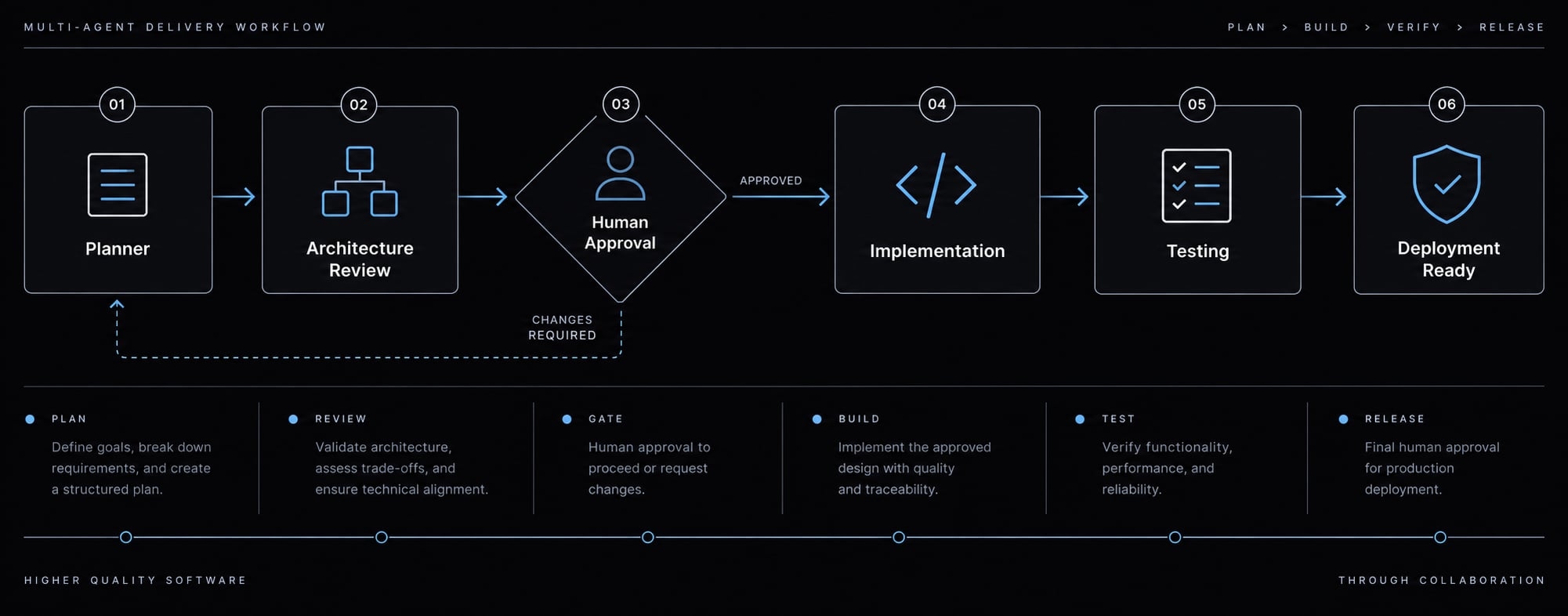
How AgentKit supports the workflow
AgentKit is AI Engineering System scaffolding for coordinating workflows across Claude Code, Codex, Cursor, DeepSeek Harness, and other supported coding agents. It packages specialized subagents for planning, implementation, review, and deployment, along with chained skill workflows that carry acceptance criteria between stages and safety hooks that load project rules and prompt for approval before sensitive operations.
Enforcement varies by harness, so documented rules do not guarantee tenant isolation or gated releases. Verify the actual configuration, and measure review time, rework, and cross-tenant regressions before judging its value.
When a coordinated workflow adds the most value
Coordination is most useful when work spans repeated sessions, shared rules, multiple contributors, and recurring validation.
A disposable prototype may not justify orchestration overhead. Architecture ownership, security review, and release approval remain human responsibilities regardless of tooling.
Multi-Tenant SaaS production-readiness checklist
Use this on-page checklist before onboarding real tenants and after changes to access boundaries. Apply it to a named environment and release.
Architecture
- Document the tenant model and ownership relationships.
- Identify shared resources and protected architectural rules.
- Name the accountable tenancy owner.
Authentication and authorization
- Validate identity and organization membership server-side.
- Test roles and resource-level permissions, including denied actions.
- Verify privileged credentials are absent from client-delivered assets.
Data isolation
- Run cross-tenant read, write, export, and delete tests.
- Verify relevant database policies with runtime credentials.
- Check storage, download links, and cache boundaries.
- Confirm denied operations cause no disclosure or mutation.
Jobs and integrations
- Validate trusted tenant context and clear it between jobs.
- Confirm missing-context workers fail without side effects.
- Test tenant-scoped token expiry, revocation, and reconnection.
- Verify webhook signatures, tenant routing, and duplicate handling.
Environments and deployment
- Verify separated resources and intended deployment targets.
- Review migrations and their recovery approach.
- Check secrets handling without exposing values.
- Run post-deployment smoke tests and confirm the recovery plan.
Operations
- Exercise alert delivery and identify the responder.
- Preserve useful audit records without unnecessary sensitive data.
- Record restore evidence against recovery objectives.
- Name the release approver and document remaining limitations.
For each check, record control ID, criticality, owner, status, evidence reference, environment, release, verification date, open issue, approver, and remediation deadline.
Use Pass / Fail / Not tested / Not applicable. Not tested is not Pass; Not applicable requires a reason. Automated verification supports these records but does not remove review responsibility.
Checklist completion supports a release decision. It does not certify security or compliance.
Frequently asked questions
What does "vibe coding" mean in the context of building a SaaS?
Vibe coding refers to developing software primarily through natural language prompting and autonomous AI agents. Instead of manually writing every line, you guide the AI to generate features, which then requires rigorous human verification to ensure system coherence and security, especially in multi-tenant environments.
Can vibe coding produce a production-ready multi-tenant SaaS?
Yes, provided you move beyond simple generation. A production-ready SaaS requires human-led architecture, enforced database-level isolation like Row-Level Security, and automated negative testing. The AI accelerates the implementation, but the human owner remains responsible for security acceptance, recovery plans, and final release decisions.
Why is building multi-tenant SaaS with AI agents risky?
AI agents prioritize task completion over system-wide architectural rules. They often omit critical security boundaries, such as tenant-specific query filters, or accidentally bypass security policies to resolve local code errors. Without human-defined boundaries and strict verification, these shortcuts can lead to cross-tenant data leaks.
How can I prevent data leaks between tenants when using AI agents?
Enforce tenant isolation at the database layer using PostgreSQL Row-Level Security (RLS). Ensure that every background job, API endpoint, and data export is explicitly scoped by a tenant_id. Additionally, implement automated cross-tenant tests that verify one customer organization cannot access the data of another.
What is the biggest mistake developers make when vibe coding SaaS?
The most common error is relying on application-layer filtering for data isolation. AI agents frequently miss WHERE tenant_id = ? clauses in generated code. Relying on ORM filters is a critical anti-pattern; you must enforce access control at the database engine level to ensure consistent security regardless of generated code quality.
How should I verify that my AI-generated SaaS is secure?
Do not rely on the AI to test itself. Implement a robust CI/CD pipeline that includes automated negative tests-specifically designed to attempt unauthorized cross-tenant data access. If an endpoint allows a user to access resources outside their organization ID, the build must fail.
Do I need a team to achieve production readiness for a SaaS?
No, but you do need established engineering processes. Even solo founders can achieve production readiness by maintaining an architectural contract, using confined implementation tasks, performing diff-based code reviews, and maintaining a clear checklist for every release gate. Human supervision is essential for high-risk system changes.
Read more:
- How to vibe code a RAG chatbot: A practical step-by-step guide
- Vibe code SaaS: Why AI-built apps need more than just speed
- Vibe coding tools: How to choose the right AI app builder
Conclusion
Vibe coding a multi-tenant SaaS is feasible when AI-generated implementation sits inside a controlled engineering process. The decisive factors are tenant isolation, persistent specifications, independently defined tests, recovery capability, and accountable approval-not how quickly the interface appears complete.
Before onboarding real organizations, inspect evidence for the access paths your customers will use. Include exports, background jobs, integrations, and deployment configuration. Treat untested boundaries as open work rather than assuming a successful demonstration covers them.
The next step is to identify release-blocking gaps, assign owners, and verify fixes before expanding features. Start with the production-readiness checklist. If repeated tasks and handoffs across AI agents are becoming difficult to manage, leverage AgentKit as an AI Engineering System scaffolding framework to maintain consistent guardrails and architectural alignment.