How to vibe code a RAG chatbot: A practical step-by-step guide
How to vibe code a RAG chatbot: A practical step-by-step guide
AI coding assistants can quickly build a RAG chatbot interface. However, creating a reliable system requires strict scoping, independent retrieval validation, verified citations, and robust security. Rather than promising a fully production-ready application, this guide walks through a six-stage process to create a focused, private MVP-demonstrated via a sales-enablement assistant-ensuring the model generates grounded responses strictly from authorized documents.
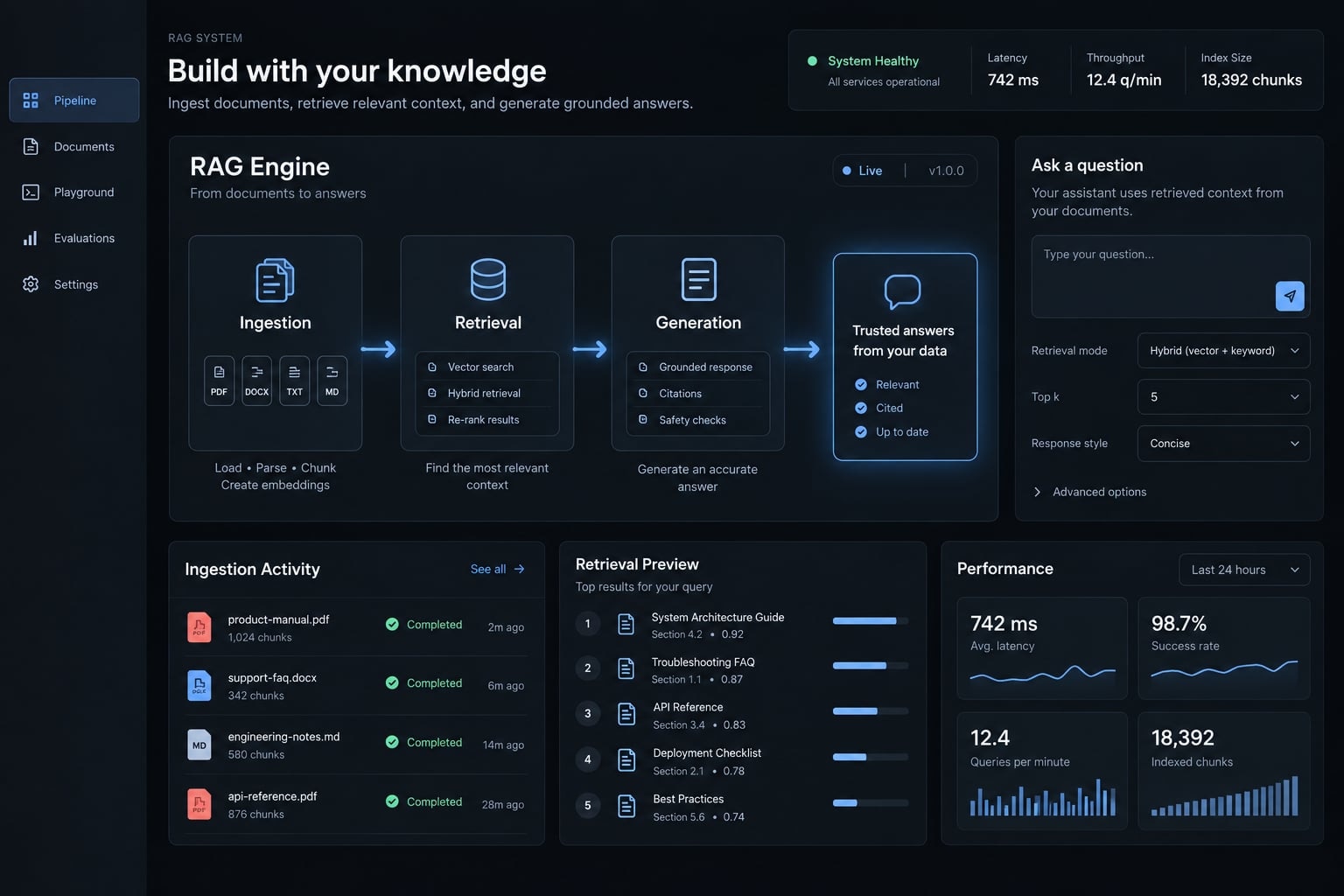
What is a vibe code RAG chatbot and how does it work?
A vibe-coded RAG chatbot is an application built through natural-language direction of a coding assistant that uses retrieval-augmented generation: Finding relevant document passages before generating responses. The coding assistant builds the software; the runtime chatbot answers users. Here, vibe coding means prompt-led prototyping with explicit human review gates.
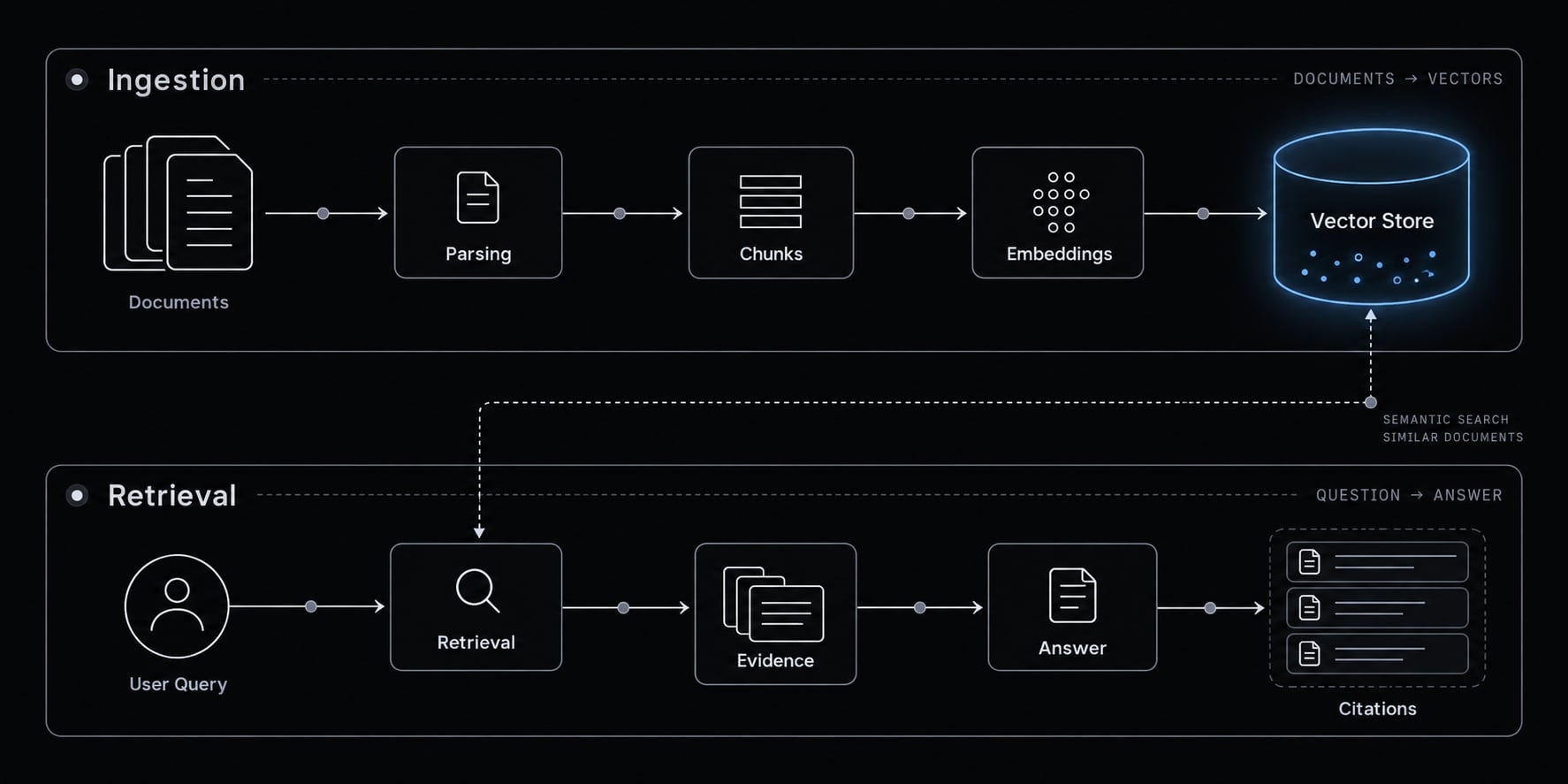
The system follows seven steps:
- Parse approved documents into readable text.
- Split text into chunks: smaller searchable passages.
- Generate document embeddings: numerical representations of meaning.
- Store text, vectors, and metadata such as source and permissions.
- Retrieve evidence relevant to a question.
- Generate an evidence-grounded response.
- Display implemented source citations for verification.
Embeddings are not stored answers. RAG does not, by itself, train the underlying model on uploaded files.
The minimum RAG architecture
INGESTIONDocuments → Parsing → Chunks + metadata → Embeddings → Searchable store │QUESTION TIME ↓User + access context → Retrieval → Evidence + question → Model ↓ Answer + citations
Vector retrieval also embeds the question. A vector database stores and searches these numerical representations; OpenAI’s Retrieval documentation describes semantic retrieval concepts.
What the coding agent can and cannot decide
Area | Agent can implement | Human must approve |
|---|---|---|
Architecture | Propose components | Complexity and trade-offs |
Documents | Build ingestion | Approved sources |
Retrieval | Configure search | Evidence requirements |
Security | Implement controls | Access policies |
Testing | Generate tests | Coverage and thresholds |
Deployment | Configure infrastructure | Release and operating limits |
Agents may recommend policies, but people remain accountable. A valid citation does not prove its passage supports the answer. RAG reduces some unsupported answers; it does not eliminate them.
Scope the MVP before asking the agent to write code
Avoid rushing to build. Start small by defining one user group, one approved document set, and one specific, repeatable question type. “Build a company-wide knowledge chatbot” leaves too many decisions unresolved. Instead, let sales representatives ask product-capability and onboarding questions.
For this illustrative RAG chatbot MVP, use:
product-guide: Approved product documentation, including identifierAPI-204.onboarding-guide: Approved onboarding instructions.restricted-pricing: Accessible only to sales leadership.
Include upload, ingestion status, chat, evidence retrieval, citations, and honest insufficient-evidence behavior. Defer fine-tuning, autonomous actions, multiple integrations, complex agents, and advanced analytics.
Enterprise-wide permission design can wait. Access control for these three documents cannot.
Write a one-page build specification
Copy this into product-spec.md and complete the unresolved decisions:
Target user/problem: Sales representatives answering product and onboarding questions.Documents/formats: product-guide and onboarding-guide; text PDFs and Markdown.Restricted source: restricted-pricing; sales-leadership role only.Supported questions: Product capabilities, API-204, onboarding prerequisites.Out of scope: Unpublished commitments, autonomous actions, unsupported advice.Citations: Material claims cite authorized passages with page/section references.Privacy/access: Authenticate users; enforce server-side roles; protect source views.Response-time target: [Define measured target and test conditions.]Cost ceiling: [Define per-session and monthly limits.]Success: Evidence, answer, citation, abstention, and access tests pass.Change control: Approval required for scope, dependency, or architecture changes.
These acceptance criteria become the contract for the RAG chatbot MVP.
Choose the simplest stack that fits the use case
Pattern | Starting stack | Best fit | Main trade-off |
|---|---|---|---|
Fast private demo | Integrated builder with protected document storage | Small, simple corpus | Inspect access, export, and pricing limits |
Internal team assistant | Web app, trusted backend, PostgreSQL with pgvector | Existing database expertise and role filtering | Your team maintains ingestion and operations |
Customer-facing product | Authenticated app, backend, managed search/storage | Higher volume and tenant isolation | More operational and evaluation work |
Vector search finds semantic similarity. Hybrid retrieval combines semantic and keyword search when exact identifiers matter; implementations differ.
Choose around privacy, parsing complexity, volume, filtering, and maintenance capacity. An integrated builder is not automatically cheaper or safer. Internal documents may require stricter controls than public-facing content.
How to vibe code a RAG chatbot step by step
- Produce an architecture plan.
- Validate document ingestion.
- Chunk and embed content.
- Test retrieval independently.
- Add grounded answers and citations.
- Deploy a restricted interface.
Non-negotiable agent rule: State assumptions, planned file changes, new dependencies, and validation methods; obtain approval before implementation.
After every stage, require actual changes and actual test results. Label unexecuted tests explicitly. Save artifacts so later stages do not depend on an indefinitely growing conversation.
Step 1 - Ask the agent to produce an architecture plan
Have your AI coding assistant turn the specification into architecture.md. Architectural confidence is not evidence that the design is correct.
Using approved product-spec.md, propose the smallest architecture. Document data flow, schema, endpoints, dependencies, implementation order, security assumptions, and justified alternatives. Verify version-sensitive APIs against official documentation. Save architecture.md. Do not write application code before approval.
Acceptance checks:
- Ingestion and chat are separate paths; both account for document access.
- Every component has a purpose, and dependency compatibility has supporting documentation.
Approve the architecture plan before requesting implementation.
Step 2 - Build and validate document ingestion
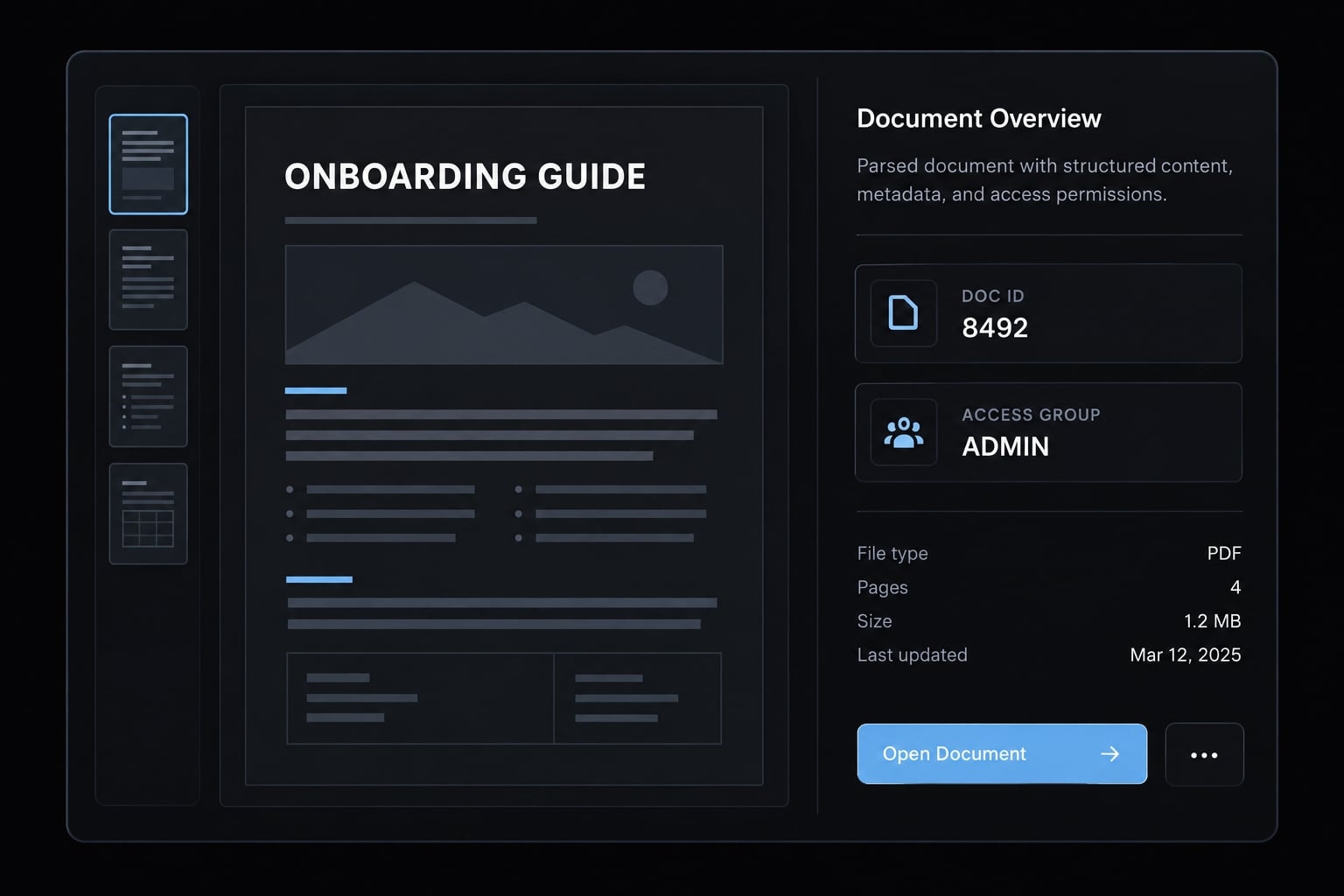
Upload, parse, normalize, record status, and preview extracted text. Metadata means descriptive fields attached to documents and passages.
Using approved product-spec.md and architecture.md, implement ingestion only. Preserve document ID, title, source location, upload date, and access group. Provide parsed-text previews, visible failures, and controlled duplicate handling. Save the schema and sanitized ingestion-check results for approval.
Scanned PDFs may require OCR (optical character recognition). Tables and multicolumn layouts need inspection; pypdf’s extraction documentation explains why PDF text extraction can be difficult.
Acceptance: References survive parsing, readable text matches the source, and unsupported files fail visibly.
Step 3 - Chunk and embed the content
Document chunking splits extracted text into searchable passages. Preserve meaningful sections where possible; no chunk size or overlap setting works best universally.
Using approved product-spec.md, architecture.md, and ingestion schema, implement documented chunking with configurable size and overlap. Preserve source/access metadata per chunk. Generate embeddings on the trusted backend; handle retries and duplicate processing. Save index configuration and sample chunks.
Record the embedding model identifier and relevant software versions. Switching embedding models generally requires re-embedding documents and using the matching model for questions.
Acceptance checks:
- Every vector embedding maps to a chunk and source location.
- Credentials remain server-side; repeat ingestion does not create uncontrolled duplicates.
Inspect the onboarding prerequisite passage before moving forward.
Step 4 - Implement retrieval before answer generation
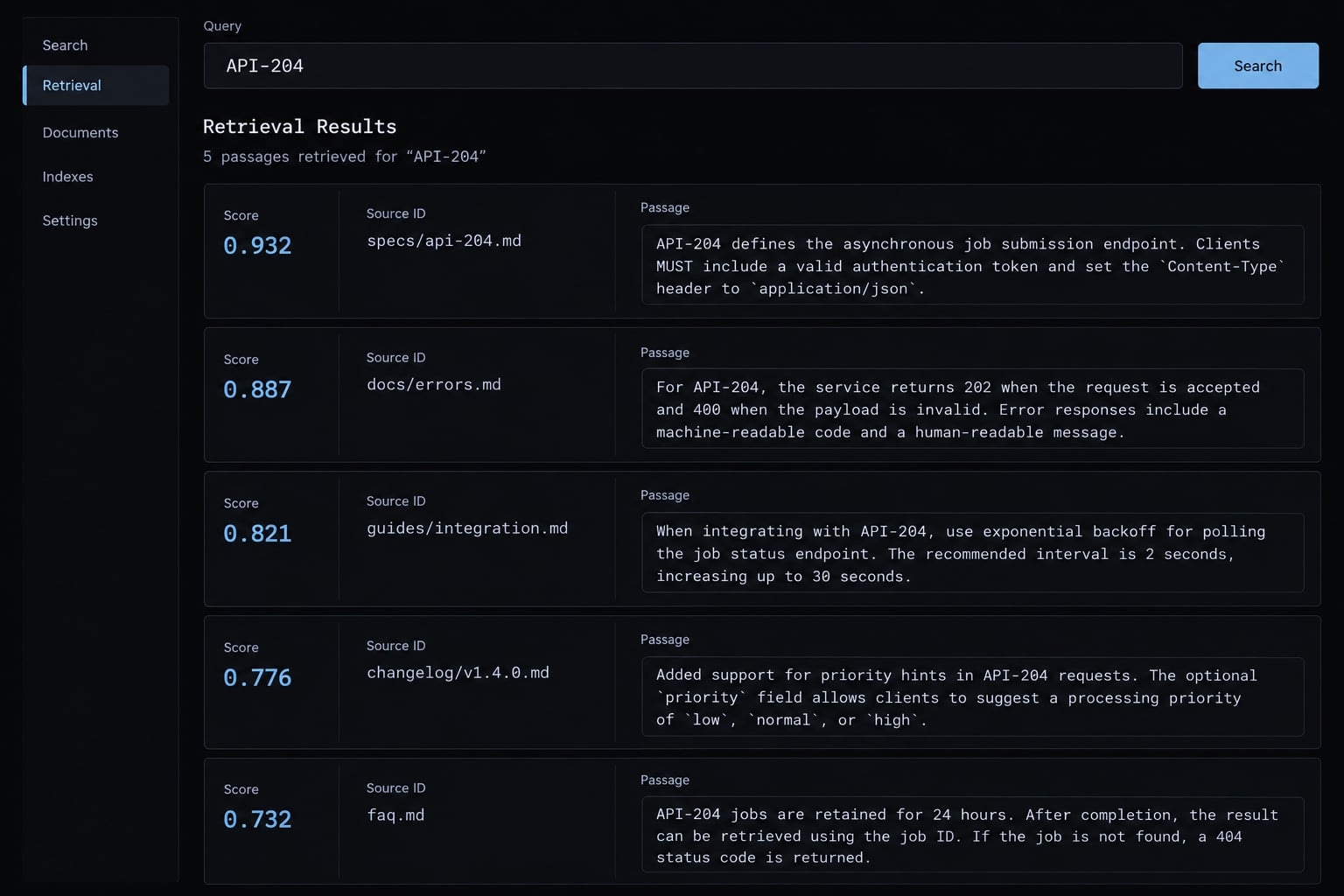
Retrieve passages without generating answers. This separates evidence problems from writing problems.
Using approved product-spec.md and index configuration, implement retrieval only. Display top passages, source IDs, scores, and metadata. Enforce authenticated server-side access constraints. Test known questions, API-204, and absent evidence. Save retrieval-check results before adding generation.
top_k is the number of returned results. Metadata filters constrain retrieval by fields such as access group. Derive permissions from trusted identity, not user-supplied role claims.
Semantic search finds related meaning; hybrid search can help preserve exact-identifier matches. Similarity scores are not confidence percentages.
Acceptance: Expected evidence appears; restricted content never enters unauthorized context; irrelevant matches do not count as sufficient evidence.
Step 5 - Add grounded answer generation and citations
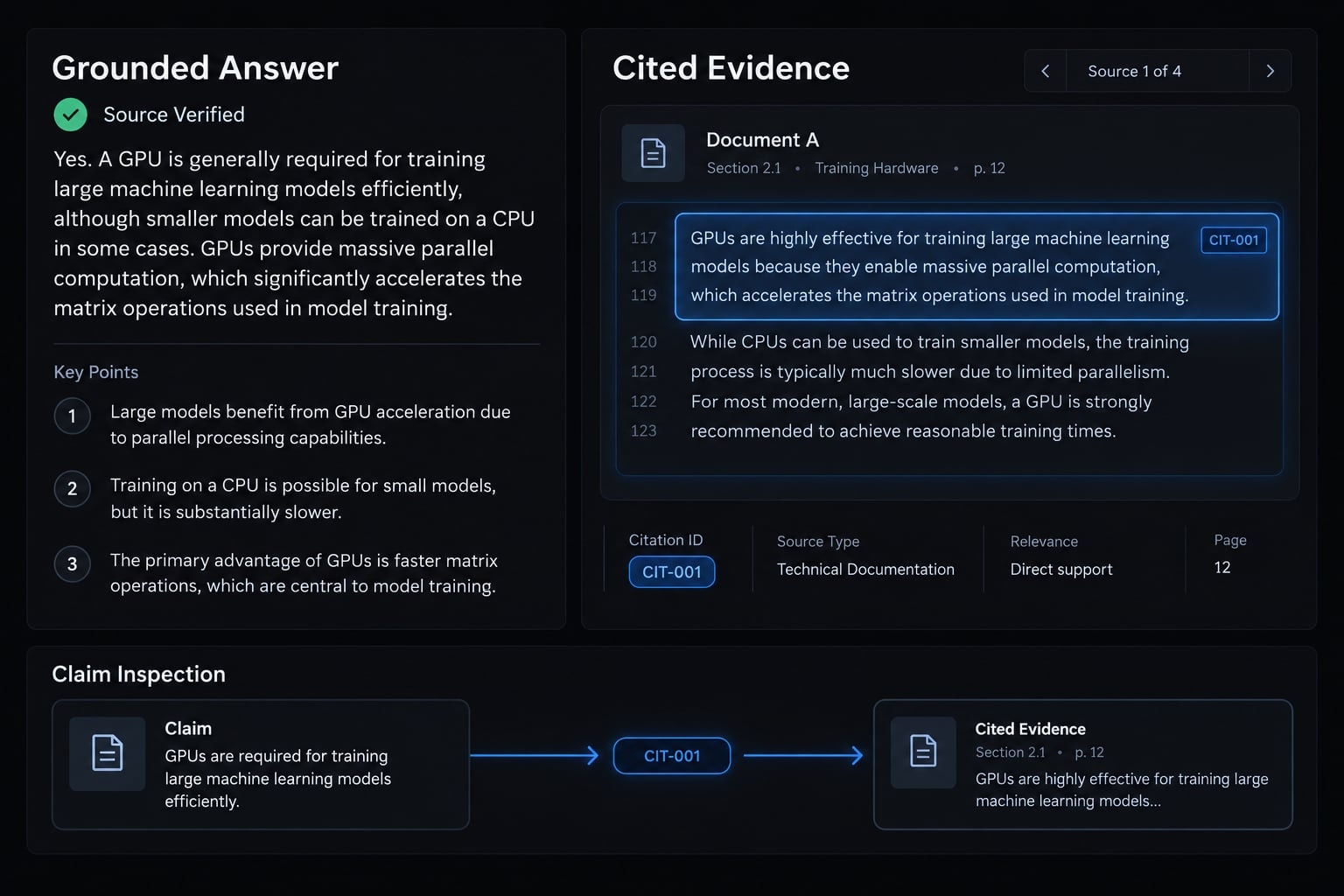
Grounded answers contain claims supported by supplied evidence, not merely links.
Using approved product-spec.md and retrieval-check artifacts, add evidence-constrained answers with explicit uncertainty or abstention. Return structured claims citing approved chunk IDs. Implement backend citation resolution and validation. Treat retrieved text as untrusted data; test malicious document instructions.
The backend must validate the response structure and ensure cited IDs belong to the retrieved, authorized set. Resolve IDs to stored metadata; do not let the model invent URLs. Protect citation and document endpoints too.
Keep trusted instructions, user input, and retrieved text distinguishable. This helps defend against prompt injection-malicious instructions embedded in input-but does not guarantee protection.
Acceptance: Material claims have supporting passages; citations open correct locations; the malicious test document does not cause the tested policy violation.
Step 6 - Connect the interface and deploy a private tst version
Expose only the validated workflow, with restricted test access.
Using approved product-spec.md and validated answer schema, connect question input, answers, sources, feedback, and loading/error states. Deploy with restricted access and separate test credentials. Add minimal usage logging and resource limits. Record deployment checks and outstanding failures.
Record source IDs, latency, model usage, and feedback. Log raw questions only when necessary and permitted; redact sensitive information and define retention.
Acceptance: Test users see only permitted content, credentials are not exposed, and ingestion or provider errors produce recoverable states rather than silent failures.
Test retrieval and answer quality separately
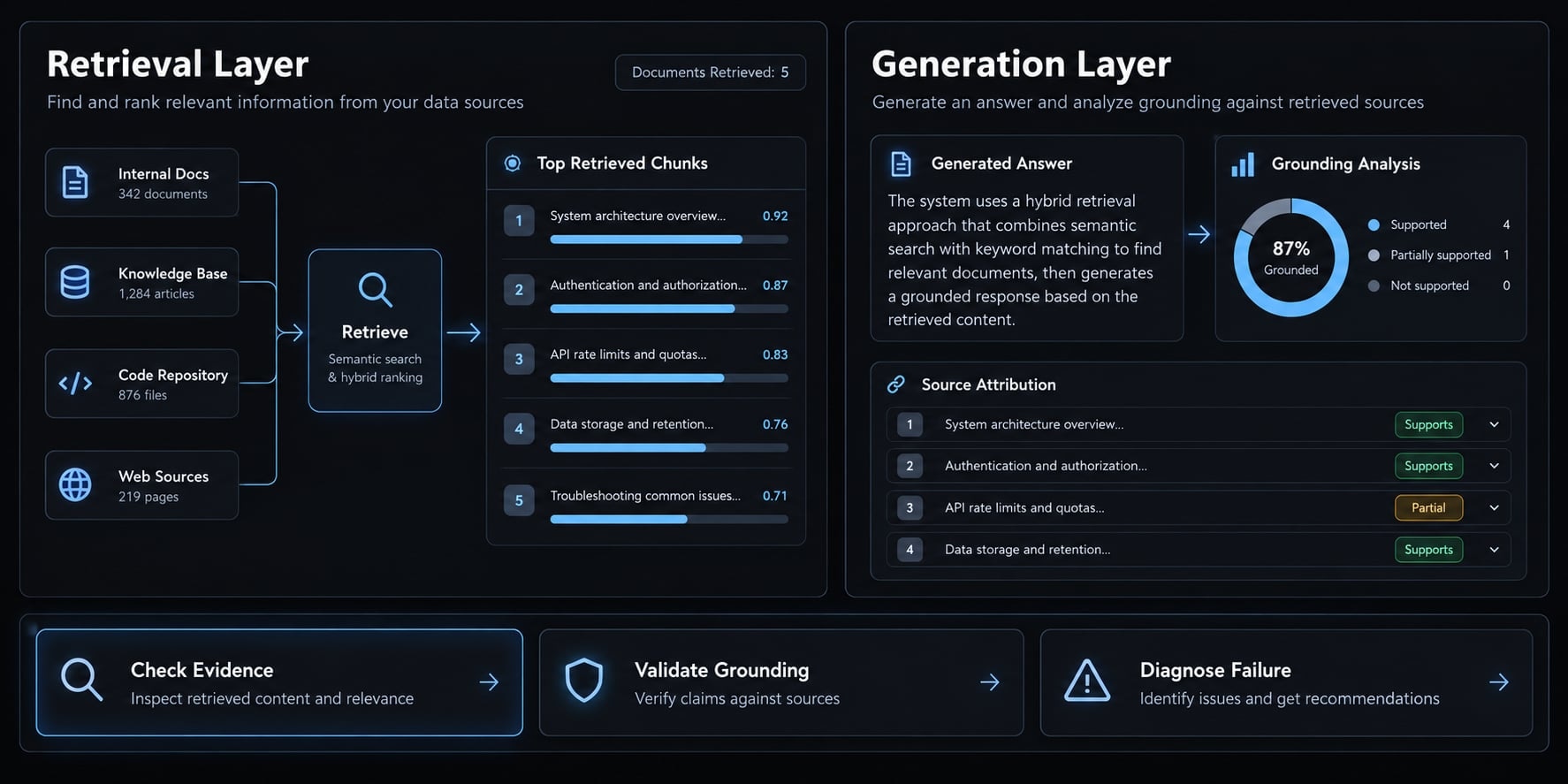
RAG evaluation checks whether a chatbot retrieves the evidence needed for a question and then uses that evidence correctly. Retrieval assessment examines the selected passages; answer assessment examines claims, relevance, and citations. Fluent language alone proves neither. Record results against predefined criteria that reflect the consequences of failure.
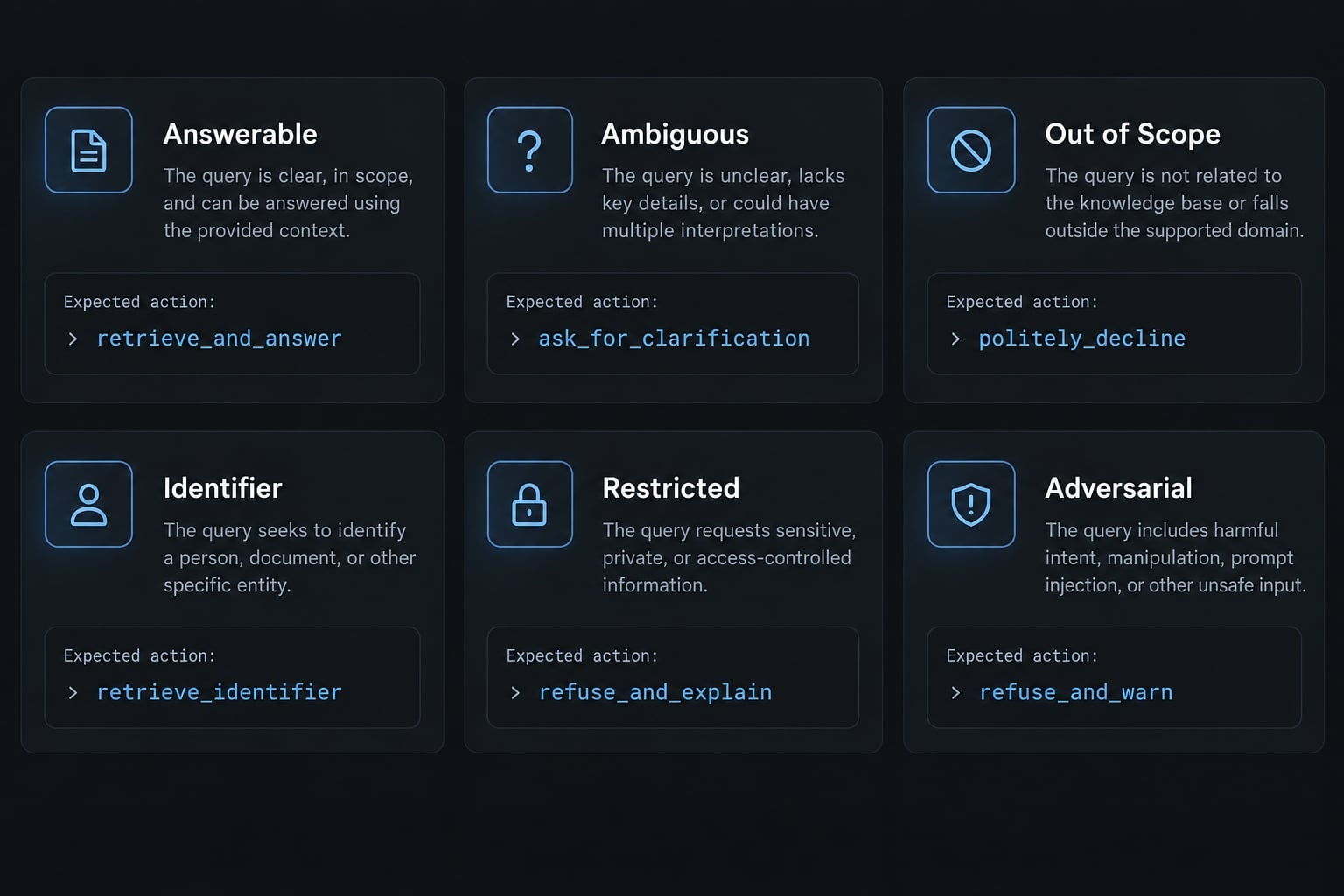
Begin with 10–20 representative questions:
- Answerable: “What are the onboarding prerequisites?”
- Ambiguous: “Does it support integration?”
- Out of scope: “What will next year’s pricing be?”
- Exact identifier: “What does API-204 mean?”
- Restricted access: A sales representative requests leadership pricing.
- Adversarial: A document instructs the chatbot to ignore its rules.
This small set is diagnostic, not statistically representative.
Record a baseline: Document-set version, chunking configuration, retrieval settings, model identifiers, and prompt version. Change one major variable at a time.
Keep these concepts distinct:
- Retrieval quality: Did needed evidence appear?
- Faithfulness: Did the answer stay within that evidence?
- Context recall: How much necessary evidence was covered?
- Answer relevancy: Did the response address the question?
Ragas documentation describes related evaluation concepts. Definitions and scoring methods vary across tools; inspect them before comparing scores.
Create a practical RAG test sheet
Use this unfilled template for each question:
Test field | What to record |
|---|---|
Question | Wording, test identity, access role |
Expected source | Document ID and page/section |
Expected answer points | Required facts and prohibited inferences |
Retrieval result | Returned chunks; missing evidence |
Answer result | Supported claims, omissions, unsupported additions |
Citation result | Valid ID, correct location, actual support |
Expected behavior | Answer, clarify, abstain, or deny access |
Pass/fail | Decision, failure category, corrective action |
Keep retrieval failures separate from generation failures. A correct-looking answer cannot repair a missing evidence trail.
Use clear MVP acceptance criteria
Require:
- Expected evidence retrieved.
- No unsupported material claims.
- Valid, supporting citations.
- Appropriate abstention when evidence is inadequate.
- No observed unauthorized disclosure.
- Recoverable ingestion and API errors.
- Latency and cost within the specification.
A permissions failure blocks release, even if other answers look good. Passing this suite supports a limited next step, not a security or accuracy guarantee.
Common vibe-coded RAG failures and how to prevent them
Diagnose the failing layer before changing models. Unreviewed generated code creates technical debt when assumptions, dependencies, and ownership remain undocumented.
Failure | Likely cause | Practical prevention |
|---|---|---|
Missing relevant evidence | Parsing loss or poor chunk boundaries | Inspect extraction; test expected passages |
Plausible unsupported answers | Weak evidence or ignored constraints | Check claims; require abstention |
Incorrect citation locations | Source metadata lost | Preserve references; validate mappings |
Missed exact identifiers | Semantic matching misses strings | Test keyword or hybrid retrieval |
Dependency drift | Incompatible APIs or packages | Lockfiles, compatibility checks, regression tests |
Client-exposed secrets | Credentials bundled into frontend | Server-side secrets; inspect bundles; rotate leaks |
Unauthorized retrieval | Missing or client-controlled filters | Authenticated server filtering; protected source endpoints |
Prompt injection | Document text treated as instructions | Layered controls, restricted tools, adversarial tests |
Mixed development/production data | Shared environments or credentials | Separate stores, credentials, and datasets |
Unexpected costs | Unbounded requests or repeated ingestion | Quotas, usage alerts, bounded retries |
OWASP’s guidance on prompt injection and secrets management supports layered controls rather than reliance on wording alone. Security checks must cover retrieval, generation, source access, and deployment.
If caching responses, isolate private entries by authorization context and invalidate them when access changes. Never share private cached answers indiscriminately across users or tenants.
Building a production-ready RAG chatbot is about establishing an operating standard, not just launching a chat interface.
Area | Private prototype | Production requirement |
|---|---|---|
Access | Restricted users; enforced document permissions | Managed identity lifecycle; tested isolation |
Evaluation | Recorded diagnostic suite | Repeatable regression and adversarial coverage |
Data lifecycle | Approved data; retention/deletion rules | Auditable updates, deletion, and index cleanup |
Monitoring | Basic errors, latency, usage | Alerts, incident ownership, quality monitoring |
Security | Protected secrets; access tests | Threat modeling and ongoing security review |
Reliability | Visible errors; bounded retries | Recovery procedures; capacity and failure testing |
Change management | Approved changes; recorded versions | Controlled releases, rollback, regression gates |
Data privacy applies from the first upload. Private deployment reduces exposure but does not replace authorization, appropriate provider data handling, or secret protection.
This checklist establishes neither certification nor regulatory compliance. Requirements depend on the data, users, and consequences of failure.
Use a coordinated Agent workflow instead of one long prompt
One long conversation can mix requirements, implementation, debugging, and review. Separate responsibilities around a shared specification and saved artifacts:
- Planning defines architecture and acceptance criteria.
- Implementation builds one component at a time.
- Testing checks ingestion, retrieval, answers, and citations.
- Review examines maintainability and dependencies.
- Security review examines secrets, access, and unsafe behavior.
These can be stages in one assistant or coordinated agents. Multiple agents are not a prerequisite for a useful MVP, and separate roles do not guarantee independent verification.
AgentKit provides reusable skills and coordinated development workflows as one way to organize these handoffs. Whatever tooling you choose, retain human approval for architecture, access policies, and release decisions.
Use the same specification throughout; pass forward inspected artifacts, not conversational assurances.
Build fast, but validate the evidence
You can vibe code a RAG chatbot without treating generated software as automatically trustworthy. Start narrowly, inspect document extraction, validate retrieval independently, and verify that answers actually follow their cited evidence. Human review remains essential, and production readiness requires more than a convincing private demonstration.
Use this RAG chatbot checklist before expanding the build:
- Narrow the use case and approved document set.
- Write and approve the specification.
- Validate parsing and preserve source locations.
- Test retrieval independently from generation.
- Generate grounded answers with honest abstention.
- Verify citation validity and evidentiary support.
- Review security before expanding access.
Copy this checklist and the six staged prompts into your project. Complete each acceptance gate, record unresolved failures, and approve the next stage only when the evidence supports moving forward.
Frequently asked questions
What is a vibe-coded RAG chatbot?
A vibe-coded RAG chatbot is an AI-powered conversational assistant built primarily through natural language prompting of an AI coding agent. It uses Retrieval-Augmented Generation (RAG) to ground its answers in specific, approved document sets rather than relying solely on the model's pre-trained internal knowledge.
How does the RAG process work in a vibe-coded application?
The system follows a two-lane process: an ingestion lane that parses documents into searchable vector embeddings stored in a database, and a runtime lane that retrieves relevant chunks based on user questions, feeds them as context to an LLM, and produces a grounded response.
Can I build a production-ready chatbot using vibe coding alone?
You can prototype a functional MVP rapidly, but production readiness requires rigorous human oversight. You must manually verify security controls, manage secret handling, implement structured evaluation suites, and ensure that authorization rules correctly constrain what information the retrieval engine can access for each user.
Why do I need to test retrieval and generation separately?
Fluency does not equal accuracy. If you only test the final answer, you cannot diagnose whether a failure was caused by the retrieval engine failing to find the correct evidence, or the LLM failing to synthesize the evidence correctly. Separating these tests is essential for reliable system debugging.
What are the most common failures in vibe-coded RAG systems?
Common issues include unsupported answers (hallucinations), retrieval of unauthorized or irrelevant passages, broken citation links, dependency drift from rapidly changing AI libraries, and security vulnerabilities like exposed database credentials or prompt injection that bypasses retrieval constraints.
Does vibe coding replace the need for technical expertise?
No. While AI coding agents handle the syntax and scaffolding, a human architect must still define the data schema, establish security boundaries, approve architectural decisions, and conduct adversarial testing. A deep understanding of the RAG pipeline remains critical to maintaining control over the generated system.
Read more:
- How to vibe code: A practical beginner guide to AI development
- How to vibe code a subscription app: A practical guide
- Spec-driven vibe coding: A smarter way to build with AI
Conclusion
In conclusion, vibe coding offers a fast way to scaffold a RAG chatbot, but achieving true reliability requires rigorous human oversight. By systematically validating document retrieval, ensuring grounded responses with clear citations, and enforcing strict security controls, you can build a secure, practical MVP that delivers trustworthy results.