Best stack for vibe coding SaaS: Next.js, Laravel or Convex?
Best stack for vibe coding SaaS: Compare Next.js, Laravel and Convex
Generating a UI is easy, but running a reliable subscription product requires balancing speed with maintainability. For TypeScript founders, a solid stack (like Next.js, Supabase, Stripe, and Claude Code or Cursor) delivers fast AI-assisted development alongside strong release control. AI accelerates iteration, but humans remain responsible for security, billing, and system resilience. This guide compares leading stack alternatives and outlines essential launch controls to help you choose based on product requirements rather than demo hype.
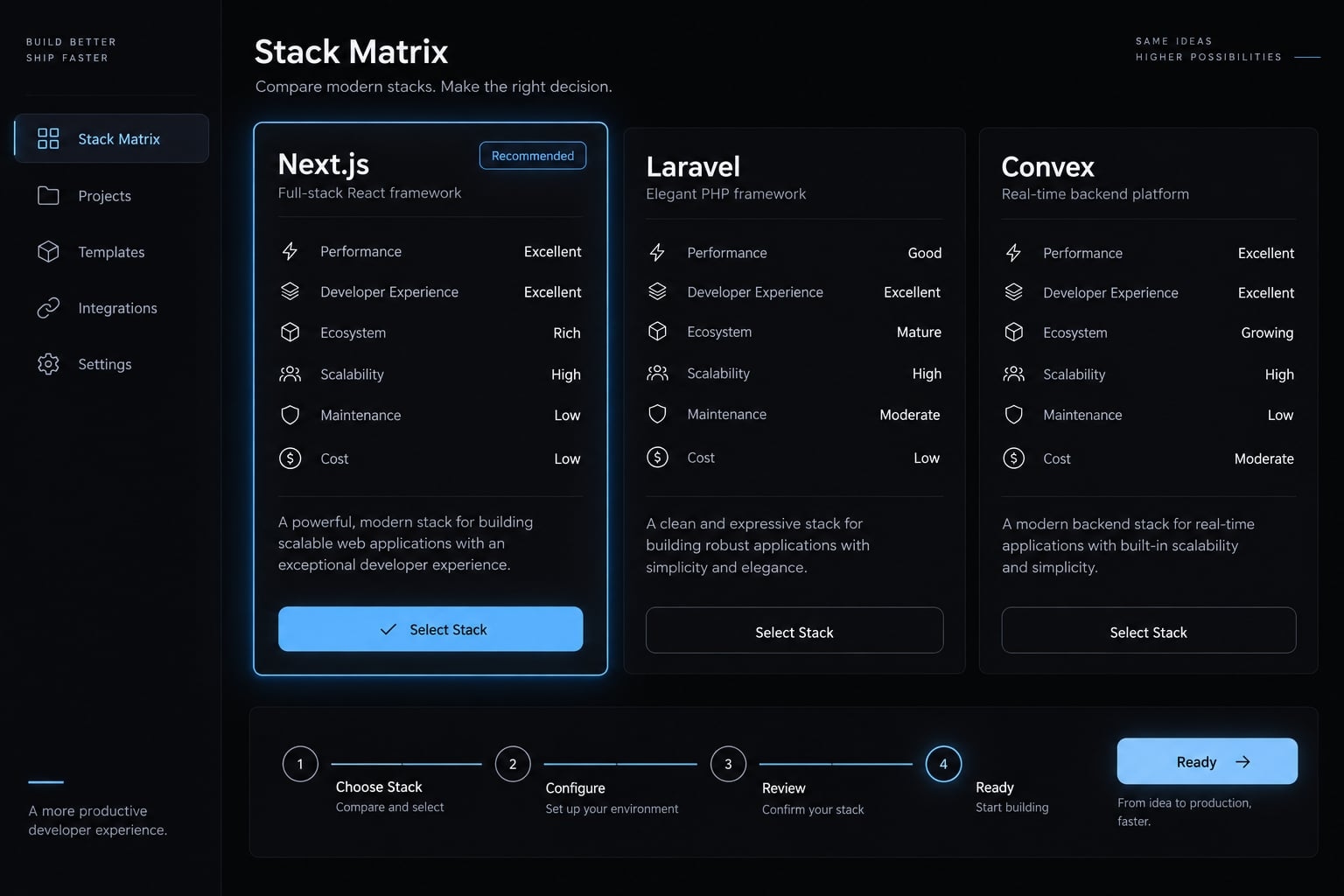
The best vibe coding SaaS stack at a Glance
For a TypeScript-oriented founder building a typical web SaaS product, start with familiar application components and one coding agent. Add services only when a concrete requirement justifies their integration and maintenance costs.
Recommended default stack
Layer | Default recommendation | Primary role |
|---|---|---|
Coding agent | Claude Code or Cursor | Repository-aware implementation and review assistance |
Application foundation | Next.js + TypeScript | Web interface and server-side application logic |
UI | Tailwind CSS + shadcn/ui | Styling and inspectable interface components |
Database | Supabase Postgres | Relational application data |
Authentication | Supabase Auth | User identity; Better Auth requires integration design |
Billing | Stripe Billing | Subscriptions and billing lifecycle |
Validation | TypeScript, ESLint, Vitest, Playwright | Static checks, unit tests, and browser tests |
Observability | Sentry plus platform logs | Error visibility and diagnostic context |
Deployment | Vercel | Application deployment; verify runtime requirements |
Coordination | AgentKit, optional | Reusable workflows, skills, and configurations |
Cursor also has agent capabilities. Using both Cursor and Claude Code is optional, not a prerequisite.
Drizzle is an optional ORM (object-relational mapper), which helps application code interact with database tables. Direct database connections and Supabase client access can use different roles and authorization paths. Do not assume identical policy enforcement.
Consider an illustrative multi-tenant client portal, where several customer organizations share one application. Next.js handles screens and server logic; Supabase stores organizations and memberships; Stripe tracks subscriptions. Your application still determines which member may view which dashboard.
When not to use the default stack
- Choose Laravel when PHP expertise or integrated backend conventions are stronger advantages.
- Consider Convex when live collaboration drives the product experience.
- Evaluate Lovable or Bolt for early demand validation and interface exploration.
- Keep your existing stack when migration costs exceed credible benefits.
Vercel is a convenient default, not a universal requirement. Alternative hosts must support the application’s runtime, background processing, and deployment needs.
What makes a tech stack good for vibe coding?
An agent-friendly stack gives AI tools clear conventions, accessible repository context, and code that people can inspect. It also provides repeatable validation and practical security, deployment, and recovery controls. Its advantage is not autonomous correctness: it makes proposed changes easier to understand, test, review, and operate with accountable human oversight.
Agent-friendly stack scorecard
Criterion | What to evaluate | Operational benefit |
|---|---|---|
Clear conventions | Predictable structure and established implementation patterns | Fewer competing approaches to maintain |
Strong typing or static analysis | Checks integrated into development and review | Earlier detection of certain defects |
Accessible context | Repository map, architecture notes, current schemas | Less guessing about existing behavior |
Repeatable validation | Reliable tests and reproducible commands | Objective feedback before release |
SaaS primitives | Supported identity, permissions, billing, and jobs | Less foundational integration work |
Code ownership | Inspectable source, usable licensing, dependency visibility | Better maintenance and exit options |
Manageable service sprawl | Justified integrations with clear owners | Fewer credentials and failure boundaries |
Deployment and recovery clarity | Preview environments, backups, release procedures | More controlled changes and incident response |
This is an editorial evaluation framework, not a measured ranking.
Opinionated framework defaults - established ways to organize common tasks - reduce ambiguity. They can discourage invented patterns, but they do not eliminate model errors.
Similarly, static analysis for AI-generated code examines code without executing the complete application. It can identify type mismatches and suspicious patterns. It cannot establish that a subscription rule is commercially correct or that every customer-data boundary is secure.
Speed is not the same as production readiness
A prototype demonstrates an interface and expected happy-path behavior. Production requires access boundaries, billing consistency, monitoring, recovery, and maintainability.
In the illustrative portal, a generated dashboard might display the correct organization’s reports. Yet changing a request identifier could expose another organization’s records.
Authentication establishes identity; authorization determines allowed actions. A successful login proves neither tenant isolation nor appropriate permissions.
Use the scorecard before selecting a starter or adding another service. Ask the person responsible for production to identify missing controls, rather than evaluating only how quickly the first screen appears.
The three best stack options compared
Laravel vs Next.js for AI-assisted development is primarily a question of team competence and architectural preferences. Convex adds another option when reactive behavior matters. Apply the same business criteria to all three.
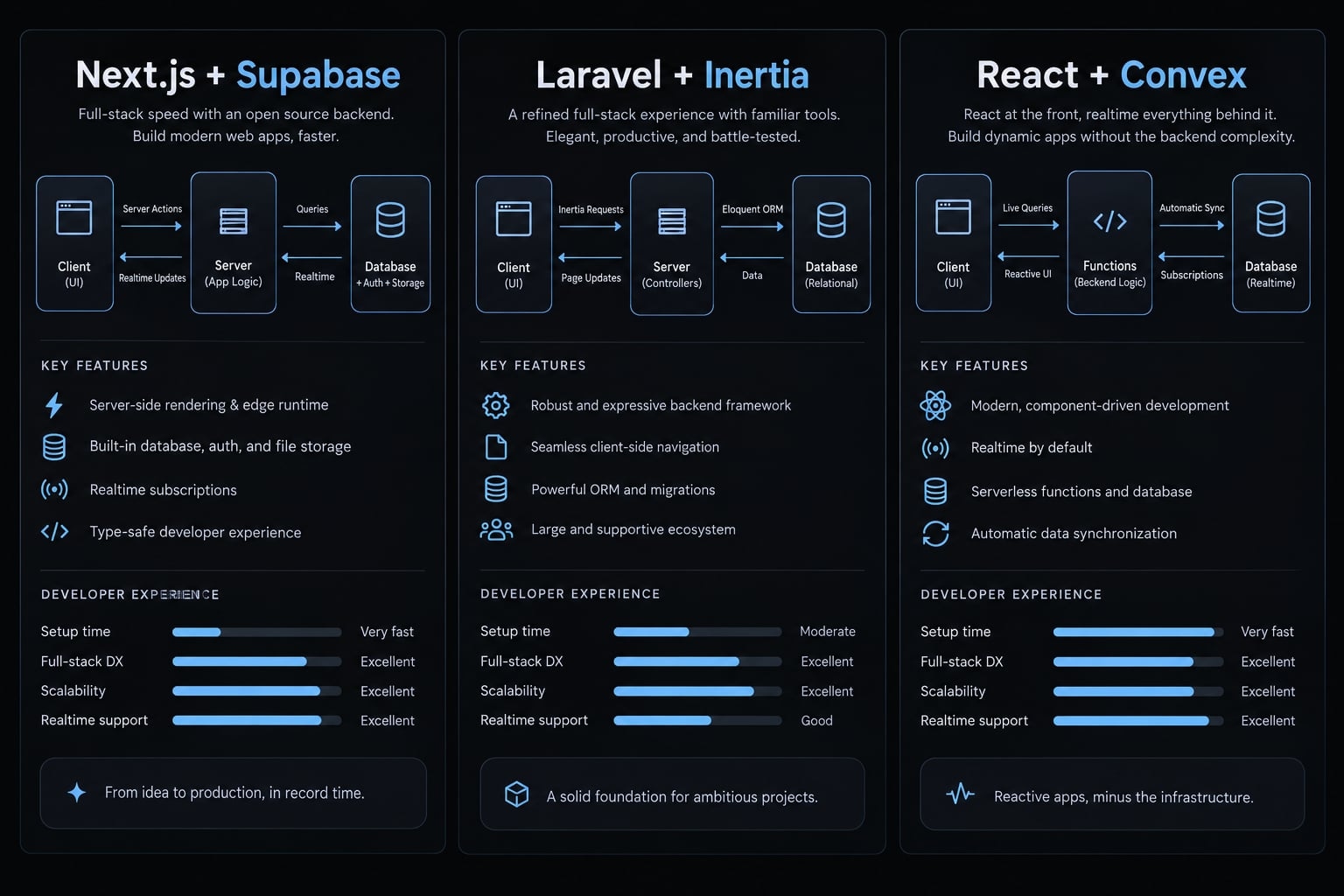
Option 1 - Next.js, Supabase, Better Auth and Stripe
Best for: TypeScript teams building relational web SaaS. Better Auth is an alternative authentication arrangement here; Supabase Auth remains the simplest aligned default.
Supabase combines managed Postgres with associated authentication, storage, and other services. This suits the reference portal’s accounts, memberships, reporting, and subscription access. Next.js supports integrating interface and server-side application work within one project.
The tradeoff is several vendors and configuration surfaces. Next.js also permits multiple legitimate architectural patterns; a team should choose conventions rather than letting each generated feature introduce another approach.
When using Better Auth, document how identity and authorization work across every Supabase access path. Do not assume an authentication replacement preserves existing policies.
Not ideal for: Teams unwilling to own integration design or unfamiliar with React and TypeScript.
Option 2 - Laravel, Inertia, React and Laravel Cloud
Best for: Backend-heavy SaaS and teams comfortable reviewing PHP.
Laravel’s conventions for database work, queues, mail, notifications, and caching reduce repeated structural decisions. Inertia supports React interfaces without requiring a separately designed API (application programming interface) for every feature.
For the client portal, this becomes attractive when approvals, scheduled reports, audit history, and notifications dominate the roadmap. Laravel Cloud is a managed deployment option, not a substitute for application engineering.
The operational requirement is genuine PHP competence. TypeScript checks on the interface do not validate the entire backend. PHPStan or Larastan can add static analysis when appropriately configured.
Not ideal for: Teams committed to TypeScript throughout, with no capacity to review or maintain PHP.
Option 3 - React or Next.js, Convex, Clerk and Stripe
Best for: Reactive TypeScript products where users need shared information to update as underlying data changes.
A Convex SaaS stack can reduce manual synchronization work. For a portal with collaborative task boards, live approval status, and shared operational dashboards, that is a meaningful product advantage.
Clerk supplies identity services; application functions still need deliberate authorization. Stripe subscription state must also be translated into appropriate product access.
The tradeoff is platform-specific data and execution patterns. Convex is not conventional relational SQL, and migration involves more than exporting frontend source. Validate the data model, available regions, compliance requirements, and usage economics against your workload.
Not ideal for: Products whose core requirements depend on conventional SQL workflows or infrastructure constraints the platform cannot satisfy.
Stack decision matrix
Decision criterion | Next.js + Supabase | Laravel + Inertia | React/Next.js + Convex |
|---|---|---|---|
Delivery fit | Familiar to React/TypeScript teams | Familiar to PHP/backend teams | Strong fit for reactive TypeScript work |
Structural guidance | Team must standardize patterns | Convention-led backend structure | Platform-defined backend patterns |
Data approach | Relational Postgres | Relational database through Laravel conventions | Reactive document-oriented model |
Collaboration | Requires synchronization design | Requires synchronization design | Integrated reactive behavior |
Portability | Portable database; integrations require migration | Hosting and service dependencies still matter | Backend patterns increase platform dependency |
Main review burden | Access paths and vendor integration | PHP logic, jobs, and permissions | Function authorization and usage behavior |
These are descriptive judgments, not performance measurements. Vendor lock-in is a migration-cost question, not simply whether source code is available.
Budget for agent and IDE subscriptions, hosting, database, storage, bandwidth, authentication usage, payment processing, monitoring, analytics, and background jobs. Include integration maintenance and migration effort. Free tiers do not make a commercial product free to operate.
Choose the stack based on product stage and team
Situation | Recommended direction | Main benefit | Main tradeoff |
|---|---|---|---|
Testing demand with a demo | Lovable or Bolt | Rapid interface exploration | Verify export, access controls, deployment flexibility |
Technical founder using TypeScript | Next.js + Supabase | Familiar full-stack development | Integration and authorization ownership |
Backend-heavy product with PHP expertise | Laravel + Inertia | Established backend conventions | PHP maintenance capability required |
Live collaborative product | React/Next.js + Convex | Less manual synchronization | Platform-specific backend design |
Small team shipping repeatedly | Best-known stack plus shared workflows | Consistent review and delivery | Workflow setup and ongoing maintenance |
Fastest option for testing an idea
Lovable or Bolt.new can suit a mock-data portal used in customer interviews. An AI app builder helps explore navigation, dashboard layout, and approval flows before investing in production integrations.
Before advancing to a paid pilot, verify:
- An inspectable repository and usable export or synchronization.
- Dependency licenses and asset rights.
- A successful deployment outside the original editing session.
- Technical review before introducing sensitive data or complex permissions.
Source export is not the same as a verified independent deployment. Builders are not inherently unsuitable for production; suitability depends on the resulting architecture and controls.
Best default for a technical founder
For someone already comfortable with TypeScript, Next.js and Supabase form a practical SaaS MVP tech stack. MVP means minimum viable product: the smallest useful version that tests the business proposition.
A starter can save setup effort, but inspect its licensing, architecture, maintenance history, and upgrade path. Inherited billing or permission code still needs review.
Keep the portal’s initial scope narrow: one organization model, explicit member roles, one billing arrangement, and one valuable dashboard.
Best option for an opinionated full-stack workflow
Choose Laravel when backend conventions match the team’s strengths. Its value is fewer structural decisions - not guaranteed agent accuracy.
The transition trigger may be a growing workload of approvals, scheduled processing, and notifications. However, these requirements alone do not justify rewriting a functioning TypeScript application.
Best option for a small product team
Prioritize shared repository instructions, test requirements, pull-request review, and named deployment ownership. A pull request is a proposed code change submitted for review.
AgentKit is one optional way to reuse those practices across projects.
Before moving the portal from demo to paid pilot, evaluate one complete customer journey with the intended production architecture. That exercise reveals more than comparing additional tool lists.
The production workflow that reduces vibe coding risk at scale
Use plan → implement → validate → review → release → monitor. Repeatable checks provide objective feedback; they do not make model behavior deterministic or guarantee a safe change.
Minimum production controls
- Write the feature specification and acceptance criteria, including rejected actions and failure states.
- Identify affected files, service dependencies, and customer-data risks before implementation.
- Run type checks, linting, and relevant automated tests in a reproducible environment.
- Review database migrations and authorization separately from interface behavior.
- Test the critical customer journey in a preview deployment using nonproduction data.
- Run security and dependency checks, then assess findings rather than merely recording completion.
- Release with named monitoring ownership and an appropriate application and data recovery plan.
Common production failure modes
Failure category | Concrete control |
|---|---|
Tenant isolation failure | Add negative tests proving organization A cannot read or modify organization B’s records |
Billing inconsistency | Verify webhook signatures; handle duplicates, retries, and relevant event-order differences |
Runtime defects | Combine static analysis with integration and browser tests; inspect actual execution failures |
Unsafe database changes | Review compatibility, backup availability, and tested restoration or forward-repair procedures |
Unrecoverable release | Distinguish application rollback from recovery after destructive database changes |
Unnoticed incidents | Configure actionable alerts, delivery channels, and an accountable responder |
Repository context drift | Maintain instructions and repository maps; review changes for duplicated or conflicting abstractions |
Supabase’s Row Level Security documentation explains RLS (row-level security), which restricts database rows according to policies. Review the roles and credentials used by each access path; privileged access can bypass expected restrictions.
Stripe’s Webhooks documentation describes signature verification, retries, duplicate deliveries, and event-order considerations. A webhook is a service-generated event delivered to your application.
Illustrative validation scenario - not a reported test: Replay a subscription event against the portal. The acceptance criterion is one correct entitlement update, without repeating an irreversible action. A duplicate effect would require idempotency: processing repeated input without producing additional unintended effects.
Static analysis reduces some defects but misses runtime conditions and business-rule errors. SaaS security therefore requires multiple controls, not a single passing check.
What still requires human review
Assign accountable reviewers for:
- Authorization, privacy, and compliance-sensitive handling.
- Billing logic and payment-related state.
- Destructive migrations and data recovery.
- Infrastructure permissions, credentials, and tool access.
- Architecture decisions with substantial future cost.
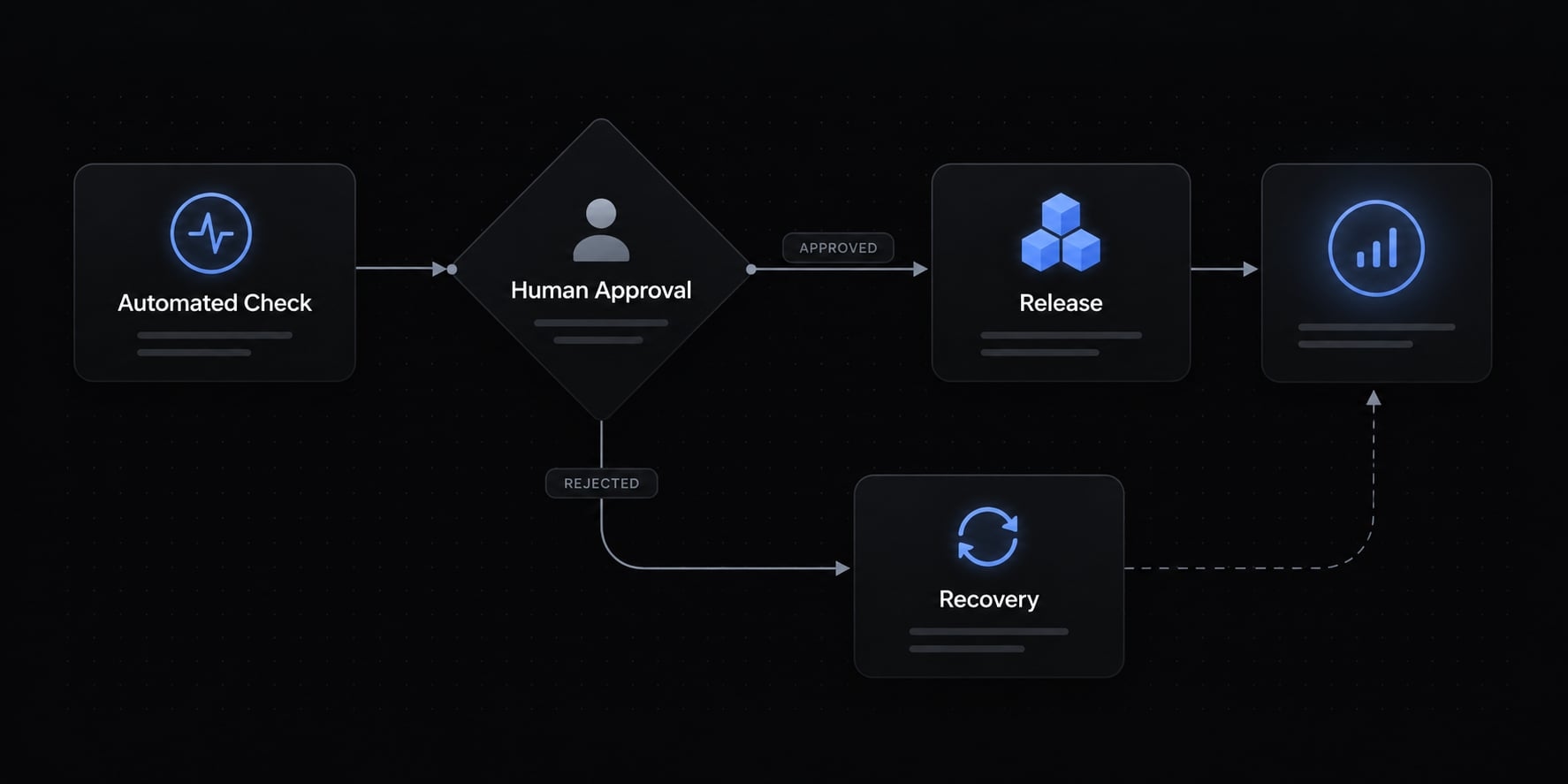
Use this seven-step checklist as a pilot-release gate. Require evidence of the checks, not simply confirmation that the agent was asked to perform them.
How AgentKit turns the stack into a repeatable development system
AgentKit complements the selected application stack by organizing reusable development workflows and tooling. It does not replace human review or guarantee security. Its relevance increases when repeated setup and inconsistent execution become operational problems.
The product scope described here includes specialized subagents, reusable skills, workflows, integrations, and management tooling.
Where AgentKit fits in the recommended architecture
Keep three boundaries explicit:
- Workflow layer: Plans, reusable agent skills, subagents, configurations, and checks.
- Application layer: Framework, database, authentication, billing, and hosting.
- Human control: Permission decisions, sensitive-change review, and release approval.
MCP (Model Context Protocol) connects agents with tools and context. MCP integrations provide controlled development access; they are not the customer-data request path through your application. Permissions and configuration still determine what an agent can reach.
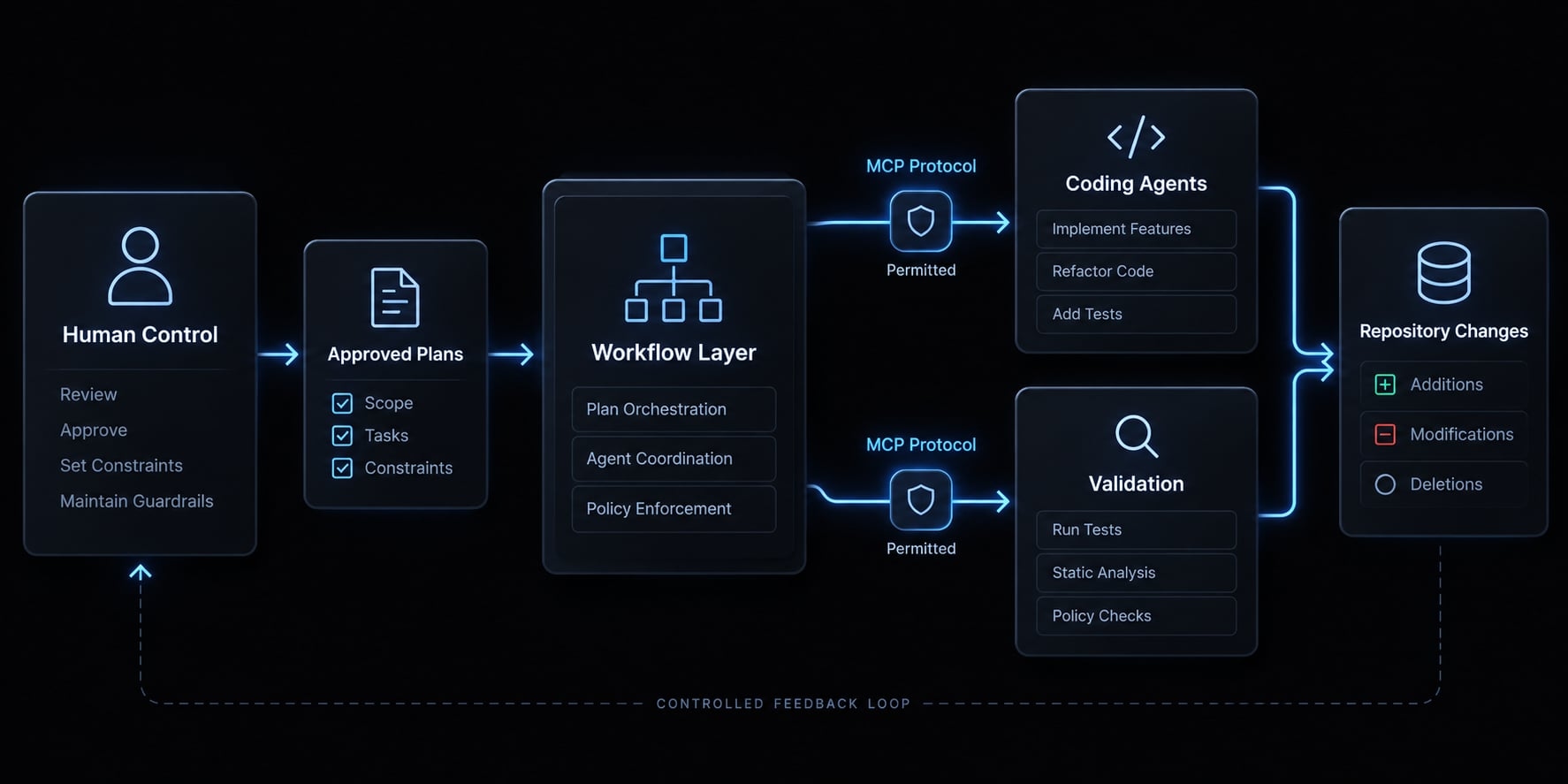
AgentKit workflow
- Define acceptance criteria for the feature.
- Assign implementation responsibilities.
- Load reusable skills and repository instructions.
- Connect approved context sources and tools.
- Run configured validation and review steps.
- Obtain human approval for sensitive actions.
These steps describe a recommended operating workflow, not proof that every environment automatically enforces approvals. Product capabilities, configured behavior, and team policy are distinct.
For the illustrative portal, a useful evidence trail is: billing-change request → plan → changed files → check results → review finding → approval. Store actual outputs; do not treat generated summaries as substitutes for execution logs.
Solution specs table
Area | Scope and qualification |
|---|---|
Development coverage | AgentKit Engineer supports development lifecycle workflows |
Specialized subagents | Focused responsibilities; outputs still need review |
Reusable skills | Repeatable instructions adapted to repository conventions |
Workflow automation | Configured sequences, not guaranteed enforcement everywhere |
MCP connections | Permission-controlled context and tool integrations |
Coding-tool compatibility | Verify the specific agent, IDE, and supported configuration |
CLI and desktop | Command-line and desktop management described; verify availability |
Deployment support | Workflow assistance, not application hosting |
Security checks | Risk signals, not certification or a security guarantee |
Evidence and measurement | Possible plans and reports; review effort and defects are suggested metrics |
For evaluation, start at AgentKit and inspect the Engineer workflow documentation against one real repository. Confirm supported integrations, expected outputs, permissions, and approval boundaries before standardizing the process before standardizing the process
Frequently asked questions
Is vibe coding suitable for building production SaaS?
Yes, provided you move beyond simple prototyping. While vibe coding excels at rapid development, production SaaS requires manual verification of authorization logic, billing webhooks, and data privacy policies. A "vibe coding" approach can be production-ready if it includes human-in-the-loop reviews and rigorous testing.
How does AI-assisted development change SaaS architecture?
It favors conventional, inspectable architectures. Frameworks with clear defaults reduce competing patterns, and type-safe foundations catch certain type and schema mismatches earlier, but runtime and business-rule errors still need tests and review.
What are the main risks of building SaaS with AI agents?
The primary risks include weak tenant isolation, incorrect authorization logic, and "context drift" where AI loses track of codebase patterns as projects grow. You mitigate these risks by implementing modular code structures, enforcing tenant isolation through server-side authorization and database controls such as Supabase RLS, verified with negative tests.
How do I ensure my AI-generated SaaS is secure?
Security requires explicit control over authorization, not just code generation. Always verify Row-Level Security policies in Supabase, implement robust authentication through trusted providers like Better Auth or Supabase Auth, and manually audit sensitive logic related to user data, payment state transitions, and administrative permissions.
Read more:
- 7 practical vibe coding examples: Build apps faster with AI
- How to vibe code: A practical beginner guide to AI development
- Vibe coding SEO: Build AI-powered assets without developers
Conclusion
The best stack for vibe coding is simply the one your team can inspect, validate, and maintain. Whether you choose Next.js with Supabase, Laravel, or Convex, AI speed never eliminates human accountability for security, billing, and system stability.
Before committing, test your workflow on a single representative feature—such as multi-tenant access or billing transitions. Validate how the stack handles edge cases, failing permissions, and rollbacks, then evaluate the ongoing maintenance burden rather than just initial generation speed.