Claude Code regression testing: A practical workflow guide
Claude Code regression testing: A practical workflow for generating, running, and reviewing tests
Claude code regression testing is a workflow for using Claude Code to analyze application changes, draft targeted tests, run approved commands, and triage failures. Approved requirements not the model’s interpretation of existing code define expected behavior. Engineers remain responsible for assertion quality, production changes, and merge approval.
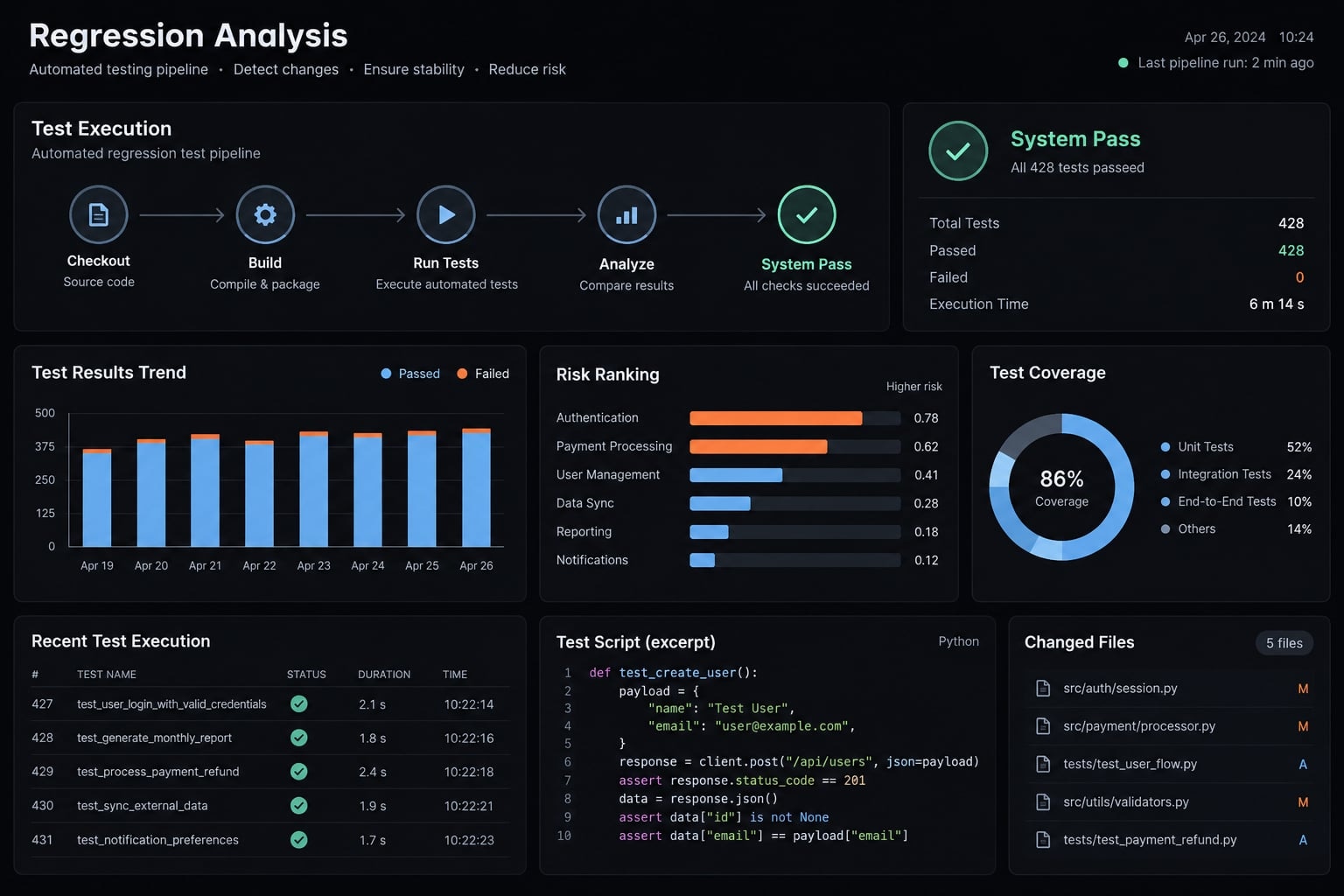
The practical challenge is avoiding tests that preserve bugs, duplicate coverage, or hide failures behind retries. This guide explains a bounded approach to AI-assisted test automation, from repository preparation to reviewed results. It covers testing your application with Claude Code, not testing Claude Code itself. Start with one feature, preserve execution evidence, and expand only when test maintenance remains manageable.
Where Claude Code fits in a regression testing workflow
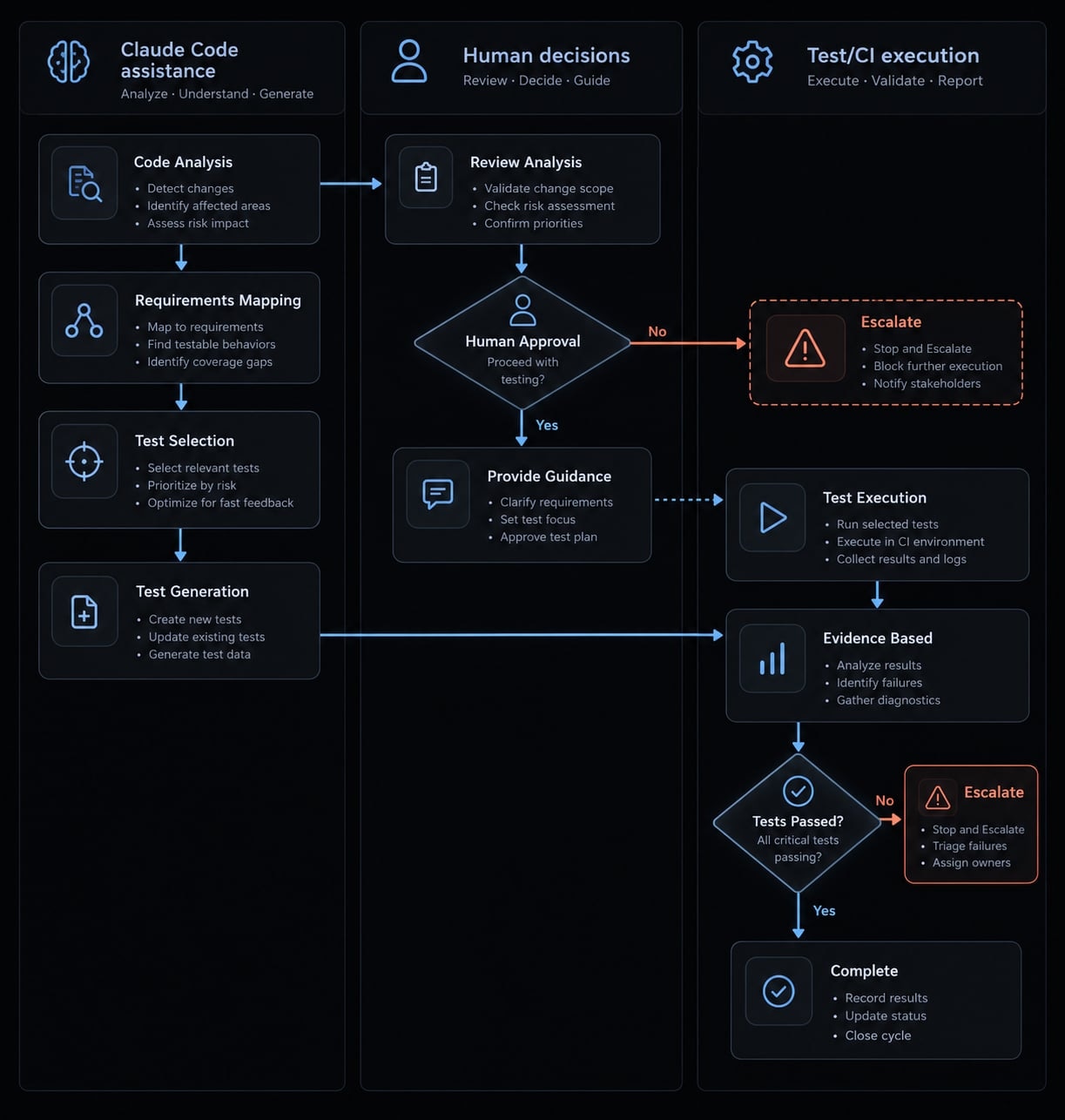
Claude Code complements your testing stack, it is not a dedicated native regression-testing feature. It proposes changes and executes tools within configured permissions. Requirements and approval authority remain outside the model.
Workflow stage | Claude Code’s contribution | Human or system control |
|---|---|---|
Change analysis | Maps affected behavior | Approved requirements |
Test selection | Recommends coverage | Engineer approves scope |
Test generation | Drafts test changes | Assertion review |
Test execution | Runs approved commands | Permissions and test runner |
Failure diagnosis | Proposes evidence-based categories | Reviewer confirms action |
Test maintenance | Suggests minimal repairs | Explicit change approval |
CI integration | Drafts configuration | Required checks and repository rules |
What Claude Code can safely assist with
As a QA assistant, it can inspect diffs, locate reusable setup, draft tests, and summarize observed results. Existing frameworks might include Playwright, Jest, Vitest, pytest, or Cypress, they are not automatically installed integrations.
Claude Code documentation on permissions and sandboxing describes the controls relevant to tool execution.
What Claude Code should not decide independently
Claude Code QA workflows should not infer missing requirements, weaken assertions, approve visual changes, authorize production fixes, or accept unresolved flaky failures. Current implementation is a reference only when its behavior is approved.
Prepare the repository before asking Claude Code to write tests
Complete this preflight before granting modification access:
- Document approved acceptance criteria.
- Identify the framework and approved test commands.
- Define test paths and test conventions.
- Record test fixtures, mocks, and seed-data policies.
- Locate reusable helpers or page objects, where applicable.
- Record required services and environment versions.
- Specify inspection and modification scope.
- List prohibited actions and escalation owners.
- Provide isolated infrastructure and non-production credentials.
- Capture test baseline results.
Define a small regression testing contract
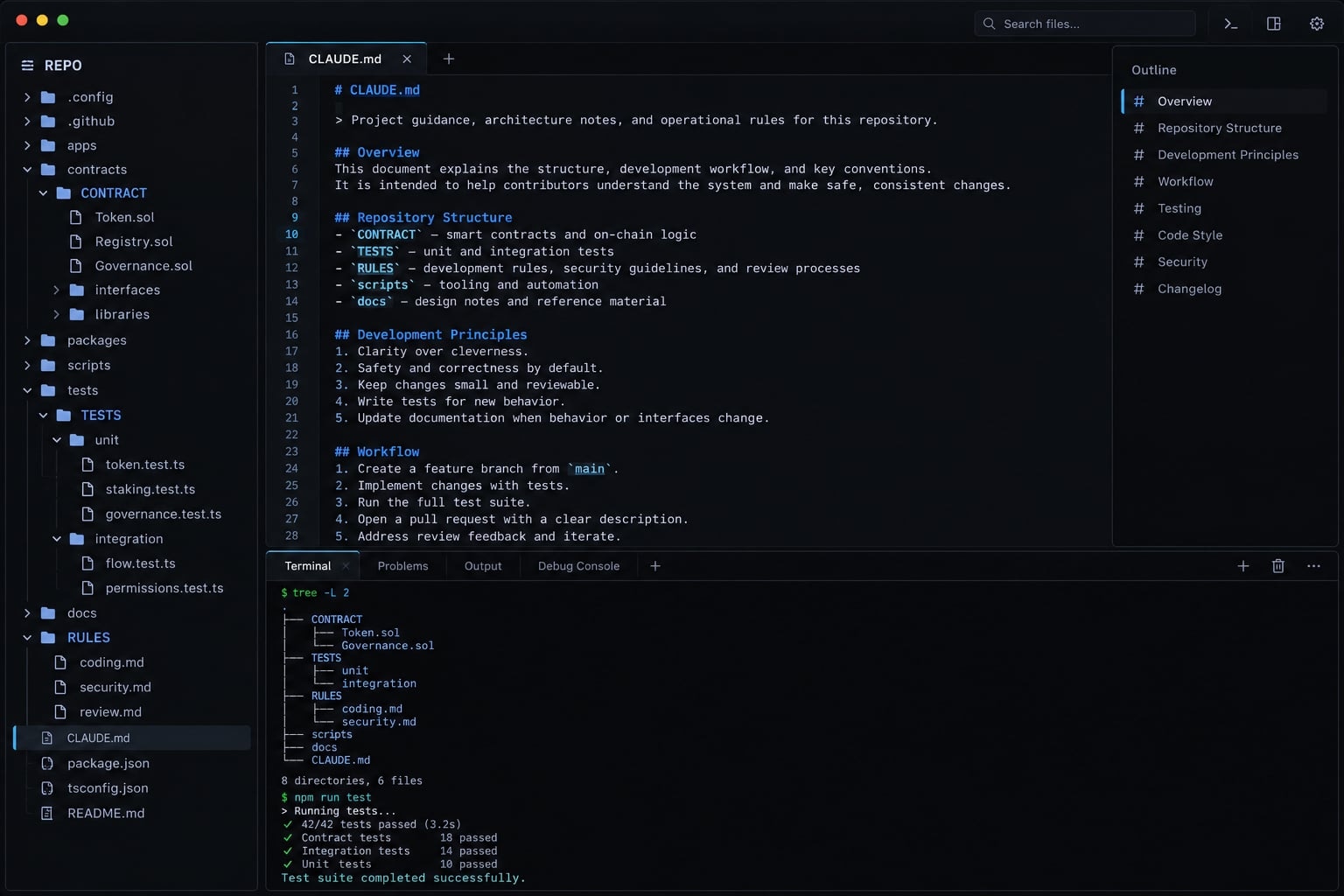
Store repository guidance in CLAUDE.md, using the project-instruction mechanism described in Claude Code’s memory documentation.
## Regression testing contract- Behavioral reference: [approved acceptance criteria].- Execute only: [approved test commands].- Modify only: [allowed test files].- Reuse existing tests and approved setup.- Shared fixture/helper changes require explicit scope approval.- No production-code changes without separate approval.- Do not skip, delete, or weaken tests.- Explain every changed assertion and its protected behavior.- Propose repairs before editing.- Example team policy: after two unsuccessful approved repair attempts, stop and escalate with evidence.- Stop when requirements or failure causes remain unclear.
The attempt limit is an example policy, not a Claude Code default. Repair attempts are not repeated reruns until a flaky test passes.
CLAUDE.md is not a security sandbox. Pair instructions with actual permissions, restricted credentials, and environment isolation. A branch or worktree isolates code changes—not shell privileges, credentials, or network access. Broad shell access can undermine intended file restrictions.
Establish a passing baseline
Record the reference commit, relevant pre-change results, environment versions, and synthetic test data. Preserve raw output, including existing failures and skipped tests.
For the checkout example below, use synthetic accounts and a payment sandbox. If the baseline fails, investigate and obtain a documented triage decision. Do not present a known failing baseline as a clean comparison.
How to run Claude Code regression testing step by step
- Analyze the change.
- Rank regression risks.
- Reuse existing coverage.
- Generate targeted tests.
- Run approved test scopes.
- Classify failures.
- Review and approve the result.
Illustrative implementation not an executed demonstration: A B2B SaaS team adds a discount-code field to self-service subscription checkout.
Approved criteria:
- An authorized workspace administrator can apply a valid discount.
- Invalid or expired codes leave the subscription total unchanged.
- Unauthorized members cannot change billing.
- Discounts affect only the intended workspace and subscription.
- Checkout without a code retains approved existing behavior.
Maintain this evidence chain: approved behavior → affected files → selected test → observed result → reviewed decision.
Step 1 - Analyze the code change
Compare the working branch with its intended base. Inspect changed files and relevant callers or dependencies.
Change impact analysis should map the discount field to validation, subscription totals, authorization, and workspace-specific billing. Require actual file paths for findings and explicit uncertainty about indirect effects.
The output is a concise impact map, not immediate edits. Stop if acceptance criteria are missing or repository context cannot establish affected behavior.
Step 2 - Build a risk-ranked regression plan
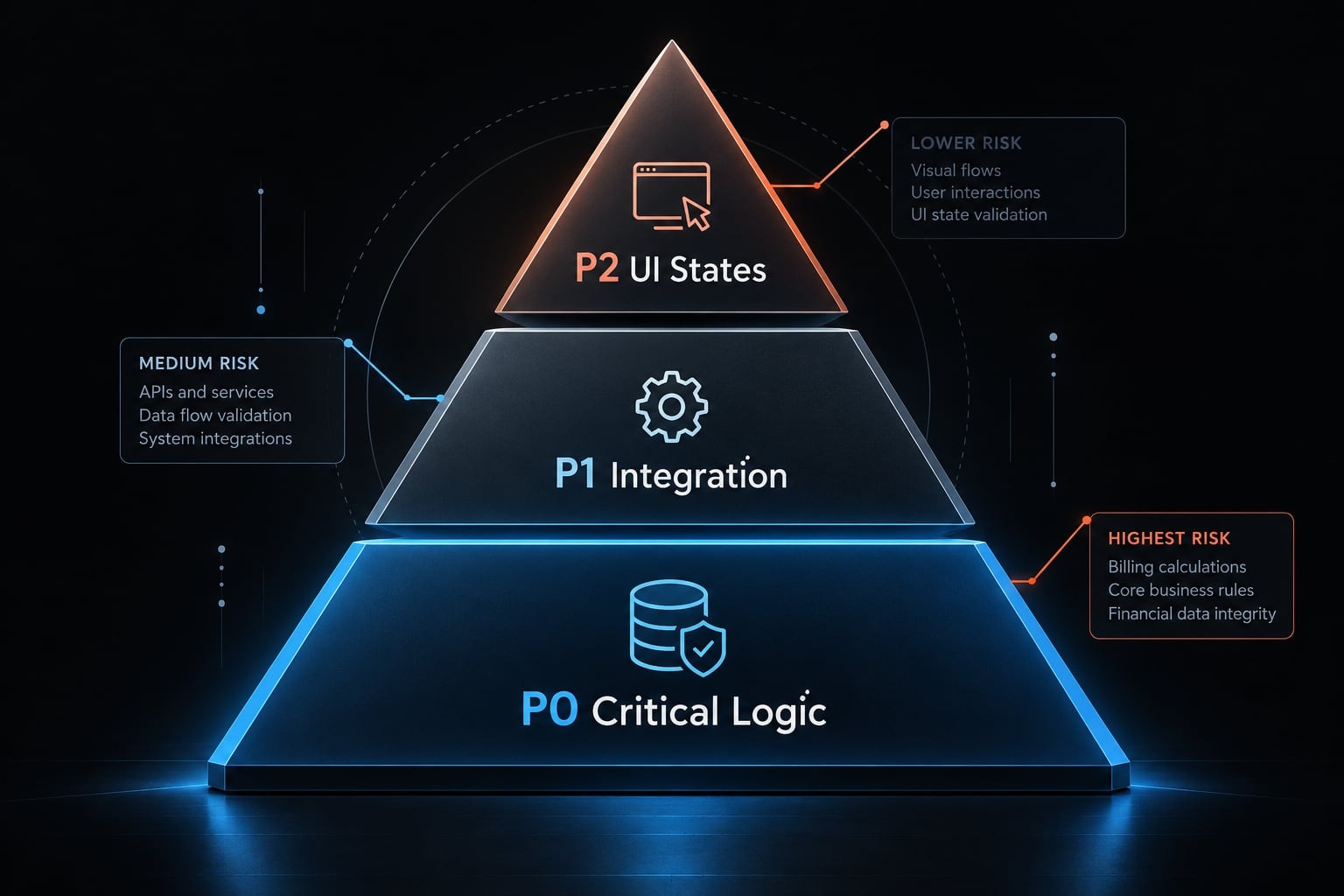
Use risk-based test selection, considering business impact, dependency reach, defect history, and reversibility.
Priority | B2B SaaS example | Appropriate coverage |
|---|---|---|
P0 | Unauthorized billing changes or incorrect totals | Focused unit/API checks and critical end-to-end coverage |
P1 | Valid and expired discount handling | Integration checks and selected journeys |
P2 | Low-impact presentation changes | Focused UI or visual checks |
These priorities are illustrative, not universal severity assignments. Expired discounts could be P0 where financial exposure is substantial.
Approve a small plan linking each test to protected behavior. End-to-end (E2E) checks cover complete journeys, not every discount variation needs one.
Step 3 - Find and reuse existing test coverage
Inspect tests, fixtures, mocks, helpers, and page objects before creating files. Extend the existing subscription-checkout coverage rather than duplicating authentication and billing setup.
Record whether each planned check needs reuse, an update, or a new test. Shared-helper changes require downstream impact review because they can affect unrelated suites.
Duplicate tests add maintenance without necessarily protecting additional behavior.
Step 4 - Generate or update targeted tests
Provide the approved plan, criteria, and writable test paths. Require behavior-based assertions and an explanation of the defect each assertion detects.
For checkout, assert the approved total and persisted billing state not merely a success message. Verify unauthorized attempts leave billing unchanged and another workspace remains unaffected.
The output is a reviewable test diff with assertion rationale. Production-code changes remain outside this task’s authorization. Missing calculation rules require clarification, not invented expected totals.
Step 5 - Run the smallest relevant test set first
Execute in order:
- New or modified tests.
- Related feature or integration tests.
- Required broader checks.
Smaller runs improve diagnostic feedback, they do not replace required coverage. Use commands approved for the repository rather than assuming framework defaults.
Preserve the command, selected scope, environment, exit code, raw output, passed/failed/skipped counts, and runtime. Failures trigger triage not immediate edits. No execution results are claimed for this illustrative example.
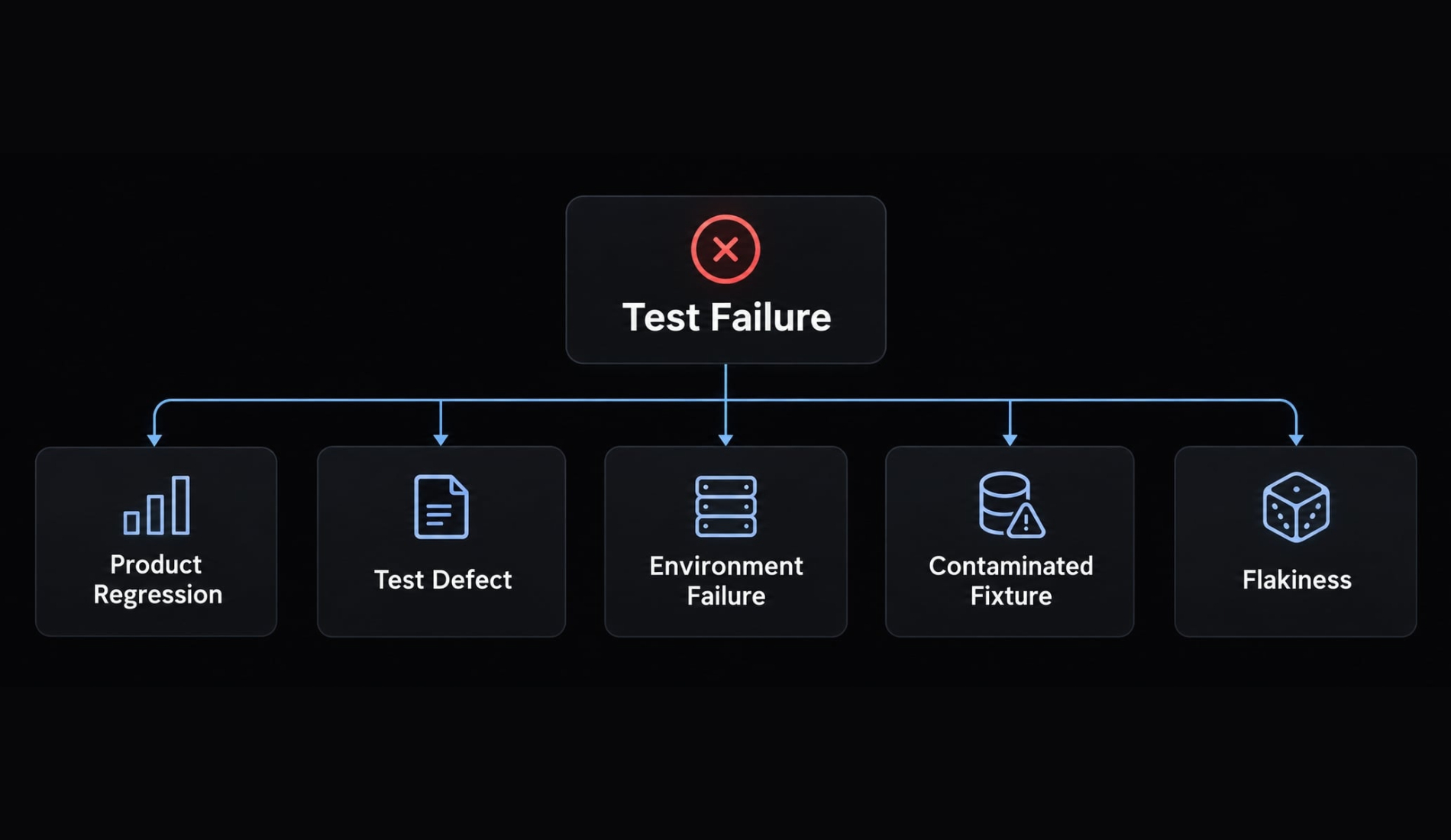
Step 6 - Classify failures before repairing anything
Failure diagnosis begins with evidence, not a mandate to make tests green.
Category | Evidence to seek | Authorized next action |
|---|---|---|
Product regression | Approved behavior is broken | Propose separately approved product fix, retain protective test |
Test defect | Assertion conflicts with requirements | Propose minimal justified correction |
Environment issue | Missing service, dependency, or configuration | Correct through approved procedures |
Fixture issue | Invalid or contaminated data | Correct approved setup and isolation |
Flaky behavior | Intermittent results under apparently equivalent conditions | Investigate timing, state, dependencies, and isolation |
These are initial diagnostic categories, not guaranteed or mutually exclusive causes. Return “insufficient evidence” when appropriate.
A stale discount fixture may resemble a product regression. Intermittency does not prove the test is defective. Reject self-healing that silently changes expected behavior.
Step 7 - Review the diff and approve the result
Apply application-code review discipline to test changes. Hand over changed files, tests added or updated, commands, results, unresolved risks, and decisions awaiting approval.
Where safe, verify that the regression test fails against known-bad behavior or a pre-fix state in an isolated environment.
Retain a proof package: commit reference, approved criteria, baseline and post-change output, test diff, and reviewer notes. Passing assertions establish results under tested conditions—not complete correctness.
Reusable Claude Code prompts for regression testing
Replace placeholders before using these Claude Code prompts. They supplement actual permissions, they do not enforce security. Approve execution separately from analysis and editing. Keep the approved criteria alongside the session so later test maintenance remains traceable.
Prompt for regression impact analysis
Compare [current branch] with [base branch] against[acceptance criteria]. Do not modify files.Identify changed behavior, dependencies, and existing tests.Rank risks with file-path evidence. Separate findings fromuncertainty. Propose a minimal regression plan.Stop if requirements or repository context are insufficient.
Prompt for test generation
Implement [approved plan] against [acceptance criteria] using[framework] conventions. Modify only [allowed files].Reuse approved setup; request approval for shared-helper changes.Do not edit production code or skip, delete, or weaken tests.Explain the defect each assertion detects.Stop when behavior is unclear. Do not execute commands yet.
Prompt for failure triage
Perform read-only flaky test diagnosis and failure analysis using[test output], the relevant diff, and [acceptance criteria].Consider product regression, test defect, environment issue,fixture issue, and flaky behavior; causes may overlap.Cite evidence, uncertainty, and missing information.Return insufficient evidence when necessary. Do not repair anything.
Prompt for safe test maintenance
Using [test output] and [acceptance criteria], propose the smallestjustified repair within [allowed files]. Wait for approval to edit.Remove no coverage; add no arbitrary waits; weaken no assertions.Product defects require separate production-change approval.Escalate unresolved expected behavior.After approval, execute only [approved commands] within agreed limits.
Prompt for pull request test review
Review the test diff against [acceptance criteria] and[approved plan], without modifications or command execution.Check assertion intent, isolation, fixtures, duplicate coverage,secrets, allowed scope, flaky-test risk, and runtime suitability.Separate blocking issues from recommendations.Identify missing evidence and approval decisions.Do not declare readiness without actual required check statuses.
These cards separate recommendation, modification, execution, and approval. Keep that separation when combining them into a larger workflow.
Add regression testing to pull requests and CI/CD
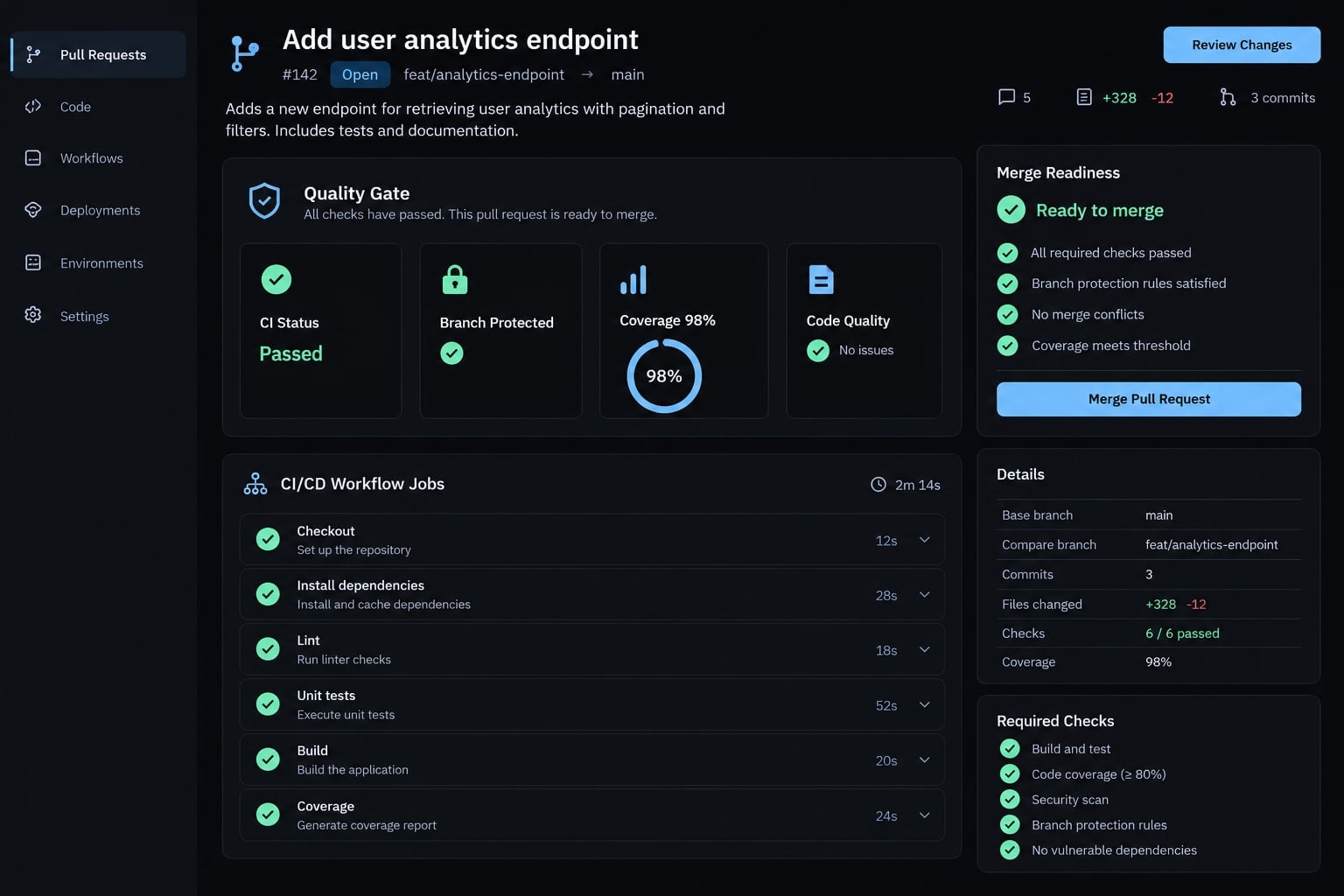
Claude Code can help prepare continuous integration and delivery (CI/CD) configuration. It does not need to run inside CI. Required jobs and repository rules enforce the pull request quality gate.
Execution stage | Test scope | Purpose |
|---|---|---|
Local | New and directly affected tests | Fast feedback |
Pull request | Required high-risk and affected integration checks | Pre-merge protection |
Scheduled | Broader suites and environment/browser coverage | Expanded detection |
Release | Critical journeys and release requirements | Release evidence |
Scheduled suites do not excuse omitted pre-merge checks. GitHub documentation on protected branches and secure GitHub Actions use supports separating repository enforcement from agent recommendations.
Use least-privilege credentials, isolated infrastructure, protected workflow configuration, and safe handling of untrusted pull-request code. Never expose production secrets in prompts or artifacts.
Agent summaries cannot override failing jobs. Explicit CI policy must handle failed, skipped, cancelled, and missing checks, a skipped job is not evidence of executed coverage.
A deterministic gate evaluates defined statuses. It does not make every underlying test execution free from nondeterminism. When to add visual regression testing:
Change | Appropriate checks |
|---|---|
Business rules and permissions | Functional checks |
Critical checkout journeys | E2E checks |
CSS, themes, component libraries | Visual plus functional checks |
Playwright’s “Visual comparisons” documentation describes screenshot assertions and environmental considerations. Stabilize viewports, fonts, test data, and dynamic content before comparing screenshots.
For the discount field, visual checks can detect displaced controls—not incorrect billing calculations.
Visual baseline updates require human approval. A changed screenshot cannot establish whether a design change was intentional.
Guardrails and common mistakes
More generated tests do not automatically provide better regression protection. A bounded agent workflow limits actions and preserves reviewable evidence.
Mistake | Risk | Control |
|---|---|---|
“Test everything” requests | Duplicate coverage | Approved risk-ranked scope |
Missing criteria | Invented expectations | Approved behavior references |
Editing tests after every failure | Hidden product defects | Evidence-based triage |
Unrestricted edits | Expanded change risk | Scoped permissions |
Arbitrary waits or retries | Concealed instability | Root-cause investigation |
Automatic snapshot approval | Accepted regressions | Human baseline review |
Running only new tests | Missed dependencies | Related and broader checks |
Treating green tests as proof | Weak or wrong assertions | Behavioral review |
Code-coverage percentages show execution reach, not whether assertions protect the right behavior. A checkout test can execute discount logic without verifying the final total.
Over-broad mocks may bypass authorization or billing integration. Presentation-dependent selectors can break after harmless styling changes, prefer stable, meaningful locators consistent with repository conventions.
Playwright’s retry documentation distinguishes flaky outcomes from first-run passes. Preserve those distinctions: repeated retries can conceal instability rather than resolve it. During test review, confirm:
- Assertions trace to approved behavior and detect meaningful defects.
- Setup is controlled, isolated, and cleaned up.
- Coverage is neither weakened nor needlessly duplicated.
- Files and production-change scope remain authorized.
- No secrets or real customer data appear.
- Runtime, limitations, and uncertainty are documented.
Assertion quality matters more than the volume of generated code. Self-healing proposals require the same evidence and approval as manual repairs.
Optional - Standardize the workflow with reusable agent skills
Start with versioned prompts and repository instructions. Add orchestration only when repeated coordination justifies its complexity. Reusable agent skills should preserve boundaries, not collapse approval into generation. Use these illustrative responsibilities not built-in agent names:
- Impact analysis: Produce evidence-linked risks and scope.
- Test implementation: Make approved, bounded test changes.
- Test review: Evaluate assertions and unresolved concerns.
- CI enforcement: Let configured systems evaluate required checks.
Claude Code regression testing implementation checklist
Paste this regression testing checklist into a pull-request template. Check items only when supporting evidence exists, record exceptions explicitly rather than treating them as completed.
- Approved behavior and acceptance criteria are documented.
- Commands and writable file scope are defined.
- Permission controls and isolated credentials are configured.
- Baseline commit, environment, and output are recorded.
- Diff analysis identifies affected behavior with paths.
- Regression risks and selected scope are approved.
- Existing coverage and setup have been assessed for reuse.
- Targeted assertions protect approved behavior.
- Relevant suites ran, raw results are preserved.
- Failures are classified or marked inconclusive.
- Unauthorized coverage weakening has been rejected.
- Human diff review is complete.
- Required CI checks satisfy repository policy.
- Visual approvals and unresolved risks are recorded.
Frequently asked questions
What is Claude Code regression testing?
Claude Code regression testing is a workflow where an AI agent analyzes application changes to identify impacted functionality, generates targeted test scripts, and assists in running them. It ensures existing features remain stable when new code is introduced, focusing on risk-ranked coverage rather than indiscriminate test execution.
How does Claude Code assist in regression testing workflows?
Claude Code acts as a QA assistant by analyzing code diffs, proposing risk-based test plans, drafting assertions using existing test frameworks, and executing approved command sequences. It also helps diagnose test failures by correlating output data with the recent application changes, though final approval of test logic remains with human engineers.
Can Claude Code safely repair failing regression tests?
Claude Code can propose repairs for failing tests, but it should never be authorized to automatically apply them without human review. Engineers must first classify the failure—determining if it is a product regression, a test defect, or an environment issue—before approving any modifications to assertion logic or test fixtures.
How do I prevent Claude Code from introducing new regressions?
To prevent agent-introduced regressions, implement "pre-tool-use" hooks that execute local test suites before allowing the agent to commit code. Additionally, enforce architectural boundaries in the project's CLAUDE.md configuration, requiring the agent to respect existing test conventions and preventing it from skipping or weakening critical assertions.
How can I integrate Claude Code into my CI/CD regression pipeline?
Claude Code should ideally be used for local, pre-commit, or pull-request-level quality gates rather than running inside a production CI/CD pipeline. By configuring CI to require passing status checks on risk-ranked test suites, teams ensure that the agent-assisted workflow remains consistent with broader quality requirements and organizational compliance.
What are the risks of using AI agents for test maintenance?
The primary risks include the generation of brittle tests, the weakening of assertions to achieve "passing" status, and the accidental deletion of coverage. Mitigate these by requiring the agent to explain the specific defect each assertion protects, and by strictly limiting the agent's permission to modify shared fixtures or production code.
Read more:
- How to use Claude Code for QA automation: A practical guide
- Playwright Claude Code testing: Setup to reviewed tests
- Claude Code unit testing: Guide to generate reliable tests
Conclusion
Claude Code regression testing works best when analysis and prioritization precede generation. Approved requirements define behavior, test runners execute checks, and engineers judge whether assertions provide meaningful protection. Classify failures before repairing them, preserve raw output, and keep CI enforcement independent of agent summaries.
Start with one affected feature or recent defect. Establish the baseline, approve a small test plan, and review the resulting evidence before expanding scope. This approach may reduce repetitive work and improve consistency, but neither benefit substitutes for sound testing decisions.
Reuse the prompts and implementation checklist above for your next narrowly scoped change, with permissions and approval points configured first.