Vibe Coding security: Risks, best practices and a pre-deployment checklist
Functional software isn't automatically secure. As AI-assisted "vibe coding" speeds up development, rapid code generation often outpaces human security review-leaving hidden flaws like broken authorization or exposed customer data. Instead of rejecting AI-generated code, teams must apply proportional security guardrails. This guide delivers a practical workflow and pre-deployment checklist to help you ship safely, remediate risks, or escalate complex issues to security experts.
What is vibe coding security?
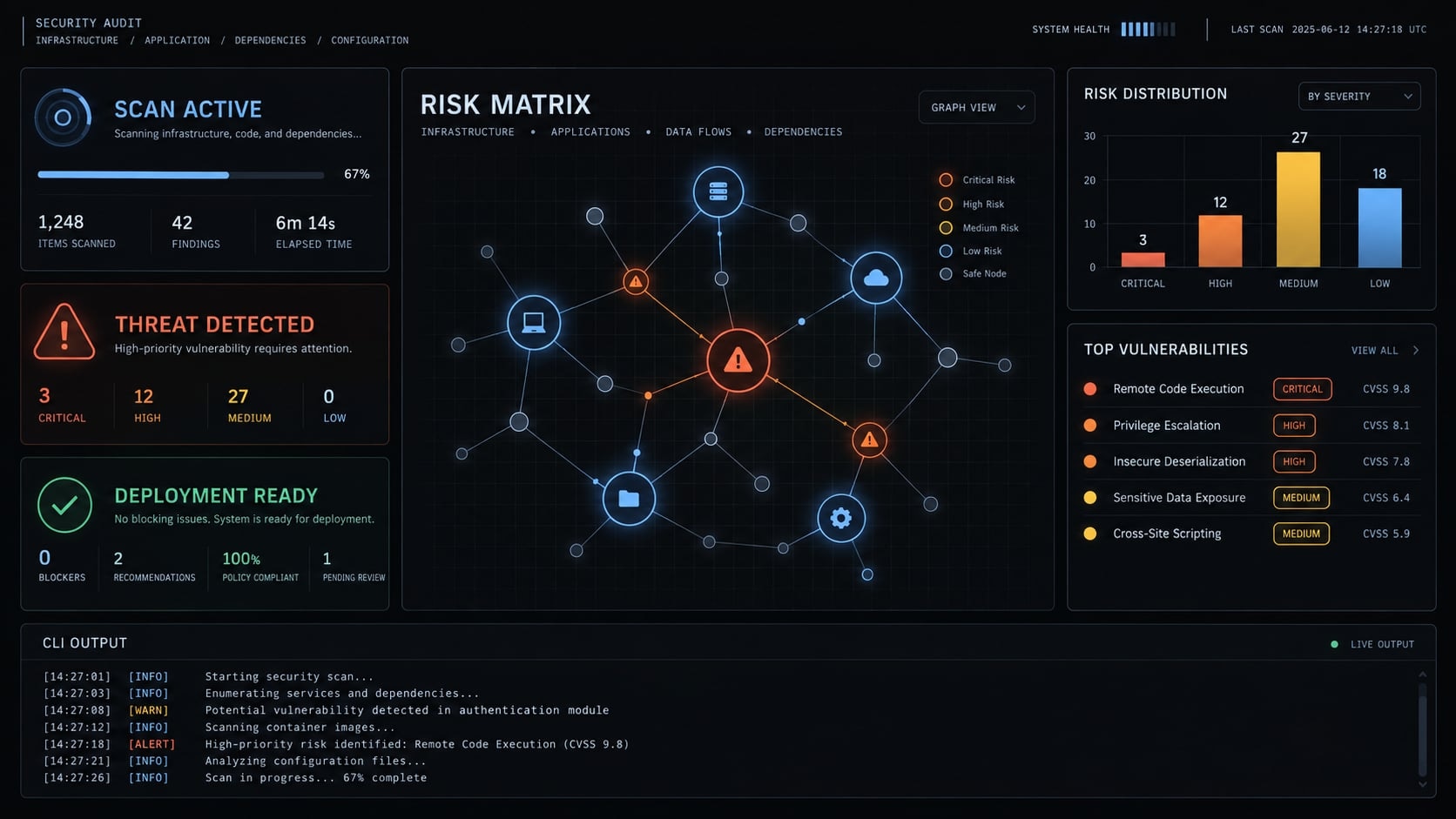
Vibe coding security is the practice of reducing security risks in prompt-driven software development across generated code, dependencies, secrets, agent permissions, deployment, and ongoing operation. It covers both the application being built and the tools building it, using proportionate controls, review, and testing rather than assuming working features are safe.
“Vibe coding” generally means conversational development, often with reduced inspection of implementation details. Usage varies: structured AI-assisted software development can involve extensive engineering review. This is a working definition, not an official security standard.
Why working software is not necessarily secure
Functional correctness asks whether intended behavior works. Security testing also asks whether prohibited behavior is prevented.
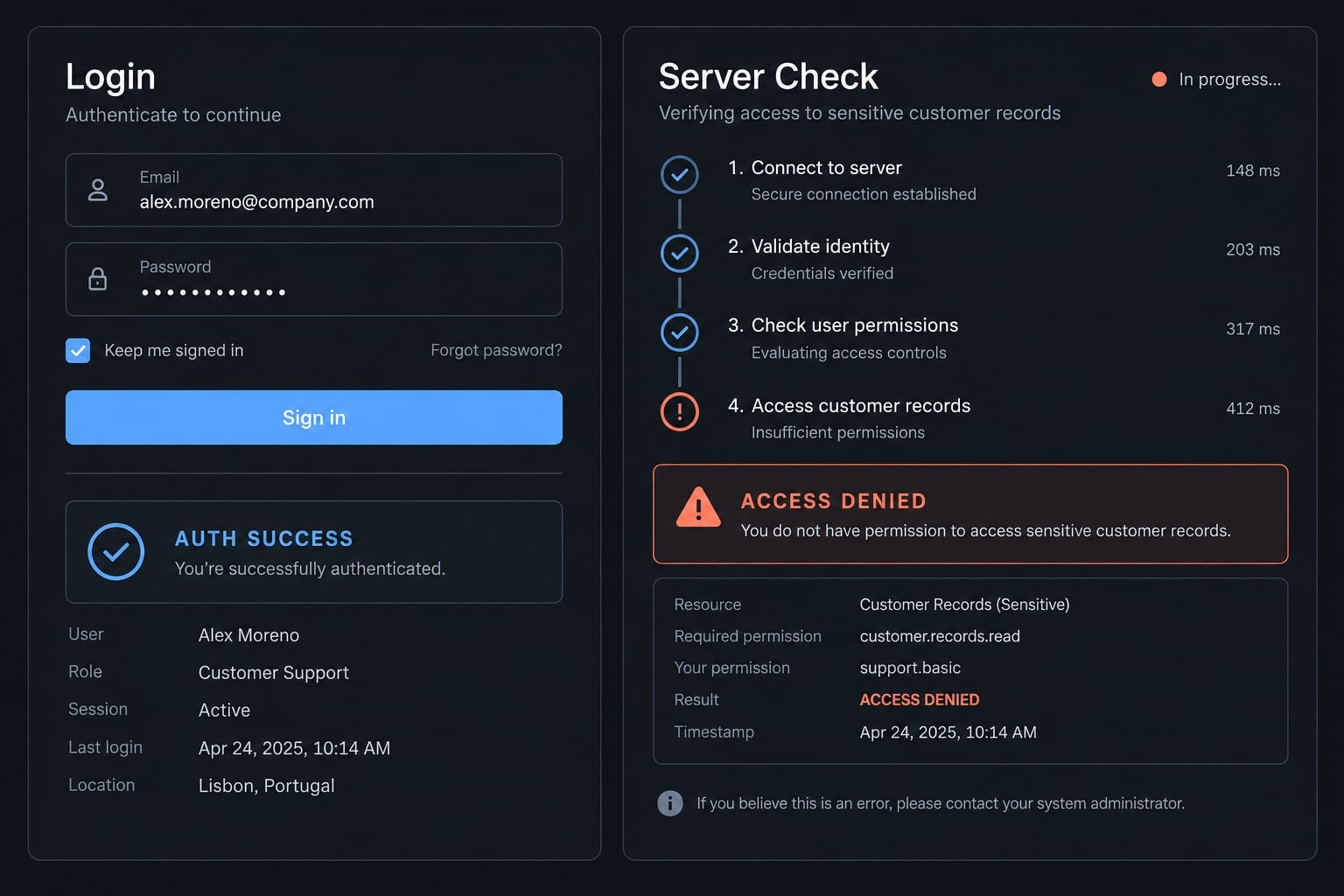
A customer workspace may authenticate users successfully while failing to check which records they may access. Authentication establishes identity; authorization establishes permission. Database policies and secrets exposed in browser code require separate attention.
Functional tests can include security assertions. The distinction concerns what they verify, not mutually exclusive test categories. NIST’s Secure Software Development Framework, Version 1.1 (2022) supports integrating security throughout development.
Three security problems commonly confused under “AI security”
Security area | Meaning | Example | Primary controls |
|---|---|---|---|
AI-generated code security | Defects in generated software | Missing record ownership check | Review and security tests |
Coding-agent security | Risks from agent capabilities | Untrusted content influences shell actions | Restricted access and approvals |
LLM feature security | Risks in large language model product features | Injected instructions manipulate a chatbot | Untrusted-input handling and bounded tools |
An application does not inherit LLM-product risks merely because AI wrote it. A development agent can nevertheless face prompt injection without any LLM feature in the finished product.
The most common vibe coding security risks
These seven risks form a practical review sequence, not a measured prevalence ranking:
- Exposed secrets and sensitive data.
- Weak authentication and broken authorization.
- Missing input validation and injection defects.
- Unverified or hallucinated dependencies.
- Insecure cloud, database, and API configuration.
- Excessive coding-agent permissions.
- Over-trust in AI reviews and security prompts.
1. Exposed secrets and sensitive data
Credentials can leak through prompts, repositories, logs, and browser bundles. Environment variables are not automatically private when frontend builds expose them.
Keep hard-coded credentials out of code, minimize sensitive prompt content, and scan relevant artifacts. GitHub’s About secret scanning documentation describes supported detection, not universal coverage. Revoke or rotate exposed credentials; deleting them does not invalidate them.
2. Weak authentication and broken authorization
Illustrative scenario: User A signs in, and the interface hides User B’s records. A direct API request still returns B’s record because server-side ownership checks are missing.
This is broken access control. Enforce authorization on every protected operation and test tenant separation. RBAC (role-based access control) assigns permissions by role but does not alone establish tenant isolation.
3. Missing input validation and injection defects
Untrusted input can reach queries, commands, or rendered pages without appropriate handling.
Validate inputs server-side, use parameterized database queries, and apply context-appropriate output encoding. Validation alone does not prevent every injection or cross-site scripting flaw. OWASP’s SQL Injection Prevention Cheat Sheet and Cross Site Scripting Prevention Cheat Sheet explain these distinct defenses.
4. Unverified or hallucinated dependencies
Agents may recommend nonexistent, misidentified, or vulnerable packages. Slopsquatting is a software supply chain threat where attackers register malicious packages under package names hallucinated by AI models.
The 2025 USENIX Security paper We Have a Package for You!, by Joseph Spracklen and colleagues, examines package hallucination risks. Verify package identity, purpose, and provenance. Popularity, age, pinning, and lockfiles support review but cannot rule out supply chain vulnerabilities.
5. Insecure cloud, database and API configuration
Public storage, permissive database policies, excessive token scopes, verbose errors, and absent abuse controls can undermine otherwise sound code.
Review deployed settings and test effective permissions. CORS (cross-origin resource sharing) governs browser access; it is not authentication and does not generally block direct API requests. Configure it appropriately without treating it as authorization.
6. Excessive coding-agent permissions
Repository files or fetched documentation can contain indirect prompt injection: untrusted text attempting to redirect agent behavior.
Apply least privilege-only the access required-to shell, filesystem, network, repository, and cloud operations. Restrict connected tools too. OWASP’s Top 10 for LLM Applications 2025 covers prompt injection; tool allowlisting limits exposure but does not make outputs trustworthy.
7. Over-trust in AI reviews and security prompts
“Make this secure” leaves requirements undefined. Another model may repeat the original implementation’s mistaken assumptions.
Use explicit requirements, targeted tests, and accountable human oversight. A second model can suggest useful checks, but it is not independent security assurance. Review evidence about the implementation, not just the confidence of its explanation.
How much security does your project need?
Security effort should follow exposure, data sensitivity, privileges, and consequences. “Prototype” and “internal” describe context, not protection.
The matrix below is an editorial decision aid informed by NIST’s secure-development framework and CISA’s Secure by Design guidance. Its categories are illustrative triage levels, not an official scoring model or certification of production readiness.
Vibe coding project risk matrix
Project type | Indicative risk | Minimum safeguards | Review level |
|---|---|---|---|
Isolated local prototype; synthetic data | Lower if genuinely isolated | No production credentials; restricted agent | Builder review and basic checks |
Internal business tool | Moderate to high | Identity, permissions, logging, recovery | Engineering review; specialist if privileged |
Public app with accounts | Elevated | Access tests, scans, hardened deployment | Security-informed engineering review |
Sensitive data or high-impact actions | High | Threat assessment and verified controls | Qualified specialist assessment |
A local prototype holding production credentials may be high risk. An internal finance tool with broad administrative access may need specialist review despite limited reachability.
Payment architecture also matters. Redirecting users to a hosted payment provider differs from storing payment credentials. Compliance obligations depend on actual data, jurisdiction, contracts, and system design.
Four questions to determine the risk level
- Reachability: Can unknown users reach the application or its APIs?
- Data: Does it process confidential, personal, or otherwise sensitive information?
- Authority: Can it change important records, transfer value, or administer infrastructure?
- Consequences: What happens if access controls fail or the service becomes unavailable?
Record the answers before development. Use the highest applicable risk level, rather than averaging a serious privilege risk against otherwise limited exposure.
A secure vibe coding workflow from prompt to production
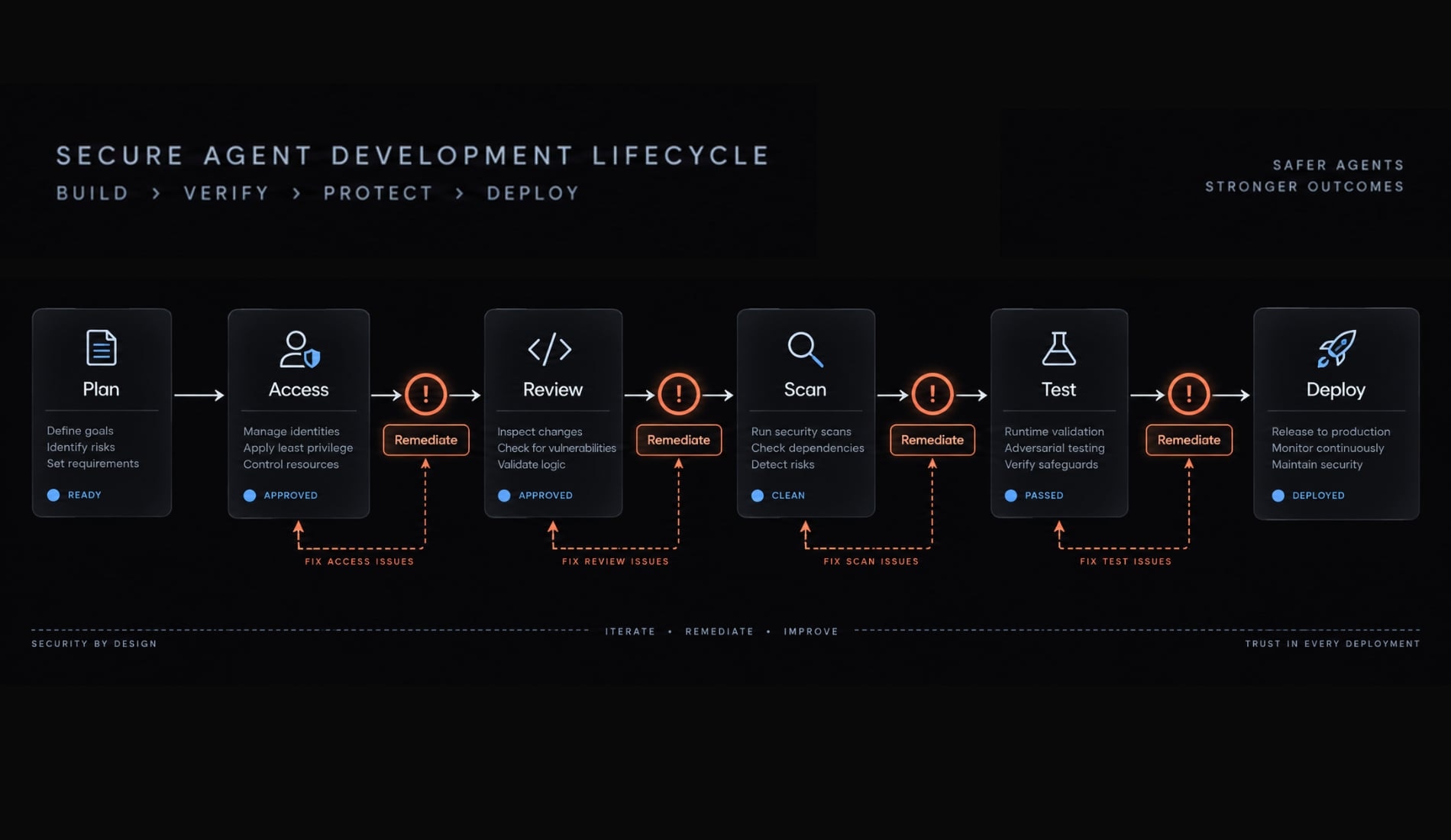
Put security requirements into planning and require evidence at release gates:
- Classify the application.
- Specify security requirements.
- Restrict agent access.
- Review generated changes.
- Automate security checks.
- Test deployed behavior.
- Monitor and maintain.
Step 1 - Classify the application before prompting
Write a short risk note covering data, roles, integrations, privileged actions, and application exposure. Identify who owns release decisions and what failures would harm users.
Use synthetic data while experimenting. For the workspace example, record tenant isolation as a required property, not an assumption inherited from the login feature.
Step 2 - Add explicit security requirements to the plan
Make security guardrails concrete enough to inspect and test:
Do not embed credentials.Enforce server-side authorization on protected operations.Use parameterized queries.Explain and justify new dependencies.Request approval for security-sensitive changes.
Also specify dependency constraints, safe errors, session handling, and appropriate abuse controls. These instructions guide generation; they do not verify the result.
Step 3 - Restrict the coding agent’s access
Limit directories, commands, network destinations, credentials, and MCP (Model Context Protocol) tools connecting agents to external tools and data. Preserve reviewable activity history.
Human approval is not an enforced access boundary. Withholding deployment credentials is stronger than saying “do not deploy.” Stop unnecessary production-access requests; legitimate privileged automation needs scoped, isolated, approved execution.
Step 4 - Review generated changes before merge
Inspect diffs, permission logic, dependencies, configuration, and tests. Split changes that exceed review capacity, especially when identity or deployment behavior changes.
Ask reviewers to explain how prohibited actions are denied, not merely how features work. Do not merge unexplained security-sensitive changes. AI-generated code deserves the same implementation scrutiny as any other contribution.
Step 5 - Automate high-value security checks
Run checks in CI (continuous integration) or another repeatable process. SAST means static application security testing; SCA means software composition analysis.
Check | What it can identify | What it cannot establish |
|---|---|---|
Secret scanning | Supported credential patterns | Absence of every secret |
SAST | Supported unsafe code patterns | All business-rule correctness |
SCA | Known vulnerable dependencies | Every package is benign |
Configuration scanning | Supported risky settings | All effective runtime permissions |
Block credible high-impact findings pending remediation or accountable disposition. Severity is an input: assess exploitability, exposure, and affected assets. Document false positives or approved exceptions with an owner and expiry. Do not waive unresolved sensitive-data exposure simply to release.
Step 6 - Test security behavior in a deployed environment
Runtime validation means testing behavior in a deployed environment. Use owned or explicitly authorized systems, preferably staging with representative configuration and synthetic data.
For the workspace example, test unauthenticated, wrong-user, and wrong-tenant access. Enforce missing ownership checks, then retest denied access and legitimate access. Failed authorization or sensitive-data exposure blocks release.
Check database/storage policies, sessions, errors, and abuse controls. Staging does not prove production matches; recheck production-sensitive settings through an approved, non-disruptive process. CORS is not proof of API protection.
Step 7 - Monitor and maintain the application after launch
Assign owners for alerts, dependency updates, incidents, and recovery. Monitor relevant access failures and unusual privileged actions without unnecessarily logging sensitive data.
Reassess when data, exposure, integrations, or privileges change. Security evidence belongs to a particular version and environment; significant changes can invalidate earlier conclusions.
Pre-deployment security checklist for vibe-coded apps
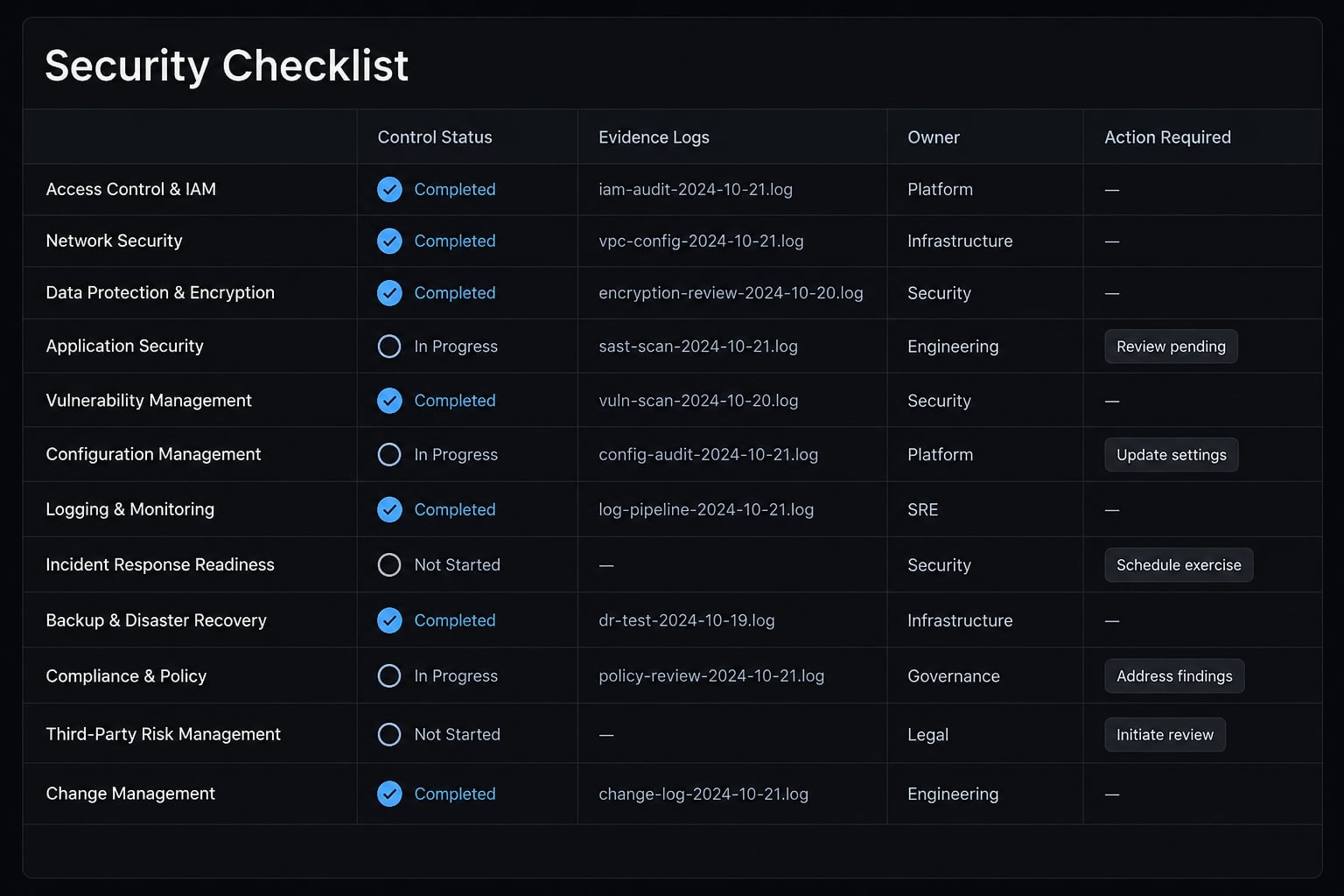
This pre-deployment security checklist supports a release decision; it is not certification. Record each item as:
Control | Pass/Fail/Not applicable | Evidence | Owner | Follow-up
“Not applicable” needs a reason. An unverified control is not a pass. Evidence should identify the tested version, environment, date, and result.
Code and access control
- Authentication components are maintained; session configuration is reviewed.
- Protected operations enforce server-side authorization.
- User/tenant separation passes access control testing; the workspace defect is retested.
- Server-side validation and safe query construction are verified.
- Error responses avoid exposing sensitive internals.
Secrets and data
- Source, builds, logs, prompts, and repository history have a documented exposure-review scope.
- Development and production credentials are separate.
- Suspected exposed credentials are revoked or rotated.
- Transport is encrypted; sensitive-data collection is minimized.
- Test data is synthetic or appropriately controlled.
Dependencies and supply chain
- Package identities and purposes are verified.
- Lockfile and dependency changes are reviewed.
- Known software supply chain vulnerabilities are triaged.
- Unnecessary packages are removed.
- Unusual installation scripts or permissions are reviewed where relevant.
Agent and workflow controls
- Filesystem, shell, network, and MCP access follow least privilege.
- Agents have no unrestricted production access.
- Destructive or production-facing actions require approval.
- Changes and security-relevant test evidence remain reviewable.
Deployment and runtime
- Effective database and storage policies are verified.
- Public exposure and context-appropriate CORS settings are reviewed.
- Protected APIs and relevant rate limits are tested.
- Monitoring and incident ownership are assigned.
- Recovery procedures are tested proportionately to project risk.
For the workspace application, retain evidence that cross-tenant access is denied after remediation and authorized access still succeeds. Record any untested operations separately.
Deployment decision rule
- Ship: Applicable controls have evidence, no release-blocking findings remain, and an accountable owner accepts residual risk.
- Remediate: Correct and retest a known gap before enabling the affected release or capability.
- Escalate: Seek qualified assessment when a sensitive control or high-impact risk cannot be confidently evaluated.
Keeping the application private reduces exposure. It does not resolve sensitive-data handling or excessive privileges.
What security tools and AI reviews cannot guarantee
No single tool can certify an application’s security. Automated checks and human review reduce risk within defined coverage, but neither establishes the absence of vulnerabilities. A clean result means the selected checks found no reportable issue under their conditions-not that every component, configuration, and business rule is safe.
DAST (dynamic application security testing) examines a running application. Conventional tools remain useful whether humans or AI wrote the code.
Control | Main use | Limitation |
|---|---|---|
AI-assisted review | Explain changes; suggest tests | Can repeat incorrect assumptions |
SAST | Identify supported source patterns | Cannot establish all runtime behavior |
SCA | Identify known vulnerable components | Cannot establish every package is benign |
DAST | Test reachable deployed behavior | Depends on authentication, paths, and configuration |
Human review | Assess design and business rules | Limited by expertise, scope, and time |
Runtime monitoring | Detect suspicious activity | Cannot prevent every flaw or detect every attack |
Business logic flaws require context. A scanner may not know whether a contractor should export workspace records or whether an administrator belongs to the correct tenant.
Combine controls around consequential failure modes rather than counting tools. Prioritize findings by exposure, exploitability, and impact. Preserve test scope and limitations alongside results so future maintainers can distinguish “no finding” from “no vulnerability.”
When professional security review is necessary
Review depth should depend on risk, not whether AI produced the code. Lightweight self-review may suit an isolated experiment, while sensitive data or privileged operations require stronger evidence. Qualified application security (AppSec) expertise becomes necessary when consequences are significant or the team cannot evaluate a critical control confidently.
Escalation triggers include:
- Sensitive or regulated information.
- Public multi-tenant access.
- Financial, administrative, or infrastructure-changing actions.
- Complex identity and permission models.
- High financial, privacy, safety, or operational consequences.
- Uncertainty about critical generated components.
A hosted payment redirect and direct handling of payment credentials do not warrant identical assessment scopes.
Choosing the appropriate review:
Review type | What it addresses |
|---|---|
Engineering code review | Implementation, tests, and security-sensitive changes |
Assets, trust boundaries, and plausible abuse paths | |
Configuration review | Effective identity, cloud, database, and deployment settings |
Penetration testing | Exploitability within agreed scope and time |
Compliance review | Applicable obligations, not absence of vulnerabilities |
These assessments are complementary, not interchangeable. OWASP’s Web Security Testing Guide provides structured testing guidance, while NIST’s secure-development framework addresses lifecycle practices.
Define the security assessment’s environment, scope, exclusions, and retest expectations. Limit exposure and use synthetic data while unresolved high-impact risks are assessed.
Frequently asked questions
What is vibe coding security?
Vibe coding security refers to the practice of identifying and mitigating risks within software applications developed primarily through natural language prompting. It encompasses securing AI-generated code, verifying third-party dependencies, enforcing strict agent access permissions, and ensuring robust runtime protections against vulnerabilities like broken access control and injection.
Why is AI-generated code often considered insecure?
AI models are trained on public datasets that frequently contain legacy patterns, outdated libraries, and insecure coding practices. Because these models prioritize functional output, they often lack the contextual understanding of security requirements-such as server-side authorization or input sanitization-necessary to prevent modern cyber threats.
Does "functional" code mean it is secure?
No. An application can pass all functional tests-such as successfully logging in or retrieving data-while remaining critically vulnerable. For example, a login feature may work perfectly for users, but if the underlying API does not verify record ownership on the server, unauthorized data access remains possible.
What is "slopsquatting" and why should developers care?
Slopsquatting is a supply chain threat where AI models hallucinate plausible but non-existent dependency names. Attackers register these names on public registries like npm or PyPI with malicious code. Developers or agents, trusting the AI's recommendation, inadvertently include these malicious packages, leading to system compromises or data theft.
How can I make my vibe-coded application more secure?
You can improve security by treating AI-generated code as untrusted input. Always validate inputs, enforce server-side authorization, rotate sensitive credentials, and utilize security-focused scanners. Most importantly, incorporate a manual human review and behavioral testing phase before deploying any AI-assisted code to a production environment.
Are traditional security tools effective for AI-generated apps?
Yes, but with limitations. Conventional tools like SAST (Static Application Security Testing) and SCA (Software Composition Analysis) are valuable for identifying known vulnerability patterns and problematic dependencies. However, they cannot replace the need for behavioral testing, business logic verification, and human oversight to catch configuration-based security gaps.
When is a professional security review necessary?
A professional review is essential when your project handles sensitive or regulated data, manages multi-tenant access, performs high-impact administrative actions, or faces significant financial or legal consequences if compromised. If you lack the internal security expertise to evaluate critical generated components, escalation to a professional auditor is required.
Read more:
- Vibe coding email: Build AI workflows safely & effectively
- Vibe code ecommerce: How to build and launch safely
- Vibe coding PRD: A practical template for AI app development
Conclusion
Vibe coding security is about keeping implementation speed aligned with understanding and evidence. AI-generated code can deliver working features while changes to dependencies, permissions, and deployment introduce risks that interface testing never examines. Neither a confident model response nor a clean scan establishes complete security.
The minimum approach is practical: Classify the application, restrict agent access, review changes, automate relevant checks, and test prohibited behavior in an authorized environment. Escalate when sensitive controls exceed the team’s expertise, and revisit decisions as the application changes. Before your next deployment, apply the on-page checklist and record the evidence behind each ship, remediate, or escalate decision.