Vibe coding developer handoff: Guide to transferring AI projects
Vibe coding developer handoff: How to transfer AI-generated work without losing context
A vibe coding handoff fails when a prototype arrives without setup steps, architectural decisions, or boundaries. Even if an AI-built UI looks complete, missing context on mocked data or access controls blocks full developer ownership. This guide offers a framework built on intent, implementation, and verified evidence—ensuring code is reproducible and safely accepted.
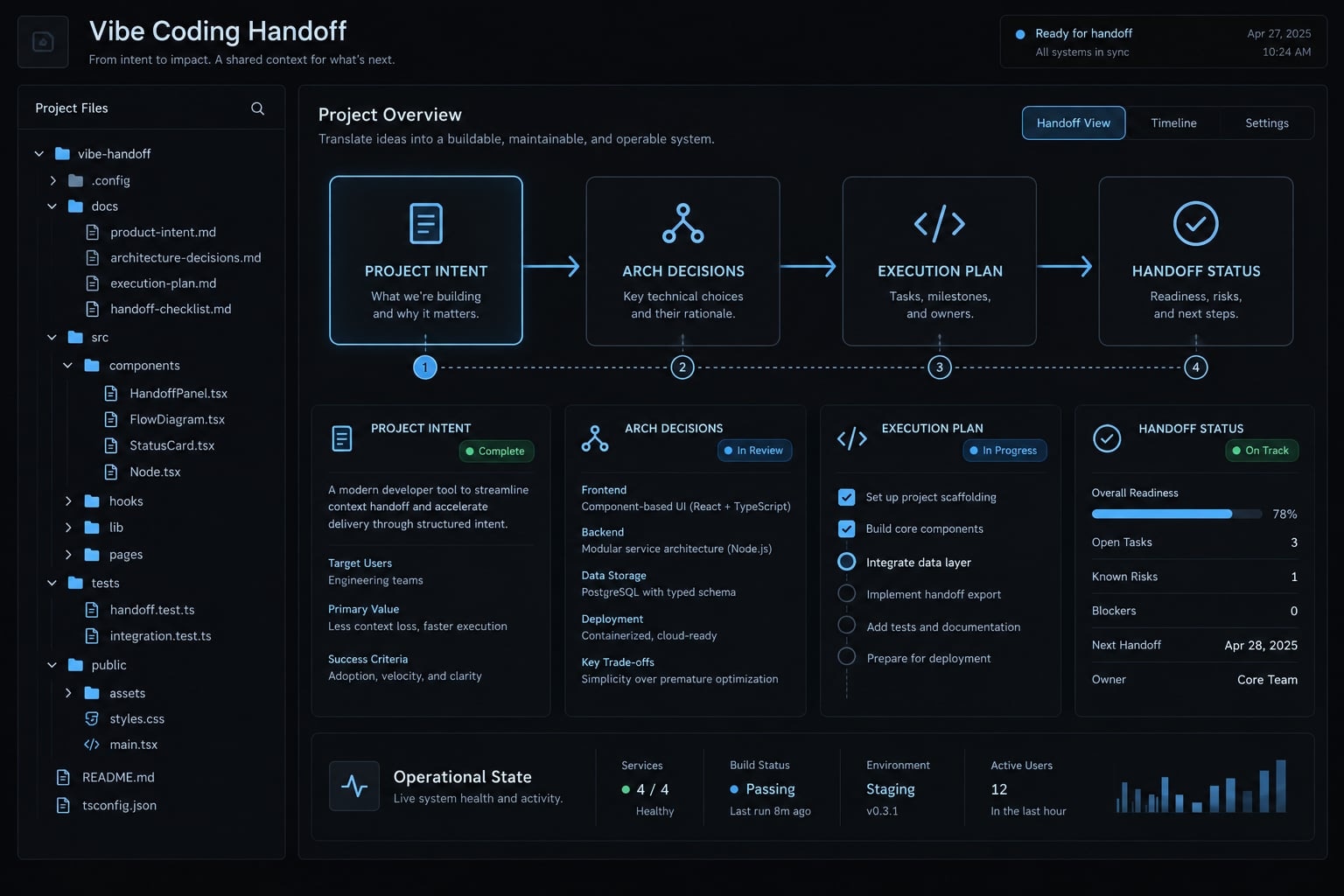
What is a vibe coding developer handoff?
A vibe coding developer handoff transfers an AI-assisted project’s product intent, implementation context, validation evidence, documented risks, and next-step ownership to a receiving developer. Its purpose is not simply to deliver working files, but to enable another person to reproduce the project, assess its condition, and accept responsibility for a defined scope.
“Vibe coding” is used loosely. Here, it means prompt-led development where implementation may advance faster than formal review and documentation. It does not describe every form of AI-assisted engineering.
Human-to-human knowledge transfer also differs from moving context between agent sessions. Loading project instructions may help an agent continue a task; it does not establish human accountability. Relevant prompts can support the transfer, but complete conversation histories are not mandatory.
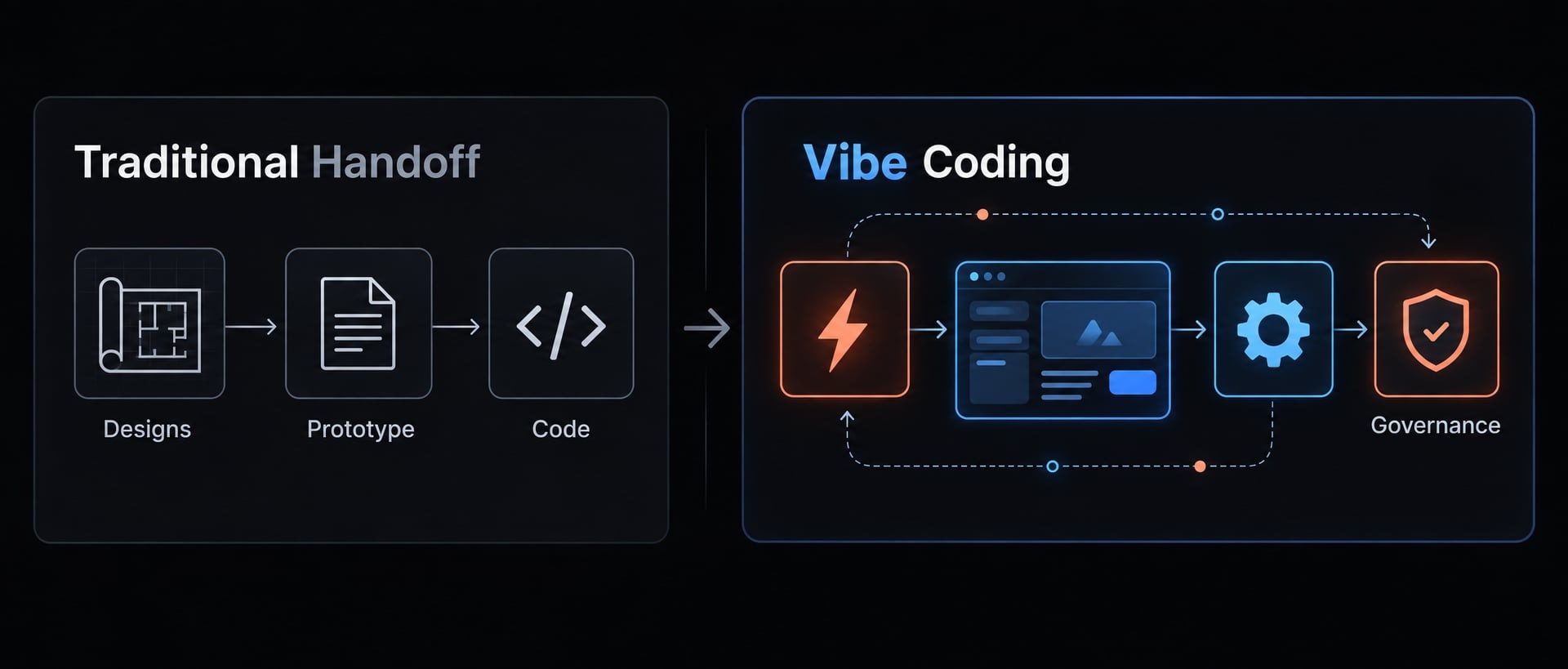
Both approaches need clarification and acceptance. AI-assisted design-to-developer handoff adds an existing implementation that requires assessment.
Dimension | Traditional handoff | Vibe coding handoff |
|---|---|---|
Primary artifact | Designs and specifications | Prototype, code, and supporting records |
Main question | What should we build? | What exists, and what should remain? |
Location of context | Design files, tickets, discussions | Those sources plus agent conversations |
Developer role | Interpret, implement, validate | Assess, retain or replace, validate |
Main risk | Requirements lost in translation | Unreviewed behavior mistaken for intent |
Completion condition | Clarified scope and accepted responsibility | Assessed implementation and accepted responsibility |
Why vibe-coded projects are difficult to hand off
The central handoff problem is uncertainty about the current state, not the involvement of AI. Missing context increases review effort and makes delivery commitments harder to defend.
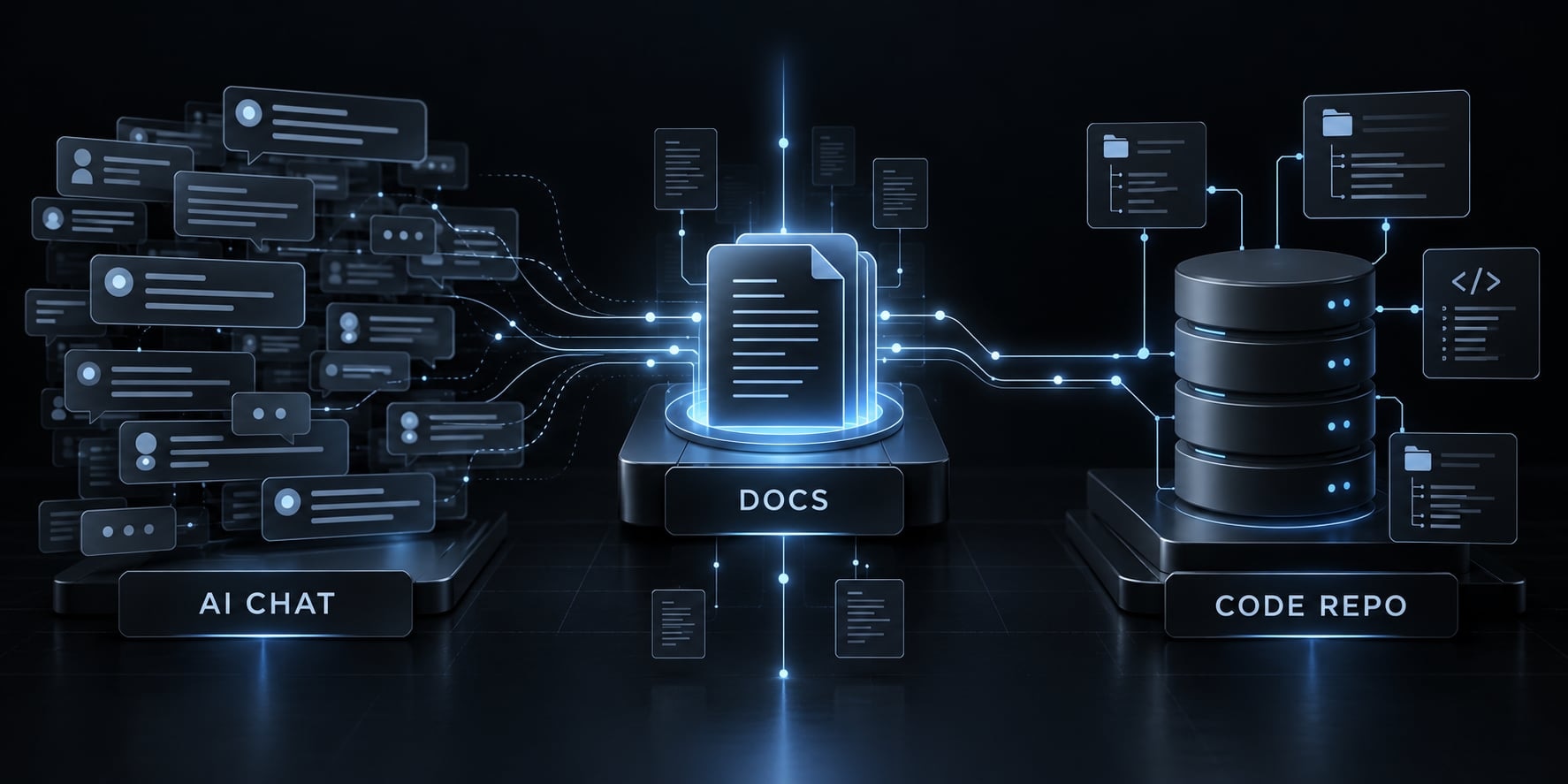
Decisions remain trapped in AI conversations
Useful decisions often sit beside discarded experiments:
- An approved requirement appears deep inside a conversation.
- An obsolete debugging workaround resembles a current instruction.
- A constraint never reaches maintained project documentation.
This creates context decay: Useful information becomes missing, stale, or difficult to distinguish from outdated instructions. Long conversations can contain these conflicts, but length alone does not determine quality.
The code shows what happened, not why
Code exposes implemented behavior more readily than architectural intent. A reviewer still needs to distinguish approved choices, temporary shortcuts, generated side effects, and defects.
Architectural drift occurs when repeated changes move the implementation away from its approved structure. It can result from human decisions, generated edits, or both.
In the illustrative dashboard, the builder knows a subscription value is mocked, but the receiving developer cannot distinguish it from a working billing integration.
Prototype and production boundaries become unclear
A successful demo establishes only that particular behavior was observed. It does not establish production readiness.
Review questions include:
- Which data and integrations are mocked?
- Where are permissions checked?
- What happens when requests fail?
- Which dependencies require investigation?
AI-generated code is not inherently defective. These questions identify uncertainty rather than presume failure. A polished interface can still leave consequential behavior unexamined.
No one has formally accepted ownership
Repository access does not establish accepted scope, responsibility, or release approval.
Without an explicit agreement, a founder may expect feature delivery while the developer believes they are conducting an assessment. Developer ownership begins with a shared definition of responsibility - not an invitation to the repository.
The three layers of a complete vibe coding handoff
- Product and design intent: What users should accomplish and which behavior is approved.
- Implementation context: How the current system works and which decisions constrain changes.
- Operational ownership: Who accepts responsibility for the documented scope and next decisions.
The Intent–Implementation–Ownership model is this guide’s editorial framework, not an independently validated industry standard.
Layer one: Product and design intent
Generated behavior is not automatically approved behavior. Record:
- User and business problem.
- Primary flow and acceptance criteria - the conditions that define acceptable behavior.
- In-scope behavior and explicit non-goals.
- Default, loading, empty, error, success, and restricted states.
- Responsive behavior across relevant screen sizes.
- Accessibility expectations for keyboard use, focus, contrast, and labels.
- Approved deviations from the design.
W3C’s Web Content Accessibility Guidelines (WCAG) 2.2 provide a reference for accessibility requirements. A few basic checks do not establish full conformance.
Layer two: Implementation context
Explain the system at the level needed to change it safely:
- Main components and data flow.
- Frameworks, services, APIs, databases, and significant dependencies.
- Setup and environment requirements.
- Important decisions and temporary choices.
- Mocked or incomplete components.
- Branch, relevant commit, and active plan.
Version-controlled files preserve decisions when maintained and consulted. Raw chat history is supporting material, not an authoritative substitute. Avoid documenting every function; prioritize boundaries and choices that affect the next task.
Layer three: Operational ownership
Validation evidence means recorded checks tied to a specific project state. Where practical, include revision, environment, check, result, date, and reviewer.
Status | Meaning |
|---|---|
Validated | A stated check passed for a specified scope. |
Partially validated | Some relevant scenarios were checked; gaps remain. |
Assumed | A belief is recorded without supporting verification. |
Unresolved | A question or decision remains open. |
Record the next owner and next approved task separately as accountability metadata, not validation statuses. Include deployment status, rollback considerations, and whether logging or monitoring exists.
How the three layers work together
In the illustrative dashboard, intent defines subscription visibility and permitted actions. Implementation identifies mocked payment data.
Ownership records that one password-based sign-in scenario was checked, while payment-provider notifications - webhooks - remain untested. That is more precise than claiming “authentication and billing are validated.”
Should the developer continue, refactor or rebuild?
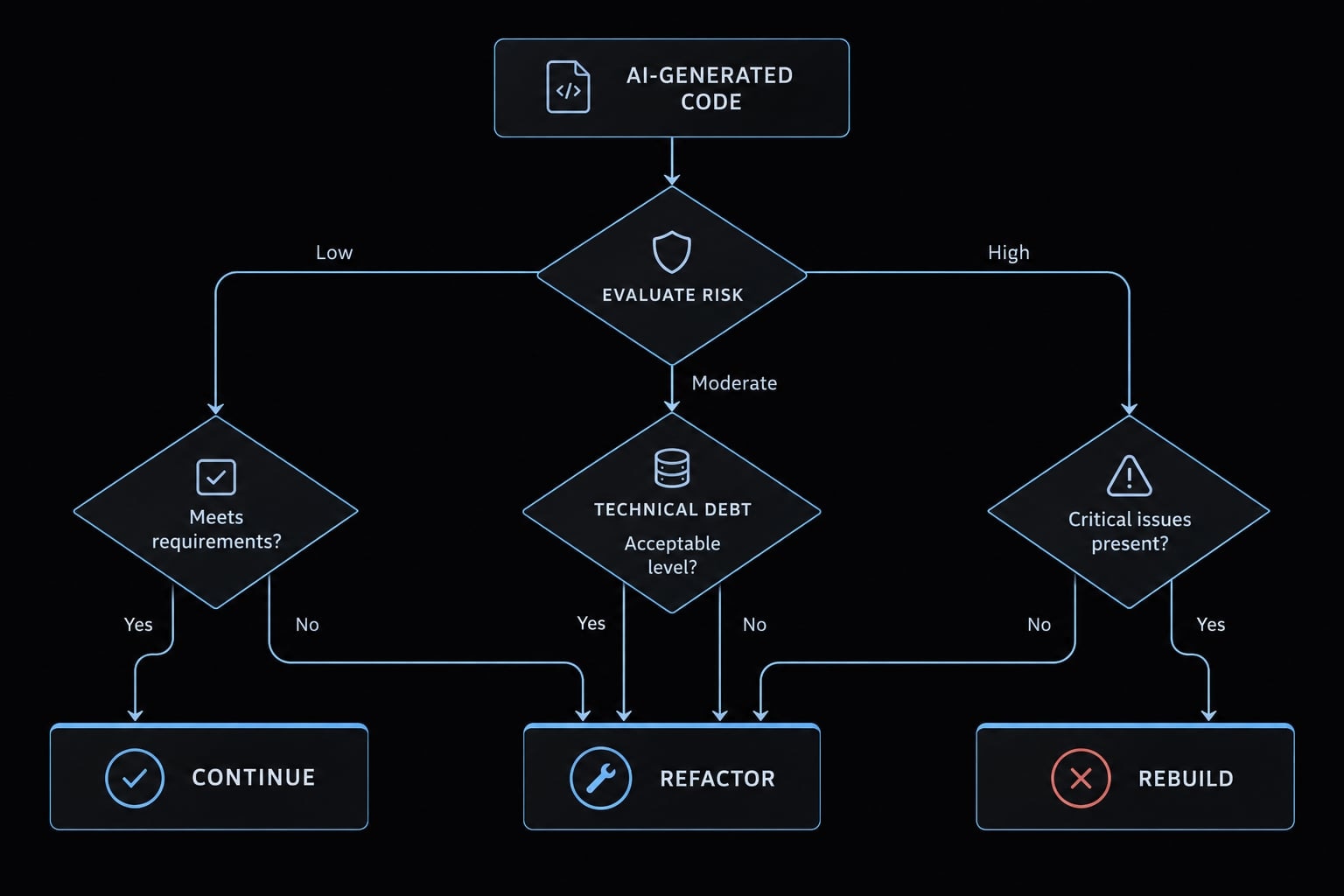
Code disposition is the decision to continue, refactor, or rebuild an implementation. Handoff does not require preserving every generated component. AI-generated code review should evaluate technical risk and codebase maintainability, not reward or reject the method of creation.
Continue-Refactor-Rebuild decision matrix
Use this matrix as a judgment aid, not a scoring algorithm. Data sensitivity and permission boundaries should influence review depth.
Dimension | Continue signals | Refactor signals | Rebuild signals |
|---|---|---|---|
Structure | Understandable boundaries | Localized coupling | Pervasive unsuitable structure |
Product fidelity | Approved flows match | Correctable deviations | Implementation encodes wrong assumptions |
Tests | Critical behavior checkable | Coverage gaps addressable | Structure obstructs meaningful validation |
Dependencies | Suitable and supportable | Targeted upgrades feasible | Foundational stack unsuitable |
Security | Reviewed boundaries fit scope | Localized control weaknesses | Systemic boundary redesign needed |
Architecture | Fits expected use | Specific boundaries need change | Core model conflicts with requirements |
Setup/deployment | Reproducible workflow | Repairable configuration gaps | Underlying platform constraints unsuitable |
Remediation cost | Incremental work defensible | Targeted correction proportionate | Replacement advantage demonstrable |
Missing tests or an outdated dependency alone do not justify rebuilding. Critical exposure may require immediate containment regardless of disposition. Unclear requirements need clarification; rebuilding cannot resolve them.
Practical decision rules
- Continue: Critical flows are understandable, and changes can be validated.
- Refactor: Problems are localized, and correction is proportionate.
- Rebuild: Fundamental assumptions or structure are unsuitable, and replacement has a defensible advantage.
Rebuilding introduces new defects, migration costs, and validation work. Compare those costs against remediation rather than treating a fresh start as automatically safer.
For the dashboard, retaining the interface while replacing mocked billing logic may be appropriate. That decision still depends on how tightly presentation and billing behavior are connected.
Preserve useful learning even when replacing code:
- Approved flows and interaction patterns.
- Copy hierarchy and acceptance criteria.
- Business, design, and technical constraints.
The minimum vibe coding handoff package
The following six files form a recommended small-team structure, not a universal standard. Equivalent maintained sections or linked records are acceptable. Required information matters more than filenames.
project/├── README.md├── product-intent.md├── architecture-decisions.md├── execution-plan.md├── handoff.md└── known-issues.md
Illustrative file structure; not evidence from a live project.
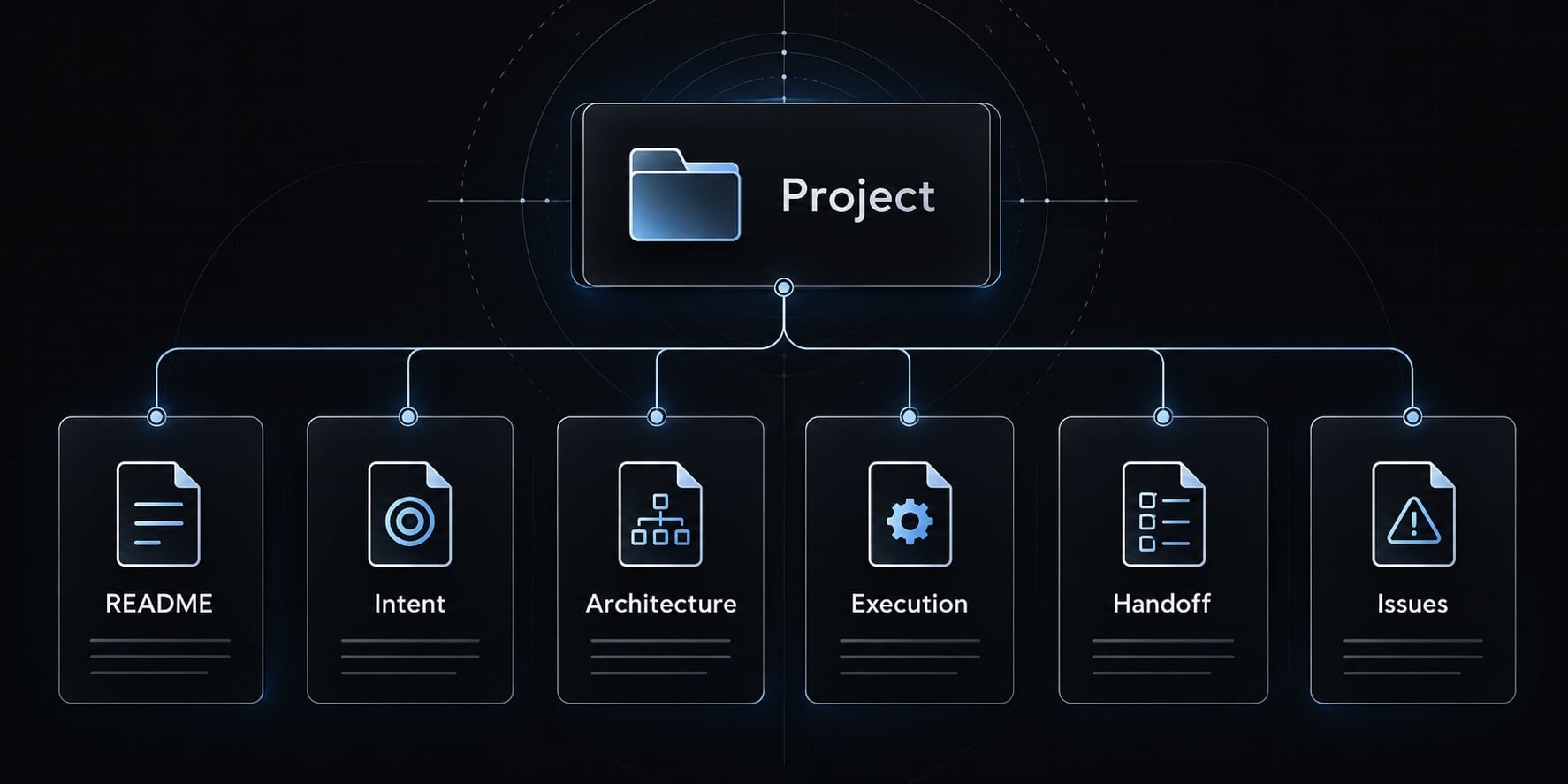
Each record needs an owner and last-updated date. Add a reviewed revision wherever claims depend on a particular code state.
README.md - Reproduce the project
Include purpose, status, prerequisites, installation, environment variable names, and run/build/test/lint commands. Add deployment instructions where applicable and references to designs and plans.
The maintainer updates it when setup, commands, or environment requirements change.
product-intent.md - Preserve the product logic
Record the user problem, primary flows, approved behavior, non-goals, edge states, acceptance criteria, design references, and implementation deviations.
The product owner updates it after approved behavior changes.
architecture-decisions.md - Record technical guardrails
Document technologies and rationale, important patterns, data and authentication boundaries, constraints, significant trade-offs, and temporary choices.
The technical owner updates meaningful decisions. Keep stable rules here rather than repeatedly copying them into handoff snapshots.
execution-plan.md - Show what is complete and what comes next
Separate completed, active, blocked, next-approved, and out-of-scope work. Reference relevant issues and pull requests - proposed code changes submitted for review.
The task owner updates the plan after verified progress or reprioritization.
handoff.md - Capture the current operational state
Include branch, code revision, latest validated change, checks and results, working and incomplete behavior, risks, next step, and decision owner.
The outgoing contributor updates it at each transfer boundary; the receiving developer verifies it.
known-issues.md - Make risk visible
Distinguish confirmed defects from suspected problems. Cover privacy/security concerns, accessibility gaps, mocked integrations, workarounds, severity, owner, and status.
The issue owner updates discoveries, reassessments, and resolutions. Link to an existing issue tracker rather than duplicating its entire log.
Minimum handoff package summary
These informational categories are required by this guide’s proposed standard; separate files are not.
Artifact | Question answered | Required information? |
|---|---|---|
| How do I reproduce it? | Yes |
| What should it do? | Yes |
| Which constraints matter? | Yes |
| What comes next? | Yes |
| What state is being transferred? | Yes |
| What risks remain? | Yes |
Raw chat history | What supporting discussion exists? | No; optional after privacy review |
Never include secret values, credentials, access tokens, or customer records. Explain how authorized developers obtain access securely. Restricted production access should not be necessary merely to run a safe local demo.
A practical developer acceptance workflow
Acceptance follows independent verification, not simply delivery. The receiving developer may decline ownership or accept only a limited assessment or remediation scope.
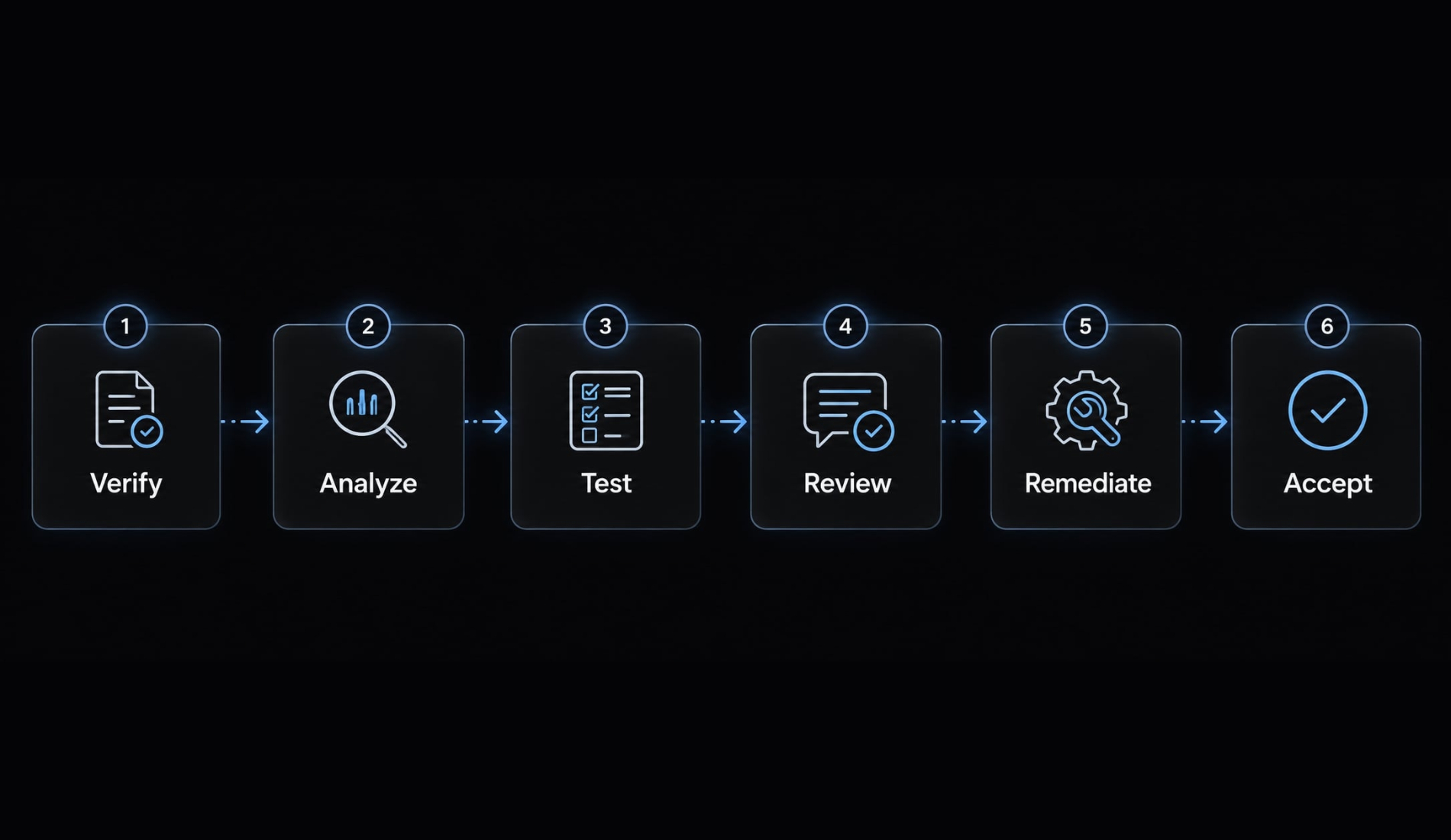
Reproduce the poject independently
Clone the repository, review unfamiliar setup scripts, install dependencies, and configure a safe environment. Run the project using its documentation. Record missing instructions rather than silently fixing them.
Validate critical product flows
Compare the main journey and important error and permission states against acceptance criteria. Identify real versus mocked integrations. For the dashboard, distinguish displayed subscription values from actual billing behavior.
Run the minimum engineering checks
Perform build, lint, tests, dependency review, secret scanning, relevant security checks, accessibility checks, and applicable preview/deployment verification. Lint checks flag configured code-quality issues.
Unavailable checks are gaps, not passes. Automated success does not prove security, maintainability, or production readiness.
Classify the code disposition
Apply the decision matrix and document the rationale. Component-level decisions are valid: continue the interface, refactor permissions, and replace a billing adapter if evidence supports those choices.
Commit validated work before updating handoff state
Complete code validation, identify the reviewed revision, update records, and commit documentation before transfer.
A single reviewed change containing code and documentation is also valid. Completion claims must follow validation, and evidence must identify the tested code state. Later implementation changes require relevant rechecks.
Accept ownership explicitly
Record accepted scope, unresolved risks, next owner, next task, release blockers, and acceptance date. Development acceptance is not production-release approval.
Developer acceptance checklist:
- Independent setup was reproduced; documentation gaps are recorded.
- Accepted product behavior and scope are understood.
- Mocked and real integrations are distinguished.
- Critical-flow checks have recorded outcomes.
- Engineering checks passed or have scope-appropriate, explicitly accepted exceptions.
- Secret scanning and review outcomes are recorded without claiming they prove no historical exposure.
- Validation evidence identifies revision, environment, date, and reviewer.
- Code disposition and rationale are documented.
- Current documentation is committed; unresolved risks and release blockers remain visible.
- Ownership transfer records accepted scope, owner, next task, and acceptance date separately from deployment approval.
Common handoff mistakes and how to standardize the process
Standardize the minimum evidence and decision points before adding automation.
Sharing only the repository
Add maintained context, validation evidence, risks, and acceptance scope. Repository access is necessary, but it is not a complete transfer.
Treating chat history as documentation
Extract current decisions into authoritative project records. Keep conversations only as supporting references after privacy review.
Assuming functional means production-ready
Apply checks proportionate to the project’s risks. Document release blockers even when the demo works.
Continuing indefinitely in one AI session
Use bounded tasks and refresh from current records when context becomes noisy. A fresh session is not inherently better; authoritative context matters more.
Automating before defining the standard
Define required artifacts, validation gates, and ownership rules first. Otherwise, automation can repeat incomplete handoffs faster.
Standardizing handoffs with AgentKit
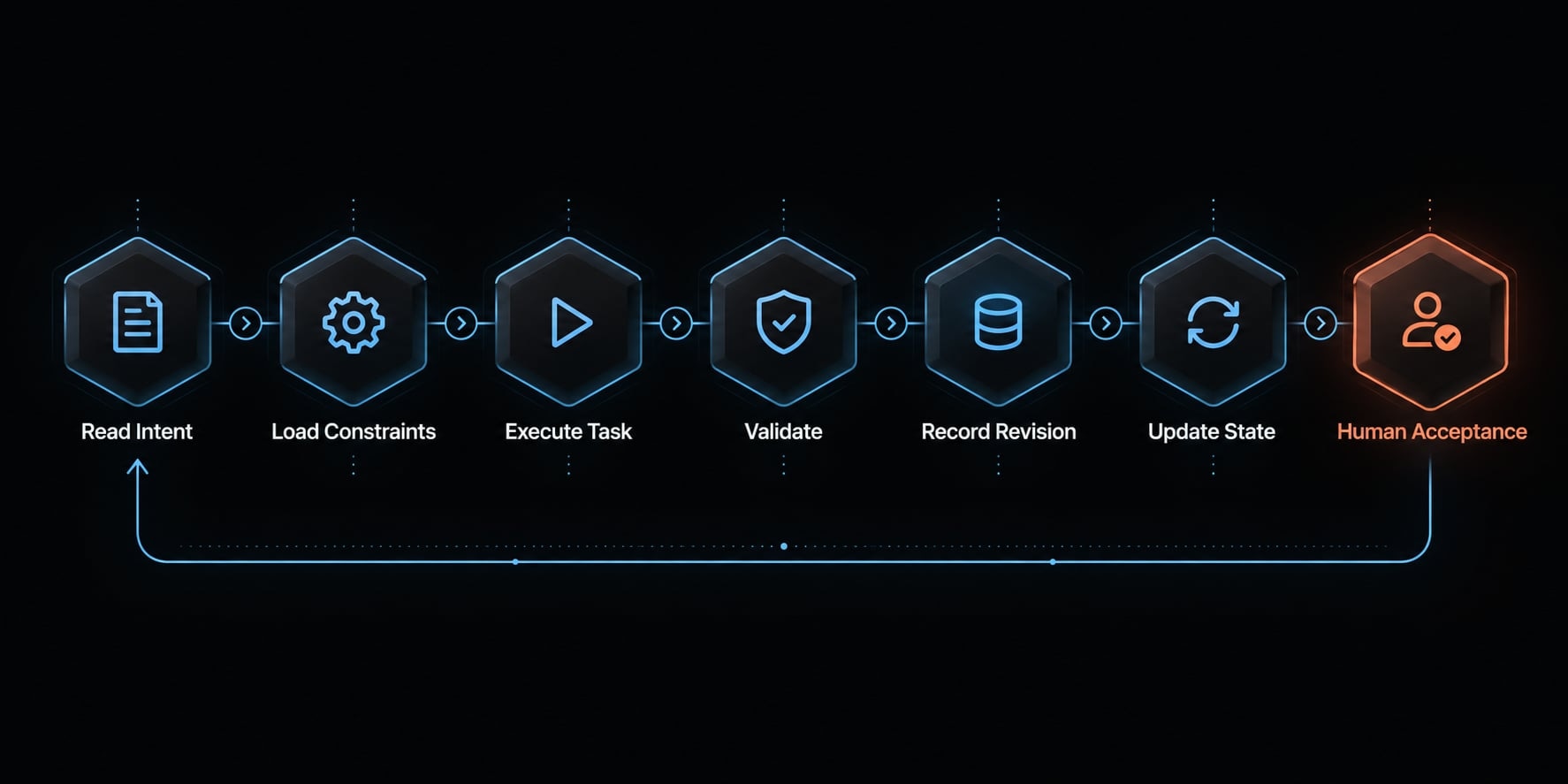
Managing handoffs across multi-agent workflows and rapidly changing AI prototypes is easier with consistent scaffolding. This is where AgentKit fits into your AI engineering workflow.
AgentKit provides scaffolding for building AI engineering systems: ready-made skills, specialized subagents, and workflows that teams customize to their own conventions. It supports coding agents such as Claude Code and OpenAI Codex, with Cursor and DeepSeek Harness on its beta channel.
How AgentKit supports handoff standards:
- Session context: Pre-session hooks load project rules, invariants, and the skills index at startup, so agents begin from maintained project records rather than old conversations.
- Evidence capture: Post-tool hooks record tool outputs, structured artifacts, and execution traces that can back the validation claims in a handoff record.
- Staged workflow: Skills chain into a plan → cook → review → ship pipeline, with pre-commit checks and multi-angle code review before work reaches human approval.
Hook coverage and enforcement vary by coding agent harness. These capabilities support the handoff; the receiving developer still verifies the records and explicitly accepts ownership.
Frequently asked questions
Why do vibe-coded projects often fail during handoff?
Projects frequently encounter "context decay," where architectural decisions, temporary workarounds, and edge-case behaviors remain trapped in ephemeral AI chat sessions. Without formal documentation or validation evidence, receiving developers struggle to distinguish intentional features from hallucinated code or abandoned debugging tangents, increasing the effort required for production readiness.
What are the three layers of a successful handoff?
A complete handoff comprises:
- Product Intent: Approved user behavior and acceptance criteria.
- Implementation Context: The technical state, including frameworks, dependencies, and temporary choices.
- Operational Ownership: A record of validation evidence, unresolved risks, and explicit agreement on the next steps and accountability.
How do I decide whether to continue, refactor, or rebuild?
This decision should be evidence-led rather than automatic. Evaluate the code against dimensions like architectural soundness, security exposure, and test coverage. If core flows are maintainable and testable, continue; if problems are isolated, refactor; only rebuild if the fundamental structure is incompatible with production requirements.
What is the developer acceptance workflow?
The acceptance workflow is a formal gate where the receiving developer independently reproduces the project, validates critical product flows, runs engineering security checks, and formally documents the scope of their ownership. This process ensures that accountability for production release is clearly defined and risks are visible.
How can I standardize these handoffs using AgentKit?
Standardization is achieved by implementing reusable Agent Skills via AgentKit. AgentKit instructs AI agents to automatically read project constraints, execute bounded tasks, run linting and security checks, and draft handoff artifacts before requesting human approval.
Read more:
- Vibe coding vs low code: Choosing the right development path
- Vibe coding vs traditional coding: Which approach wins?
- Agentic coding vs vibe coding: A practical guide for developers
Conclusion
A reliable vibe coding handoff transfers preserved intent, clear implementation context, and visible evidence alongside code. By documenting known risks and establishing explicit scope boundaries, receiving developers can confidently decide what to adopt, adjust, or rebuild. Use the six-file template and acceptance checklist to standardize handoffs, tie validation to specific revisions, and ensure clear ownership before every transfer.