AI-Assisted Coding vs Vibe Coding: What’s the Difference?
The distinction between AI-assisted coding and vibe coding lies in verification, not the tools used. While vibe coding prioritizes speed and visible outcomes with minimal code inspection, structured AI-assisted coding relies on developer oversight to evaluate, test, and manage releases. Because neither approach guarantees production-ready software by default, projects must tailor their level of verification to their specific data risks, user needs, and potential failure impacts.
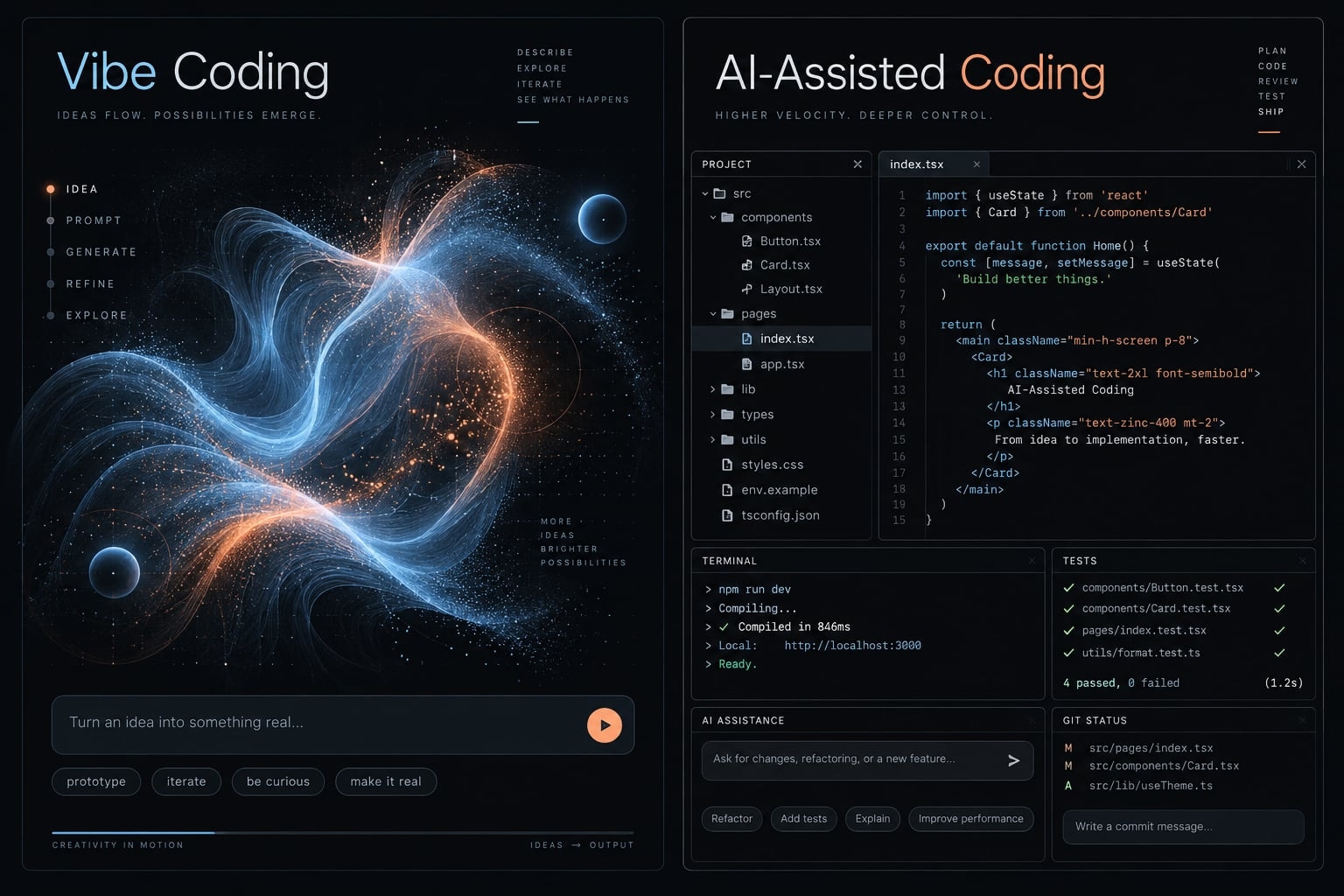
Vibe coding vs AI-assisted coding at a glance
Broadly, AI-assisted coding includes any development supported by AI, including vibe coding. Here, the comparison column means structured, developer-led AI-assisted coding. Code review means inspecting proposed changes for correctness, clarity, and risk. Architecture describes how system components and responsibilities fit together.
These represent typical workflows-not fixed developer identities or guarantees of quality
Factor | Vibe coding | Structured AI-assisted coding |
|---|---|---|
Primary goal | Reach a useful, visible result quickly. | Deliver verified changes within defined requirements. |
Human role | Describe outcomes and evaluate observable behavior. | Direct implementation, inspect risks, and approve releases. |
Code inspection | Implementation inspection may be limited or deferred. | Code review targets correctness and consequential changes. |
Architecture | Design often emerges through successive prompts. | Architectural oversight guides boundaries and design decisions. |
Testing | Emphasizes visible behavior and exploratory checks. | Combines exploratory checks with automated verification. |
Debugging | Iterates on reported errors and visible symptoms. | Investigates causes and verifies targeted fixes. |
Security | Explicit security review may be deferred. | Security review follows data and access risks. |
Documentation | Context may remain mostly in conversations. | Maintained records explain operation and important decisions. |
Best fit | Bounded experiments and rapid prototyping, subject to risk. | Shared or maintained software, with proportionate controls. |
Accountability | Ownership may be unclear; human responsibility remains. | Explicit owners accept changes and release risks. |
Main risk | Unexamined implementation problems remain beneath working behavior. | Formal checks create false confidence when verification is weak. |
A tool such as Claude Code or GitHub Copilot may support either approach. A useful prototype is not automatically a maintainable product. Conversely, formal process cannot replace competent verification: Reviews and tests must address the actual risks, rather than merely exist.
What vibe coding and AI-assisted coding actually mean
What is vibe coding?
Vibe coding is a development approach in which a person describes desired behavior to AI, accepts generated implementation, and iterates primarily through observable results. Understanding the underlying code receives less emphasis than achieving the intended experience, so important implementation decisions may remain unexamined even when the application appears to work.
Andrej Karpathy introduced the term in a February 2025 post describing an unusually hands-off relationship with generated code. Contemporary usage varies.
Examples include a B2B software-as-a-service (SaaS) interface mockup or a disposable proof of concept-a feasibility experiment-using synthetic data. Natural-language prompts alone do not make either project vibe coding.
What is AI-assisted coding?
AI-assisted coding is software development supported by AI for activities such as implementation, explanation, testing, refactoring, and documentation. In its structured form, developers retain ownership of requirements, important design choices, generated changes, and release decisions. AI contributes work, while people establish what evidence is sufficient to accept it.
Effective review does not require manually reading every generated line with equal attention. It requires understanding consequential behavior and inspecting changes according to risk.
Prompt-based development can therefore be disciplined engineering. The distinction is informed verification, not whether someone types instructions instead of code.
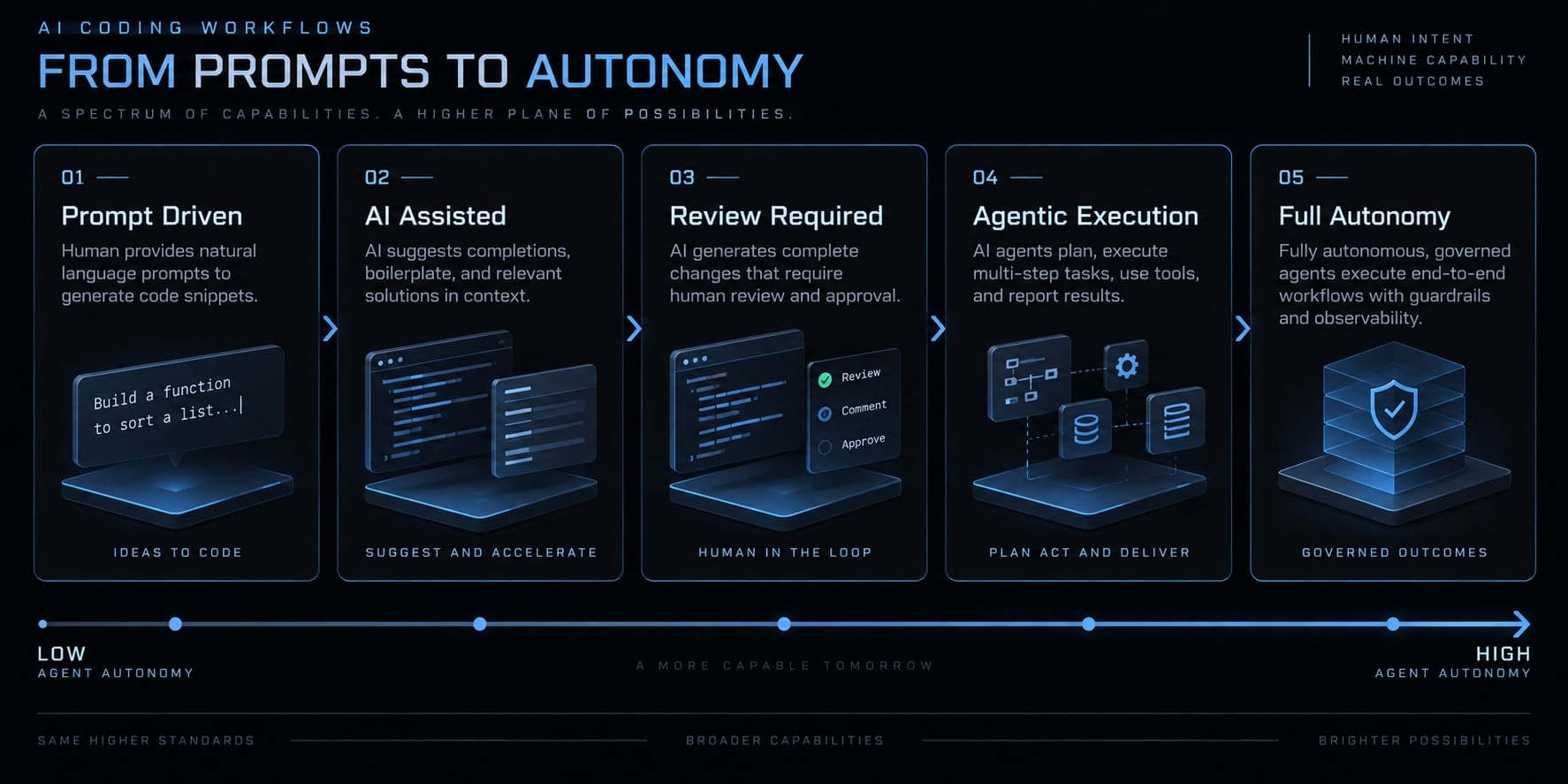
The two approaches exist on a spectrum
- Prompt and accept: Use generated output with minimal inspection.
- Behavioral verification: Check whether visible results match expectations.
- Selective review: Inspect consequential code paths and sensitive operations.
- Structured AI-assisted coding: Apply planned review, testing, and release controls.
- Governed agentic engineering: Use coding agents within defined tasks, permissions, verification, and approval boundaries.
This is a practical oversight spectrum, not a standardized maturity model. The fifth workflow is not universally better than the fourth. AI coding agents can execute substantial work autonomously while people retain strict release authority. Autonomy and oversight are separate dimensions of AI-assisted software development.
How to choose the right approach for a project
Choose controls by project risk, not by whether the application is called a prototype or minimum viable product (MVP). In a hypothetical example, a founder’s SaaS onboarding prototype moves from synthetic data to real customer accounts; its interface stays unchanged, but its risk increases. Sharing it now requires more than confirming that signup works.
Evaluate five project risk factors
- User impact: Who depends on the result, and could an error interrupt their work or affect their decisions?
- Data sensitivity: What information can the software access or expose, including customer records, credentials, and confidential business information?
- System complexity: What other systems and permissions are involved, particularly integrations that can modify records beyond the application?
- Expected lifespan: Will the code be discarded after exploration, or maintained through changing requirements and future handovers?
- Cost of failure: What would an incorrect result, outage, or destructive action cause, and how difficult would recovery be?
These questions support judgment; they are not a validated scoring system. One serious risk can justify stronger controls, regardless of otherwise reassuring answers.
Project risk matrix
Illustrative project conditions and proportionate controls.
Project condition | Recommended approach | Reason |
|---|---|---|
Disposable experiment | Lightweight iteration in an isolated environment. | Exclude sensitive data and important write permissions. |
UI mockup | Vibe coding with synthetic information. | Validate interaction without connecting live business systems. |
One-time script | Selective review; strengthen controls for destructive actions. | Low risk only when actions are bounded and recoverable. |
Shared internal tool | Structured workflow, access controls, and named ownership. | Customer records and operational dependence create real exposure. |
Customer-facing MVP | Structured review, testing, and release approval. | Early users still depend on reliable data handling. |
Existing collaborative codebase | Follow established review and integration checks. | Local changes may break teammates’ existing functionality. |
SaaS product | Structured engineering with continuing operational support. | Customer isolation, reliability, and maintenance require ongoing evidence. |
High-consequence or regulated system | Domain-specific engineering, security, and compliance review. | Generic AI guidance cannot establish acceptable safety or compliance. |
A personal script can still erase important records. Conversely, a shared mockup may remain low consequence when isolated from real systems. Labels describe intent, not permissions or failure impact.
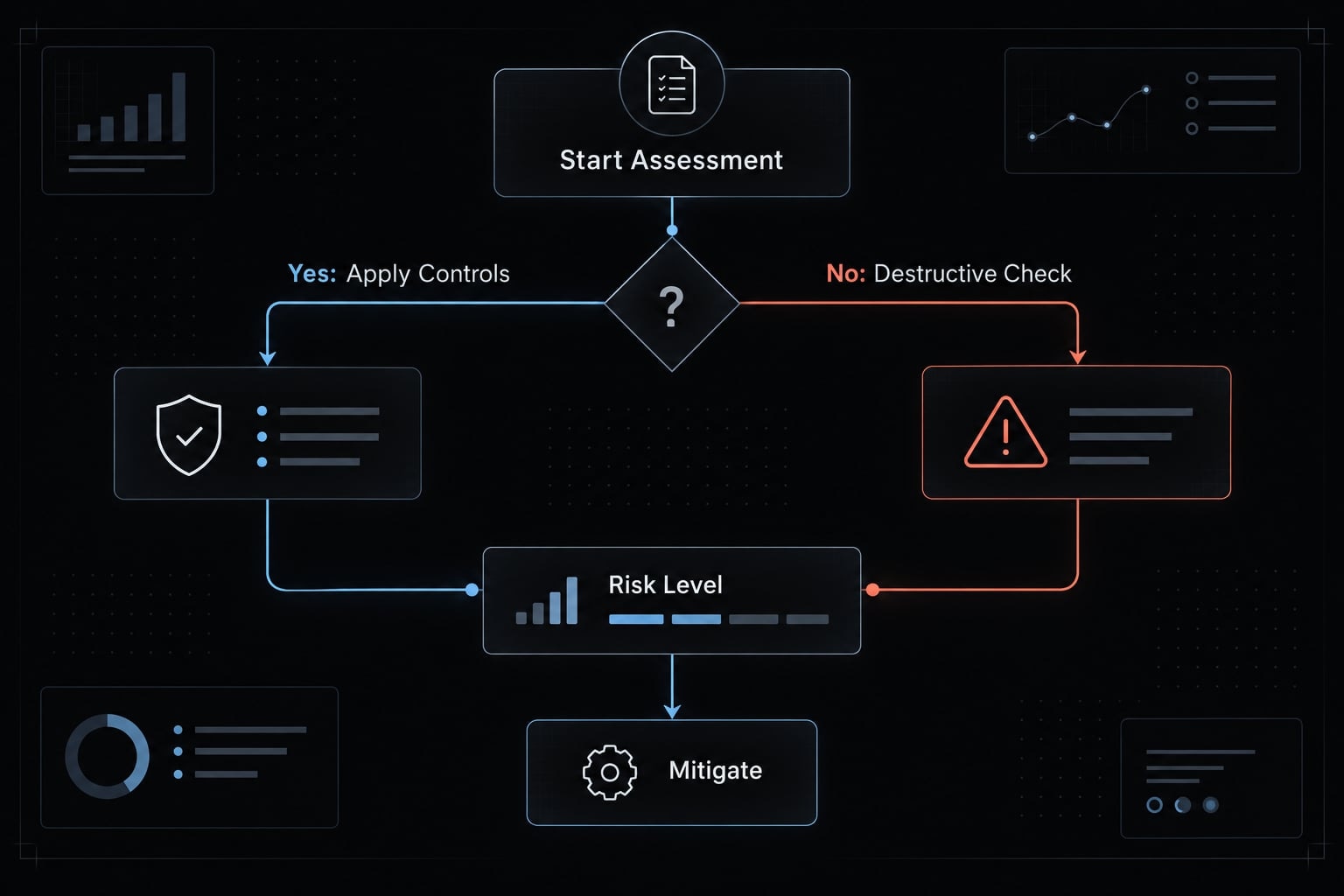
Fast Decision Rule
- Will someone else depend on it?
- Will it handle important data?
- Will it need ongoing maintenance?
Any “yes” should trigger a structured AI-assisted workflow. Three “no” answers do not guarantee safety if the software can take costly or destructive actions. Before sharing the onboarding prototype, inspect its actual access-not just its screens.
Why vibe-coded software can break down as it grows
A convincing demo can conceal implementation problems. These are not unique to AI-generated code; limited verification makes them easier to miss.
Hidden architecture and technical debt
Repeated prompts may create two conflicting versions of onboarding permission logic. Later changes require updating both; overlooking one increases regression risk and maintenance effort.
This is technical debt: Shortcuts or design problems that increase future maintenance costs. Some shortcuts are reasonable when deliberate, documented, and bounded. Unrecognized duplication is harder to manage.
Security and data risks
Signing in proves identity through authentication. Authorization determines whether that person may access a particular customer’s records. A working login does not prove customer isolation.
Limited review can miss exposed secrets, missing authorization checks, unsafe user-input handling, and excessive database permissions. OWASP’s Top 10 guidance identifies related application-security risks. Relevant checks should follow actual data flows and access boundaries, rather than stop at visible interface behavior.
The debugging and maintenance problem
In the hypothetical prototype, a prompt-based fix could repair new-user signup while breaking invitation-based onboarding. Repeatedly forwarding errors may fix symptoms without resolving causes.
A regression test checks that previously working behavior still works after changes. Missing tests, weak documentation, and unclear ownership undermine software maintainability and make handovers harder.
What “production-ready” actually requires
Production-ready software has evidence that it can serve intended users under defined operating conditions, with someone responsible when it fails.
- Clear ownership and risk-appropriate architecture.
- Reviewed code changes.
- Automated tests for critical behavior.
- Appropriate authentication, authorization, and input validation.
- Dependency and secret checks.
- Logging, monitoring, and error reporting.
- Deployment and rollback procedures.
- Maintainer documentation.
- Known limitations and accepted residual risks.
Observability-logs, metrics, and alerts that explain system behavior-supports detection after release. Access controls should fit the application; not every system needs user authentication, but relevant boundaries require assessment.
Passing tests does not prove complete correctness or security. These controls align broadly with practices described in NIST’s Secure Software Development Framework, version 1.1.
This nine-item checklist is a baseline, not exhaustive certification or evidence of compliance. If you cannot evaluate high-risk generated code, obtain qualified review before release.
How to transition from vibe coding to production-ready software engineering
A successful prototype may be a validated specification rather than a reusable production codebase. Start with a code audit-a systematic assessment of implementation and risks-before choosing hardening or rebuilding. Incremental cleanup is not always cheaper, faster, or safer.
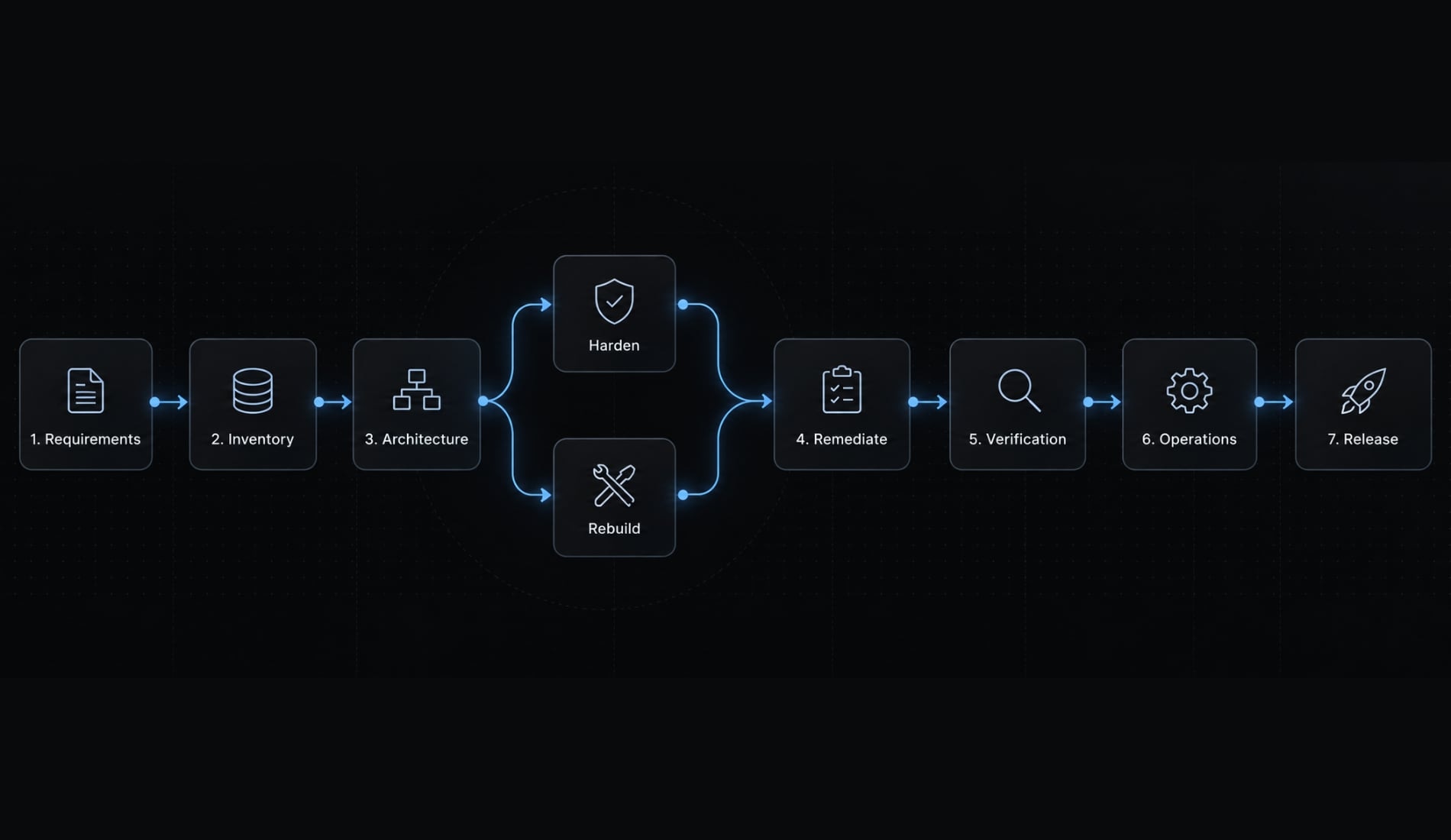
Seven-step transition workflow:
- Freeze validated requirements: Record required onboarding behavior and exclusions. Output: acceptance criteria and agreed scope, with later changes handled explicitly.
- Inventory the generated system: Identify dependencies, application programming interfaces (APIs), data stores, and deployment components. Output: a system inventory identifying external connections.
- Review architecture and data flows: Trace information movement and access boundaries. Output: risk findings and a documented harden-or-rebuild decision.
- Remove prototype shortcuts: Replace unsafe permissions, hardcoded secrets, and duplicated critical logic. Output: prioritized remediation with owners and verification requirements.
- Add automated verification: Cover critical behavior and failure cases with focused component and integration checks. Output: automated testing evidence, including onboarding regressions.
- Add operational controls: Establish monitoring, separate test and live environments, verify recoverability, and plan rollback. Output: operational readiness evidence.
- Require human approval before release: Evaluate changes, unresolved findings, test results, and accepted risks. Output: a named release owner and documented approval.
For the hypothetical founder, this means verifying customer isolation and both onboarding paths before connecting live accounts. Database suitability depends on configuration, durability, and workload-not whether the initial choice seemed lightweight.
Governed agents can assist throughout, but generated tests and automated reviews also require scrutiny. Approval must reflect evidence, not a completed form.
Frequently asked questions
What is the primary difference between vibe coding and AI-assisted coding?
Vibe coding is an outcome-focused approach where developers iterate by prompting AI and observing if the application "feels" or "looks" correct, often skipping manual code review. AI-assisted coding is a structured, developer-led workflow where AI acts as a partner, and humans retain strict oversight of code quality, architecture, and security.
Is vibe coding suitable for production software?
It depends on risk, not on the label. Lightweight iteration fits disposable experiments and isolated mockups using synthetic data. Once software handles real customer information, supports other people's work, or takes destructive actions, it needs structured review - including things called prototypes, scripts, or MVPs.
Why does vibe-coded software often break as it grows?
As projects expand, vibe-coded codebases often suffer from architectural inconsistency and logic conflicts created by disconnected prompts. Without manual intervention or regression testing, hidden technical debt accumulates, making it increasingly difficult to diagnose bugs or implement necessary system changes. Whether to harden incrementally or rebuild is a decision to make after a code audit, not a foregone conclusion.
How can I transition from vibe coding to a production-ready workflow?
To transition, you should inventory your generated system, perform a thorough code and security audit, remove prototype-level shortcuts, and implement automated testing. Once these controls are in place, establish a formal release process requiring human approval for all changes before deploying into live environments.
Are all AI-generated code snippets insecure?
Not necessarily. The same defect classes appear in hand-written code that skips the same checks. What raises exposure is accepting changes without inspecting data flows and access boundaries - generation volume makes that easier to skip.
Read more:
- Vibe coding vs traditional coding: Which approach wins?
- Agentic coding vs vibe coding: A practical guide for developers
- Vibe coding MVP: Build fast without fooling yourself
Conclusion
The real distinction between AI-assisted coding and vibe coding lies in verification, oversight, and control rather than tools or process labels. While lightweight workflows suit bounded experimentation, software that handles sensitive data, supports user workflows, or requires maintenance demands proportionate engineering controls and explicit human accountability. Ultimately, engineering quality depends on rigorous evidence-such as systematic review and readiness checks-rather than how code was generated.