Oh My Claude Code: Mastering multi-agent development workflows
Oh My Claude Code: How OMC Orchestrates Multi-Agent Development Workflows
A single coding agent can plan, implement, test, debug, and review a change. As repository complexity increases, however, combining every responsibility in one session can produce inconsistent verification and repeated prompting. Oh My Claude Code, formally oh-my-claudecode or OMC, addresses this workflow problem through multi-agent orchestration on top of Claude Code. This guide explains how the Claude Code orchestration layer coordinates specialized roles, where parallel execution helps, how to test OMC safely, and which risks remain.
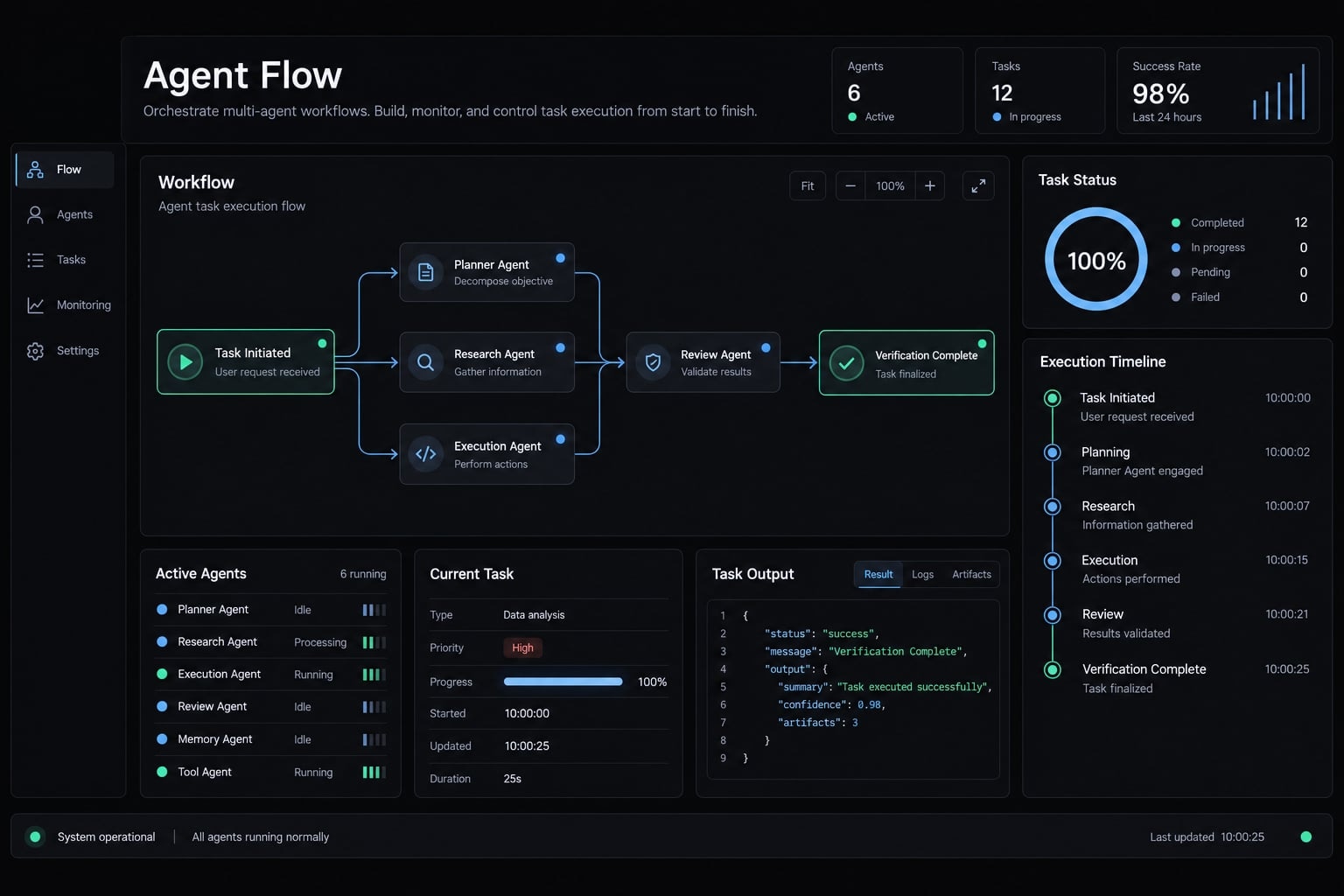
Oh My Claude Code is an open-source orchestration layer for Claude Code. It coordinates specialized agents across planning, implementation, testing, review, and verification while Claude Code remains the underlying coding environment responsible for interacting with repositories and development tools.
What is Oh My Claude Code?
Oh My Claude Code is a workflow coordination plugin built around Claude Code. It decomposes development objectives, delegates responsibilities to specialized subagents, coordinates execution, and applies verification steps before treating work as complete.
OMC is designed for situations where one general-purpose coding session would otherwise perform several competing roles. For example, a SaaS team adding validation to an existing REST API may need to inspect current behavior, define acceptance criteria, modify the endpoint, add tests, review the diff, and confirm that response compatibility remains intact.
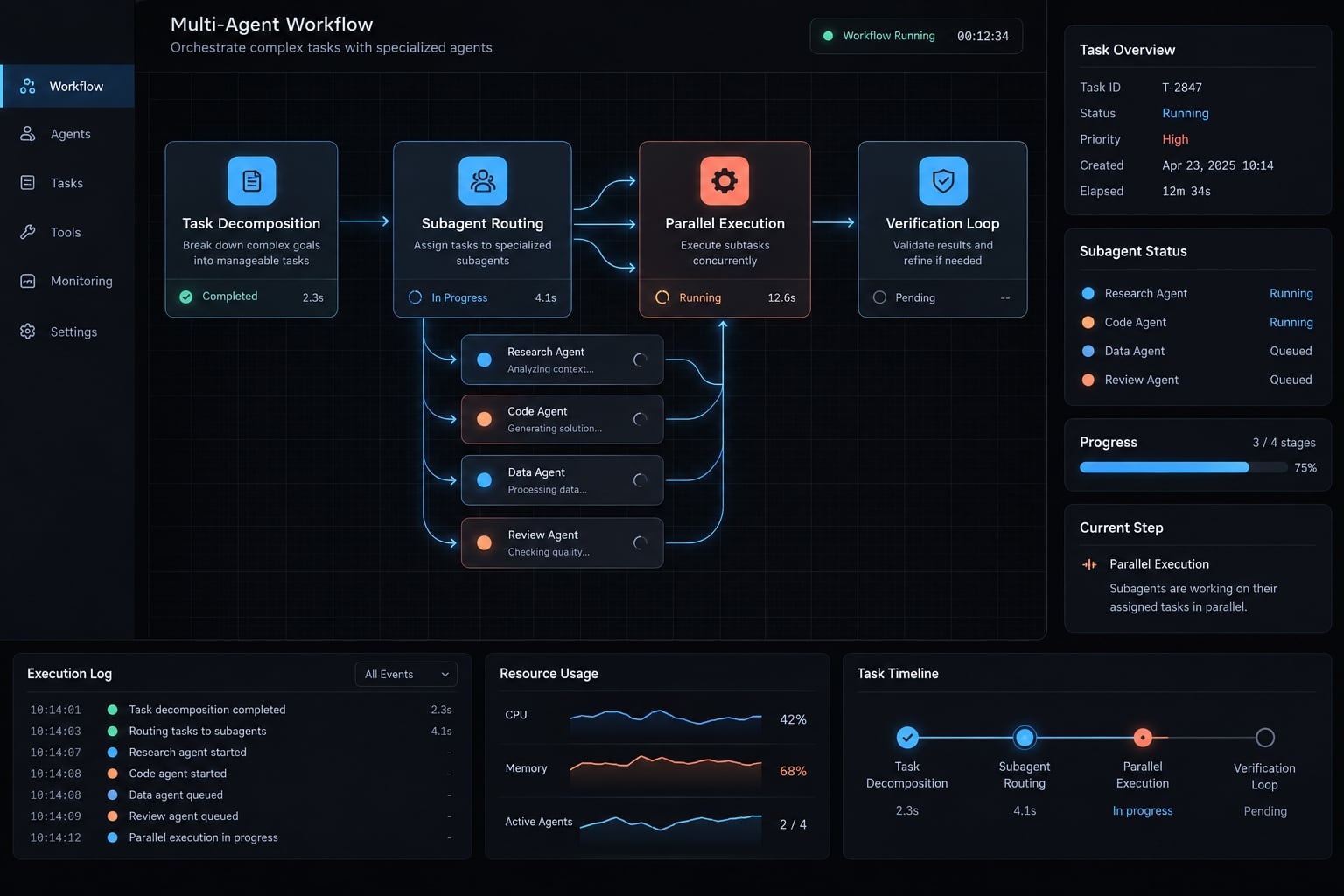
Without a structured workflow, the same agent may implement a decision and then validate its own assumptions. OMC attempts to create clearer separation among those responsibilities. Its main workflow capabilities include:
- Task decomposition: Splitting a development objective into smaller, reviewable units.
- Specialized subagents: Assigning narrower responsibilities such as planning, testing, debugging, or security review.
- Agent routing: Sending each task to an agent or model suited to that responsibility.
- Parallel task execution: Running independent workstreams concurrently when their files and assumptions do not conflict.
- Verification and retry loops: Checking results against tests, review rules, and acceptance criteria before completion.
OMC is not a foundation model, standalone IDE, or replacement repository environment. It is better classified as a multi-agent programming framework that coordinates work around Claude Code.
Commands, modes, role names, and supported capabilities can change between releases. Confirm the current behavior through the official oh-my-claudecode repository and its latest README or release notes.
OMC is not a replacement for Claude Code
No. OMC does not replace Claude Code. It adds workflow coordination, role-based delegation, execution modes, and verification gates around it.
Claude Code remains responsible for reading and modifying repository files, invoking permitted tools, and interacting with the development environment. This native Claude Code integration also means you still need Claude Code, applicable model access, and any associated subscription or usage capacity.
OMC may be open source, but its operation is not cost-free. Model calls, context processing, retries, and parallel agent activity can still consume paid resources.
Avoid confusing OMC with similarly named tools
Tool | Basic distinction |
|---|---|
Claude Code | The underlying agentic coding environment developed by Anthropic. |
Oh My Claude Code | An orchestration layer designed to coordinate development workflows around Claude Code. |
Oh-My-OpenCode | A similarly named project associated with OpenCode rather than Claude Code. Verify its current identity through its official repository before comparing features. |
Broader agent platforms | Systems that may coordinate reusable skills, integrations, configurations, and workflows across multiple tools or business functions. |
Similar names do not imply shared maintainers, architecture, model access, or compatibility. Always confirm the repository owner, release history, license, and current installation instructions before running a plugin.
How OMC’s multi-agent orchestration works
OMC treats software delivery as a coordinated workflow rather than one continuous agent conversation. The following sequence is a practical model of how that workflow can operate; it should not be interpreted as an immutable description of OMC’s internal architecture.
- Interpret the objective. Identify the requested outcome, repository context, constraints, and missing information.
- Create or validate a plan. Define the intended implementation approach before changing files.
- Decompose the task. Separate implementation, testing, review, security, and verification responsibilities.
- Route responsibilities. Use agent routing to assign each responsibility to an appropriate specialized agent or model.
- Implement changes. Modify the approved files while respecting scope and non-goals.
- Run tests and reviews. Execute tests, inspect the implementation, and flag security or maintainability concerns.
- Retry, escalate, or request human approval. Fix failed checks, revise the plan, or pause for a developer’s decision.
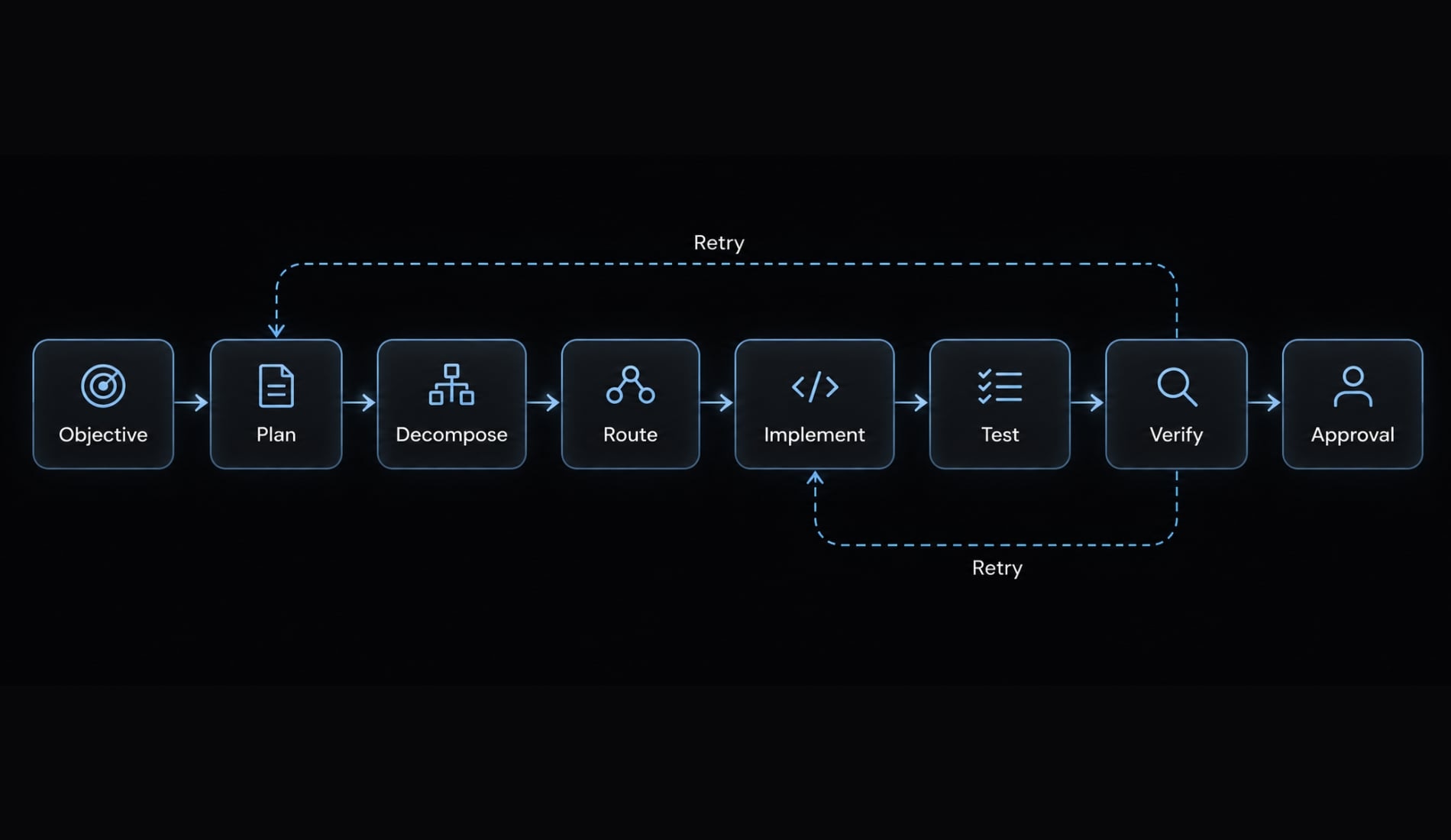
Role separation may reduce self-review bias because the agent implementing a change is not necessarily the only component evaluating it. A separate reviewer can inspect whether the code follows the plan, while a verifier can compare the final result with written acceptance criteria.
That separation does not guarantee independence or correctness. Agents can share incomplete context, rely on the same mistaken assumption, or approve tests that do not represent actual behavior.
Parallel task execution is most useful when workstreams are genuinely independent. One agent might update endpoint validation while another prepares isolated tests. It becomes riskier when several agents modify the same files, depend on unfinished interfaces, or make conflicting architectural assumptions.
OMC may also use model routing, meaning different models can be assigned according to complexity, capability, or cost. Routine repository exploration may not require the same reasoning capacity as architecture work. Any resulting token optimization should be measured rather than assumed because routing, repeated context, and retries can introduce additional overhead.
Human intervention should remain mandatory for:
- Architecture approval.
- New dependencies.
- Permission or infrastructure changes.
- Database migrations.
- Security-sensitive logic.
- Commit and merge approval.
- Production deployment.
From user request to verified result
Consider a request to add authentication to an existing REST API. The planner first identifies protected endpoints, current middleware, credential handling, and backward-compatibility requirements. An executor then implements the approved changes within defined file boundaries.
A test engineer adds valid, invalid, expired, and missing-credential cases. A security reviewer checks for sensitive logging, weak defaults, authorization gaps, and unsafe secret handling. Finally, the verifier compares the implementation with the acceptance criteria and reports unresolved conditions.
This process supports human-in-the-loop AI development, not autonomous accountability. A developer should review:
- The proposed architecture.
- Files selected for modification.
- Full Git diff.
- Authentication and authorization behavior.
- Test coverage and independent test output.
- Configuration or dependency changes.
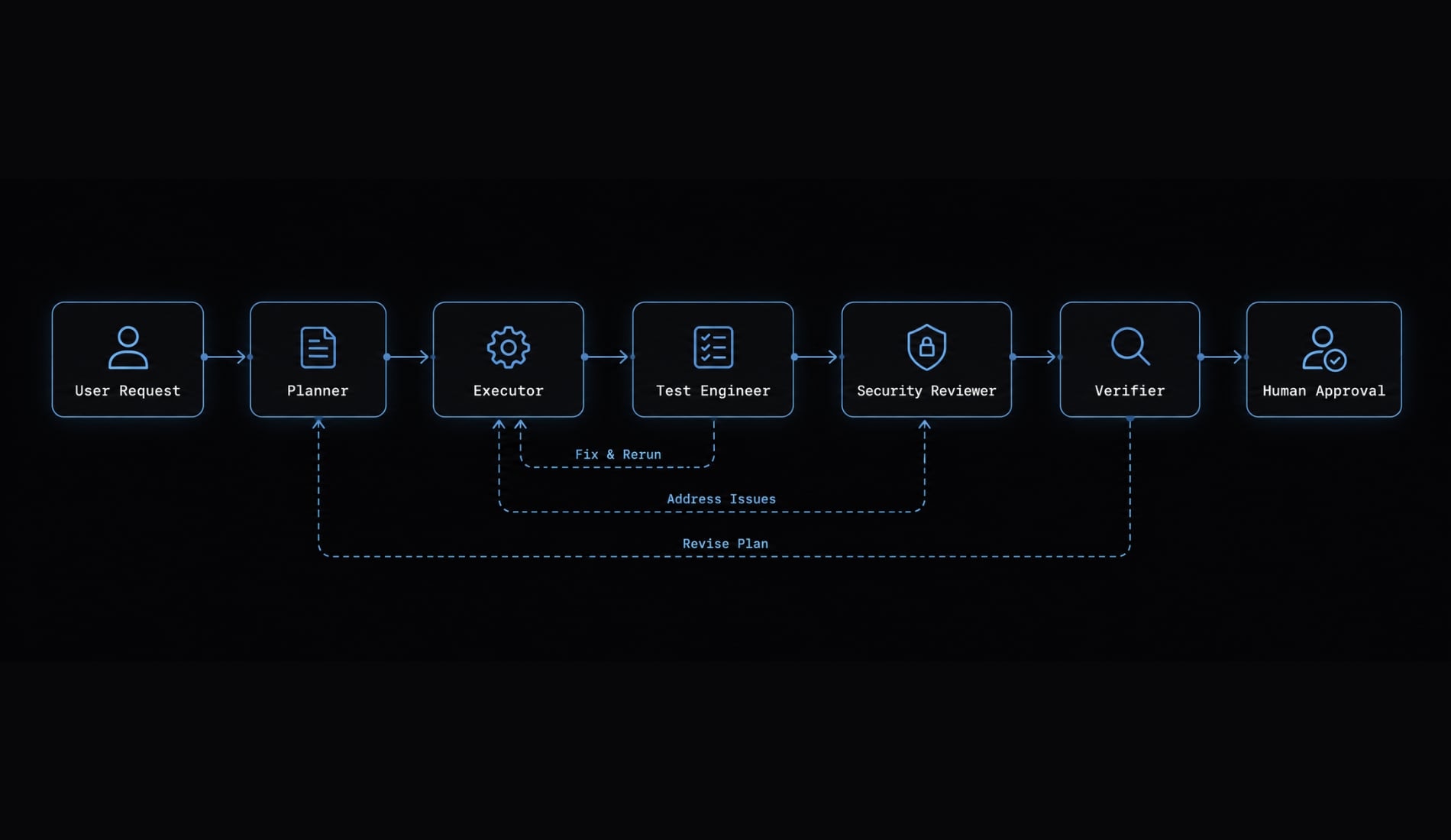
Generated tests can be incomplete or aligned too closely with the implementation. Critical tests should therefore be rerun independently through the developer’s environment or CI system.
Common specialist roles
Role | Primary responsibility |
|---|---|
Planner or architect | Defines scope, constraints, dependencies, and implementation direction. |
Executor | Makes code changes according to the approved plan. |
Debugger | Investigates failures, traces causes, and proposes focused corrections. |
Test engineer | Creates or updates tests covering expected and invalid behavior. |
Code reviewer | Inspects correctness, maintainability, consistency, and unnecessary changes. |
Security reviewer | Flags potential vulnerabilities, unsafe permissions, or sensitive-data exposure. |
Verifier | Checks the final output against tests, review findings, and acceptance criteria. |
These specialized subagents should have distinct responsibilities, but role names and availability may vary by release. A security reviewer adds another control; it does not replace threat modeling, penetration testing, or professional security review.
OMC execution modes and when to use them
OMC modes represent different balances of autonomy, persistence, coordination, and supervision. Select a mode according to task clarity and risk-not according to the maximum amount of automation available.
The following mode descriptions reflect the official project information supplied for this guide. Verify current names and behavior against the latest OMC documentation before use.
Mode | Best fit | How it operates | Main risk |
|---|---|---|---|
Autopilot | Bounded, reversible tasks with explicit requirements | Coordinates planning, implementation, testing, and review with limited manual prompting | Broad or ambiguous instructions may produce unnecessary changes |
Execute | Implementing a plan already approved by a developer | Repeats implementation, verification, and correction until checks pass or escalation is needed | Persistent retries can consume tokens without resolving a flawed plan |
Team | Independent modules or tasks with clear ownership boundaries | Coordinates several agents around a shared task list | Conflicting edits and assumptions can emerge in coupled modules |
Ralph | Difficult debugging or tasks requiring persistent investigation | Continues planning, correction, and verification cycles | Open-ended persistence can create costly, unproductive loops |
A verification gate can improve process consistency, but it cannot establish that a result is correct or production-safe. Mode availability and invocation syntax may change across releases.
Choose by task risk, not by maximum automation:
- Use Autopilot mode for small, reversible work with explicit acceptance criteria and non-goals.
- Use Execute mode after a developer has reviewed and approved the implementation plan.
- Use Team mode when workstreams have clear file ownership or separate Git worktrees.
- Use Ralph mode for difficult debugging only after defining retry, time, and token limits.
- Require human checkpoints for security, customer data, infrastructure, migrations, permissions, and production changes.
Increase automation only after scope, rollback, tests, budget limits, and approval points are explicit.
How to install and test Oh My Claude Code
A safe OMC evaluation should separate installation success from workflow success. The plugin responding correctly does not prove that it improves delivery quality, reduces cost, or fits your repository.
A controlled setup follows seven steps:
- Install and authenticate Claude Code.
- Open a clean test repository, branch, or Git worktree.
- Confirm the baseline test suite passes.
- Add the official OMC plugin marketplace.
- Install the plugin.
- Run the current documented setup command.
- Complete and independently validate a small pilot task.
Command freshness: OMC installation syntax and mode commands may change. Verify every command against the official repository, then record the release or commit and test date used by your team.
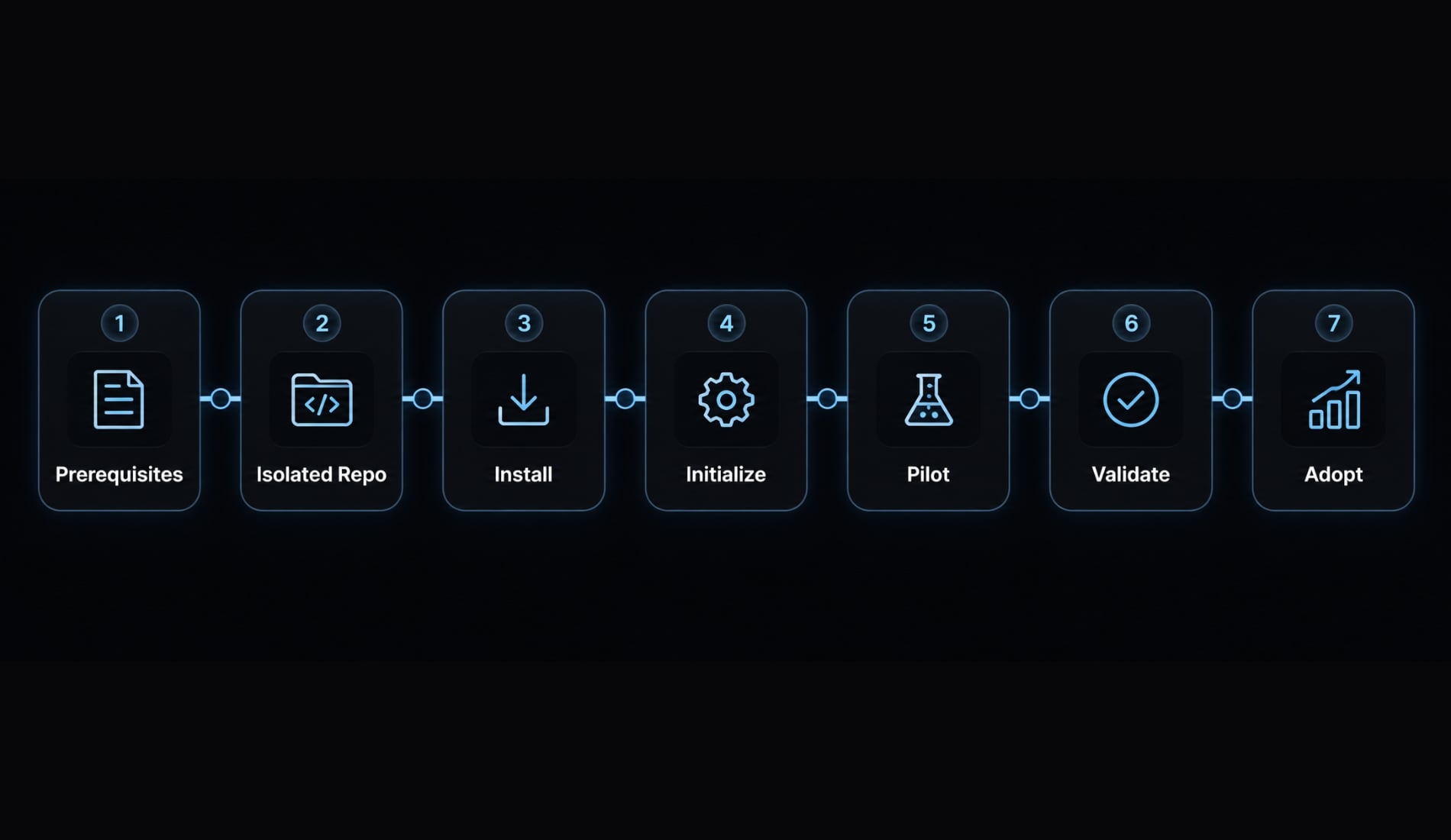
Step 1: Prepare a safe test repository
Use a non-critical repository with a measurable baseline. Before installing or invoking OMC, confirm:
- A clean branch or dedicated Git worktree is available.
git statusshows no unrelated changes.- Existing tests pass.
- A rollback point has been created.
- Secrets are absent from tracked files and prompts.
- Approved files or modules are explicitly defined.
- The first task does not affect production infrastructure or customer data.
Git worktrees provide isolated working directories tied to separate branches. They are useful when Team mode or concurrent workstreams need separation without repeatedly cloning the repository. Isolation limits the potential impact of incorrect changes. It does not remove the need for manual review.
Step 2: Install and initialize OMC
The official quick-start information supplied for this guide documents the following Claude Code commands:
/plugin marketplace add https://github.com/Yeachan-Heo/oh-my-claudecode/plugin install oh-my-claudecode
It also documents this initialization command:
/omc-setup
Before running them:
- Compare the commands with the current repository README.
- Confirm the marketplace URL belongs to the official project.
- Review the repository license and recent release notes.
- Install the Claude Code plugin in the isolated environment.
- Run the documented initialization command and confirm the expected response.
Record the repository URL, OMC release or commit, Claude Code version, operating system, and test date. If the README differs from the commands above, follow the current official documentation rather than this article.
Step 3: Run a small pilot task
A suitable first task is bounded, reversible, and easy to test. Adding input validation to an existing endpoint is safer than changing authentication, migrations, or deployment infrastructure.
Use a prompt such as:
Add input validation to the existing create-task REST API endpoint.Acceptance criteria:- Reject an empty title with HTTP 400.- Preserve the current response schema for valid requests.- Add tests for valid and invalid requests.- Run the relevant test suite after implementation.Non-goals:- Do not modify authentication.- Do not add or change database migrations.- Do not replace the existing validation framework.- Do not modify files outside the endpoint and its tests.Before implementation:- Show the proposed plan.- List every file you intend to modify.- Wait for approval before changing code.
This prompt uses OMC’s natural language interface while keeping the result measurable. If the current release supports Autopilot mode, verify its exact invocation syntax before adding it to the prompt.
Step 4: Validate the Result
Treat OMC’s output as a change proposal requiring independent code verification.
- Inspect the full Git diff.
- Run relevant tests outside the agent’s reported session.
- Run linting and static analysis where available.
- Review dependency and configuration changes.
- Confirm no credentials appeared in files or logs.
- Confirm unrelated files remained unchanged.
- Check every acceptance criterion individually.
- Test invalid and edge-case behavior manually where appropriate.
- Require human approval before commit, merge, or deployment.
Agent-generated evidence is not independent evidence. A developer or CI system should rerun critical checks. Passing generated tests alone does not establish production-ready code.
Benefits, limitations, costs and production safety
OMC may improve coordination for multi-step development work, but every additional agent introduces context, routing, and supervision overhead. The relevant question is not whether orchestration is more advanced. It is whether that overhead improves measurable delivery outcomes for your workload.
Evaluation area | Potential benefit | Practical limitation |
|---|---|---|
Coordination | Separates planning, implementation, testing, and review | More roles can create duplicated work or inconsistent assumptions |
Quality | Adds review and verification stages | Automated reviewers may miss defects or repeat the implementer’s assumptions |
Speed | Independent tasks may run concurrently | Coupled changes can create conflicts and rework |
Cost | Model routing may reserve stronger models for complex tasks | Parallel agents, retries, and repeated context may increase usage |
Reliability | Persistent workflows can continue through recoverable failures | Persistence can become an expensive loop when the plan is wrong |
Safety | Security and verification agents add explicit checks | These checks do not replace permissions, CI controls, or human review |
OMC is distributed under an open-source license according to the official project information supplied for this guide. Open source does not mean zero operational cost. Claude Code access, model usage, context size, agent count, and retries can all affect total consumption.
The project reports performance and token-saving benefits. These should be treated as vendor-reported claims, not predictable outcomes. AgentKit has not independently verified fixed speed improvements or percentage-based token savings.
Evaluate token optimization through a controlled comparison. Run native Claude Code and OMC against the same:
- Starting repository state.
- Development task.
- Acceptance criteria.
- Non-goals.
- Model access and configuration, where possible.
- Validation process.
Record:
- Completion time.
- Token usage where available.
- Tests passed.
- Defects discovered during review.
- Retry count.
- Human interventions.
- Unrelated file changes.
A faster first response may still produce a slower delivery cycle if developers must correct broad changes or resolve agent conflicts.
When OMC is a good fit
OMC may justify its coordination overhead for:
- Multi-step features requiring planning, implementation, testing, and review.
- Cross-module work with explicit ownership boundaries.
- Persistent debugging of difficult, reproducible failures.
- Solo developers seeking repeatable code verification gates.
- Small teams standardizing a Claude Code-based automated agentic workflow.
OMC is most relevant when coordination complexity is meaningful but controllable. Repository size alone does not determine whether an AI multi-agent software engineering workflow will provide value.
When native Claude Code may be enough
Native Claude Code remains a practical choice for:
- One-file, low-risk fixes.
- Documentation updates.
- Straightforward test additions.
- Exploratory repository analysis.
- Small refactors under direct human supervision.
- Tasks where orchestration would take longer than implementation.
In a Claude Code vs Oh My Claude Code decision, prefer the simplest workflow that preserves the required quality controls. If the task can be planned, completed, reviewed, and validated clearly within one supervised session, native Claude Code may be enough.
Production-readiness checklist
- Use a dedicated branch or Git worktree.
- Restrict command, network, and filesystem permissions.
- Exclude credentials from prompts, repositories, and logs.
- Run tests, linting, and static analysis independently.
- Review every new or updated dependency.
- Inspect the full diff manually.
- Block automatic merge and deployment for high-risk repositories.
- Maintain a tested rollback point.
- Log OMC and Claude Code versions.
- Verify every written acceptance criterion.
- Require human approval for security-sensitive changes.
- Escalate critical findings beyond the automated security reviewer.
Production readiness is a property of the validated delivery process-not an automatic property of AI-generated code.
OMC vs native Claude Code vs reusable agent platforms
Native Claude Code, OMC, and broader agent platforms solve different operational problems. The right choice depends on workflow scope, required governance, reuse across projects, and the number of tools or business functions involved.
Criterion | Native Claude Code | Oh My Claude Code | |
|---|---|---|---|
Primary purpose | Direct AI-assisted repository work | Claude Code-native multi-agent orchestration | Reusable agent workflows across engineering and marketing |
Setup complexity | Lowest for existing Claude Code users | Requires plugin installation and workflow configuration | Requires selecting kits, skills, integrations, and controls |
Specialized subagents | Available through direct workflow configuration | Role-based delegation is a core workflow concept | Included through ready-to-use agent kits |
Parallel workflows | Depends on how the developer structures sessions | Designed to coordinate applicable parallel workstreams | Supports coordinated workflows and specialized agents |
MCP integrations | Available through Claude Code configuration | Depends on Claude Code and current OMC support | MCP integrations are part of the broader system |
Workflow scope | Primarily direct coding assistance | Software development inside Claude Code workflows | Engineering, SEO, content, outreach, CRM, and growth operations |
Centralized management | Primarily configuration-driven | Focused on OMC’s Claude Code workflow layer | Cross-platform CLI and desktop control center |
Best-fit user | Developer needing direct, supervised assistance | Developer wanting structured orchestration inside Claude Code | Teams needing reusable skills and repeatable cross-tool workflows |
This comparison does not establish a universal winner. OMC focuses on orchestration within Claude Code. AgentKit addresses a broader operational layer involving reusable agent kits, automated workflows, configurations, and MCP integrations across development and marketing use cases.
Practical Verdict
Choose native Claude Code when
The task is direct, low risk, and easier to supervise in one interaction. It is often the most efficient option for small fixes, documentation, repository exploration, and focused refactoring.
Choose OMC when
The development task benefits from delegation, persistent execution, separate review, and explicit verification inside Claude Code. OMC is most compelling when those controls solve a real coordination problem.
Evaluate AgentKit when
Your requirements extend to reusable skills, coordinated kits, MCP integrations, centralized management, or combined engineering and marketing workflows across multiple projects.
Use the same bounded task and acceptance criteria to evaluate shortlisted options. Compare the complete delivery cycle rather than relying on feature counts or vendor-reported performance claims.
Frequently asked questions
What is Oh My Claude Code (OMC)?
Oh My Claude Code (OMC) is an orchestration layer that extends Claude Code by organizing AI agents into a coordinated development team. It automates role-based task decomposition, parallel execution, and verification gates, helping developers manage complex software projects with greater consistency and role separation.
Does OMC replace Claude Code?
No. OMC acts as a workflow coordination layer built on top of Claude Code. You still require an active Claude Code environment and necessary model access. OMC simply adds structure, specialized subagents, and automated verification loops to handle tasks more efficiently than a single, uncoordinated agent.
How does the multi-agent orchestration work in OMC?
OMC decomposes high-level objectives into smaller responsibilities, routing them to specialized agents (e.g., planners, executors, reviewers). These agents operate through a workflow of planning, implementation, and verification gates. Parallel tasks are coordinated to prevent conflicts, while human-in-the-loop checkpoints remain necessary for critical architectural decisions and final approvals.
Which execution mode should I use?
Mode selection depends on your task complexity and risk. Autopilot is suited for well-defined, bounded tasks. Execute mode is best for tasks with a pre-approved plan. Team mode handles independent workstreams efficiently, while Ralph provides persistence for difficult debugging. Always verify mode behavior against the current release documentation.
How can I test OMC safely?
Start by creating a clean Git worktree or branch in a non-critical repository. Install OMC using the latest official commands, run a bounded pilot task with explicit acceptance criteria, and independently validate all changes. Require human approval for any diffs, dependency updates, or security-sensitive modifications before merging.
What are the main benefits and limitations?
OMC can improve coordination, provide structured verification, and potentially optimize token usage through model routing. However, it introduces orchestration overhead, possible task-conflicts, and requires careful management of retries. Token savings are vendor-reported outcomes; always benchmark performance and costs against your specific repository requirements.
Is OMC production-ready?
OMC is a tool for enhancing developer workflows, not a substitute for rigorous engineering standards. Production readiness requires a validated delivery process, including mandatory human review of diffs, independent test execution, linting, security scans, and clear rollback paths. Never deploy AI-generated code without independent verification and explicit human authorization.
Read more:
- Claude Code toolkit: Scale your AI development workflow easily
- Superpowers Claude Code: Mastering structured AI workflows
- Master Claude Code parallel agents: Boost efficiency properly
Conclusion
Oh My Claude Code extends Claude Code rather than replacing it. OMC adds task decomposition, specialized agents, parallel execution, review, retry, and verification to development workflows that would otherwise depend on repeated manual coordination.
Those controls may improve consistency for complex tasks, but they also introduce token, permission, conflict, and supervision risks. Begin with a reversible pilot, document acceptance criteria, and compare the result with native Claude Code using the same repository state and validation process.