Claude Code vs OpenCode Features: Choosing the right CLI agent
Claude Code vs OpenCode Features: Which fits your development workflow better?
When teams compare Claude Code vs OpenCode Features, the tools can look similar on the surface: both work in the terminal, both can inspect code, and both help ship changes faster. You’ll only make the real call once you weigh workflow fit, setup friction, provider flexibility, cost patterns, and vendor lock-in. If you are choosing for solo development or trying to standardize a small-team workflow, feature lists alone are not enough. This guide breaks down practical differences in feature impact, pricing logic, extensibility, and governance so you can decide which tool is easier to trust, easier to scale, and better aligned with how your team actually works.
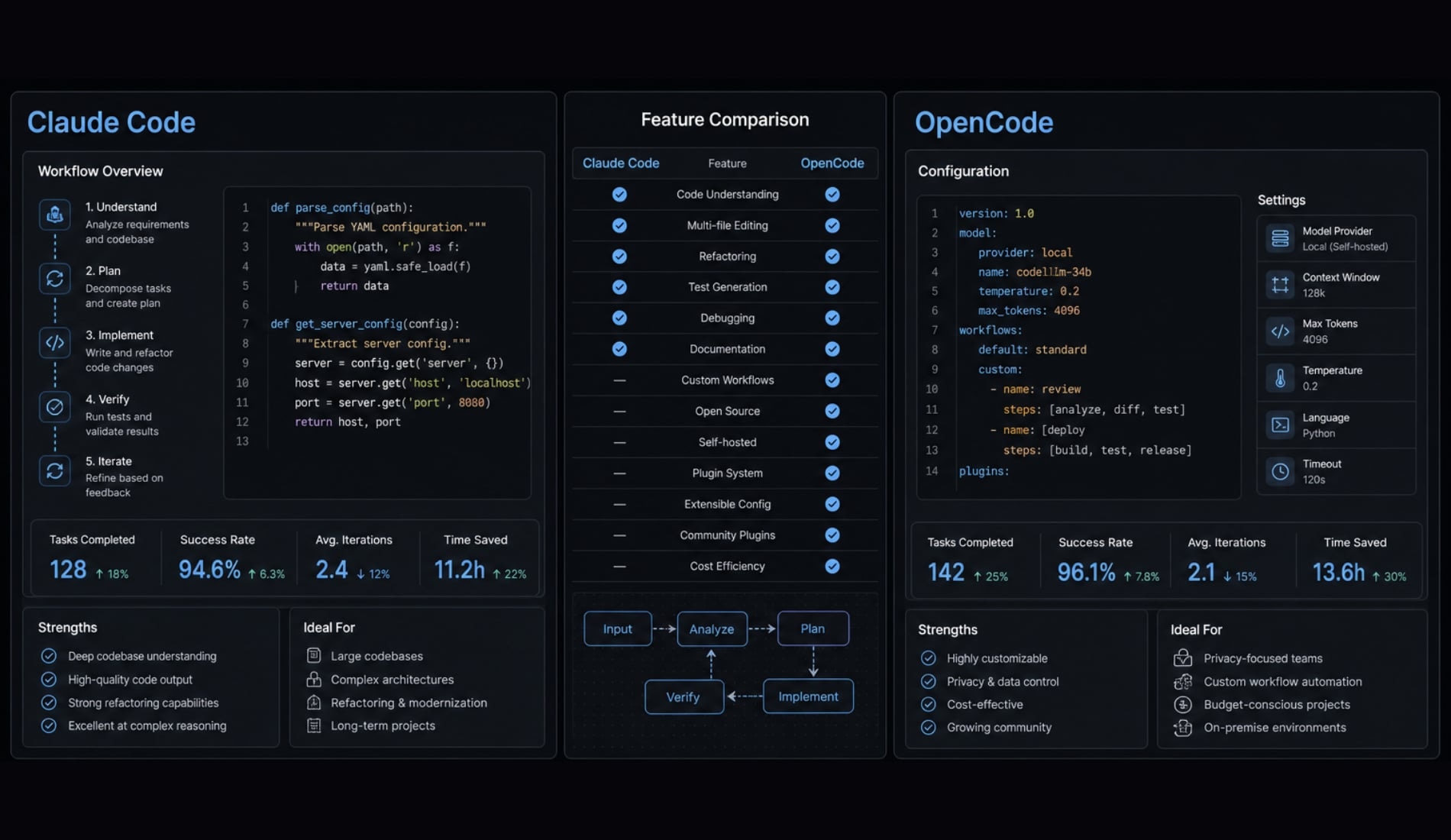
Claude Code vs OpenCode Feature comparison at a glance
Claude Code and OpenCode are AI-native terminal coding agents designed to help developers work directly with a codebase from the command line. Claude Code is Anthropic’s official CLI and stays inside the Claude ecosystem, while OpenCode is an open-source, model-agnostic alternative focused on provider choice, extensibility, and infrastructure control.
The most useful way to compare Claude Code vs OpenCode features isn’t to ask which tool writes better code. It is about what each tool optimizes for in day-to-day work: time-to-productivity, control over providers, safety defaults, and how much configuration burden you are willing to accept.
What each tool is optimized for:
- Claude Code is optimized for a cleaner, more official Anthropic-native experience. In practice, that usually means faster setup, fewer moving parts, and a more polished default path for users already committed to Claude.
- OpenCode is optimized for flexibility. It behaves more like an open framework for AI coding workflows, giving users broader control over providers, local models, and integrations. That flexibility can be valuable, but it also introduces more responsibility.
For a solo builder, this often comes down to speed versus control. For a small team, the issue appears when different users need consistent behavior without rebuilding setup choices every week.
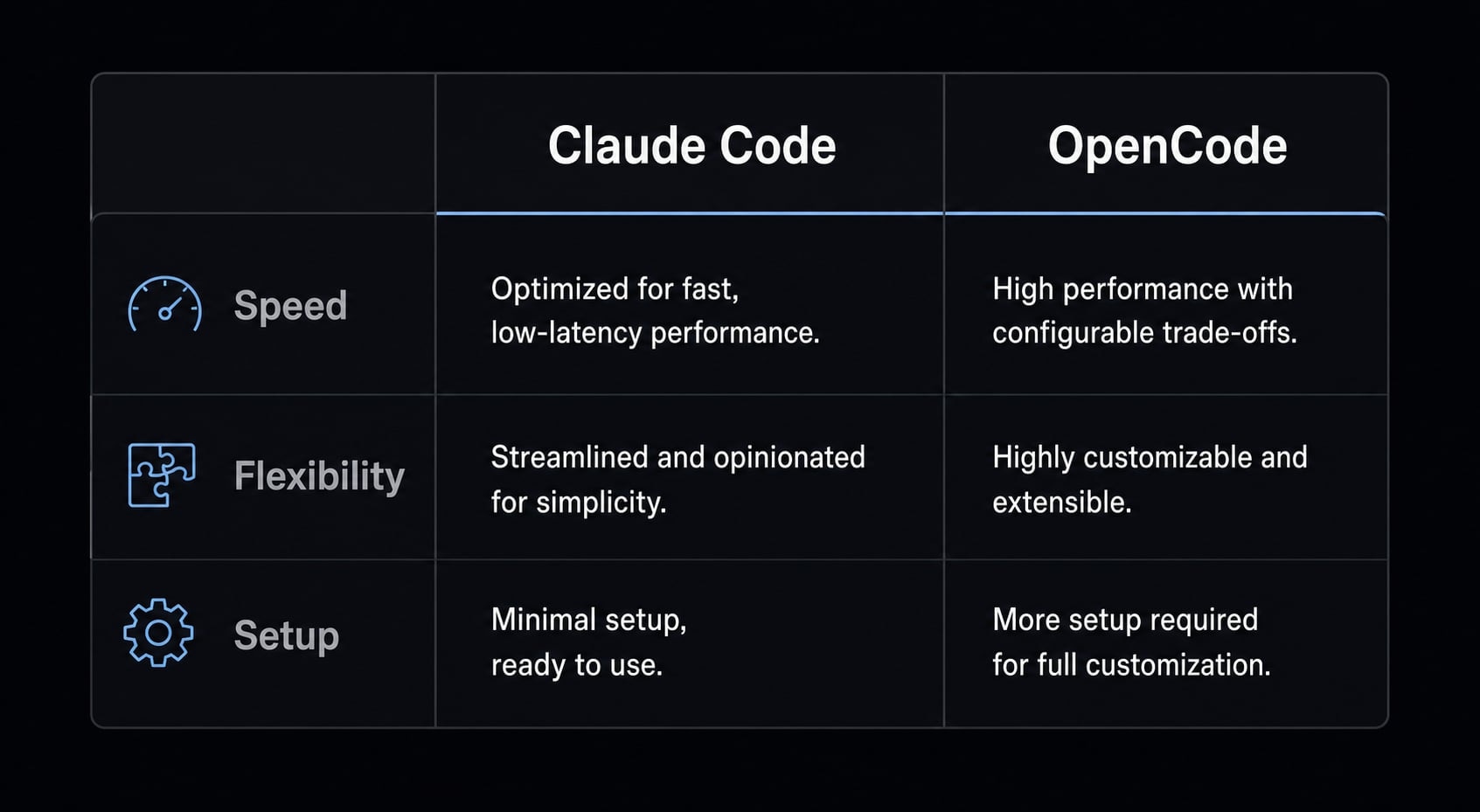
Comparison Area | Claude Code | OpenCode |
|---|---|---|
Ownership / ecosystem | Proprietary, Anthropic-owned | Open source |
Provider support | Claude only | Multi-provider |
Local model support | Limited / not core | Yes, stronger fit |
UX / setup style | Simpler, polished default path | More configurable |
Extensibility | More bounded | Broader control surface |
Pricing logic | Anthropic subscription or API path | Bring your own provider / model |
Safety posture | Safer defaults, approval-oriented | More configurable responsibility |
Best-fit user | Anthropic-centered user seeking speed | Power user prioritizing optionality |
Claude Code is the better default for a streamlined Anthropic-native workflow, while OpenCode is stronger for users who prioritize optionality, portability, and control.
Feature-by-feature comparison that actually affects workflow
The most important differences show up in daily execution, not product pages. In a terminal-based development environment, what matters is whether the tool reduces friction, produces trustworthy edits, and fits how you already build.
The five comparison lenses that matter most are:
- Codebase awareness and editing.
- Model and provider support.
- Extensibility and MCP compatibility.
- Permissions and safety defaults.
- Workflow fit by operating style.
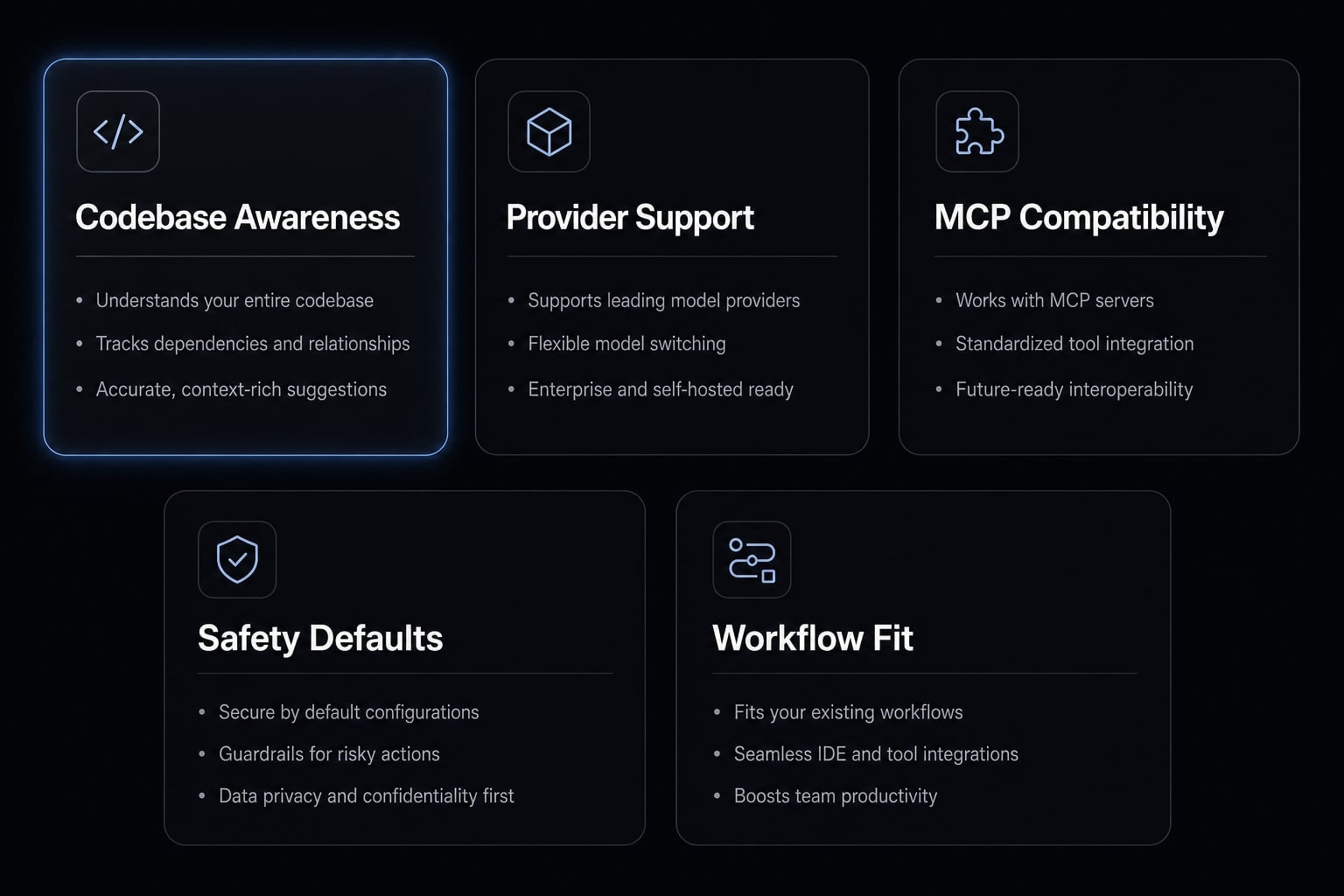
Codebase awareness and editing workflow
For most developers, codebase interaction capability matters more than raw feature count. The question is simple: how quickly can the tool understand a repo, navigate files, and make multi-file changes with acceptable confidence?
- Claude Code:
- Usually feels more straightforward for common code reading and editing tasks
- Lower cognitive overhead for users who want an official CLI flow
- Better fit when you want to move quickly with fewer setup decisions
- OpenCode:
- Can support broader workflows and more configurable operating patterns
- Better suited to users who want more control over how sessions and providers are handled
- May involve more setup thinking before the workflow feels settled
In practice, this becomes a trust issue. If a tool helps you review changes quickly and predictably, adoption goes up. If every task requires more configuration attention, the friction typically shows up in review time and switching cost.
Claude Code usually feels more direct for common coding tasks, while OpenCode offers more workflow control for users willing to manage extra complexity.
Model support and provider flexibility
This is one of the biggest differences between Anthropic CLI vs open-source coding agents. Claude Code is tightly aligned with Anthropic. OpenCode belongs in the category of model-agnostic AI developer tools, where provider choice is part of the value proposition.
Why this matters:
- Fallback options: You are not tied to one provider if pricing, access, or quality changes.
- Cost control: You can compare usage paths instead of accepting a single vendor model.
- Experimentation: Teams can test different models for refactoring, debugging, or test generation.
- Portability: Lower long-term dependence on a single vendor.
OpenCode also has a clearer path for local models, which matters for privacy-sensitive workflows or users exploring lower-cost local inference. That does not automatically make it better. Local setups only help if your hardware, model quality, and maintenance burden are realistic.
Claude Code wins on simplicity if Anthropic is already your standard, while OpenCode wins on optionality and local or private workflow paths.
Extensibility, MCP, and advanced control surface
Model Context Protocol (MCP) is a way to connect AI tools to external capabilities and structured tool access without turning every workflow into a one-off prompt chain. For buyers, the practical question is not protocol theory. It is whether extensibility helps your real workflow.
Claude Code takes a more bounded approach. That can be a strength if you want fewer moving parts and less customization overhead.
OpenCode is more extensibility-first. That broader control surface can support more advanced orchestration, custom tool injection, and workflow adaptation. This matters most for power users and teams building repeatable agentic workflow automation patterns.
For many teams, more extensibility is only valuable once the basic workflow is already stable. Otherwise, extra control becomes extra configuration.
Claude Code is better for bounded simplicity, while OpenCode is better for users who actively need extensibility-first architecture.
Permissions and safety behavior
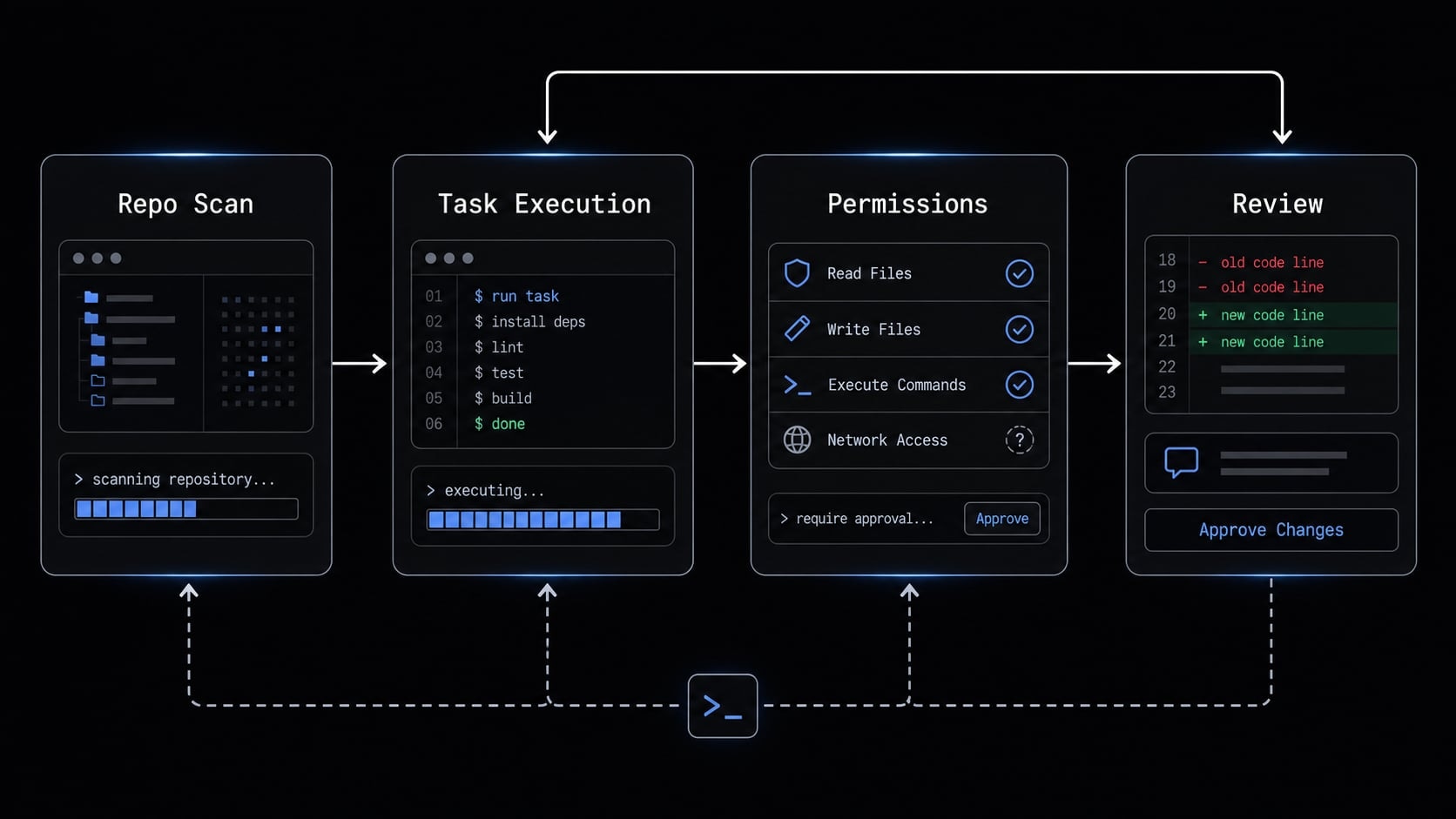
An AI coding agent security features comparison should start with one principle: Safer defaults reduce misuse risk, especially when multiple users are involved.
- Claude Code:
- More approval-oriented behavior.
- Better for users who want a clearer safety boundary.
- Easier to trust in mixed-experience environments.
- OpenCode:
- More configurable permissions and behavior.
- Better for users who want control over how the agent operates.
- Requires more user discipline and workflow ownership.
For solo developers, looser control may feel efficient. For founder-builders and small teams, the friction usually appears when trust, reviewability, and repeatability matter more than raw freedom. A tool with flexible controls is not automatically safer if nobody governs how it is used.
Claude Code is usually safer by default, while OpenCode gives more power at the cost of greater user responsibility.
Feature winner by category
Raw feature count is not the decision rule. Workflow fit is.
- Best for simplicity: Claude Code
- Best for flexibility: OpenCode
- Best for local/private needs: OpenCode
- Best for quick adoption: Claude Code
- Best for advanced control: OpenCode
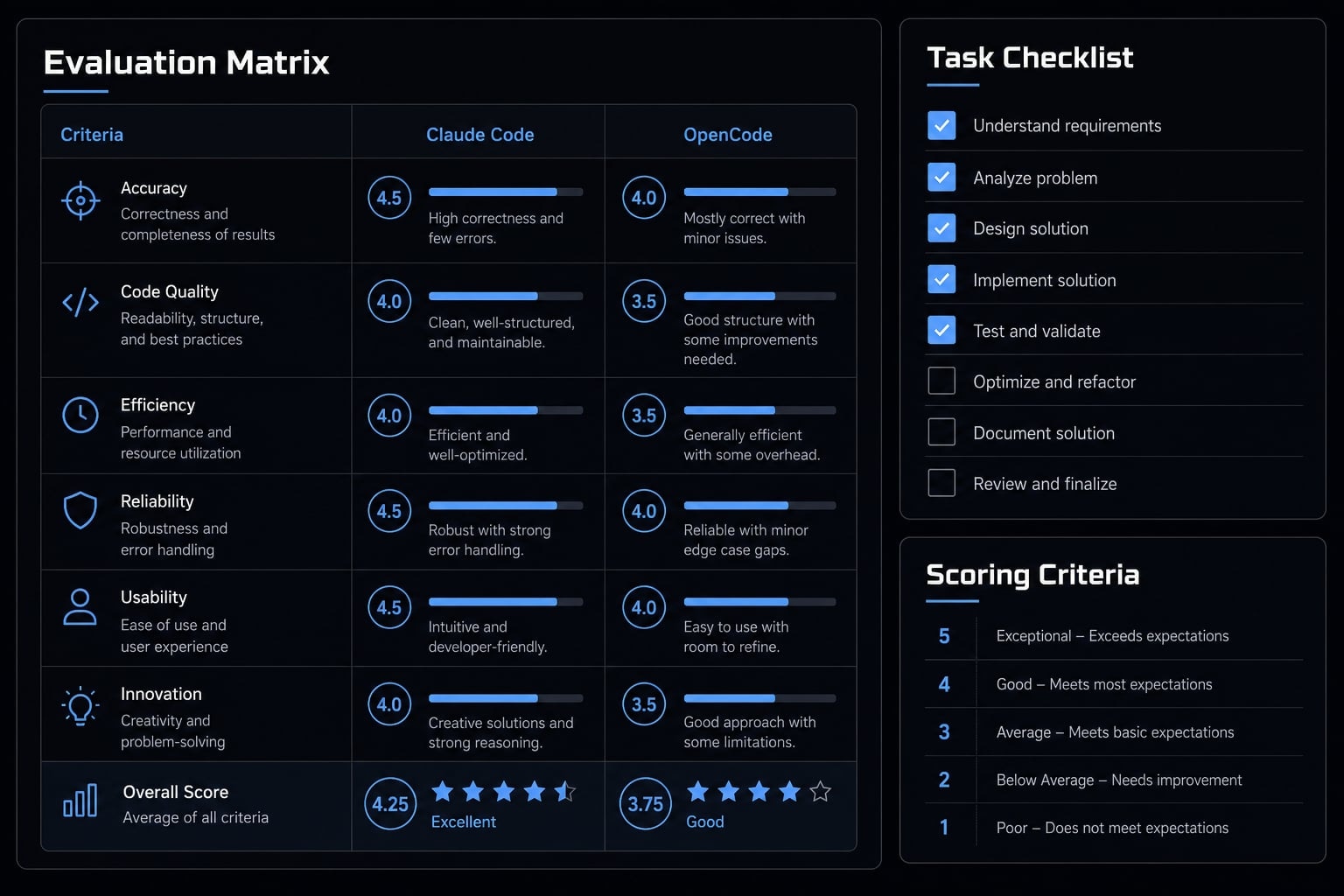
If you are comparing multiple AI coding tools at once, use a standardized evaluation sheet. A simple scorecard for setup friction, edit quality, review burden, and provider control will usually expose the better fit faster than feature lists.
Pricing, cost control, and lock-in risk
Vendor lock-in in AI coding tools refers to becoming operationally dependent on one provider’s models, pricing structure, workflow assumptions, or access rules in a way that makes switching harder later. In practice, lock-in is not just about technology. It affects budget predictability, migration effort, and negotiating leverage.
A common mistake is comparing sticker prices without understanding subscription vs API pricing. A bundled vendor experience may feel simpler operationally. A usage-based path can be cheaper or more expensive depending on task volume, model choice, and team habits.
Subscription leverage vs variable API spend
If you are already paying for an official provider ecosystem, the workflow can be easier to justify. Fewer billing variables often means simpler budgeting and less operational overhead.
But variable API consumption changes the equation. Heavy usage, larger contexts, and repeated agent runs can create spend that is harder to forecast. That is why cost-effective LLM inference strategies are usually about controlling usage patterns, not chasing the lowest headline price.
BYOK, provider switching, and local model economics
BYOK (Bring Your Own Key) means using your own API credentials instead of being locked into one bundled vendor path. This gives you more control over provider switching, cost comparison, and experimentation.
OpenCode is stronger here. It gives users more flexibility to swap providers or explore local models for privacy or cost reasons. The trade-off is clear: more freedom usually means more configuration responsibility and more internal decision-making.
Cost verdict by user type
- Solo developer already deep in Claude: Claude Code may feel more operationally efficient.
- Power user using multiple providers: OpenCode usually offers better cost and provider control.
- Small team reducing future switching friction: OpenCode may provide better portability - provided the team can handle the added setup discipline.
Cost Factor | Claude Code Tendency | OpenCode Tendency |
|---|---|---|
Spend predictability | More predictable if workflow stays inside one ecosystem | More variable, but more controllable |
Provider switching | Lower flexibility | Higher flexibility |
Local model path | Weaker fit | Stronger fit |
Budget control granularity | Simpler, less granular | More granular |
Lock-in exposure | Higher | Lower |
The cheapest path depends on usage volume, provider mix, and whether local models are realistic for your team.
Adoption friction, learning curve and team governance
The best tool on paper can still fail if adoption friction is too high. In small-team environments, rollout problems usually come from setup inconsistency, unclear permissions, and workflows that depend too heavily on one power user.
Time-to-productivity
Claude Code usually gets users productive faster. The official path reduces setup decisions, which matters when the goal is to start shipping rather than building a custom workflow layer.
OpenCode may require more configuration effort upfront. For solo experimentation, that can be acceptable. For team standardization, the friction appears when each user configures providers, behaviors, or integrations differently.
Governance and trust model
In AI coding workflows, governance means setting clear rules for how agents access code, use tools, request approvals, and produce changes that other team members can review and reproduce. Good governance reduces operational risk without making the workflow unusably slow.
Key governance factors include:
- Permissions: Who can run what, and under which conditions.
- Auditability: Whether actions and changes are easy to inspect later.
- Reproducibility: Whether the same task can be rerun consistently.
- Approval model: Whether teams can control write or execution behavior.
- Provider agnosticism: Whether your workflow can move without major rewrites.
Safer defaults usually help non-expert adoption. More configurability can be powerful, but it can also create hidden dependence on the one person who understands the full setup.
Best fit by operating model
- Solo developer: Choose based on speed versus control preference
- Founder-builder: Claude Code if you want lower friction; OpenCode if portability matters early
- Small product team: Claude Code for easier standardization; OpenCode if provider flexibility is strategic
- Advanced AI workflow power user: OpenCode is often the stronger fit
A tool that works extremely well for one expert user may still be the wrong choice for team-wide standardization.
If your team is already seeing inconsistent prompts, inconsistent approvals, or uneven output quality, it is a good time to run a workflow audit before you standardize on any single coding agent.
Decision matrix: Which one should you choose?
If you are asking how to choose between Claude Code and OpenCode, the cleanest answer is to decide based on operating constraints, not feature marketing. A practical terminal AI coding agent decision matrix should prioritize workflow reliability, control needs, and AI coding workflow standardization requirements.
Choose Claude Code if...
- You want the official Anthropic CLI experience.
- You prefer lower setup friction.
- You value safer default behavior.
- Your workflow is already Anthropic-centered.
Choose OpenCode if...
- You want model and provider freedom.
- You need local models.
- You care about infrastructure control and extensibility.
- You accept more setup for more optionality.
If you are undecided, test both on the same repository
The most reliable way to compare these tools is a same-repository evaluation. Use the same codebase, the same task types, and the same success criteria.
Test this task set:
- Refactor task.
- Bug fix.
- Test generation.
- Multi-file change.
Track these metrics:
- Time-to-output.
- Edit quality.
- Approval friction.
- Setup overhead.
- Reproducibility of results.
Scenario | Better Fit | Why |
|---|---|---|
Solo Anthropic-heavy user | Claude Code | Faster path, lower friction |
Multi-provider experimenter | OpenCode | Better provider flexibility |
Privacy-sensitive workflow | OpenCode | Stronger local model path |
Small team wanting standardization | Claude Code | Easier consistency for most teams |
Advanced workflow tinkerer | OpenCode | More extensibility and control |
If your priorities are evenly split, run the same-repository test before standardizing.
Where AgentKit fits if you want a more repeatable AI development workflow
Choosing between Claude Code and OpenCode is only one layer of the decision. The bigger operational issue often appears later: Every user starts rebuilding prompts, tool settings, and workflow logic from scratch.
That is where workflow standardization becomes more valuable than surface-level tool hype. Even the right coding agent becomes noisy if each developer uses different configurations, different tool access patterns, and different approval habits.
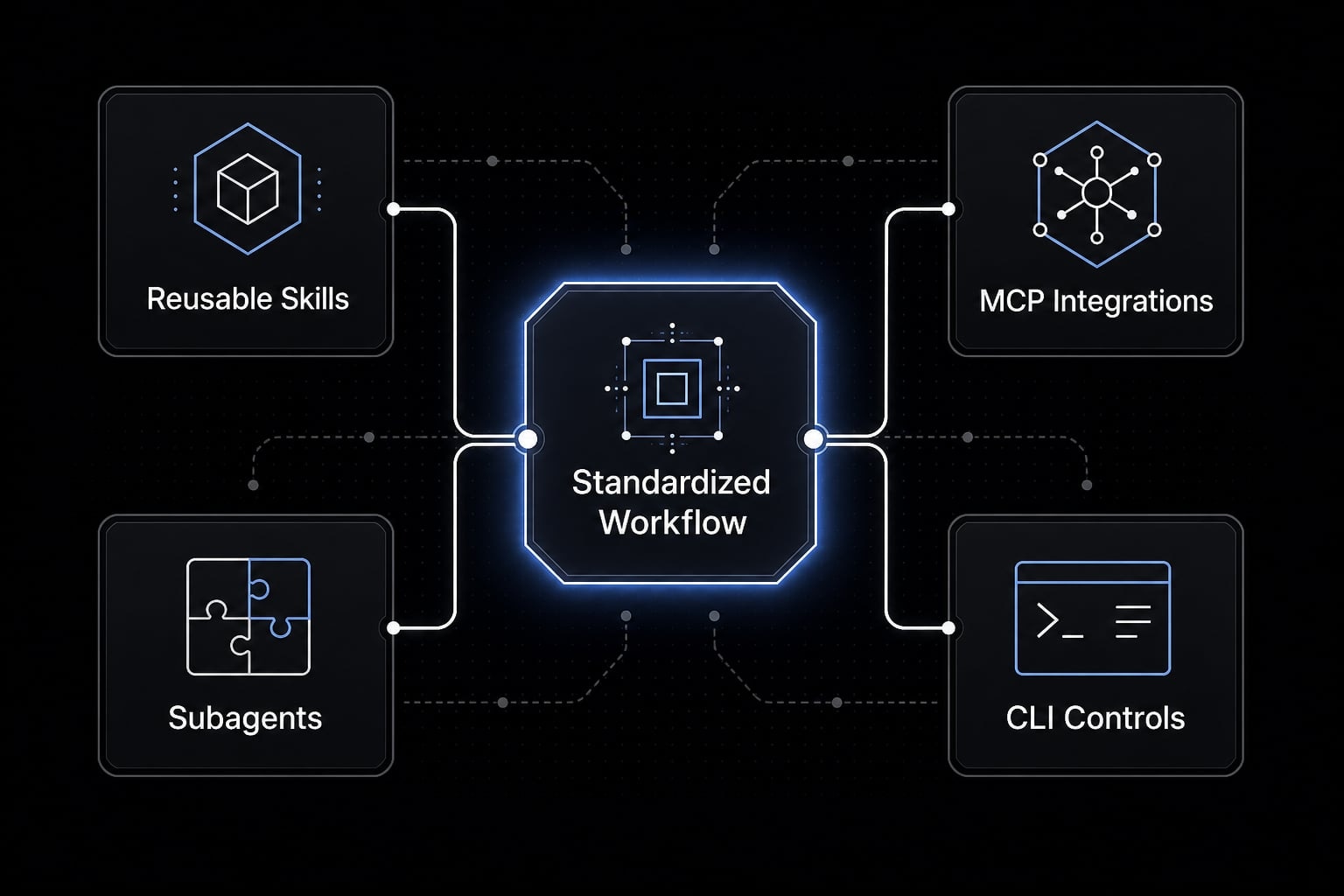
For teams moving toward repeatable AI development operations, the next step is often a standardization layer built around:
- Reusable skills
- Subagents
- MCP integrations
- Agentic workflow automation
- Shared configurations and controls
- More production-ready AI development teams
AgentKit fits this layer. It does not replace Claude Code or OpenCode directly. It is better understood as workflow infrastructure for teams that want more repeatable execution across tools, users, and environments. That matters once experimentation becomes operational dependency and the cost of inconsistency starts showing up in delivery speed, review quality, and internal trust.
Frequently asked questions
How do Claude Code and OpenCode differ?
Claude Code is Anthropic’s official CLI tool, designed to deliver an optimized experience within the Claude ecosystem. OpenCode, in contrast, is an open-source, multi-provider solution focused on infrastructure control and flexible customization for advanced users.
How should you choose between Claude Code and OpenCode?
Base your decision on your operational priorities. Choose Claude Code if you need stability, deep Anthropic integration, and a straightforward workflow. Choose OpenCode if you require maximum flexibility, support for local models, and cost control across multiple providers.
Should you use Claude Code for enterprise projects?
Yes, particularly when a project prioritizes security through safe defaults and rigorous approval processes. However, consider OpenCode if your team requires extensive workflow customization or independence from a specific AI provider.
How does the Model Context Protocol (MCP) affect your choice of tool?
MCP connects external data sources to coding agents. Claude Code allows users to configure MCP manually through the CLI, while OpenCode integrates MCP servers as configuration dependencies, supporting more controlled and consistent context management in complex projects.
Why is BYOK important when choosing an AI coding agent?
Bring Your Own Key (BYOK) allows you to manage costs directly through API providers rather than relying on fixed subscription plans. This makes OpenCode more suitable for users who want to optimize expenses based on actual usage and experiment with multiple models.
When should you consider an automation solution such as AgentKit?
Consider AgentKit when managing configurations, prompts, and tools becomes overwhelming. It helps standardize workflows and is suitable for teams that need reusable skills, centralized configuration management, and synchronized AI deployment processes to improve development efficiency.
Read more:
- Claude Code vs Cline: Which AI coding workflow suits you?
- Aider vs Claude Code: Choosing the right AI Coding Assistant
- Gemini CLI vs Claude Code: Which coding tool suits you best?
Conclusion
The most useful way to evaluate Claude Code vs OpenCode Features is to stop asking which tool has more capabilities and start asking which one creates less friction in your actual workflow. That is the real answer to how to choose between Claude Code and OpenCode.
Claude Code tends to be the leaner, more polished default for teams that want an official Anthropic experience with stronger safety guardrails and faster deployment. OpenCode is usually stronger if you value open-source control, provider flexibility, broader infrastructure options, and lower long-term dependence on one vendor.
The better choice depends on workflow fit, cost behavior, governance needs, and how much configuration responsibility your team is prepared to absorb. If the decision is high impact, run a same-repository evaluation first. If your next challenge is repeatability across teams, review whether a workflow standardization layer such as AgentKit is the missing piece.