Vibe coding maintenance: A practical guide for AI-built apps
Vibe coding maintenance: A practical guide to keeping AI-built apps maintainable
A working prototype proves an idea can run—not that its next change will be safe. Vibe coding maintenance addresses that gap: keeping AI-built software understandable, changeable, and recoverable after the initial implementation. For founders and small teams using AI-assisted development, the warning signs are familiar: a minor update breaks permissions, another patch creates duplication, and nobody remembers why a dependency exists.
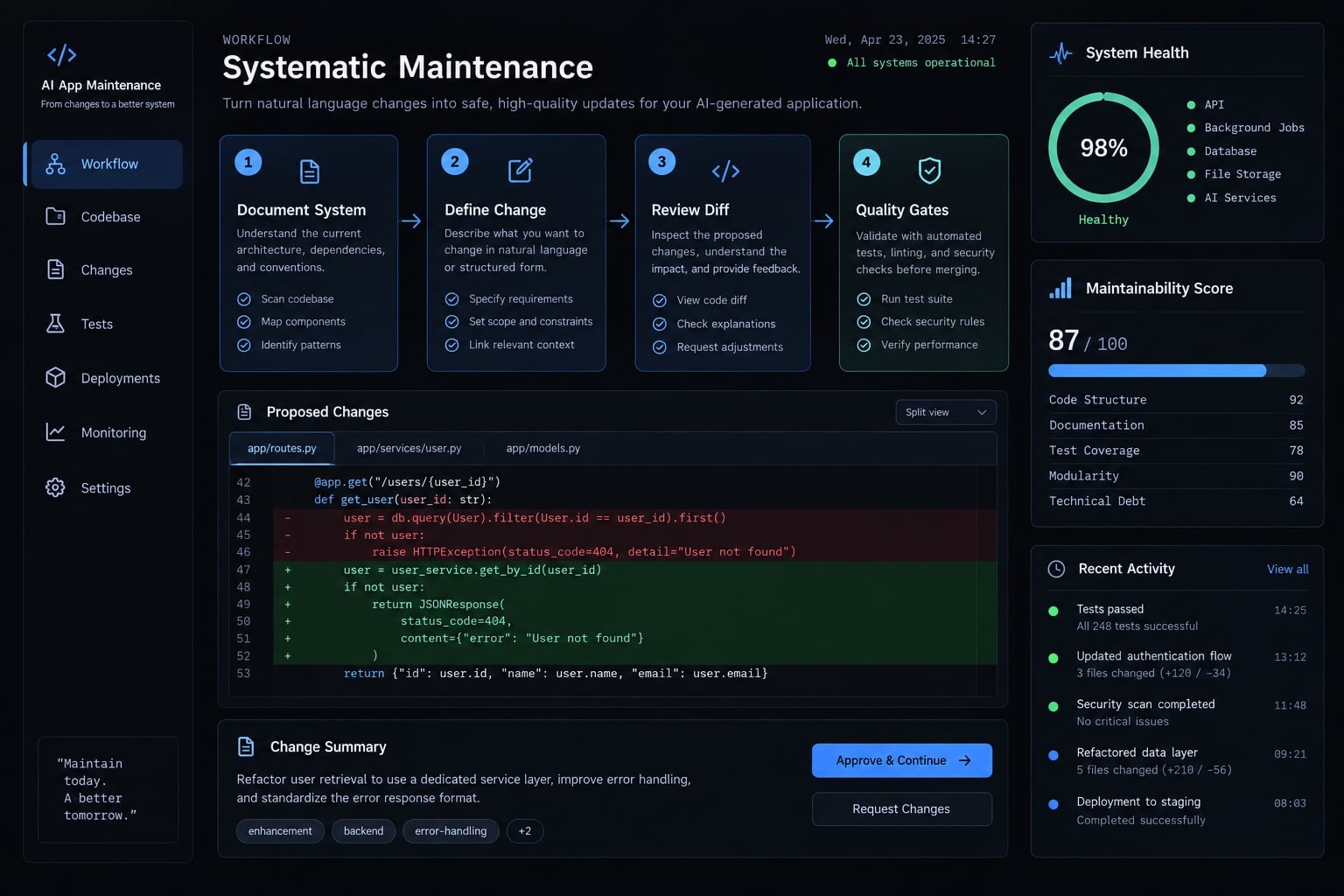
The problem is not AI usage alone. It is generating changes faster than the team can explain and validate them. This guide provides a maintainability scorecard, a seven-step workflow, production requirements, and a decision framework for continuing, refactoring, or rebuilding. First, distinguish the underlying causes from their symptoms.
Why vibe-coded applications become harder to maintain
Vibe coding maintenance is the ongoing work of understanding and updating software built through loosely supervised AI prompting. It includes testing, security, deployment, monitoring, and handover - not just cleanup - so someone other than the original builder can safely change the application while preserving intended behavior and recovering from failures.
The difference between fast generation and sustainable delivery
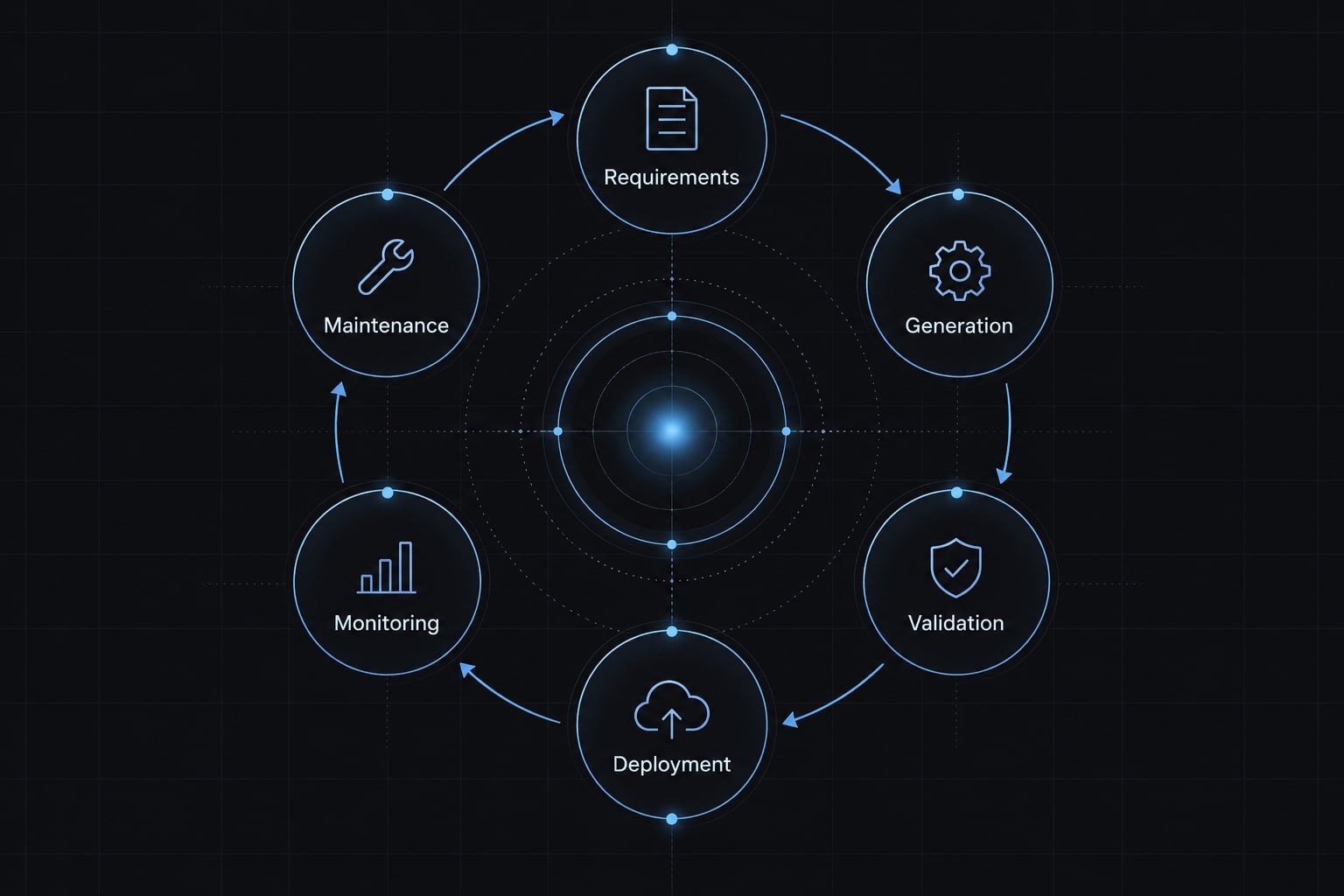
Code generation is one activity within the software development lifecycle, which also includes validation, release, operation, and subsequent changes. Disciplined AI-assisted engineering retains understanding and review; loosely supervised prompting may bypass both.
Total lifecycle effort = initial implementation + validation + operations + rework + future changes.
This is a planning lens, not an empirical forecasting model. A fast implementation remains valuable when downstream effort stays manageable.
How vibe coding debt differs from traditional technical debt
Technical debt is future work created by design or implementation compromises. It can be intentional or accidental in conventional and AI-assisted development.
Insufficiently controlled generation can amplify four patterns:
- Inconsistency sprawl: Similar components use conflicting patterns.
- Architectural amnesia: Design rationale was never preserved.
- Context drift: Changes rely on outdated or incomplete instructions.
- Test theater: Checks pass without protecting important behavior.
These are explanatory labels, not standardized diagnostic categories. Together, they can increase cognitive debt: The effort needed to reconstruct intent before changing anything.
Consider a hypothetical multi-tenant SaaS application: several customer organizations share software but must have isolated records. Permission rules exist separately in exports, search, and record views.
Repeated patches fix individual screens without correcting the duplicated rule. The process needs to change: centralize the policy, test prohibited access, and assign review ownership. Another prompt alone does not resolve the underlying problem.
Observable signs that maintenance velocity is declining
Diagnose code maintainability from repository evidence, not AI authorship:
- Small changes break unrelated behavior.
- Repeated patches miss root causes.
- Business logic appears in multiple places.
- New sessions introduce conflicting patterns or dependencies.
- Correction work increasingly displaces planned work.
- Understanding the repository requires old chats.
Symptom | Maintenance consequence | Business consequence |
|---|---|---|
Duplicated permissions | Several fixes per rule | Greater exposure |
Missing rationale | Repeated investigation | Slower handover |
Fragile releases | More emergency work | Less predictable delivery |
These signals justify investigation, not an automatic rewrite. A conventionally written repository can exhibit the same problems.
A five-dimension maintainability scorecard
A code maintainability assessment should inspect evidence across five dimensions. This scorecard is triage, not a formal audit; it identifies where further work or qualified review is needed:
Dimension | Green | Amber | Red |
|---|---|---|---|
Code understanding | Another developer explains a critical flow | Explanation requires builder assistance | Critical behavior cannot be explained |
Change safety | Automated testing covers permissions and tenant isolation | Main paths tested, failures missing | Critical behavior unprotected or repeatedly broken |
Operational visibility and recovery | Owned alerts; recovery and relevant restores tested | Logs exist, recovery untested | Important failures invisible or recovery unavailable |
Security and dependencies | Permissions, package provenance, and vulnerabilities reviewed | Inventory or review incomplete | Exposed secrets or serious uncontained vulnerabilities |
Ownership and handover | Named code ownership; another maintainer follows setup | Ownership exists; handover incomplete | No accountable maintainer or usable operating instructions |
An older dependency is not automatically unsafe. Investigate known vulnerabilities, support status, provenance, and how the application uses it.
How to interpret the score
- Mostly green: continue with routine controls.
- Multiple amber areas: prioritize high-impact gaps; defer discretionary features where necessary.
- Critical red: stop the affected release or expansion and obtain qualified review.
Apply risk weighting: consequences matter more than counting favorable cells. Mostly green is not production certification. Leaked credentials require immediate containment, not a later assessment.
In the hypothetical SaaS application, strong test results cannot compensate for missing recovery ownership. Somebody must recognize an incident, decide what to do, and restore service.
Business indicators to monitor alongside code quality
Indicator | What to record |
|---|---|
Routine change time | Ready-to-start through verified release |
Regression frequency | Previously working behaviors broken per release |
Change failure rate | Share of releases requiring incident remediation |
Mean time to restore service | Average incident onset-to-restoration duration |
Emergency patch count | Unplanned corrective releases |
Developer onboarding time | Time to an independently approved change |
Maintenance versus feature effort | Hours classified using consistent categories |
Review these over a consistent window, such as rolling eight-week periods. Define incident onset, restoration, and failure consistently, report release counts alongside percentages.
These are operational indicators, not all DORA metrics. Their purpose is to reveal trends within your system not to create unsupported cross-company benchmarks.
A practical vibe coding maintenance workflow
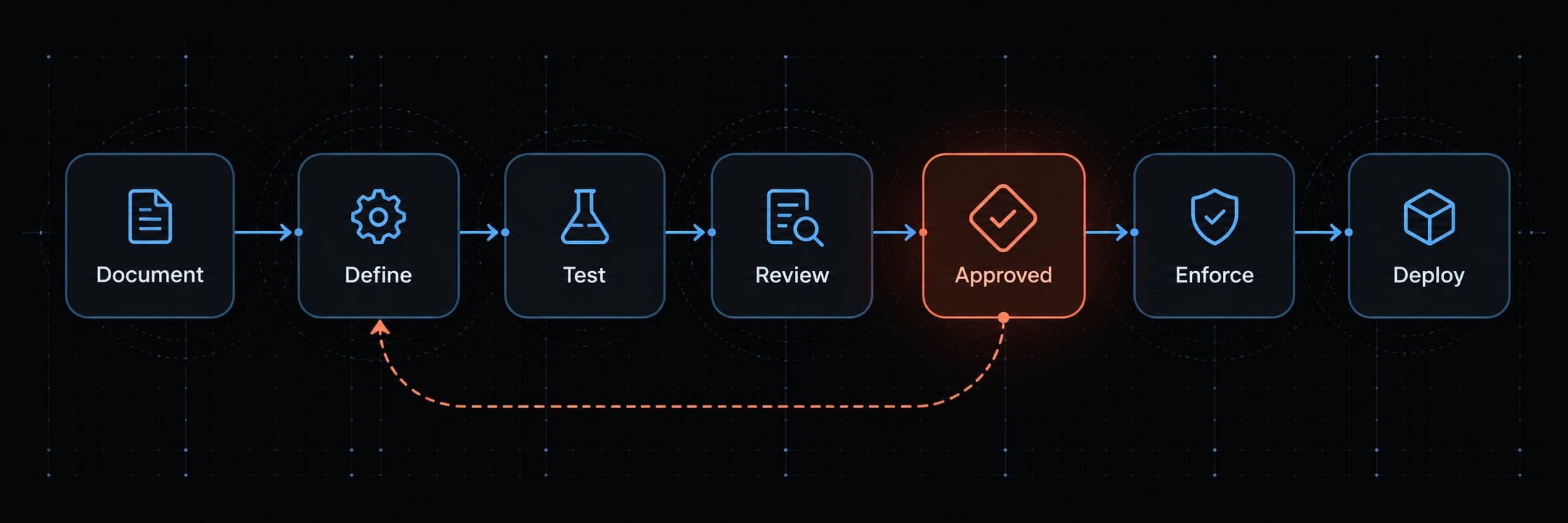
Preserve intent before generating code, then validate the change before releasing it.
- Document the system.
- Define the change.
- Test business behavior.
- Review the diff.
- Enforce automated gates.
- Deploy with recovery controls.
- Schedule maintenance.
Step 1 - Document the system before changing it
Create version-controlled repository context covering:
- Architecture, setup, and integrations.
- Data flows and sensitive boundaries.
- Operating instructions and known limitations.
- Architecture decision records: short explanations of important design choices.
Repository instructions help supply context; they do not guarantee an agent reads or follows them.
Step 2 - Define the change before prompting the model
Use spec-driven development: establish expected behavior before implementation. A reusable change request needs six fields:
- Problem: what needs to change and why?
- Acceptance criteria: what observable outcomes establish success?
- Affected areas: likely components, integrations, and data.
- Non-goals: what must remain outside scope?
- Risks: permissions, compatibility, and operational exposure.
- Recovery: how will failure be contained or corrected?
Affected files are an estimate, not the complete risk boundary.
Step 3 - Generate tests around business behavior
Derive expected outcomes from requirements, not the generated implementation. Check permissions, data updates, integration failures, billing where relevant, and rejected operations. For the hypothetical SaaS app: a user from workspace A must not read workspace B’s records.
Test that prohibited access directly. Successful login or page rendering does not establish tenant isolation; high coverage does not establish test quality.
Step 4 - Review the diff, not the final screen alone
A diff shows what changed between versions. Inspect scope, duplicated logic, dependencies, permissions, database structure changes, and removed safeguards.
Automated code review can assist inspection. High-risk changes still require competent human judgment and explicit approval.
Step 5 - Enforce automated quality and security gates
Use CI/CD quality gates: Checks in the automated build-and-release pipeline that block progression when configured requirements fail.
Gate | Purpose |
|---|---|
Build, lint, types where supported | Detect integration and consistency errors |
Behavior and regression tests | Protect specified customer behavior |
Dependency and secret scans | Flag known risks and exposed credentials |
Retain results with the change. Scanning is not a complete security assessment. NIST’s Secure Software Development Framework supports integrating security practices throughout development, rather than relying on one final check.
Step 6 - Deploy with recovery controls
Record the target environment, approver, monitoring owner, backup status, and recovery instructions.
Test relevant restores and rollback procedures - steps for reverting a release. Database migrations may be irreversible; require a tested recovery or forward-fix plan instead of assuming application rollback restores data.
Step 7 - Schedule maintenance instead of waiting for failure
Prioritize insecure, business-critical, frequently changed, or poorly understood areas. Maintain an owned backlog; avoid cosmetic refactoring without a clear benefit.
The product or technical owner owns acceptance criteria; a qualified engineer owns high-risk approval; a named operator owns monitoring and recovery. One person may hold several roles. Agents prepare artifacts, not organizational accountability.
Prototype vs production maintenance requirements
Production readiness follows exposure and consequences, not whether software was created through rapid prototyping. A disposable prototype is isolated and uses synthetic or replaceable data. Basic credential protection still applies.
Control | Disposable prototype | Internal or low-risk tool | Customer-facing production system |
|---|---|---|---|
Architecture documentation | Purpose and setup | Components and integrations | Boundaries, decisions, operating context |
Automated tests | Validate experiment | Protect important behavior | Critical flows and failure paths |
Code review | Before reuse or exposure | Risk-based review | Accountable review before release |
Security checks | Protect secrets; isolate access | Assess data and privileges | Verify access controls and dependencies |
Monitoring | Local visibility | Actionable failure alerts | Owned service and security signals |
Backups and recovery | Data safely replaceable | Follow data value | Tested recovery against agreed needs |
Handover readiness | Mark disposable limits | Another maintainer can operate | Documented ownership and procedures |
Internal tools connected to payroll, customer databases, or administrative credentials may require production-level controls. Backup needs follow data value and recovery requirements not audience.
In the hypothetical scenario, synthetic account records support an isolated experiment. An internal support tool exporting live customer records has materially different exposure.
Production-readiness stop signs
Pause the affected release or expansion when these conditions remain unresolved:
- No adequate recovery path for important data or service.
- Unclear authentication identity or authorization permitted actions.
- Exposed credentials.
- Untracked or unreviewed production data changes.
- No meaningful protection for critical workflows.
- Unassessed dependency provenance or serious dependency risk.
- No incident owner.
- Setup or operation depends entirely on the original builder.
Distinguish urgent defects from investigation triggers. A leaked secret requires revocation or rotation and exposure assessment, not merely deletion from the latest file.
OWASP’s Application Security Verification Standard provides relevant authentication and access-control requirements. Applying selected checks does not establish full compliance. Maintainability, security, and reliability overlap, but none substitutes for the others.
Continue, refactor, rebuild, or request expert review?
The refactor vs rebuild decision should minimize future risk and disruption, not reward cleaner-looking code. Assess problem localization, testability, product traction, migration exposure, and confidence in the replacement design.
Option | Choose when | Avoid when |
|---|---|---|
Continue with the current structure | Behavior is stable, changes remain understandable | Critical exposure remains unresolved |
Targeted refactoring | Problems are localized and behavior can be protected | Local edits cannot address structural causes |
Phased restructuring | Continuity matters; boundaries can change incrementally | Interim states cannot be operated safely |
Full rebuild | Fundamental constraints defeat viable incremental options | Replacement assumptions remain untested |
Expert review | Consequences exceed available expertise | Used as a substitute for ongoing ownership |
Expert review can accompany every other option. A focused code audit may clarify access-control risk without requiring a complete application review.
Avoid sunk-cost bias: retaining a system solely because substantial work already exists. Also avoid rewrite bias: assuming a clean start removes uncertainty.
A rebuild must account for data migration, integration compatibility, support continuity, and delayed customer work. Without correcting the development workflow, it can recreate the same problems.
Phased restructuring may first need characterization tests, which record important existing behavior. Missing tests justify establishing safeguards, not automatically rejecting incremental change. AI-assisted refactoring still requires those safeguards and review.
When a founder or small team can continue independently
Continuing is reasonable when the team has:
- Limited exposure.
- Low data sensitivity.
- Localized, recoverable changes.
- Meaningful tests.
- Understandable repository context.
“Independently” still requires enough skill to interpret results and recognize escalation triggers. A stable reporting module with awkward names may not warrant intervention.
When senior engineering oversight becomes necessary
Request senior engineering review for:
- Sensitive access-control, billing, or data changes.
- Significant migrations or infrastructure changes.
- Repeated production regressions.
- Unexplained critical dependencies.
- Scale, handover, enterprise requirements, or diligence.
- Inability to assess a proposed change’s consequences.
In contrast to awkward naming, the hypothetical SaaS application’s tenant-isolation defect warrants qualified review. The decision turns on customer exposure, not code aesthetics or whether AI authored the implementation.
From ad hoc prompting to a controlled AI-agent maintenance workflow
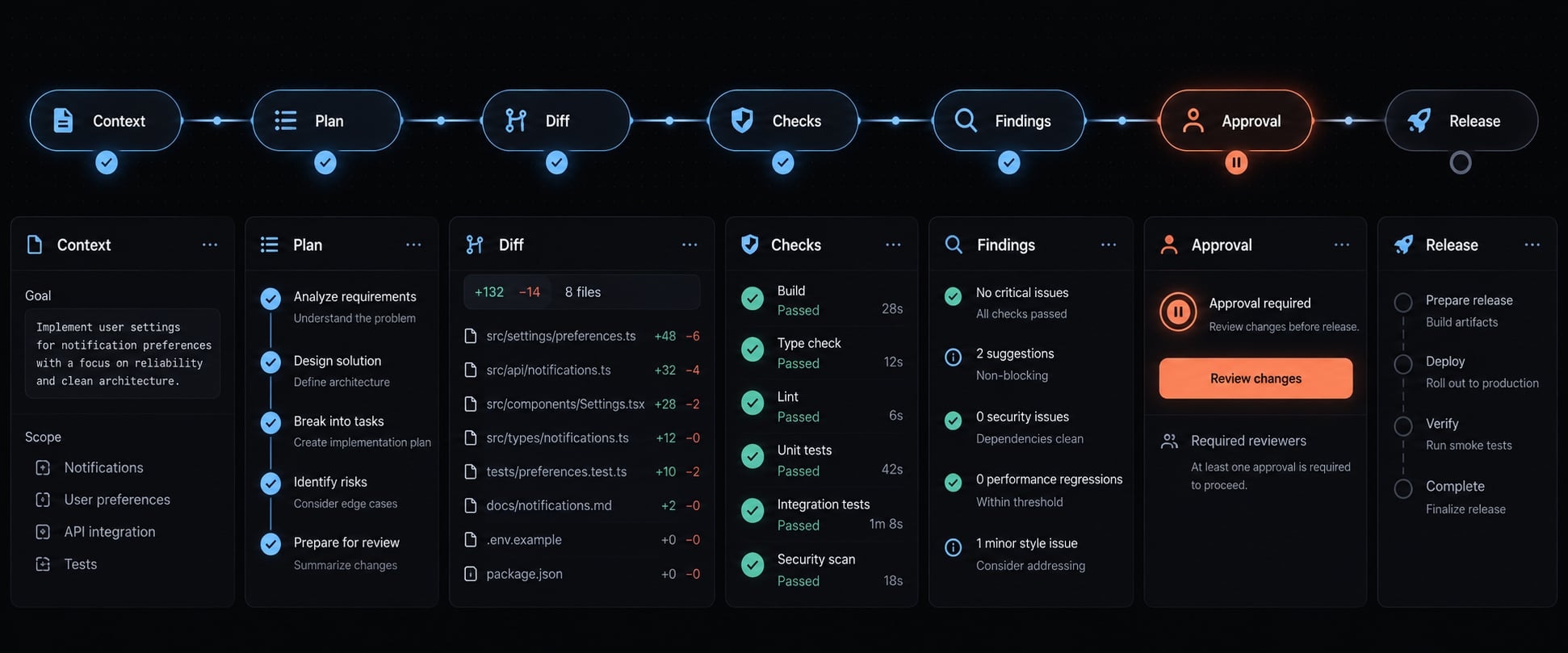
An agentic coding workflow organizes one or more AI agents around defined tasks and artifacts, using repository context, explicit permissions, and verifiable checks. It specifies what each step receives and produces, and where human oversight is required by risk, rather than treating an open-ended conversation as the complete development process.
Example controlled workflow
- Collect relevant repository context.
- Produce a plan and risk assessment.
- Implement the approved scope.
- Update tests and execute checks.
- Review the diff.
- Assess security findings.
- Obtain required human approval.
- Update documentation and recovery notes.
These are workflow roles—not a requirement to run eight separate agents.
Why separation of responsibilities matters
Narrow tasks make outputs easier to inspect. Separate steps produce traceable artifacts, but a reviewing agent using the same model and context may repeat the implementer’s assumptions:
Area | Ad hoc prompting | Controlled workflow |
|---|---|---|
Context | Conversation history | Maintained repository references |
Scope | Broad request | Accepted plan and non-goals |
Implementation | Expanding patch | Reviewable change |
Testing | Confirm generated behavior | Verify specified outcomes |
Review | Self-approval | Separate review step with explicit criteria |
Security | Informal confidence | Findings assessed by an owner |
Release | Implicit permission | Defined approval and recovery |
Independent test expectations and accountable review matter more than agent count. Coordinated coding agents can also add latency, token cost, and orchestration complexity.
A passing pipeline proves only that its displayed checks passed for that run. It does not establish complete behavioral correctness or secure operation.
Frequently asked questions
What is vibe coding maintenance?
Vibe coding maintenance refers to the systematic process of debugging, refactoring, securing, and stabilizing software applications developed primarily through AI-assisted rapid prototyping. It ensures that fast-generated code remains reliable, secure, and understandable for long-term operational use by human engineering teams.
Why do AI-generated applications often become difficult to maintain?
Maintenance friction occurs when initial development prioritizes generation speed over architectural context. Common issues include inconsistent code patterns across modules, "test theater" where tests pass without verifying business logic, "context drift," where changes rely on outdated or incomplete instructions about the original design constraints.
What are the warning signs that an AI-built app is becoming fragile?
Key diagnostic signs include small changes causing unrelated bugs, business logic being duplicated across different files, frequent regression of previously fixed issues, and an increasing reliance on original chat sessions to interpret how the codebase functions. These symptoms indicate growing technical debt and a lack of durable documentation.
How can teams keep vibe-coded applications production-ready?
Teams should implement a controlled workflow by drafting explicit technical specifications before prompting, enforcing automated CI/CD quality gates, reviewing diffs line-by-line rather than just observing app behavior, and establishing a clear ownership structure for monitoring, recovery, and security patches.
Is it better to refactor or rebuild an AI-built prototype?
Rebuilding is not the default solution. If the core architecture is sound, targeted refactoring or phased restructuring is often more efficient. Choose to rebuild only if the system lacks essential safety controls, fails to meet business-critical reliability needs, or if the current maintenance cost significantly outweighs the effort of a clean implementation.
Read more:
- Vibe coding benefits: Uses, risks and best practices
- How to vibe code an AI agent: Build prototypes to production
- Vibe coding documentation: A guide for AI-assisted projects
Conclusion
AI-assisted development can accelerate discovery and implementation. Sustainable vibe coding maintenance ensures that this speed does not depend on the original builder, an old conversation, or repeated emergency patches.
Maintainable software needs durable context, behavior-focused tests, reviewable changes, recovery procedures, and named owners. These controls protect future changes; they do more than improve code appearance. Automated checks reduce repetitive work, but people remain accountable for interpreting evidence and accepting risk.