Vibe coding stripe: From fast payment prototype to production-ready workflow
AI can "vibe code" a Stripe Checkout flow in hours, but a working demo doesn't guarantee it can reliably handle real money. In payment integrations, defects don't just break the UI-they jeopardize revenue, data integrity, and customer trust. This guide bridges the gap between AI-generated prototypes and production-ready billing systems. We analyze three real-world cases, highlight where AI-assisted integrations typically fail, and provide a robust production checklist covering webhooks, error handling, and security.
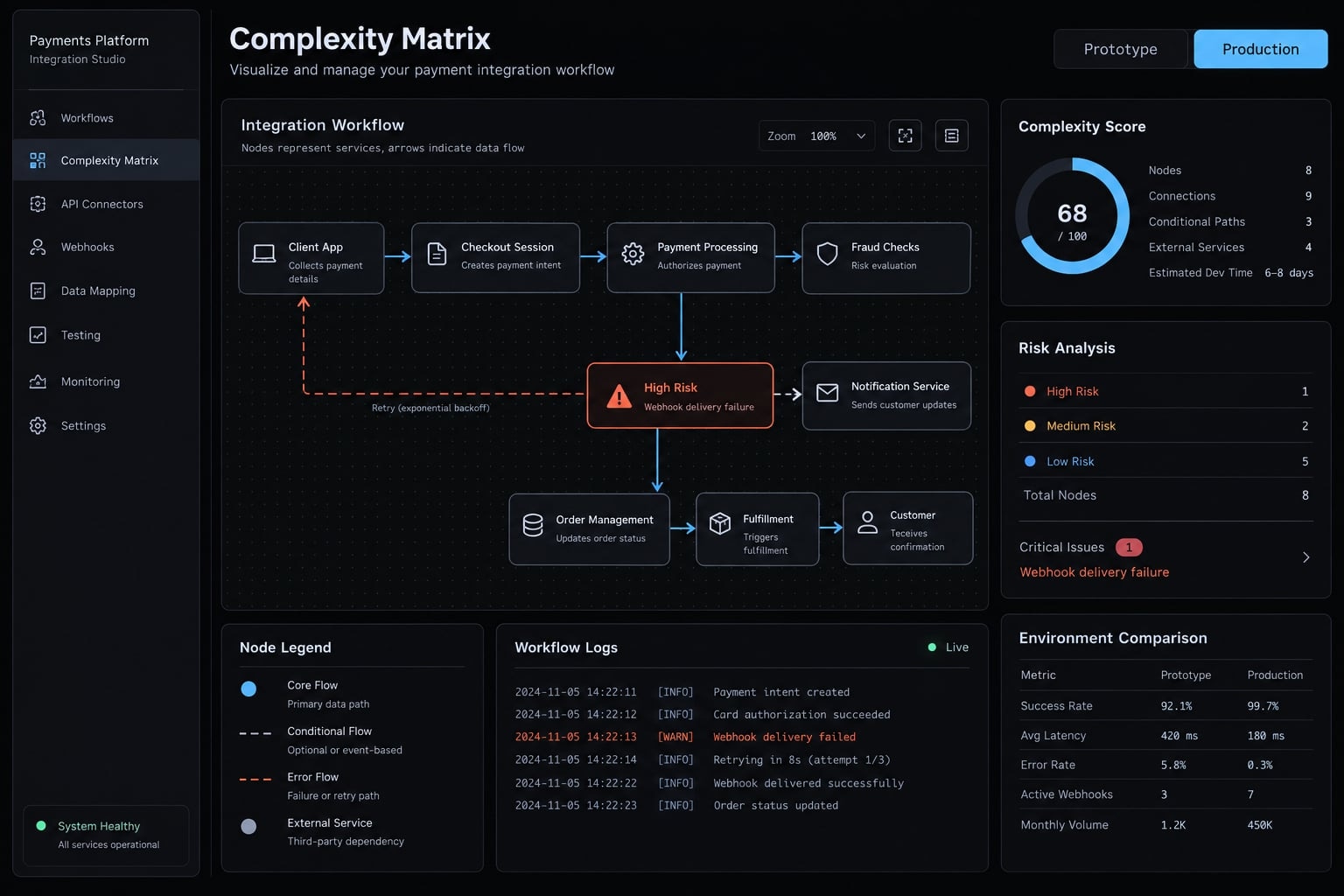
What does “vibe coding stripe” mean in practice?
Vibe coding Stripe means using natural-language instructions with an AI coding tool or agent to create a Stripe checkout, billing, or payment-operations workflow. The agent may generate plans, code, configuration, and tests, but a qualified human must review the financial rules, credentials, application behavior, and production deployment.
This approach is sometimes described as prompt-to-billing development: Using prompts to accelerate payment implementation rather than building every component manually. It is a descriptive phrase, not an established technical standard or a code-free operating model.
The responsibilities remain separate:
Actor | Primary responsibility |
|---|---|
AI agent | Generates plans, code, tests, configuration, or automation logic. |
Stripe | Processes payments and produces payment or billing events. |
Application | Translates verified events into product access and internal records. |
Product team | Approves pricing, refunds, access rules, credentials, and deployment. |
An AI agent can implement instructions, but it should not independently decide when customers receive access or how refunds affect entitlements.
Three forms of vibe coding with stripe
- AI-generated checkout or subscription implementation: A coding agent creates a hosted Stripe Checkout flow for a small SaaS product with monthly plans.
- Monetization of an AI-generated SaaS product: An AI application charges for measured credits through usage-based billing, such as generated images, API calls, or token consumption.
- Post-payment automation triggered by Stripe events: A webhook integration initiates failed-payment notifications, CRM updates, credit allocation, or dispute-evidence collection.
Natural language programming with payment integration is most useful when the commercial rules are already clear. Ambiguous pricing or access policies usually produce ambiguous code.
Prototype-ready vs. Production-ready stripe integration
Readiness area | Prototype-ready | Production-ready |
|---|---|---|
Primary proof | One successful happy-path transaction | Validated success and failure states |
Payment confirmation | Redirect or visible success page | Verified server-side Stripe event |
Webhook handling | Basic endpoint receives an event | Verified, traceable, idempotent processing |
Subscriptions | Simple active/inactive assumption | Explicit mapping for all approved states |
Credentials | Test configuration works | Test and live environments remain isolated |
Testing | Successful payment | Failures, retries, refunds, changes, and duplicates |
Operations | Manual observation | Monitoring, alerting, reconciliation, and rollback |
Approval | Agent output appears functional | Accountable human approves production |
A prototype proves that the happy path can complete. A production-ready Stripe integration must also handle failure states, verified events, secure credentials, repeated delivery, monitoring, and accountable approval after launch.
Three real-world vibe coding and stripe case studies
These cases represent three different operating patterns: Monetizing an AI product, automating a Stripe-related task, and using coding agents under human review. They should not be treated as equivalent payment integrations or standard performance benchmarks.
Lovable: Monetizing and scaling a vibe-coding platform
Lovable enables users to create applications through natural-language instructions. Its business challenge was to monetize a rapidly growing global product without diverting substantial engineering resources into building financial infrastructure internally.
According to the official Stripe customer story about Lovable, the company used Stripe Atlas, Stripe Checkout, Stripe Billing, local payment methods, Link checkout, usage-based billing, and centralized payment reporting.
When Lovable introduced cloud and AI products in 2025, Stripe reported that the team configured usage meters and rate cards in approximately two weeks. The system supported real-time usage ingestion, credit consumption, and billing based on actual product use.
Stripe also reported that optimized payment-method selection improved conversion by 2% to 3%, while Link accounted for 58% of transaction volume at the time covered by the customer story. Stripe’s case study further reported that Lovable reached $100 million in annual recurring revenue in July 2025, eight months after launch.
These are reported company outcomes, not proof that Stripe alone caused Lovable’s growth.
Lesson: Managed checkout and billing infrastructure can preserve engineering capacity for product differentiation, especially during rapid expansion.Limitation: Lovable is an exceptional high-growth case. Its speed, payment volume, and revenue trajectory should not be used as ordinary founder benchmarks.
Levels.io: Automating stripe dispute evidence
Payment disputes require businesses to assemble relevant records under time constraints. For a small team, manually collecting signup information, payment history, and product-usage evidence can make responding uneconomical.
In the original Levels.io founder post, the described vibe-coded dispute responder followed four steps:
- Stripe sends a dispute event through a webhook.
- The application gathers relevant payment, signup, account, and usage records.
- AI-assisted logic organizes the evidence into a structured narrative.
- The workflow produces a response document for review and submission.
The founder reported winning a $1,199 dispute after previously ignoring or losing many dispute cases. This is a founder-reported individual result, not an audited average win rate or a guarantee of future outcomes.
The task fits AI assistance because the evidence may be distributed across several systems and must be presented consistently. However, automated evidence collection still requires controls for relevance, data minimization, customer privacy, record accuracy, and human approval.
Lesson: AI can reduce the operational cost of chargeback mitigation by organizing existing evidence. It cannot determine whether evidence is complete, appropriate, or persuasive without accountable review.
Stripe minions: Agentic engineering with human review
Stripe Minions are internal coding agents used by Stripe; they are not an external Stripe payment integration product. Stripe’s engineering team described Minions as specialized agents that receive structured tasks and produce end-to-end implementation changes. Human engineers still review the resulting pull requests before merge.
In its February 9, 2026 Minions publication, Stripe reported that these agents were responsible for more than 1,000 merged pull requests per week. The transferable insight is not that every team can reproduce Stripe’s internal system. It is that generation and production approval remain separate stages.
For payment workflows, this human-in-the-loop model creates a clear boundary:
- AI agents generate or modify implementation work.
- Automated checks identify predictable defects.
- Human engineers evaluate correctness and operational impact.
- An accountable owner approves production deployment.
Lesson: Reliable agentic engineering depends on structured tasks, automated validation, specialized responsibilities, and an explicit human approval boundary.
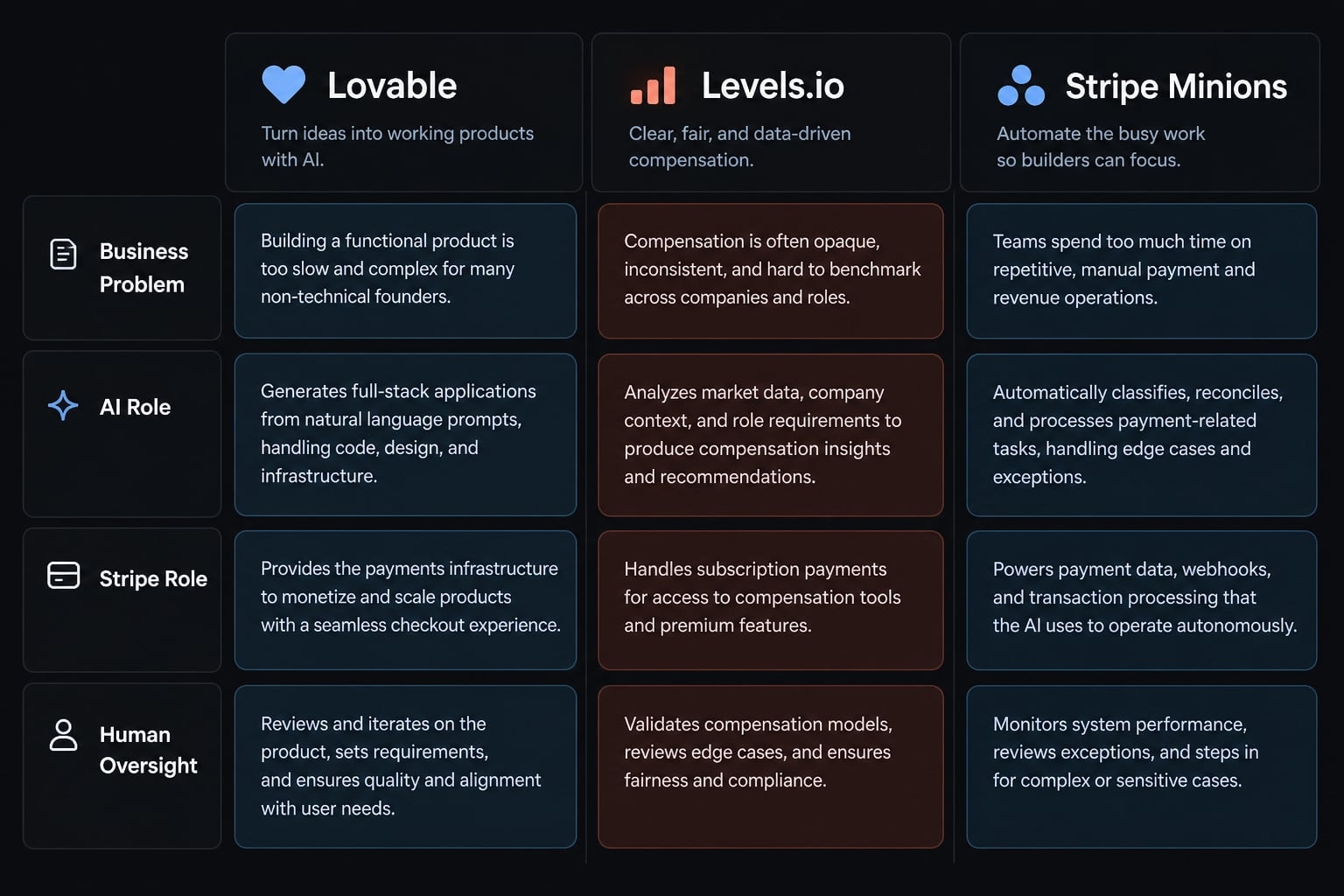
Comparison of the three operating patterns
Case | Business problem | Role of AI | Role of stripe | Human role | Transferable lesson |
|---|---|---|---|---|---|
Lovable | Monetize a global AI platform | Powers application creation | Checkout, billing, payments, reporting | Defines products and growth operations | Use managed infrastructure to protect product focus |
Levels.io | Reduce dispute-response effort | Organizes evidence and documents | Emits dispute events and manages responses | Reviews evidence before submission | Automate collection, not accountability |
Stripe Minions | Scale engineering execution | Produces implementation changes | Internal engineering environment | Reviews and approves pull requests | Separate generation from approval |
The cases demonstrate different relationships between AI, Stripe, and human owners. None supports deploying payment-critical logic without verification and review.
Which Stripe workflows are realistic to build with vibe coding?
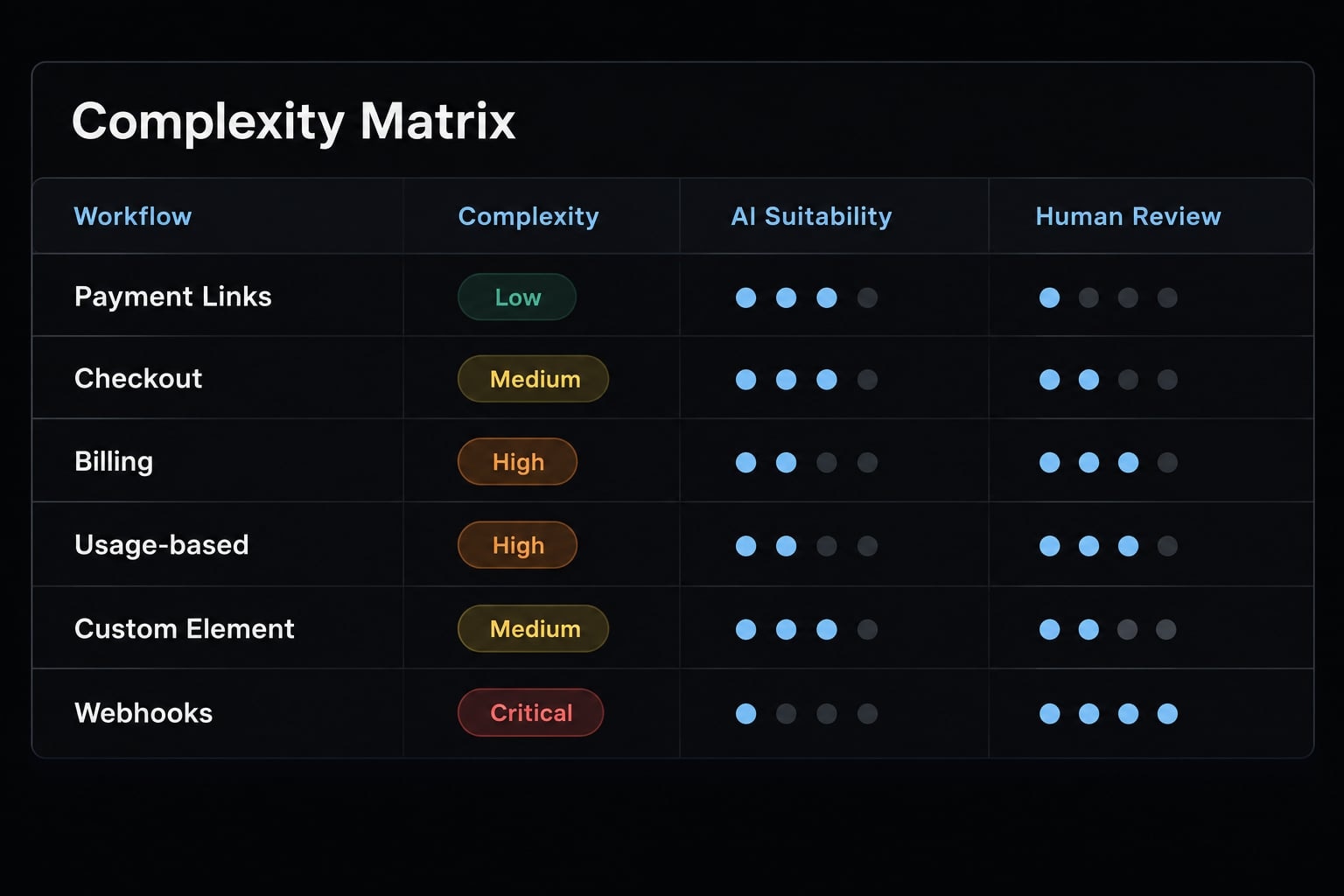
AI can assist with every workflow below, but suitability depends on the commercial model and operational risk. Each additional layer of customization creates more testing, monitoring, and maintenance responsibility.
Stripe workflow complexity matrix
Use case | Recommended starting point | Complexity | AI suitability | Human review need |
|---|---|---|---|---|
Validate willingness to pay | Stripe Payment Links | Low | High | Moderate |
Sell a one-time digital product | Stripe Checkout | Low | High | High |
Launch a SaaS subscription | Checkout with Stripe Billing | Medium | High | High |
Bill for AI usage or credits | Usage-based billing | High | Medium | Critical |
Build a custom payment interface | Payment Element or custom flow | High | Medium | Critical |
Automate disputes or payment operations | Verified webhooks and internal workflows | High | Medium | Critical |
The safest approach is usually the least complex Stripe product that supports the business model.
- Stripe Payment Links provide a fast way to validate demand without building a complete checkout experience.
- Stripe Checkout supports standard hosted one-time and subscription purchase flows.
- Stripe Billing is appropriate when Stripe subscription management must cover plans, seats, trials, renewals, or metering.
- Usage-based billing fits measured AI credits, tokens, API consumption, or compute usage, but requires accurate metering and reconciliation.
- A custom payment interface is justified only when it produces measurable conversion or user-experience value.
- Webhooks support event-driven operations but require verification and duplicate-event controls.
Use these four selection rules:
- Use Stripe Payment Links to validate demand.
- Use Stripe Checkout for standard purchases.
- Add Billing for recurring plans or usage-based rules.
- Build custom payment UI only for measurable business value.
Where AI-generated stripe integrations commonly fail
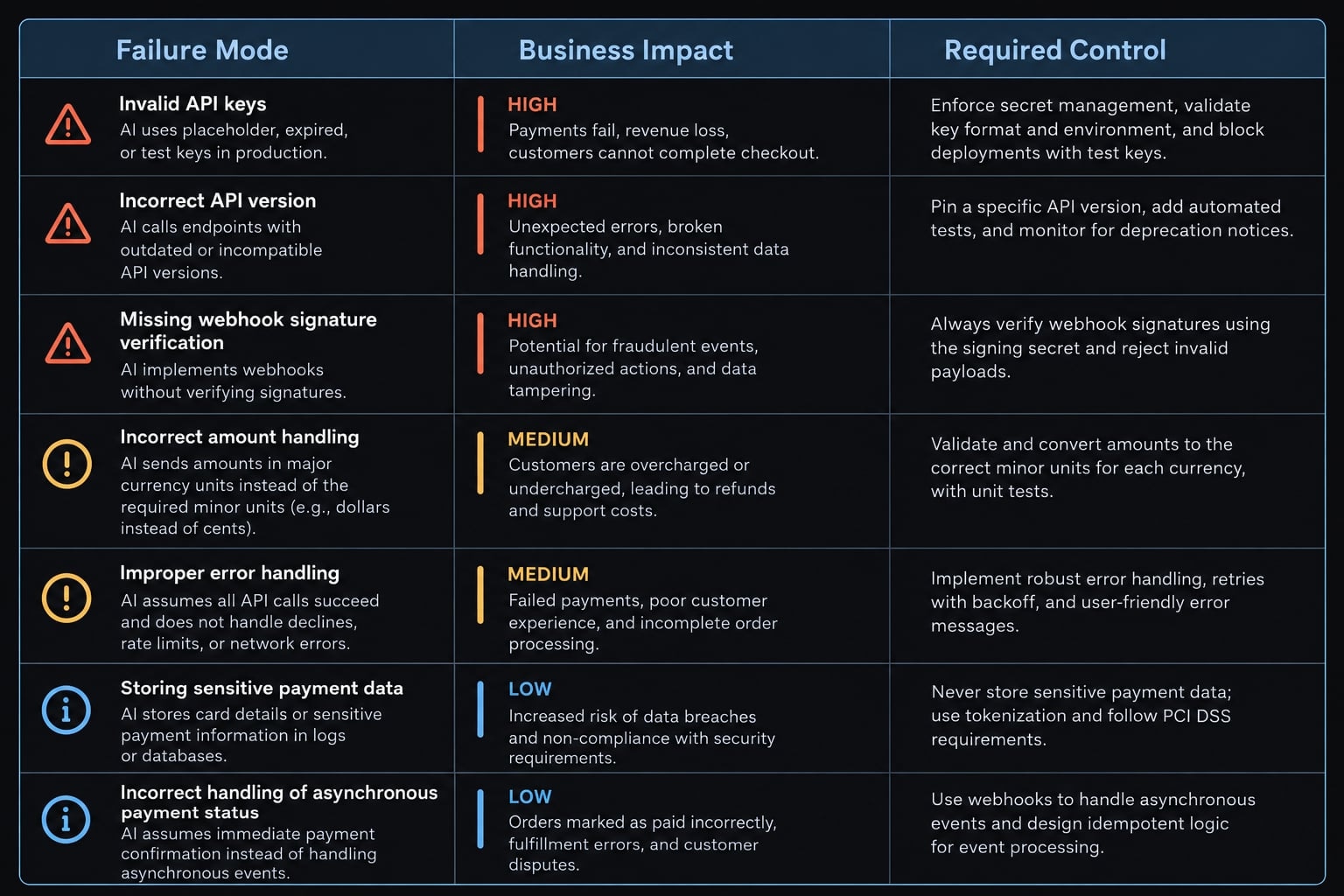
AI-generated payment code often implements the happy path first. Production defects usually emerge around payment confirmation, webhook verification, duplicate delivery, subscription states, credentials, and exceptional scenarios.
1. Trusting the checkout redirect as proof of payment
- Problem: A browser redirect confirms that the customer reached a page, not that the application safely processed the payment.
- Business impact: Customers may receive unpaid access, or paying customers may never receive the product.
- Required control: Use server-side fulfillment based on verified Stripe events rather than the browser redirect alone.
2. Missing Webhook signature verification
- Problem: The application accepts an event without confirming that Stripe sent it.
- Business impact: False events could create unauthorized access, incorrect credits, fake orders, or invalid lifecycle changes.
- Required control: Follow Stripe’s current webhook signature verification documentation, use a supported official SDK, retain the request body in the required format, isolate signing secrets by environment, and test invalid signatures.
A payment security review should block deployment if Stripe webhook verification is missing or cannot be explained by the engineering owner.
3. Processing the Same Event More Than Once
- Problem: Stripe can retry event delivery, causing the same event to reach an endpoint repeatedly.
- Business impact: Duplicate webhook events may generate repeated credits, fulfillment, emails, or CRM records.
- Required control: Use idempotent handling, meaning repeated processing produces no additional operational effect. The application should recognize previously handled event identifiers.
Stripe’s webhook documentation should remain the authority for current delivery behavior and retry guidance.
4. Treating Subscriptions as Active or Inactive Only
- Problem: Binary subscription logic ignores trials, payment failures, cancellations, pauses, and plan changes.
- Business impact: Access may remain open too long, end too early, or reflect the wrong plan limits.
- Required control: Create explicit product entitlement logic, meaning rules that map verified subscription states to product access.
State or scenario | Product question |
|---|---|
Trial | Is access full, limited, or time-bound? |
Active | Which plan, seats, and limits apply? |
Past due or unpaid | Is there a grace period? |
Canceled | When should access end? |
Plan change | When do new entitlements begin? |
Paused | What remains accessible? |
Teams should verify terminology against Stripe’s current subscription lifecycle documentation.
5. Exposing or mixing credentials
- Problem: AI-generated configuration may mix test and live environments or place secrets in unsafe locations.
- Business impact: Transactions may reach the wrong environment, while exposed credentials can allow unauthorized activity.
- Required control:
- Separate publishable and secret keys correctly.
- Keep secret keys server-side.
- Isolate test and live configuration.
- Exclude keys from repositories, prompts, logs, screenshots, and client bundles.
- Apply least-privilege permissions.
Publishable and secret keys do not carry equal sensitivity, but both require correct placement and environment management.
6. Testing only the happy path
- Problem: The team validates one successful transaction and assumes the workflow is complete.
- Business impact: Failures become visible only after revenue, access, support, and internal records have already diverged.
- Required control: Test successful, failed, and delayed payments; duplicate events; webhook retries; cancellations; plan changes; refunds; and internal fulfillment failures after Stripe accepts payment.
Failure-mode summary
Failure mode | Typical generated mistake | Business impact | Required control |
|---|---|---|---|
Redirect trusted as payment proof | Access granted in the browser flow | Incorrect or missing access | Verified server-side fulfillment |
Signature not verified | Any event is accepted | False orders or credits | Official signature verification |
Event processed repeatedly | Every delivery triggers actions | Duplicate fulfillment | Idempotent event handling |
Binary subscription logic | Only active/inactive recognized | Incorrect entitlements | Approved state-to-access mapping |
Credentials mixed or exposed | Secrets copied into unsafe configuration | Security and environment failures | Secret isolation and review |
Happy path only | Exceptional states remain untested | Revenue and support disruption | Failure-state test suite |
Each control should be treated as part of production approval, not as optional cleanup after launch.
A safe prototype-to-production workflow for stripe
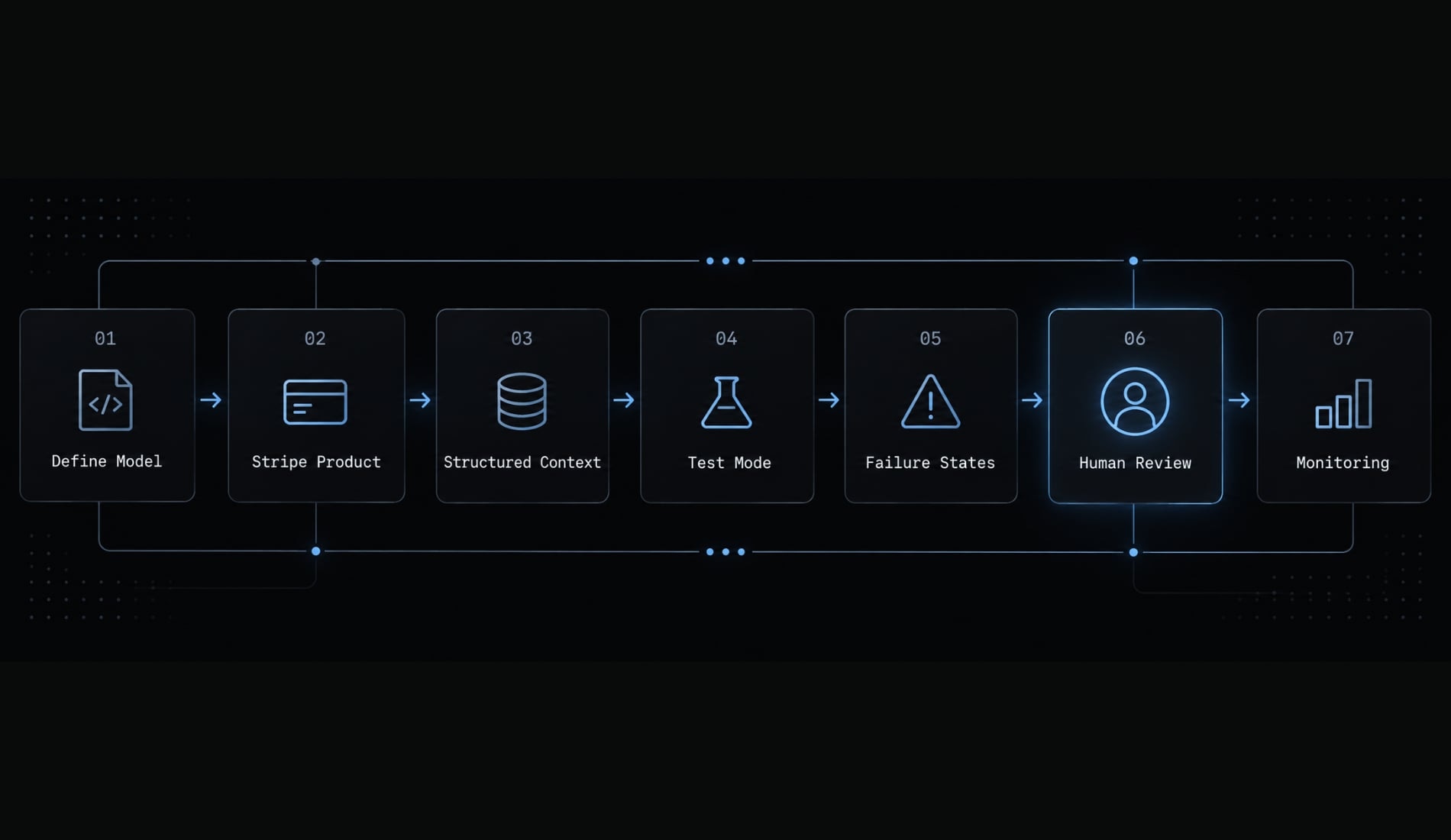
The safest answer to how to build Stripe billing with AI agents is a controlled seven-stage process:
- Define the commercial model.
- Select the least complex Stripe product.
- Give the AI agent structured context.
- Build in Stripe test mode.
- Test failure states and retries.
- Conduct human code and business-logic review.
- Deploy with monitoring and rollback controls.
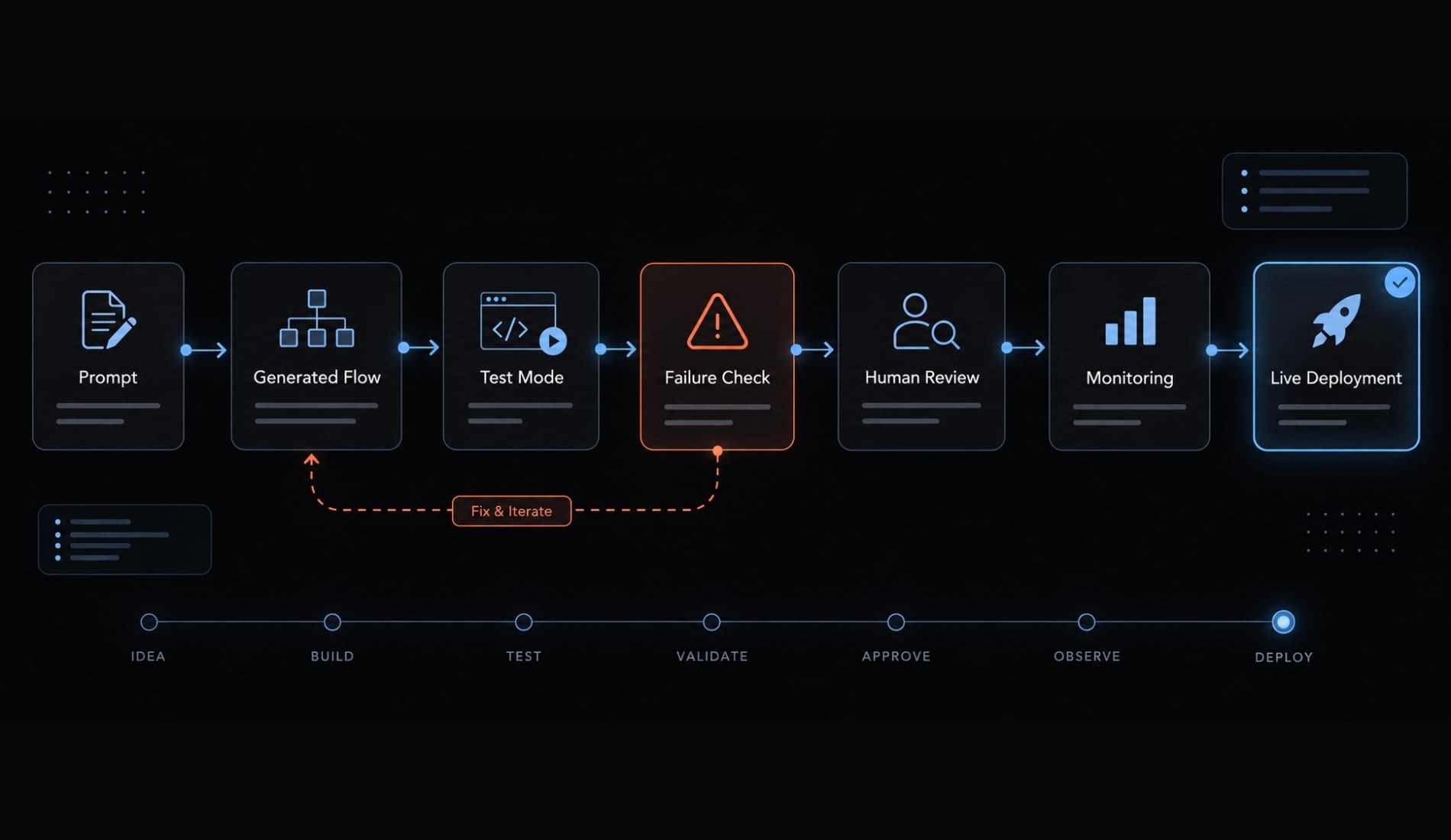
Step 1: Define the commercial model before generating code
Document whether the product uses a one-time purchase, fixed subscription, usage-based billing, or prepaid credits. Define trials, cancellations, refunds, failed-payment behavior, and product access before asking an agent to implement them.
Assign each source of truth, meaning the authoritative system for a specific record:
- Stripe is the payment and billing source of truth.
- The application database is the product entitlement source of truth.
- Synchronization must be explicit, monitored, and testable.
Step 2: Select the least complex stripe product
Use a simple decision tree:
- Need to validate payment demand: Use Payment Links.
- Need a standard hosted flow: Use Checkout.
- Need recurring plans or metering: Use Billing.
- Need unique interface control: Consider the Payment Element or a custom flow.
Document why additional complexity is necessary. Customization should solve a measurable business requirement, not merely demonstrate technical capability.
Step 3: Give the AI agent structured context
Provide:
- Application framework.
- Supported Stripe SDK or integration method.
- Commercial and pricing model.
- Required payment and subscription events.
- Product entitlement rules.
- Expected failure behavior.
- Test environment.
- Logging and security constraints.
- Requirement to use current official documentation.
Require an implementation plan before code. Never include live keys, customer payment data, personal records, or credential screenshots in prompts.
Step 4: Build in stripe test mode
- Use test keys, products, and prices.
- Configure a test webhook endpoint.
- Complete standard payment and subscription scenarios.
- Separate test and live configuration.
- Record every event the application expects to handle.
Stripe’s testing documentation explains supported test scenarios. Stripe test mode is necessary but insufficient for production approval.
Step 5: Test failure states and retries
Validate:
- Failed or delayed payment.
- Duplicate event delivery.
- Webhook retry.
- Cancellation or plan change.
- Refund or dispute where relevant.
- Internal application failure after payment acceptance.
- Mismatch between Stripe and application records.
Both the customer-facing experience and internal records must remain correct.
Step 6: Conduct human code and business-logic review
An accountable reviewer must explain:
- How checkout or billing begins.
- How payment is confirmed.
- How access is granted.
- How repeated events are handled.
- How failed payments affect access.
- Where credentials are stored.
- How refunds and cancellations affect customers.
- Which unresolved conditions block deployment.
Deployment must stop when no human owner understands the end-to-end financial logic.
Step 7: Deploy with monitoring and rollback controls
Activate production webhook monitoring, failed-event alerts, Stripe-to-application reconciliation, and a feature-disable or rollback procedure. Manually review the first real transactions even after extensive test-mode validation. Convert every production correction into an automated regression test.
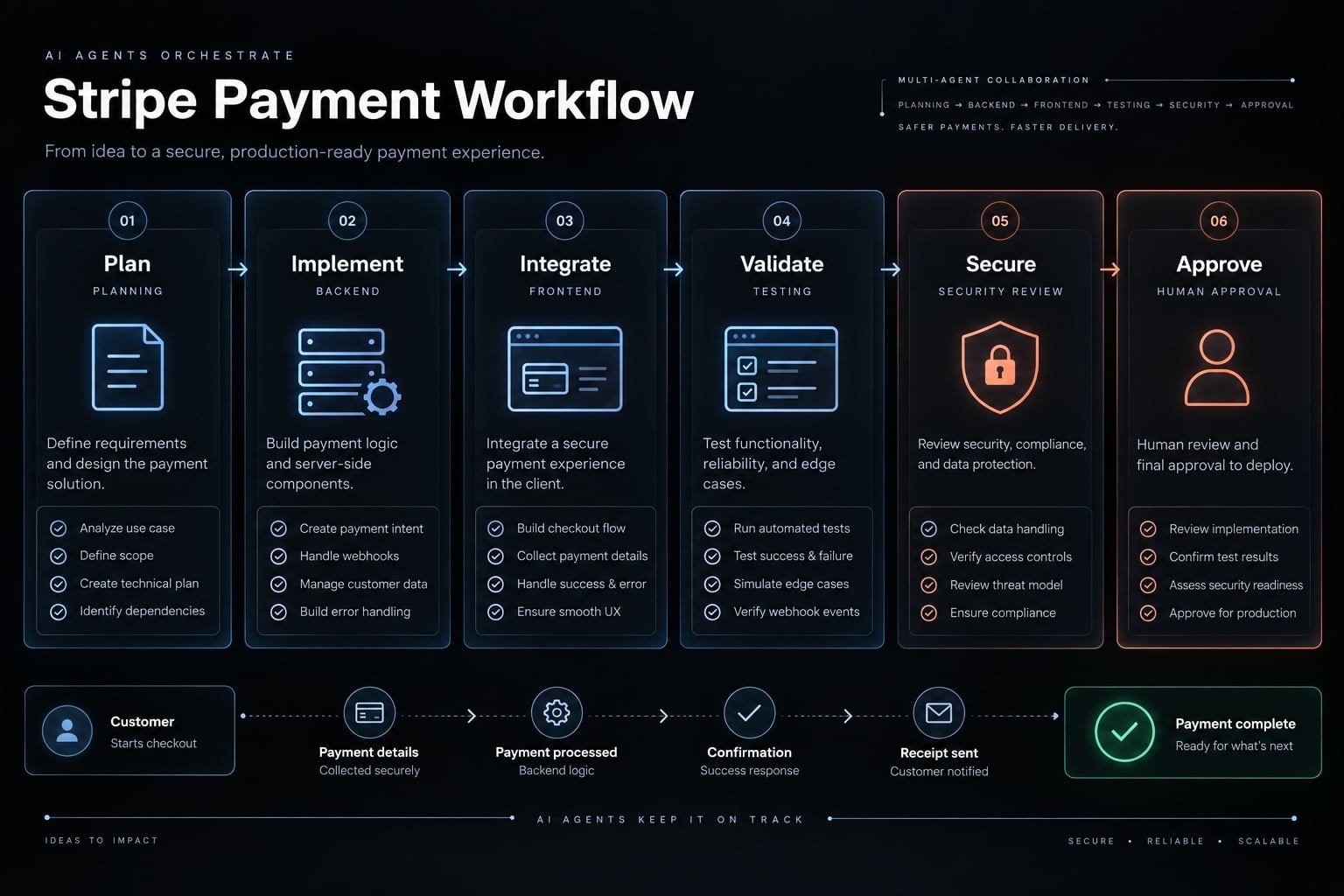
How coordinated agents can make the workflow more reliable
One-shot vibe coding may produce a working feature while overlooking billing assumptions, tests, credentials, or deployment requirements. Coordinated AI agents make responsibilities visible, but additional agents do not automatically create safer code.
An illustrative AgentKit Stripe workflow can separate the work:
- A planning agent defines the Stripe product and billing states.
- A backend agent implements server-side payment and event handling.
- A frontend agent adds pricing and purchase initiation without exposing secrets.
- A test agent covers success, failure, retries, duplicates, and cancellations.
- A security reviewer checks credentials, permissions, logs, and webhook verification.
- A human owner approves financial logic, live credentials, and deployment.
AgentKit can help teams preserve reusable Stripe skills, standardize plans, coordinate specialized agents, run an automated testing workflow, and structure AI code security checks. It remains an orchestration layer—not a payment processor, compliance guarantee, or autonomous financial decision-maker.
AgentKit can help with | Human owners must still control |
|---|---|
Reusable implementation skills | Pricing and billing policy |
Coordinated planning and development | Refund and cancellation rules |
Test generation and execution | Production credentials |
Security and configuration checks | Final code review |
Workflow documentation | Deployment approval and financial accountability |
The operational benefit is repeatability and role separation. Production accountability remains with the founder, engineering owner, security reviewer, and finance or operations owner.
Vibe-coded stripe production-readiness checklist
This Stripe production checklist is a launch gate, not a list of optional recommendations. Unresolved credential, webhook, fulfillment, or entitlement issues should block live deployment. It does not replace an expert security, legal, tax, or compliance review.
Billing and product rules
- Payment model and pricing rules are documented.
- Product access maps to verified payment or subscription states.
- Trial, failed-payment, cancellation, and refund behavior are defined.
- Usage measurement and credit rules are documented where applicable.
- Stripe and the application have assigned sources of truth.
- A named human owner approves pricing and entitlement logic.
Webhooks and fulfillment
- Webhook signatures are verified with an official supported method.
- Fulfillment does not rely only on browser redirects.
- Duplicate events are processed safely.
- Failed webhook deliveries are visible and retryable.
- Event processing is traceable.
- Logs exclude secrets and unnecessary customer data.
Security and credentials
- Secret keys exist only in protected server-side environments.
- Test and live credentials are separated.
- Signing secrets are environment-specific.
- Keys and customer data are excluded from AI prompts.
- Keys are excluded from repositories, client bundles, screenshots, and logs.
- Account and API permissions follow least-privilege principles.
Testing and release
- Success, failure, delay, retry, and duplicate scenarios have been tested.
- Subscription changes, cancellations, and refunds have been validated.
- Stripe and application records have been reconciled.
- A human reviewer can explain the complete payment flow.
- Production monitoring and alerting are active.
- A rollback or feature-disable procedure exists.
- Initial live transactions will be reviewed manually.
Launch blocker: Any unresolved critical item involving credentials, verified events, payment confirmation, product access, or refunds must block deployment.
Download the Stripe production-readiness checklist to use as a repeatable approval gate for AI-generated code review and Stripe deployment testing.
Frequently asked questions
What is "vibe coding Stripe" integration?
"Vibe coding Stripe" refers to the practice of using AI coding agents and natural language prompts to rapidly generate payment and billing logic for applications. While it enables fast prototyping, production-ready integration requires human oversight to ensure security, webhook verification, and robust handling of subscription lifecycle events.
Is AI-generated Stripe code production-ready by default?
No. AI agents can generate functional code for "happy path" scenarios (like a single checkout), but they often overlook production-critical requirements. To ensure safety, you must manually implement webhook signature verification, failure-state testing, duplicate event handling, and secure credential management before deploying to a live environment.
What are the most common failures in AI-generated Stripe integrations?
Common failures include: trusting browser redirects instead of server-side events, failing to verify webhook signatures, processing duplicate events (causing double credits), and mismanaging subscription states. These issues can result in incorrect product access, revenue leakage, and severe security vulnerabilities if left unaddressed.
Which Stripe workflows are best suited for AI-assisted development?
Start with the least complex solution that fits your business model. Use Stripe Payment Links for demand validation, Stripe Checkout for standard transactions, and Stripe Billing only when recurring or usage-based logic is required. Avoid custom payment UIs unless they provide measurable business value, as they significantly increase testing and maintenance requirements.
How do coordinated agents improve the reliability of Stripe implementations?
Coordinated agents allow you to separate responsibilities: a planning agent can define billing logic, a backend agent implements the API, a test agent handles edge cases, and a security agent performs configuration checks. This structured approach helps ensure that human reviewers are checking defined boundaries rather than raw, unverified code.
What is the safest way to transition from prototype to production?
Follow a rigorous workflow: define your commercial model first, build in Stripe test mode, test all failure states (retries, refunds, disputes), and conduct a human-led code and logic review. Finally, deploy with active production monitoring and a clear rollback plan to ensure that any financial logic issues can be addressed immediately.
Read more:
- Vibe coding product spec: Build faster with AI clarity
- Vibe coding tools: How to choose the right AI app builder
- How to vibe code a landing page that actually converts
Conclusion
Vibe coding Stripe is useful for accelerating implementation and iteration. Lovable demonstrates AI-product monetization, Levels.io shows operational automation, and Stripe Minions illustrates agent-assisted engineering under human review. None of these cases supports skipping verification, failure testing, monitoring, or accountable approval.
A production-ready payment workflow requires verified events, protected credentials, explicit entitlement rules, duplicate-event controls, failure-state testing, reconciliation, and operational monitoring. AI agents can support each stage, but financial accountability remains human-in-the-loop.