Enterprise vibe coding: Benefits, risks, and governance guide
Enterprise vibe coding: Benefits, risks and production controls
Enterprise vibe coding speeds up prototyping, but it doesn't eliminate the need for security, correctness, and long-term maintainability. True adoption requires shifting from viewing AI as a simple productivity tool to managing it as a strategic software operating model. By establishing clear delivery frameworks, defining production evidence, and standardizing governance, organizations can safely capture the speed of AI development while retaining full accountability for the code they ship.
What is enterprise vibe coding?
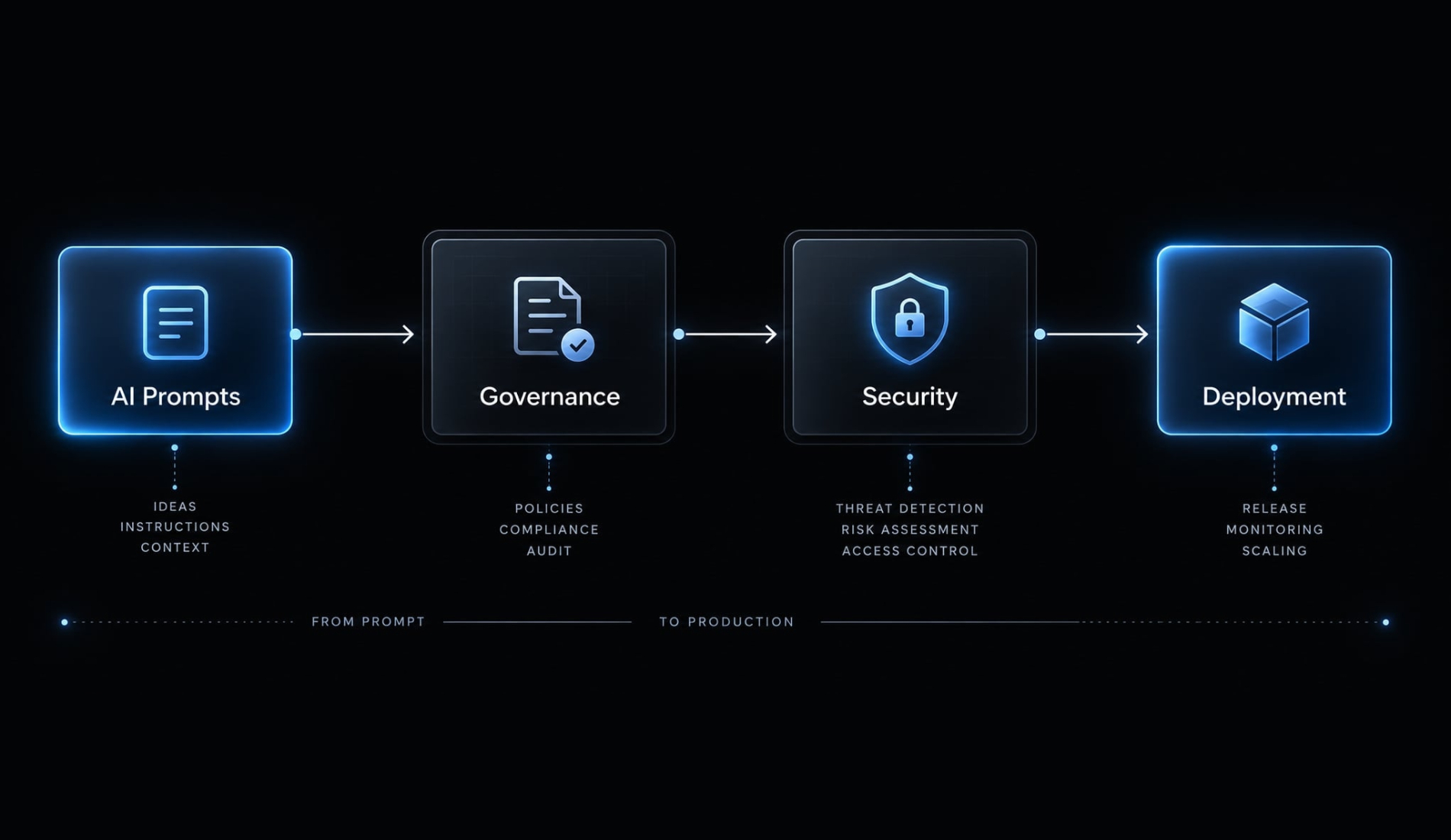
Enterprise vibe coding is an emerging, loosely used label for creating software through natural-language intent and AI-generated implementation within an enterprise context. As a practical working definition, it includes experimentation and agent-driven development, while production use requires explicit controls for review, access, testing, deployment, ownership, and maintenance.
The qualification matters. Andrej Karpathy’s February 2, 2025 commentary defined vibe coding as a workflow where the user speaks to the AI in natural language without heavily inspecting or writing raw code. Adding accountable review and lifecycle controls moves enterprise practice toward governed AI-assisted development, rather than preserving that original approach unchanged.
Vibe coding vs. AI-assisted engineering
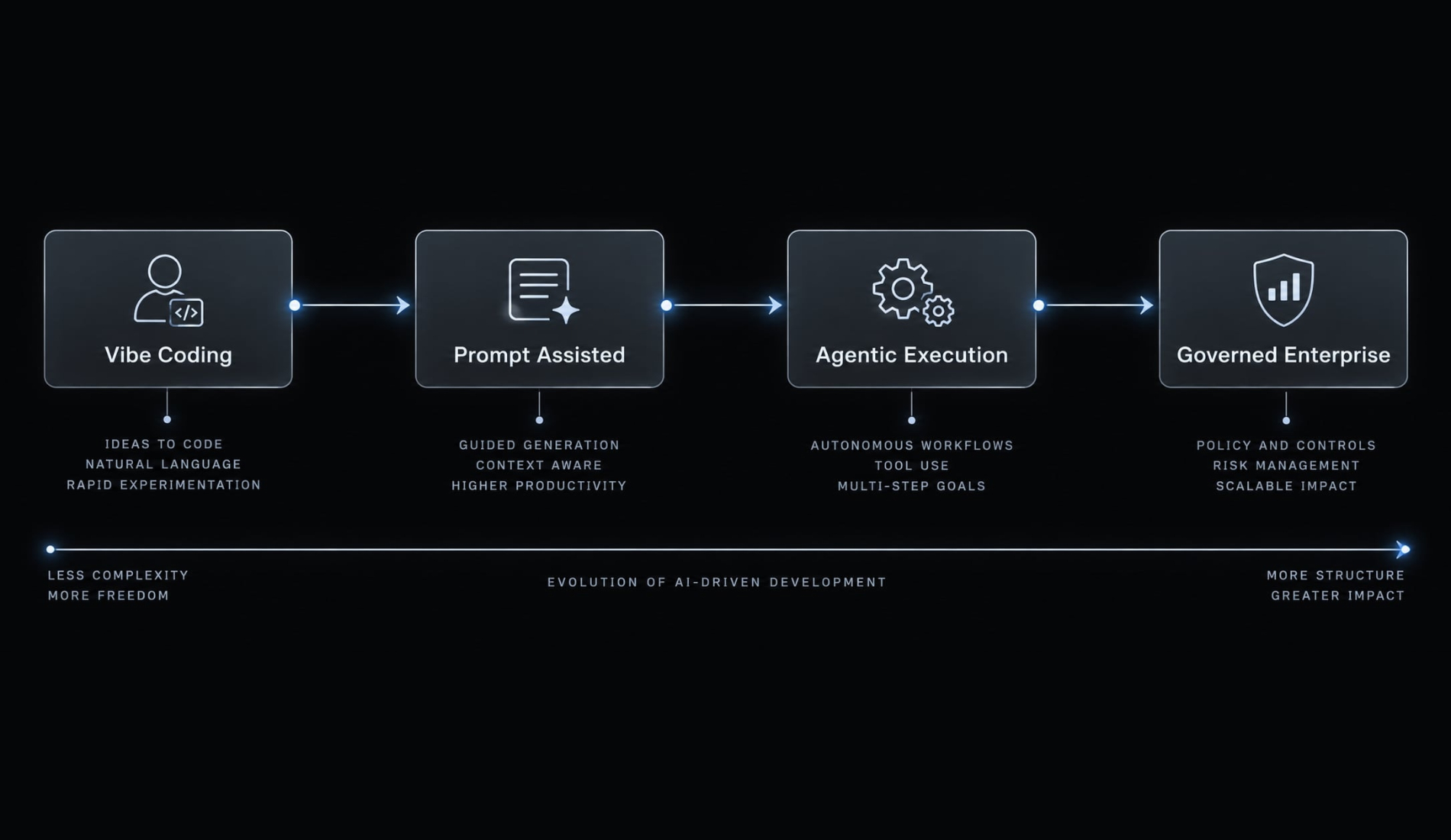
These are overlapping operational modes, not sequential stages in a maturity ladder. Agentic coding means agents execute development tasks; autonomy alone does not determine human understanding or production suitability.
Mode | AI contribution | Autonomy | Human understanding | Production condition |
|---|---|---|---|---|
AI autocomplete | Suggestions | Limited | Still requires inspection | Review and testing |
Prompt-assisted implementation | Requested changes | Variable | Depends on review | Validated changes |
Agentic task execution | Multistep tasks | Potentially broad | Must be established | Scoped execution, approval |
Vibe-coded prototyping | Intent-led iteration | Variable | Often limited | Reassessment before release |
Governed enterprise AI development | Any combination | Risk-limited | Accountable maintainers | Evidence-based gates |
Human-in-the-loop review requires a qualified person with authority to reject changes - not merely acknowledge generated output.
Consumer vs. Enterprise vibe coding
Enterprise software development introduces continuing obligations. Buying an enterprise license does not establish them.
Area | Typical experimental workflow | Enterprise requirement |
|---|---|---|
Objective | Explore feasibility | Deliver supported outcomes |
Data | Mock or local records | Classified, approved access |
Review | Builder judgment | Accountable review |
Testing | Demonstration paths | Risk-based acceptance evidence |
Deployment | Convenient hosting | Controlled release, rollback |
Identity | Individual access | Appropriate SSO and RBAC |
Ownership | Original builder | Business and technical owners |
Auditability | Informal history | Traceable decisions and changes |
Maintenance | Optional continuation | Support through retirement |
SSO means single sign-on; RBAC means role-based access control. Neither independently establishes application security. Experimental workflows can also adopt strong controls; the comparison describes operating expectations, not universal tool limitations.
Enterprise vibe coding: Real benefits vs. The speed myth
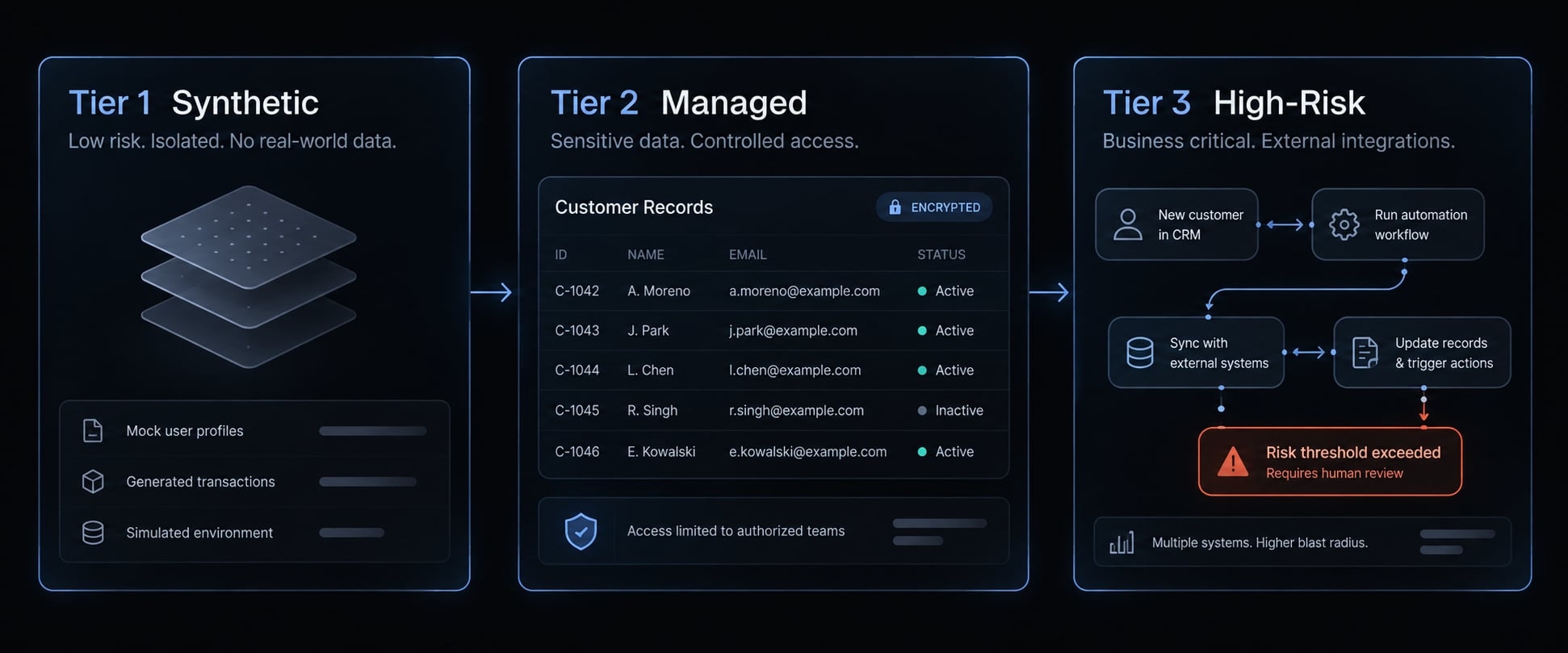
Time to first demo is not time to approved release. A faster implementation creates value only if validation, correction, deployment, and support do not consume the gains.
Where the business value comes from
Potential benefits include:
- Faster process validation: Test workflows before funding integration.
- Reduced boilerplate: Redirect engineering attention toward consequential decisions.
- Shorter requirement-to-prototype cycles: Resolve misunderstandings earlier.
- Bespoke internal applications: Address narrow needs underserved by existing software.
- Bounded legacy modernization: Improve isolated components without uncontrolled system changes.
- Reduced central engineering backlog: Delegate constrained work while retaining technical ownership.
Illustrative scenario: A B2B software company prototypes an account-health dashboard using synthetic records. Customer-success managers validate useful signals before engineers connect approved customer data. Earlier feedback can improve time to value without bypassing engineering.
Why faster generation does not automatically mean higher productivity
Implementation effort may shift into review and correction rather than disappear.
Comprehension debt is a useful analytical term for the gap between software an organization operates and software its maintainers can confidently explain, change, and recover. Unlike technical debt, it can exist even when code is structurally reasonable. The liability becomes visible during debugging, ownership transfer, and long-term maintenance.
Development productivity therefore depends on accepted outcomes. A plausible interface may conceal misunderstood business rules, expensive dependencies, or missing recovery procedures. Evaluate those costs before claiming a delivery improvement.
A better enterprise scorecard
Compare similar tasks using consistent boundaries. Track nine key measures:
Metric | Measurement definition |
|---|---|
Release lead time | Accepted requirement to approved production release |
Review effort | Reviewer hours per accepted change |
Rework effort | Correction hours per accepted change |
Escaped defects | Production defects within a stated observation window |
Security findings | Severity, scope, and unresolved status |
Change failure rate | Failed releases divided by all scoped releases |
Recovery time | Restoration time for defined incident classes |
Maintenance and handoff | Support, documentation, and transfer hours |
Cost per accepted production change | Scoped labor, tooling, model usage, and rework |
Count each cost once; correction labor must not appear in both general labor and an additional rework charge. Record task complexity and reviewer availability alongside results.
Where enterprise vibe coding works and where it should be restricted
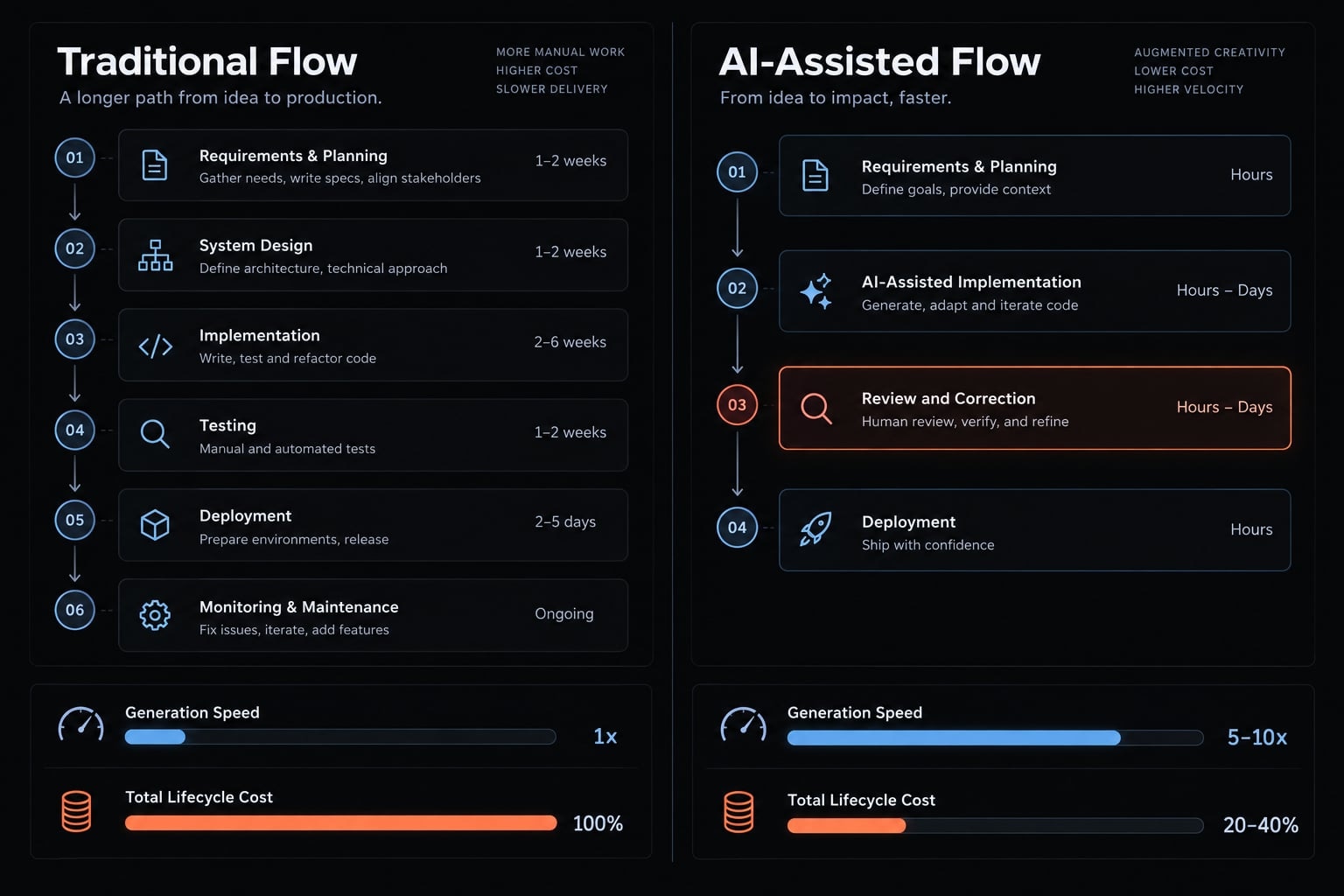
Classify the workload, not the tool. This practical three-tier framework considers application criticality, sensitive data, permissions, and consequences. It is a decision aid, not a regulatory classification.
Tier 1: Low-risk experimentation
Suitable candidates include disposable mock interfaces, synthetic-data demonstrations, and isolated scripts without sensitive access.
Minimum controls include:
- Approved tools and isolated execution.
- No production credentials.
- Basic functional validation.
- A named builder and disposal date.
The illustrative dashboard begins here only while it uses synthetic records and remains isolated. A read-only application can expose confidential information. A public microsite also requires reassessment if scripts, data collection, or integrations increase exposure.
Tier 2: Managed-risk internal applications
Connecting the dashboard to approved customer records changes its obligations, even without write access.
Require:
- Named business and technical owners.
- Version control and code review.
- Risk-appropriate testing and staging.
- Scoped data access.
- SSO and RBAC where applicable.
- Monitoring, rollback, and maintenance responsibility.
“Internal” does not mean low consequence. Customer records can require stronger handling restrictions, while incorrect account-health signals can distort commercial decisions. Test those business rules directly; code-coverage percentages do not establish correctness.
Tier 3: High-risk or restricted systems
Payments, authentication, sensitive-data processing, regulated workflows, and safety-critical systems require stronger scrutiny. So do core revenue services, irreversible actions, and deeply coupled integrations.
Qualified engineers may use AI assistance. However, autonomous architecture, permission changes, and release decisions should face strict restrictions. Some workflows should remain outside autonomous vibe coding entirely.
If the dashboard begins writing account status into a CRM (customer relationship management system), reassess downstream effects. Writes that trigger consequential customer actions may justify Tier 3. Require threat modeling - identifying plausible threats and defenses - plus architecture review, appropriate security validation, and accountable approval.
Enterprise use-case decision matrix
Factor | Lower-exposure condition | Escalation trigger |
|---|---|---|
Data sensitivity | Synthetic records | Confidential or regulated data |
Business criticality | Optional experiment | Revenue or essential operations |
User exposure | Isolated testers | Customers or broad access |
Integration scope | Disconnected environment | Privileged, coupled systems |
Failure consequences | Reversible inconvenience | Material loss or harm |
Lifespan | Scheduled disposal | Persistent dependency |
Reviewer availability | Qualified owner available | No competent reviewer |
Operational complexity | Simple recovery | Continuous service, difficult restoration |
One severe factor can justify escalation; benign factors do not cancel high-consequence exposure. Missing reviewers may block delivery rather than merely increase its classification.
The risks are broader than insecure code
Correctness, security, maintainability, reliability, and accountability require separate evaluation. Agent permissions cut across all five dimensions, expanding what a development mistake can affect.
Security, data and access risk
Pair concrete failures with controls:
- Exposed credentials → secrets management and detection.
- Weak authorization → least privilege and access review.
- Unsafe dependencies → approved components and software supply chain scanning.
- Excessive agent access → scoped tools and audit logs.
- Data leakage → approved processing boundaries.
MCP (Model Context Protocol) connects models or agents to external tools and resources. MCP security depends on implemented permissions, not the protocol label. Malicious instructions in repositories or tool outputs can also influence agents.
OWASP’s Top 10 for Large Language Model Applications, 2025, specifically Prompt Injection and Excessive Agency, supports examining these exposures.
Quality and correctness risk
The illustrative dashboard’s automation might pass a demonstration but apply the wrong approval rule to strategic accounts.
Ambiguous requirements and untested exceptions create errors that security scanners cannot resolve. AI-generated tests remain useful, but may reproduce implementation assumptions. Business owners must define acceptance criteria independently, including special account categories and prohibited outcomes.
Technical debt and comprehension debt
Duplicated logic, unexplained design decisions, and unreviewed dependencies make debugging and ownership transfer harder.
Address comprehension debt through focused design records and maintainer walkthroughs. Ask the receiving engineer to explain critical behavior and demonstrate a safe change. A model update does not automatically modify deployed code. The concern is lost context and unreliable future modification - not spontaneous changes to running software.
Shadow AI and shadow operations
Shadow AI concerns unapproved AI use. Shadow operations describes unmanaged applications that quietly become critical business dependencies.
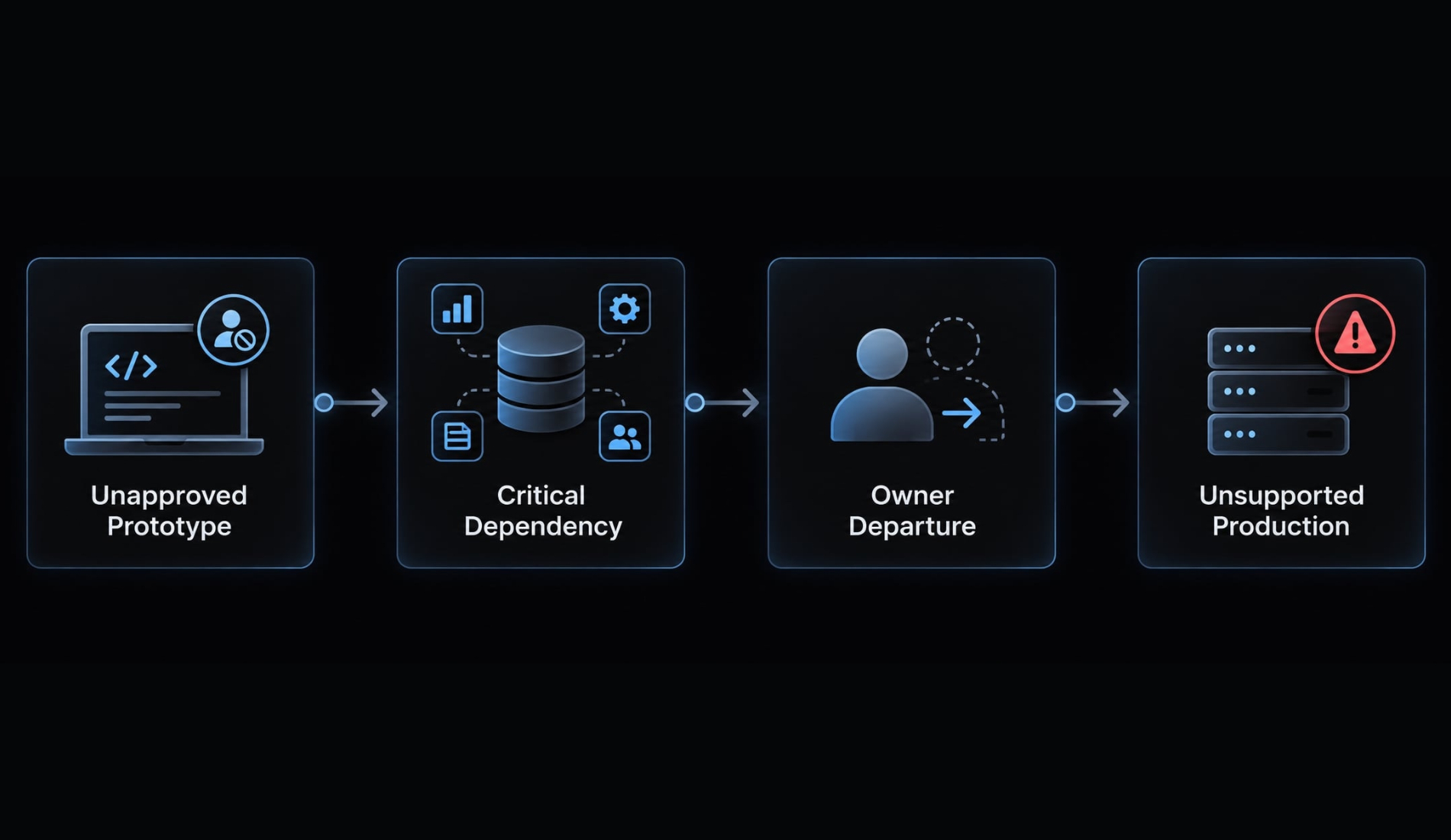
In an illustrative extension of the dashboard scenario, an employee adds a scheduled CRM synchronization job. Other teams depend on its updates. The employee changes roles, leaving credentials, alerts, and support responsibilities undocumented.
An approved AI tool can still produce shadow operations. Prevent that outcome through application inventory, named ownership, credential lifecycle management, and decommissioning controls.
Risk-control summary
Risk | Accountable role | Control evidence |
|---|---|---|
Security | Security owner | Access reviews, findings disposition |
Correctness | Business owner | Approved acceptance results |
Maintainability | Technical owner | Design review, demonstrated handoff |
Reliability | Operating owner | Monitoring, rollback, recovery exercise |
Accountability | Service owner | Inventory, approvals, retirement plan |
Agent permissions: cross-cutting | Platform owner | Scoped identities, tool-call records |
CISA’s Shifting the Balance of Cybersecurity Risk: Principles and Approaches for Secure by Design Software, updated October 2023, emphasizes ownership of customer security outcomes. A passed scan is only one input to that responsibility.
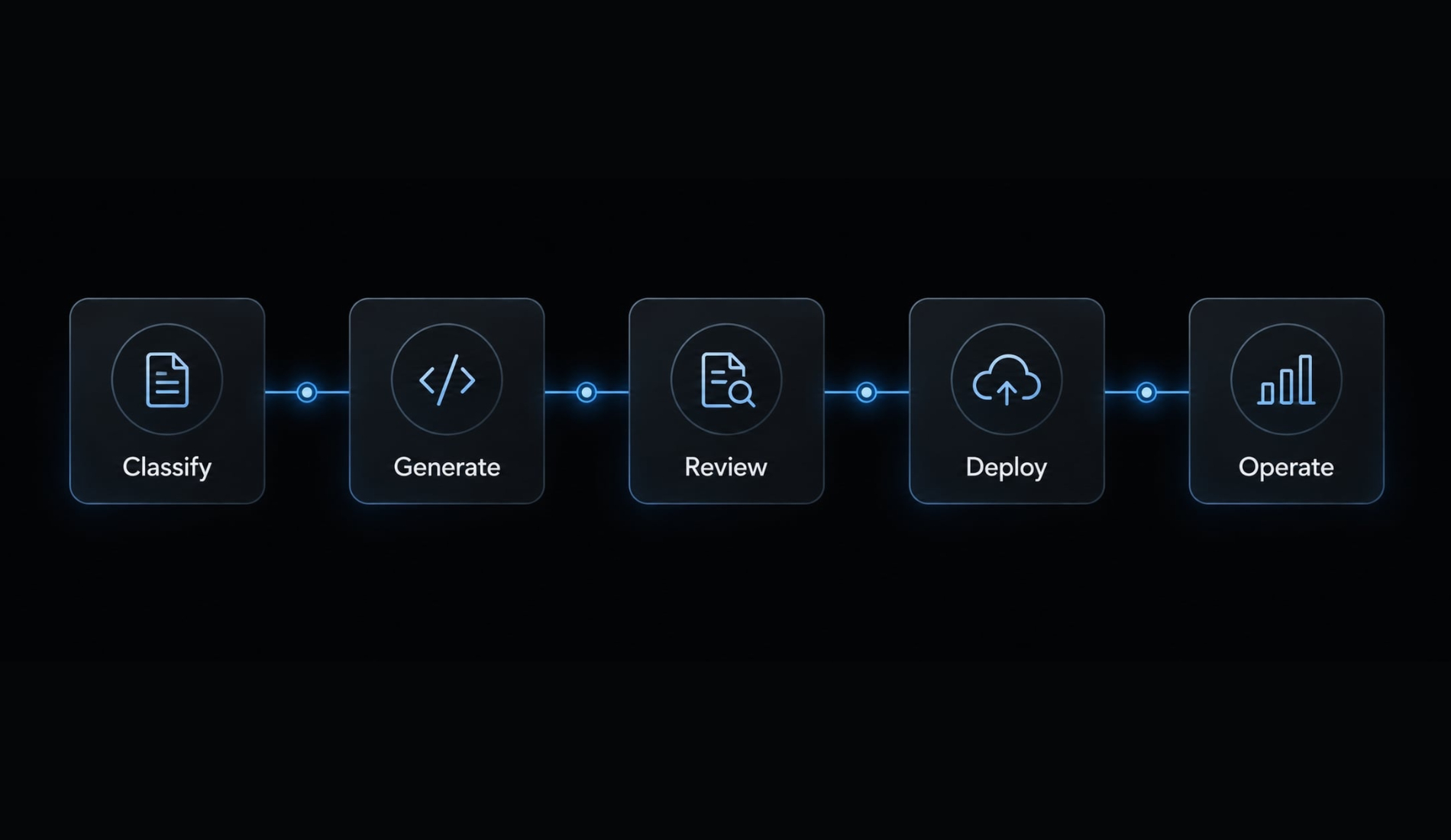
A five-stage framework for production-ready enterprise vibe coding
Governance must begin before generation and continue after release:
- Classify.
- Generate within constraints.
- Review and test.
- Deploy through controls.
- Operate, maintain, transfer, and retire.
Apply controls proportionally to risk. NIST’s Secure Software Development Framework, Version 1.1, February 2022, supports lifecycle practices; alignment is guidance, not application certification.
Stage 1: Classify the use case before code generation
Record business purpose, lifespan, data classification, user exposure, and failure impact. Distinguish read, write, and delete permissions.
Assign a risk tier, business owner, and technical owner. Specify prohibited actions and integrations before implementation starts. Application ownership must survive the original builder’s departure.
Required output: A recorded use-case assessment establishing ownership and boundaries. Reclassify the dashboard before customer-data access or CRM writes - not after deployment.
Stage 2: Generate within approved constraints
Approve tools, models, repository boundaries, architecture patterns, and scoped MCP integrations. Prefer read-only access when writes are unnecessary, while recognizing confidentiality risks.
Keep raw production credentials out of prompts and context. Use managed secrets and retain change provenance - traceable origins and modifications - within data-handling and retention rules.
Required output: Approved tool configuration and access boundaries. Natural-language instructions are not enforced permissions. Identity, repository, tool, and infrastructure controls must make prohibited actions unavailable.
Stage 3: Review and test independently
Require evidence appropriate to consequences:
- Acceptance criteria defined separately from implementation.
- Qualified human review.
- Unit, integration, and acceptance tests.
- Static analysis of code without executing it.
- Dependency and secret scanning.
- Threat modeling where justified.
- Maintainer explanation of critical modules.
Required output: Review records, test results, findings, and their disposition. A second agent can assist, but a different role label does not establish independent judgment. Reviewers must challenge business assumptions, not simply confirm that tests pass.
Stage 4: Deploy through controlled environments
Separate development, staging, and production. Use managed credentials, appropriate identity controls, and CI/CD (continuous integration and delivery) approval gates.
Maintain protected release records, usable rollback procedures, and incident responsibilities. Apply network isolation where exposure warrants it.
Required output: An approved release record and usable rollback procedure. Distinguish software generated during development from applications executing generated or user-submitted code at runtime. Runtime execution requires additional isolation.
Stage 5: Operate, maintain, transfer and retire
Monitor availability, errors, access, and intended business outcomes. Assign maintenance responsibility, review dependencies, and preserve architecture and operational documentation.
Reassess risk when permissions, data, users, or business importance change. Define support expectations and retirement criteria before the application becomes indispensable.
Required output: An operating owner, monitoring evidence, support expectations, and retirement plan.
Production-readiness gate
Use this evidence table as the baseline for an Enterprise Vibe Coding Production-Readiness Checklist:
Area | Evidence to inspect |
|---|---|
Ownership | Named business, technical, and operating owners |
Requirements | Approved outcomes, exclusions, acceptance criteria |
Code | Versioned changes and review records |
Testing | Results mapped to requirements and exceptions |
Security | Assessment scope, findings, disposition |
Data | Classification, processing boundaries, retention rules |
Identity | Approved roles and access tests |
Deployment | Release approval and rollback procedure |
Observability | Working alerts, logs, response ownership |
Agent access | Scoped tools, identities, action records |
Maintenance | Support plan and demonstrated handoff |
Retirement | Owner, triggers, access-removal procedure |
Approve when applicable evidence is satisfactory; block unmet critical requirements. Permitted exceptions need an approver, rationale, compensating controls, and expiry.
From ad hoc prompts to controlled agent workflows
Isolated prompts create inconsistent instructions, artifacts, and review expectations. Repeatable workflows make work easier to inspect, but only enforced boundaries prevent agents from exceeding their assigned authority.
The controlled agent operating model":
Role | Responsibility | Required boundary |
|---|---|---|
Planning | Requirements and task plan | No production-change permissions |
Development | Scoped implementation | Restricted repository access |
Testing | Validate expected behavior | Protected, independently approved acceptance criteria |
Review | Inspect changes and assumptions | Read-only access where practical |
Security workflow | Run checks, report findings | No authority to waive failures |
Deployment workflow | Prepare and execute releases | Accountable approval for consequential changes |
Coordinated development agents still need least privilege - meaning only necessary access. Human-in-the-loop review and tool-call auditing require supporting platform controls.
Frequently asked questions
What is enterprise vibe coding?
Enterprise vibe coding is the practice of building software using conversational AI while applying security, governance, and scale controls. It transitions AI-generated code from experimental prototypes into production-ready applications by enforcing organizational standards for access, auditability, and maintenance.
How does enterprise vibe coding differ from consumer vibe coding?
The fundamental difference is the governance layer. Experimental workflows typically prioritize speed to a working app, while enterprise vibe coding adds production requirements such as role-based access control, security scanning, staging environments, and auditable ownership before any code reaches production.
What is the biggest risk of using vibe coding in an enterprise?
The primary risk is the governance gap, where AI-generated applications touch production data or systems without oversight. This leads to security vulnerabilities, shadow operations that IT cannot monitor, and comprehension debt, where systems exist in production that no team member fully understands or can maintain.
Does AI-generated code automatically meet security compliance requirements?
No. Generated code may omit security controls unless they are specified and verified. Compliance obligations such as SOC 2 or HIPAA apply to the whole system and its operation, so AI-generated code must go through the same security review, access controls, testing, and audit evidence as any other code.
How can enterprises safely scale AI-assisted development?
Enterprises should adopt a risk-proportional framework: classify the workload, generate within predefined boundaries, enforce independent human review, deploy through controlled CI/CD pipelines, and mandate clear operational ownership. This ensures that AI accelerates development without bypassing essential safety and maintenance gates.
What is "comprehension debt" in the context of AI development?
Comprehension debt occurs when an application is generated so quickly that the development team lacks a deep understanding of its architecture, logic, or dependencies. Unlike technical debt, which refers to poor code structure, comprehension debt creates significant operational risks during debugging, security audits, or future system modifications.
What is the role of human accountability in enterprise vibe coding?
Human accountability is non-negotiable. AI agents act as accelerators, but they cannot accept responsibility for software security, regulatory compliance, or business outcomes. A human engineer or manager must own the application, review the generated artifacts, and remain responsible for its performance and maintenance throughout its lifecycle.
Read more:
- AI-Assisted coding vs vibe coding: A practical comparison
- Agentic coding vs vibe coding: A practical guide for developers
- How to vibe code: A practical beginner guide to AI development
Conclusion
Enterprise vibe coding is appropriate only where workload suitability and accountable engineering support it. Low-risk experiments can tolerate lightweight controls; critical systems require stricter boundaries and may exclude autonomous execution. Production readiness includes understanding, testing, security, operation, and maintenance - not simply a convincing demonstration.
Start with one bounded use case, such as a synthetic-data dashboard. Define its owners and acceptance criteria, then measure approved delivery, review effort, rework, and operating cost. Expand permissions only when the evidence supports expansion. Tools can standardize execution, but they cannot remove human accountability.