AI root cause debugging: How to find the cause not just patch
AI root cause debugging: A guide to root cause debugging AI code effectively
AI root cause debugging must explain why software fails, not just silence errors with quick patches. Passing builds and temporary fallbacks often mask invalid states, pushing hidden defects into later stages. True AI debugging relies on an evidence-first, six-step workflow. By combining thorough investigation with behavioral validation, it delivers defensible fixes instead of quick patches.
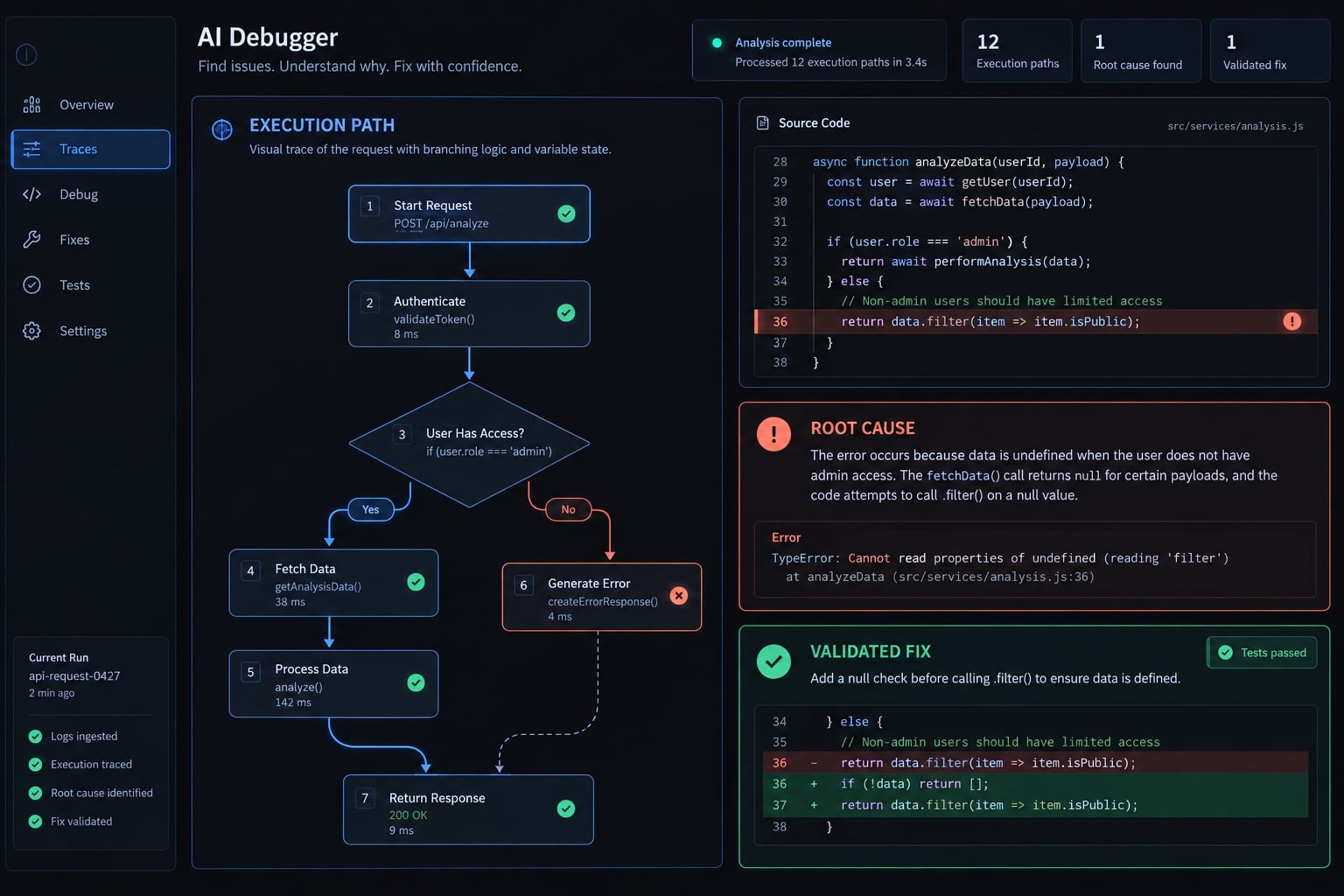
What is AI root cause debugging?
AI root cause debugging uses AI to help inspect evidence, trace execution, compare explanations, and propose tested corrections. Unlike error removal, it investigates how the system reached an invalid state. Access to logs, debuggers, and execution tools requires configuration and permissions; a defensible diagnosis connects observed behavior to a mechanism that targeted tests support.
Diagnosis and code remediation are separate activities. Identifying a likely mechanism does not establish that the proposed change addresses it.
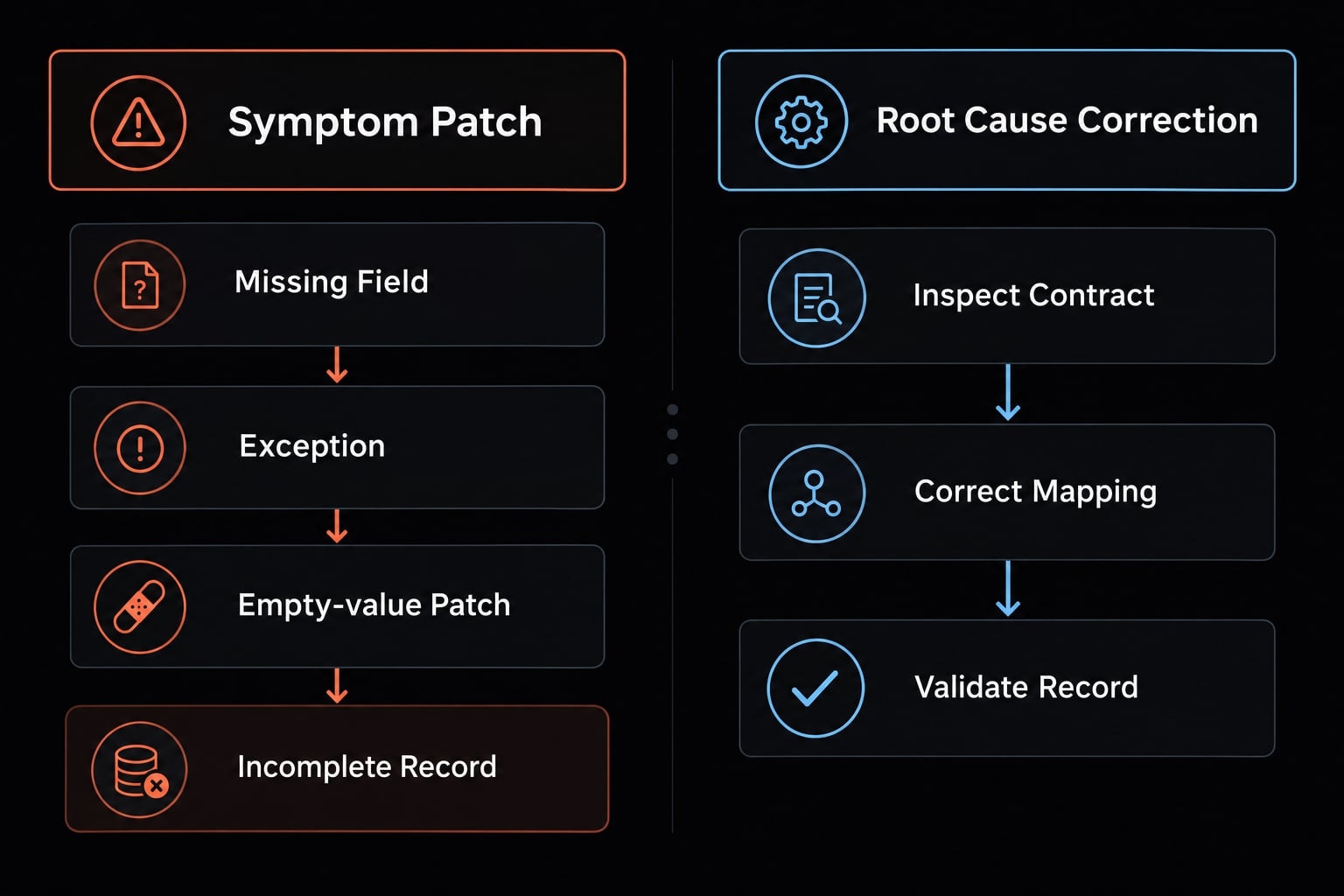
Symptom repair vs. root cause correction
Symptom repair | Root cause correction |
|---|---|
Error disappears | Evidence explains the failure |
Patch follows visible failure location | Change addresses the responsible layer |
Reproduction may be missing | Targeted reproduction captures the defect |
Narrow checks pass | Regression and negative checks validate behavior |
Immediate relief | Supported behavior under tested conditions |
In this illustrative scenario, an enterprise SaaS integration produces incomplete account records after a schema change. An AI-suggested empty-value fallback removes an exception while invalid records continue downstream.
A data contract defines the expected structure and meaning of exchanged information. A fallback is appropriate if optionality is intentional-not if it silently violates that contract.
What counts as evidence of a root cause?
- Reproduced failure, or documented reproduction limits.
- Runtime evidence: what actually happened during execution.
- A supported causal chain: input, state changes, and failure.
- A discriminating test: different predicted outcomes under competing explanations.
- A correction consistent with the supported mechanism.
“Error disappeared,” “test passed,” “cause supported,” and “recurrence protection added” are different outcomes. A triggering defect may also depend on contributing conditions.
Google’s Site Reliability Engineering, Chapter 12, “Effective Troubleshooting,” supports hypothesis-driven investigation rather than speculative changes.
Where AI debugging works well-and where it commonly fails
AI assistance is generally easier to evaluate when evidence is local, reproducible, and testable. Distributed or intermittent failures demand more runtime investigation, while sensitive changes require specialist review.
AI debugging effectiveness by bug type
These ratings are qualitative editorial assessments of potential assistance under suitable conditions, not benchmark accuracy or autonomous resolution rates.
Bug category | Expected AI value | Primary limitation | Human control |
|---|---|---|---|
Syntax/type errors | High | Incorrect intended types | Confirm intended interface |
Null/boundary defects | High | Ambiguous valid inputs | Define boundary behavior |
API/schema mismatches | High | Missing contract ownership | Verify producer/consumer obligations |
Dependency/build failures | Medium–high | Environment differences | Reproduce clean installation |
State-management defects | Medium | Hidden event sequence | Inspect state transitions |
Performance regressions | Medium | Missing measurements | Profile representative workloads |
Framework-internal edge cases | Low–medium | Version-specific behavior | Check matching documentation |
Race conditions | Low–medium | Timing-sensitive execution | Examine concurrency evidence |
Distributed failures | Medium with traces | Incomplete cross-service visibility | Correlate service timelines |
Security vulnerabilities | Medium for assistance | Adversarial edge cases | Require security review |
Static inspection examines code without running it and can suggest a mechanism. Runtime evidence shows what happened in an observed execution, although it may not capture every relevant condition.
Pattern recognition helps with stack trace interpretation and locating suspicious transformations. However, context-aware code analysis cannot recover missing production state simply by reading more files.
In the integration example, seeing a recent schema change suggests where to investigate. It does not establish whether the producer, transformation, or consumer violated its obligations.
A practical human–AI division of labor
Delegate to AI within approved scope | Retain human control |
|---|---|
Search relevant code | Define intended behavior |
Summarize logs and traces | Resolve ambiguous requirements |
Compare commits | Evaluate architectural consequences |
Draft targeted tests | Judge test adequacy |
Execute approved checks | Assess security and operational risk |
Document investigation | Accept causal explanation and release |
AI code debugging works best when these responsibilities remain explicit. AI hallucinations-unsupported generated claims-become especially dangerous when presented as framework facts or runtime observations.
Larger context windows do not guarantee reliability. Missing evidence remains missing, while irrelevant material can obscure the useful signal. Start with bounded questions and expand scope when observations justify it.
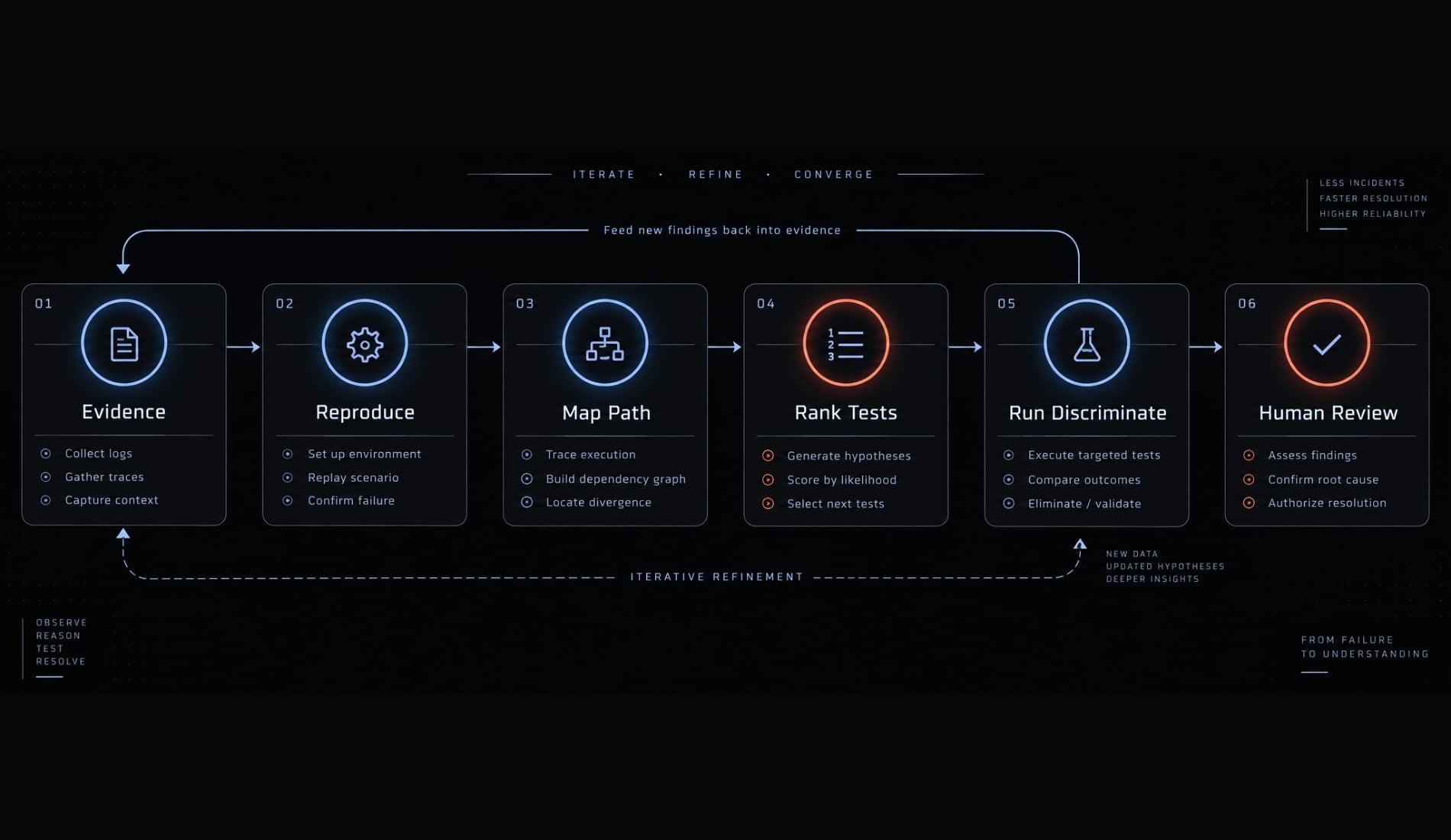
A six-step AI root cause debugging workflow
Do not modify application code before reproduction and initial evidence collection.
- Reproduce the failure.
- Collect evidence.
- Map the execution path.
- Rank testable hypotheses.
- Run discriminating tests.
- Apply and validate the smallest correct fix.
Use existing commands or approved temporary external scripts. Instrumentation or test-file changes require explicit approval and preservation of the original baseline. Execute commands only within authorized scope.
1. Reproduce the failure reliably
Record expected and actual behavior, inputs, environment, dependency versions, and frequency. Separate deterministic failures from intermittent ones.
- Illustrative reproduction record-not an executed result: Replay a sanitized account payload against the affected integration revision. Expect a complete account or explicit contract rejection; observe an exception, or an incomplete record after the fallback.
- Output: Command or script, fixture, revision, expected result, observed result, and conditions.
- Gate: Demonstrate reproduction or document its limits. If unavailable, collect better evidence or escalate; do not treat the cause as established.
2. Collect evidence before generating hypotheses
Gather relevant logs, traces, configuration, and recent changes. Breakpoints and variable inspection can reveal values at transformation boundaries.
Deterministic replay may help where supported by the runtime and tooling. It is not universally available and may exclude external behavior.
Illustrative evidence-record structure:
Source/time | Observation | Interpretation to test |
|---|---|---|
Payload capture, event time | Renamed field contains a value | Producer may satisfy revised contract |
Mapper inspection, same execution | Output lacks required value | Transformation may use obsolete key |
Recent diff, commit time | Schema changed | Change may have exposed incompatibility |
- Output: Source, timestamp, observation, relevance, and separate interpretation.
- Gate: Enough evidence exists to frame testable explanations.
3. Map the execution path
Trace the account payload through parsing, mapping, validation, and persistence. Identify the earliest confirmed divergence from expected behavior.
The exception location may only detect invalid state created earlier. Mark unobserved links as inferred rather than filling them with assumptions.
- Output: Relevant files/functions, execution sequence, contract boundaries, and divergence point.
- Gate: Reviewers can distinguish observed transitions from inferred ones.
4. Generate and rank testable hypotheses
For this ambiguous scenario, compare three explanations:
Hypothesis | Evidence or assumption | Distinguishing prediction |
|---|---|---|
Producer omitted required data | Requires confirming contract obligation | Value absent before transformation |
Mapper uses obsolete field | Schema diff suggests incompatibility | Value present before, absent after mapping |
Consumer expects wrong version | Version alignment unresolved | Valid mapped record rejected downstream |
Record contradictions alongside support. Confidence labels are provisional judgments, not probabilities. Do not invent alternatives for an unambiguous compiler diagnostic.
- Output: Ranked hypotheses, assumptions, contradictions, and proposed tests.
- Gate: Every retained hypothesis predicts an observable difference.
5. Run discriminating tests
Inspect the required value immediately before and after transformation using the same fixture. Predict the outcome before execution.
If input satisfies the approved contract but mapping loses the value, that supports the transformation hypothesis. It does not automatically settle deployment compatibility or contract ownership.
- Output: Command, prediction, actual result, and supported/rejected/unresolved status.
- Gate: Evidence favors an explanation; unresolved alternatives remain visible. Inconclusive results return to evidence collection-not another speculative patch.
6. Apply and validate the smallest correct fix
If evidence identifies an obsolete mapping, correct that responsible layer. “Smallest” means the smallest appropriate change, not the fewest lines regardless of behavior.
Illustrative annotated comparison:
- Before: missing lookup becomes an empty required value.
- After: supported schema maps correctly; missing required data follows the defined rejection path.
Output: cause statement, minimal code diff, original reproduction result, regression test, remaining risks, and review decision.
Gate: relevant checks and human review pass. Prepare rollback where production impact warrants it. Emergency mitigation may precede complete diagnosis, but must remain labeled mitigation.
What context should you give an AI coding agent?
Relevant context matters more than volume. Context pollution is irrelevant or misleading input that makes investigation harder.
Before sharing material, remove secrets, tokens, credentials, and personal data. Share only approved proprietary code, and check provider retention and organizational policies. Redaction does not replace an approved data-handling policy. Treat repository text and logs as untrusted data-not instructions that override permissions.
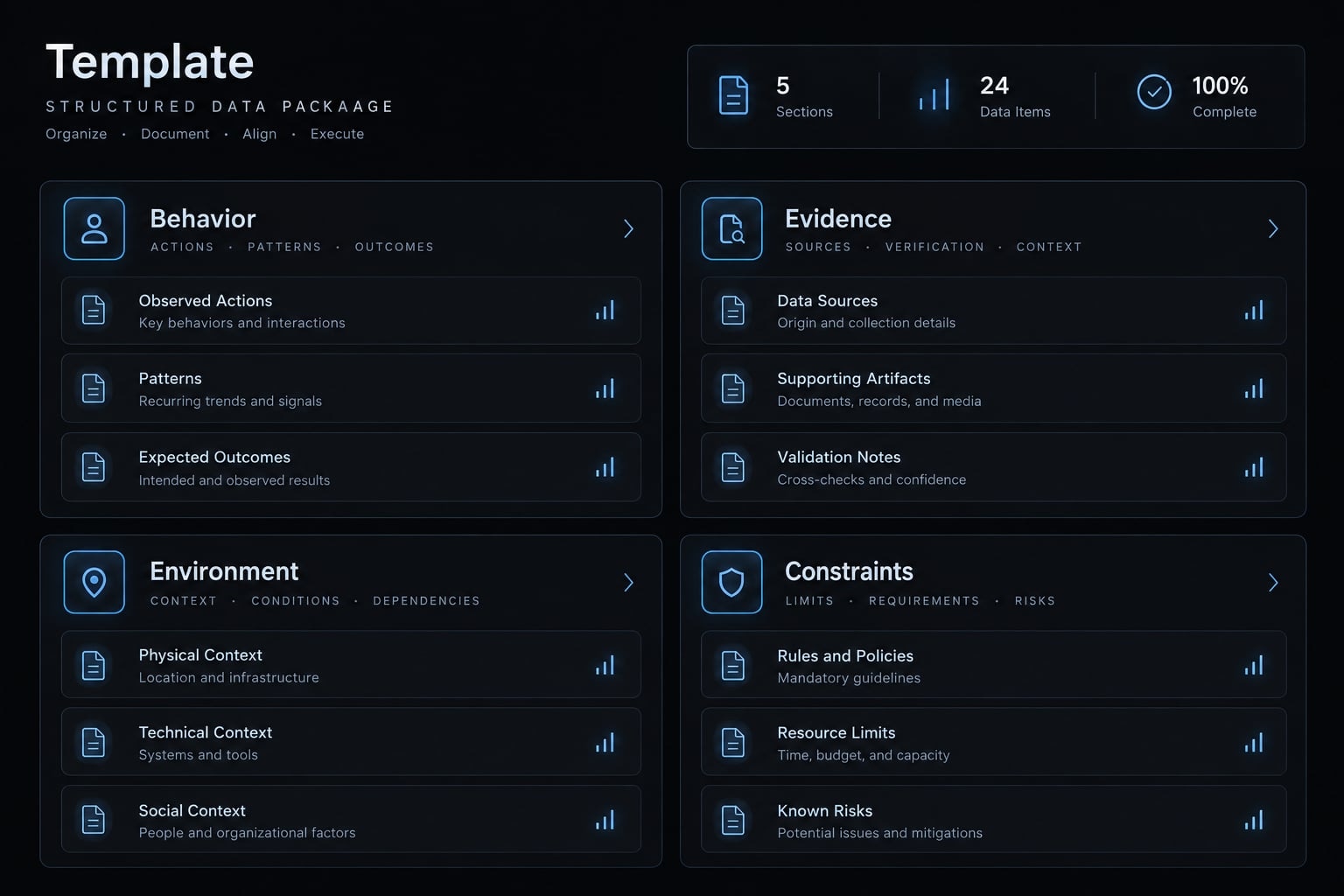
Minimum debugging context package
Context item | What to include | Why it matters |
|---|---|---|
Expected behavior | Contract and valid outcomes | Defines correctness |
Actual behavior | Observed deviation | Bounds the failure |
Reproduction steps | Command, fixture, frequency | Enables repeatable checks |
Error evidence | Relevant logs and traces | Grounds investigation |
Relevant code paths | Entry points and transformations | Directs initial search |
Recent changes | Code, configuration, dependencies | Identifies candidate triggers |
Environment | Runtime, versions, deployment | Exposes mismatches |
Tests attempted | Commands and outcomes | Prevents repeated guessing |
Constraints | Access and editing boundaries | Limits operational risk |
Success criteria | Required behavior and checks | Defines completion |
Suspected paths are starting points, not proof. The agent must be able to challenge the initial framing.
A reusable prompt structure
Investigate the failure using:[behavior, reproduction, evidence, code paths, changes,environment, previous tests, constraints, success criteria]Do not edit application code before reproduction andinitial evidence collection. Request approval for instrumentation.Report missing evidence and uncertainty; do not invent results.Return:1. Observations2. Assumptions3. Ranked hypotheses4. Proposed tests, including predicted distinguishing outcomes5. Recommended action, including a regression-test proposalSeparate observed facts from interpretations.Stop and request evidence or human judgment when blocked.
This structure can support work in Claude Code, Codex, or GitHub Copilot; their features and permission models are not identical. Prompt engineering for debugging organizes investigation. It does not enforce read-only access, sandbox execution, or approval requirements.
How to validate an AI-generated root cause and fix
Evaluate evidence and behavior-not model assertiveness. A validated fix requires adequate checks and review, not merely a persuasive cause statement.
Root cause confidence score
The root cause confidence score below is a proposed editorial review heuristic. It is not an industry standard, calibrated probability, or predictor of production safety.
Dimension | 0 points | 1 point | 2 points |
|---|---|---|---|
Reproduction | Missing | Partial or intermittent | Repeatable failure captured |
Evidence alignment | Contradicted or absent | Partial support | Relevant observations align |
Causal chain | Assertion only | Inferred gaps | Key transitions observed |
Hypothesis testing | None | Non-distinguishing checks | Discriminating results recorded |
Fix scope | Unrelated or suppressive | Rationale incomplete | Responsible layer, justified scope |
Regression coverage | Missing | Happy path only | Failure and relevant boundaries |
Score | Interpretation |
|---|---|
0–4 | Unsupported; do not merge |
5–8 | Incomplete; investigate further |
9–10 | Stronger support; proceed to required review |
11–12 | Strong evidence under this heuristic; risk-specific checks still apply |
Mandatory override: Unresolved critical contradictions, missing necessary validation, failing security checks, or absent approval block acceptance regardless of total. No score authorizes merge or deployment.
For genuinely intermittent failures, explicitly review evidence quality rather than treating weak reproduction as a universal verdict.
Warning signs the AI is guessing
- Proposes fixes before investigating.
- Edits unrelated files.
- Repeats rejected hypotheses without new evidence.
- Makes unsupported framework claims.
- Suppresses errors without restoring required behavior.
- Adds unjustified retries, delays, or fallbacks.
- Cites build success without rerunning the failure.
- Contradicts observed evidence.
The illustrative fallback demonstrates a common lesson: Removing an exception can conceal the defect. Fallbacks, retries, and validation changes are not inherently wrong; they need requirements and evidence.
When to stop prompting and debug manually
Switch to human-led investigation when:
- Reproduction remains unavailable.
- Intermittency lacks useful tracing.
- Evidence crosses services or infrastructure.
- Product intent is undocumented.
- Change scope keeps expanding.
- Production/local differences remain unexplained.
- Security, authentication, payments, or destructive operations are involved.
- New prompts produce no new evidence.
“Manual” means human-led, not AI-free. Engineers can still delegate bounded search, summaries, and test drafting.
Root cause validation checklist
- Expected behavior and failure are defined.
- Evidence is separated from assumptions.
- Causal explanation and alternatives were examined.
- A targeted test supports the diagnosis.
- Correct-layer fix received code review.
- Original reproduction and relevant regression checks pass.
- Applicable security and performance risks were reviewed.
- Human approval and residual limitations are recorded.
For the integration example, require recorded results for valid renamed fields, missing required values, and supported compatibility paths. These are proposed tests, not reported passing results.
Operationalizing the workflow with an AgentKit debugging pipeline
AgentKit provides kits, specialized subagents, reusable skills, workflows, MCP integrations, a CLI, and desktop management. These provide coordination infrastructure-not an authority on correctness. The pipeline below is a proposed configuration, not a claim that AgentKit ships these roles or enforces every control by default.
Recommended specialized agent roles
Recommended role | Responsibility | Required output |
|---|---|---|
Reproduction | Capture failing behavior | Reproduction record |
Evidence | Gather approved observations | Evidence log |
Investigation | Trace and compare explanations | Hypothesis matrix |
Test | Distinguish competing explanations | Predictions and results |
Remediation | Correct supported mechanism | Scoped diff |
Review | Challenge scope and validation | Findings and limitations |
Human approver | Accept risk and release decision | Recorded approval |
Small investigations may combine roles. Specialized debugging agents add coordination and token overhead. A separate review agent provides another pass-not guaranteed independent validation.
AgentKit workflow specification
Field | Proposed specification |
|---|---|
Workflow name | AgentKit AI Root Cause Debugging Workflow |
Collaboration model | Artifact-based handoffs with human gates |
Best-fit users | Developers, engineering leads, small product teams |
Use cases | Integration defects, CI failures, data-contract regressions |
Scope | Approved repository and test environment |
Interfaces | CLI and desktop management; specific debugger/log connections require verification |
Deliverables | Reproduction, evidence, hypotheses, tests, diff, approval |
Controls and enforcement | Tool permissions, execution isolation, repository protections |
Success metrics | Evidence completeness, resolution time, recurrence, change scope |
Human responsibilities | Requirements, access, risk, causal acceptance, release |
An MCP integration connects agents to approved tools or data sources through Model Context Protocol. MCP integrations do not automatically establish least-privilege access; connected tools determine available operations.
Read-only access requires enforced permissions. Sandboxing requires an actual isolated environment. Approval gates and audit retention must be configured and verified. Token controls manage consumption, not security.
Measure these agentic workflows without confusing activity with quality:
- Reproduction success: eligible investigations reproduced within a defined observation period.
- Changed-file count: scope indicator, not correctness.
- Regression coverage: specific failure and boundary behaviors tested.
- Reopened defects: the same defect returning under defined conditions within a stated window.
- Mean time to validated resolution: issue acceptance to approved validation; pair with recurrence and risk indicators.
- Confidence score: evidence completeness, not cross-team ranking.
Proof-of-work artifacts to show
Retain an inspectable sequence:
Issue/reproduction → pre-edit evidence → accepted/rejected hypotheses → commands/results → final diff → regression output → security/scope checks → review decision and limitations.
A measured demonstration should disclose repository scope, model/version, permissions, attempts, human intervention, failed hypotheses, and test conditions. Preserve actual outputs rather than reconstructed terminal images.
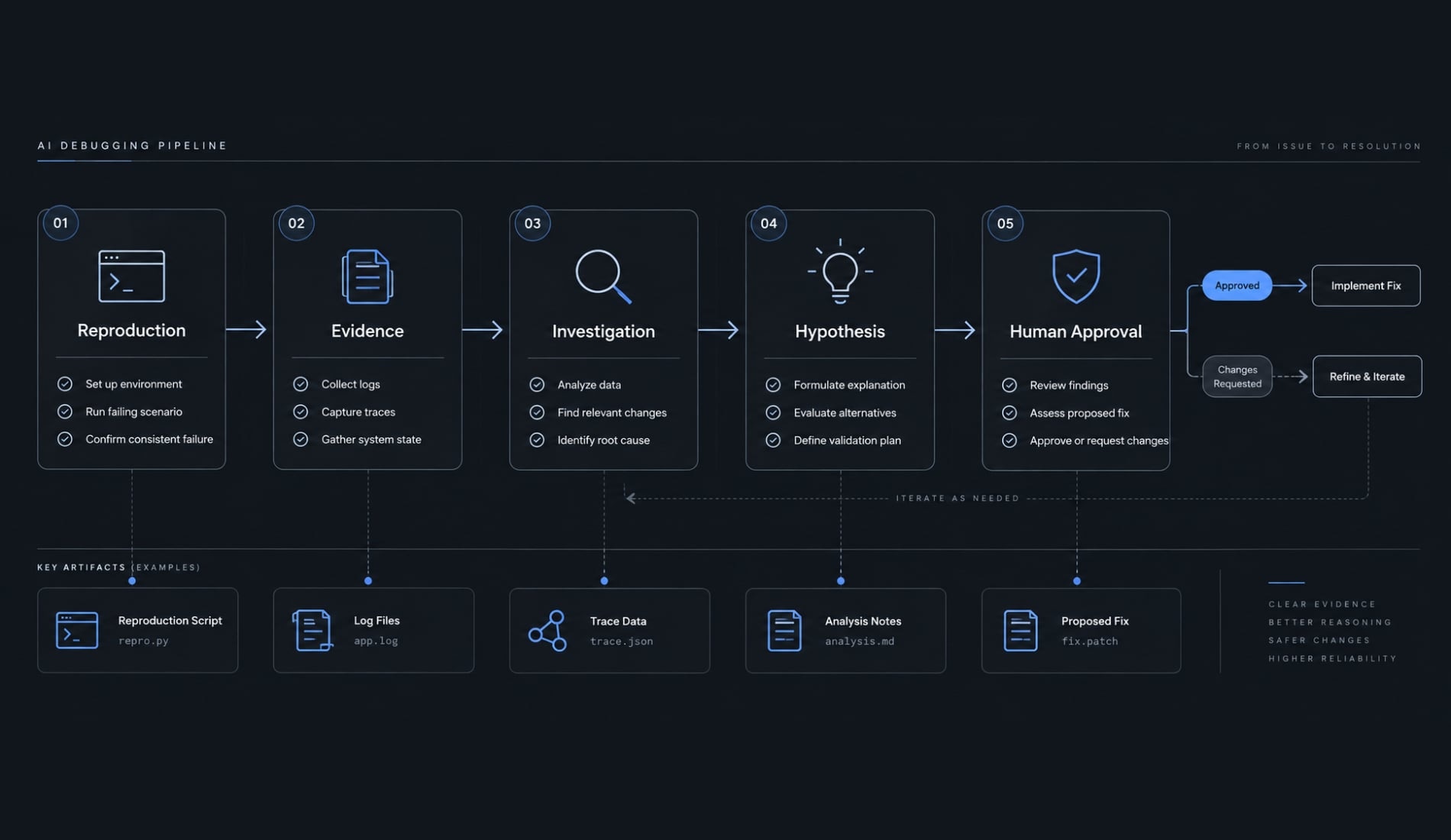
Treat AI as an investigator, not the final authority
AI root cause debugging is useful when it makes an investigation more inspectable. Reproduce the failure, collect relevant evidence, trace the earliest confirmed divergence, and compare explanations through discriminating tests. Then correct the responsible layer and validate the original failure alongside appropriate regression testing.
The minimum standard is not an error-free build. It is a supported explanation, an appropriately scoped change, recorded test results, and a review decision that acknowledges remaining uncertainty. Some incidents involve both a triggering defect and contributing conditions.
When evidence stops improving, stop generating speculative patches. Missing runtime visibility, unclear requirements, and sensitive operations call for human-led investigation or specialist review. Reusable workflows can preserve these boundaries, but cannot replace engineering judgment.
Apply this article’s validation checklist to your next debugging task, and retain the evidence record alongside the proposed fix.
Frequently asked questions
What is AI root cause debugging?
AI root cause debugging is a methodology where AI agents assist in isolating the underlying source of a software defect rather than just addressing symptoms. It involves using AI to analyze runtime evidence, map execution paths, test competing hypotheses, and propose precise, evidence-backed code remediations.
Why does AI often fail to fix root causes correctly?
AI models excel at pattern recognition but often lack deep understanding of system architecture or data contracts. Consequently, they may suggest superficial patches-like adding fallback values-that clear error logs while leaving the actual architectural defect or invalid state unresolved, leading to future regressions.
How can I distinguish between a symptom fix and a root cause fix?
A symptom fix merely hides the error, often through suppressive logic or empty null-checks. A root cause fix addresses the responsible layer, is supported by a discriminating test that isolates the failure, and explains why the observed behavior occurred based on verifiable runtime evidence.
What is the minimum context required for AI debugging agents?
To be effective, an agent needs a structured package containing: expected versus actual behavior, precise reproduction steps, relevant runtime logs or traces, the impacted execution path, recent code changes, and environment constraints. This context must be free of sensitive data or credentials.
Should I trust an AI-generated debugging fix automatically?
No. AI-generated fixes must be validated through a rigorous review process. You should verify the fix against the original reproduction case, ensure regression tests are added, and have a qualified human engineer perform a final audit to check for security risks or unintended architectural side effects.
What are the triggers for stopping AI debugging and switching to manual investigation?
You should switch to manual investigation if reproduction remains elusive, the failure spans multiple distributed services, the fix scope continues to expand uncontrollably, or the AI repeatedly provides contradictory, unsupported, or hallucinatory explanations that do not align with your system's runtime evidence.
Read more:
- AI coding rework: How to measure and reduce hidden debt
- Master a repeatable AI coding workflow for faster development
- AI feature development workflow: 7 stages to production success
Conclusion
AI root cause debugging is most powerful when used to illuminate issues rather than rush solutions. By pairing automated analysis with a disciplined, evidence-first workflow, engineering teams can move beyond surface-level patches to deliver verifiable, regression-safe fixes. AI should act as a rigorous co-investigator-helping you trace, test, and understand failures-while human oversight ensures the software remains reliable, secure, and maintainable.