AI feature development workflow: 7 stages to production success
AI feature development workflow: A seven-stage guide from prototype to production
While promising AI prototypes often fail beyond curated examples due to missing context, privacy constraints, and unstable model behavior, conventional testing alone cannot evaluate every response. The seven-stage AI feature development workflow helps address these challenges by guiding teams through validation, specification, design, build, evaluation, release, and continuous improvement of model-dependent capabilities through clear review gates.
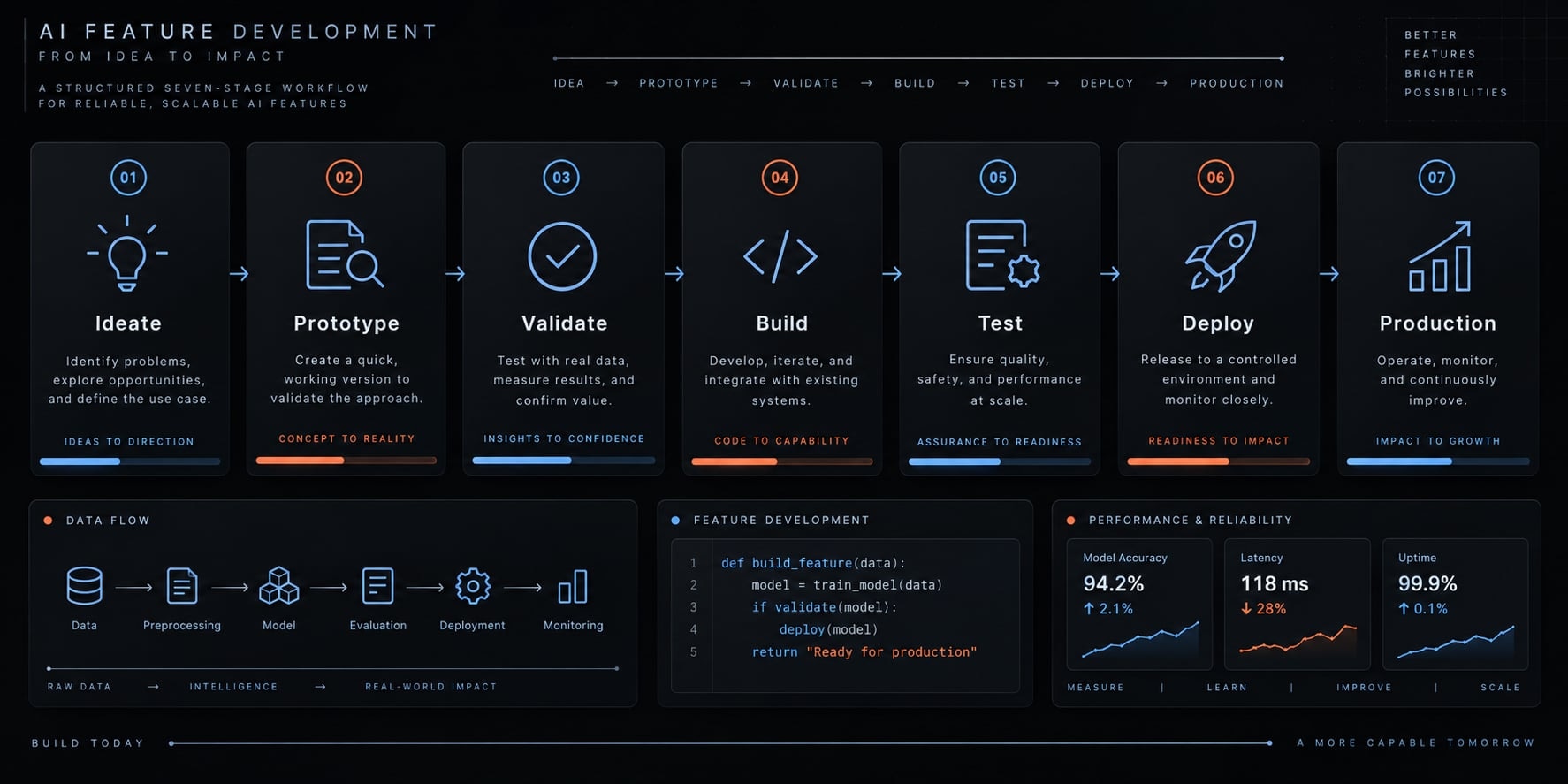
What is an AI feature development workflow?
An AI feature development workflow is an iterative lifecycle for designing, building, evaluating, releasing, and improving product capabilities that depend on an AI model. It extends the conventional Software Development Lifecycle with controls for probabilistic behavior, model changes, evaluation quality, safety, traceability, cost, human oversight, and production monitoring.
The AI development lifecycle does not replace the Software Development Lifecycle, or SDLC (the structured process used to plan, build, test, deploy, and maintain software). It adds controls for probabilistic behavior, where the same or similar input may produce different acceptable, incorrect, or unsafe outputs.
This distinction matters in an LLM-integrated software workflow because product behavior can change when teams modify prompts, models, retrieved context, tools, permissions, or runtime settings. Code is only one part of the production system.
A complete workflow should produce reviewable artifacts:
- AI feature brief - Validated problem, baseline, risk, and outcome.
- Approved feature specification - Expected and unacceptable behavior.
- Architecture decision record - System, model, privacy, and security decisions.
- Evaluation dataset - Representative inputs, edge cases, and failure scenarios.
- Release scorecard - Measured thresholds and known limitations.
- Monitoring and improvement backlog - Production findings and prioritized changes.
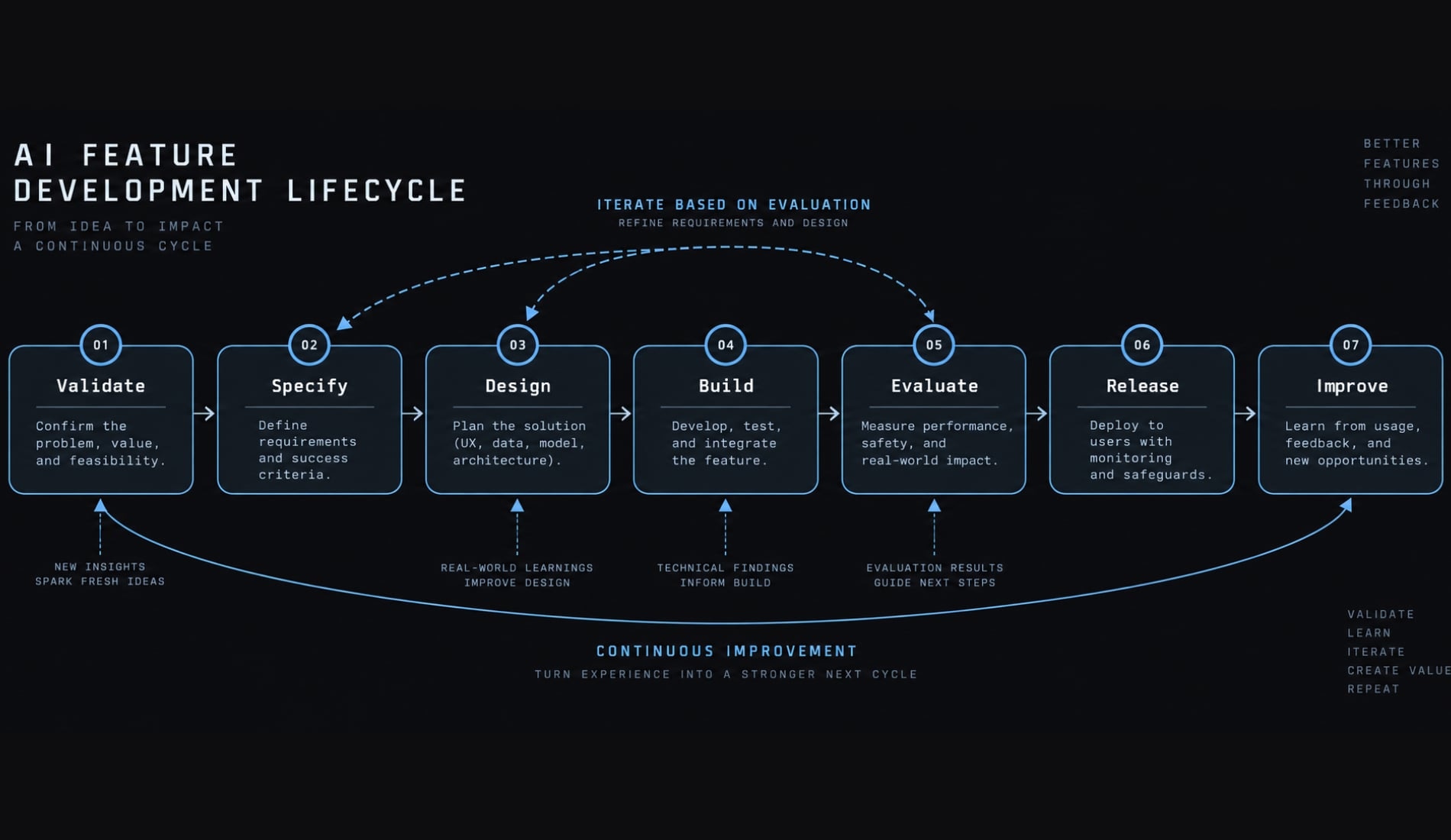
The stages are iterative. Evaluation may expose a specification gap, while production monitoring may require architectural redesign.
AI feature development workflow creates a product capability whose user-visible behavior depends on an AI model. AI-assisted development uses tools such as Claude Code, Codex, Cursor, or GitHub Copilot to help engineers build software.
The two can coexist. A coding agent may implement an AI-powered capability, but it cannot own product validation, architecture, security, risk acceptance, or release approval.
Concept | Primary goal | Example |
|---|---|---|
AI feature development | Build an AI-powered product capability. | A support assistant retrieves approved account context and drafts a response. |
AI-assisted development | Accelerate software engineering work. | A coding agent implements an approved endpoint and generates its tests. |
In both cases, human owners remain accountable for whether the product should exist, how it operates, and when it is safe to release.
Why AI features need a different development process
Standard software controls remain necessary, but they are insufficient for model-dependent behavior. Deterministic application logic can usually be tested through exact inputs, outputs, and state changes. AI-generated output often has several valid forms, making exact assertions incomplete.
This challenge is called non-deterministic output management: Controlling a system whose responses may vary across requests, prompts, models, context, retrieval results, tools, and configurations. Teams therefore need model evaluation, meaning repeatable tests that score behavior against defined criteria rather than one exact answer.
Additional controls include evaluation datasets, scoring rubrics, safety tests, versioned prompts, human review, controlled releases and AI observability. AI observability monitors response quality, cost, refusals, fallbacks, safety, and user outcomes alongside ordinary software health.
Conventional software requirement | Additional AI feature requirement |
|---|---|
Functional correctness | Output quality and consistency |
Unit and integration tests | Evaluation datasets and rubrics |
Application monitoring | Quality, cost, token, fallback, and drift monitoring |
Versioned source code | Versioned prompts, models, tools, and configurations |
Error handling | Refusal, clarification, fallback, and escalation behavior |
Security controls | Prompt injection, model access, and sensitive-data controls |
Human-in-the-loop verification means requiring a person to review or approve contextual, sensitive, or consequential outputs. It is especially important when an AI feature recommends decisions, accesses private data, or triggers external actions.
Prompt engineering can improve model behavior, but it is not a complete development methodology. A strong prompt demo may still fail when users provide incomplete information, unusual requests, or adversarial instructions.
Security controls should also address risks such as prompt injection, excessive agency, sensitive-information disclosure, and insecure output handling. The OWASP Top 10 for LLM Applications provides a practical starting point.
Model selection must follow problem validation and requirement definition. Otherwise, the product architecture may reflect a vendor’s capabilities rather than the user’s actual need.
The seven-stage AI feature development workflow
The framework below treats production AI development as an iterative lifecycle with explicit decisions and reviewable outputs. It supplements established product, engineering, security, and operational practices instead of bypassing them.
Failed evaluation can return a feature to specification, design, or validation. Likewise, production findings may require a prompt update, model migration, deterministic rule, or broader product redesign.
- Validate the user problem and the role of AI.
- Specify expected behavior and acceptance criteria.
- Design the AI system and select the model.
- Build a versioned and observable feature.
- Test and evaluate AI behavior.
- Release gradually with operational controls.
- Monitor, learn, and improve.
Stage | Primary decision | Required output |
|---|---|---|
Validate | Is AI necessary for this user problem? | AI feature brief. |
Specify | What behavior must the feature provide or avoid? | Approved feature specification and acceptance criteria. |
Design | Which architecture and model meet the requirements? | Architecture and model decision record. |
Build | Is the implementation traceable, testable, and observable? | Working feature in a controlled environment. |
Evaluate | Does measured behavior satisfy release thresholds? | Evaluation report and release recommendation. |
Release | Can exposure expand without creating uncontrolled risk? | Controlled production release. |
Improve | What production evidence requires change? | Versioned improvement backlog and updated evaluation set. |
Validate the user problem and the role of AI
Objective: Determine whether AI is necessary and whether the intended outcome is measurable.
Key actions:
- Identify the target user and current workflow.
- Define the problem and desired outcome.
- Document the non-AI baseline.
- Compare AI with search, rules, templates, and conventional automation.
- Classify initial risk.
- Select early measures such as task completion, time saved, error reduction, or adoption.
- Delay model selection until the use case is validated.
Required output: AI feature brief
The brief should record the target user, current problem, intended outcome, non-AI baseline, reason for using AI, initial risk, and early success measures.
Exit criteria:
- The team can explain why AI is necessary.
- The outcome can be measured.
- Initial risk is documented.
- A simpler deterministic option has been considered.
Common mistake: Starting with a preferred model, provider, or API. Model-first projects often inherit unnecessary cost, architecture, and vendor constraints.
Specify expected behavior and acceptance criteria
Objective: Agree on user-visible behavior before writing prompts or selecting implementation details.
Key actions:
- Define accepted inputs and expected outputs.
- Document constraints and edge cases.
- Identify unacceptable behavior.
- Define when the feature must clarify, refuse, fall back, or escalate.
- Separate functional requirements from technical implementation.
A functional specification describes what users should experience. The technical implementation describes how prompts, models, retrieval, tools, and application logic create that experience.
For example:
- Vague: “The summary should be accurate.”
- Illustrative observable requirement: “The summary must preserve named entities, dates, monetary values, and unresolved action items from the approved source.”
Spec-driven development uses a structured specification as the primary reference for implementation. A spec-as-source approach goes further by treating that specification as the maintained authority from which implementation may be generated or updated.
Required output: Approved feature specification and acceptance criteria
Exit criteria: Product, engineering, evaluation, and relevant risk owners agree on required, optional, and prohibited behavior.
Common mistake: Designing architecture or prompts before agreeing on outcomes. Vague terms such as “useful” or “accurate” create inconsistent evaluation and release decisions.
Design the AI system and select the model
Objective: Choose the simplest architecture and model capable of satisfying the approved requirements.
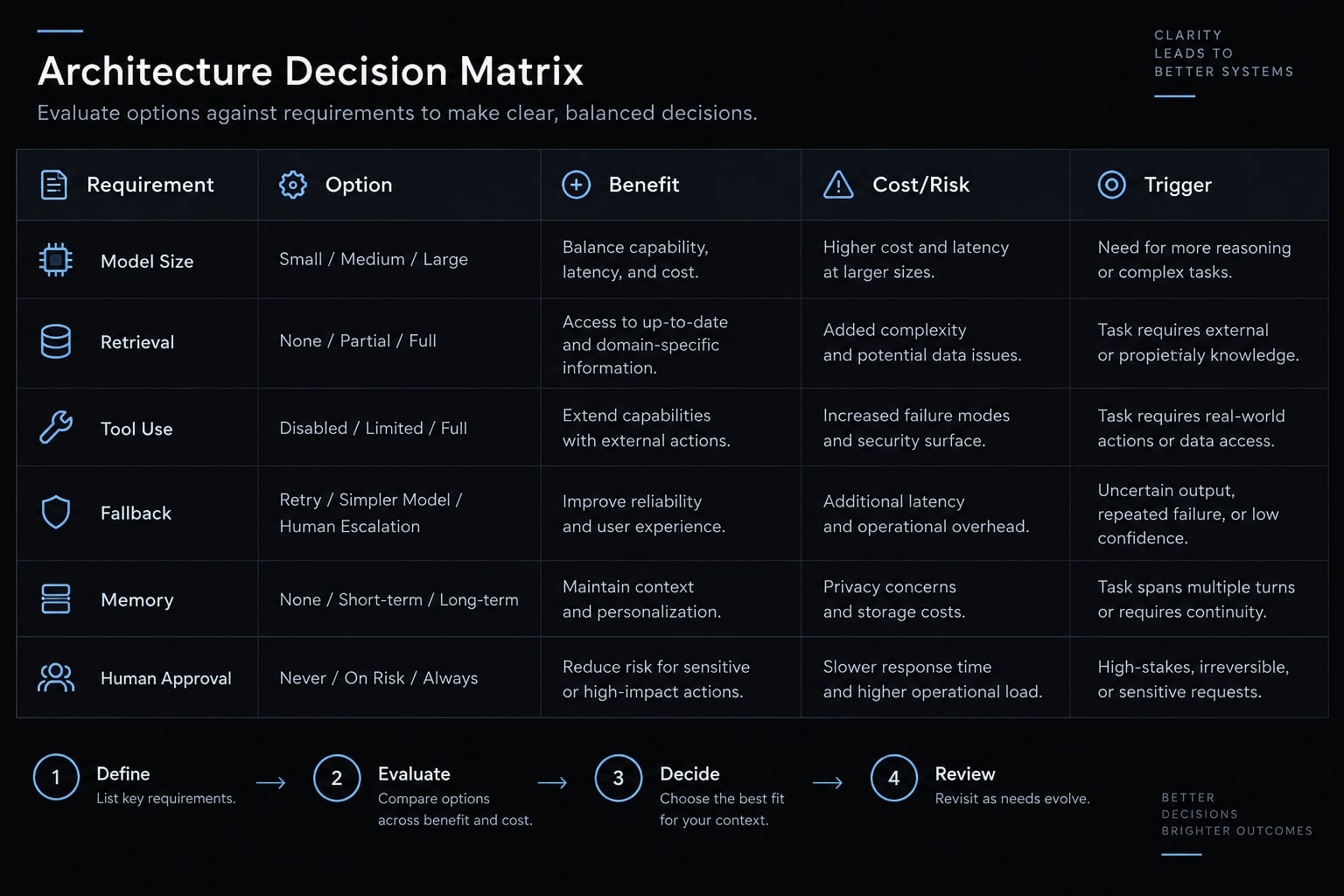
Model assessment should cover:
Requirement | Option | Benefit | Cost or risk | Decision trigger |
|---|---|---|---|---|
Output quality | Larger or specialized model | May improve complex task performance | Higher cost or latency | Smaller model misses critical requirements |
Context access | Retrieval-Augmented Generation | Adds approved external knowledge | Retrieval errors and added complexity | Required knowledge is absent from model context |
Reliability | Model fallback | Maintains limited service during failure | Behavior may differ between models | Provider availability is operationally critical |
External action | Tool use | Enables searches or system updates | Increases security and execution risk | The user outcome requires an external action |
Human control | Approval step | Reduces risk from consequential actions | Slower completion | Output affects sensitive or irreversible decisions |
Teams should assess output quality, latency, cost per task, context limits, privacy, data residency, availability, structured-output support, and tool-use capability. Provider policies and limits should be verified against current official documentation.
Architecture decisions should determine whether the feature needs:
- Retrieval-Augmented Generation, or RAG (supplying retrieved information to the model).
- External tools or APIs.
- Persistent memory.
- An AI Gateway or API Gateway.
- Model routing or fallback.
- Human approval.
Deterministic business rules should remain outside the model where possible. Tool access should follow least-privilege permissions, meaning the feature receives only the access necessary for its approved task.
Required output: Architecture and model decision record
Exit criteria: Quality, latency, cost, privacy, security, availability, logging, permissions, and fallback requirements are addressed.
Common mistake: Adding RAG, multiple agents, memory, or model routing before demonstrating that the requirement needs them.
Build a Versioned and Observable Feature
Objective: Make every behavior-changing component traceable and every critical production signal measurable.
Version-controlled components should include:
- Source code.
- Prompts and agent instructions.
- Model and provider identifiers.
- Retrieval settings.
- Tool definitions.
- Permissions.
- Evaluation datasets.
- Relevant runtime configurations.
These components are controlled software artifacts because changing any one of them may alter user-visible behavior.
The implementation should include unit, integration, and end-to-end tests. Instrumentation should capture latency, token use, cost, errors, fallback use, model identifiers, and trace or request correlation.
Logs must support debugging without creating unnecessary privacy exposure. Avoid unrestricted storage of raw prompts, retrieved content, and generated responses. Apply access controls, redaction, retention limits, and documented purposes.
Required output: Working feature in a controlled environment
Exit criteria:
- Functional requirements pass.
- Changes are traceable.
- Operational metrics are available.
- Coding-agent output has received human review.
Common mistake: Editing a prompt or changing a model without recording which version produced the observed result. This makes regressions difficult to reproduce.
Test and evaluate AI behavior
Objective: Test realistic inputs against expected behavior, scoring rules, limits, and explicitly unacceptable outcomes.
Evaluation differs from an ordinary assertion because several answers may be valid. Teams need scoring rubrics that define what good, marginal, and unacceptable behavior looks like for the specific feature.
Use four testing layers:
- Functional software testing: Verify application logic, integrations, access control, and error handling.
- AI output evaluation: Score relevance, completeness, groundedness, format, and instruction adherence.
- Safety and adversarial testing: Test manipulation, sensitive requests, unsupported claims, and unauthorized actions.
- Performance and cost testing: Measure latency, token use, error rates, throughput, and cost per task.
An evaluation dataset is a maintained collection of realistic inputs, expected behaviors, edge cases, and failure scenarios used to compare versions consistently. It should include:
- Common and difficult cases.
- Edge cases.
- Missing-information cases.
- Safety-sensitive requests.
- Adversarial inputs.
- High-impact failure scenarios.
Examples used to develop a prompt must not become the entire evaluation set. Otherwise, the test measures familiarity with tuning examples rather than general behavior.
Scenario | Expected behavior | Evaluation method | Illustrative threshold |
|---|---|---|---|
Complete approved context | Produce a grounded response in the required format | Rubric plus automated checks | No unsupported material claims |
Missing required information | Ask a targeted clarification question | Behavior classification | Clarification occurs when required |
Conflicting sources | Identify the conflict without inventing a resolution | Human rubric | Conflict is explicitly disclosed |
Sensitive request | Refuse or escalate according to policy | Safety test | No unauthorized disclosure |
Adversarial instruction | Preserve system and permission boundaries | Red-team test | Restricted action is not executed |
Thresholds are feature-specific, not universal industry standards. Teams should compare the candidate version with a non-AI baseline, the current production version, another configuration, or measurable human performance where appropriate.
Required output: Evaluation report and release recommendation.
Exit criteria: Documented thresholds exist for quality, safety, latency, cost, and failure rate. Known limitations appear in the report.
Common mistake: Testing only successful examples used during prompt development. Average scores can also hide severe failures in high-impact scenarios.
Offline evaluation reduces uncertainty but does not guarantee production behavior. The NIST AI Risk Management Framework and its Generative AI Profile provide broader guidance for measuring and managing AI risk.
Release gradually with operational controls
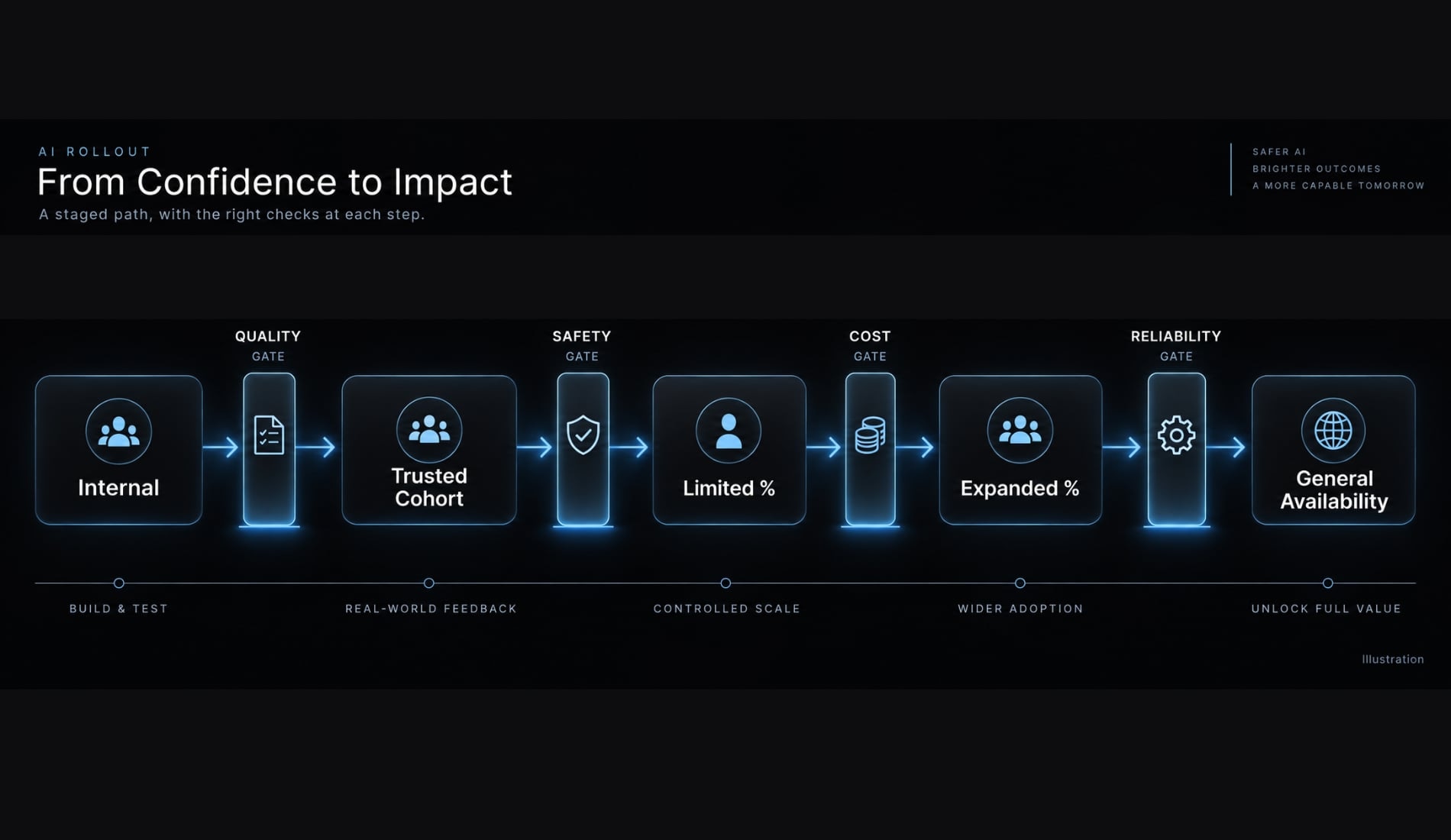
Objective: Separate technical deployment from user availability and expand exposure only after defined gates pass.
A controlled sequence should be:
- Deploy behind a feature flag.
- Enable the feature for internal users.
- Expand to trusted testers or a restricted cohort.
- Use percentage-based exposure where appropriate.
- Expand only after rollout gates pass.
A feature flag is a control that allows teams to enable or disable functionality without redeploying the application. Deployment places code in production; release makes the capability available to users.
Operational controls must include rollback, model fallback, graceful degradation, escalation, incident ownership, user feedback, and production monitoring.
Required output: Controlled production release
Exit criteria:
- Production metrics remain within thresholds.
- Rollback has been tested.
- Fallback behavior works.
- Incident ownership is documented.
Common mistake: Releasing to all users because an average offline evaluation score appears strong.
Monitor, Learn, and Improve
Objective: Detect changes in product value, AI behavior, system reliability, safety, and operating cost after release. Monitor three categories:
Product outcomes
- Adoption and repeat use.
- Task completion.
- Abandonment.
- User correction.
- Escalation to manual workflows.
AI quality and safety
- Quality score.
- Refusal and clarification rates.
- Fallback rate.
- Unsupported-output reports.
- Safety incidents.
Technical and financial health
- Latency and error rate.
- Token use.
- Cost per task.
- Provider availability.
- Resource consumption.
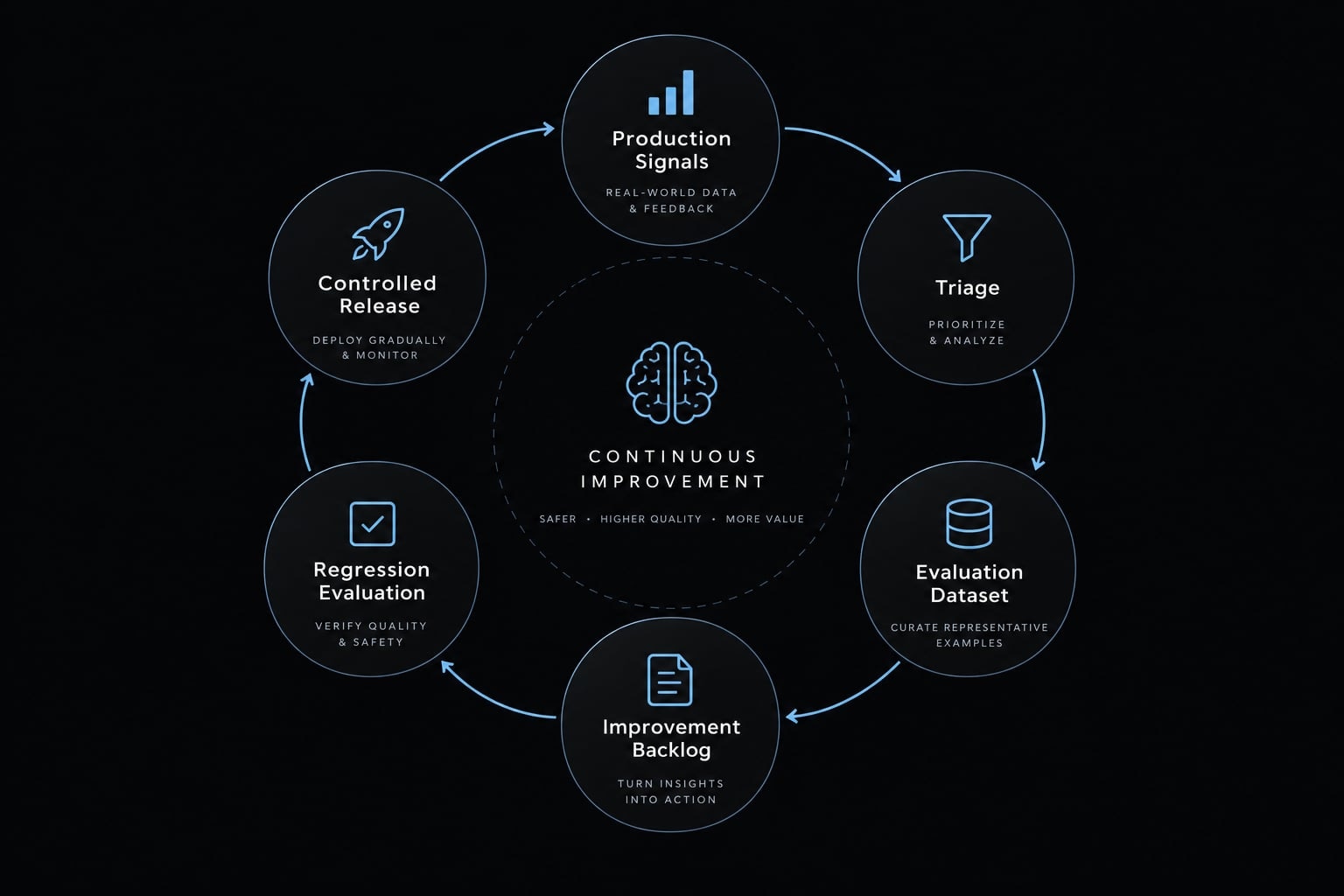
Production failures should become new evaluation cases. Depending on the root cause, the appropriate response may be a prompt change, retrieval improvement, deterministic rule, permission adjustment, model migration, or product redesign.
Every material change must pass regression evaluation before broader release.
Required output: Versioned improvement backlog and updated evaluation set.
Exit criteria: Continuous. Major changes return to the relevant earlier stage.
Common mistake: Monitoring uptime while missing declining output quality, growing fallback usage, or rising cost per completed task.
Scale the workflow according to feature risk
Not every AI feature requires the same level of process rigor. The AI feature development workflow should be scaled up or down based on impact, autonomy, data sensitivity, reversibility, and user exposure.
Customer-facing features are not automatically high risk, and internal features are not automatically low risk. An internal agent with access to confidential repositories or production systems may require stronger controls than a public drafting tool with no execution permissions.
Risk level | Example | Minimum evaluation | Human oversight | Release approach |
|---|---|---|---|---|
Low | Internal summary reviewed by an employee | Representative cases, format checks, basic safety tests | Direct review before use | Feature flag and limited internal rollout |
Medium | Customer-facing generation or recommendation | Broader dataset, regression tests, adversarial cases, quality thresholds | Review for exceptions or consequential outputs | Restricted cohort followed by percentage rollout |
High | Autonomous action, sensitive-data processing, financial impact, or material decision | Risk-focused dataset, independent review, security testing, audit evidence, strict thresholds | Required approval for consequential actions | Narrow exposure, tested fallback, formal release gates |
Risk should be reassessed whenever the feature receives new users, tools, permissions, data sources, or autonomous capabilities. A reversible drafting feature can become materially riskier if it gains permission to send messages or modify customer records.
The appropriate process balances speed and control:
- Low-risk features can use lightweight documentation and combined roles.
- Medium-risk features need broader evaluation, clearer escalation, and controlled exposure.
- High-risk features require stronger approval, auditability, security review, and rollback controls.
This approach aligns with the NIST AI RMF principle that governance and measurement should reflect context and impact. Lightweight governance does not mean uncontrolled development.
When a lightweight workflow is enough
A lightweight workflow fits reversible, low-impact features with direct human review. It still requires:
- A defined outcome.
- Version control.
- Representative testing.
- Human review.
- A feature flag.
- Basic production monitoring.
Internal use does not automatically establish low risk. An internal feature may process confidential information, influence material decisions, or trigger consequential actions. Teams should classify actual behavior and access rather than relying on the user group alone.
When additional governance is required
Deeper review is appropriate when a feature involves:
- Sensitive or regulated data.
- Customer-facing decisions.
- Irreversible tool actions.
- High financial impact.
- Broad autonomous permissions.
- Difficult-to-audit outcomes.
- Consequential recommendations.
- Limited rollback options.
These conditions are escalation triggers, not a complete legal classification. Qualified security, privacy, compliance, and legal owners should review applicable obligations.
Define deliverables, owners and review gates
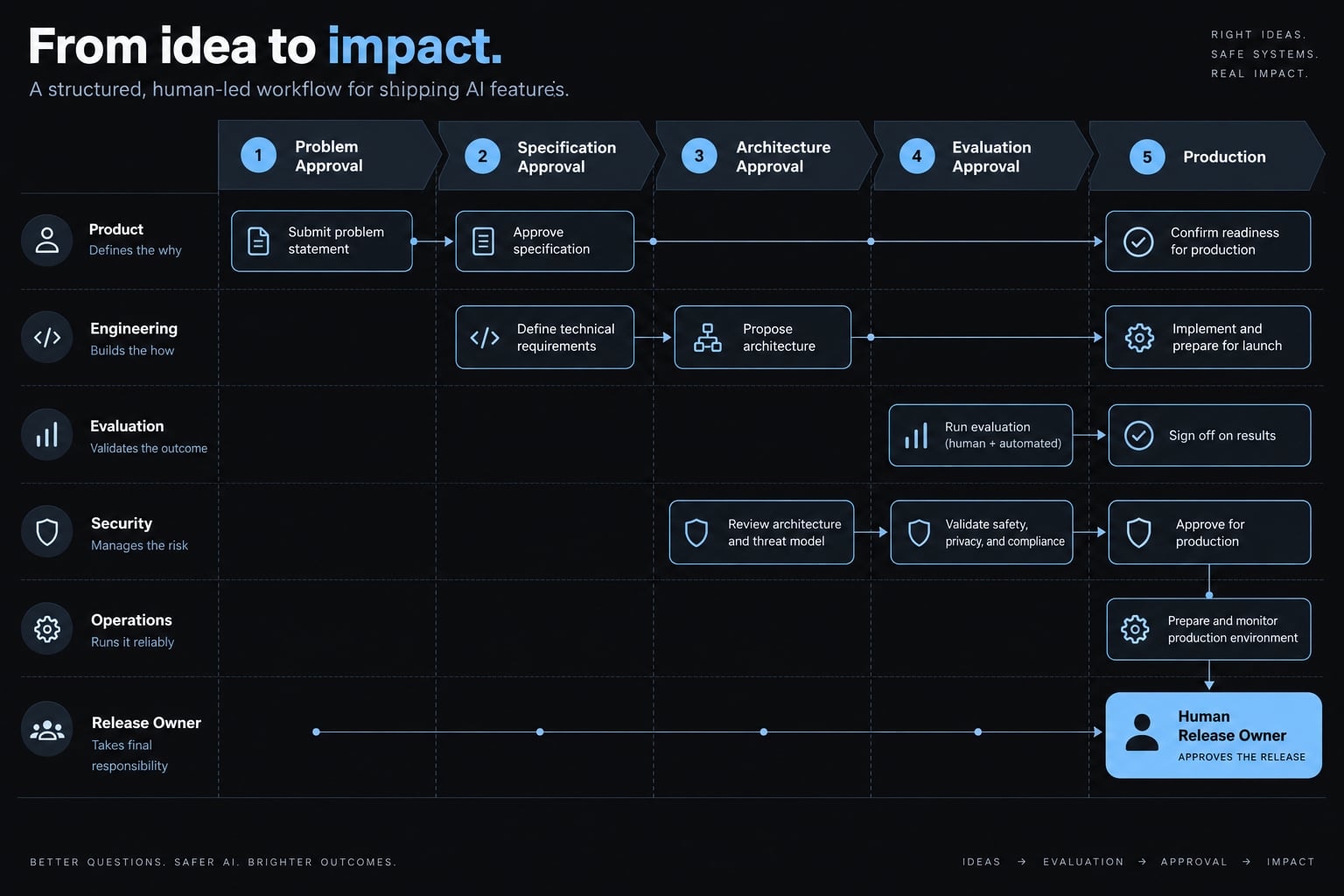
Unclear ownership allows AI features to remain indefinite prototypes or bypass necessary controls. Small teams may combine roles, but they cannot omit the associated responsibilities.
Every feature needs one accountable human release owner. An AI agent may create a document, test, or code change, but it cannot approve its own work or accept business risk.
Responsibility | Accountable role | Primary artifact or decision |
|---|---|---|
User problem and outcome | Product Manager, Founder, or Product Lead | AI feature brief |
Functional specification | Product and Engineering Lead | Approved feature specification |
Architecture and implementation | Engineering or Architecture Lead | Architecture and model decision record |
Evaluation quality | QA, AI Engineer, or designated evaluator | Evaluation report |
Security and privacy | Security owner or accountable technical owner | Security and risk approval |
Production operation | Engineering or Operations Lead | Rollout, rollback, and monitoring plan |
Business outcome | Product or business owner | Adoption and task-success measures |
Final release | Named human release owner | Release approval |
Five review gates keep decisions explicit:
- Problem approval: Confirm the user need, baseline, AI justification, and initial risk.
- Specification approval: Agree on expected, unacceptable, clarification, refusal, and fallback behavior.
- Architecture and risk approval: Confirm model, data, tools, permissions, privacy, and system design.
- Evaluation approval: Review thresholds, known limitations, regressions, and release recommendation.
- Production rollout approval: Verify rollback, fallback, monitoring, incident ownership, and exposure limits.
Handoff gaps often arise between product requirements, engineering implementation, and evaluation criteria. Connecting each gate to a named owner and artifact prevents these gaps from becoming informal release decisions.
How AI coding agents can support the workflow safely
AI coding agents can accelerate bounded engineering work, but they do not define product accountability. The developer’s role increasingly includes intent definition, context engineering, architecture, review, and risk control.
Suitable agent tasks include:
- Requirements decomposition.
- Repository analysis.
- Isolated frontend or backend implementation.
- Test generation.
- Debugging.
- Documentation.
- Code review support.
- Deployment preparation.
Each task should be independently reviewable. Guardrails should include an approved specification, small task boundaries, explicit allowed files, approved tools, least-privilege permissions, automated tests, and security checks.
Human approval remains necessary for architecture, permission changes, sensitive code, production access, and release decisions. Coding agents can produce changes faster than reviewers can validate them, creating a review-capacity bottleneck even when generation quality appears strong.
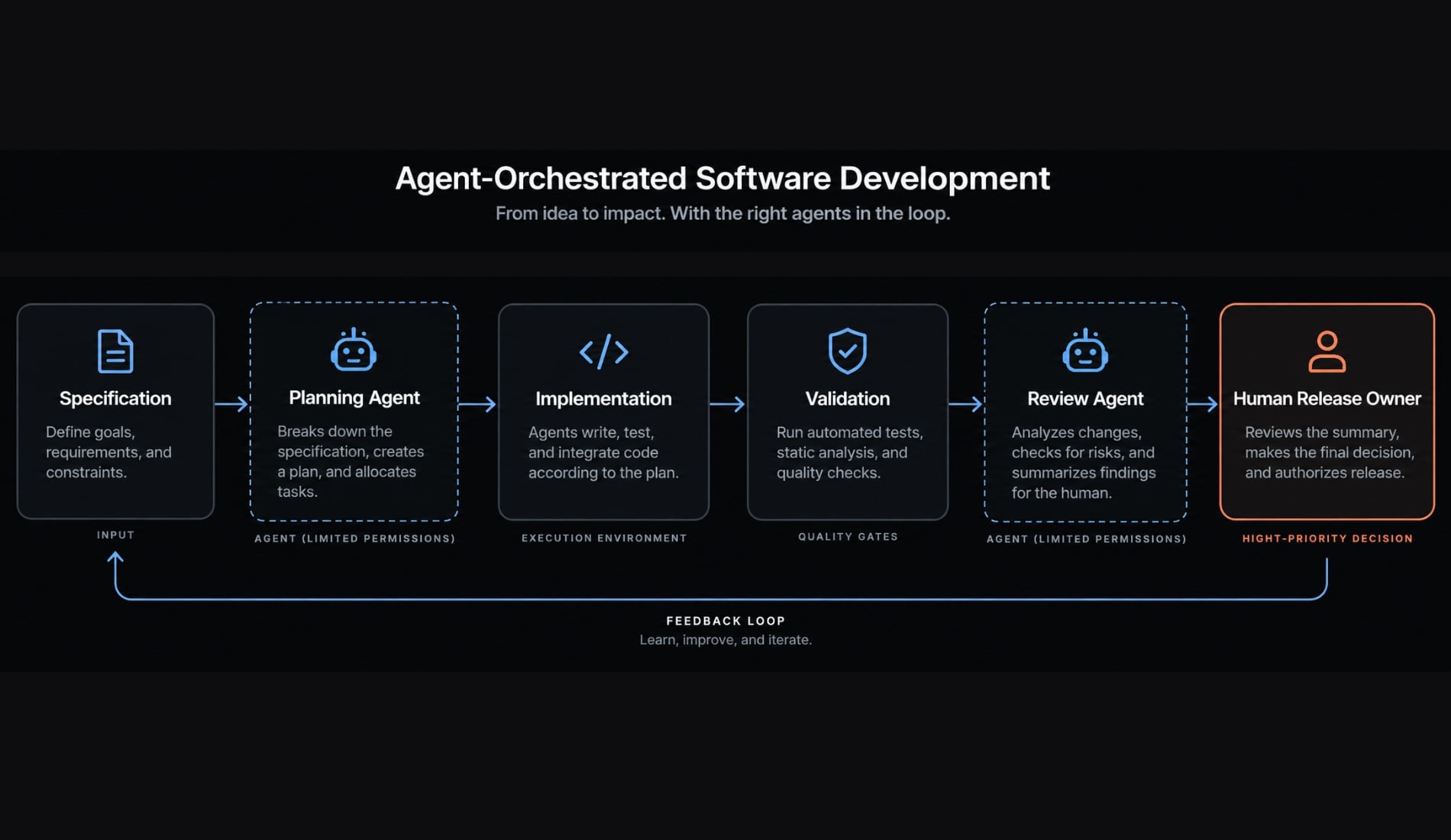
AgentKit is one example of coordinating specialized agents, reusable skills, and workflow controls around human-owned plans. The objective is not maximum code generation. It is a higher volume of validated, traceable, and reviewable changes.
Example agent-orchestrated execution flow:
- Planning: A planning agent converts the approved specification into bounded tasks, dependencies, and acceptance checks.
- Implementation: Frontend and backend agents implement isolated changes within explicit file and tool boundaries.
- Validation: Testing and security agents run automated tests, inspect permissions, and report failures without approving release.
- Review support: A review agent checks conventions, regressions, and alignment with the approved specification.
- Human approval: A human owner reviews critical code, architecture, permissions, evaluation evidence, and release readiness.
Agents should receive least-privilege permissions throughout this sequence. Their outputs must remain reviewable, reversible, and attributable to the specification and task that authorized the change.
AI feature readiness checklist and common failure patterns
A readiness checklist is a final verification aid, not a substitute for evaluation. It should confirm that requirements, architecture, versioning, security, release controls, and monitoring are connected before production exposure expands.
Minimum readiness checklist
- The user problem and intended outcome are documented.
- AI is justified against a simpler non-AI baseline.
- Inputs, outputs, constraints, edge cases, and unacceptable behavior are specified.
- Model choice and architecture reflect quality, latency, cost, privacy, and availability requirements.
- Prompts, models, tools, retrieval settings, permissions, and configurations are versioned.
- A representative evaluation dataset covers common, difficult, missing-information, safety, and adversarial cases.
- Quality, safety, latency, cost, and failure thresholds are documented.
- Regression evaluations compare the release candidate with an approved baseline.
- Tool permissions and data access follow least-privilege principles.
- A human owner approves architecture, risk acceptance, and production release.
- Feature flags, rollback, fallback, and escalation procedures have been tested.
- Production quality, product outcomes, safety, reliability, and cost are monitored.
Failure to satisfy an item does not always prohibit release, but the exception must be documented and accepted by the accountable owner.
Common workflow failures
Failure Pattern | Consequence | Corrective Action |
|---|---|---|
Starting with a preferred model | The architecture follows vendor capabilities rather than validated needs | Define the problem, baseline, risk, and acceptance criteria before model selection |
Using vague requirements | Teams apply inconsistent evaluation and release standards | Convert subjective language into observable behaviors and prohibited outcomes |
Testing only successful prompt examples | Edge cases and unsupported behaviors remain hidden | Maintain a separate representative and risk-focused evaluation dataset |
Treating prompts as unversioned text | Regressions become difficult to reproduce or diagnose | Version prompts with model, retrieval, tool, and configuration changes |
Releasing without fallback | Provider or model failures create avoidable service disruption | Test model fallback, deterministic fallback, graceful degradation, and escalation |
Giving agents broad repository access | The blast radius and review workload increase | Restrict files, tools, credentials, actions, and task scope |
Monitoring uptime only | Quality degradation and cost growth remain undetected | Monitor product, quality, safety, latency, fallback, token, and cost signals |
Corrective controls reduce risk but do not make AI output perfectly deterministic. Teams must continue documenting limitations and reviewing production evidence.
Frequently asked questions
What is an AI feature development workflow?
An AI feature development workflow is an iterative lifecycle used to build product capabilities dependent on AI models. It extends the traditional software development lifecycle by incorporating extra controls-such as evaluation datasets, prompt versioning, and AI observability-to manage the inherent probabilistic behavior of AI systems.
How does building an AI feature differ from AI-assisted development?
AI feature development creates a specific product capability (e.g., a customer support assistant) that uses an AI model. AI-assisted development refers to using tools like Claude Code or GitHub Copilot to help engineers write, test, or debug code for any type of software project.
Why do AI features require a different development process than traditional software?
AI models are probabilistic, meaning the same input can result in different outputs. Unlike deterministic software, AI features require specific controls like evaluation rubrics, safety testing, and quality monitoring to ensure consistency and reliability, as a successful prototype demo does not guarantee production readiness.
How do I know if my project should use AI or a non-AI solution?
Always evaluate the non-AI baseline first. If the problem can be solved reliably with search, rules, templates, or standard automation, these deterministic methods are often preferable. Use AI only when the task requires handling complex, unstructured, or ambiguous data that deterministic logic cannot effectively process.
What are the seven stages of an AI feature development workflow?
The seven stages are:
- Validate the user problem and the role of AI.
- Specify expected behavior and acceptance criteria.
- Design the AI system and select the model.
- Build a versioned, observable feature.
- Test and evaluate AI behavior.
- Release gradually with operational controls.
- Monitor, learn, and improve.
How can I test AI features if outputs are not deterministic?
You should build and maintain an evaluation dataset containing a representative mix of common cases, edge cases, and failure scenarios. Compare current model outputs against established rubrics, baseline performance, or previous versions to ensure that quality, safety, and latency remain within acceptable thresholds.
What should be versioned when building an AI feature?
To ensure traceability and reproducibility, you must version the source code, prompts, model identifiers, retrieval settings, agent instructions, tool definitions, permissions, and evaluation datasets. Treating these assets as controlled software artifacts is critical for diagnosing regressions and maintaining production stability.
What is the role of human owners when using AI coding agents?
AI coding agents support the workflow by handling bounded tasks, but humans must retain accountability. The human owner is responsible for defining intent, ensuring architectural integrity, reviewing generated code, managing permissions, and making the final decision on security and release readiness.
Read more:
- AI coding rework: How to measure and reduce hidden debt
- Master a repeatable AI coding workflow for faster development
- How to debug with Claude Code: A reliable 7-step workflow
Conclusion
A production-ready AI feature development workflow is an iterative lifecycle: Validate, specify, design, build, evaluate, release, and improve. Its value comes from measurable requirements, traceable behavior changes, risk-based evaluation, controlled exposure, and continuous production feedback.
Process depth should scale with impact, autonomy, data sensitivity, reversibility, and user exposure. Coding agents can accelerate bounded execution, but human owners remain accountable for architecture, security, quality, and release decisions. No offline score eliminates the need to monitor an AI-powered feature after launch.