AI coding rework: How to measure and reduce hidden debt
AI coding rework: How to measure the hidden cost of faster code
AI coding tools promise speed, but often just shift the workload downstream into reviews, debugging, and fixes-a hidden cost known as AI coding rework. While fast first drafts are easy to celebrate, the true measure of success is total engineering effort, not generation speed. This guide explains what AI rework is, how to measure it, and how to minimize it without stalling AI adoption.
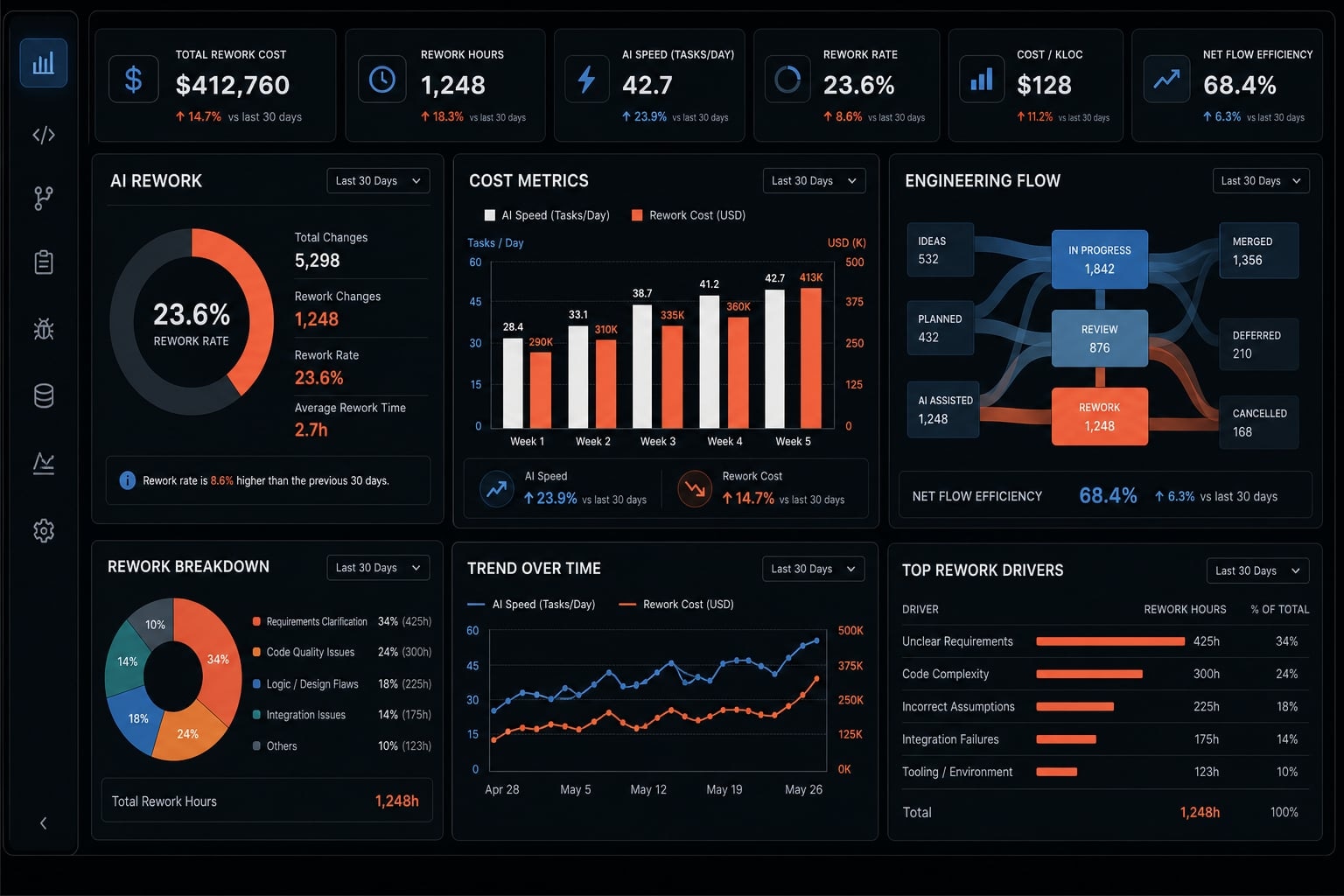
What AI coding rework actually means
AI coding rework is the avoidable downstream correction work created when AI-generated code looks acceptable early, but later requires extra review, debugging, rewriting, or production fixes to become truly usable and safe.
Simply put, AI coding rework is not just about AI writing bad code. It is the extra engineering effort that appears after a task seems complete. That effort may show up in repeated review comments, follow-up commits, reopened pull requests, fix-forward patches, or user-facing bugs that force unplanned changes later.
Leaders should care because AI coding rework directly affects delivery efficiency, engineering ROI, and long-term maintainability. If an assistant saves 20 minutes during implementation but creates 45 minutes of downstream cleanup, the team did not get faster. It simply shifted cost into a less visible part of the workflow. Over time, that pattern can compound into AI-generated code technical debt and a persistent hidden debugging tax that distorts software delivery outcomes.
A common pattern is simple: The code compiles, passes a basic test, and looks “done” in the IDE. Then review reveals missing edge cases, a naming convention mismatch, an architectural shortcut, or a dependency misuse. The first draft felt fast. The total delivery effort was not.
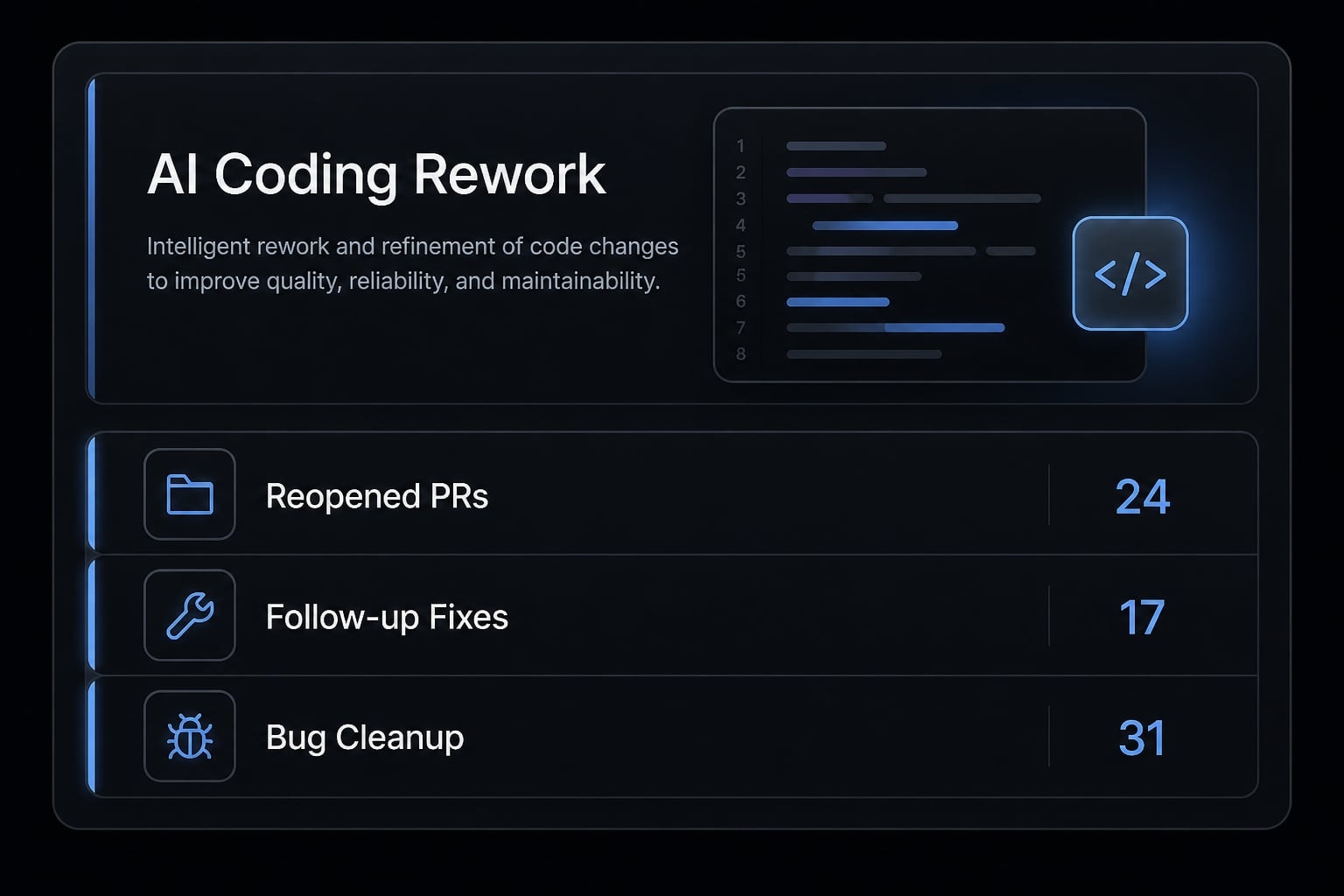
AI coding rework vs. normal engineering iteration
Not all revision is bad. Good teams iterate. The distinction is whether the work is planned learning or avoidable correction.
Normal iteration is expected and healthy:
- Refining a design after stakeholder input.
- Improving tests based on new product understanding.
- Adjusting scope as requirements become clearer.
Rework is avoidable correction effort:
- Repeated review comments on the same category of issue.
- Follow-up commits to fix code that should not have been merged as-is.
- Reopened PRs after “done”.
- Fix-forward patches for defects that slipped through validation.
A simple definition leaders can use internally
AI coding rework is the extra correction work created after AI-generated code enters review or merge flow, including additional review cycles, follow-up fixes, reopened work, and production bug remediation.
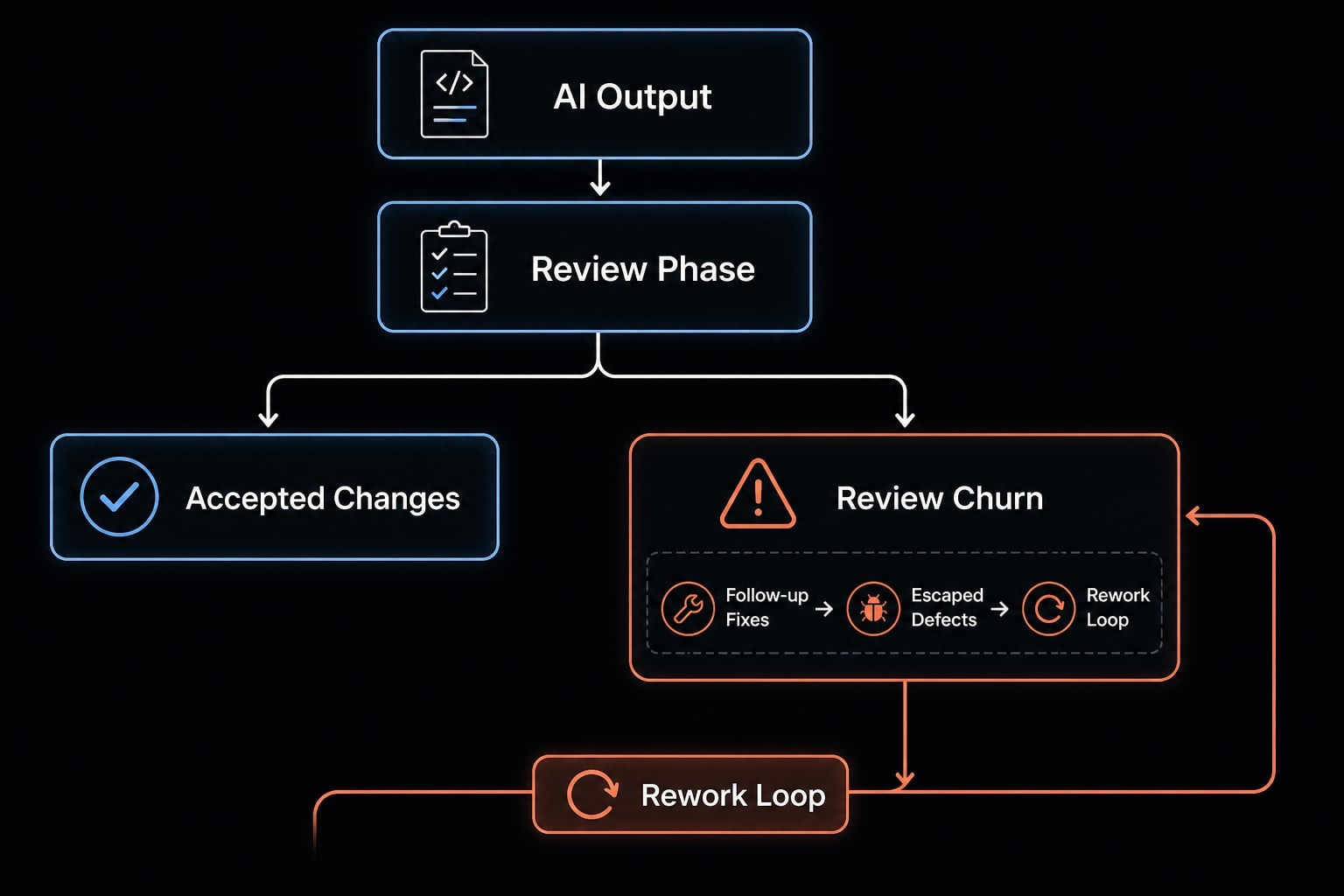
Why AI coding can increase rework instead of reducing it
AI-generated code often looks productive at the moment of generation. The management problem starts later, when the team discovers that speed at output time did not translate into lower total delivery effort.
The main reasons AI can increase rework are:
- Near-miss output that looks plausible but fails later.
- Poor context quality that leads to misaligned code.
- Review overload caused by larger or faster-moving changes.
- Cognitive bias that makes teams trust weak output too easily.
This does not mean AI should be rejected. AI can help a great deal on bounded work. The real issue is control. Many teams experience acceleration whiplash: the tool increases output faster than the team can validate safely.
Near-miss code is more expensive than obviously wrong code
The most expensive output is rarely nonsense. It is the almost-right answer that passes a surface check and enters the workflow. That near-miss loop creates more waste than clearly broken code because obviously wrong output is rejected quickly.
A typical example looks like this:
- The code passes linting and basic tests.
- It appears consistent with the request.
- It later breaks a domain rule, edge case, or service integration assumption.
That is why near-miss output creates a hidden cost. Teams spend time reviewing, clarifying, patching, and retesting code that looked acceptable at first glance.
Poor context creates plausible but misaligned output
In many cases, the biggest issue is not model capability. It is context quality. If the assistant does not receive enough architectural, business, or testing context, it fills the gap with plausible guesses.
Common context gaps include:
- Missing architecture rules.
- Internal coding conventions not supplied.
- Incomplete dependency awareness.
- Weak understanding of domain constraints.
- Mismatch with existing test patterns.
- Lack of clear acceptance criteria.
This usually shows up as code that is syntactically correct but operationally misaligned. Better context quality often matters more than trying a different model.
Larger PRs and review fatigue amplify downstream cost
AI can produce more code faster than human reviewers can inspect it well. That creates review burden, especially when teams allow broad prompts to generate large diffs.
A common pattern is:
- Larger PRs increase cognitive load.
- Reviewers focus on surface correctness, not deeper risk.
- Review quality drops as volume rises.
- More issues escape into merge or production.
- Maintainability and technical debt worsen over time.
This is why AI adoption can hurt delivery stability even when throughput appears higher. More output does not equal better output. If the team’s validation capacity stays flat while generated change volume rises, review burden becomes a leading indicator of future rework.
Cognitive biases make teams underestimate rework
AI changes judgment, not just speed. Teams often underestimate rework because of predictable biases.
- Automation bias: assuming the output is more trustworthy because it came from a capable automated system.
- Anchoring effect: accepting the first generated solution too quickly instead of exploring better alternatives.
- Sunk-cost reluctance: hesitating to discard almost-right code after investing time in guiding it.
- Overvaluing confident wording or polished explanations around weak implementation choices.
From a management perspective, these biases matter because they translate into more review cycles, more escaped issues, and less confidence in delivery quality. The issue is not that developers are careless. The issue is that AI can make weak code look cheaper than it really is.
How to measure AI coding rework without guesswork
If teams only track adoption, prompt volume, or time to first code, they are measuring the wrong layer of the workflow. The right question is not whether the assistant generated code quickly. It is whether the team shipped usable changes with less total effort.
Developer sentiment and time to first draft are useful signals, but incomplete proxies for delivery efficiency. To understand how to measure AI coding rework rate, teams need a lightweight scorecard that reflects downstream work, not just generation speed.
No single metric is enough. The practical goal is to baseline before and after AI usage, then segment results by task type instead of averaging everything into one number.
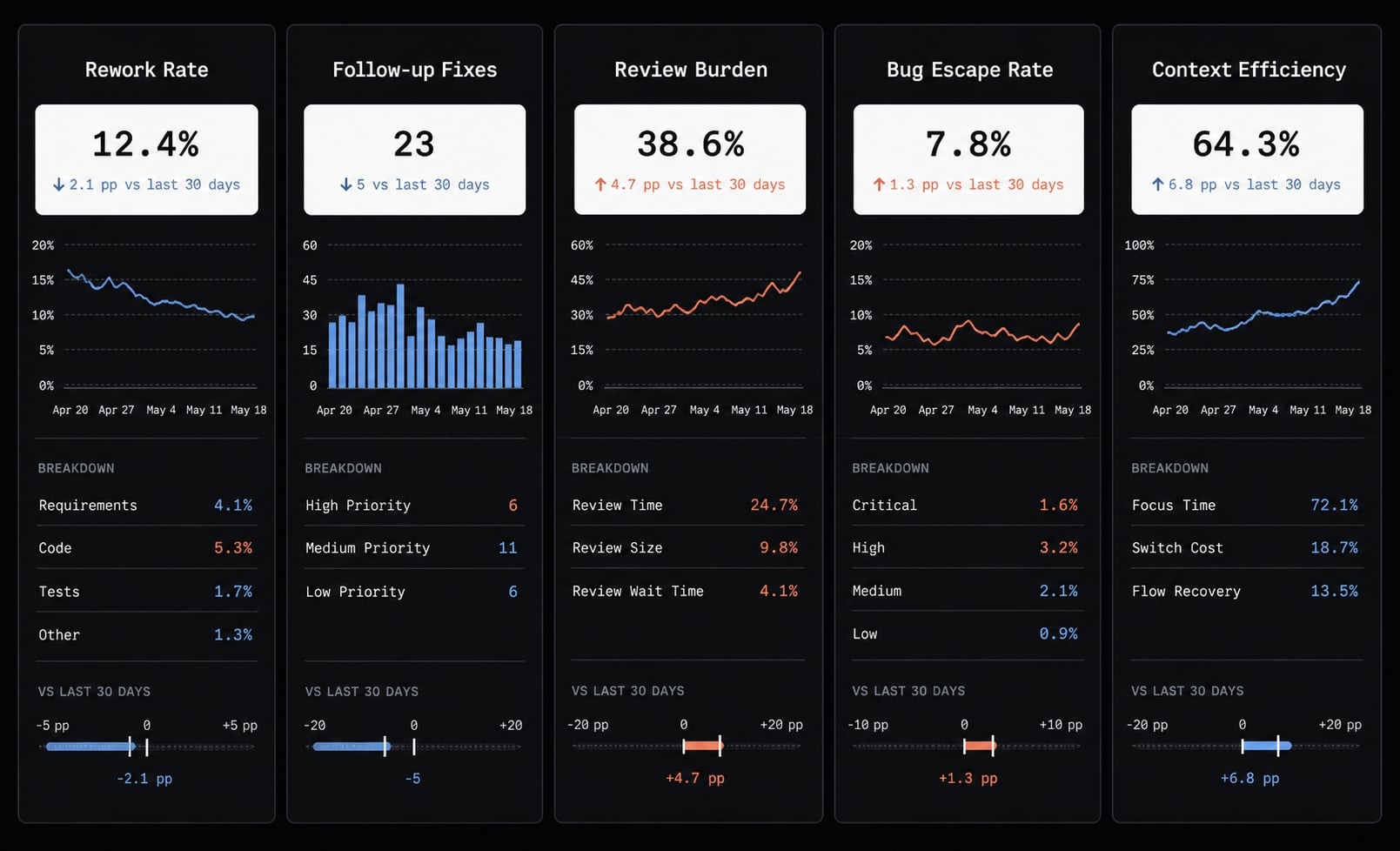
The 5 metrics that matter most
To answer how to measure AI coding rework rate, start with these five metrics:
- Rework rate
- Follow-up commits or follow-up fixes
- Review burden
- Bug escape rate
- Context efficiency
1. Rework rate
- What it indicates: The share of changes that trigger unplanned correction work later.
- Why it matters: It shows whether speed is creating cleanup.
- How a small team can track It: mark each PR or deployment that required unplanned correction after it seemed complete.
2. Follow-up commits / fixes
- What it indicates: How often teams need extra commits to correct merged or nearly merged work.
- Why it matters: It captures hidden instability before it becomes a major incident.
- How a small team can track it: Count follow-up commits within 24 to 72 hours of PR approval or merge.
3. Review burden
- What it indicates: The human verification load required per change.
- Why it matters: AI may shift effort from writing into reviewing.
- How a small team can track it: Use a simple review burden coefficient such as extra review rounds, comment density, or unusually long review times.
4. Bug escape rate
- What it indicates: How often issues reach users or production after the code passed normal checks.
- Why it matters: This is one of the clearest signals that the workflow validated too little.
- How a small team can track it: Log post-merge or post-release bugs tied to AI-assisted work.
5. Context efficiency
- What it indicates: Whether the assistant received useful inputs and produced aligned output.
- Why it matters: Poor context often causes avoidable churn.
- How a small team can track it: Note when tasks needed repeated clarification, missing files, or multiple restarts because the AI lacked the right materials.
A simple manual-first approach works well:
- Maintain a spreadsheet or PR log
- Mark reopened PRs
- Count extra review cycles
- Note post-merge bugs
- Flag repeated clarification patterns
This is usually enough to understand how to measure AI coding rework rate before investing in dashboards.
Why DORA’s rework rate matters in the AI era
The DORA rework rate is increasingly relevant because it captures downstream correction work more directly than many traditional speed metrics.
In plain English:
- DORA rework rate measures how much unplanned delivery activity is spent fixing user-facing problems.
- It is not the same as change failure rate.
- It helps teams see cleanup work that throughput metrics can hide.
A useful distinction:
- Change failure rate asks: how often did a deployment cause an immediate failure or incident?
- DORA rework rate asks: how much unplanned work did the team create for itself after delivery?
That difference matters in AI-assisted workflows. A team may keep shipping frequently while quietly generating more downstream cleanup. Rework makes that visible.
Measure by task class, not just overall team sentiment
One of the biggest mistakes in AI measurement is averaging all tasks together. AI helps some task classes more than others.
AI often performs well on:
- Boilerplate generation.
- Test scaffolding.
- Documentation.
- Narrow refactors.
AI often creates more risk on:
- Architecture-sensitive changes.
- Legacy code areas.
- Security-sensitive flows.
- Cross-service coordination tasks.
- Logic with hidden business rules.
This is why task-class segmentation matters. A team may find that AI reduces effort in low-risk work while increasing total effort in complex changes. Without segmentation, the signal gets buried.
Comparison table: What teams measure too often vs what they should measure instead
If an engineering manager is building an internal reporting view, the fastest improvement is often replacing vanity metrics with workflow metrics that reflect total delivery quality.
Criteria | What teams measure too often | What teams should measure instead | Best choice |
|---|---|---|---|
Perceived speed | Time to first draft | End-to-end cycle time | End-to-end cycle time |
AI usage | Prompt volume or tool adoption | Accepted output by task class | Accepted output by task class |
Developer sentiment | “Feels faster” feedback | Rework rate + review burden | Rework rate + review burden |
Code output | Lines of code generated | Useful, merged, production-safe changes | Production-safe changes |
Quality signal | Test pass on first run | Bug escape rate + follow-up fixes | Bug escape rate + follow-up fixes |
Operational efficiency | Raw output volume | Context efficiency and token-to-outcome ratio | Context efficiency |
A Simple Framework to Reduce AI Coding Rework
Reducing rework is about preserving speed with controls, not slowing adoption. In practice, most teams do not need a new tool first. They need operating discipline around where AI is used, how work is scoped, how context is packaged, and how downstream learning is captured.
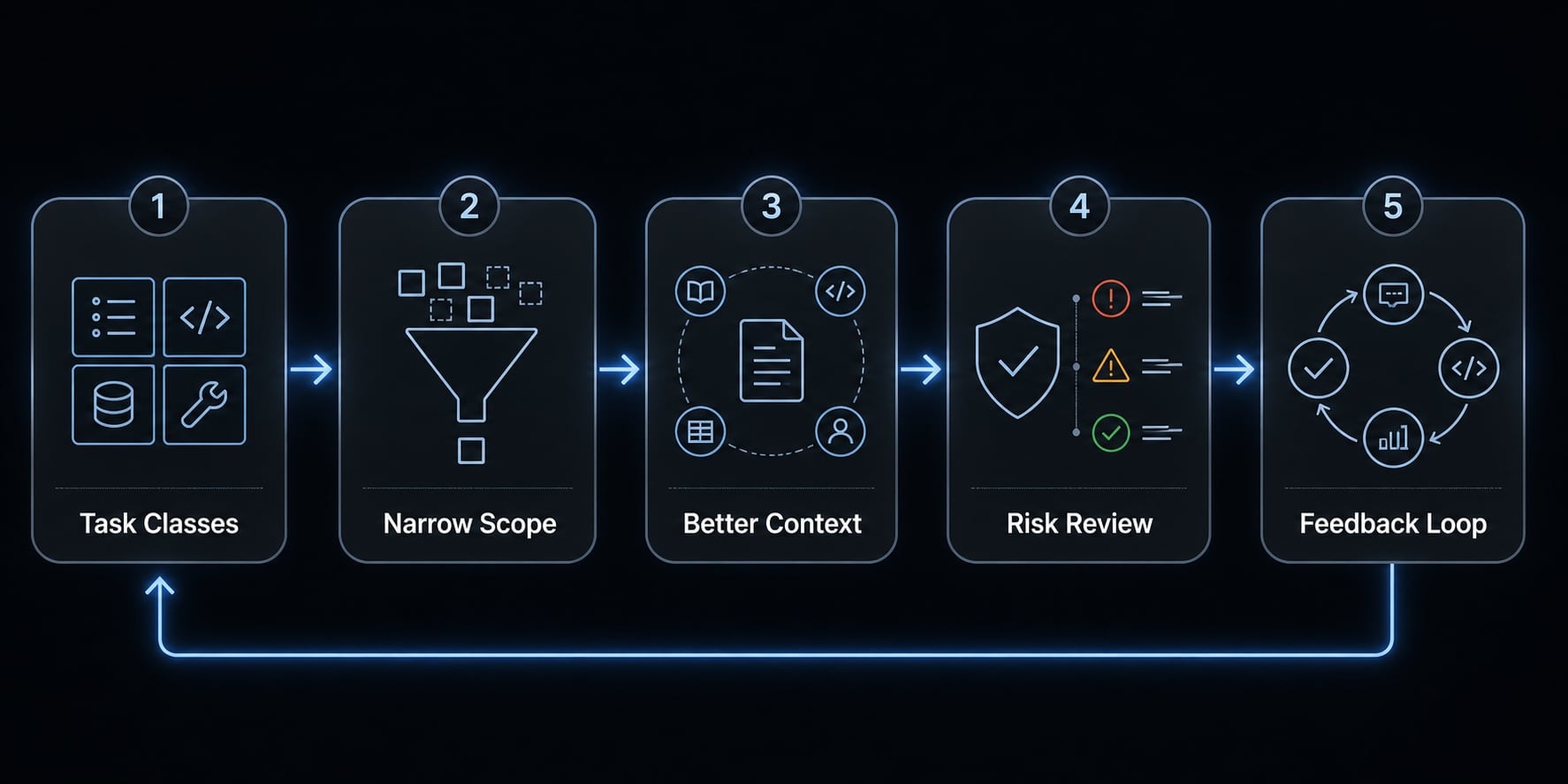
A practical framework for AI-assisted software delivery looks like this:
- Use AI on the right task classes.
- Shrink the scope of each request.
- Give the model better context, not just better prompts.
- Keep human review focused on risk, not style.
- Track the rework loop and feed it back into the workflow.
Step 1: Use AI on the right task classes
AI is usually strongest when the task is bounded and validation is straightforward. It becomes riskier when domain nuance or architectural judgment matters.
Best-fit tasks
- Tests.
- Boilerplate.
- Docs.
- Narrow refactors.
- Repetitive internal utilities.
Higher-risk tasks
- Deep domain logic.
- Architecture changes.
- Security-sensitive flows.
- Cross-service changes.
- Fragile legacy areas.
This step alone helps with reducing technical debt from AI-generated code because it keeps the tool in areas where mistakes are cheaper to detect and fix.
Step 2: Shrink the scope of each request
Smaller requests reduce hidden regressions. They also make review easier and improve accountability when something goes wrong.
Useful operating habits include:
- Plan first, generate second.
- Break broad tasks into narrower subproblems.
- Start new AI interactions when context becomes noisy.
- Avoid “implement the whole feature” prompts where possible.
Broad prompts increase compounding error risk. Small requests make failures easier to isolate and cheaper to correct.
Step 3: Give the model better context, not just better prompts
Strong context-aware workflows usually outperform clever prompting alone. The goal is to reduce guesswork before generation starts.
Context checklist:
- Coding standards.
- Relevant files or modules.
- Clear acceptance criteria.
- Architectural constraints.
- Dependency expectations.
- Test expectations.
- Known edge cases.
- Security or policy restrictions.
This is one of the highest-leverage ways of reducing technical debt from AI-generated code. Better inputs lower the chance of plausible but misaligned output.
Step 4: Keep human review focused on risk, not style
The purpose of review is not to debate formatting first. It is to verify whether the change is safe, aligned, and maintainable.
Human review should prioritize:
- Architecture fit.
- Edge cases.
- Security.
- Maintainability.
- Domain assumptions.
- Integration impact.
At the same time, use automated quality gates for what machines handle well:
- Formatting.
- Linting.
- Basic test execution.
- Static analysis.
- Policy checks where available.
This reduces unnecessary code review burden and keeps reviewer attention on higher-value judgment.
Step 5: Track the rework loop and feed it back into the workflow
Rework should become process learning, not just a recurring annoyance. Good feedback patterns include:
- Repeated review comments update future instructions.
- Recurring bug types refine task boundaries.
- Common context gaps become reusable setup material.
- High-risk repositories get tighter workflow controls.
Over time, this is how teams build more reliable context-aware workflows. The goal is not perfect output. The goal is fewer repeated mistakes.
What this look like for small teams vs. larger engineering organizations
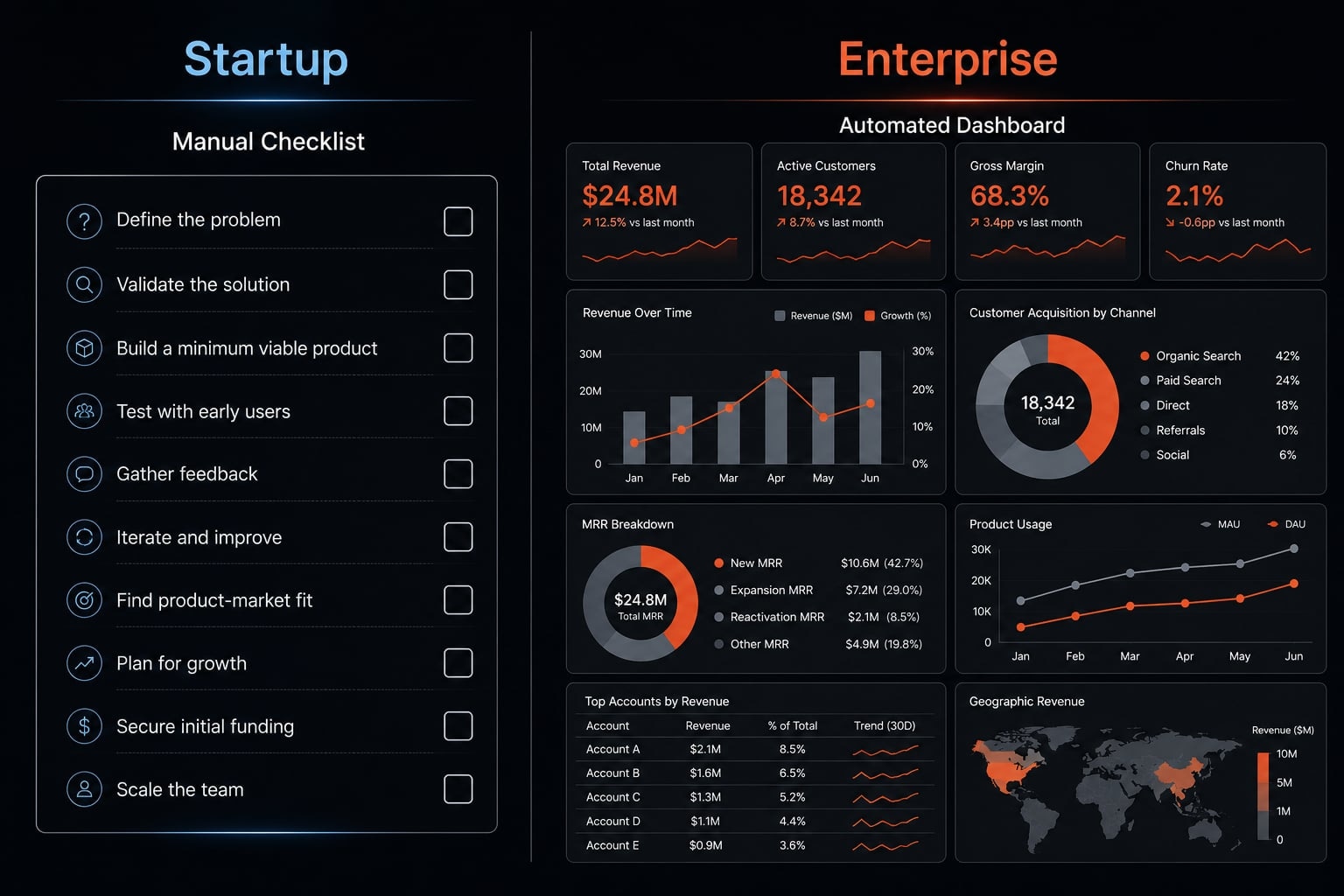
The same workflow risk exists across team sizes, but the controls should match team maturity. A startup does not need enterprise governance on day one, and a large organization should not rely on gut feel forever. The shared goal is better software quality and stronger engineering ROI.
For founders, indie teams, and small product squads
For lean product teams, the best move is to start manually and keep the process lightweight. Use a simple checklist or spreadsheet to track:
- Reopened PRs.
- Post-release bugs.
- Extra review cycles.
- Follow-up commits after “done”.
- Tasks that repeatedly required clarification.
This approach improves developer experience because it creates visibility without adding heavy process. Manual first, instrumentation later is usually the right order.
For engineering managers and platform leaders
Larger teams should add rework tracking to DevEx or DORA-style dashboards, then segment results by task class, repository type, and workflow pattern.
Good practices include:
- Compare workflow patterns, not just AI adoption rate.
- Separate low-risk automation from architecture-sensitive work.
- Review where AI governance is needed lightly, not bureaucratically.
- Track whether different teams have different review and bug outcomes from similar usage levels.
The objective is not control for its own sake. It is to understand where AI improves flow and where it quietly adds downstream cost.
Practical example: How structured AI workflows lower rework
The fastest way to lower rework is usually not a better prompt. It is a better operating pattern. Structured AI workflows reduce ambiguity before generation starts and reduce cleanup after the code appears.
Before:
- Broad prompts created inconsistent outputs.
- Reviewers had to reconstruct missing context.
- Review burden increased.
- The same clarifications were repeated across tasks.
After:
- Smaller tasks were assigned with clearer boundaries.
- Reusable instructions captured coding rules and acceptance criteria.
- Subagents or task-specific roles handled narrower work.
- Stronger context control improved alignment.
- Basic workflow automation reduced handoff mistakes.
This pattern does not require one specific tool. In some teams, platforms such as AgentKit help standardize structured workflow design, but the underlying principle is broader: repeatable context and tighter task boundaries usually lower downstream churn more effectively than prompting alone.
Frequently asked questions about AI coding rework
What is AI coding rework?
AI coding rework is the avoidable downstream effort required to correct, debug, or refine AI-generated code after it has already been initially drafted. Unlike healthy engineering iteration, this rework typically manifests as follow-up commits, reopened pull requests, and unplanned hotfixes necessitated by plausible-but-misaligned AI output.
Why does AI-generated code increase rework?
AI tools often generate "near-miss" code that passes basic syntax checks but fails to respect domain assumptions, edge cases, or architectural constraints. This creates a "hidden debugging tax" where teams experience acceleration whiplash—saving time during initial generation only to spend significantly more time on code review, debugging, and production-safe fixes.
How do you measure AI coding rework?
To measure rework accurately, move beyond "time to first draft" and track metrics such as:
- Rework rate: The ratio of unplanned deployments to fix bugs.
- Review burden: Tracking extra review cycles or comment density.
- Follow-up fixes: Counting commits made specifically to correct merged AI code.
- Bug escape rate: Monitoring defects discovered post-merge.
- Context efficiency: Assessing how often the AI uses correct internal documentation.
What should teams measure instead of AI coding speed?
Teams should prioritize delivery outcomes over vanity metrics. Focus on end-to-end cycle time rather than generation speed, and track accepted output by task class rather than total lines of code. Monitoring your bug escape rate and review burden coefficient provides a more honest picture of engineering ROI than measuring prompt volume or developer sentiment alone.
How do teams reduce AI coding rework?
Reducing rework requires shifting from "faster generation" to "controlled workflows." Follow these steps:
- Segment by task class: Use AI for tests and boilerplate; reserve manual effort for architecture.
- Scope requests: Break work into smaller, bounded tasks.
- Control context: Provide specific internal standards and relevant documentation.
- Human-in-the-loop: Focus reviews on architecture and edge cases.
- Iterate: Feed rework patterns back into your AI instructions.
Does measuring rework mean I should stop using AI coding tools?
No. Measuring rework helps you move from speculative adoption to disciplined engineering. It allows you to preserve the speed benefits of AI coding by identifying exactly where and why your workflow breaks down, enabling you to implement the necessary quality gates to keep production safe and delivery efficient.
Read more:
- Mastering the Claude Code workflow for reliable AI development
- ClaudeKit: Optimize your AI workflow and development delivery
- Vibe code marketplace: Defining AI-driven development & risks
Conclusion
AI coding rework is not a niche engineering complaint. It is a delivery-quality issue that affects speed, maintainability, and confidence in output. If teams evaluate AI only by how fast code appears, they miss the downstream effort created in review, debugging, and unplanned fixes.
The practical response is straightforward: Define rework clearly, measure it with a lightweight scorecard, and reduce it through structured AI workflows and better workflow controls. Speed matters only when downstream cleanup stays under control.
If your team is adopting AI coding quickly, a simple rework checklist, measurement worksheet, or workflow audit is often the fastest way to see whether output is truly improving delivery rather than shifting effort later.