AI implementation planning: A framework for scaled success
AI implementation planning: A practical framework for enterprise AI success
While a quick AI demo can deliver instant answers, a dependable enterprise workflow requires managing incomplete inputs, permissions, reviewer availability, exceptions, and costs. True AI implementation goes beyond tool procurement to connect strategic business goals with a controlled, accountable, and ROI-driven process. By focusing on practical executive decisions-defining outcomes, data boundaries, approvals, and scaling thresholds-this guide provides a step-by-step framework using AI-assisted SEO brief creation as a real-world example.
What an AI implementation plan should include
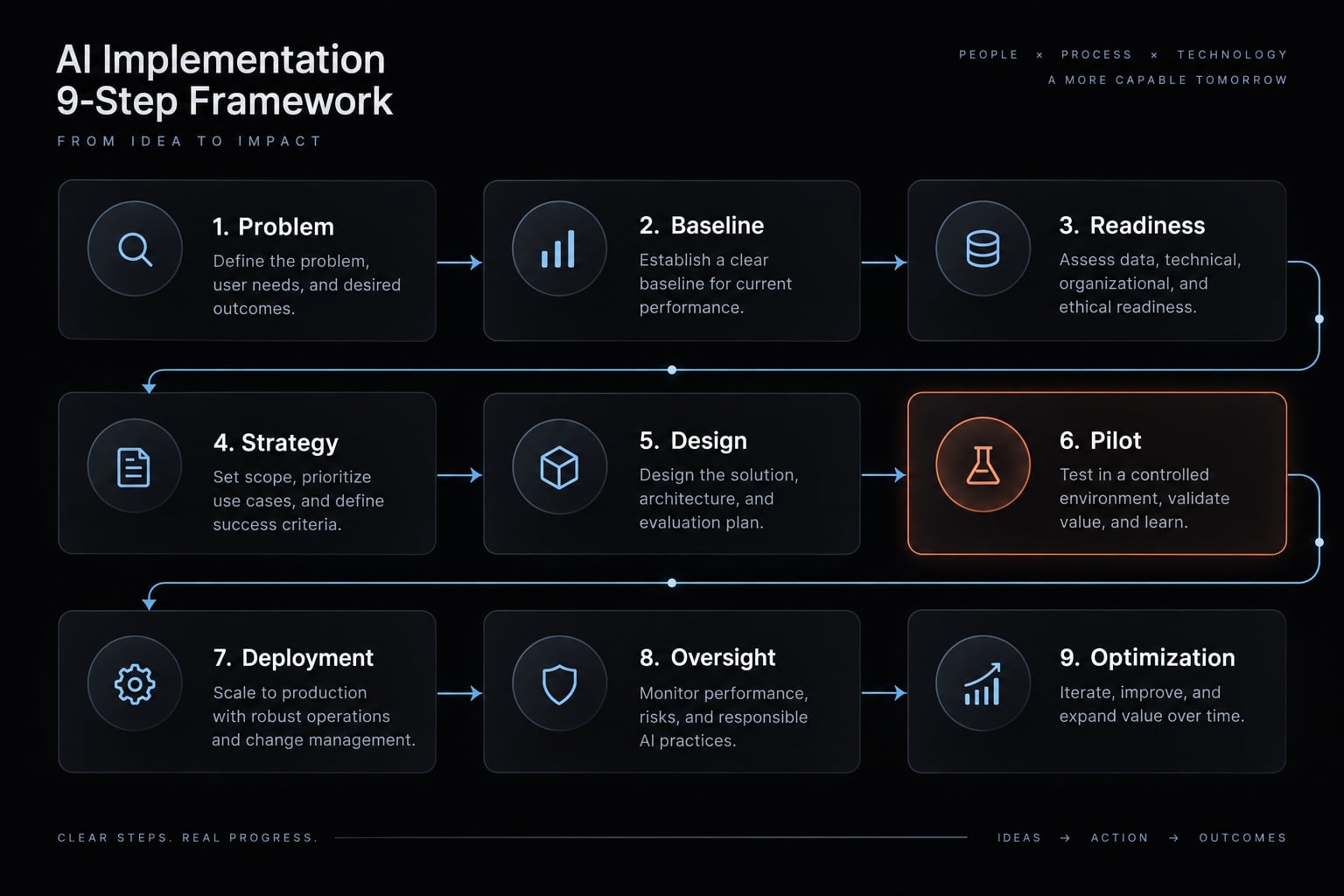
AI implementation planning translates business outcomes into executable plans. These plans cover workflow scope, data requirements, system needs, ownership, costs, and risk controls. It defines the baseline, pilot acceptance criteria, expansion requirements, and operating responsibilities, including when to pause, revise, or stop deployment if evidence fails to support continued investment.
Strategy determines where AI should create value. The implementation plan determines how to deliver and test that value. The operating model determines who remains responsible afterward. For SEO briefs, the strategy might prioritize content operations efficiency. The plan establishes a baseline and approval boundary; the operating model assigns ongoing editorial oversight.
The seven components of an executable AI implementation plan
- Objective and baseline: Specify the outcome and current performance.
- Workflow and use case: Define inputs, outputs, handoffs, and exclusions.
- Readiness: Identify process, data, technology, and capability gaps.
- Economics and KPIs: Set costs, benefits, and key performance indicators.
- Ownership: Assign delivery, approval, escalation, and operating decisions.
- Pilot and thresholds: Establish tests and acceptance criteria before execution.
- Deployment and operations: Define rollout, monitoring, maintenance, and containment.
These are components of the document—not a rigid sequence of project phases.
The core deliverables at each planning stage
Planning stage | Primary question | Expected deliverable |
|---|---|---|
Outcome definition | What should improve? | Objective and baseline |
Readiness assessment | What prevents a safe pilot? | Scorecard and blocker register |
Workflow mapping | Where should AI participate? | Current-state workflow map |
Prioritization | Which candidate comes first? | Weighted comparison |
Business case | Is the investment justified? | Cost, KPI, and ownership worksheets |
Pilot design | What evidence is required? | Pilot charter and test plan |
Deployment decision | Stop, revise, expand, or scale? | Stage-gate scorecard |
Operations | Who maintains performance? | Monitoring and change schedule |
A small team can combine these artifacts into one working document. Larger organizations may need separate workstreams, but documentation should remain proportional to risk.
Assess AI readiness before selecting tools
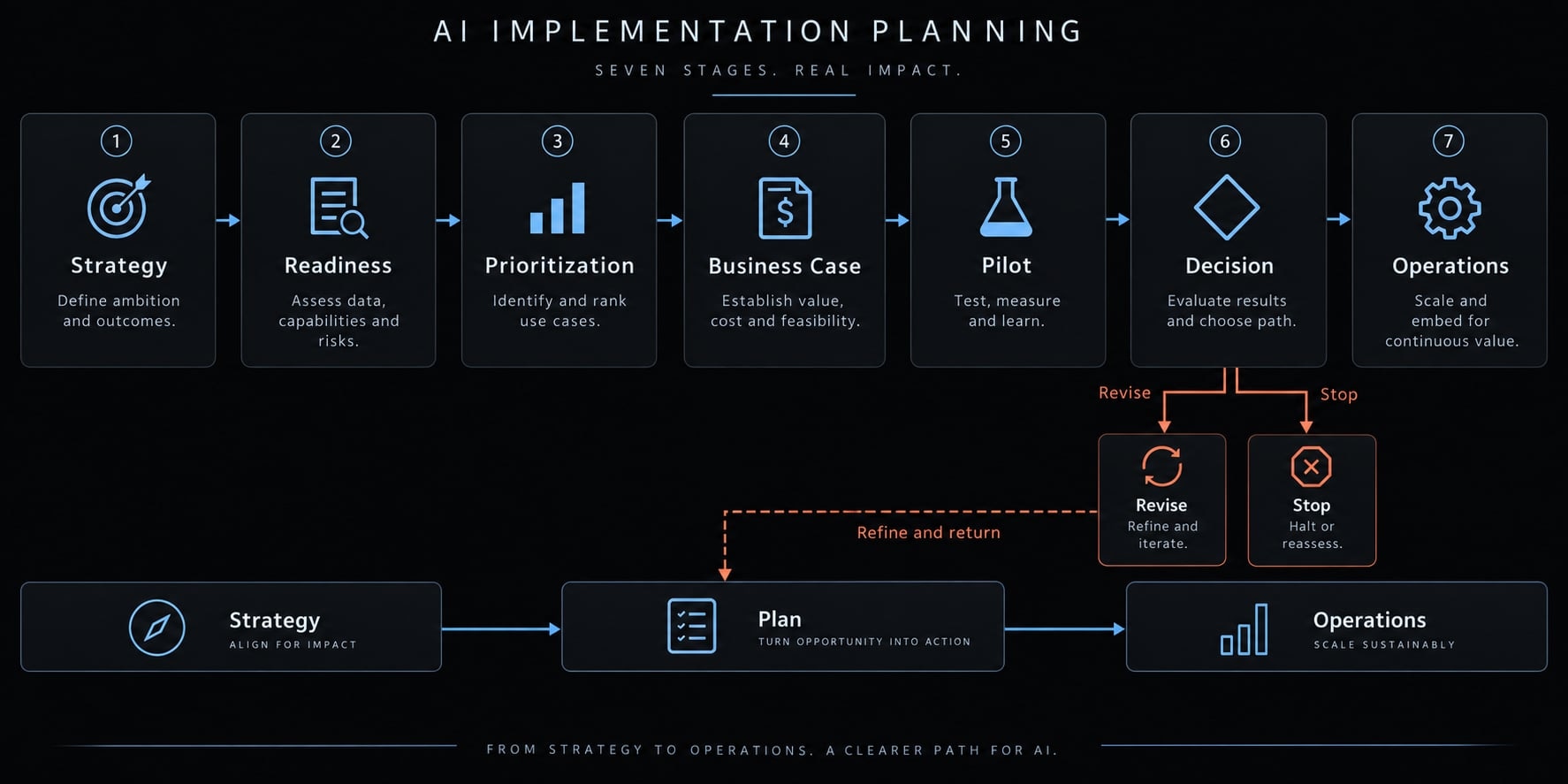
An AI readiness assessment is workflow-specific. A company may be ready to draft internal briefs but unprepared to let an agent publish them. Assess observable conditions rather than executive confidence. Strong data quality helps performance, but it cannot compensate for prohibited data use or missing accountability.
Five dimensions of AI implementation readiness
Dimension | Planning questions | Common blocker |
|---|---|---|
Business | Is the outcome measurable and owned? | No accountable owner |
Process | Are steps, exceptions, and approvals understood? | Unstable workflow |
Data | Are inputs accurate, accessible, and permitted? | Unclear usage rights |
Technology | Can systems connect with controlled access? | Unsupported integration |
People/governance | Can users review, escalate, and maintain? | No review capacity |
Use this illustrative editorial rubric, not an industry-certified maturity model:
Score | Meaning |
|---|---|
1 | Undefined or unavailable |
2 | Major gaps remain |
3 | Adequate for a bounded pilot with documented controls |
4 | Documented and tested |
5 | Proven under relevant operating conditions |
Interpret the results as follows:
- Prepare: A critical blocker remains or a required dimension scores below 3.
- Pilot: Required dimensions score at least 3, blockers are resolved, and controls are approved.
- Scale-ready: Readiness supports expansion and pilot evidence meets the stage gates defined later.
Never average away a blocker. Record its owner, resolution evidence, and approval status separately.
Readiness requirements for agentic AI workflows
An assistant produces an output. An agent can take actions across tools, creating additional operational exposure. Human-in-the-loop means a person reviews or approves specified decisions or actions. For draft-only briefs, editorial approval may be sufficient within the agreed scope. Publishing access requires stronger boundaries:
- Least-privilege access: Role-based access control gives users and agents only the permissions their responsibilities require.
- Approved tools: Specify allowed systems, actions, and destinations.
- Approval boundaries: Require approval before external or irreversible actions.
- Action logs: Record actions and decisions with appropriate data protection.
- Exception handling: Define fallback, escalation, and access suspension.
- Adversarial testing: Test data leakage and prompt injection—untrusted content attempting to redirect AI behavior.
MCP (Model Context Protocol) is an optional approach for connecting AI applications with tools and data. Official MCP documentation describes connectivity and authorization mechanisms; implementing a connector does not automatically make tool use safe.
When AI is not the right solution
Fix the foundations or choose another approach when:
- Stable rules already solve the task.
- Volume cannot justify implementation overhead.
- Data use is not permitted.
- Potential harm cannot be adequately controlled.
- Process ownership remains undefined.
Before comparing vendors, complete this AI readiness assessment with the workflow owner and security reviewer.
Map the workflow and prioritize the right AI use cases
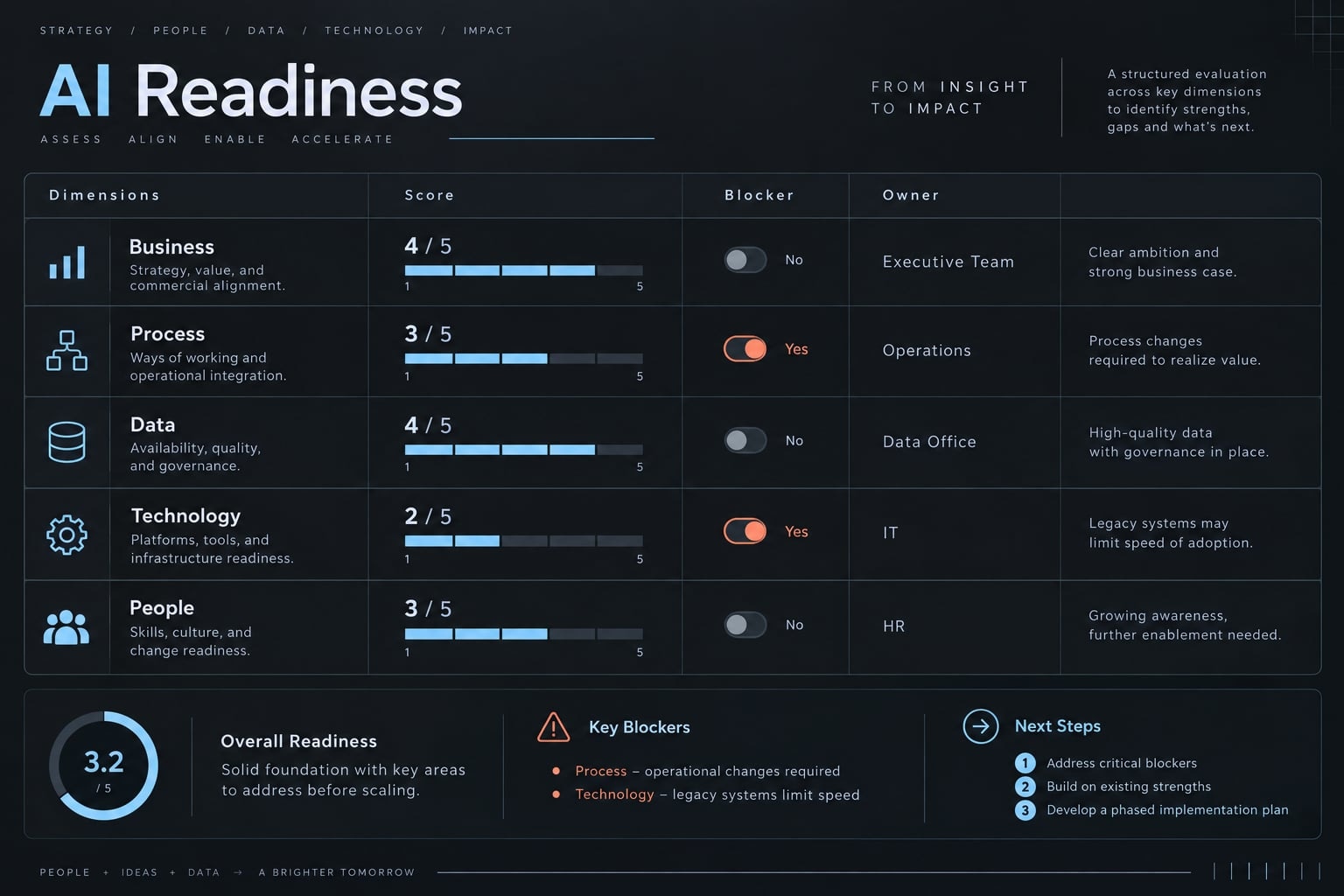
Prioritize a workflow, not an impressive capability. AI use-case prioritization should balance business value, implementation feasibility, and controllability. A high score supports investigation. It never authorizes prohibited activity.
Map the current-state workflow before redesigning it
Use this sequence:
Trigger → inputs → steps → systems → human decisions → outputs → exceptions
For the recurring example:
Approved topic → source material → research and outlining → content workspace → editor review → approved brief → missing evidence or revisions
Measure baseline time, cost, rework, and volume. Separate active working time from elapsed time: A brief may require little drafting but spend days awaiting approval. Choose the intervention that fits the bottleneck:
- Rules-based automation: Predictable routing, formatting, and checks.
- Generative assistance: Creating drafts for review.
- Predictive AI: Estimating outcomes from historical patterns.
- Retrieval-supported answers: Using approved knowledge to inform responses.
- Agents: Coordinating actions across steps and systems.
For brief creation, generative assistance with approved-source retrieval may be enough. Adding autonomous publishing would expand scope without necessarily improving the original objective.
Use a weighted AI use-case prioritization matrix
The following weights are proposed planning guidance, not validated industry standards.
Criterion | Weight | Scoring guidance |
|---|---|---|
Business impact | 25% | 5 = stronger meaningful benefit |
Data readiness | 15% | 5 = accessible, permitted, suitable data |
Implementation effort | 15% | 5 = lower implementation burden |
Risk exposure | 15% | 5 = lower residual exposure |
Workflow frequency | 10% | 5 = frequent enough to matter |
Adoption probability | 10% | 5 = stronger user fit |
Time to value | 10% | 5 = faster credible value |
Score each criterion from 1–5. Higher normalized scores must consistently indicate a better first-pilot candidate. If raw effort or risk uses 5 for the highest burden, convert it using 6 − raw score. Never reverse-score an already normalized input.
Weighted score = Σ(normalized score × decimal weight)
Weights total 100%, so the result remains on a 1 - 5 scale. Record assumptions and review them with business, technical, security, and end-user representatives.
Worked example: Prioritizing a marketing workflow
This is a hypothetical scenario, not a measure of implementation performance. Score sequences follow the criteria order above.
Candidate | Normalized scores | Weighted result | Additional condition |
|---|---|---|---|
SEO brief drafting | 4, 4, 4, 4, 5, 4, 5 | 4.20/5 | Editorial approval |
Autonomous publishing | 4, 3, 2, 1, 5, 2, 2 | 2.80/5 | Exclude if publishing risk is unacceptable |
CRM enrichment with approval | 4, 3, 3, 3, 4, 3, 3 | 3.35/5 | Verify sources and record matching |
CRM means customer relationship management system.
The calculation for the SEO brief is:
(4 0.25) + (4 0.15) + (4 0.15) + (4 0.15) + (5 0.10) + (4 0.10) + (5 * 0.10) = 4.20
This estimates suitability, not return on investment. CRM enrichment still requires permission to use source data, matching accuracy checks, and review before changes.
Build the business case, budget and ownership model
The business case must survive review effort, exceptions, and maintenance-not just demonstrate cheaper generation. Total cost of ownership includes internal capacity as well as external spending.
Calculate total implementation cost, not just license cost
Cost category | Timing | Include |
|---|---|---|
Discovery and workflow design | Setup | Internal workshops; external facilitation |
Data remediation | Setup and recurring | Cleanup, permissions, maintenance |
Integration and configuration | Setup and changes | Internal engineering; contractor costs |
Evaluation and security | Setup and recurring | Test design, assessments, retesting |
Software and model usage | Recurring | Subscriptions, usage, failed attempts |
Review and exception handling | Recurring | Editorial labor, corrections, escalation |
Training and adoption | Setup and recurring | Onboarding, guidance, refreshers |
Operations and support | Recurring | Monitoring, incident response, vendor support |
Track internal labor and external expenditure separately. This prevents a lower software bill from concealing a larger staffing burden.
Cost per successful workflow = total attributable workflow cost ÷ successful completions
A successful completion meets the agreed quality and control criteria. Include failed attempts, retries, review, and exception handling in the numerator.
Illustrative planning example: $3,000 in attributable monthly cost ÷ 600 accepted completions = $5 per successful workflow.
Assume the numerator includes $500 of setup cost allocated to that month, plus $2,500 in operating costs, including internal labor. Use the same accounting treatment when comparing alternatives.
For AI ROI-return on investment-compare incremental benefits and incremental costs over one consistent period. Released staff capacity is not automatically cash savings. It becomes financial value only through a credible change, such as avoided hiring or productive reassignment.
Build downside, base, and upside scenarios. Do not double-count time savings, capacity, and resulting revenue. AI ROI and total cost of ownership should be reviewed together.
Define a four-level KPI hierarchy
Level | SEO brief measure |
|---|---|
Business outcome | Cost per accepted brief |
Process performance | Cycle time and reviewer minutes |
Output quality | Evidence accuracy and acceptance rate |
Adoption and control | Eligible-workflow usage and approval compliance |
Faster drafting is useful only if approved briefs improve without excessive correction. Do not attribute revenue growth directly to drafting speed without supporting evidence.
Assign ownership through a practical RACI model
RACI defines Responsible, Accountable, Consulted, and Informed participation.
Decision | Responsible | Accountable | Consulted | Informed |
|---|---|---|---|---|
Pilot acceptance | Implementation owner | Business owner | Security and quality owners | Sponsor |
Assign one accountable role per decision. Give security and quality owners explicit approval rights for their respective controls; consultation alone does not create veto authority. A fuller RACI matrix can include the business owner, implementation owner, technical owner, security owner, quality owner, user lead, and sponsor. Small teams may combine roles.
For AI governance, NIST’s AI Risk Management Framework and ISO/IEC 42001 provide useful risk-management and management-system references. Using them does not establish compliance or certification. Before approving spending, review this worksheet with finance and the person accountable for pilot acceptance.
Design a controlled AI pilot with clear stage gates
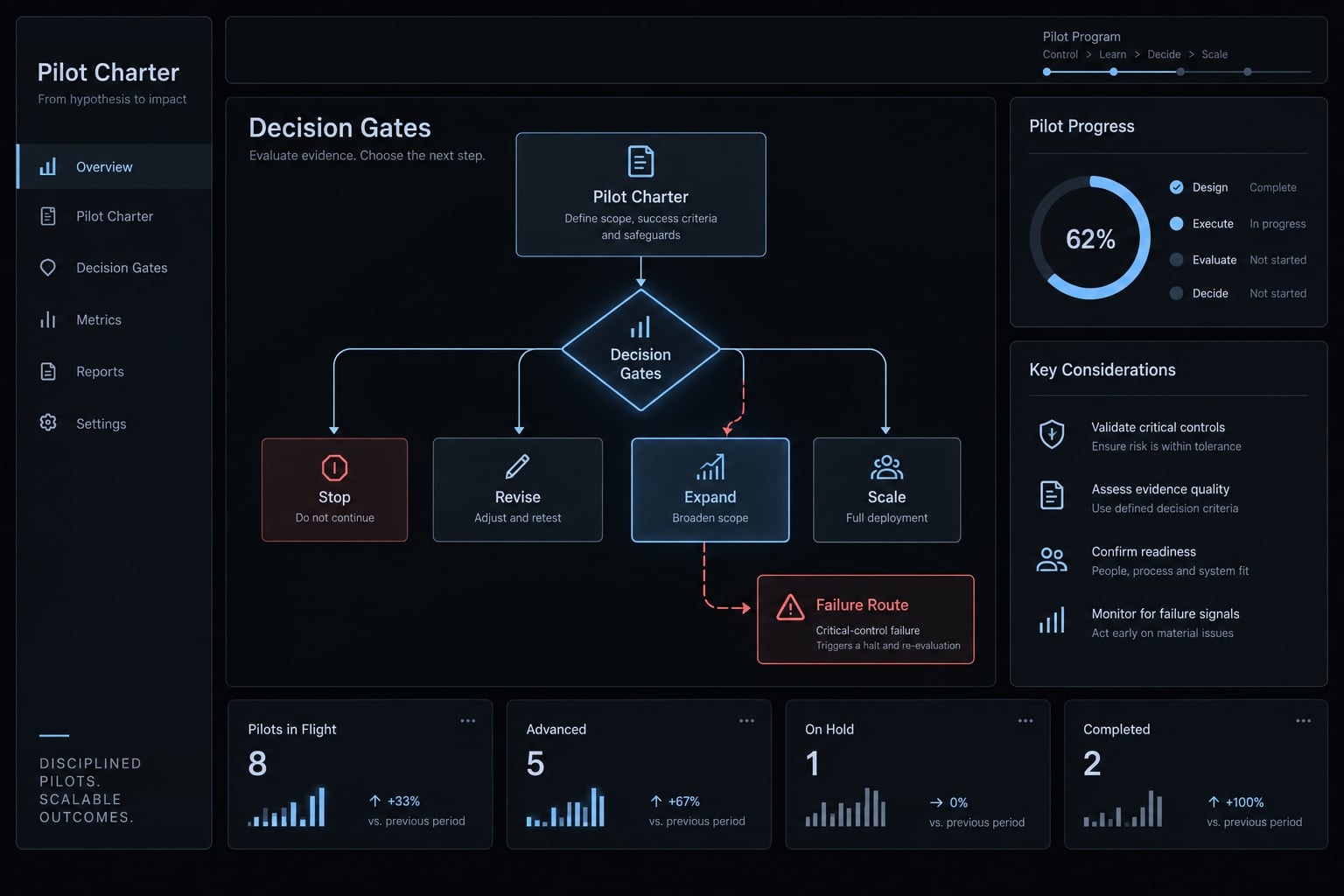
An AI pilot is a bounded business test that evaluates value, output quality, adoption, cost, and risk across an entire workflow. It compares results against a documented baseline and predefined acceptance criteria, producing evidence for a decision to stop, revise, expand, or scale.
Build the pilot charter
A pilot charter should contain:
- Objective and hypothesis.
- Scope and exclusions.
- Users and transaction volume.
- Timeline and spending ceiling.
- Baseline measurement.
- KPIs and measurement methods.
- Quality threshold.
- Human approvals.
- Access boundaries.
- Escalation rules.
- Rollback or containment.
- Review date and decision owner.
For SEO briefs, restrict the pilot program to a defined content category, approved sources, and named reviewers. Explicitly exclude publication and unapproved customer data.
Rollback may mean reverting configurations, disabling access, or restoring the previous process. Published content and sent messages may require remediation rather than true reversal.
Set the schedule around sufficient evidence, not an arbitrary launch date. Data preparation, integration, and review requirements determine the timeline.
Test the workflow, not only the model
Model validation alone cannot establish workflow viability. Test representative routine cases, difficult edge cases, and failure or misuse scenarios. Keep repeatable records of inputs, configuration versions, outputs, reviewer decisions, and corrections. Measure end-to-end quality, correction effort, latency, reliability, adoption, and cost.
For agents, include:
- Unauthorized access attempts.
- Prompt injection in retrieved sources.
- Wrong tool selection.
- Duplicate actions.
- Missed escalation.
Human approval reduces some risks but does not guarantee correctness. Reviewers need evidence, clear criteria, and enough time to challenge outputs. Sample size depends on variability and risk. No observed incidents in a small pilot program does not prove safety.
Apply explicit scale, revise and stop criteria
Predeclare acceptance criteria before reviewing results. This illustrative scorecard uses organization-specific thresholds rather than universal benchmarks:
Dimension | Threshold to define before testing |
|---|---|
Business | Accepted-brief throughput reaches approved target. |
Quality | Rubric score and critical-error limits are met. |
Cost | Cost per accepted brief stays below agreed ceiling. |
Adoption | Eligible users meet participation and completion targets. |
Control | No unauthorized publication; required approvals recorded. |
The pilot charter should specify actual values, measurement windows, and minimum evidence requirements.
Decision | Evidence required |
|---|---|
Stop | Unacceptable risk, invalid economics, or no credible path to value. |
Revise and retest | Remediable deficiencies and a bounded correction plan. |
Expand within the function | Targets met within the tested context. |
Scale more broadly | Repeatability demonstrated and new contexts assessed. |
A failed critical control blocks expansion even when productivity targets are met. The stage-gate decision should record both evidence and unresolved limitations.
Stopping is a legitimate investment outcome. A review agent may support checking, but it does not replace independent evaluation.
Operationalize, scale and improve the AI capability
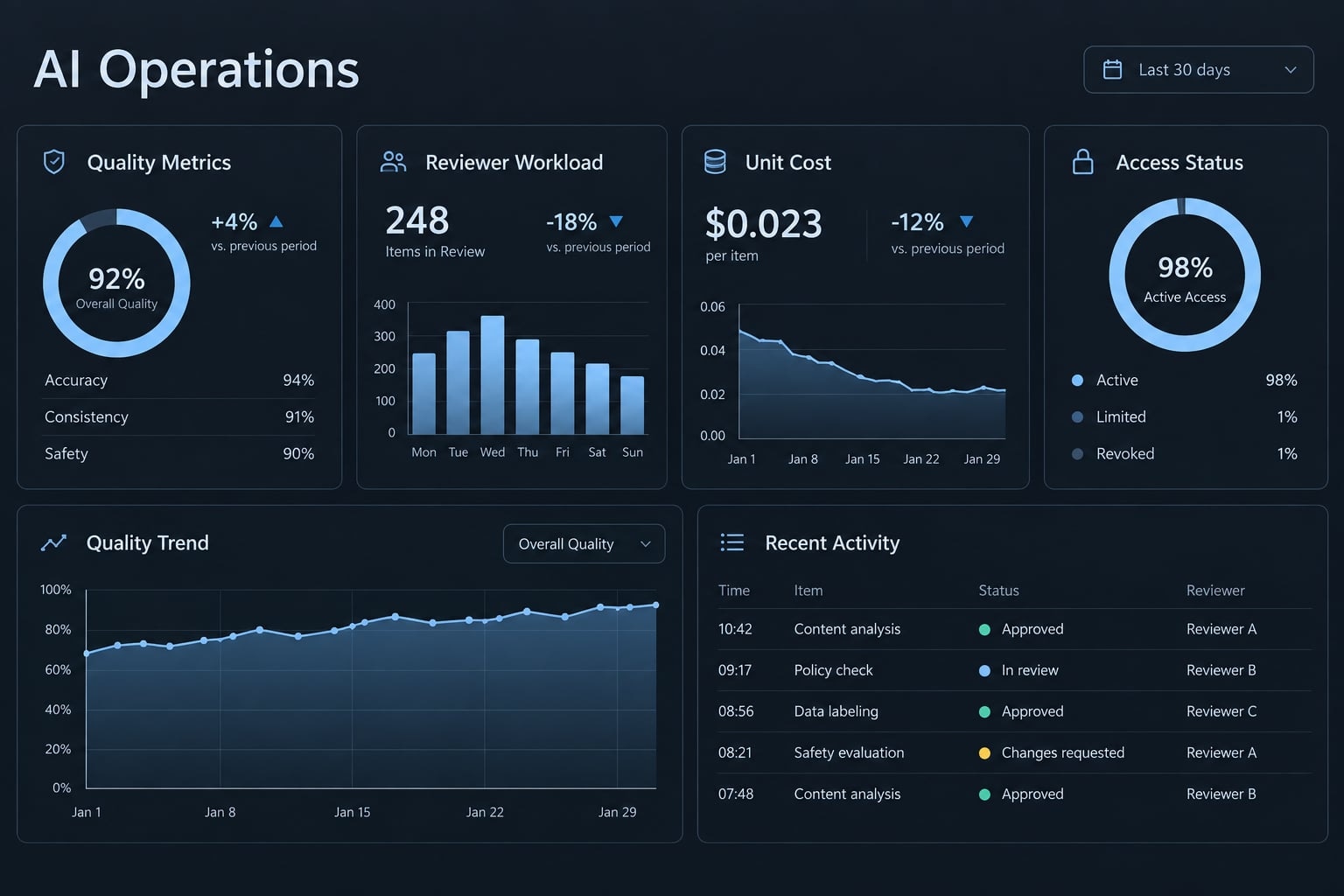
Scaling increases operating responsibilities, not just usage. Assign an AI operations owner to coordinate quality, cost, access, adoption, and incident response.
The business owner retains outcome accountability. Technical and security owners remain responsible for their respective controls.
Move from pilot to production in controlled increments
- Standardize the validated workflow.
- Document configurations and approval rules.
- Establish production permissions.
- Train the next cohort.
- Increase volume gradually.
- Monitor outcomes and controls.
- Pause expansion when thresholds deteriorate.
New users, data sources, languages, or departments can introduce conditions absent from the pilot. Reassess those differences before declaring scalability.
For SEO briefs, expansion from one product category to another may introduce unfamiliar terminology or restricted sources. Treat that as a scope change, not merely additional volume.
Establish an AI operations cadence
This is a suggested cadence, adjusted to workflow risk and volume.
Frequency | Review focus | Primary owner |
|---|---|---|
Real-time/daily | Failed actions, incidents, urgent quality exceptions. | Operations owner. |
Weekly | Reviewer workload, usage, completion rates, user feedback. | Workflow owner. |
Monthly | Cost per successful workflow and business outcomes. | Business owner with finance. |
Quarterly | Access, vendors, ownership, training needs. | Security and technical owners. |
After material changes | Regression tests and renewed approvals. | Implementation owner with control owners. |
AI FinOps means managing AI usage, cost allocation, and unit economics. It connects spending to accepted business outputs rather than treating low model-usage costs as sufficient evidence of value. Regression testing means rechecking established test cases after a change. Changes to models, retrieval sources, workflows, vendors, or permissions should trigger proportionate revalidation.
For example, a new research source may alter brief quality. Pause expansion, rerun evaluation, and obtain renewed quality approval before accepting the configuration. Change management also requires ongoing training and a feedback route for users. Monitoring enables corrective action; it does not itself produce continuous improvement.
Prevent the most common implementation failures
- Tool-first selection → Start with the measurable problem.
- Unstable processes → Clarify steps before automation.
- Too many pilots → Limit work to available review capacity.
- Vanity metrics → Measure accepted outputs and operating value.
- Missing review → Fund and schedule oversight.
- Underestimated costs → Include retries and exception labor.
- One-time training → Refresh guidance after changes.
- Premature scale → Assess new operating conditions.
- Disconnected configurations → Version shared settings and assign ownership.
- Missing rollback → Test containment and manual fallback.
Choose the right implementation path: Build, buy, configure or partner
No delivery approach is universally best. Build, buy, and configure describe implementation choices. A partner can support any of them; external delivery does not remove internal accountability.
Build, buy, configure or partner comparison
Dimension | Build internally | Buy software | Configure reusable workflows | Partner-supported |
|---|---|---|---|---|
Time to pilot | Often longer | Often faster if fit is strong | Often faster within supported scope | Depends on access and scope |
Customization | Potentially extensive | Product-dependent | Flexible within tooling limits | Depends on delivery approach |
Skills | Engineering and evaluation | Product administration and evaluation | Workflow configuration and evaluation | Lower delivery burden; ownership remains |
Integration | Custom work | Supported connectors | Available tools and connectors | Scoping and integration support |
Maintenance | Internal responsibility | Shared with vendor | Internal configuration upkeep | Contract-defined responsibilities |
Governance | Potentially strong if maintained | Constrained by product controls | Requires explicit boundaries | Requires contractual and internal controls |
Best fit | Distinctive requirements | Standardized needs | Repeatable supported tasks | Capability or coordination gaps |
Hybrid approaches are common. A team might buy model access, configure reusable agent workflows, and engage an AI implementation partner for integration or independent evaluation.
When internal implementation is usually sufficient
Internal delivery is appropriate when the organization has:
- A bounded, lower-risk use case.
- Existing supported tools.
- Manageable integrations.
- Named business and technical owners.
- Evaluation and control capability.
- Capacity for ongoing maintenance.
Company size alone is not decisive. A small team with sensitive data may need specialist support; a larger organization may deliver a narrow workflow internally.
When external support may reduce implementation risk
Consider support when cross-system dependencies, sensitive data, limited capacity, stalled pilots, or unclear delivery controls exceed internal capabilities.
Evaluate an AI implementation partner against:
- Relevant proof of work.
- Transparent scope, assumptions, and exclusions.
- Client ownership of data and configurations.
- Acceptance criteria and documented handover.
- Support responsibilities and exit terms.
Ask who fixes failures after launch and who can export configurations when the engagement ends. Compare full operating responsibility, not merely proposal price.
AgentKit implementation example: Reusable, controlled agent workflows
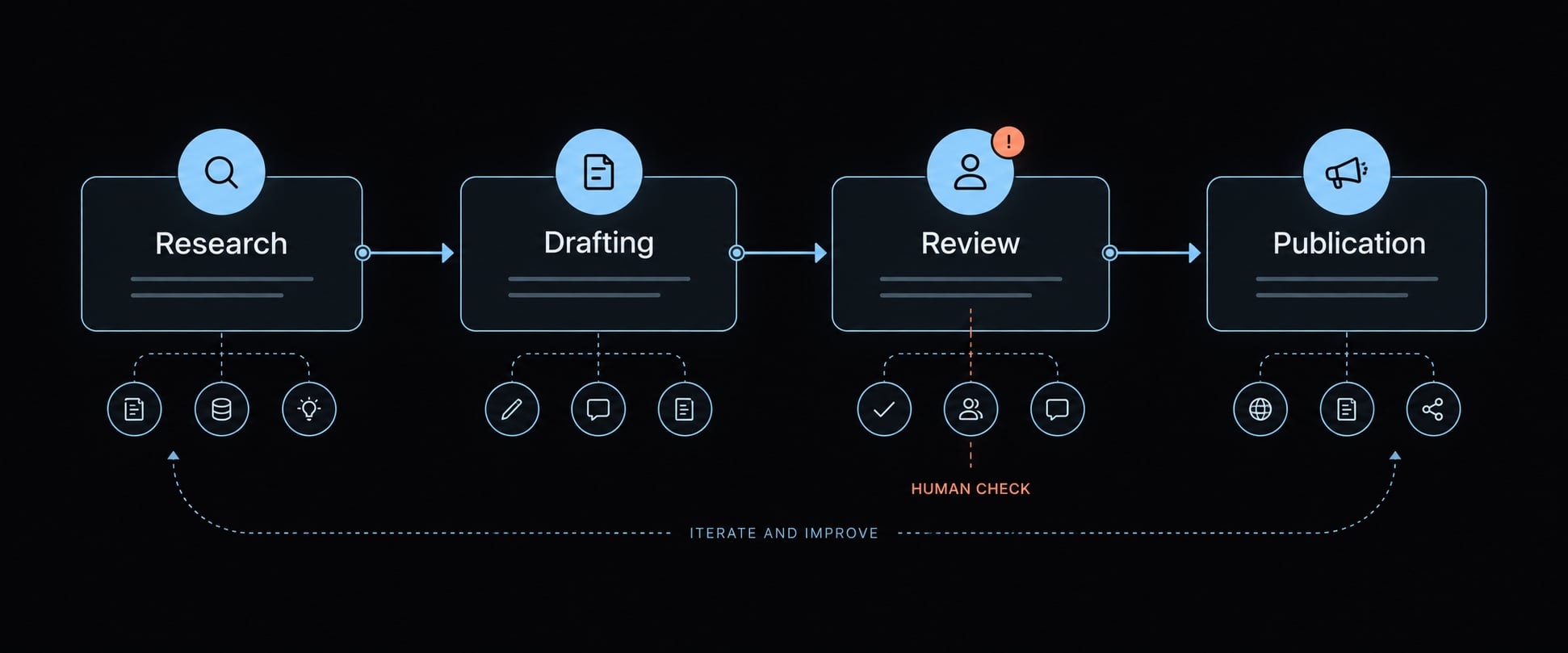
For the SEO brief workflow, AgentKit’s agent kits, specialized subagents, reusable skills, and workflows provide building blocks for approved-source research, structured drafting, and criteria-based review. Human approval should remain a separate boundary before publication.
MCP integrations can connect supported tools. The CLI—command-line interface—and desktop control center support management of configurations and related resources. Shared configuration can improve consistency, but it is not centralized governance.
Before deployment, verify which permissions, approvals, logs, and security checks are enforced by AgentKit, connected systems, or organizational procedures. Reusable agent workflows support execution; they do not replace accountable ownership, governance policy, process redesign, or measurable success criteria.
Frequently asked questions
What is AI implementation planning?
AI implementation planning is a structured framework that connects organizational objectives to technical execution. It defines business outcomes, maps workflows, establishes data governance, identifies ownership, and sets measurable criteria for testing, scaling, or stopping AI initiatives to ensure measurable return on investment.
What should an AI implementation plan include?
A comprehensive plan must include:
- Clear business objectives and performance baselines.
- Mapped current-state workflows.
- Readiness assessments across people, data, and technology.
- Budget and economics (cost per successful workflow).
- RACI model for decision accountability.
- Pilot charter with predefined stage gates.
- Deployment and production monitoring operations.
How do you assess AI readiness?
Readiness is evaluated across five dimensions: business alignment, process stability, data quality, technology capability, and governance. Organizations use a scorecard to identify critical blockers. Readiness is only confirmed when required dimensions score adequately and all security, legal, and operational blockers are resolved.
How do you prioritize AI use cases?
Use cases are prioritized using a weighted matrix based on business impact, data readiness, implementation effort, and risk exposure. Criteria are scored 1–5, and weighted calculations determine the candidate most suitable for a pilot. This method ensures resources are directed toward high-value, controllable initiatives.
What does AI implementation cost include?
Total cost of ownership includes one-time setup and remediation, recurring model and infrastructure usage, internal labor for development and management, and external vendor expenditure. Organizations should track the total attributable cost per successful workflow to ensure economic viability beyond initial license fees.
When should an AI pilot scale?
A pilot should scale only after meeting predeclared success thresholds in the pilot charter, including quality, cost, adoption, and control metrics. If a pilot meets targets, it may expand within the function; broader scaling requires demonstrating repeatability and rigorous evaluation across new contexts.
How do you scale an AI pilot to production?
Scaling requires standardizing the validated workflow, establishing production-level permissions, training team cohorts, and implementing continuous monitoring. Organizations must apply a gradual rollout, review quality exceptions regularly, and pause expansion if KPIs or control thresholds deteriorate, ensuring all changes undergo revalidation.
Should we build, buy, configure, or partner?
The choice depends on the workflow's complexity and internal capacity. Buying or configuring tools is often faster for standard tasks, while building custom workflows offers more control over complex data. An implementation partner can provide expertise to reduce risk, accelerate deployment, and ensure proper governance regardless of the chosen delivery path.
Read more:
- Agent skills vs prompts: Choosing the right AI architecture
- Master a repeatable AI coding workflow for faster development
- AI feature development workflow: 7 stages to production success
Conclusion
AI implementation planning starts with a measurable outcome and an understood workflow-not a software shortlist. Assess readiness, resolve blockers, compare candidate use cases, and calculate economics that include review and maintenance. Assign decision rights before testing. Then use a bounded pilot to establish whether quality, cost, adoption, and controls justify expansion. Production requires continued ownership, monitoring, and renewed evaluation whenever material conditions change.
Start with one meaningful workflow whose boundaries and success criteria you can explain clearly. Treat stop conditions as responsible investment controls, not evidence of failure. A successful pilot earns the next controlled step, not organization-wide deployment.