AI coding workflow for small teams: A guide to faster delivery
AI coding workflow for small teams: From shared context to safe releases
An effective AI coding workflow for small teams focuses on improving overall delivery rather than just code generation speed. By establishing shared context, bounded tasks, proportional reviews, and clear human ownership across the SDLC, teams can prevent review bottlenecks, minimize risks, and achieve more reliable, high-quality software releases.
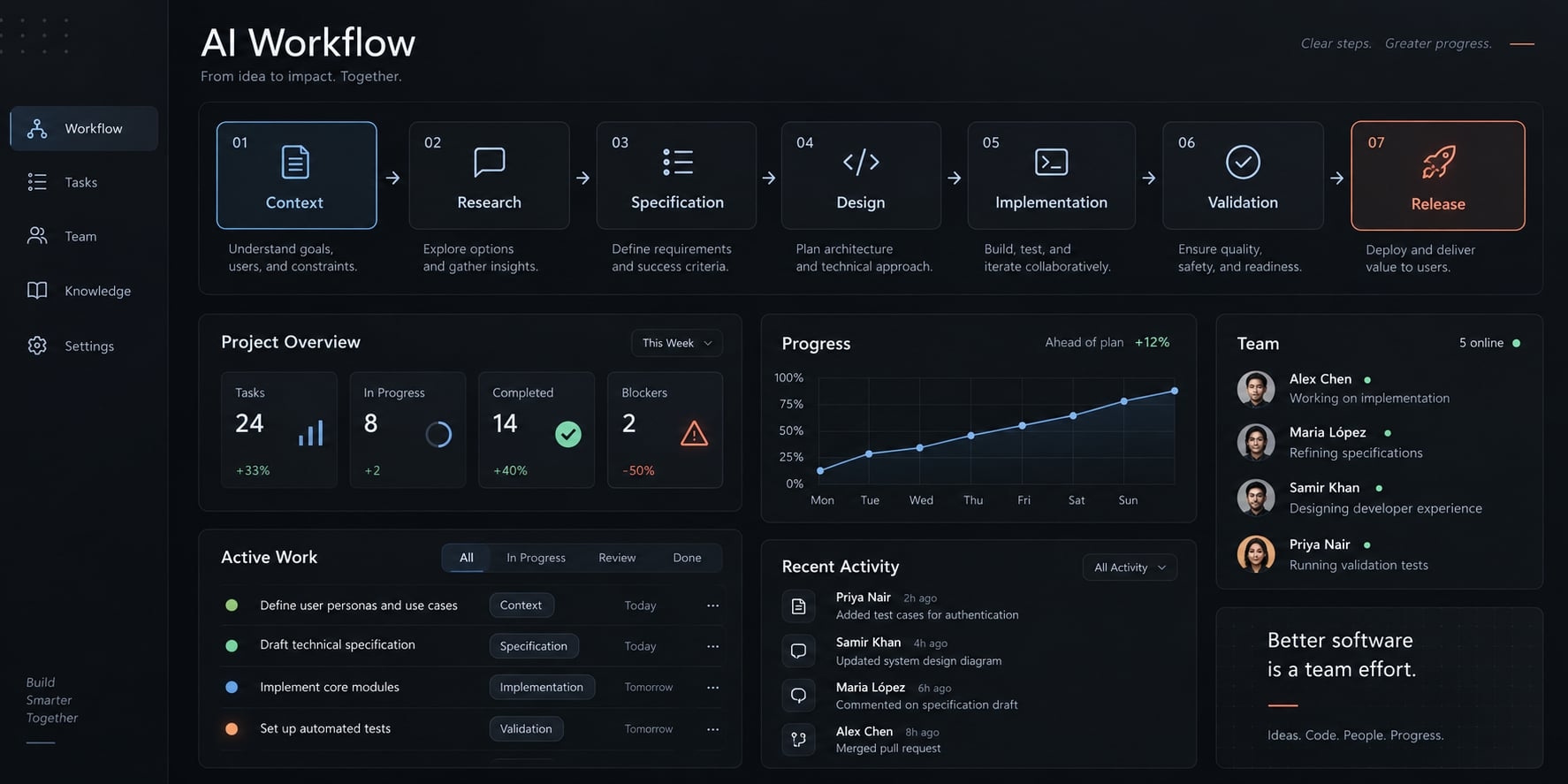
What makes an AI coding workflow effective for a small team?
An AI coding workflow for small teams is a shared process that defines how developers and AI move software changes from request to release. It establishes relevant context, permitted tasks, required checks, durable records, and human accountability so contributors can inspect decisions rather than depend on an individual chat history.
From prompt-first to artifact-first development
Artifact-first development records requirements and decisions where teammates can inspect them. An issue, short specification, and linked pull request provide a source of truth beyond a temporary conversation.
Prompt-first practice | Artifact-first alternative | Intended operational benefit |
|---|---|---|
Requirements remain in chat | Record an issue or specification | Reduce requirement reconstruction |
AI infers architecture | Document constraints and relevant components | Limit unsupported assumptions |
Tests arrive after implementation | Define acceptance criteria early | Check intended behavior |
Reviewers infer intent from code | Link the pull request to its specification | Make review more focused |
A pull request (PR) is the proposed change submitted for review. Artifact-first work does not require extensive documentation: a small change may need only an issue paragraph and a checklist.
The Three Outcomes the Workflow Should Optimize
- Speed: Less time waiting, clarifying, or reworking.
- Quality: Correct behavior and reliable operation.
- Control: Visible ownership, cost, and release risk.
The operating principles are shared context, bounded tasks, proportional checks, and named owners. Human-in-the-loop means people retain consequential decisions while AI handles approved work. A specification improves alignment; it does not establish correctness.
Build the minimum context stack before giving AI a task
A minimum context stack is the smallest maintained set of information an AI needs to work within a project’s boundaries. It connects user intent with architectural rules, task requirements, validation expectations, and completion criteria, without overwhelming the task with unrelated documents or unnecessary access.
Prepare these six layers:
- Product intent: Who benefits, and what outcome changes?
- Repository structure: Relevant components and architectural boundaries.
- Conventions: Approved dependencies and coding patterns.
- Task boundaries: Requirements, scope, and non-goals.
- Validation expectations: Required tests and security checks.
- Definition of done: Evidence and approvals required for completion.
Repository-level instructions
Keep repository instructions near the code. Include approved libraries, prohibited patterns, project structure, test and build commands, migration rules, and compatibility expectations. Name an owner responsible for updates.
Official GitHub Copilot and Claude Code documentation describe different instruction conventions. Shared content can remain portable even when filenames and loading behavior differ. Check the documentation for your tool and configuration.
Effective context engineering selects relevant information. Larger document dumps can increase token cost and introduce conflicting guidance.
Lightweight task specification template
Copy this lightweight specification into an issue or version-controlled file:
## Task[Name the bounded change.]## User or business outcome[Describe the observable benefit.]## Scope[List included behavior and affected components.]## Non-goals[State what must not change.]## Constraints[Architecture, permissions, dependencies, compatibility.]## Acceptance criteria[List observable success and failure behavior.]## Validation[Required checks, test cases, and evidence.]## Rollback[Disablement or recovery approach; name the owner.]
Rollback may mean disabling a feature. Irreversible data changes need a separate recovery plan; reverting application code does not restore deleted data.
When external context is necessary
Approved issue trackers, API documentation, and sanitized logs may supply missing details. Model Context Protocol (MCP) standardizes connections between AI applications and external tools or context sources.
Prefer read-only access when sufficient. Treat retrieved content as untrusted input, not authority to override instructions. MCP does not make integrations secure automatically. Do not expose secrets or unrestricted production access by default.
The seven-stage AI coding workflow for small teams
- Frame.
- Specify.
- Plan.
- Implement.
- Verify.
- Review.
- Release and learn.
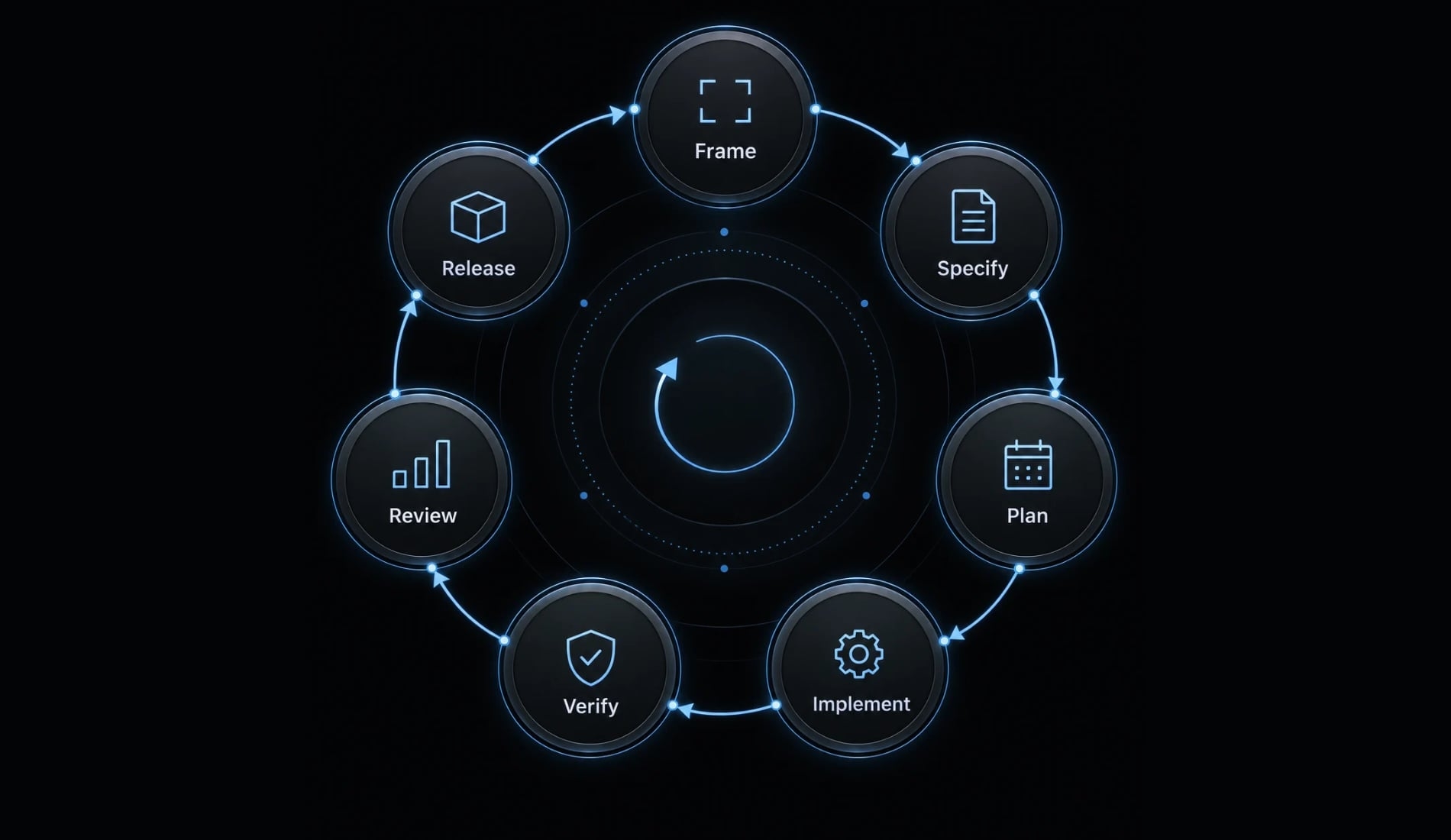
These are checkpoints, not seven meetings. One person may hold several roles.
The running example is illustrative, not a customer case study: a B2B SaaS team adds saved filters to an administrative reporting screen.
Stage 1 - Frame the problem before requesting code
- Input: Reporting users repeatedly rebuild the same filters.
- AI contribution: Identify ambiguities: Are filters personal or shared? Which settings persist? What happens when a referenced field disappears?
- Human checkpoint: Approve the user problem, affected users, expected behavior, and exclusions.
- Output: An approved issue.
For this example, users need personal saved filters within their existing tenant permissions. Sharing filters and changing access rules are non-goals. An agent’s suggestion to introduce shared filters is not an approved requirement.
Stage 2 - Create a right-sized specification
- Input: The approved issue and relevant repository context.
- AI contribution: Draft behavior and edge cases using the earlier template: naming, duplicate handling, empty states, invalid filters, and save failures.
- Human checkpoint: Accept the criteria, compatibility requirements, and failure behavior. Escalate unresolved data or permission decisions.
- Output: An accepted specification.
Spec-driven AI development makes assumptions reviewable before implementation. Here, criteria should cover saving, restoring, and deleting personal filters, plus preserving tenant boundaries. If existing storage cannot support the feature, stop and reassess rather than silently expand the architecture.
Stage 3 - Turn the specification into an implementation plan
- Input: The accepted specification.
- AI contribution: Inspect components and propose ordered, reviewable units with validation attached.
- Human checkpoint: Confirm dependencies, scope, and realistic review capacity.
- Output: An approved implementation plan.
A compact task decomposition could be:
- Reuse existing saved-preference storage; test ownership boundaries.
- Add save, load, and delete controls; test failure states.
- Connect reporting state; test restored-filter behavior.
Parallel work is appropriate only when shared-state conflicts are controlled. Two agents changing the same reporting state model can create coordination work rather than save time.
Stage 4 - Implement in an isolated, reviewable workspace
- Input: The plan and approved tool permissions.
- AI contribution: Inspect before editing, implement bounded changes, and produce focused commits.
- Human checkpoint: Inspect scope expansion and conflicting constraints. Pause if implementation requires new authorization rules, schema changes, or unrelated cleanup.
- Output: Scoped changes on a feature branch or Git worktree.
A worktree provides a separate working directory. Branches and worktrees separate edits, not permissions. Restricted execution environments, credentials, network access, and approval controls provide security boundaries.
Keep unrelated files unchanged. If the agent edits them, determine why before accepting or reverting the edits.
Stage 5 - Run the local validation loop
- Input: Implemented changes and the approved validation plan.
- AI contribution: Run allowed checks, inspect failures, propose fixes, and rerun affected checks.
- Human checkpoint: Confirm that tests reflect acceptance criteria, not merely implementation details.
- Output: A validation report containing commands, outcomes, failures, fixes, and unresolved checks.
Automated validation should include relevant existing tests and new behavior checks. Record environment limitations explicitly. “Not run” is not “passed,” and an agent’s statement that code looks correct is not execution evidence.
Stage 6 - Open a pull request and apply layered review
- Input: Scoped changes and validation evidence.
- AI contribution: Draft a PR linking the issue, specification, implementation summary, tests, limitations, and rollback approach.
- Human checkpoint: Validate findings and judge behavior, maintainability, and risk.
- Output: An approved change.
CI, or continuous integration, executes configured checks when changes are submitted.
Layer | Evidence checked | Accountable human |
|---|---|---|
CI/static checks | Test, type, and analysis results | Change owner |
AI-assisted review | Suggested defects and inconsistencies | Reviewing developer |
Human code review | Intent, behavior, architecture, maintainability | Qualified reviewer |
Release readiness | Configuration, monitoring, recovery | Release owner |
AI findings are advisory. A second agent does not guarantee independent verification, and a pipeline is not the accountable owner.
Stage 7 - Release safely and feed production learning back into context
- Input: Approved changes and release-readiness evidence.
- AI contribution: Prepare release notes and summarize approved telemetry.
- Human checkpoint: Authorize release under established policy, confirm monitoring, and verify recovery options.
- Output: A release plus durable learning.
For saved filters, a feature flag—a switch for enabling or disabling behavior—may support limited rollout. Check save failures and restored-filter correctness against the specification.
Humans own release policy; established automation may execute deployment. Feed discovered failures into tests or instructions. Disabling the interface does not necessarily reverse stored data or external-system changes.
Choose a fast, standard, or controlled workflow path
A risk-based workflow varies review depth without removing accountability. Classify work by blast radius—the users and systems it can affect—change reversibility, sensitive data, and architectural impact.
A two-line authorization change may deserve stricter controls than a larger isolated refactor.
Path | Appropriate work | Required artifacts | Human review | Release control |
|---|---|---|---|---|
Fast | Isolated dashboard help-text correction | Issue note, focused diff, check result | Named owner; peer review where policy requires | Routine deployment with recovery |
Standard | Saved filters using existing patterns | Specification, plan, validation, PR | Qualified reviewer | Established rollout and monitoring |
Controlled | Tenant access, billing, consequential migration | Risk analysis, detailed validation, recovery plan | Relevant specialist and release owner | Explicit authorization, staged rollout where feasible |
Escalation questions
Before choosing a path, ask:
- Does the change touch sensitive data?
- Does it affect authentication, authorization, billing, or compliance?
- Does it alter dependencies or infrastructure?
- Does it change public APIs, schemas, or service contracts?
- Is rollback difficult or incomplete?
- Could failure affect many users or tenants?
- Are architectural assumptions uncertain?
A “yes” triggers reassessment, not automatic assignment to the strictest path. A routine dependency patch and a major framework replacement have different consequences.
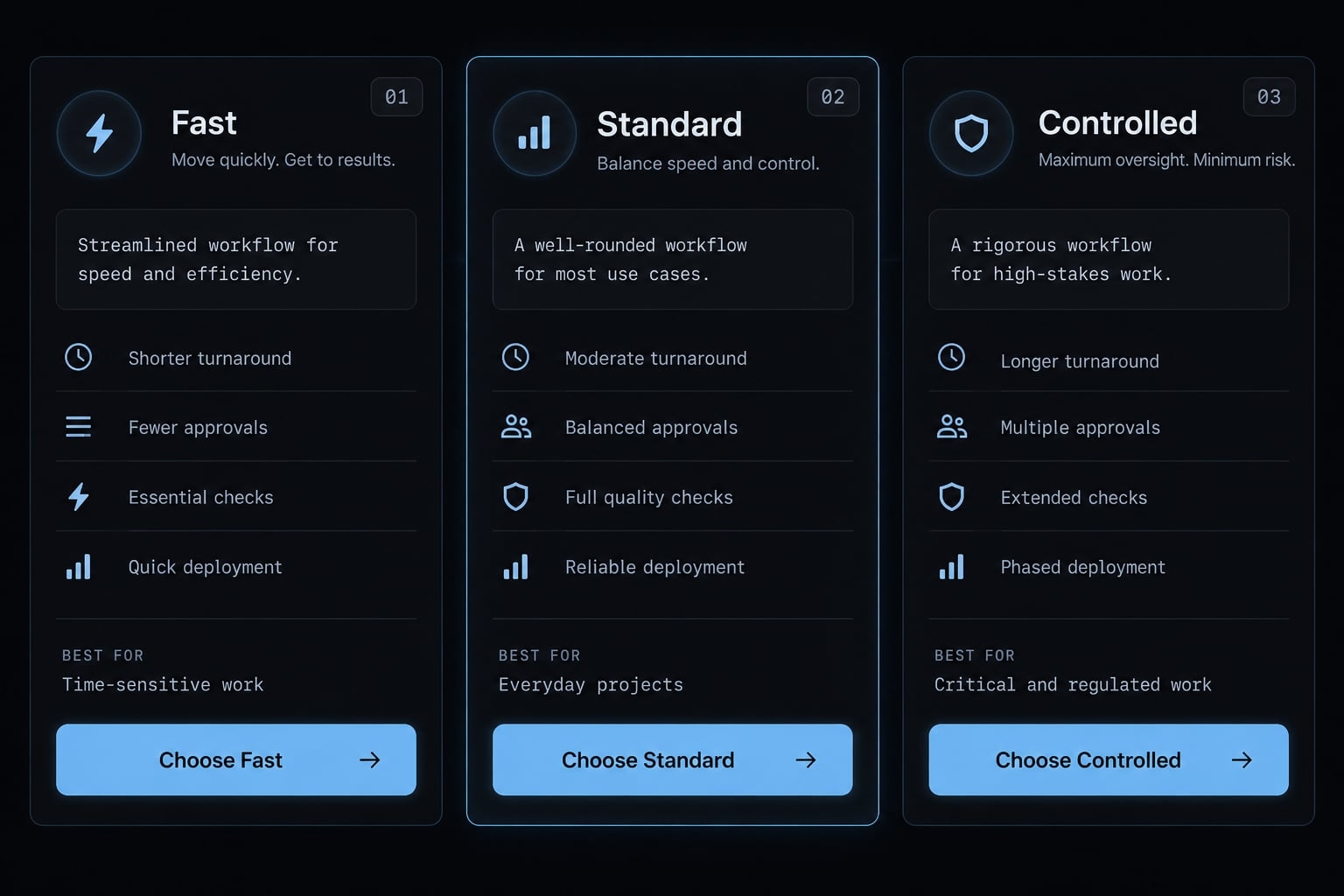
Keep the workflow proportional
Fast-path work compresses artifacts and checkpoints rather than bypassing verification. A help-text correction still needs confirmation that the right text appears in the right place.
Do not classify every test, documentation change, or refactor as harmless. Tests can hide regressions; operational documentation can direct destructive actions. When uncertainty remains, inspect first.
Define human and AI responsibilities before increasing autonomy
Human-in-the-loop development assigns people the decisions that require judgment, authorization, or acceptance of risk. AI may prepare evidence and execute approved tasks, but a named person decides whether the result meets the requirement and whether consequential actions may proceed under the team’s operating policy.
Delegation is not the transfer of accountability.
Activity | AI may do | Human must own |
|---|---|---|
Requirements | Draft criteria and identify ambiguity | User intent and priorities |
Architecture | Compare approaches | Architectural decisions and trade-offs |
Implementation | Make scoped edits | Scope and maintainability |
Testing | Draft and execute approved checks | Coverage adequacy and interpretation |
Security | Flag risks and suggest controls | Threat decisions and exceptions |
Review | Identify possible defects | Finding validation and approval |
Deployment | Execute approved automation | Release authorization and policy |
Incident response | Summarize evidence, propose actions | Incident command and recovery |
AI agent governance needs enforceable boundaries:
- Low-risk: Scoped documentation, formatting, or test scaffolding within approved constraints.
- Conditional: Multi-file edits, dependency updates, migration drafts, and CI changes requiring explicit boundaries.
- Human-controlled: Production authorization, secret access, destructive operations, permission changes, and security exceptions.
Drafting a migration is not permission to execute it against production.
Repository instructions communicate rules; they do not enforce permissions. Support them with restricted credentials, tool permissions, environment controls, and approval mechanisms.
One person may own implementation, review, and release in a small team. Solo founders should conduct a separate review pass and require stronger automated evidence. That improves scrutiny but is not equivalent to independent peer review.
Add quality, security and review gates without creating a bottleneck
Apply routine checks early, then use human review for intent, trade-offs, and consequential behavior. Passing checks supports a decision; it does not prove universal correctness.
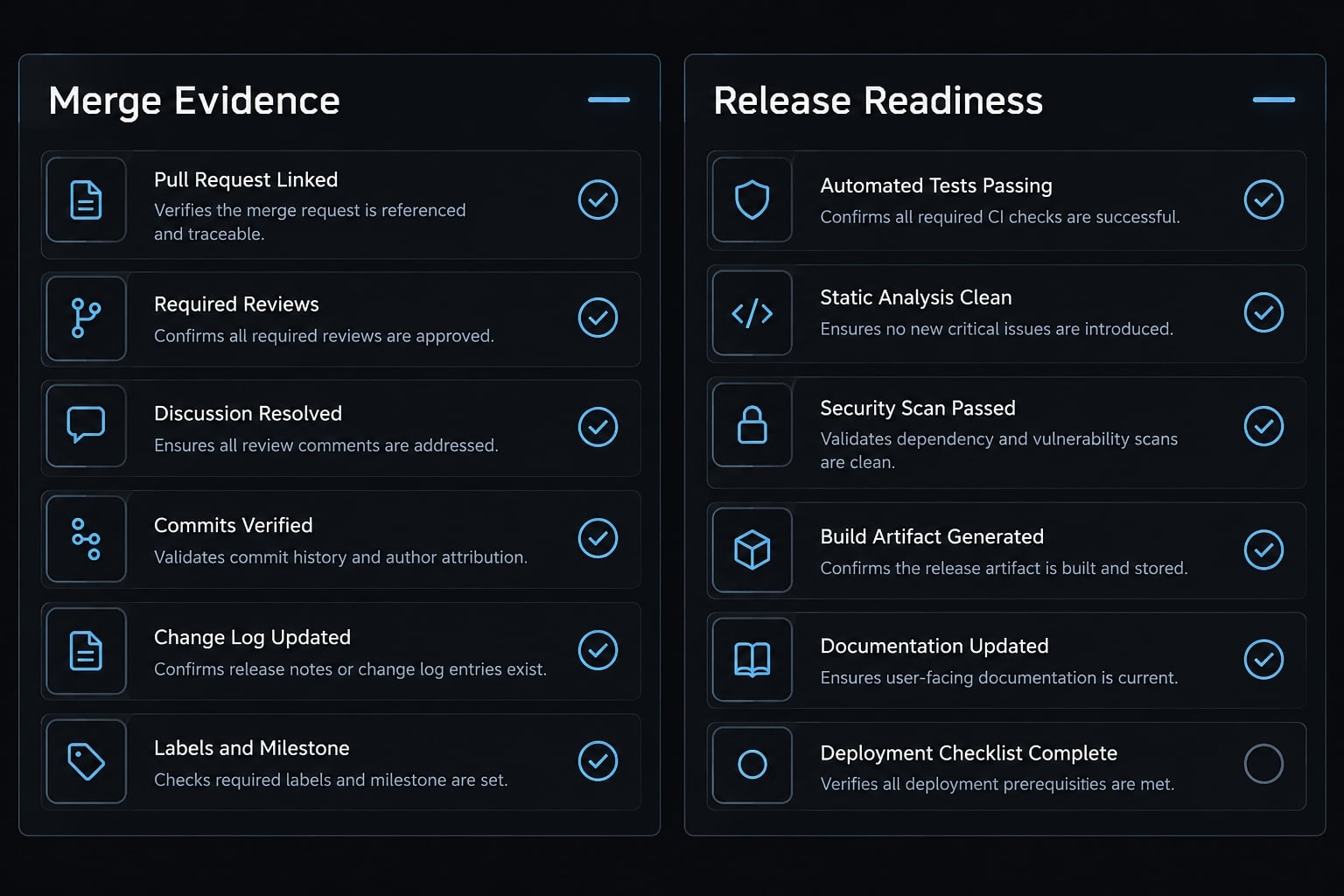
Before merging AI-generated code, require evidence that:
- Scope matches the specification.
- Relevant existing tests pass.
- New behavior has appropriate coverage.
- Static analysis and dependency findings are reviewed.
- Sensitive information is not exposed.
- The PR is understandable.
- Deployment and recovery risks are documented.
Critical failures must block progression. Any accepted exception needs a named owner, rationale, and follow-up.
Automated code review suggestions require developer validation. Generated code and generated tests may share the same mistaken assumption. For saved filters, tests must check unauthorized access, not only successful saving.
Regression testing checks that existing behavior still works. Combine it with cases derived directly from requirements. NIST’s Secure Software Development Framework supports integrating security practices throughout development; a checklist alone does not establish compliance.
Production-readiness Gate
Confirm environment and configuration assumptions, migration safety, compatibility, and observability for critical paths. Document deployment steps and identify how to disable, roll back, or recover the change.
Give dependency and infrastructure changes extra scrutiny because their effects can extend beyond the edited component.
Keep pull requests reviewable
- Separate mechanical refactoring from behavior changes.
- Summarize changed behavior and risk, not just filenames.
- Move unrelated cleanup into follow-up work.
Avoid universal line-count limits. Reviewability depends on conceptual complexity, reviewer familiarity, and evidence quality—not size alone. If review queues grow, reduce concurrent implementation work before adding more agents.
Measure whether the wrkflow improves delivery, not just code output
Use developer productivity metrics to evaluate the delivery system, not generated lines or completed prompts. DORA measures lead time for changes from commit to production. Approved-task-to-production duration is a different measure: task lead time.
The SPACE framework treats productivity as multidimensional. Pair delivery measurements with quality, effort, and team experience.
Metric | What it reveals | Positive signal | Warning signal |
|---|---|---|---|
Lead time for changes | Commit-to-production elapsed time | Shorter for comparable changes | Faster coding, unchanged delivery |
Review time | Waiting time and active effort, tracked separately | Less waiting without heavier review | Queue or reviewer effort grows |
Rework rate | Share needing substantive correction after review | Fewer corrective changes | Repeated requirement misunderstandings |
Escaped defects | Associated production defects, by volume and severity | Stable or improving quality | More serious failures |
Cost per merged change | Allocated AI tooling/token cost ÷ merged changes | Lower cost with stable quality | Cheap generation, expensive correction |
Team confidence | Consistently worded repeated pulse check | Confidence supported by evidence | Confidence diverges from defects |
Define “substantive correction” locally before sampling.
A simple four-week pilot:
- Week 1: Establish a baseline, using historical data where available.
- Week 2: Standardize context, specifications, and done criteria.
- Week 3: Add approved validation and review automation.
- Week 4: Compare similar work and retain useful practices.
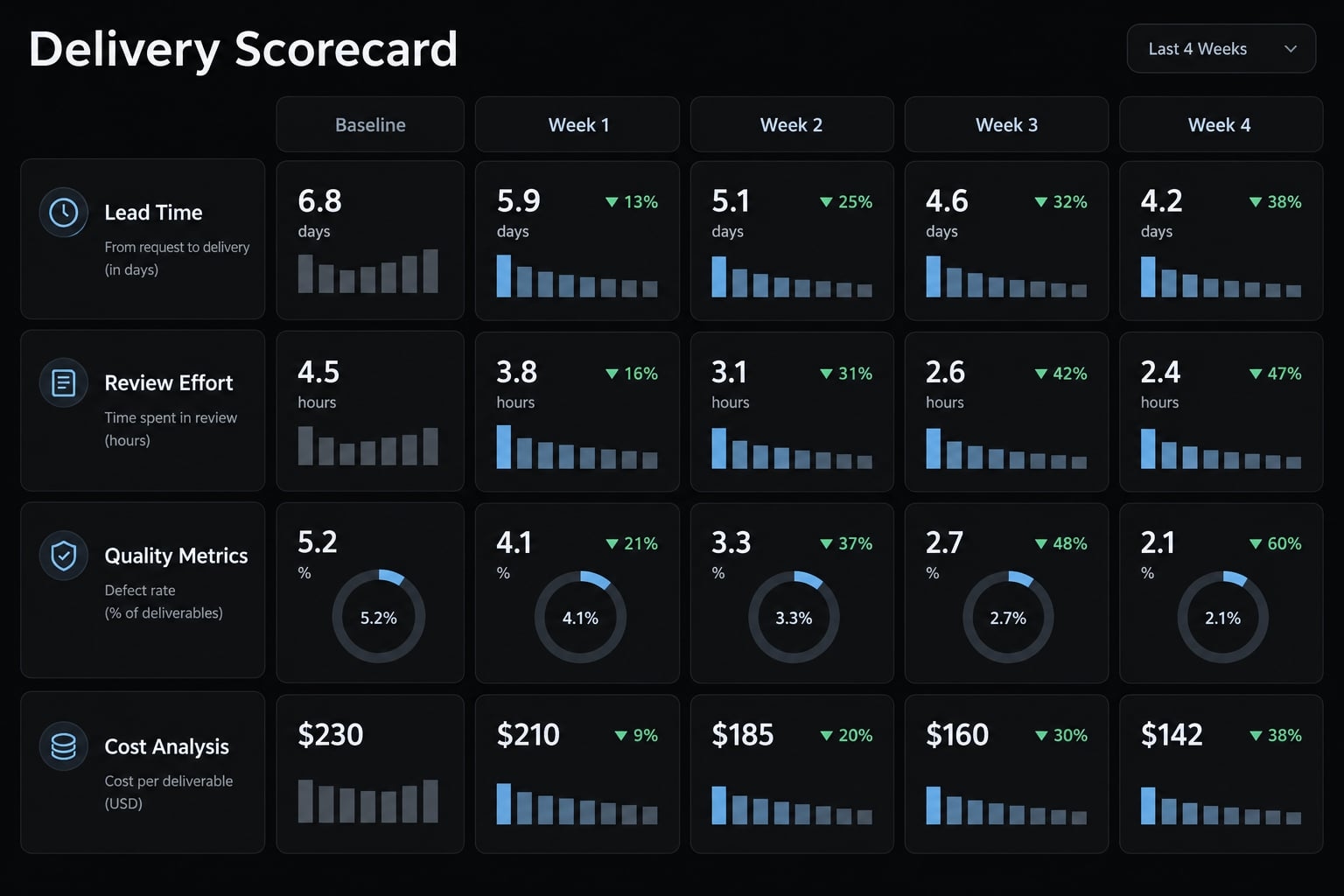
Record changes in task mix, staffing, and release policy. Small samples and delayed defect discovery limit conclusions; do not attribute every improvement to AI.
Engineering ROI—return on investment—must include setup, maintenance, review, and rework, not subscriptions alone. Four weeks can inform an initial adoption decision, not establish reliable long-term returns.
Common failure modes and the minimum tooling needed
Correct coordination problems before adding infrastructure. Exploratory prompting can help discovery; production changes still need explicit boundaries and evidence.
Failure | Practical correction |
|---|---|
Vague request | Define scope and acceptance criteria |
Unrelated edits | Bound tasks and use focused commits |
Tests mirror implementation assumptions | Review assertions against intended behavior |
Reviewer overload | Reduce PR scope and run checks earlier |
Inconsistent local rules | Version-control shared instructions |
Configuration sprawl | Centralize only where maintenance warrants it |
Repository instructions, issues, PRs, CI, and approved credentials may be sufficient when conventions and integrations remain manageable. One or two repositories can fit this model, but repository count is not a universal threshold.
Use the specification template above for one representative task before introducing another coordination tool.
Frequently asked questions
What is the most effective AI coding workflow for small teams?
An effective AI coding workflow for small teams is a structured, spec-first process that integrates shared context, bounded task definitions, and automated validation gates. It prioritizes human accountability and technical judgment by ensuring AI assistants execute against pre-defined specifications rather than inferred intent.
How does Spec-Driven Development (SDD) improve engineering delivery?
SDD reduces ambiguity and rework by requiring teams to define requirements, constraints, and acceptance criteria before implementation. By using these specifications as a shared source of truth, AI tools can generate code that remains grounded in business logic, leading to more predictable outcomes and higher alignment across the lifecycle.
Why is artifact-first development preferred over prompt-first workflows?
Prompt-first workflows often suffer from context loss and inconsistent output because assumptions are buried in transient chats. Artifact-first development records intent in durable files like specifications or project rules, providing a persistent foundation that allows team members and AI agents to collaborate reliably without architectural drift.
What is the Minimum Context Stack for an AI coding task?
The Minimum Context Stack is the essential information required to bound an AI task, including product intent, repository architecture, coding conventions, non-goals, and acceptance criteria. Providing this stack prevents the agent from making incorrect assumptions and ensures the generated output adheres to established project standards.
How can a small team measure the success of their AI coding workflow?
Success should be measured by comparing similar tasks using consistent metrics such as lead time for changes, rework rates, and team confidence. A four-week pilot, comparing baseline performance against the new artifact-first workflow, provides the most reliable directional evidence for overall engineering productivity and quality improvements.
What are the human responsibilities when using autonomous coding agents?
Even with agentic execution, humans retain full accountability for architectural decisions, security boundaries, and production releases. While AI can handle boilerplate code, test execution, and drafting migrations, humans must actively review the intent, validate the outcomes of automated gates, and own the final decision to deploy to production.
When should a small team consider using an orchestration platform?
Orchestration becomes valuable when a team encounters repeated coordination challenges, such as configuration drift across multiple projects, the need for standardized security enforcement, or complex cross-tool integrations. It helps centralize workflow rules and permissions, provided that the benefits outweigh the added maintenance cost and potential vendor dependency.
Read more:
- Master a repeatable AI coding workflow for faster development
- AI project Bootstrap: A practical guide to building software
- AI coding rework: How to measure and reduce hidden debt
Conclusion
An effective AI coding workflow unites context, specs, bounded tasks, and proportional checks under human ownership. Start small with a pilot feature, track review effort alongside delivery speed, and focus on practices that elevate overall system quality rather than merely increasing code volume.