AI backend development workflow: 8 steps for reliable code
AI backend development workflow: Eight steps from specification to release
While fast AI code generation speeds up development, reliable backend engineering requires strict operational controls to prevent security gaps, unsafe migrations, and review overhead. A reliable AI-assisted workflow combines five key elements: clear specifications, rich repository context, scoped changes, automated testing, and human oversight. By establishing what to delegate and requiring continuous test evidence, developers leverage AI speed while retaining full ownership of production systems.
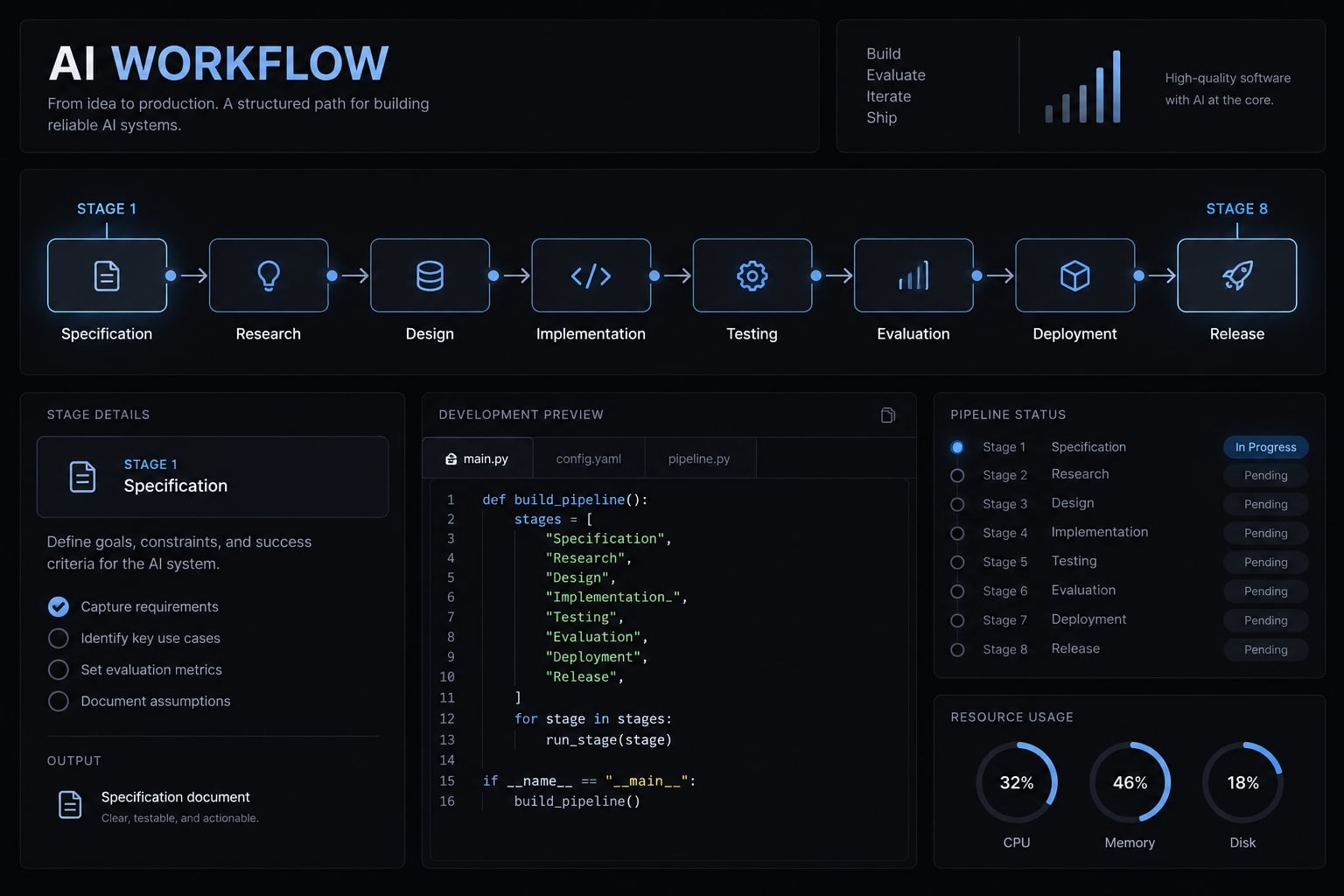
What is an AI backend development workflow?
An AI backend development workflow is a structured process that leverages AI assistants and agents across every stage—from planning and implementation to release preparation and monitoring. It combines relevant context, bounded tasks, and verification while keeping developers responsible for architecture, security, data integrity, and production approval throughout the software development lifecycle.
This guide focuses on using AI to develop backend software, rather than designing AI inference infrastructure.
Working Model | Typical Scope | Main Limitation |
|---|---|---|
AI autocomplete | Local completion and suggestions | Context and execution scope depend on the product |
Repository-aware agent | Repository inspection and multi-file tasks | Requires constraints, permissions, and verification |
Coordinated workflow | Multiple stages or specialized roles | Adds coordination and governance overhead |
These are working models, not rigid product categories. One tool may support several modes. Informal prompting can be useful for exploration. A repeatable workflow additionally records the intended outcome, permitted actions, validation evidence, and accountable reviewer.
Model capability still matters. Workflow design is an important controllable factor because it determines what the model can access, change, and submit. It also makes failures easier to inspect rather than hiding them behind a convincing completion summary.
The eight-step AI backend development workflow
Follow these stages for each bounded change. Failed checks return work to the relevant earlier stage; they do not justify bypassing approval.
- Define the feature and acceptance criteria.
- Supply relevant repository context.
- Inspect the repository and approve a plan.
- Implement small, reviewable units.
- Generate and execute tests.
- Review security, data, and architecture.
- Prepare the pull request and deployment plan.
- Monitor production and update guidance.
Stage | AI role | Human role | Required output | Quality gate |
|---|---|---|---|---|
Define | Clarify requirements | Set boundaries | Specification | Criteria are testable |
Context | Inspect relevant files | Validate context | Context summary | Rules, commands, permissions, assumptions reviewed |
Plan | Propose changes | Approve approach | Implementation plan | Scope and risks approved |
Implement | Edit within scope | Inspect changes | Bounded diff | No unexplained scope expansion |
Test | Draft and run tests | Validate coverage | Execution evidence | Required checks pass |
Review | Flag risks | Resolve findings | Review record | Blocking findings resolved |
Prepare | Draft release materials | Authorize release | PR and recovery plan | Checks and approvals recorded |
Monitor | Summarize approved telemetry | Assess behavior | Follow-up actions | Release criteria assessed |
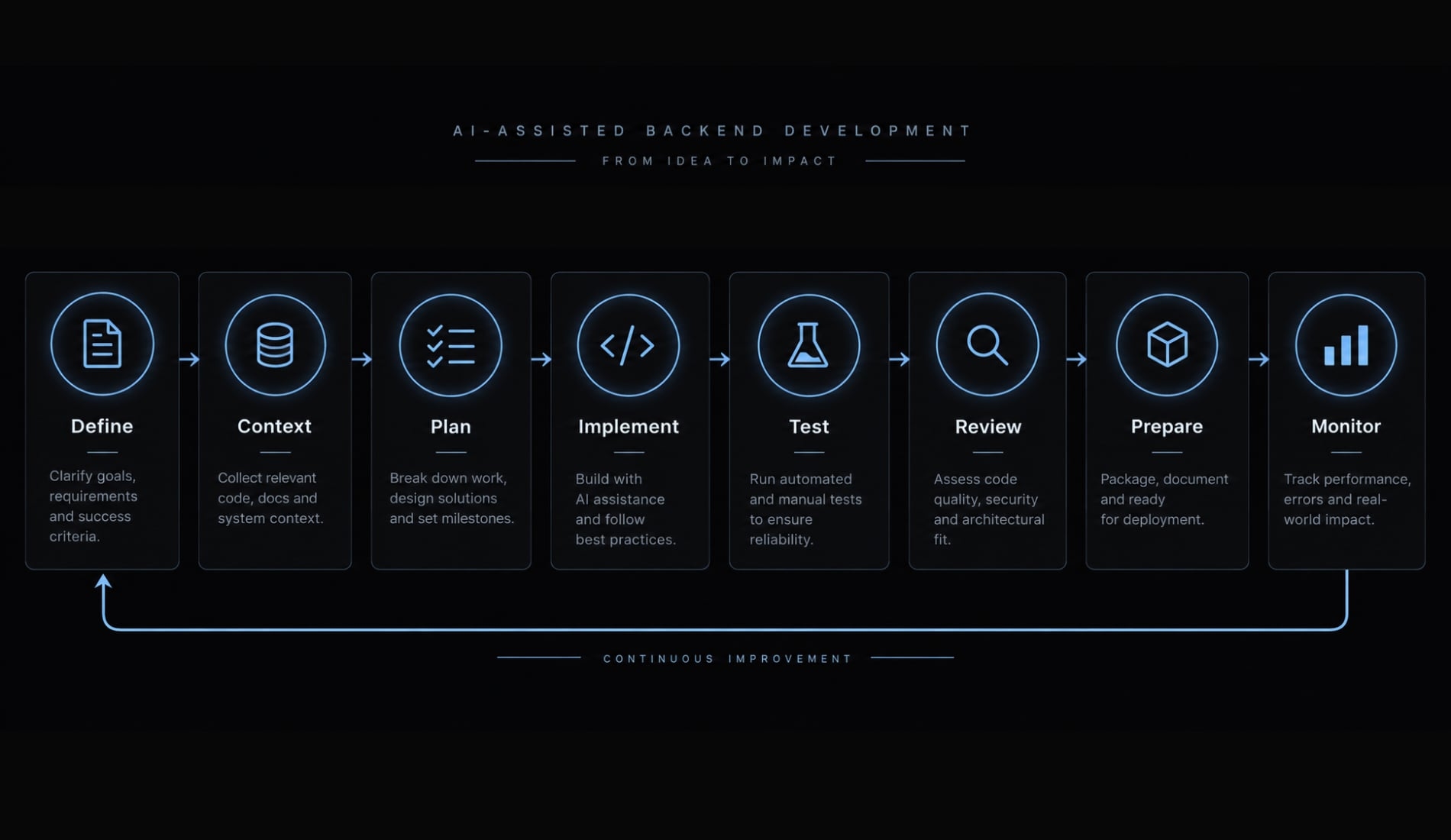
Approved local edits are distinct from sensitive external state changes. High-risk actions require authorization under team policy. Use the backend quality gates to verify completion.
Define the feature and acceptance criteria
Begin with the intended outcome, not “build an endpoint.” Specify inputs, outputs, authorization, failure behavior, operational limits, and exclusions. For an account export, a testable requirement is: a user cannot export another tenant’s account.
Specification template
Objective and scope:- User outcome; included behaviorAPI/data/security constraints:- Inputs, outputs, permissions, permitted fields- Failure responses, volume limits, audit requirementsAcceptance criteria and required tests:- Expected behavior- Unauthorized, invalid, and failure casesOut-of-scope changes:- Explicit exclusions
Spec-driven development makes requirements inspectable before implementation; it does not eliminate ambiguity. For larger features, proposal.md, design.md, and tasks.md offer optional file organization. A small change may need only one concise specification.
Give the AI the right repository context
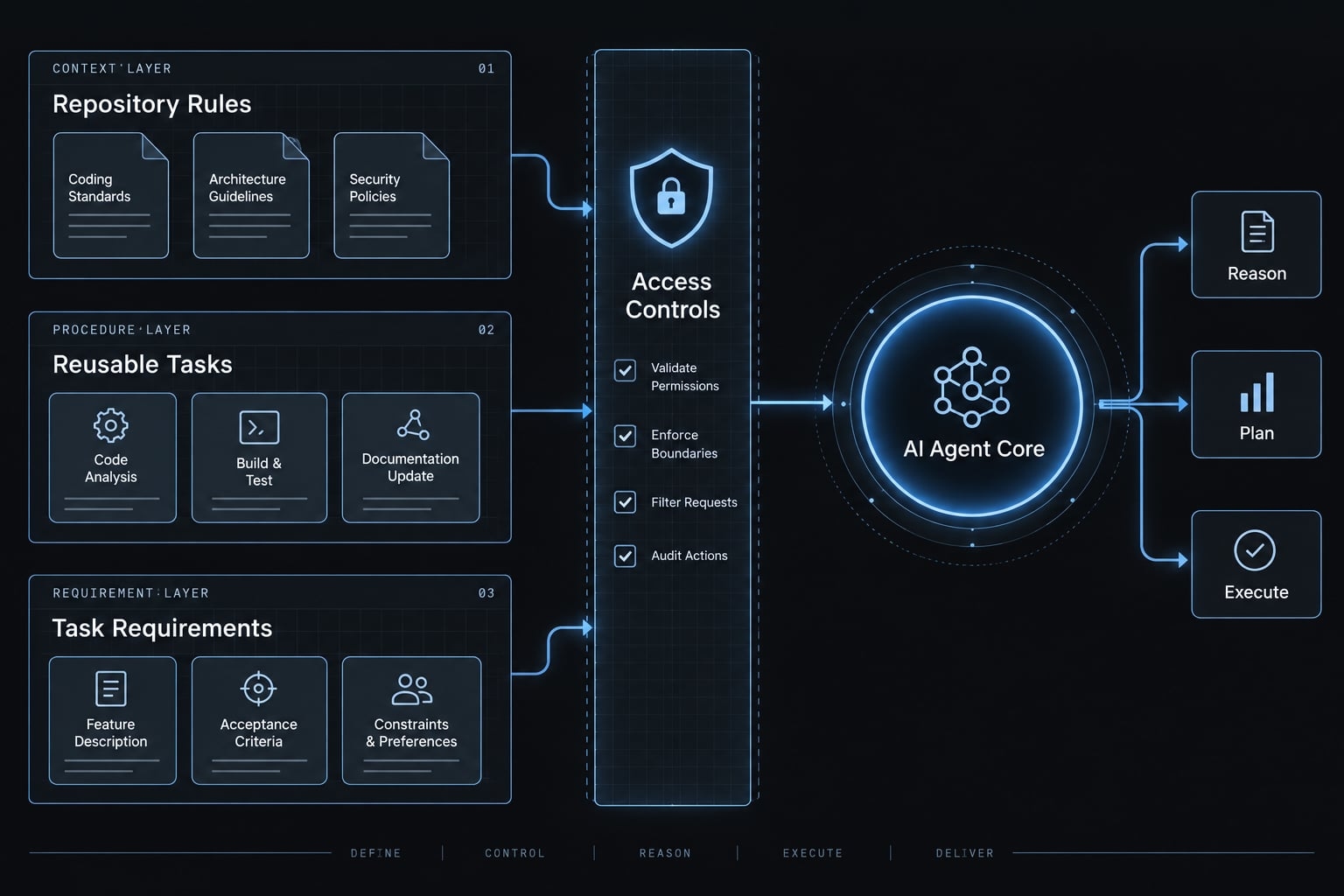
Separate stable guidance from change-specific requirements.
Context Type | Purpose |
|---|---|
Repository instruction file | Stable project rules and commands |
Reusable skill | A repeatable, specialized procedure |
Task specification | Requirements for the current change |
Illustrative AGENTS.md skeleton
Architecture: services/, persistence/, tests/Commands: [verified build, test, lint commands]API/database: contract rules; migration conventionsSecurity: no secrets or production accessPlanning: inspect first; flag unresolved assumptionsReporting: changed files, commands, results, limitations
Instruction discovery, precedence, and Agent Skills formats vary by tool and version. Check the selected tool’s official documentation and use its equivalent mechanism where necessary.
Context window management means selecting relevant, current material—not loading everything. Remove stale or conflicting guidance. Exclude secrets, production credentials, and unapproved customer data.
AGENTS.md expresses instructions; enforced permissions must exist separately.
Ask for a plan before allowing code changes
Require repository inspection before the implementation plan. For the export feature, the agent should locate existing account-access checks rather than inventing parallel authorization logic.
The plan must identify:
- Affected modules.
- API changes.
- Schema or migration impact.
- Authentication and authorization impact.
- Dependencies.
- Tests.
- Deployment risks.
- Unresolved assumptions.
For architectural changes, request alternatives and trade-offs. A developer approves the approach before implementation begins.
Human approval establishes scope, not correctness. Later diff inspection and tests must confirm that implementation follows the agreement. Missing repository evidence or unresolved security assumptions should return the task to inspection.
Implement the feature in small, reviewable units
Effective task decomposition creates reviewable units with a clear purpose, inspectable changes, relevant tests, and a stable checkpoint.
- Poor boundary: Add exports, redesign permissions, and replace the database layer.
- Better boundary: Add one bounded export using existing authorization, an approved field list, and focused tests.
A narrow vertical slice—one working behavior across required layers—may be easier to validate than separate controller, service, and database tasks.
Each completed unit should report:
- Changes and rationale.
- Commands executed.
- Test results.
- Remaining assumptions.
Exclude unrelated refactoring. Keep unfinished work isolated; do not knowingly merge broken intermediate states merely to make tasks smaller.
Generate and run the required tests
Automated testing and validation should follow this sequence:
Derive tests from requirements → generate or update tests → execute them → inspect failures and evidence.
Select applicable layers:
- Unit tests for individual behavior.
- Integration tests for component interactions.
- API/contract tests for response compatibility.
- Authentication and permission tests.
- Migration tests when schemas change.
- Negative and failure-path tests.
Generated tests can repeat implementation mistakes. Independently add adversarial cases, such as a valid session requesting another tenant’s export.
Distinguish tests drafted, tests executed, and tests passed. Report unavailable execution explicitly. Never silently weaken assertions to accommodate incorrect code.
For backends containing large language model behavior, eval-driven development adds representative cases, output-validity checks, and latency/cost limits. Evaluation results may be probabilistic; these checks supplement ordinary backend tests.
Review security, data and architecture
Passing tests cannot prove complete correctness or security. Review the risks the tests may have missed.
Risk group | Review question |
|---|---|
Authentication and authorization | Beyond proving identity, does access enforce resource ownership and tenant isolation? |
Inputs, queries, exposure | Are inputs validated, queries safe, and export fields explicitly permitted? |
Transactions, concurrency, idempotency | Can retries or concurrent requests duplicate effects or corrupt state? |
Compatibility and migrations | Can clients and deployed versions coexist safely? |
Secrets and dependencies | Are credentials protected and new dependencies justified? |
For tool access, combine least privilege, sandboxing, scoped credentials, narrow capabilities, and sensitive-operation approval. Command allowlists alone are insufficient.
MCP (Model Context Protocol) standardizes integrations; it does not guarantee safety. Repository content and tool output may contain untrusted instructions. Review database migration safety separately from code quality.
Prepare the pull request and deployment plan
The AI may draft a pull request (PR) summary, changed components, test evidence, API/schema/configuration changes, deployment sequence, and recovery instructions. The developer must verify:
- The summary matches the actual diff.
- Required continuous integration (CI) checks completed successfully.
- High-risk changes received approval.
- Recovery steps fit the specific change.
Local test output is useful, but it does not replace required CI evidence. CI/CD quality gates—checks in continuous integration and delivery—should enforce required validations.
Rollback instructions must distinguish application rollback from database recovery. Destructive data changes may require restoration, a forward fix, or compatibility sequencing; reverting code may not help.
Human authorization can operate through an approved automated release policy. It does not require manually typing deployment commands.
Monitor production and feed lessons back into the workflow
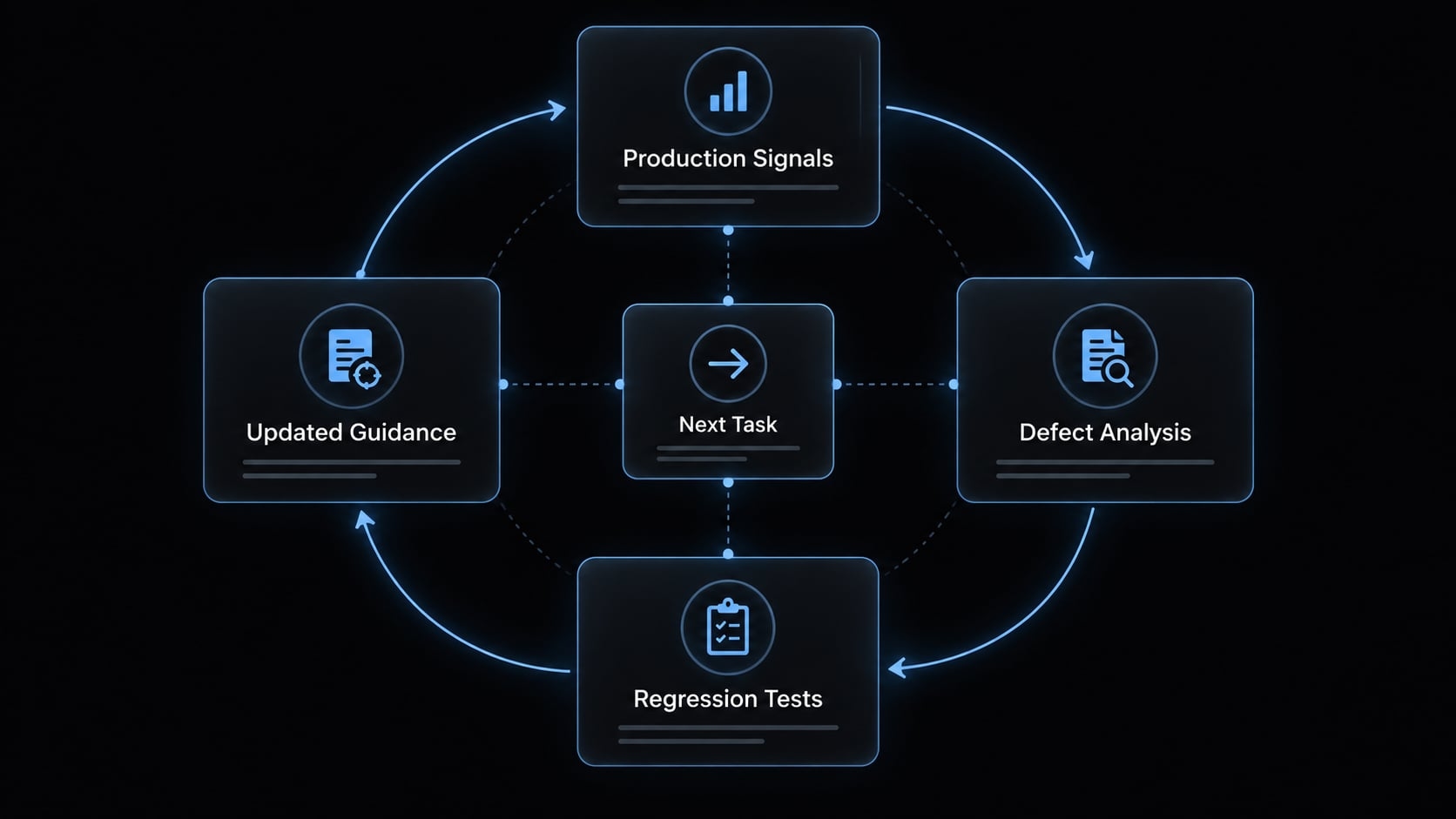
Production monitoring checks whether released behavior matches the specification:
- Compare runtime behavior with acceptance criteria.
- Inspect errors, latency, failed requests, database behavior, and relevant security events.
- Document escaped defects.
- Update tests, repository instructions, or reusable skills.
- Apply the lesson to subsequent tasks.
For exports, monitor rejected requests, processing failures, resource consumption, and audit-event completeness without recording exported contents.
OpenTelemetry documentation describes instrumentation for traces, metrics, and logs. It is an optional framework, not a complete monitoring backend. Do not send raw sensitive logs to external models without approval and appropriate data controls.
What AI should do and what developers must continue to own
Base AI task delegation on risk and reversibility, not whether an agent can execute the command. A reversible local edit differs from exposing customer data or changing production records. Use three control levels:
- Execute within approved scope and report.
- Propose; proceed only with approval.
- Human-owned decision or authorization.
Task | AI role | Human role | Control level |
|---|---|---|---|
Scaffolding | Generate bounded structure | Developer verifies conventions | 1 |
Documentation | Draft updates | Maintainer confirms accuracy | 1 |
Unit-test scaffolding | Generate test structure | Developer validates assertions | 1 |
Architecture | Compare alternatives | Technical lead selects design | 3 |
Data models | Propose structures | Data owner approves invariants | 2 |
Migrations | Draft and rehearse | Release owner authorizes execution | 2; production: 3 |
Authentication and authorization | Implement approved policy | Security owner validates boundaries | 3 |
Public APIs | Draft contract changes | API owner approves compatibility | 2 |
Production release | Prepare evidence | Release owner authorizes rollout | 3 |
Incident response | Summarize evidence | Incident lead directs actions | 3 |
In small teams, one person may hold several roles. The responsibility should still be explicit. Human-owned describes accountability, not a prohibition on AI assistance. Human-in-the-loop controls preserve architectural control while allowing approved automation.
Enforce agent permissions through credentials, environment isolation, and protected release paths. Written restrictions cannot substitute for least privilege. Rollback cannot undo every data exposure or integrity failure, so reversibility must be assessed before delegation.
Backend quality gates for AI-generated changes
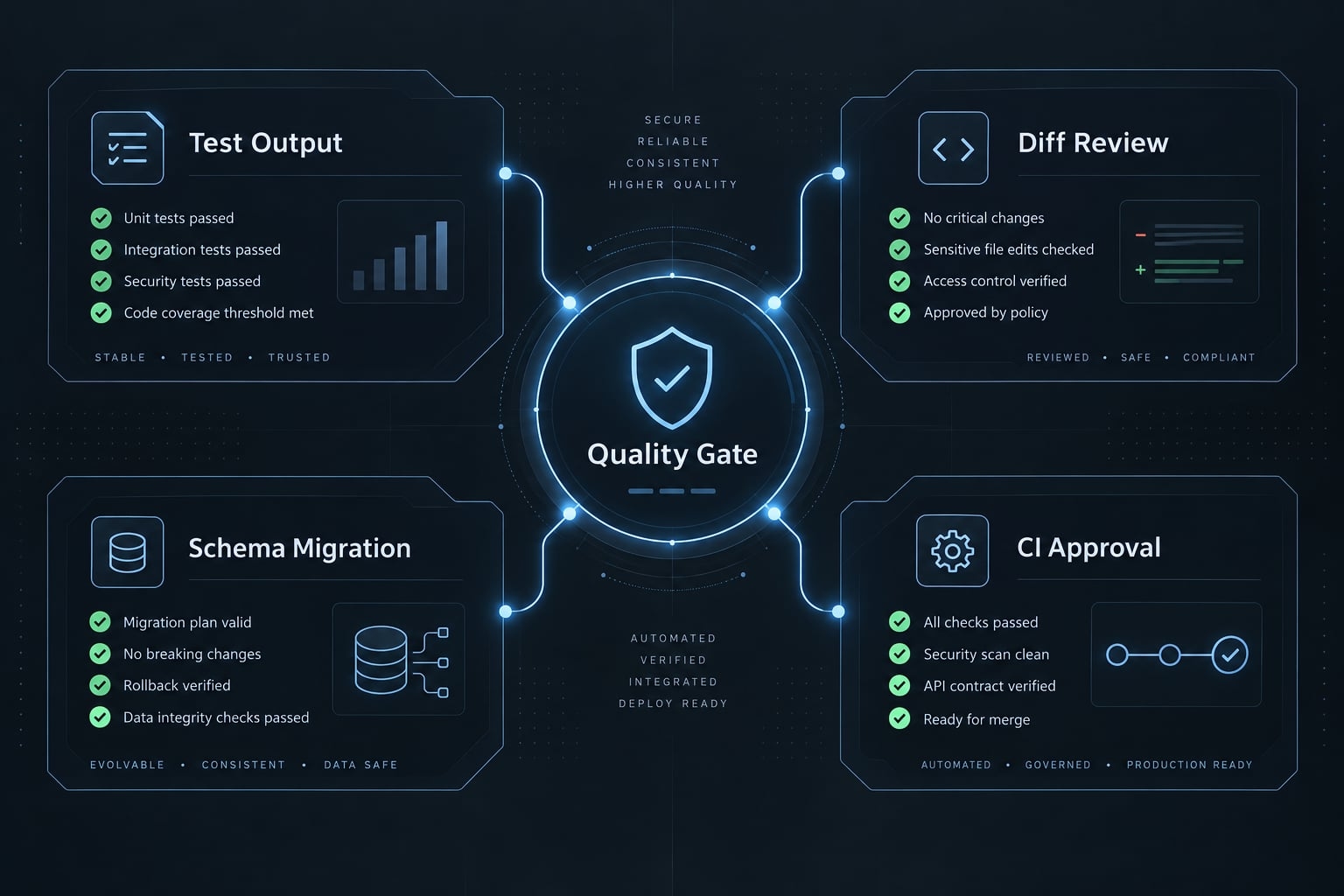
Quality gates are required checks and evidence before merge or deployment. Automated checks provide repeatable results; human review addresses judgments that cannot be reduced to deterministic tests. AI code review is supporting evidence, not the release gate itself.
Functional correctness
Verify acceptance criteria against expected, failure, and edge cases. Check error consistency and unintended behavior changes. A passing test suite is meaningful only when its assertions reflect the required behavior.
API and data integrity
Inspect contract compatibility, boundary validation, transactions, retries, and data constraints. API compatibility includes existing clients, not just the new endpoint. Schema changes need a rehearsed recovery strategy appropriate to their data impact.
Security and access control
Check identity separately from resource- and tenant-level access control. Review secret handling, dependency changes, untrusted inputs, and agent permissions. Least privilege must remain enforced even when an instruction or tool result requests broader access.
Maintainability and architecture
Assess repository conventions, duplicate logic, justified abstractions, and dependency costs. Confirm privacy-aware logging and human-readable implementation. Architecture fit requires accountable judgment; an automated style check cannot establish it.
Delivery and operational readiness
Operational readiness requires completed CI checks, documented configuration, monitoring, and release/recovery instructions. Confirm reviewable scope and recorded approvals. Pending or skipped checks are not equivalent to successful checks.
Copyable backend quality checklist
Document “not applicable” with a reason where appropriate.
Functional correctness- [ ] Map acceptance criteria to passing test output.- [ ] Check expected, negative, edge, and error cases.- [ ] Inspect the diff for unintended behavior changes.API and data integrity- [ ] Verify contracts and boundary validation.- [ ] Test constraints, transactions, and retry behavior.- [ ] Attach migration rehearsal and recovery evidence, or justified N/A.Security and access control- [ ] Verify authentication and resource/tenant authorization.- [ ] Review secrets, dependencies, and untrusted-input handling.- [ ] Confirm enforced permissions and sensitive-action approvals.Maintainability and architecture- [ ] Inspect convention compliance and duplicate logic.- [ ] Justify abstractions and dependencies in review.- [ ] Check readability and privacy-aware logging.Delivery and operational readiness- [ ] Attach successful required CI results for the reviewed revision.- [ ] Document configuration, monitoring, rollout, and recovery.- [ ] Record reviewer approval and high-risk authorization.
AI backend development workflow
Common AI backend development mistakes
AI coding mistakes often originate in workflow boundaries rather than syntax. Correct the operating condition instead of repeatedly rewriting the instruction.
Mistake | Risk | Correction |
|---|---|---|
Coding before requirements stabilize | Correct-looking implementation of the wrong behavior | Approve a testable specification first |
Excessive scope | Unreviewable diffs and technical debt | Use bounded units with stable checkpoints |
Unreviewed schema or infrastructure changes | Data loss, downtime, unexpected access | Require approval and migration rehearsal |
Automatically trusting generated tests | Implementation and tests share blind spots | Add independently derived negative cases |
Excessive or conflicting context | Stale rules steer implementation | Keep agent context focused and current |
Measuring output rather than delivery quality | More code conceals greater review burden | Measure reviewed delivery and operational outcomes |
Track approved-task-to-reviewed-PR time, review effort, substantial rewrites, escaped defects, change failure rate, and recovery time. Define where each measurement starts and ends.
For comparisons, retain the baseline, comparison period, task count, complexity differences, and material tool/model versions. Label observational findings accordingly.
Productivity depends on repository quality, task type, developer experience, and review requirements. If instructions, tests, and tooling changed together, do not attribute improvement to AI alone. There is no universal savings percentage to assume.
How to start without overengineering the workflow
Minimum viable setup
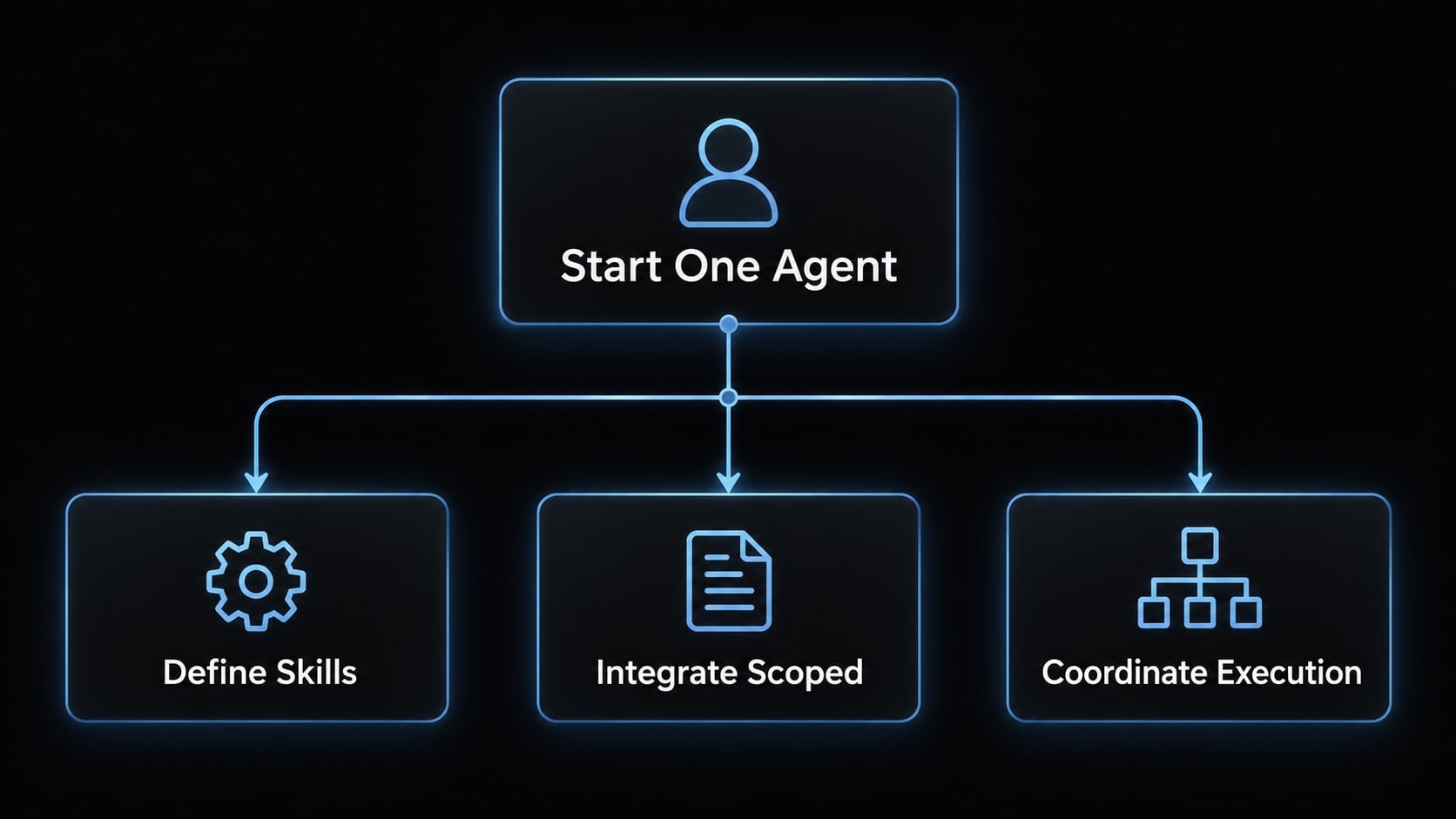
Start with one agent, one repository, and one repeatable task:
- Select one repository-aware coding tool.
- Add concise repository instructions.
- Choose a low-risk backend task.
- Require a plan.
- Run existing checks.
- Review before merge.
- Record failures and improve guidance.
Claude Code, Codex, and GitHub Copilot are possible options. Check current official documentation for the selected operating mode, repository access, permissions, and instruction support; their mechanisms are not interchangeable.
A focused validation change or test addition is a better pilot than replacing authentication. Establish review expectations before increasing execution scope.
When to add reusable skills
Add a reusable procedure when work recurs: API conventions, migration review, security checks, or PR preparation. Each skill needs an owner, review, and updates when repository behavior changes. Keep task-specific assumptions out of permanent guidance.
Do not convert every successful one-off instruction into a skill. First determine whether the procedure is stable enough to reuse.
When MCP or multiple agents become useful
Use this editorial decision aid—not an industry-certified maturity standard.
Level | Recommended Setup | Appropriate Use |
|---|---|---|
Starter | One agent and existing checks | Bounded repository tasks |
Standardized | Shared instructions and skills | Recurring procedures |
Coordinated | Scoped integrations or specialized roles | Clear access or handoff bottlenecks |
Advanced | Stateful execution and recovery controls | Long-running, interruption-sensitive work |
MCP can help a single agent; multiple agents do not necessarily require MCP. Multiple agents also do not guarantee independent verification.
Durable execution—retaining progress across interruptions—matters only when interruption recovery justifies its complexity. “Advanced” is not automatically better.
Practical example: From backend feature request to reviewed pull request
This illustrative backend feature workflow covers a bounded B2B SaaS account-data export. It is not a documented customer result.
The endpoint requires authentication, an authorized user/account relationship, tenant isolation, an approved export schema, rate limiting, audit logging, and explicit failure responses. Large exports may require asynchronous processing; this scenario excludes them.
Stage | Example application |
|---|---|
Define | Specify permitted fields, volume limits, allowed roles, and rejection behavior |
Contextualize | A repository-aware agent locates authorization, serialization, and audit conventions |
Plan | The AI implementation plan identifies touched modules, tests, and any schema impact |
Implement | Add one bounded endpoint using existing permission checks; exclude unrelated refactoring |
Test | Check valid exports, cross-tenant denial, excluded fields, rate limits, and dependency failures |
Review | Inspect account ownership enforcement, query boundaries, resource limits, and audit privacy |
PR preparation | Attach the diff summary, execution evidence, CI results, rollout sequence, and recovery plan |
For example, a deliberately cross-tenant test should fail if account lookup omits the tenant constraint. That failure should trigger an implementation correction—not a weaker assertion.
Before release, assign monitoring ownership for export errors, rejected access, latency, and audit completeness. Feed any escaped defect into a regression test and updated guidance.
AgentKit can optionally package reusable roles, skills, and workflows. That packaging does not replace CI enforcement or developer approval.
Frequently asked questions
What is an AI backend development workflow?
An AI backend development workflow is a structured process using coding agents and LLM-assisted tools to build backend software from planning through deployment. Unlike ad hoc coding, it relies on bounded task units, repository-aware context, and mandatory human-led quality gates to keep architecture and security decisions accountable and inspectable.
How does an AI coding agent differ from traditional autocomplete?
While traditional autocomplete suggests code snippets locally, repository-aware agents analyze your entire project structure, execute terminal commands, run tests, and manage multi-file refactoring. They require clear specifications, repository instructions, and human approval to maintain system architecture, security boundaries, and reliable delivery performance.
Why is an implementation plan required before generating code?
An implementation plan prevents scope creep and lets developers confirm the approach, affected modules, schema impact, and unresolved assumptions before code is generated. Approval establishes scope, not correctness — diff inspection and tests confirm the rest.
How do I use repository instructions to improve AI results?
Keep stable project rules — architecture, verified commands, conventions, security constraints — in your tool's repository instruction file. Discovery and precedence vary by tool and version, so check its documentation. These instructions guide behavior; enforced permissions must exist separately.
Are generated tests sufficient for production readiness?
No. Generated tests are supporting evidence, not a replacement for human validation. You must derive tests from your requirements, run them as part of your CI pipeline, and manually verify critical code paths and edge cases. AI-generated code still requires human oversight to ensure it is secure and maintainable.
What are the essential quality gates for AI-assisted changes?
Before merging, changes must pass automated CI checks and human review across five gates: functional correctness, API and data integrity, security and access control, maintainability, and operational readiness. Each gate ensures the code meets production standards, regardless of whether it was generated by an AI or a human.
Can AI agents handle production deployments safely?
AI agents can draft deployment plans, PR summaries, and recovery instructions, but a human must remain the final decision-maker. Always verify that deployment sequences are appropriate for your specific change and that high-risk operations—like database migrations or permission changes—have been explicitly reviewed and authorized.
How should I monitor AI-generated backend features?
Monitor production behavior by comparing runtime logs, latency, and error rates against your initial acceptance criteria. Use OpenTelemetry for tracing and, if errors occur, document them to update your repository instructions or reusable skills, creating a feedback loop that improves the reliability of future AI-assisted tasks.
Read more:
- AI generated code review checklist: A pre-merge guide
- Project-aware AI coding: A complete guide and evaluation
- AI project Bootstrap: A practical guide to building software
Conclusion
A reliable AI backend development workflow relies on five core controls—clear specifications, targeted context, bounded scope, automated validation, and human ownership—each producing verifiable evidence rather than plain claims. Quality gates enforce these requirements to make risk visible, but developers retain ultimate accountability.
To adopt this workflow, start small with a single low-risk task, measure review effort, and adapt the provided specification template and quality checklist to your repository's specific risks before scaling.