AI generated code review checklist: A pre-merge guide
AI-generated code review checklist before merge
While AI-generated code often looks polished, it can harbor flawed assumptions, missing safeguards, or hidden security risks. Regardless of the coding assistant your team relies on, AI-generated code demands the same rigorous verification as human-written work. This guide provides a structured, priority-based review checklist to help you validate requirements, catch merge blockers, and ensure production readiness before approving any pull request.
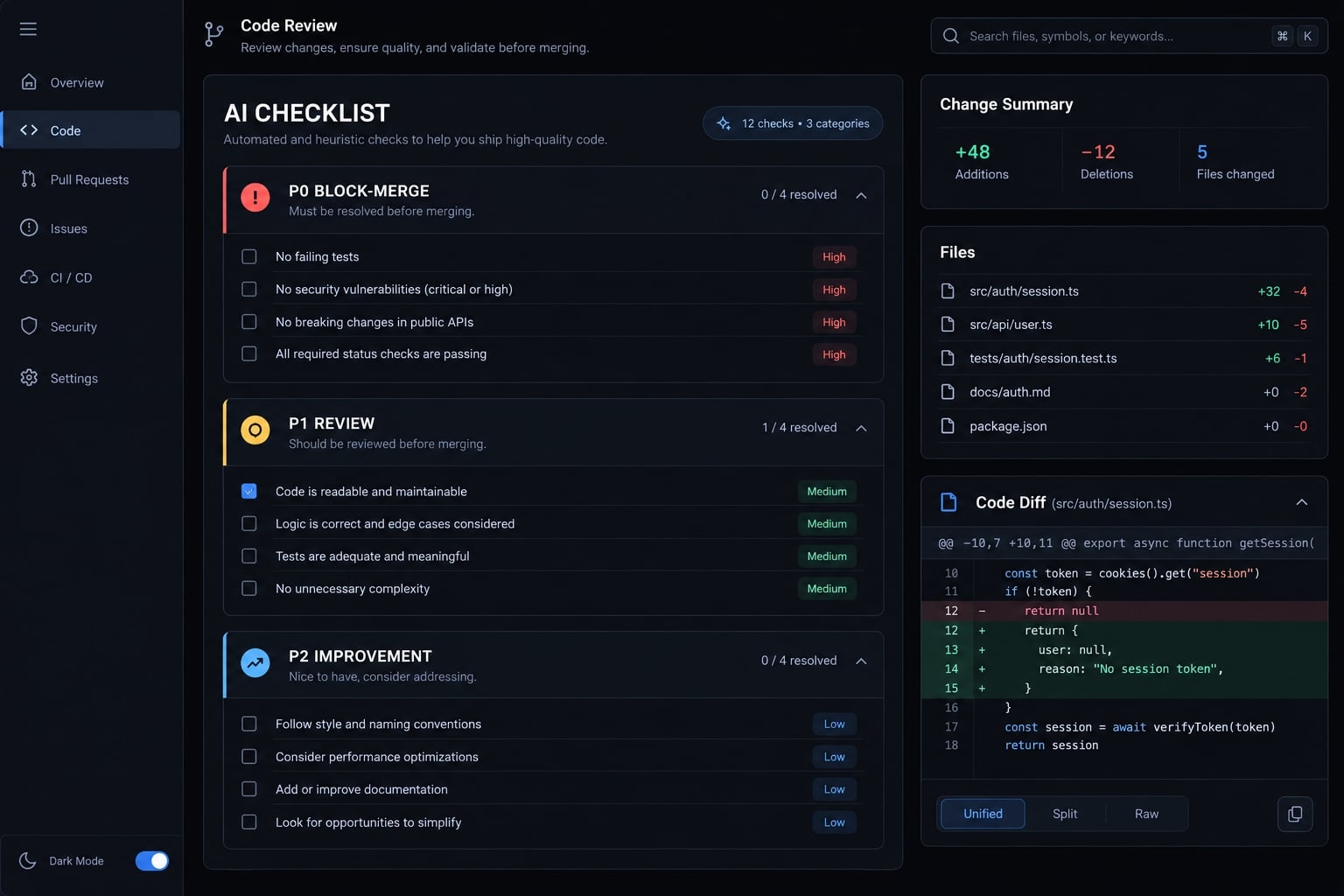
Quick AI-generated code review checklist
An AI-generated code review checklist is a structured set of pre-merge checks for verifying generated code against requirements, security controls, dependency policies, tests, and operational expectations. It connects each review area to evidence and an accountable decision, rather than treating compilation, passing tests, or an AI explanation as sufficient approval.
This article proposes three priorities—not a universal severity standard:
- P0: Blocks merge until resolved.
- P1: Requires assessment; unresolved findings need documented acceptance under repository policy.
- P2: Non-critical improvement that may be deferred with ownership.
Priority | Review area | Core question | Review method |
|---|---|---|---|
P0 | Requirements | Does behavior meet acceptance criteria? | Trace criteria to implementation and tests. |
P0 | Access controls | Are actions and tenant boundaries authorized? | Exercise permitted and denied requests. |
P0 | Input and secrets | Are sensitive destinations protected? | Inspect data flows and secret scans. |
P0 | APIs and dependencies | Are identities and interfaces verified? | Check registries, documentation, and advisories. |
P0 | Required checks | Did mandatory gates pass? | Inspect results for the reviewed revision. |
P1 | Failure behavior | Are errors and retries safe? | Reproduce failures and inspect state. |
P1 | Test quality | Do assertions establish functional correctness? | Challenge expected outcomes. |
P1/P2 | Repository fit | Does code follow established patterns? | Compare architecture and resource usage. |
P1 | Deployment | Can the change be introduced and recovered? | Review rollout and recovery evidence. |
P0 - Block-merge checks
Block destructive operations without safeguards, exposed secrets, broken required checks, and unverified packages or APIs. Triage security vulnerabilities against policy and impact.
P1 and P2 - Review and improvement checks
Risk acceptance is not cosmetic deferral. Impact overrides category: timeouts, migrations, or performance defects become P0 when consequences are unacceptable.
Automated checks support these decisions; green CI alone does not authorize merging.
Why AI-generated code requires a different review approach
The standard does not change; the attention pattern does. Inspect assumptions, repository context, dependency legitimacy, and shared errors between code and tests.
The verification gap
The verification gap is the distance between code that compiles or passes its current tests and evidence that it behaves correctly in its intended system. Closing it requires independently specified expectations, relevant failure scenarios, and review of integration effects—not simply another confident explanation of the implementation.
Common AI-specific failure modes
These patterns deserve attention but are neither exclusive to AI nor claims about their frequency:
- Hallucinated dependencies or APIs: Suggested packages or methods are nonexistent or incompatible.
- Context blindness: Local changes ignore repository-wide constraints.
- Logic drift: Implementation subtly changes the requested behavior.
- Happy-path bias: Successful execution receives attention; failures do not.
- Self-validating tests: Assertions repeat incorrect implementation assumptions.
A second AI review can suggest useful investigations. Different models do not automatically provide independent verification.
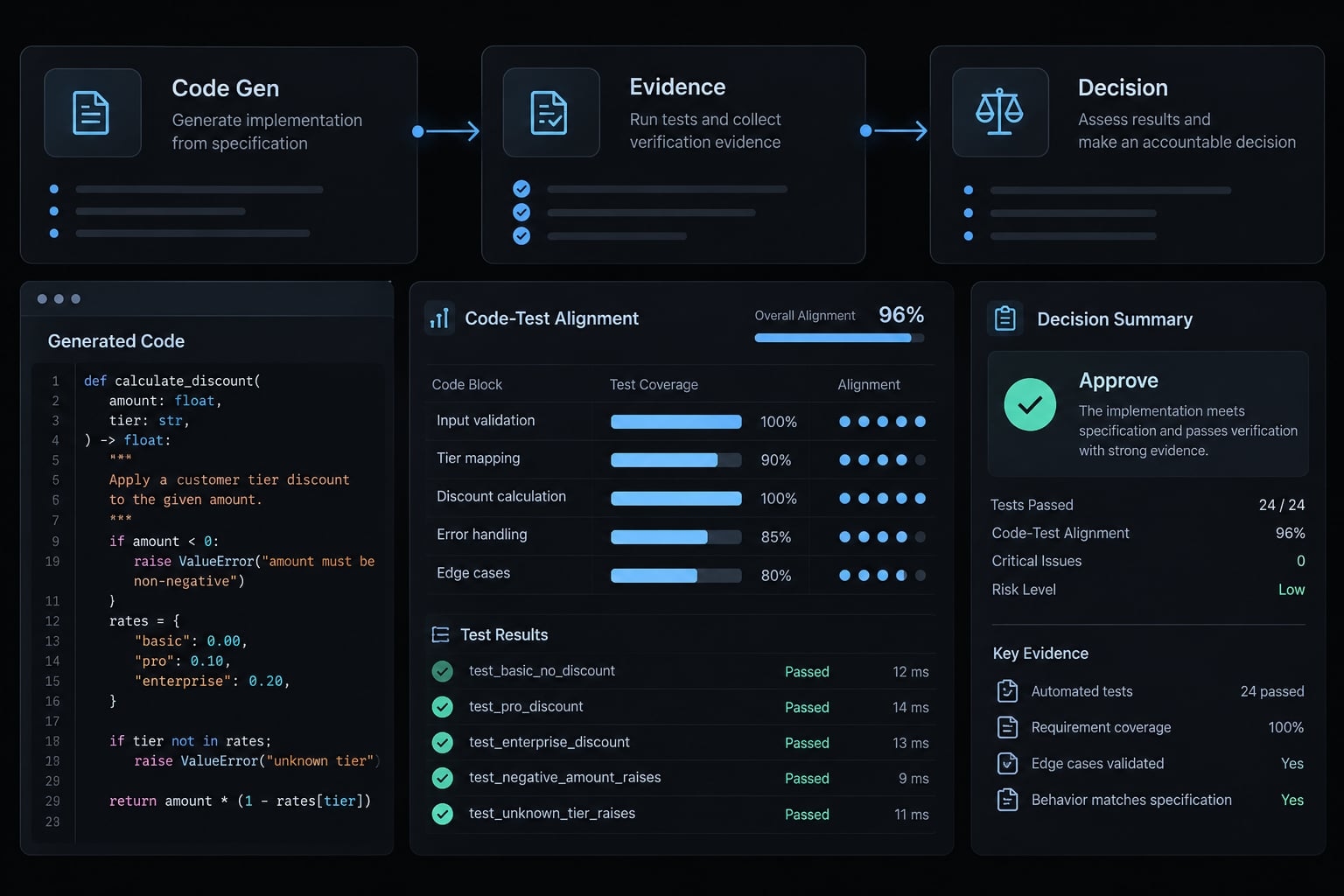
Verify requirement fidelity, logic and edge cases
Start with acceptance criteria, not the generated explanation. Requirement fidelity means implementing the requested behavior without silently weakening existing guarantees.
Match the implementation to the original requirement
Use this traceability format:
Acceptance criterion → implementation location → verification method → expected failure behavior
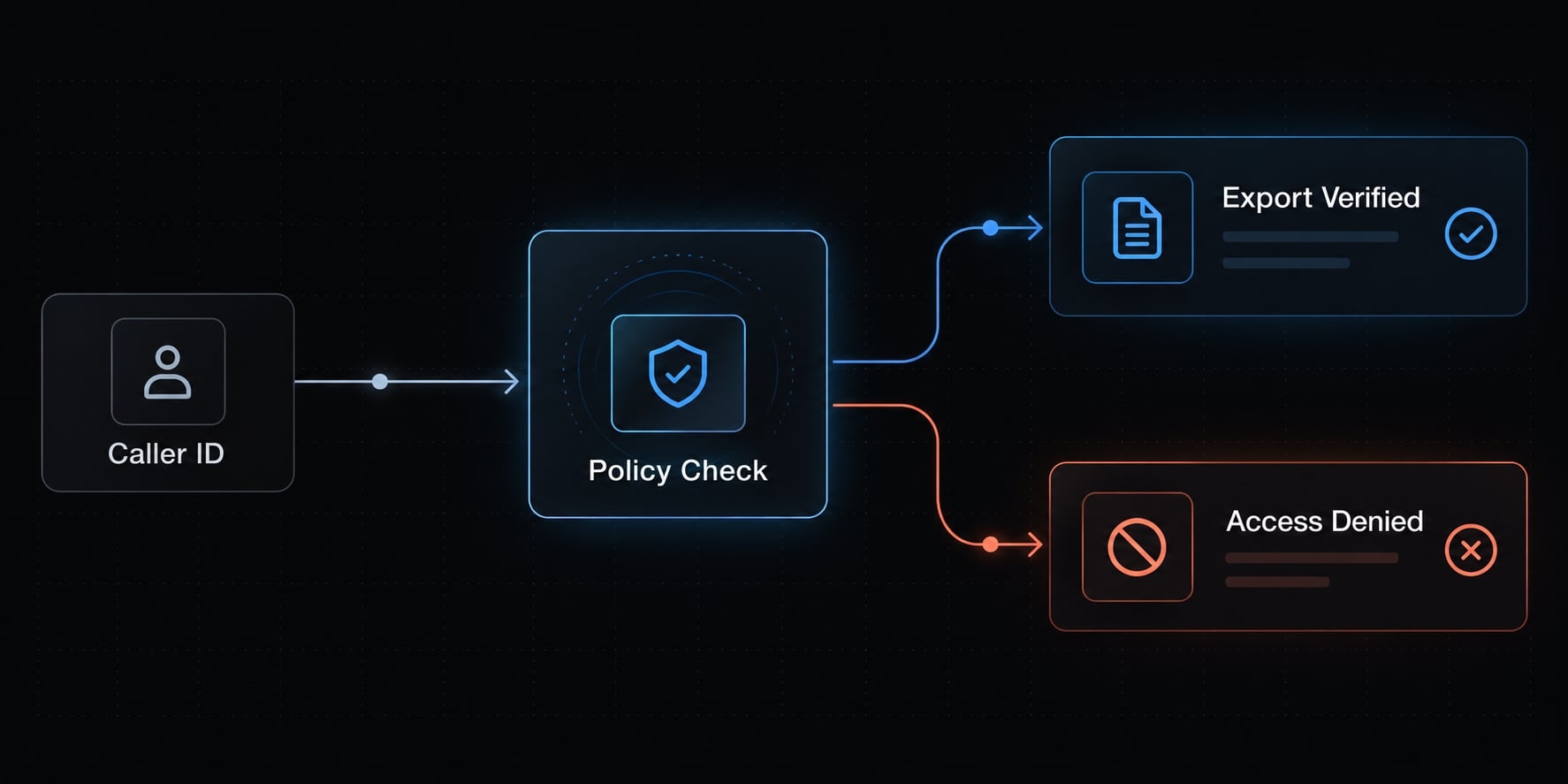
Throughout this guide, consider an illustrative multi-tenant customer relationship management (CRM) export job. It is not a reported customer project. Its independently specified requirement: Authorized users may export permitted records within their tenant; unauthorized requests must create no job or downloadable file.
Map that requirement to the request handler, authorization service, worker, and download endpoint. Inspect added assumptions, changed defaults, removed safeguards, and unrelated modifications. Legitimate cross-file implementation is not automatically scope expansion.
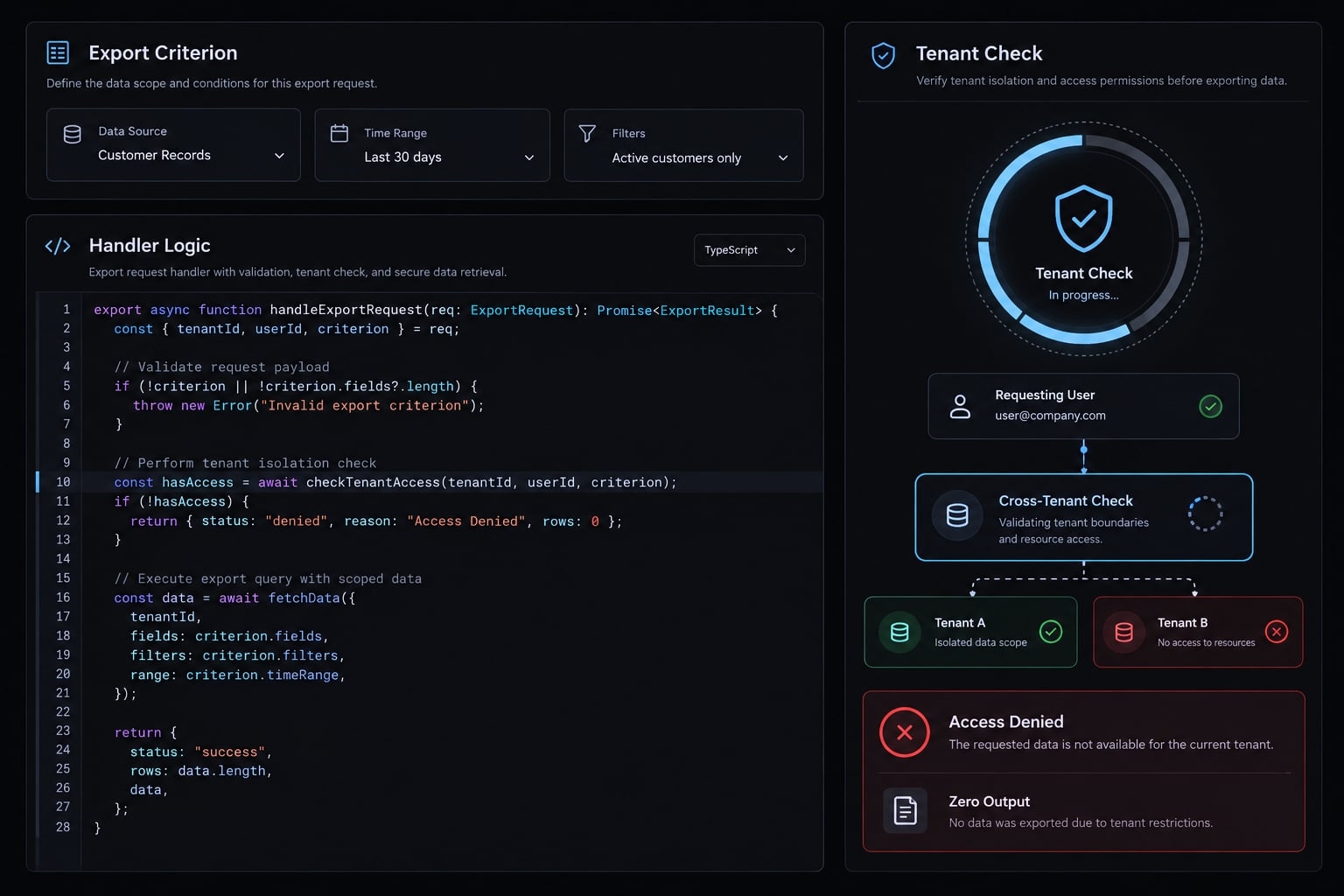
Trace happy paths and failure paths
Choose expected outcomes before running the implementation.
Scenario | Export check | Observable outcome |
|---|---|---|
Happy path | Authorized export | One job; permitted records only |
Empty/null | No matching records | Defined empty result; no crash |
Boundary | Maximum supported size | Enforced limit or bounded processing |
Malformed input | Invalid filter | Validation response; no queued job |
Timeout/downstream failure | Storage unavailable | Recorded failure; bounded retries |
Partial success | File saved, notification fails | Retry avoids duplicate export |
These edge cases expose behavior that compilation cannot establish. Record response status, persisted state, and external effects—not merely “works locally.”
Check integration and side effects
Inspect affected databases, queues, APIs, files, and notifications. For exports, test whether retries duplicate jobs or leave orphaned files.
Idempotency means repeated execution preserves the intended effect without unintended duplication. Verify its behavior under concurrent attempts, not just sequential retries.
Database transactions do not automatically reverse external API calls. Cross-system failures may require explicit cleanup, reconciliation, or compensating actions.
Review security, trust boundaries, APIs and dependencies
Security approval requires evidence about the application’s actual policy—not simply the presence of security-related functions.
Verify authentication, authorization and tenant isolation
Authentication identifies the caller. Authorization determines permitted actions. Object ownership and tenant scope inform that decision but do not replace the full access policy.
Request-supplied IDs are not inherently unsafe. The risk is trusting them without server-side authorization using tenant context established through the approved trust model.
For the export scenario, verify read, write, export, administrative, background-job, and download paths where applicable. An authorized request handler cannot compensate for an unsafe worker or file endpoint.
Inspect inputs, outputs, secrets and side effects
Trace untrusted input to its destination:
- Database: Use parameterized queries and validate allowed operations.
- HTML/templates: Apply context-appropriate output encoding.
- Shell/filesystem: Avoid unsafe command construction; constrain paths.
- Outbound URLs: Restrict destinations and redirects appropriately.
- Logs/errors: Exclude credentials and unauthorized sensitive data.
- Model prompts/tools: Keep untrusted content from granting privileged actions.
Validation, encoding, and parameterization solve different problems.
Require approved secret storage, access controls, rotation, and safe runtime handling. Environment variables alone are not a complete strategy. An internal endpoint name is not automatically a credential; evaluate its disclosure impact.
Validate every new API and dependency
Dependency auditing should establish more than whether a package installs.
Check | Evidence to inspect |
|---|---|
Existence and identity | Namespace, publisher, configured registry, intended package |
Version fit | Resolved version, lockfile, versioned API documentation |
Security | Maintainer advisories, vulnerability results, applicability |
Maintenance | Support status, releases, unresolved critical issues |
License | Terms and compatibility with repository policy |
Necessity | Existing alternatives and added operational burden |
Verify suspected hallucinated APIs against documentation for the resolved version.
Slopsquatting is malicious registration of names models may suggest. Dependency confusion occurs when resolution selects an unintended public package instead of an expected private dependency. Spelling checks alone address neither comprehensively.
Registry presence and absent advisories do not prove safety. License scanners support review; they do not decide legal compatibility or establish every generated snippet’s provenance.
Evaluate test quality, maintainability and repository fit
Tests must fail for the right reason. Passing tests matter only when their assertions reflect the required behavior.
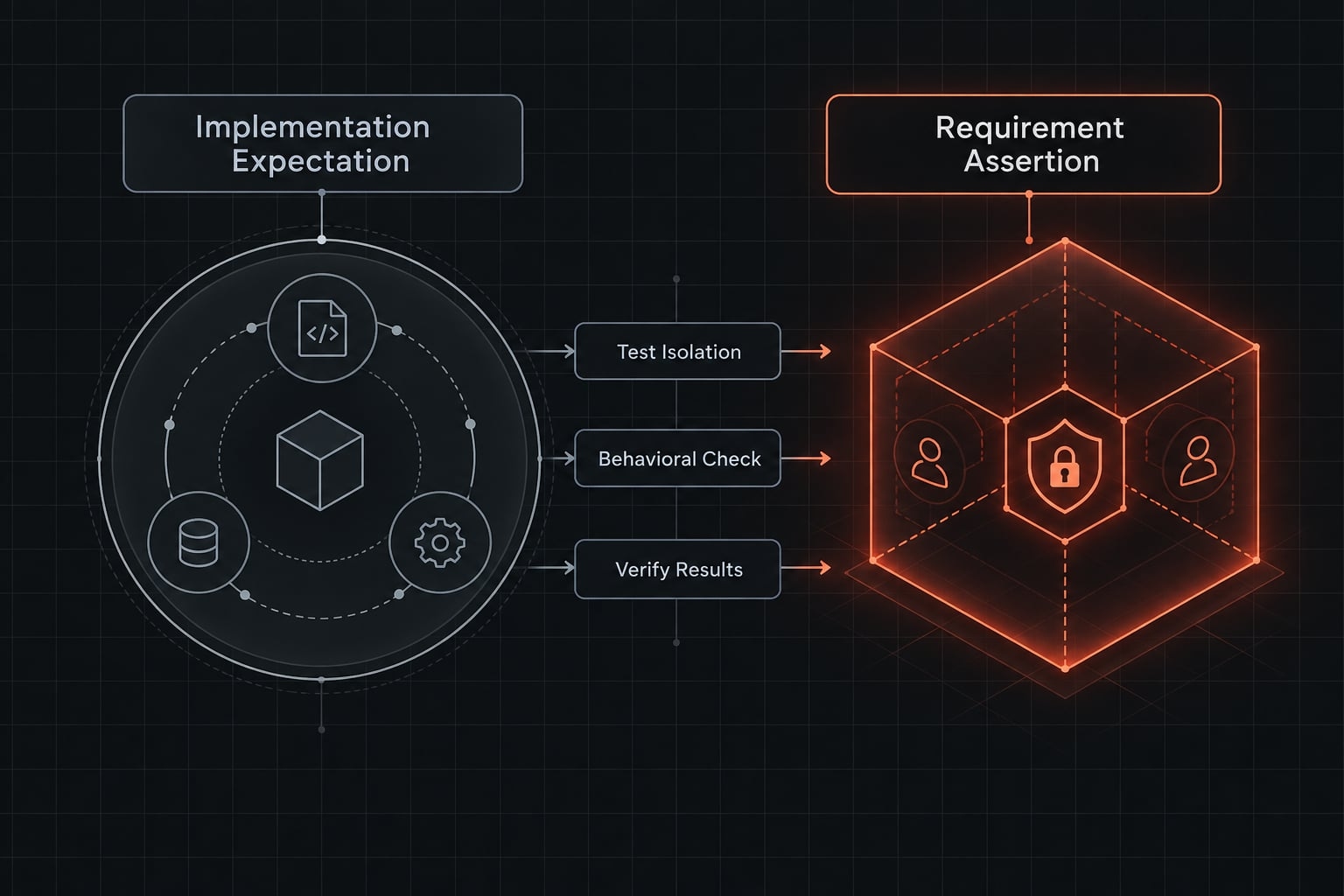
Test the requirement, not the generated implementation
In a controlled local check, remove the export’s tenant filter. Confirm that the relevant assertion detects unauthorized records—not merely broken setup. Restore the safeguard afterward.
Behavioral testing means checking observable behavior. It applies to unit, integration, and end-to-end tests; it is not an alternative to unit testing. Independent expectations come from requirements and separately checked evidence, not changing models.
Detect tautological and over-mocked tests
Warning | Better evidence |
|---|---|
Expected value uses the implementation’s helper | Independently specified expected result |
Mock replaces authorization | Real policy exercised in relevant tests |
Snapshot contains unexplained output | Meaningful contract assertions |
Test checks calls, not effects | Persisted state or output verified |
High coverage masks missing assertions | Incorrect behavior triggers failure |
Mocks, snapshots, and interaction assertions have legitimate uses. They become insufficient when they remove the behavior under review. Coverage measures execution, not assertion correctness.
Confirm maintainability and architectural fit
Check existing clients, validators, error conventions, logging patterns, and architectural boundaries.
A duplicate database helper might look clean while bypassing the established tenant-aware client. Code maintainability includes preserving system guarantees, not merely readable naming.
Review accessibility when interface behavior changes, including keyboard operation and understandable error states.
Review performance and resource handling
Inspect:
- N+1 queries: additional queries per returned item.
- Unbounded concurrency and memory growth.
- Retry storms and ignored rate limits.
- Unclosed connections, streams, and files.
- Repeated network or model calls.
Measure representative workloads before prescribing caching, batching, or concurrency changes. Each can alter correctness as well as performance.
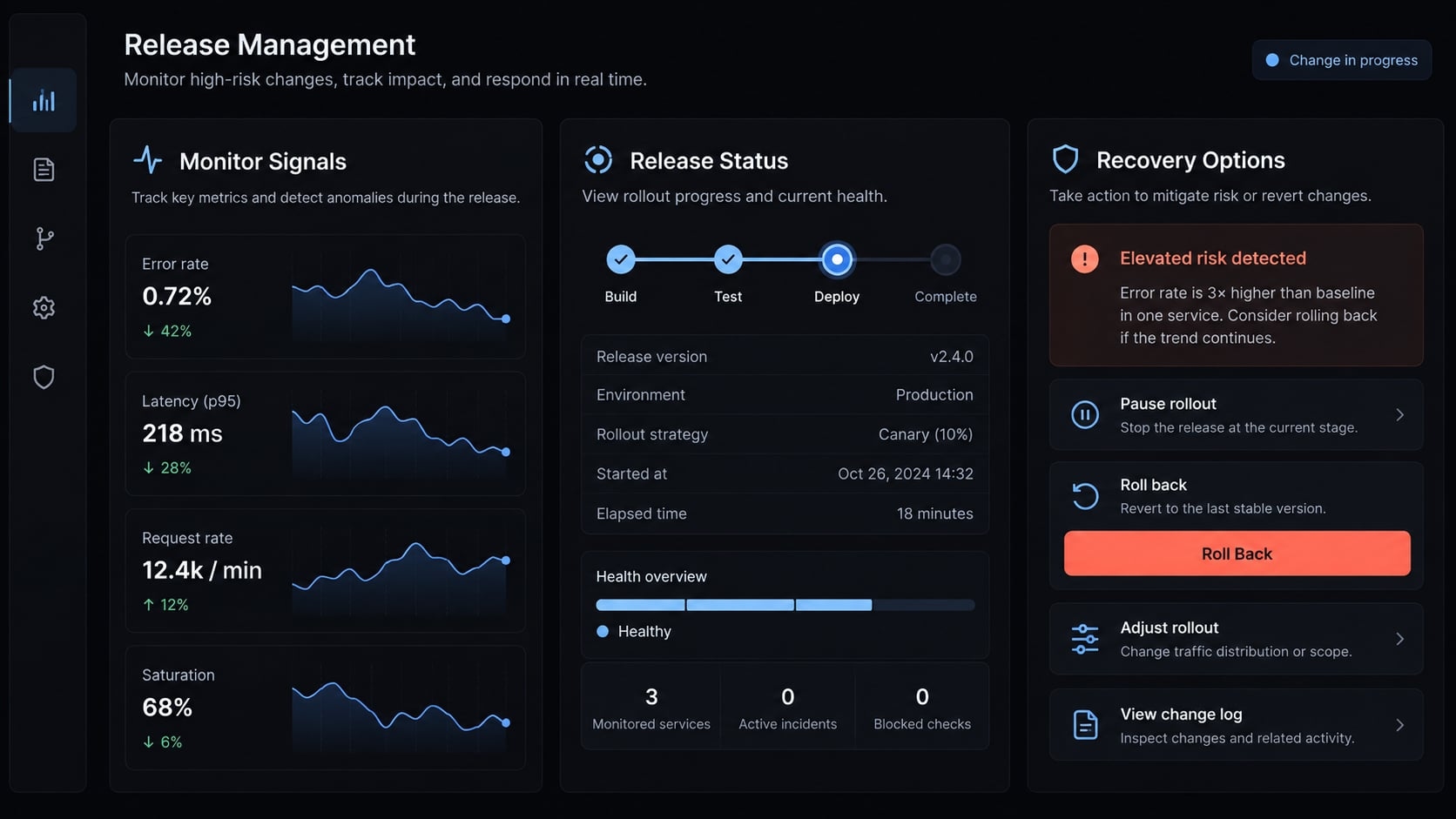
Confirm deployment and operational readiness
Code review contributes evidence toward production readiness. It does not replace deployment approval or operational validation.
Validate CI/CD ouality gates
Check the continuous integration and delivery (CI/CD) pipeline against the actual reviewed revision:
- Build, tests, linting, and type checks.
- Security and dependency checks.
- Required approvals and enforced repository policies.
Where policy requires them, inspect artifact provenance and the software bill of materials (SBOM). An SBOM inventories components; it does not prove security. Merge readiness and release readiness may be separate gates. Record outstanding release conditions explicitly.
Review migrations, configuration and infrastructure
Check rolling-deployment compatibility, database locking, and data-loss risk. Verify safe configuration defaults and feature-flag behavior.
Inspect identity and access management (IAM) permissions and network changes. A small application diff can introduce broad infrastructure access. For the export job, confirm old and new workers can safely process queued payloads during rollout.
Plan observability and recovery
Define observability-the signals needed to understand runtime behavior:
- Success and failure metrics.
- Logs without sensitive export data.
- Relevant alerts.
- A recovery owner.
- Rollback, disablement, or documented recovery steps.
Some migrations cannot safely roll back. Disabling a feature does not undo destructive writes; require credible forward recovery or restoration where reversal is unsafe.
Decide what to automate and what humans must review
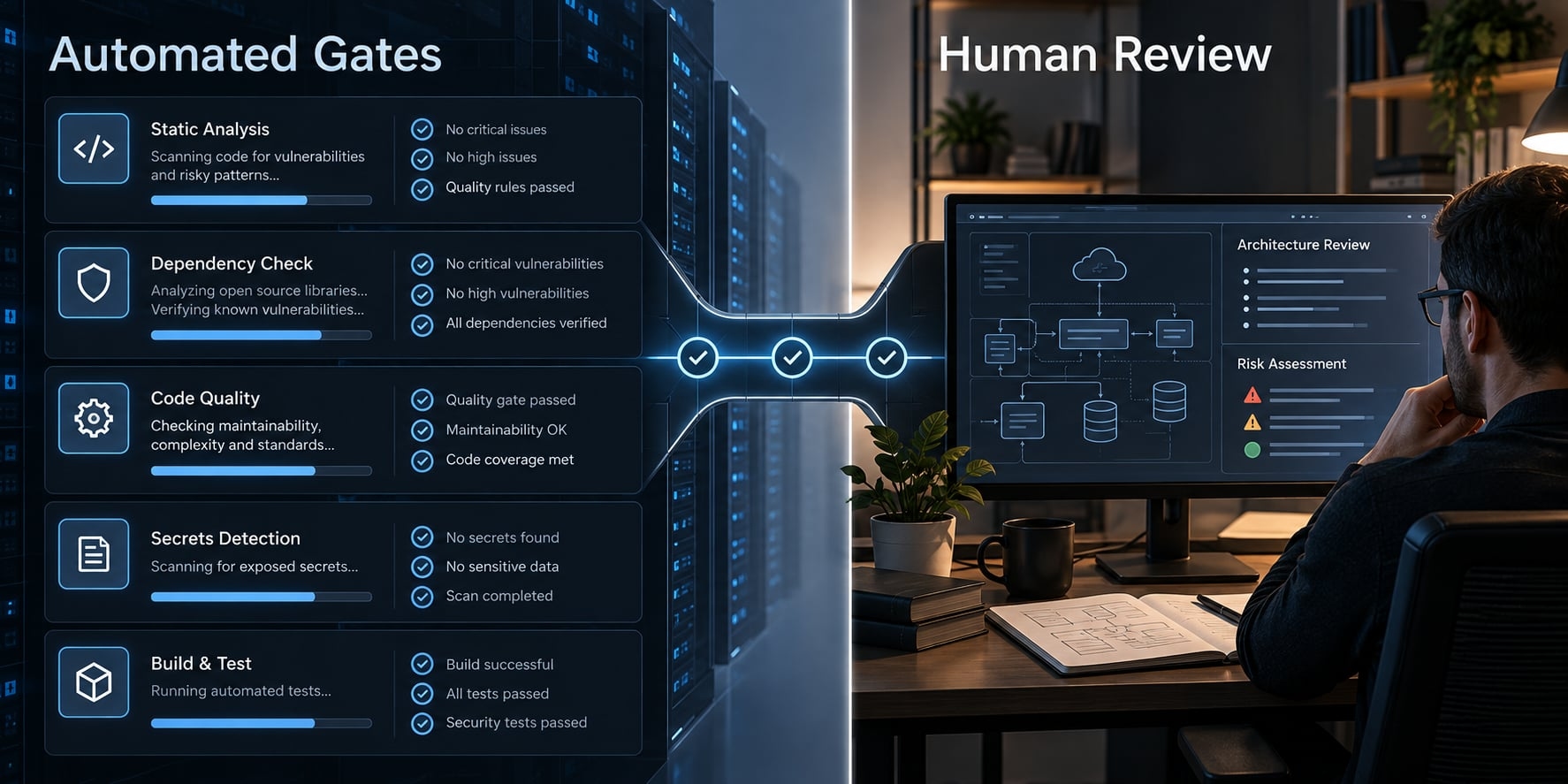
Automated code quality assessment provides repeatable execution. Human code review supplies contextual interpretation and accepts responsibility for unresolved risk.
Good candidates for automated quality gates
Review check | Automate | Human review | Why |
|---|---|---|---|
Build/types | Execute | Failures/exceptions | Success does not establish intent |
Formatting/linting | Enforce rules | Rule changes/exceptions | Routine formatting needs no manual inspection |
Tests | Execute suites | Assertions and gaps | Tests can encode wrong expectations |
Secret detection | Scan patterns | Triage and response | Detection has blind spots |
Dependencies | Inventory and scan | Identity and applicability | Package trust needs context |
SAST | Run configured analysis | Validate findings | Alerts are not final judgments |
Repository policies | Enforce configured rules | Policy meaning/exceptions | Only encoded rules execute |
Requirements | Assist comparison | Own interpretation | Intended behavior needs confirmation |
Test independence | Flag circular patterns | Own assessment | Shared assumptions need investigation |
Architecture/release risk | Assist analysis | Own approval | System consequences exceed local checks |
Checks that require human context
Requirements, access-policy meaning, architecture, side effects, and accepted production risk remain human-owned. AI review findings are hypotheses until supported by inspected code, reproduced behavior, or other reliable evidence.
Configured gates can block detected violations when enforced correctly. They cannot detect every failure.
For solo developers, schedule a deliberate review pass separate from implementation. Seek specialist review for high-impact changes where practical; self-review is not equivalent to independent peer review.
Record the accountable decision-maker even when the author and reviewer are the same person.
Copy-ready pull request checklist
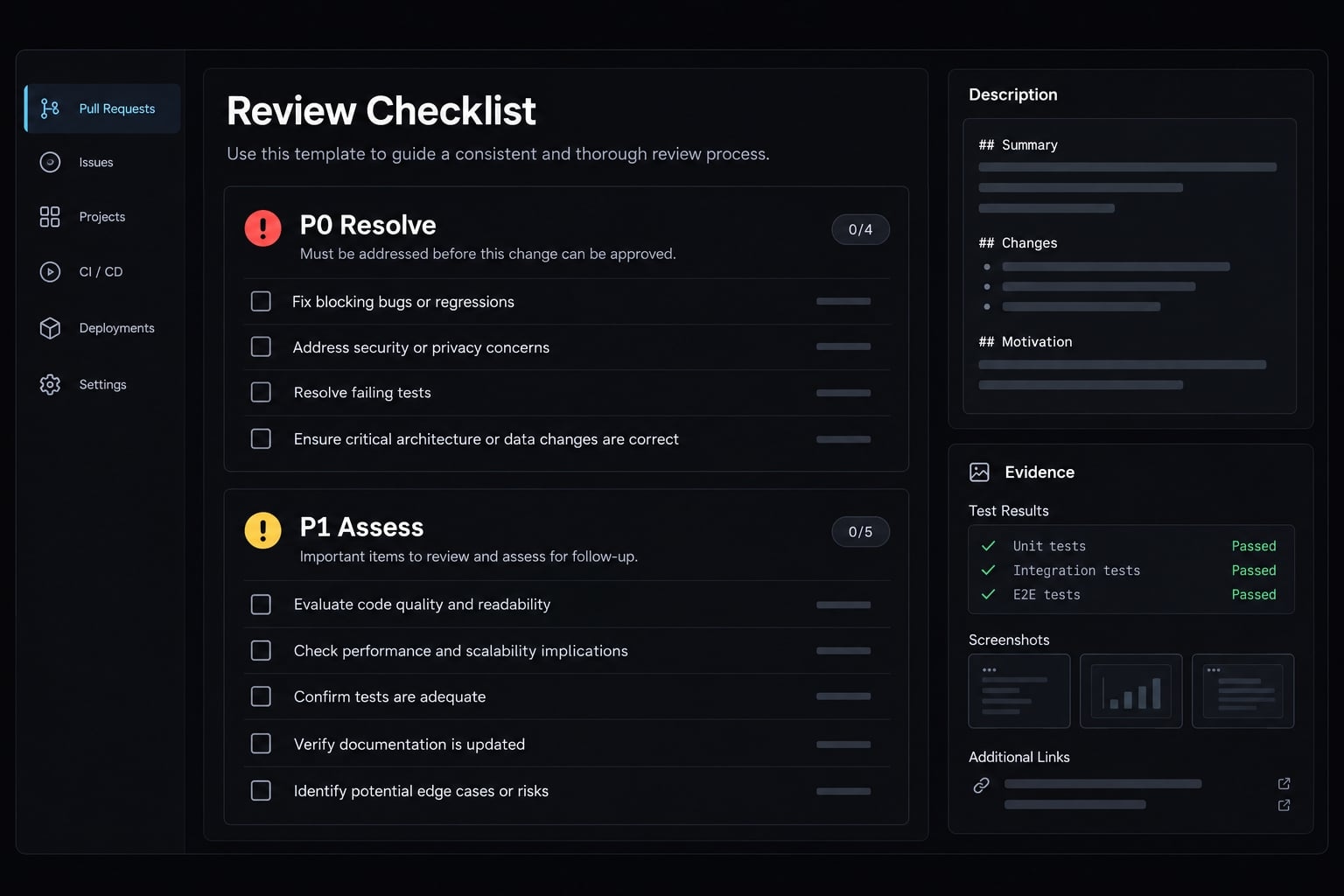
Copy this versioned Markdown template. Mark irrelevant checks N/A with justification; completion never overrides unresolved critical findings. Escalate any unacceptable impact to P0.
Optional AI-assistance context
The context fields are optional unless repository policy requires them. Do not include raw conversations, credentials, or unnecessary personal information.
Pre-merge checklist groups
## Review checklist — v1.0### Optional AI-assistance context- Tool:- Substantially generated components:- Source requirement:- Human changes after generation:- Tests/scans run and evidence:- Assumptions/high-risk areas:Use N/A with justification where irrelevant.Evidence must identify the reviewed revision.Unacceptable impact escalates any finding to P0.### P0 — Resolve before merge- [ ] Trace acceptance criteria to implementation and evidence.- [ ] Verify scope changes are approved; explain cross-file changes.- [ ] Exercise allowed and denied actions under the access policy.- [ ] Verify tenant isolation through request, worker, and download paths.- [ ] Inspect input handling and destination-specific safety controls.- [ ] Check secret scan evidence and safe runtime secret handling.- [ ] Verify package identity, registry, versions, and API compatibility.- [ ] Confirm all required checks pass for the reviewed revision.### P1 — Assess before merge- [ ] Exercise empty, boundary, malformed, and timeout scenarios.- [ ] Verify error responses and persisted failure states.- [ ] Check retries, concurrency, and external side effects.- [ ] Link requirement-derived tests that detect incorrect behavior.- [ ] Compare clients, validators, logging, and architectural boundaries.- [ ] Inspect resource handling and representative workload evidence.- [ ] Check configuration, migrations, permissions, and rollout compatibility.- [ ] Record monitoring signals, alerts, and a recovery owner.- [ ] Verify rollback, disablement, or forward-recovery steps.### P2 — Improve or assign ownership- [ ] Compare naming with repository conventions.- [ ] Inspect duplication and justify retained abstractions.- [ ] Record deferred improvements with owners and tracking references.### Final approval and evidence- [ ] Record residual risks, rationale, and policy-authorized acceptance.- [ ] Record accountable approval and separate release conditions.Reviewed commit:Test evidence:Security/dependency scan evidence:N/A justifications:Open findings and owners:Decision-maker:Independent reviewer, if any:Decision/date:
For GitHub, save the pull request template at .github/pull_request_template.md. For GitLab, use a named Markdown file within .gitlab/merge_request_templates/.
Installing this pre-merge checklist does not enforce branch protection or CI gates. Configure enforcement separately.
Turn the checklist into a repeatable review workflow
Review two axes: Specification alignment asks whether behavior matches the request; standards alignment asks whether architecture, security, and testing follow repository rules.
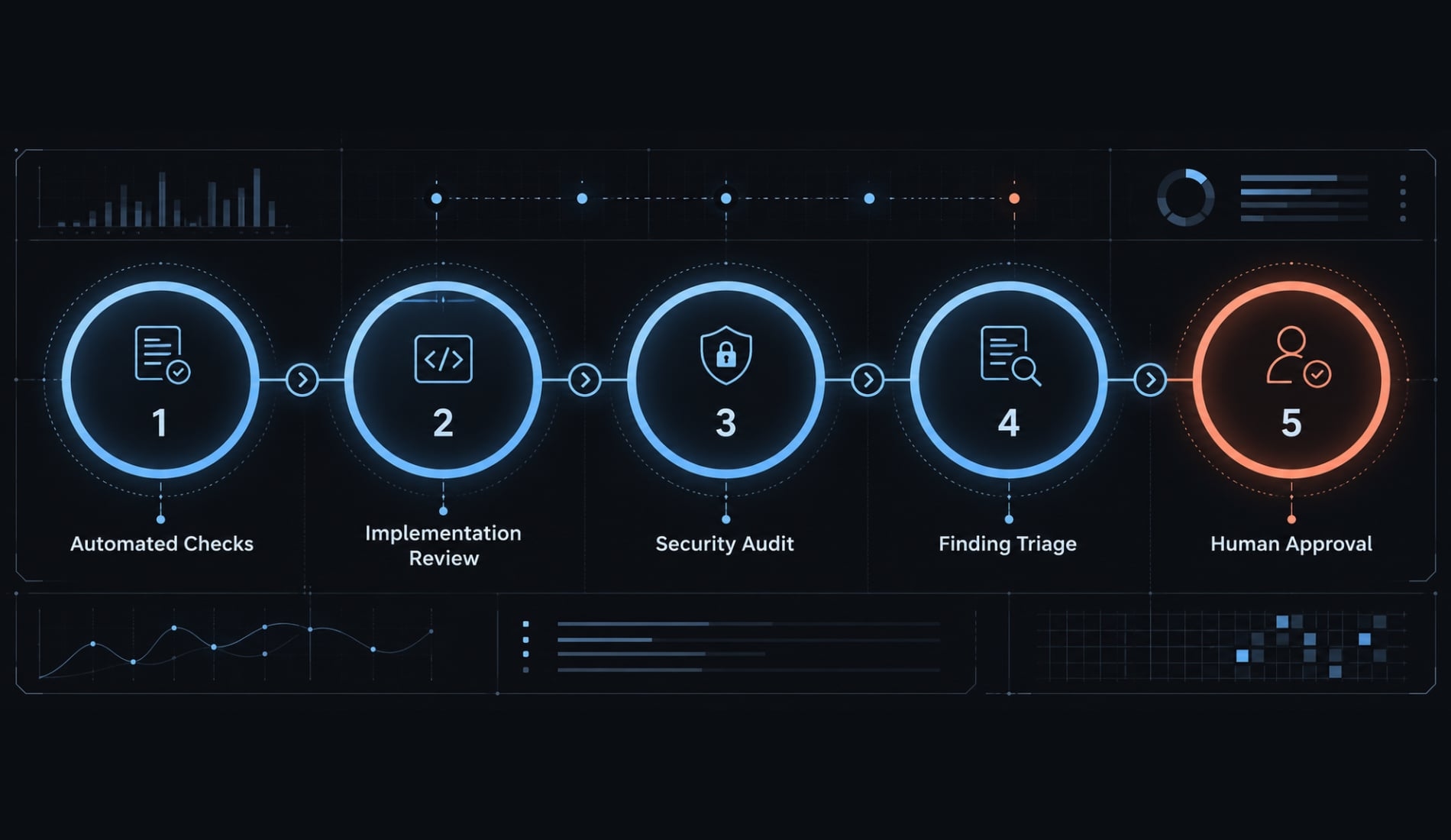
Suggested pre-merge workflow
- Run configured automated checks: Preserve revision-linked results.
- Compare implementation with acceptance criteria: Record traceability.
- Review security, tests, and architecture with repository context: Inspect affected boundaries.
- Triage findings and document resolution or acceptance: Assign owners and escalate impact.
- Obtain accountable human approval: Separate release conditions where necessary.
Store expectations in repository instructions, evidence fields in the PR template, and executable checks in CI configuration. Keep the review workflow versioned alongside these artifacts. Repeatable execution does not make scanner findings exhaustive or infallible.
Frequently asked questions
What is the AI-generated code review checklist?
The AI-generated code review checklist is a structured verification framework used by engineering teams to ensure that AI-authored code meets quality, security, and functional standards. It focuses on identifying plausible logic errors, hallucinated APIs, and missing edge cases that automated linters often fail to detect.
Why is reviewing AI-generated code different from human-written code?
The standard is the same; the attention pattern differs. Generated code is often syntactically clean, so context blindness, logic drift, and self-validating tests are easier to overlook. These patterns are not exclusive to AI — the verification gap is what changes, not the review bar.
What are the most common failure modes in AI-generated code?
The five primary failure modes include hallucinated API calls, context blindness (ignoring architectural constraints), logic drift (implementation subtly changing the requested behavior), happy-path bias, and self-validating test suites where the AI writes both the implementation and the tests, potentially sharing the same blind spots.
How can I verify that AI-generated tests are actually effective?
To ensure tests are effective, verify that they "fail for the right reason." Introduce a deliberate bug in your local environment and confirm that the corresponding test fails. Avoid "tautological tests" that use excessive mocking or circular assertions, which may provide high coverage metrics without actually validating the domain logic.
Is it safe to automate the entire AI code review process?
No. While automated tools can handle formatting, linting, and basic dependency scanning, they cannot replace human judgment regarding architecture, access policies, and requirement fidelity. Use automation for execution (e.g., CI/CD gates), but retain human review for assessing side effects, security assumptions, and operational readiness.
What should I look for when reviewing AI-generated dependencies?
Always verify that new libraries exist on official registries, check their version compatibility, and scan for "slopsquatting," where malicious packages are registered with names similar to legitimate libraries. A package’s presence in a repository or a clean automated scan does not guarantee it is safe, maintained, or licensed for your project.
How do I handle AI-generated code that involves sensitive authorization?
Exercise both permitted and denied requests rather than reading the code alone. Request-supplied IDs are not unsafe in themselves — the risk is accepting them without server-side authorization using tenant context from the approved trust model. Check the request handler, the background worker, and the download endpoint separately; an authorized handler cannot compensate for an unsafe worker.
Read more:
- AI feature development workflow: 7 stages to production success
- Project-aware AI coding: A complete guide and evaluation
- Human in the loop AI coding: Optimize speed and quality
Conclusion
An effective AI-generated code review checklist evaluates whether a change fulfills requirements, addresses security risks, integrates cleanly into the repository, and provides sufficient evidence for a merge decision.
Reviewers must prioritize findings by impact, attach clear evidence to the specific revision, and distinguish critical blockers from minor enhancements. While automated tests and clean scans offer helpful signals, human judgment remains irreplaceable—accountable engineers retain final responsibility for approving changes and managing operational risks.