Claude Code vs Devin: Choosing between steering and delegation
Claude Code vs Devin: Choose between active steering and scoped delegation
Choosing between Claude Code and Devin depends on where you apply engineering judgment: real-time or asynchronously. Claude Code fits actively steered, ambiguous tasks in the terminal, while Devin excels at fully scoped work reviewed asynchronously. Rather than feature counts, your decision rests on workflow ownership—whether human insight adds the most value during real-time iteration or post-execution review.
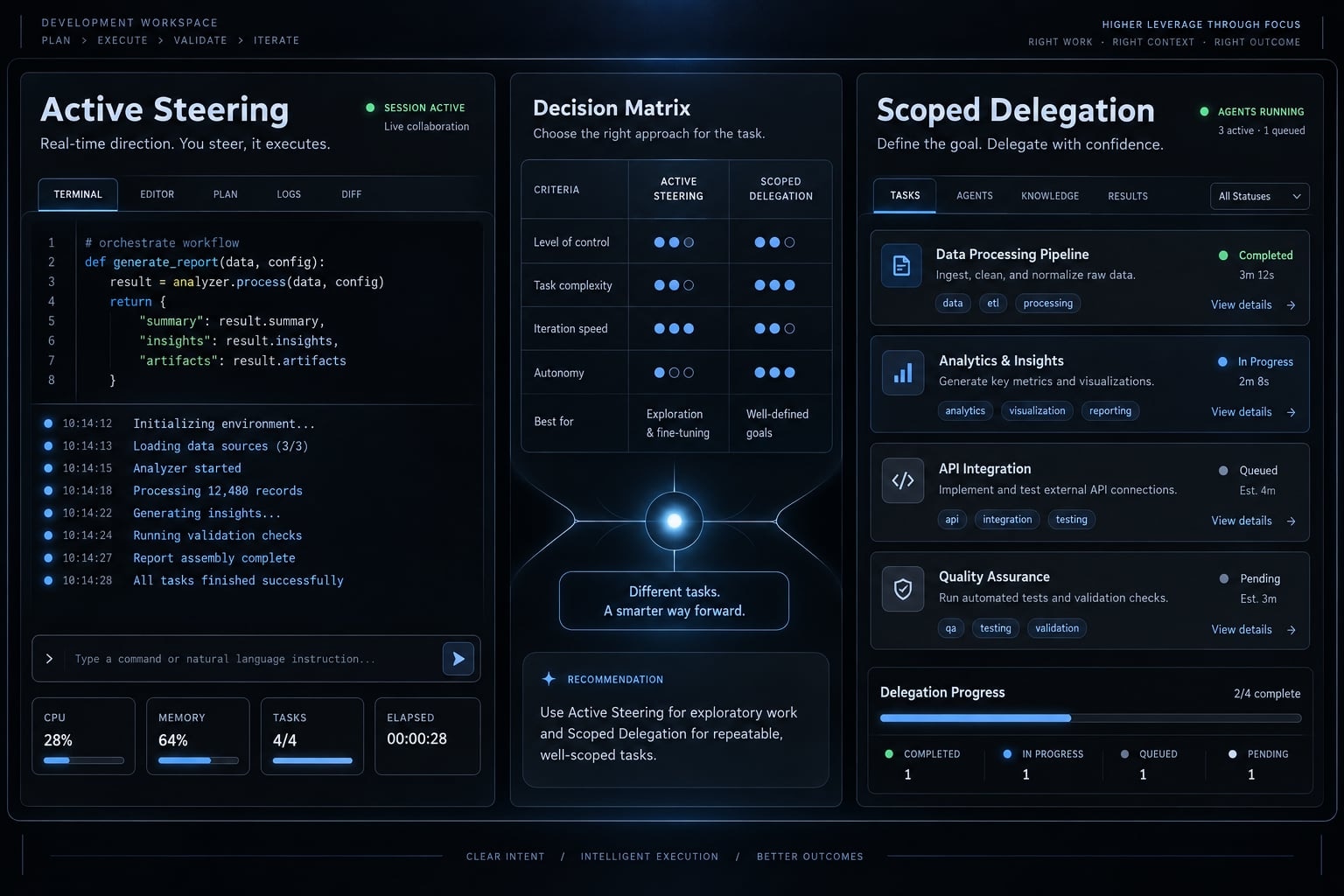
Claude Code vs Devin at a glance
When evaluating Claude Code vs Devin, workflow ownership matters far more than feature count. An agent can generate a plausible patch without resolving the underlying engineering problem. Both products require someone to own requirements, permissions, verification, and acceptance.
Quick comparison table
The table describes predominant workflows, not exclusive capabilities. Team-fit recommendations are editorial judgments.
Criterion | Claude Code | Devin | Practical implication |
|---|---|---|---|
Predominant operating model | Interactive collaboration | Asynchronous delegation | Decide when humans steer |
Typical workflow | Inspect, implement, redirect | Scope, assign, review | Different attention patterns |
Execution environment | Developer-controlled execution options | Managed task environments | Validate actual deployment |
Human involvement | Often continuous | Often concentrated at checkpoints | Budget supervision and review |
Suitable task characteristics | Evolving or ambiguous | Bounded and verifiable | Route by uncertainty |
Course correction | Direct conversational steering | Feedback during delegated work | Check intervention mechanics |
Output and handoff | Changes prepared within development workflow | Changes prepared for review | Neither equals accepted code |
Integration emphasis | Developer tools and extensibility | Task assignment and delivery | Check required connections |
Operational risk | Attention demand; broad permissions | Scope drift; review queues | Controls matter for both |
Team fit | Hands-on engineering | Dependable delegation process | Readiness outweighs headcount |
Short verdict by priority
- Control: Claude Code commonly fits teams prioritizing developer control during implementation.
- Delegation: Devin commonly fits async delegation of bounded, independently verifiable work.
- Mixed workloads: Consider both only when benefits justify additional subscriptions, configuration, and coordination.
Interactive control is not inherently safer, nor is full delegation automatically more productive. Both workflows fail when acceptance criteria are weak or review capacity is lacking.
The fundamental difference: Collaborate with Claude Code or delegate to Devin
Both follow an agentic loop: plan, execute, inspect results, and revise. The collaborate vs delegate distinction concerns where human attention enters that loop.
Claude Code: Interactive, steerable development
Claude Code’s interactive pattern keeps the developer close to implementation decisions.
- Define the objective and boundaries.
- Inspect relevant repository context.
- Propose or execute an implementation.
- Review progress and redirect assumptions.
- Test and prepare the change.
Illustrative example: A B2B SaaS export intermittently fails. Investigation begins with database timeouts, but logs suggest tenant-specific configuration. The developer changes the hypothesis before an unnecessary query rewrite expands the patch.
This pattern helps when discovering the problem is part of the task. Command approvals and unattended behavior depend on permissions and configuration; not every action necessarily requires a manual click.
Devin: Asynchronous, delegation-first execution
Devin’s delegation pattern moves more work into the initial brief and subsequent review.
- Define a ticket and acceptance criteria.
- Prepare or access the execution environment.
- Plan and implement the change.
- Run tests and prepare reviewable output.
- Review the result and request corrections.
Illustrative example: Update a documented dependency within a specified version range. Require unchanged public interfaces, passing compatibility tests, and a rollback note.
Delegation becomes practical because the expected result is explicit. Missing credentials, broken setup instructions, or incompatible dependencies can still require intervention. Unattended completion is not guaranteed.
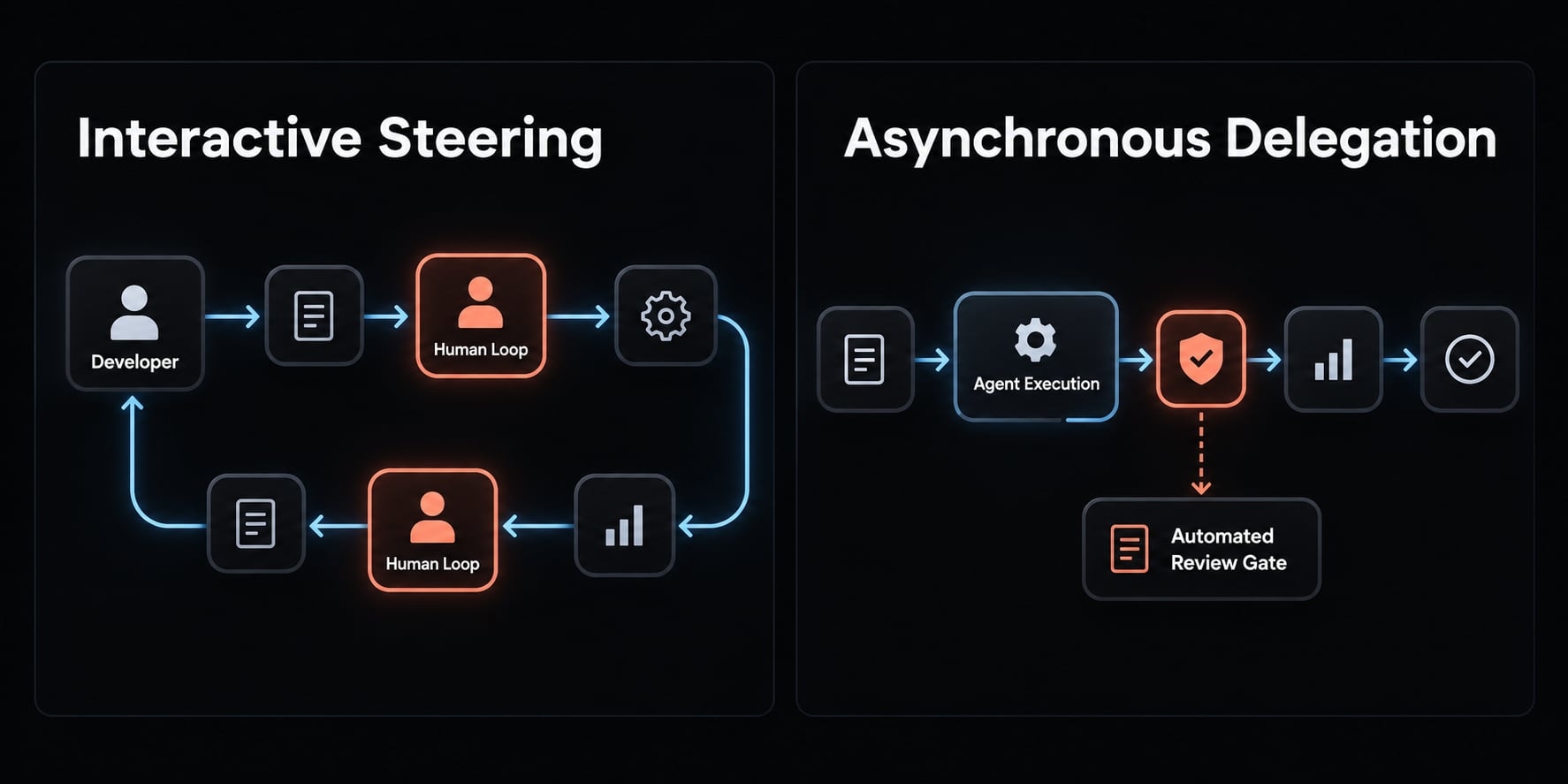
Why workflow matters more than features
Interactive work consumes attention earlier but can expose mistaken assumptions sooner. Delegation frees execution-time attention but may postpone expensive corrections until review.
Choose where human judgment belongs, not whether to have it. A human-in-the-loop process must include meaningful authority to stop, correct, and reject work.
Claude Code vs Devin across the most important decision criteria
Evaluate stable operational requirements before temporary feature advantages. Use this framework:
Task ambiguity + Change risk + Verification effort + Team readiness = Appropriate level of delegation.
Ambiguity means unresolved requirements. Risk means consequences of failure. Verification effort means difficulty proving correctness. Readiness means dependable setup, tests, permissions, and review ownership.
Autonomy and developer control
Execution autonomy is useful when it reduces human effort without transferring excessive work into review.
Compare intervention options, supervision needs, parallel-task limits, and the cost of correcting an assumption. Claude Code’s interactive pattern favors frequent steering. Devin’s delegation pattern favors prepared work that can progress between checkpoints.
Runtime is not attention time. A forty-minute run requiring two minutes of intervention differs from forty minutes of continuous supervision. Neither measurement reveals review burden by itself. Record them separately.
Execution environment and code access
Claude Code: A developer-controlled environment can provide existing dependencies and working state. That convenience also creates risks from unrelated changes, inherited credentials, and machine-specific behavior.
Devin: A managed environment can support repeatable task execution when repository setup is reliable. Private packages, restricted services, or missing fixtures can erase the delegation benefit.
For both, verify repository access, credential scope, network requirements, and reproducibility. Test setup from a clean environment rather than assuming existing instructions work.
A local interface does not mean code stays on the device. A managed sandbox does not establish complete isolation or regulatory compliance.
Context and codebase understanding
A context window is the information available to a model within a given interaction. Repository retrieval or indexing helps find relevant files and documentation. Neither mechanism guarantees correct codebase reasoning. Stale architectural notes can mislead an agent regardless of context capacity.
Evaluate context handling through behavior: Does the agent identify existing patterns, inspect callers, preserve contracts, and recognize missing information? Shared repository instructions help, but they need maintenance. Do not select either product on an unqualified context-window number or an assumed repository-indexing advantage.
Integrations and extension model
Evaluate integration capabilities by structural category rather than raw logo counts:
- Development environment access.
- Repository hosting and review handoff.
- Issue assignment and status updates.
- Continuous integration, meaning automated build and test checks.
- External documentation and operational tools.
MCP integrations use Model Context Protocol, a standard for connecting AI applications to tools and data sources. Separate native support from third-party connectors and custom implementations. Ask who maintains authentication, permissions, failure recovery, and compatibility. An integration that works in a demonstration may still require substantial operational ownership.
Confirm each required connection for the selected product, plan, and deployment.
Team governance and standardization
Coding agent governance determines whether useful individual behavior becomes a repeatable team process. Assign ownership for: shared instructions, approved tools and permissions, repository access rules, human approval gates, action logs, required tests and reviews, and configuration changes.
AgentKit provides scaffolding, shared skills, and session hooks that can standardize instructions and approval prompts across a team. It supports governance but does not make a workflow inherently correct.
Before purchasing, ask a reviewer to inspect an agent-generated change using your normal standards. If evidence is incomplete, fix the handoff rather than lowering the review threshold.
Which tool is better for common software engineering tasks?
Route by ambiguity, risk, and verification effort - not task labels alone. A dependency update can be more consequential than a feature change if it alters authentication or transaction behavior.
Task-based recommendation matrix
This matrix is workflow-fit guidance, not measured superiority.
Task | Recommended direction | Reason or condition |
|---|---|---|
Unclear production issues | Claude Code, human-led | Controlled investigation using sanitized evidence; no implied production-write access |
Repository-wide refactoring | Claude Code initially | Complex refactoring needs architectural checkpoints and staged validation |
Ambiguous features | Claude Code | Requirements need clarification during implementation |
Dependency updates | Devin when bounded | Explicit version scope, compatibility checks, rollback |
Test generation | Either | Humans must validate assertions and meaningful coverage |
Documented bugs | Devin when reproducible | Clear failure case and acceptance test |
Codebase exploration | Claude Code | Interactive codebase reasoning and follow-up questions |
Repetitive maintenance | Devin when standardized | Backlog automation with repeatable acceptance rules |
Security-sensitive changes | Human-led; tool secondary | Specialist review and risk-specific verification |
Independent task batches | Devin, conditionally | Current concurrency limits and reviewer capacity must support volume |
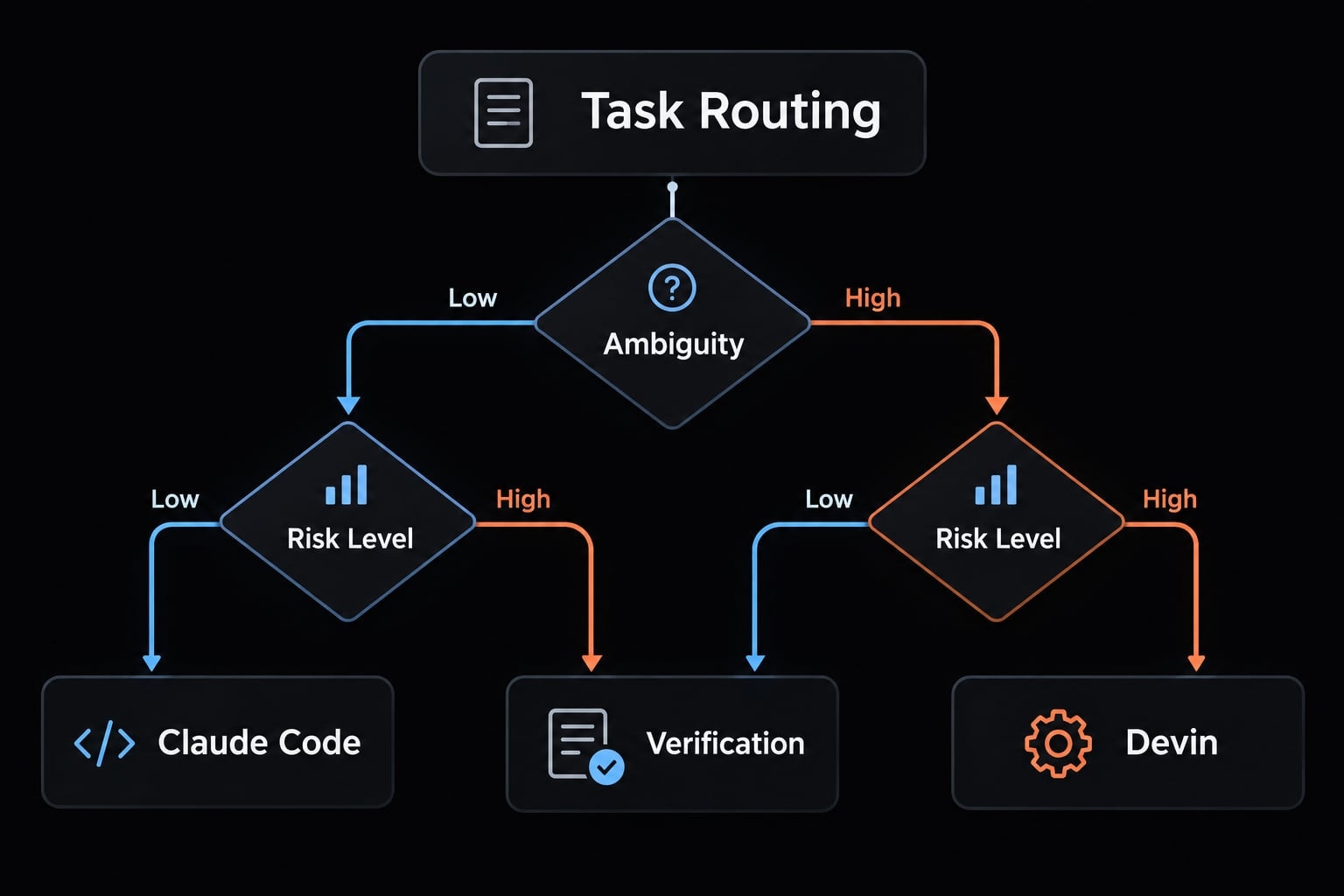
A generated patch becomes an engineering outcome only after it satisfies acceptance criteria, required checks, and human review. Counting opened pull requests alone rewards output volume rather than completed work.
Where Claude Code has the stronger fit
Evolving requirements, interactive investigation, architecture-sensitive work, and specialized local context share one characteristic: implementation depends on ongoing judgment.
Claude Code is therefore a useful starting point when the developer expects to revise the plan repeatedly. The advantage is access to timely correction - not demonstrated superiority across every difficult coding task.
Where Devin has the stronger fit
Clear acceptance criteria, reproducible setup, independent tasks, and reliable automated checks make delegation easier to evaluate.
Devin becomes more attractive when assignments can progress without constant clarification. However, dependency updates and test generation are not inherently low-risk. Weak assertions can approve incorrect behavior, while passing tests can miss compatibility failures.
When neither tool should operate independently
Keep consequential changes human-led: Authentication, authorization, payments, cryptography, irreversible database operations, sensitive-data handling, incomplete incident investigations, and large transformations without tests or rollback.
Illustrative B2B SaaS scenario: A cross-tenant authorization fix passes ordinary endpoint tests but still exposes another customer’s records through an export route. Correctness requires adversarial tests, domain knowledge, and review of related access paths. Task risk overrides the convenience of either workflow.
Pricing, total cost, failure modes and security
Purchase price is only one cost component. Pricing and plan terms change frequently, so this comparison omits dollar figures.
Product | Pricing basis to confirm | Additional conditions |
|---|---|---|
Claude Code | Eligible subscription access or API-based billing arrangement | Included usage, additional usage, seats, organizational controls |
Devin | Selected plan’s subscription and usage terms | Allowances, additional consumption, concurrency, enterprise requirements |
Source references for procurement: Anthropic pricing documentation; Cognition Devin pricing documentation. Obtain current terms and record the verification date before budgeting.
Compare cost per accepted change, not monthly price alone
Use consistent monetary units when calculating total cost of ownership:
Period TCO = vendor charges + allocated setup and infrastructure costs + human labor cost + other attributable operating costsHuman labor cost = Σ(nonoverlapping activity hours × loaded hourly rate)Cost per accepted task = period TCO ÷ accepted tasks
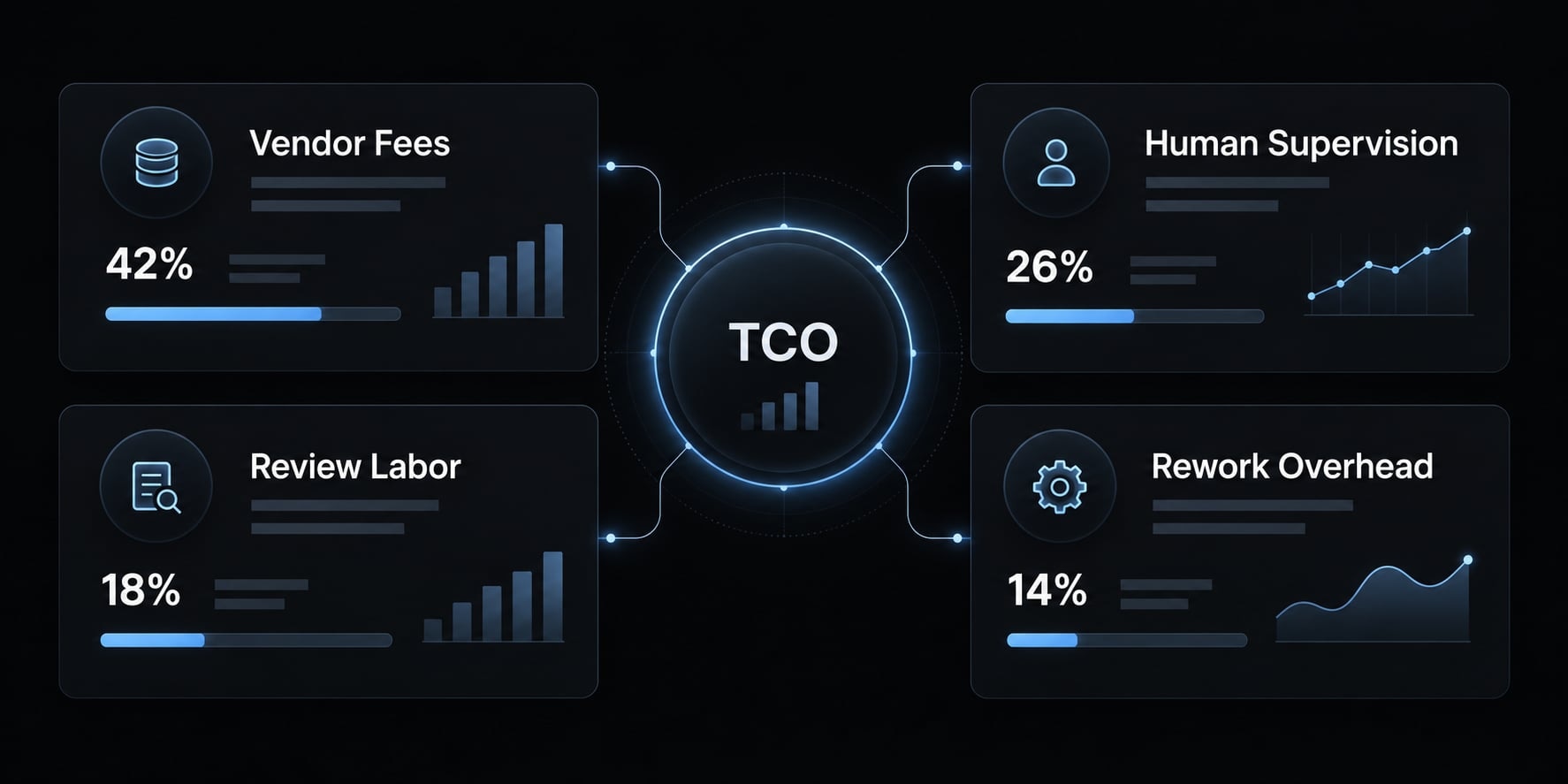
Include scoping, active supervision, review, rework, and governance. Allocate setup across an explicit period or expected workload.
An accepted task meets predefined requirements, checks, and review standards. Compare similar task categories; one pull request is not a standardized unit.
Count unsuccessful-run charges and labor once. If no tasks are accepted, report zero accepted outcomes and total expenditure - not a misleading unit cost.
Typical failure modes
These are workflow risks, not inevitable product behaviors.
Failure mode | Visibility and response |
|---|---|
Misunderstood requirements | Interactive steering may expose assumptions sooner; delegated work needs explicit checkpoints |
Excessive edits | Review scope continuously or at handoff; reject unrelated changes |
Environment mismatch | Reproduce from clean setup; distinguish machine-specific from application failures |
Review concentration | Delegated batches can queue; cap work against reviewer capacity |
Wasted execution | Set usage ceilings, time limits, and stop conditions for both |
Recovery approach | Preserve evidence, reset affected work, clarify scope, rerun narrowly |
Avoid repeatedly prompting a failing run without diagnosing the failure. A setup problem needs environment repair; an unclear requirement needs a human decision.
Security and governance checklist
For the selected plan and deployment, confirm:
- Where execution occurs.
- What repository content is transmitted or cloned.
- How secrets are stored and exposed.
- Which networks and commands are permitted.
- Whether logs contain sensitive code or data.
- Which destructive actions require approval.
- Applicable retention and model-training policies.
- Procurement, contractual, and compliance requirements.
- Enforcement of normal testing and code review.
Prompt injection occurs when untrusted content attempts to redirect an agent. Repository files and connected tools can contain such instructions; treat their contents as data, not authority.
Benchmark claims: Useful but incomplete
SWE-bench Verified evaluates issue resolution under defined conditions. It does not directly measure private-repository productivity, setup friction, or reviewer effort. Any score needs its benchmark version, agent configuration, model when disclosed, date, evaluation harness, conditions, and original source.
Which should you choose? Recommendations by user and team type
Team size is a proxy, not the deciding factor. An agent-ready repository has dependable setup, clear instructions, meaningful tests, and accountable reviewers.
Solo developers and indie founders
Claude Code is a common starting point when rapid steering matters more than unattended execution. Solo developers and indie founders often hold product context that is difficult to capture completely in tickets.
Startups and small product teams
Changing requirements often favor interactive work. Startups and small product teams can add delegation once task boundaries, environments, and acceptance checks become dependable.
Do not infer readiness from company age. A small team with reproducible setup may delegate effectively; a larger team with undocumented dependencies may struggle.
Mature engineering organizations
Mature engineering organizations should evaluate task routing and procurement rather than crown a universal winner. Review identity controls, permissions, logging, data handling, reviewer capacity, and acceptance metrics.
Standardized infrastructure can improve delegation, but complex ownership or review queues can cancel those gains. Organizational maturity does not automatically make autonomous execution economical.
When using both is the better decision
A hybrid AI development workflow can follow four steps:
- Route ambiguous work to interactive collaboration.
- Route bounded work to delegated execution.
- Apply risk-based approval gates to both.
- Measure accepted outcomes and total operating cost.
The trade-off includes duplicate subscriptions, configuration ownership, and handoff complexity. Avoid assigning overlapping changes simultaneously without coordination. This is an operating model, not a claim of native Claude Code–Devin or AgentKit–Devin integration. Use both only when complementary results justify the overhead.
Team readiness check
Use this practical diagnostic, not a validated maturity score:
- Reproducible setup.
- Current repository instructions.
- Clear task boundaries.
- Explicit acceptance criteria.
- Meaningful automated tests.
- Least-privilege credentials.
- Named reviewers.
- Rollback procedures.
- Cost and outcome tracking.
Missing items identify preparation work, not automatic disqualification. Begin with a narrow task category where the gaps are manageable. Expand only when review and recovery remain dependable.
Run a controlled pilot before standardizing either tool
An AI coding agent evaluation should test representative work, not just impressive demonstrations. Small pilots provide directional evidence, not definitive rankings.
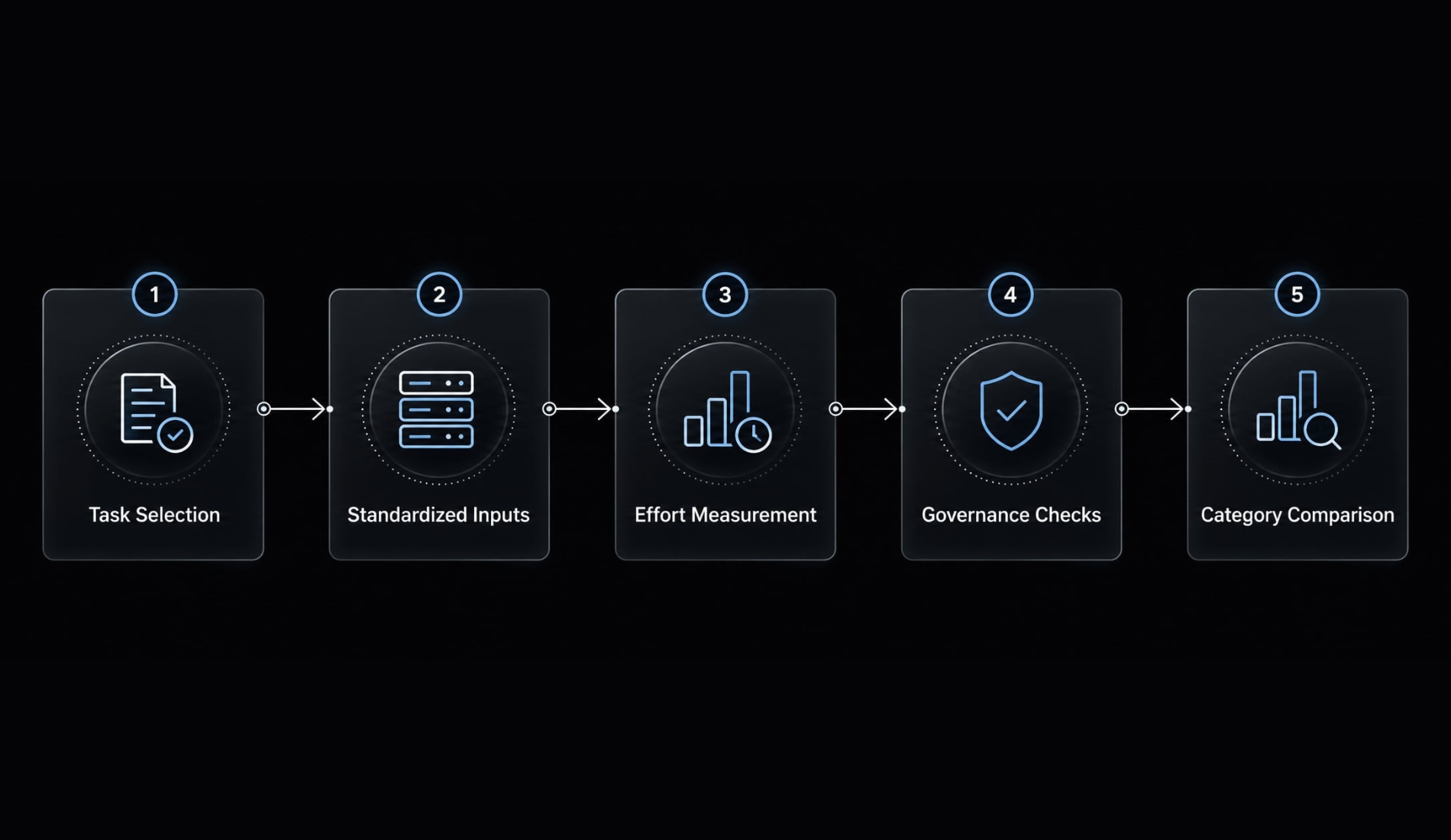
Five-step evaluation framework
- Select tasks: Include a clear bug, dependency update, test task, complex refactor, and ambiguous request.
- Standardize inputs: Use equivalent snapshots, documentation, permissions, and acceptance criteria. Isolate branches or repository copies; do not expose either tool to the other’s solution.
- Measure complete effort: Record setup, scoping, intervention, execution, review, and rework. Document configuration and evaluator experience.
- Evaluate governance: Inspect access, logs, secrets, approvals, and policy fit. Define limits, stopping conditions, and acceptance rules beforehand.
- Compare by category: Use reasonable native workflows, not artificially identical interactions. Repeat representative tasks where feasible.
Five individual tasks are a smoke test. They cannot establish general superiority across repositories or engineering teams.
Pilot success metrics
Define “major rework” before starting. These developer productivity metrics measure different dimensions; elapsed time and labor time are not additive.
Metric | Operational definition |
|---|---|
Accepted task rate | Accepted without major rework ÷ attempted |
Active developer time | Hands-on execution supervision |
Review time | Human validation effort |
Cycle time | Elapsed assignment-to-acceptance time |
Rework rate | Tasks needing predefined substantial correction ÷ attempted |
Defect rate | Confirmed defects per accepted task within 30 days |
Cost per accepted task | Full pilot cost ÷ accepted tasks |
Autonomous drift rate | Out-of-scope runs ÷ evaluated runs |
Security exceptions | Policy deviations, classified by severity |
Frequently asked questions
What is the fundamental difference between Claude Code and Devin?
Claude Code’s predominant pattern is interactive collaboration, where developers steer as work progresses, though it also supports automation. Devin’s predominant pattern is delegation: you assign a scoped task and review the prepared changes, though you can intervene during the work.
Which tool is easier to approve for security-sensitive environments?
It depends on the deployment. Claude Code runs in a developer-controlled environment, but repository content still reaches the model provider, and enterprise options such as cloud-provider hosting can change data paths. Devin executes in managed environments. For either, confirm what is transmitted, retention terms, secret handling, and network permissions before approval.
Is Devin or Claude Code better for handling complex, ambiguous coding tasks?
Claude Code is usually the stronger starting point for ambiguous tasks, because interactive steering can expose mistaken assumptions earlier. Delegated work on vague prompts may surface a misinterpretation only at review, so ambiguous tasks need clearer scoping before delegation.
How do pricing and usage models differ between the two?
Both start with entry-level plans, but cost drivers vary. Devin scales with task volume and usage of its cloud VMs. Claude Code uses subscription or API-based token usage covering your Anthropic configuration, meaning high-volume usage scales with token consumption per user or organization.
Can I use both Claude Code and Devin in the same engineering workflow?
Yes, many engineering teams use a hybrid approach. You can use Devin to clear routine, well-scoped backlog tickets, such as dependency updates or minor bug fixes, while using Claude Code for high-judgment architectural refactoring, complex debugging, and exploration where tight human control is necessary.
Read more:
- Connect GitHub MCP to Claude Code: Step-by-step guide
- Blender MCP with Claude Code: A secure AI scripting setup guide
- Aider vs Claude Code: Choosing the right AI Coding Assistant
Conclusion
Claude Code vs Devin is primarily a choice about where engineering judgment enters the workflow. Claude Code is usually the stronger starting point when requirements evolve and developers need active steering. Devin often fits scoped delegation when setup is reproducible, acceptance criteria are explicit, and reviewers can validate results efficiently.
Neither transfers responsibility for requirements, tests, permissions, or approval away from your team. Route work by ambiguity, risk, verification effort, and readiness. Evaluate cost per accepted task alongside cycle time and review burden - not generated code volume.
Start with the team readiness check above and run a controlled pilot on representative tasks. Adopt a hybrid workflow only if measured benefits earn its additional complexity.