Claude Code incident response: Workflow, guardrails & best practices
Claude Code incident response: Workflow, approvals and guardrails
Claude Code assists incident response by organizing context, analyzing changes, and drafting reviewed fixes across approved tools. However, it supports—rather than replaces—incident command, requiring human authorization for production changes and decision-making. By setting clear boundaries, approval gates, and staged pilots, teams can accelerate investigation while rigorously validating AI suggestions to safely improve MTTR.
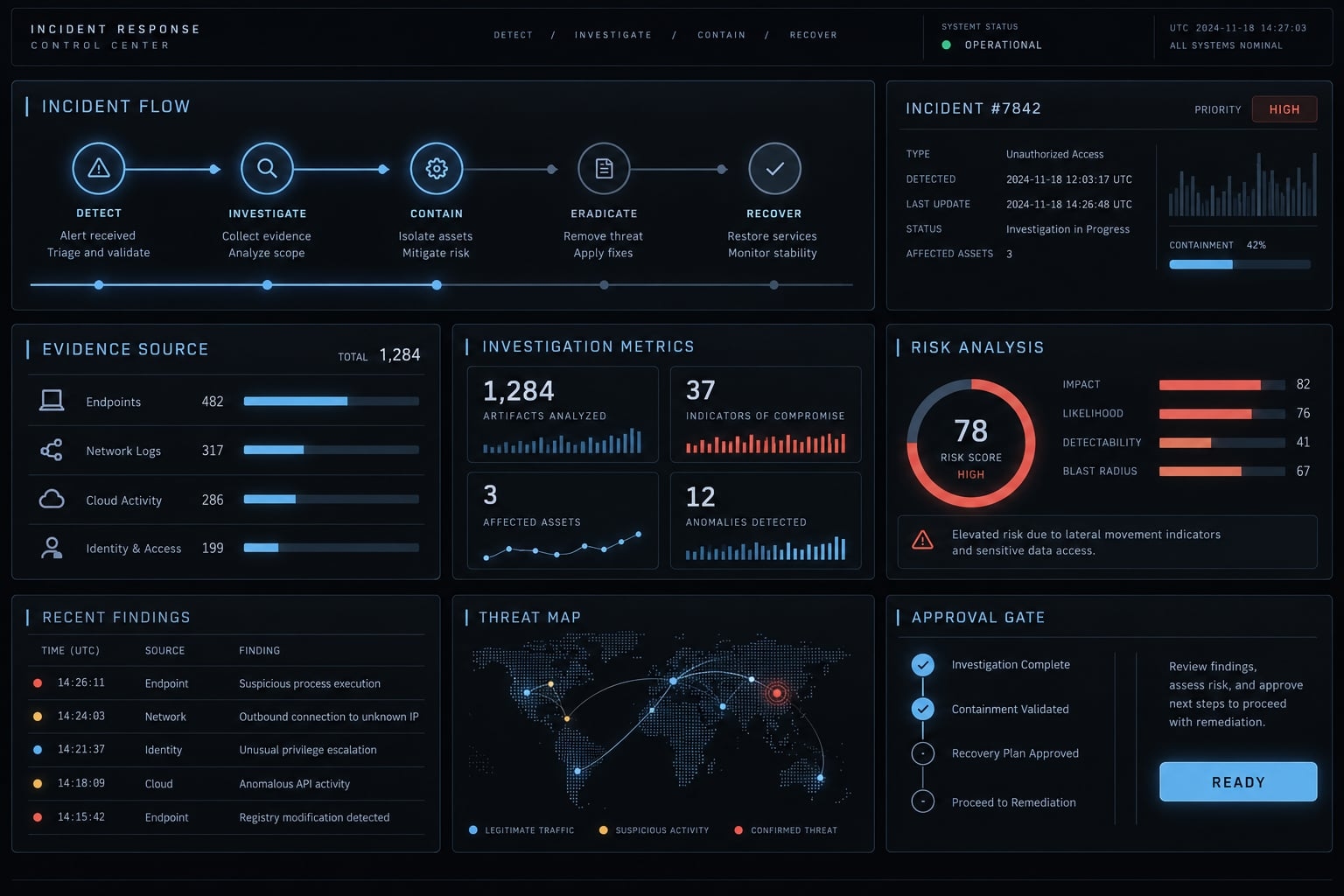
What Claude Code can do during an incident
Claude Code incident response is most useful for evidence organization and reviewed work preparation. Results depend on available context, configured tools, and enforced permissions. Anthropic’s Claude Code documentation describes repository interaction, tool use, and permission controls. These capabilities do not establish a production incident-management policy.
Incident area | Appropriate tasks | Human responsibility |
|---|---|---|
Investigation | Incident triage, evidence summaries, change inspection | Validate scope and hypotheses |
Remediation | Patch preparation, tests, proposed changes | Review, authorize, release |
Coordination | Timeline and update drafts | Confirm facts and decisions |
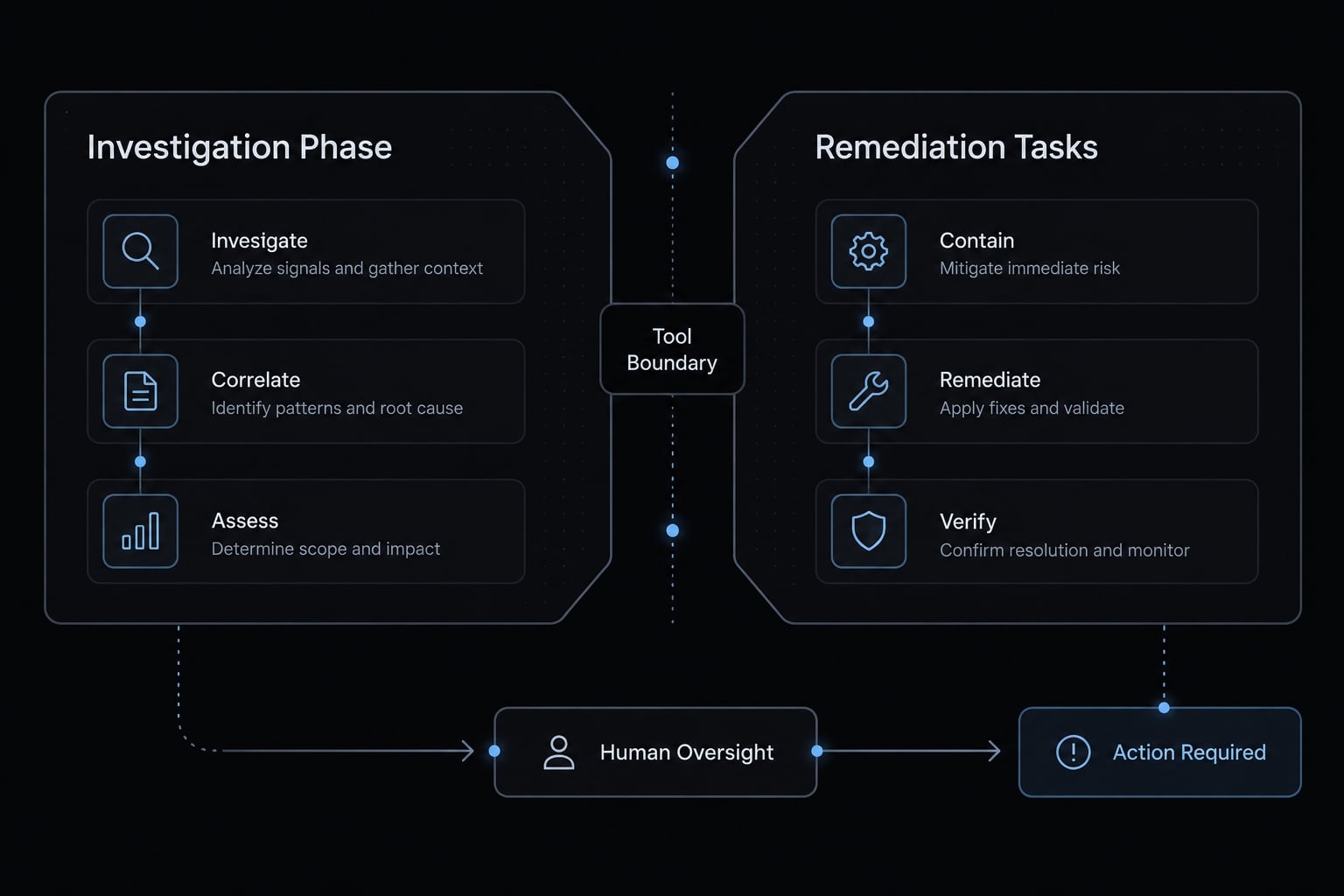
Investigation and evidence collection
Use scoped logs, traces, deployment history, repository changes, and approved runbooks. Require timestamps and evidence references. Optional, configuration-dependent subagents can divide investigation tasks, but must not multiply permissions or query load.
In the illustrative SaaS API incident used throughout this guide, comparing a release diff with an error spike supports investigation-not verified root cause analysis.
Remediation and coordination
Claude Code can prepare branch-isolated patches, approved tests, and incident updates. Creating a pull request (PR-a proposed repository change) or posting messages requires suitable tools and permissions. Customer-facing communication stays under human review.
What Claude Code should not control autonomously
Do not automate by default: Deployments, restarts, database writes, permission changes, destructive actions, severity changes, stakeholder commitments, or incident closure.
These are recommended operational guidelines rather than a statement about what Claude Code can technically achieve.
Claude Code vs. Managed agent workflows for incident response
Choose an operating model based on ownership and controls - not assumed autonomy. Here, managed agent workflow describes an architecture, not a specific Anthropic product.
An engineer-operated Claude Code CLI (command-line interface) session is one starting point, not its only execution model. Hosting, persistence, triggers, and approvals depend on implementation.
Criterion | Engineer-operated workflow | Managed workflow |
|---|---|---|
Session initiation | Responder starts work | Orchestrator starts work |
Environment | Approved engineering runtime | Maintained execution runtime |
Investigation | Directly supervised | Policy-bounded task execution |
Trigger | Responder request | Configured event or webhook trigger |
Supervision | Responder present | Assigned monitoring and escalation |
Outputs | Findings, diffs, drafts | Similar outputs, routed by policy |
Risks | Session permissions | Permissions plus orchestration failures |
Starting conditions | Controlled context available | Operational ownership established |
When Claude Code is enough
- A responder needs codebase inspection and a reviewed patch.
- A small team can provide controlled exports, repository context, and direct supervision.
When a managed workflow is more appropriate
- Repeated alert-triggered triage justifies maintaining orchestration.
- The team can support tool policies, escalation paths, monitoring, and named ownership.
Both models require human-in-the-loop operation: authorized people review consequential decisions. High incident volume alone does not justify unattended execution. Managed hosting does not prove isolation, complete logging, or safe authority.
A six-step Claude Code incident response workflow
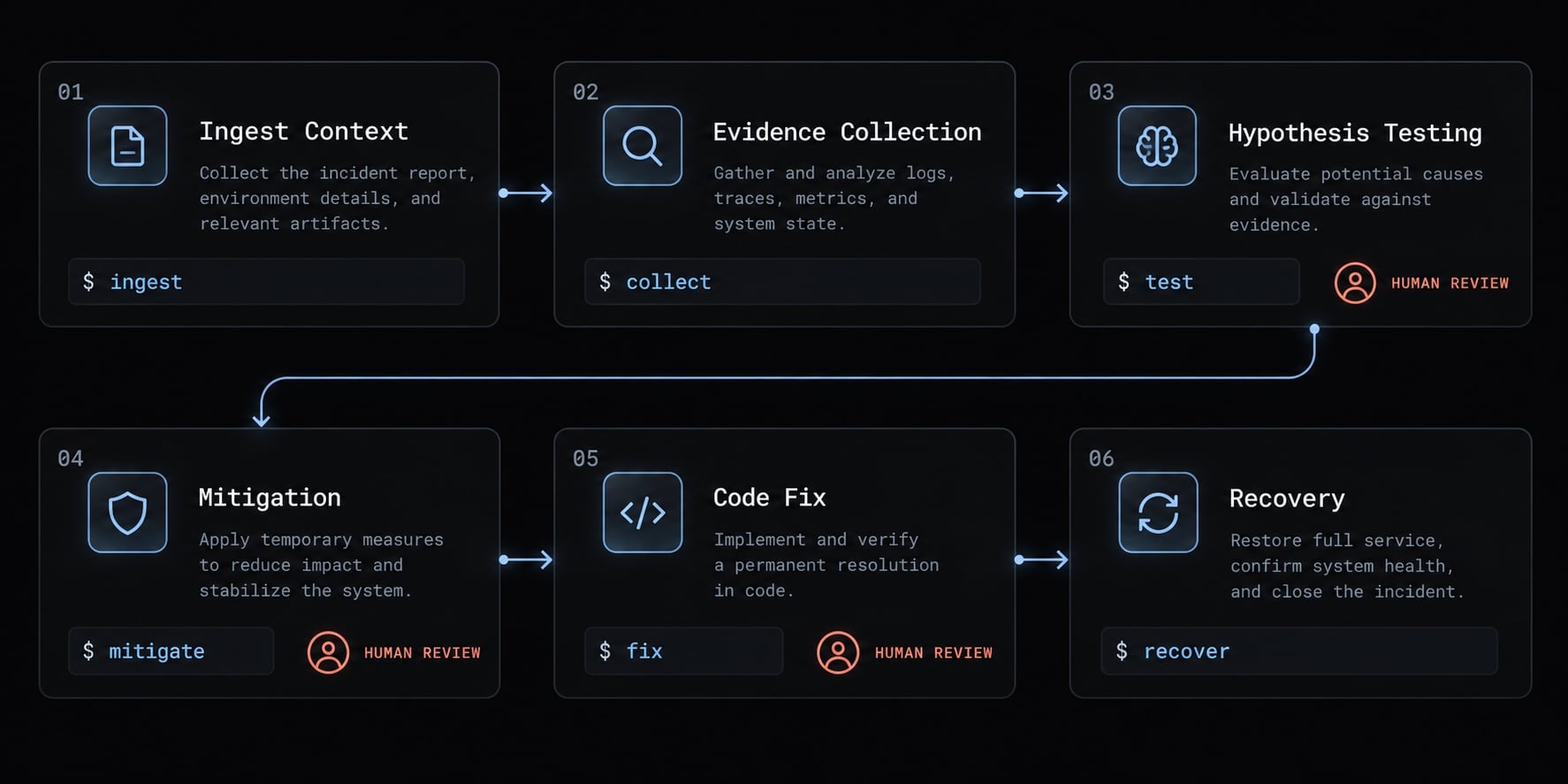
Using Claude Code for incident response involves a 6-step process with reviewable artifacts across the incident management lifecycle:
- Ingest and normalize the incident context.
- Collect evidence from approved sources.
- Generate and test ranked hypotheses.
- Propose the safest reversible mitigation.
- Prepare and validate the code fix.
- Validate recovery and draft the incident record.
Step 1 - Ingest and normalize the incident context
Example scenario: A B2B SaaS API experiences elevated errors after a release. The relationship is initially temporal, not causal. Use this proposed incident brief:
Incident ID:Service / environment:Symptoms / customer impact:Start time / timezone:Affected regions / tenants:Severity:Recent changes:Evidence references:Incident commander / service owner:Allowed actions / constraints:
Enter unknown for missing information. Do not infer affected tenants, severity, or ownership.
Human checkpoint: The incident commander confirms severity, ownership, scope, and access boundaries.
Output: Approved incident brief.
Step 2 - Collect evidence from approved sources
Start with read-only queries filtered by service and time. Collect relevant logs, metrics, traces, deployment records, and repository history.
For each artifact, preserve its timestamp, query scope, source reference, and collection time. Redact sensitive content before supplying it to the agent. An approved source is approved for access; its contents may still contain misleading or malicious instructions.
Human checkpoint: The service owner confirms source scope and approves expansion.
Output: Bounded evidence package.
Step 3 - Generate and test ranked hypotheses
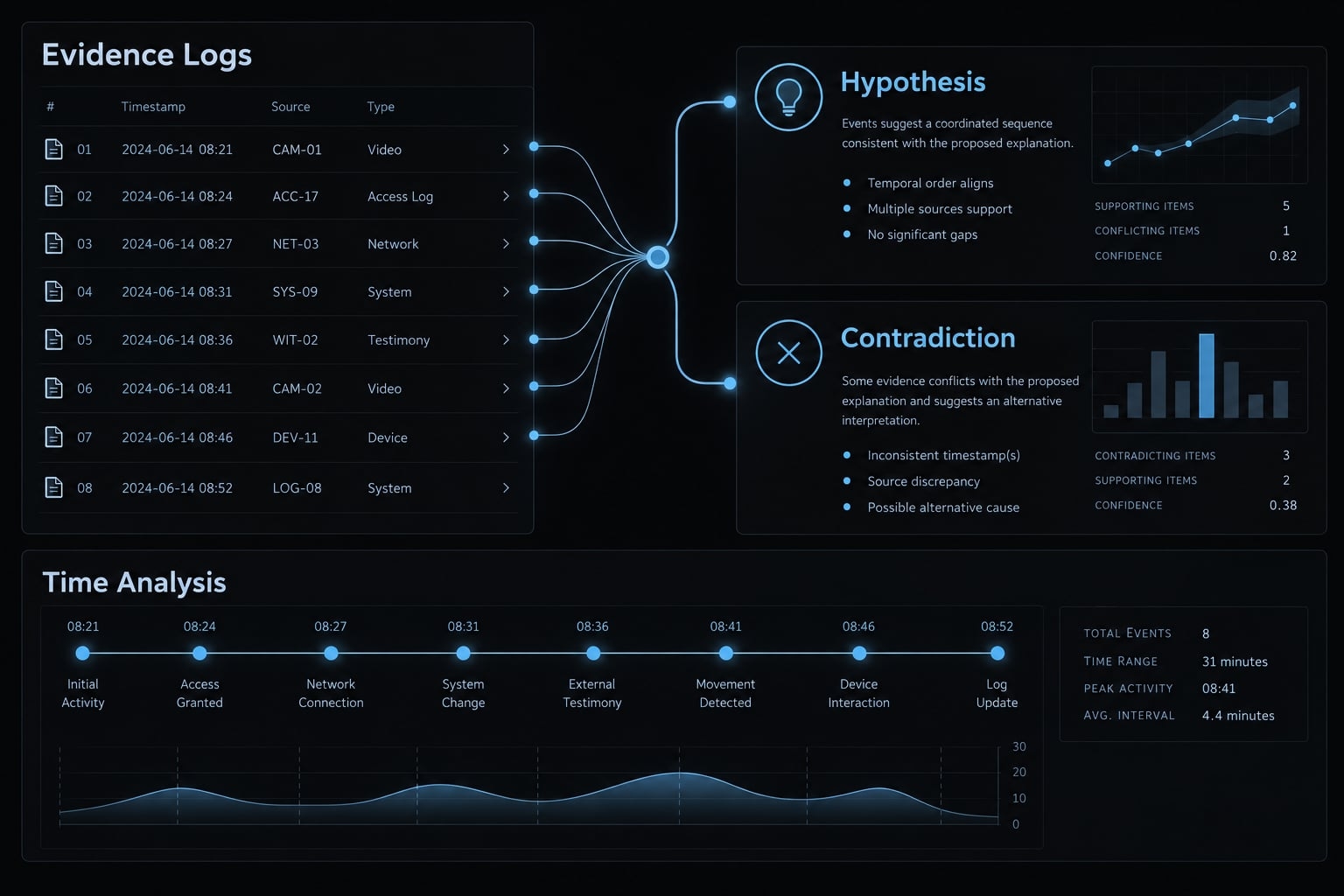
Separate observations from assumptions. The following entries illustrate reasoning structure, not actual production findings.
Hypothesis | Supporting evidence | Contradiction | Confidence | Next safe check |
|---|---|---|---|---|
Release regression | Errors follow release | Timing alone is insufficient | Low: untested | Compare affected code paths |
Dependency failure | Compatible with API errors | Dependency health unknown | Low: missing telemetry | Inspect scoped dependency traces |
Require contrary evidence and missing information. Avoid invented confidence percentages. Promote a hypothesis to a confirmed cause only when evidence supports the failure mechanism.
Human checkpoint: The investigation lead reviews ranking and authorizes further checks.
Output: Evidence-linked hypothesis shortlist.
Step 4 - Propose the safest reversible mitigation
Mitigation reduces current impact; remediation addresses the underlying failure. Restoration takes priority over completing a diagnosis. A mitigation plan needs expected impact, prerequisites, blast radius, named operator, validation signals, recovery procedure, and stop conditions.
Rollback or feature-flag changes are options-not inherently safe actions. Schema changes, migrations, dependencies, and customer state can make reversal hazardous. Runbook automation may prepare these checks, but cannot waive them.
Human checkpoint: An authorized operator approves and executes the mitigation.
Output: Reviewed mitigation plan.
Step 5 - Prepare and validate the code fix
Prepare incident remediation in a controlled branch or isolated workspace. Make the smallest change addressing a supported failure mechanism, with regression tests where practical. Run only approved validation commands. Tests execute code: isolation must cover credentials, network access, and resource consumption.
Include evidence, test results, limitations, risks, and recovery instructions in the PR. Pull request automation must preserve required review, branch protection, and CI (continuous integration-automated change checks). These controls are described in GitHub’s protected-branch documentation.
Human checkpoint: The code owner reviews; an authorized release owner approves delivery.
Output: Reviewable patch and validation record.
Step 6 - Validate recovery and draft the incident record
Validate recovery immediately after mitigation, not only after a permanent fix. Check customer-visible behavior, error rate, latency, resource saturation, and relevant service indicators over an appropriate observation window.
Deployment success alone is insufficient. Record the timeline, evidence, actions, approvals, and remaining uncertainty. Label suspected and confirmed causes separately.
Human checkpoint: The incident commander confirms recovery and closure.
Output: Reviewed recovery record and post-incident draft.
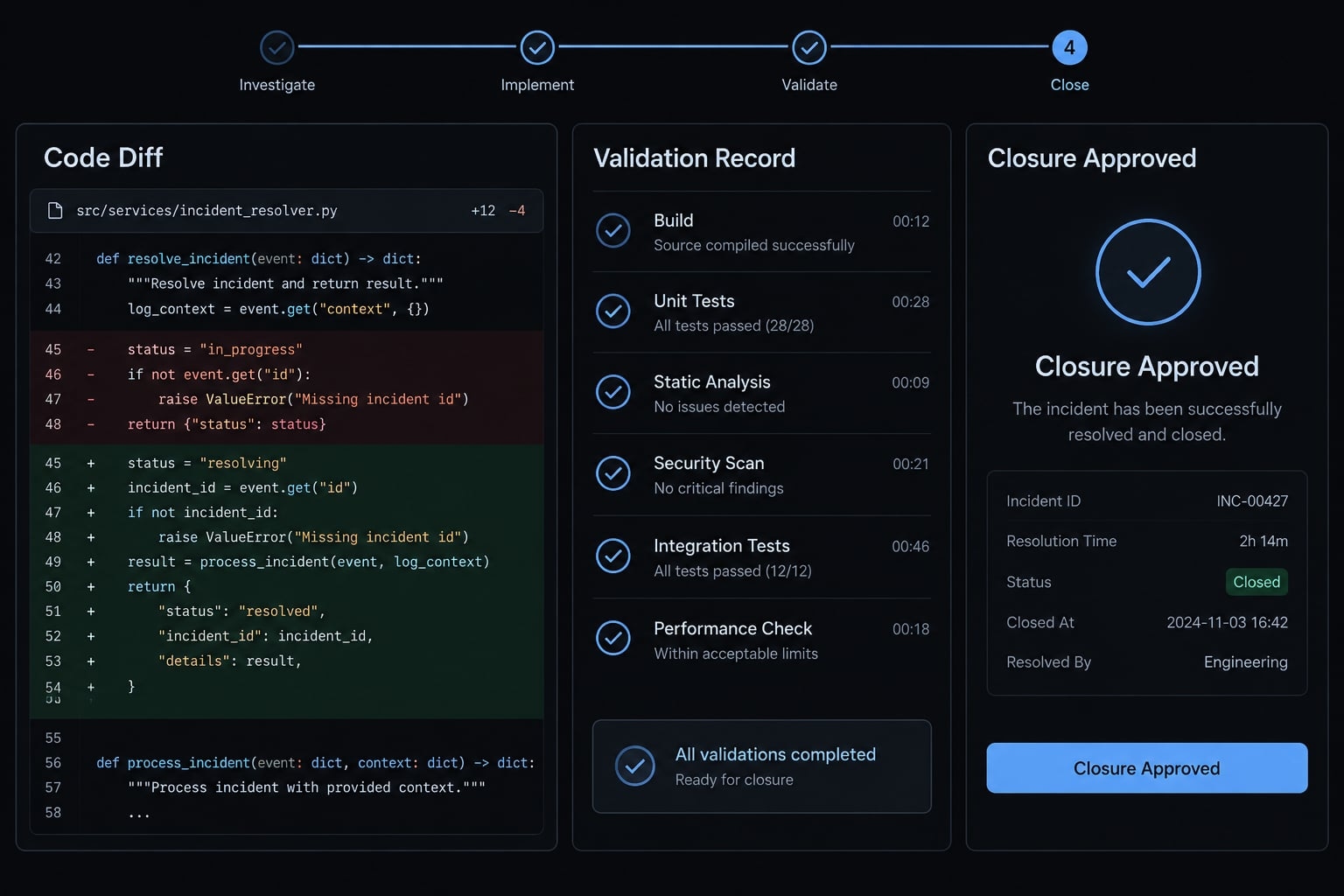
This automated SRE workflow remains bounded assistance; established incident procedures take precedence.
Context and integrations Claude Code needs
MCP integration (Model Context Protocol integration) enables standardized tool connectivity; it does not independently establish authorization or trustworthy inputs. The official MCP specification and security guidance distinguish protocol behavior from implementation responsibilities.
Start with bounded context, not unrestricted access. These are source categories, not claims of native integrations.
Context category | Example source | Minimum access | Purpose |
|---|---|---|---|
Incident metadata | Incident management platform | Scoped read | Impact and ownership |
Observability | Metrics, logs, traces | Limited queries | Validate symptoms |
Source control | GitHub repository | Read; separately authorize writes/PRs | Inspect changes |
Deployment history | Release records | Scoped read | Establish chronology |
Runbooks | Versioned documentation | Read | Follow procedures |
Communication | Incident channel | Scoped read; separate posting approval | Capture decisions |
Incident history | Reviewed postmortems | Scoped read | Compare patterns |
Do not assume branch-specific authorization is available everywhere. Use repository, identity, and workflow controls supported by the actual platform.
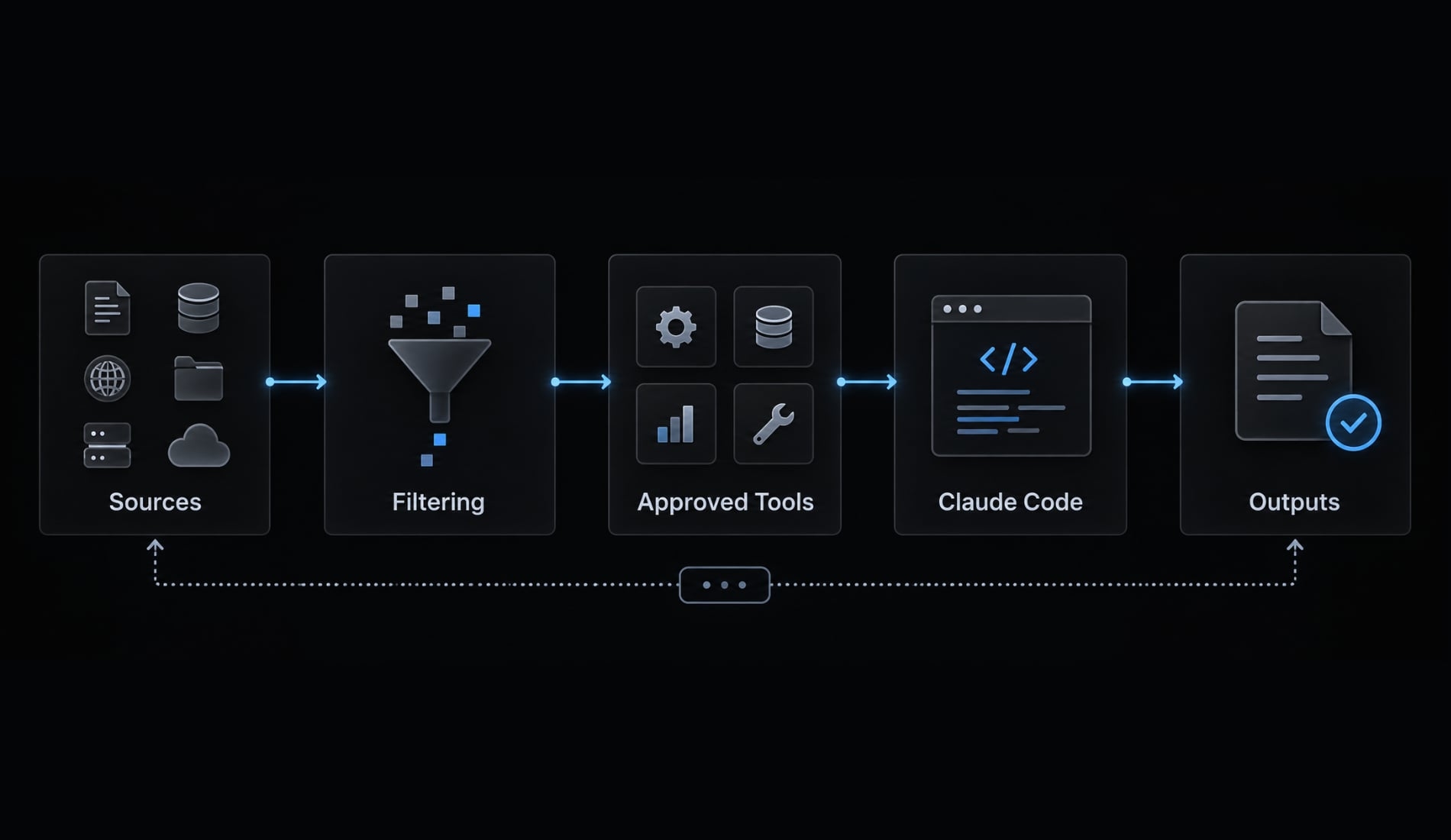
The minimum context package
Prepare these seven items:
- Current incident brief.
- Dependency summary.
- Approved runbook.
- Recent changes.
- Scoped telemetry.
- Repository context.
- Explicit permission policy.
Small teams can supply controlled exports instead of live integrations. Observability and logging access should expand only when the investigation requires it.
Structuring runbooks for agent use
Include an owner, version, review date, prerequisites, and expected outputs. Separate diagnostic steps from production-changing steps. Specify evidence requirements, escalation paths, and stop conditions.
A runbook skill is reusable guidance—not an authorization mechanism. Runbook automation should retain these boundaries.
Avoiding context overload
Filter by service, time, region, version, and error signature. Preserve representative raw evidence and source references when summarizing. Mark stale or contradictory material. Expand context only with a stated investigative reason.
What to automate and what to approval-gate
Human-in-the-loop operation means approval changes what the system is permitted to execute—not merely what the model is asked to do. Assign automation levels by action risk, data sensitivity, and accountability. Enforce least privilege outside the model, and prohibit self-expansion of authority.
Action | Default level | Required boundary |
|---|---|---|
Read runbooks | Automatic read-only | Approved sources |
Query telemetry | Automatic read-only | Scope, cost, data limits |
Summarize evidence | Automatic | References and uncertainty |
Draft incident updates | Automatic | Review distribution |
Edit code | Sandboxed | Isolated workspace |
Execute tests | Sandboxed | Restricted credentials/network/resources |
Create PR | Human-approved | Account for CI and notifications |
Merge change | Human-approved | Required reviews |
Deploy/restart | Human-approved | Normal change controls |
Roll back | Human-approved | Compatibility and recovery checks |
Write infrastructure/database | Restricted approval | Additional risk-specific controls |
Change credentials/permissions | Prohibited by default | Separate authorized procedure |
Close incident | Human-approved | Commander confirmation |
A simple risk test for every agent action
- Does it change state or create side effects?
- Can it be safely reversed?
- Is the blast radius bounded?
- Can results be independently verified?
- Will the action and decision be recorded?
- Is authorization specific to the target and action?
These questions inform review; they do not constitute universal clearance. Read-only queries can expose sensitive data, consume resources, or overload systems.
Preserve incident command authority
Recommendations enter the established command channel. Each action needs one visible owner. The approval workflow must bind approval to the reviewed command or diff, target, scope, and relevant conditions. A changed plan requires renewed approval. Prevent execution when approval cannot be validated.
Google’s SRE materials on managing incidents emphasize clear coordination and operational roles. Existing emergency procedures remain authoritative; the agent must not create a competing command structure.
Production guardrails and common failure modes
Production guardrails must separate untrusted incident content from execution authority. Logs, tickets, repository files, and chat messages are evidence—not instructions that can override policy.
Minimum production guardrails
- Use short-lived, task-specific credentials and separate environment identities.
- Default to read-only access.
- Apply sandboxing: isolated execution with restricted network and resource access.
- Approve tools and validate arguments.
- Minimize data and redact secrets.
- Enforce human approval for consequential actions.
- Record actions, denials, and approvals.
- Support session termination and credential revocation.
- Preserve CI, review, and release controls.
Command allowlists alone are insufficient when permitted commands accept dangerous arguments or invoke other programs.
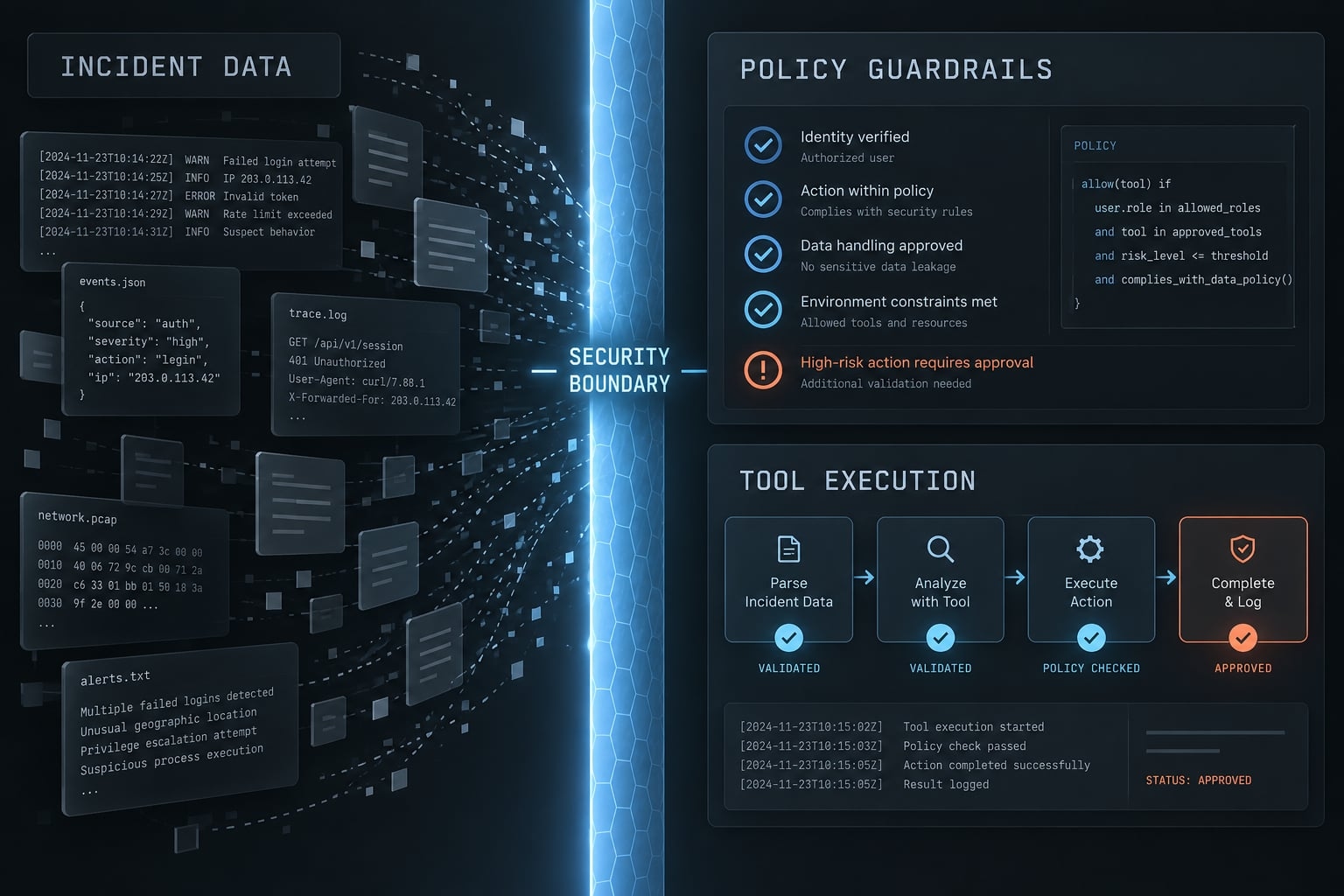
Failure modes and fallbacks
Failure mode | Warning signal | Risk | Required fallback |
|---|---|---|---|
Stale runbook | Version mismatch | Wrong procedure | Stop; ask service owner |
Incomplete telemetry | Missing intervals | Biased diagnosis | Reconstruct evidence manually |
Unsupported causal claim | No mechanism/evidence | Wrong mitigation | Reject claim; investigate |
Log-based prompt injection | Embedded instructions | Unauthorized action | Block call; isolate input |
Context overload | Lost contradictions | Misleading synthesis | Narrow scope; rebuild evidence |
Integration outage | Failed/stale queries | False visibility | Use established runbook |
Unsafe command | Unexpected write/target | Production damage | Deny execution; escalate |
Human-agent conflict | Competing action plans | Coordination failure | Pause; commander decides |
Incorrect summary | Source disagreement | Bad decisions | Correct from original evidence |
OWASP’s guidance on prompt injection supports treating external content as untrusted. Separate data from authority, restrict tools, and enforce approvals independently. These measures reduce risk; they do not eliminate it.
If controls fail, responders should return to established procedures-not broaden agent permissions to finish the task.
Auditability requirements
Agent observability means visibility into agent actions and outcomes. Record source references, tool identity, relevant inputs, commands, outputs, code diffs, human approvals, decision owners, denied actions, and validation results.
The audit trail also needs confidentiality controls: redact sensitive content, restrict access, and define retention. Avoid indiscriminate storage of customer payloads or entire sessions. Recorded does not mean immutable. Tamper resistance depends on the storage design and access controls, not the existence of a session log.
How to pilot Claude Code incident response
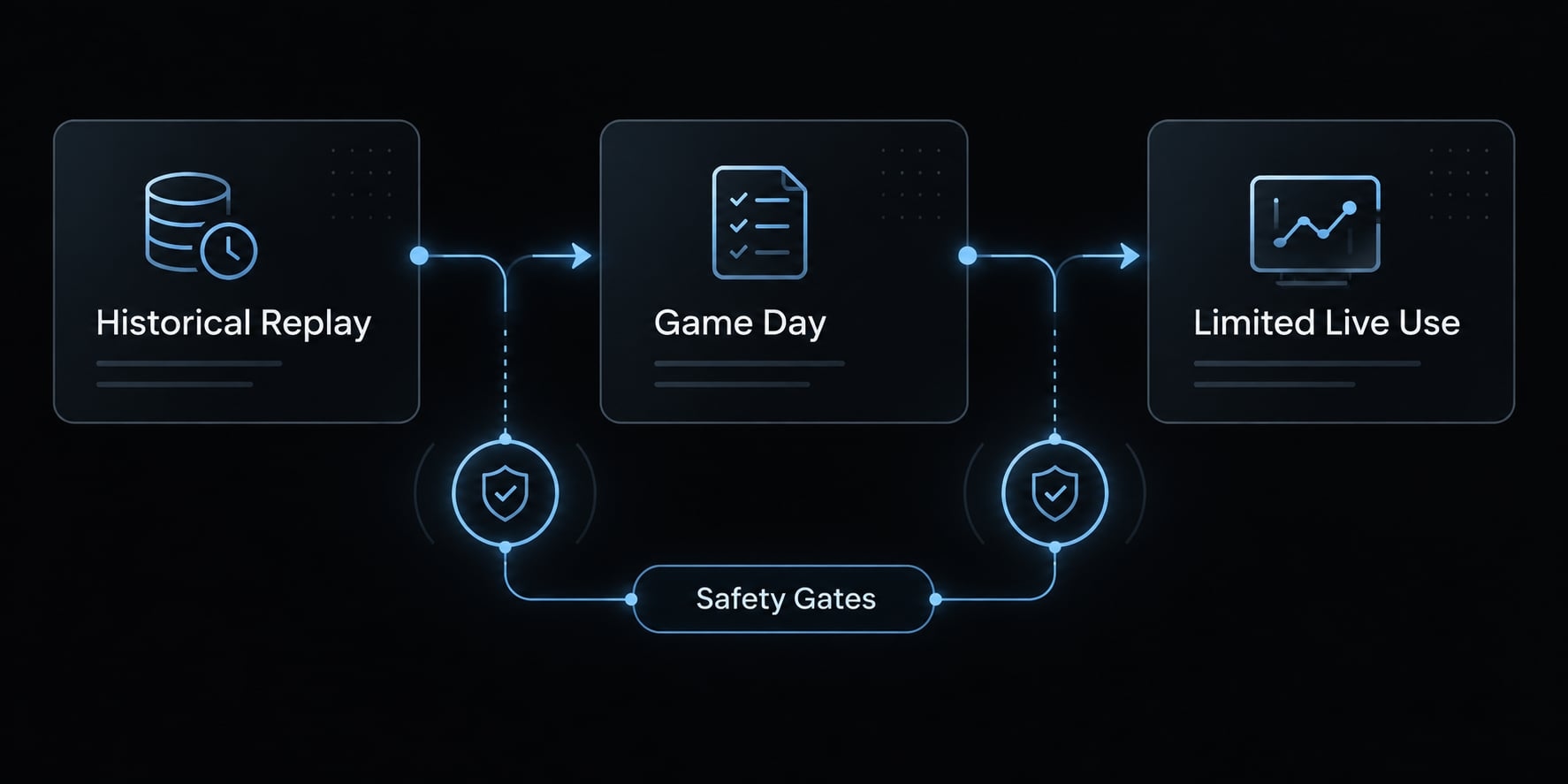
An incident response pilot should test usefulness, safety, and responder effort together. Define agent evaluation criteria before introducing live access.
Phase 1 - Historical incident replay
- Supply only evidence available at the replayed moment.
- Withhold the final postmortem and known cause; use them for evaluation.
Compare with the existing responder workflow. A small team needs only a redacted incident, repository, runbook, and exported telemetry.
Phase 2 - Game-Day investigation
Use read-only tools during a game day, a controlled incident simulation. Introduce missing telemetry, stale runbooks, and misleading inputs. Test approval enforcement, stopping behavior, termination, and credential revocation.
Phase 3 - Limited live use
Select services and trained responders; name a pilot owner. Begin read-only. Permit sandboxed code preparation only after earlier gates pass. Review every assisted incident.
Metrics that determine whether the pilot works
Metric | Definition |
|---|---|
Context preparation time | Start to approved brief |
Evidence collection time | Start to reviewable package |
Useful hypothesis rate | Reviewer-accepted, evidenced, testable hypotheses |
Unsupported claims | Incorrect or evidence-free assertions |
Evidence coverage | Significant claims with references |
Time to mitigation | Incident start to impact reduction |
Time to resolution | Incident start to defined resolution |
Responder effort | Work plus review time |
Unsafe attempts/blocks | Separate attempt and block counts |
Documentation effort | Drafting plus correction time |
Define timing events consistently. Here, MTTR means mean time to resolution, distinct from mitigation. Compare SRE metrics across similar severity and complexity; small samples limit conclusions. A reasonable hypothesis later disproven is not automatically an unsupported claim.
Pilot exit criteria
- Stop immediately: sensitive data enters traces, or approval boundaries are bypassed.
- Pause or narrow: unsupported conclusions repeatedly affect decisions, or recommendations lack traceable evidence.
- Reassess at pilot end: coordination burden increases, or useful gains remain unproven.
Frequently asked questions
What is Claude Code incident response?
Claude Code incident response refers to using Anthropic’s agentic command-line interface to assist SREs and engineers in diagnosing and mitigating production failures. It facilitates evidence collection, hypothesis generation, and patch preparation while maintaining strict human-in-the-loop oversight to ensure safe, authorized production changes.
Can Claude Code autonomously resolve production incidents?
No. Claude Code is designed as an assistant, not an autonomous operator. While it can aggregate logs, propose code fixes, and draft updates, all actions that modify production state or impact incident status require explicit human review and authorization to prevent unintended system side effects.
How does Claude Code help improve SRE incident workflows?
Claude Code reduces cognitive load by automating the retrieval and correlation of telemetry, deployment history, and runbook instructions. By using multi-agent workflows or specialized incident response plugins, it allows teams to investigate hypotheses in parallel, significantly shortening the time required to gather context before a human fix.
What are the security risks of using agentic AI for incident response?
The primary risks include potential prompt injection via untrusted log data, unintended command execution, and the leakage of sensitive environment information. Effective mitigation requires strict sandboxing, short-lived task-specific credentials, read-only default access, and enforced approval gates that exist outside the agent's control.
How do I ensure an agent does not exceed its authority?
Authority is managed through policy-based controls, such as the Principle of Least Privilege and explicit approval checkpoints for consequential actions. By requiring a human operator to verify the scope, target, and intent of every proposed change-such as a pull request or infrastructure adjustment-teams ensure the agent remains a tool under human command.
How should a team pilot Claude Code in their incident management lifecycle?
Teams should start with a historical incident replay using read-only access to evaluate if the agent’s reasoning is accurate without impacting real production systems. Once successful, teams can progress to "game day" simulations in sandboxed environments before finally introducing the agent to live, highly supervised incident response tasks.
Read more:
- Claude Code backups: Save essential config & verify recovery
- Production-ready Claude Code: Engineering workflow guide
- Claude Code for Rails: Best workflow and safety practices
Conclusion
Claude Code incident response should begin with evidence gathering, hypothesis review, controlled change preparation, and documentation. Its value depends on trustworthy inputs, reviewable outputs, and boundaries enforced outside model instructions. Neither a persuasive diagnosis nor a passing test authorizes a production change.
Start with historical replay, then a controlled simulation, before limited read-only live use. Keep the workflow human-in-the-loop, preserve incident command, and measure responder effort alongside safety and recovery outcomes. Expand scope only when the evidence justifies it. Adapt the incident brief and approval matrix above into a reviewed team runbook, with named owners and explicit stop conditions before the first live session.